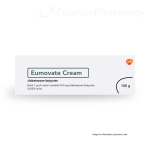
Eumovate cream is a moderate topical steroid (clobetasone butyrate 0.05%) used for short-term relief of inflamed, itchy eczema and dermatitis, especially when skin is sore, red, or weeping.
Eumovate cream is a moderate-strength topical steroid used to calm inflamed, itchy skin. It’s often used for flare-ups of eczema and dermatitis, where the skin is red, sore, and doing that classic “please don’t touch me” thing [1], [2], [3]. The active ingredient is clobetasone butyrate 0.05%, which helps settle inflammation in the skin so the itching and redness can ease.
Eumovate cream is water-miscible, which basically means it has a lighter feel than an ointment. That makes it a good fit for moist, weeping, or “angry and shiny” patches of skin, and for areas where ointments feel too greasy to live with day-to-day [4]. It’s designed for short courses, then you step down the frequency (or switch to a milder option) once things are under control.
The best way to think about Eumovate cream is as the “fire extinguisher” for a flare, not the long-term plan. The long-term plan is usually: identify triggers, keep the skin barrier strong with emollients, and treat early when symptoms start. NHS guidance for eczema and dermatitis focuses heavily on moisturising and trigger management, with topical steroids used in bursts when needed [1], [2].
Overview: Eumovate cream
Eumovate cream is a moderate topical steroid for eczema and dermatitis flares
It reduces inflammation and itch so skin can settle and heal
Use it in short courses, then step down as soon as you can
Moisturiser is not optional; it’s the foundation of eczema care
Avoid using it on infections, acne, rosacea, or long-term on the face without advice
Eczema and dermatitis are common, and they’re not a hygiene issue. They’re usually a mix of skin barrier weakness, immune overreaction, and triggers (like soaps, stress, weather, allergens, or irritants). When the barrier is leaky, the skin loses moisture and lets irritants in more easily, which fuels inflammation and itching [1], [2].
Eumovate reduces inflammation
Eumovate cream helps by switching down the inflammation. That can break the itch-scratch cycle, which is basically the skin version of digging a hole while you’re standing in it. Once the itch eases, people scratch less, the skin gets fewer micro-tears, and healing has a chance to catch up [4].
But here’s the honest bit: if you only use steroid cream and skip the moisturiser, flares tend to bounce back. NHS advice for atopic eczema puts emollients at the centre of treatment, with topical steroids used for flare control [1]. The same “protect the barrier” logic applies in contact dermatitis too, where avoiding the trigger is key [2], [3].
Eumovate cream is classed as a moderately potent topical steroid. That’s strong enough to make a difference in many flares, but it still needs respect. The main safety rules are about duration, area (face and folds are more delicate), and avoiding occlusion (like tight dressings or nappies) unless a clinician has told you to do so [4].
If your skin isn’t improving, it doesn’t always mean you need a stronger steroid. Sometimes the real issue is infection, ongoing trigger exposure, wrong diagnosis (psoriasis can mimic eczema), or using too little product. A quick review can save weeks of frustration and a bathroom shelf full of half-used tubes [1], [3], [4].
Buy Eumovate cream (Prescription Only)
Eumovate cream is a Prescription Only Medicine (POM). That means it’s only available with a valid prescription.
You can buy Eumovate cream from courierpharmacy.co.uk by completing a quick online consultation. A UK-qualified prescriber reviews your answers to make sure the treatment is safe and suitable for you.
How it works
Complete the online consultation
A prescriber reviews your answers
If approved, a prescription is issued
We dispense and deliver discreetly
If it isn’t suitable, we’ll explain why and suggest the next best option.
Additional information
Pack size
1 x 30g, 1 x 100g
MOJO WISDOM
Take control of your health by understanding your condition and what this medication is doing for you.
READ:
More information about this treatment.
UK-based doctors and pharmacists
Discreet and Confidential
UK-based doctors and pharmacists
Free, Expert Advice
No video link provided.
No video link provided.
UK-based doctors and pharmacists
Free, expert advice
Discrete and confidential
Fast delivery
Giving you trusted clinical advice for over 40 conditions
A UK regulated pharmacy providing safe, effective treatments online since 2014
Eumovate cream is a moderate topical steroid for eczema and dermatitis flares
It reduces inflammation and itch so skin can settle and heal
Use it in short courses, then step down as soon as you can
Moisturiser is not optional; it’s the foundation of eczema care
Avoid using it on infections, acne, rosacea, or long-term on the face without advice
Eczema and dermatitis are common, and they’re not a hygiene issue. They’re usually a mix of skin barrier weakness, immune overreaction, and triggers (like soaps, stress, weather, allergens, or irritants). When the barrier is leaky, the skin loses moisture and lets irritants in more easily, which fuels inflammation and itching [1], [2].
Eumovate cream helps by switching down the inflammation. That can break the itch-scratch cycle, which is basically the skin version of digging a hole while you’re standing in it. Once the itch eases, people scratch less, the skin gets fewer micro-tears, and healing has a chance to catch up [4].
But here’s the honest bit: if you only use steroid cream and skip the moisturiser, flares tend to bounce back. NHS advice for atopic eczema puts emollients at the centre of treatment, with topical steroids used for flare control [1]. The same “protect the barrier” logic applies in contact dermatitis too, where avoiding the trigger is key [2], [3].
Eumovate cream is classed as a moderately potent topical steroid. That’s strong enough to make a difference in many flares, but it still needs respect. The main safety rules are about duration, area (face and folds are more delicate), and avoiding occlusion (like tight dressings or nappies) unless a clinician has told you to do so [4].
If your skin isn’t improving, it doesn’t always mean you need a stronger steroid. Sometimes the real issue is infection, ongoing trigger exposure, wrong diagnosis (psoriasis can mimic eczema), or using too little product. A quick review can save weeks of frustration and a bathroom shelf full of half-used tubes [1], [3], [4].
Buy Eumovate cream (Prescription Only)
Eumovate cream is a Prescription Only Medicine (POM). That means it’s only available with a valid prescription.
You can buy Eumovate cream from courierpharmacy.co.uk by completing a quick online consultation. A UK-qualified prescriber reviews your answers to make sure the treatment is safe and suitable for you.
How it works
Complete the online consultation
A prescriber reviews your answers
If approved, a prescription is issued
We dispense and deliver discreetly
If it isn’t suitable, we’ll explain why and suggest the next best option.
Active ingredient in Eumovate cream
The active ingredient in Eumovate cream is clobetasone butyrate 0.05% w/w. It’s a topical corticosteroid that reduces inflammation, itching, and redness in steroid-responsive skin conditions [4].
Eumovate cream also contains excipients that matter for some people, including cetostearyl alcohol (can trigger contact dermatitis in sensitive skin) and chlorocresol (can cause allergic reactions). It also contains paraffin, which is important for the fire safety warning section (yes, really) [4].
What is Eumovate cream used for
Eumovate cream is used for the relief of inflammatory and itchy symptoms in steroid-responsive dermatoses. In normal-person language: it’s for eczema and dermatitis flares where the skin is red, itchy, sore, and inflamed [1], [2], [4].
Common examples include atopic dermatitis (atopic eczema), irritant or allergic contact dermatitis, seborrhoeic dermatitis, and insect bite reactions. It can also be used in some cases as a “step-down” option between courses of stronger topical steroids, under clinical guidance [4].
If your symptoms are mainly dryness without redness or itch, Eumovate cream usually isn’t the first choice. That’s moisturiser territory. And if there’s pus, golden crusting, spreading redness, or you feel unwell, you may be dealing with infection, which needs a different approach [1], [3], [4].
How does Eumovate cream work?
Eumovate cream works by reducing inflammation in the skin. Topical steroids act on multiple pathways involved in the inflammatory response, which helps reduce redness, swelling, and itch [4].
When inflammation drops, the skin’s nerve endings are less irritated, so itching often improves. That’s a big deal because scratching damages the skin barrier further, letting in more irritants and raising infection risk. So reducing itch isn’t just about comfort; it’s part of the healing loop [1], [4].
Eumovate cream is designed to act mainly in the skin. However, topical steroids can be absorbed into the body, especially if used on large areas, for long periods, under occlusion, on broken skin, or on thin skin like the face. Children absorb proportionally more, which is why paediatric courses are shorter [4].
Used correctly, Eumovate cream can help you get control of a flare so you can step down to maintenance with emollients and trigger avoidance. That “step down” approach is a key part of sensible steroid use: enough to settle the flare, not so much that you create new problems [1], [3], [4].
How to use Eumovate cream
Wash and dry your hands, then apply a thin layer of Eumovate cream to the affected area. Rub it in gently. You’re aiming for a light sheen, not a thick white layer. More isn’t better; correct coverage is better [4].
Apply once or twice daily until the flare improves, then reduce the frequency. If you stop suddenly after heavy use, some people can get rebound flares, so stepping down is often more comfortable and more realistic [4].
If you also use an emollient, let Eumovate cream absorb first before applying the moisturiser. Many people find a gap of around 20–30 minutes works well in real life, but the key point is: don’t slap everything on at once and hope for the best. Layering too quickly can dilute the steroid and make results patchy [1], [4].
Warnings and precautions: Eumovate cream
Do not use Eumovate cream on untreated skin infections. If eczema is infected, it may need antimicrobial treatment first (or alongside), and steroid use may need review. If infection spreads, topical steroid treatment should be stopped and you should seek advice [4].
Avoid using Eumovate cream for long periods, especially on delicate areas like the face, eyelids, or skin folds. These areas are more prone to thinning and other local side effects. If used on eyelids, take care to avoid getting it in the eye, as repeated exposure can contribute to cataract or glaucoma risk [4].
Be cautious with occlusion (covering the area with airtight dressings). Occlusion increases absorption. In infants, nappies can act like occlusive dressings, which is one reason steroid courses are kept short in young children [4].
Fire safety warning: Eumovate cream contains paraffin. Clothing, bedding, and dressings that have been in contact with paraffin-containing products can catch fire more easily. Avoid smoking or naked flames, and wash fabrics regularly. It sounds dramatic, but it’s a real safety warning in the product information [4].
If you get blurred vision or other visual changes, stop and seek medical advice. Visual disturbance has been reported with topical and systemic corticosteroids and needs assessment [4].
Side effects: Eumovate cream
Most people use Eumovate cream without serious problems when it’s used correctly and for short periods. The most common issues are local reactions like burning, stinging, itching, or irritation, especially if the skin is very inflamed or broken [4].
With prolonged or heavy use, topical steroids can cause skin thinning (atrophy), stretch marks, visible small blood vessels, and changes in pigmentation. These risks are higher on the face, folds, or if used under occlusion [4].
Rarely, enough steroid can be absorbed to cause systemic effects, including suppression of the body’s natural steroid production (HPA axis suppression) or Cushingoid features. This is more likely with large areas, long duration, occlusion, and in children [4].
A newer topic that gets talked about online is topical steroid withdrawal. It’s described as a rebound reaction with redness, burning, and spreading irritation after stopping long-term steroid use. It’s more likely with long-term use on delicate areas. The key prevention is sensible, time-limited use and stepping down rather than long continuous courses [4].
If your skin worsens, becomes painful, oozes, crusts, or you feel unwell, get reviewed. Infection or a different diagnosis may be the real cause [1], [3], [4].
Drug interactions: Eumovate cream
Most interactions are unlikely because Eumovate cream is applied to the skin. However, systemic absorption can happen, and certain medicines can increase steroid exposure if enough is absorbed [4].
Strong CYP3A4 inhibitors (for example ritonavir, cobicistat-containing products, and itraconazole) can reduce steroid metabolism and increase systemic exposure. The clinical relevance depends on how much steroid is used, where it’s used, and for how long. If you’re on these medicines, it’s worth flagging before starting topical steroids on large areas or for extended periods [4].
Using multiple steroid products at the same time (for example a steroid inhaler plus a steroid cream plus steroid tablets) can increase overall steroid burden. That doesn’t automatically mean “don’t use it”, but it does mean “use the minimum effective amount and keep courses short” [4].
If you’re using other medicated creams on the same area, ask a pharmacist about spacing. Too many products at once can irritate skin or make it hard to know what’s causing a reaction [1], [3], [4].
FAQ: Eumovate cream
What is Eumovate cream?
Eumovate cream is a moderate topical steroid containing clobetasone butyrate 0.05% used to treat inflamed, itchy steroid-responsive skin conditions.
What is Eumovate cream used for?
It’s used for eczema and dermatitis flares, including atopic eczema and contact dermatitis.
Is Eumovate cream strong?
It’s classed as a moderately potent topical steroid. Strong enough to calm many flares, but still intended for short courses and careful use.
How often should I use Eumovate cream?
Usually once or twice daily until improvement, then reduce frequency. Avoid continuous daily use beyond 4 weeks in adults unless advised.
How long can I use Eumovate cream for?
Adults should avoid continuous daily use beyond 4 weeks. In children, treatment is usually much shorter (often up to 7 days) unless a doctor advises otherwise.
Can I use Eumovate cream on my face?
Only with caution and usually for short periods, as facial skin is more prone to thinning and side effects. If you need steroid treatment on the face, get advice.
Can I use Eumovate cream on eyelids?
Be careful to avoid getting it in the eye. Repeated exposure can increase risk of cataract or glaucoma. Seek advice for eyelid eczema.
Can children use Eumovate cream?
Yes, but use in children under 12 should be on a doctor’s advice, and courses are usually short because children absorb more steroid through the skin.
Can I use Eumovate cream for nappy rash?
It can be used for steroid-responsive nappy rash under medical guidance, but nappies can act as occlusion and increase absorption, so extra caution is needed.
Can I use Eumovate cream if my eczema is infected?
Not on untreated infection. If there’s infection, you may need antimicrobial treatment and a review of steroid use.
What are the common side effects of Eumovate cream?
Local burning, stinging, itching, irritation, and sometimes rash. Most are mild and improve when treatment is adjusted.
Can Eumovate cream thin the skin?
Yes, especially with prolonged use, on the face, in folds, or under occlusion. That’s why short courses and stepping down matter.
What is topical steroid withdrawal?
A rebound reaction after stopping long-term topical steroid use, with redness and burning that can spread beyond the treated area. It’s linked to long-term use, especially on delicate skin.
Can I use moisturiser with Eumovate cream?
Yes, and you should. Let Eumovate absorb first, then apply emollient. Emollients are the foundation of eczema care.
What if Eumovate cream isn’t working?
You may need a review. Reasons include infection, ongoing trigger exposure, wrong diagnosis, or not using enough to cover the area properly.
Can I use Eumovate cream for acne?
No. Acne vulgaris is listed as a condition that should not be treated with Eumovate.
Can I use Eumovate cream for rosacea?
No. Rosacea is listed as a condition that should not be treated with Eumovate.
Can I use Eumovate cream for itching without a rash?
No. Pruritus without inflammation is listed as a condition that should not be treated with Eumovate.
Can Eumovate cream interact with other medicines?
Interactions are uncommon, but strong CYP3A4 inhibitors (like ritonavir or itraconazole) can increase systemic steroid exposure if enough is absorbed through the skin.
Is Eumovate cream safe in pregnancy?
There are limited human data. Use in pregnancy should only be considered if the benefit outweighs the risk by a clinician, using the minimum amount for the shortest time.
Is Eumovate cream safe while breastfeeding?
Safety isn’t fully established. If used, under the supervision of a clinician, it should be the minimum amount for the shortest time, and it should not be applied to the breasts to avoid accidental ingestion by the infant.
What’s the fire risk warning with Eumovate cream?
It contains paraffin. Fabrics that contact paraffin products can burn more easily. Avoid smoking or naked flames and wash clothing/bedding regularly.
Disclaimer: This article is for informational purposes only and does not constitute medical advice. Always consult with a qualified healthcare professional before starting any new treatment.