

Find the right eyelash hair growth treatment for you
View All Products



What you should know about eyelash hair growth treatments
Most people notice early changes at around four weeks, with the peak effect at sixteen weeks of consistent nightly use. Patience matters; applying more serum, or applying it twice a day, does not speed things up and can make side effects worse.
Yes. Randomised clinical trials of bimatoprost 0.03% have consistently shown significant increases in eyelash length, thickness, and darkness versus placebo, making it the most clinically proven cosmetic eyelash treatment available worldwide.
In the UK, any effective eyelash growth treatment containing bimatoprost is a Prescription Only Medicine (POM). That means it can only be supplied with a valid prescription after a proper consultation with a UK-qualified prescriber. Anything offering bimatoprost online without a consultation is operating outside UK law and basic patient safety.
Most side effects are mild and local: conjunctival hyperaemia (mild eye redness), eyelid skin darkening, itching, and dryness. Less commonly, iris pigmentation changes and periorbital fat loss can occur, both of which are discussed in detail during your consultation. Careful application and a fresh sterile applicator for each eye significantly reduce the risk.
One drop onto a fresh sterile single-use applicator, then drawn carefully across the skin of the upper lash line from inner to outer corner, like liquid eyeliner. Dispose of that applicator, use a fresh one for the other eye, and never apply to the lower lash line or place the drops directly into the eye for cosmetic use.
The effect is reversible. Over a few months, lashes gradually return to their previous length, thickness, and darkness. If you want to keep the effect, you continue at a maintenance dose, which is typically every other night, or two to three nights a week, after the initial sixteen-week induction.
Yes. Prescription eyelash serum is applied at night to clean skin and absorbs within a few minutes, so it sits happily alongside daytime mascara. It can also be used between lash extension appointments, though a short break from extensions is often a good idea to let the lash line recover.
It’s not suitable for pregnant or breastfeeding women, anyone under eighteen, people with a known allergy to bimatoprost or the preservative benzalkonium chloride, glaucoma patients already using another prostaglandin-analogue eye drop, or people with active uveitis, iritis, or certain cataract histories. A proper consultation is how we catch this early, so no one starts a treatment that won’t suit them.
Additional information
Eyelash growth: a calm, expert guide to longer, fuller lashes
What this page covers
This is a clear, friendly guide to eyelash growth for anyone who feels their lashes are thinner, sparser, or patchier than they’d like. We cover what healthy eyelash growth actually looks like, the most common reasons lashes fall out or stop growing, how the science of prescription lash treatments works, what to expect in the first sixteen weeks, and how Courier Pharmacy’s online consultation can help you find a treatment that fits you. Written for real people, not mannequins.

Five key takeaways
- Eyelash growth slows or stops for many reasons, from ageing and thyroid changes to blepharitis, chemotherapy, and lash extensions.
- The medical term for sparse lashes is eyelash hypotrichosis, and most cases are treatable with the right prescription or cosmetic approach.
- Bimatoprost 0.03% is the most clinically proven prescription treatment for eyelash growth, shown to increase lash length, thickness, and darkness in randomised trials.
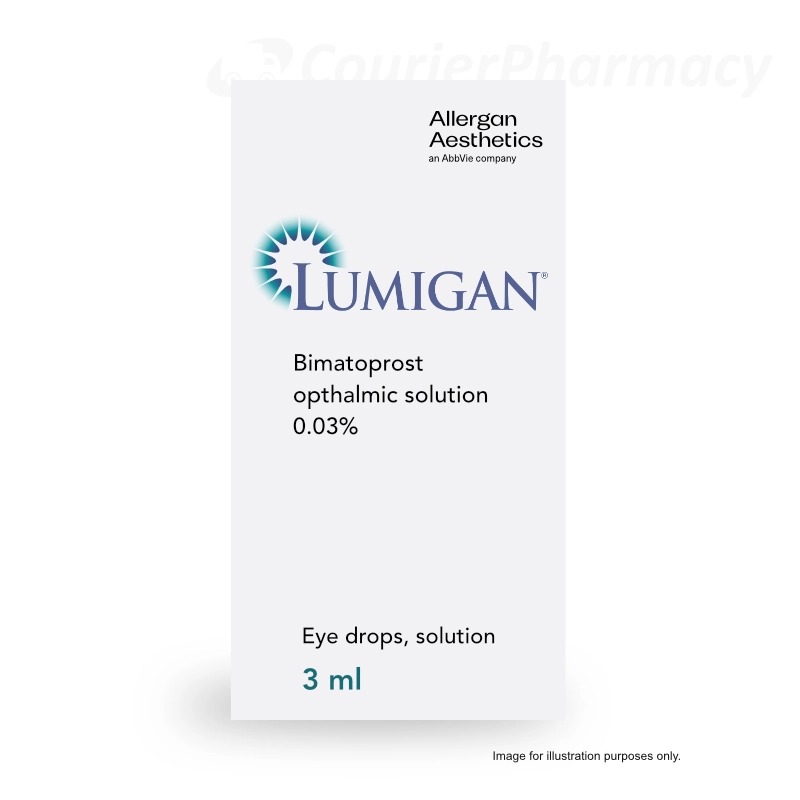
- In the UK, bimatoprost (Lumigan) is licensed for glaucoma, so any use for eyelash growth is off-label and must be prescribed privately by a qualified UK prescriber.
- Peptide lash serums, gentle lash care, and treating underlying conditions like blepharitis are useful non-prescription options depending on the cause.

What you should know about eyelash growth
Eyelash growth is quieter than scalp hair growth, but it follows the same basic rules. Each lash has its own growth cycle, its own timeline, and its own sensitivities. Most people shed a few lashes every day without noticing. Some people notice a lot more, and worry something’s wrong.
Often, something is worth checking. Lash loss can point to something simple, like rough makeup removal or long-term extensions, or to something that needs attention, like blepharitis, thyroid shifts, or medication side effects. That’s why we don’t just throw a serum at the problem.
On this page you’ll find:
- A plain-English overview of the eyelash growth cycle
- Medical and cosmetic causes of sparse lashes
- How prescription treatments like bimatoprost actually work
- Non-prescription options and lash care tips
- How Courier Pharmacy personalises your care
Eyelash growth overview
Lashes serve a real purpose. They shield the eye from dust, sweat, and debris, and they act as a touch sensor that triggers a blink if something comes too close. In modern life they also frame the face, which is why thinning lashes can hit confidence hard even when vision stays fine.
Hypotrichosis is the medical word for inadequate lashes. It covers a wide range of situations, from a single bald patch after a stye to near-total lash loss during chemotherapy. The clinical literature tends to use the word trichomegaly to describe unusually long or dense lashes, which is what prescription treatments like bimatoprost are designed to produce.
Many cases sit in a frustrating middle ground. Lashes aren’t gone, but they’re shorter, paler, and more fragile than they used to be. Makeup doesn’t sit right. Mascara does half the job it used to. You find yourself peering in the mirror thinking, “Was it always like this?” It wasn’t, and there are evidence-based steps you can take.
Diagnostic and treatment challenges exist. Lash loss is often dismissed as vanity, underlying causes get missed, and cosmetic fixes are pushed before medical ones. A good consultation starts with the question, “Why are these lashes like this?” and then works backwards to a plan.
What is eyelash growth?
Eyelash growth is the natural cycle by which lash follicles produce new hairs, rest, and shed old ones. The cycle has three phases: anagen (growth), catagen (transition), and telogen (rest). The anagen phase for lashes is naturally much shorter than for scalp hair, which is why eyelashes stay a limited length without intervention.
Key features of healthy eyelash growth include:
- Upper lid has about 90 to 150 lashes; lower lid has around 70 to 80
- Each lash lives for about four to eleven months total
- Losing one to five lashes a day is completely normal
- Full regrowth after loss typically takes six to sixteen weeks
- Lash colour, thickness, and curl are largely genetic
If your lashes feel noticeably sparser than a year ago, or you’re losing clumps rather than singles, that’s worth a closer look.
How common is reduced eyelash growth?
Reduced eyelash growth is more common than most people think, although it’s under-reported because many people manage it privately with makeup or extensions. Clinical literature on lash conditions confirms a long list of medical and drug-related contributors, underlining how frequently lash changes go noticed but unaddressed in clinical settings.
Women’s use of cosmetic bimatoprost formulations is also rising sharply. Recent survey data show that bimatoprost-based cosmetic drops are widely used, often without a prescription, and that many users are unclear about the correct dose and side effects. That same pattern is echoed globally, which matters because it underlines how much demand there is for evidence-based, prescriber-led lash care rather than unregulated self-purchase.
Lash loss in paediatric populations, particularly after chemotherapy or in alopecia areata, is also a recognised problem. Clinical trials of bimatoprost in these groups have shown meaningful regrowth when treatment is properly supervised.
What causes reduced eyelash growth?
Lash loss has a long list of possible causes. The clinical literature groups them broadly as follows:
- Lid margin conditions: blepharitis, styes, meibomian gland dysfunction
- Skin conditions: atopic dermatitis, seborrheic dermatitis, psoriasis, rosacea
- Autoimmune: alopecia areata, frontal fibrosing alopecia, discoid lupus
- Endocrine: hypothyroidism, hyperthyroidism
- Nutrition: iron, zinc, biotin, vitamin D, vitamin B12 deficiency
- Medications: chemotherapy, certain antithyroid drugs, amiodarone, some anticoagulants
- Mechanical: lash extensions, heavy mascara, harsh makeup removal, eye rubbing
- Psychological: trichotillomania (compulsive lash pulling)
- Infections: staphylococcal blepharitis, Demodex mites, herpes
- Ageing: natural slowing of the lash cycle from around mid-thirties onwards
- Scarring processes: burns, eyelid surgery, severe trauma
A few causes destroy the follicle itself and cause scarring lash loss that usually doesn’t regrow on its own. Most causes, though, are non-scarring, and the lashes come back once the underlying issue is treated.
What happens in the body with reduced eyelash growth?
Each lash follicle has its own miniature biology. It lives in the lid margin, sits next to a sebaceous gland, and cycles independently of its neighbours. When something disrupts that follicle, the lash may fall out early, grow back thinner, or stop cycling altogether.
Inflammation is the most common disruptor. In blepharitis, bacteria and Demodex mites trigger chronic low-grade inflammation of the lid margin, which damages the follicle and thins the lashes. In alopecia areata, the immune system attacks the follicle itself, sometimes producing dramatic lash loss that responds well to prescription treatment when supervised by a clinician.
Hormones play a role too. Thyroid hormones regulate hair cycle length, so both over- and under-active thyroid can shorten the anagen phase and leave lashes thinner. Ageing gradually reduces follicle responsiveness, much like it does on the scalp.
On the prescription side, bimatoprost works precisely because it nudges the follicle back into anagen. It binds to prostaglandin receptors in the dermal papilla cells and follicular melanocytes of the lash, prolonging the growth phase and increasing melanogenesis. That combination is why clinical trials consistently report longer, thicker, and darker lashes in treated groups. When you stop using it, the follicle drifts back to its previous cycle over several weeks to months.
Diagnosing reduced eyelash growth
Diagnosis is mainly clinical. A good consultation starts with a careful history: when did you first notice it, is it one eye or both, are other areas of hair affected, what medicines are you on, any recent illness, stress, or changes in diet? This picks up the large majority of cases.
Next comes a look at the lid margin. Crusting, redness, foamy tear film, or scaling points to blepharitis. Patchy loss in the outer third of the brow may hint at thyroid issues. Broken lashes of different lengths can suggest trichotillomania. A widespread pattern alongside scalp hair changes prompts an autoimmune workup.
Tests that may follow include:
- Thyroid function blood test
- Ferritin, vitamin D, vitamin B12, zinc
- Autoimmune screen if lupus or alopecia areata is suspected
- Swab if infection is likely
- Slit-lamp examination for lid margin conditions
The most common diagnostic delay isn’t clinical difficulty; it’s that people don’t raise the issue, or they’re told to “try a serum” before anyone checks for the cause. Our consultation process is designed to catch that.
Managing reduced eyelash growth: current treatments
Treatment depends on the cause. The better the match, the better the result.
Medicine-based options include:
- Bimatoprost 0.03% solution applied to the upper lid margin nightly, off-label in the UK, but backed by the most robust evidence base of any lash treatment
- Lid hygiene treatments and short courses of topical antibiotic or steroid for blepharitis
- Treatment of underlying thyroid, autoimmune, or nutritional issues
- Triamcinolone injections for alopecia areata of the lashes (specialist-led)
Non-medicine options include:
- Peptide-based lash serums (gentler, more variable evidence)
- Castor oil and nutritional support: popular, evidence is thin
- Gentle lid hygiene with diluted tea-tree wipes or warm compresses
- Short breaks from lash extensions and heavy mascara
- Cosmetic options: magnetic lashes, tinting, microblading for brows
- Eyelash transplantation in severe, scarring cases (rare)
Evidence sits most firmly with bimatoprost. In a paediatric randomised trial, lash prominence improved in 70.8% of bimatoprost-treated participants versus 26.1% on vehicle, with significant increases in measured length, thickness, and darkness. In adults with eyelash alopecia areata, 43.24% achieved acceptable cosmetic responses, with complete regrowth in 24.32% and moderate regrowth in 18.91% after one year. Peptide serums can help modestly and suit people who want to avoid prescription options.
Patient experiences and challenges
The most common thing we hear from patients is, “I felt silly asking about my lashes.” Eyelash loss gets treated as vanity when it’s usually anything but. It’s a visible, persistent reminder of ageing, illness, or a condition you’re still trying to understand.
For people going through chemotherapy, losing lashes can feel worse than losing scalp hair because a wig can’t hide the eyes. Prescription bimatoprost can genuinely help in this context, with reliable regrowth shown in supervised clinical use. Knowing that can be quietly life-changing.
Stigma also shows up for people with trichotillomania. Compulsive lash pulling is a recognised mental health condition, not a weakness, and treatment works best when it combines behavioural therapy with support rather than judgement. We’ll always approach this side of the conversation privately and sensitively.
There’s a safety issue on the consumer side too. A laboratory screening study of eyelash-enhancing serums sold online identified bimatoprost in four of 64 products tested, with three of those products failing to declare it on their packaging. Users of undeclared prostaglandin-containing products have reported unexpected side effects, including periocular pigmentation changes and dry eye. In short: if you’re buying lash serum online without a prescription, you may be using a pharmaceutical without knowing it.
Innovative and new treatments for eyelash growth
Options have expanded quietly over the last decade. Alongside bimatoprost, newer peptide-based serums, platelet-rich plasma (PRP) applied to the lid margin, and low-level light therapy are all being studied, with variable evidence so far. Personalised compounding is another area where Courier Pharmacy can help, tailoring a preparation to your skin sensitivity or allergy history.
For people who can’t tolerate bimatoprost, or who have contraindications like active uveitis or certain cataract histories, peptide serums offer a gentler alternative. Evidence is weaker, but so are the side effects.
For eyebrow hypotrichosis, clinical research has explored bimatoprost’s role as a targeted therapy, drawing on the same prostaglandin receptor biology that drives the eyelash effect. Bimatoprost remains off-label for brows worldwide, but it’s a useful topic to raise in consultation.
Comparative evidence across prostaglandin analogs used in glaucoma also suggests that these agents differ in how strongly they promote hair growth as a side effect. Bimatoprost remains the only prostaglandin analog with specific FDA approval for eyelash hypotrichosis, reflecting the strength of its efficacy data and favourable risk-benefit profile in this indication.
Looking to the future: research and hope
Research into lash biology has picked up pace. Scientists are studying the specific prostaglandin receptors that drive lash growth, which could lead to newer, more targeted treatments with fewer side effects than current analogs. Detection studies using advanced mass spectrometry techniques are also tightening the net around undeclared pharmaceuticals in cosmetic lash serums, which should eventually mean safer products on the shelf.
There’s also real interest in combining approaches: lid hygiene plus bimatoprost plus nutritional support for patients whose lash loss has multiple drivers. This is the direction personalised medicine is heading, and it fits exactly with how we like to work at Courier Pharmacy.
How Courier Pharmacy helps with eyelash growth
We take eyelash growth seriously. Many people feel dismissed or embarrassed when they bring it up, so we built our consultation to do the opposite: start with your history, look for the underlying cause, and match the treatment to the person.
Our approach leans on personalisation and guidance. If your consultation flags possible thyroid issues, nutritional gaps, or blepharitis, we’ll say so clearly and help you get the right testing or referral. If prescription bimatoprost is right for you, a UK-qualified prescriber reviews your suitability and we dispense through a GPhC-registered pharmacy, with clear, evidence-based dosage advice drawn from the full clinical literature. If you’d rather try a gentler route first, we’ll talk through peptide serums and lash care without pressure. Compounding is available where skin sensitivity or allergies are a factor.
This is where our brand ambassador Dr Ada Jex-Cori comes in. She represents our whole ethos: listening, challenging one-size-fits-all care, and building healthcare that fits the person, not the system. Behind her is a real team of pharmacists and prescribers who do this work every day, and a community of patients we genuinely enjoy hearing from.

Service highlights
- Online eyelash growth consultation reviewed by a UK-qualified prescriber
- Personalised treatment plans built around the cause, not a one-size-fits-all kit
- Access to prescription-strength options like bimatoprost where appropriate
- Practical guidance on lash care, cleansing routines, and blepharitis management
- Friendly follow-up support and access to our free community talks
Frequently asked questions about eyelash growth
What is eyelash growth?
Eyelash growth is the natural cycle by which lash follicles produce new hairs, rest, and shed old ones. The cycle has three phases: anagen (growth), catagen (transition), and telogen (rest). The anagen phase is naturally short for lashes, which is why they stay limited in length without intervention.
How common is reduced eyelash growth?
It’s more common than most people realise, and often under-reported because people manage it privately with mascara, extensions, or lash serums. Reviews of lash conditions confirm a long list of medical and medication-related contributors, with eyelash loss and abnormal lash growth both frequently encountered in clinical practice.
What causes sparse eyelashes?
Causes range from blepharitis and thyroid disease to nutritional deficiency, chemotherapy, lash extensions, alopecia areata, and trichotillomania. Finding the right treatment usually starts with finding the right cause, which is why a proper consultation matters.
How is reduced eyelash growth diagnosed?
Mostly through a careful history and lid margin examination. Blood tests for thyroid, iron, vitamin D, B12, and zinc may be useful, and an autoimmune screen may be ordered if alopecia areata or lupus is suspected. A slit-lamp exam is helpful for suspected blepharitis.
Can sparse eyelashes be cured?
Often, yes. Most cases are non-scarring, and lashes regrow once the underlying cause is treated or removed. Scarring causes, like severe burns or discoid lupus, may be permanent and usually need cosmetic or surgical solutions rather than medicine.
What treatments are available for eyelash growth?
Options include bimatoprost 0.03% (the most clinically proven prescription option), peptide-based lash serums, lid hygiene for blepharitis, treatment of underlying medical causes, and cosmetic options like extensions and tinting. The right one depends on the cause.
Does bimatoprost really work for eyelash growth?
Yes. Randomised trials show bimatoprost 0.03% increases lash length, thickness, and darkness, with 70.8% of treated participants in one paediatric trial showing significant improvement versus 26.1% on vehicle. Results return to baseline within a few months of stopping.
Is bimatoprost available on the NHS for eyelash growth?
No. In the UK, bimatoprost (Lumigan) is licensed only for glaucoma, so any use for eyelash growth is off-label and must be privately prescribed through a qualified UK prescriber. Courier Pharmacy can arrange this after a proper consultation.
What are the side effects of bimatoprost?
Most are mild and local: conjunctival hyperaemia (eye redness), eyelid skin darkening, itching, and dryness. Iris pigmentation changes and increased vellus hair growth around the lid have also been documented, particularly with long-term use. It’s not suitable in pregnancy, breastfeeding, or in people with certain eye conditions.
Do lash serums without a prescription work?
Some help modestly, but be careful with them. Laboratory analysis of serums sold online has found undeclared bimatoprost in several cosmetic products, meaning consumers may unknowingly be using a pharmaceutical and risking side effects like pigmentation changes and dry eye. A prescriber-led route is safer and clearer.
How can Courier Pharmacy help with eyelash growth?
We offer an online consultation reviewed by a UK-qualified prescriber, personalised treatment plans, access to prescription options like bimatoprost where suitable, and practical guidance on lash care and underlying causes. We’ll flag when you need testing or referral rather than a cream, and we follow up to make sure treatment is working.
More than a condition: our community
Healthcare shouldn’t only happen when you’re buying something. That’s why Courier Pharmacy runs free fortnightly drop-in talks and clinics at Insomnia in Derby, from 10am to 12pm, open to anyone living with long-term or complex conditions. It’s a calm space to ask questions, compare notes, and meet others going through similar experiences with skin and hair conditions, menopause, thyroid issues, and more. No cost, no pressure, and you’re welcome to bring a friend. Learn more about our community talks on the courierpharmacy.co.uk community page.

How this content was created
Written by the Courier Pharmacy editorial team and reviewed by a GPhC-registered pharmacist. Grounded in the latest NHS, NICE, BNF, and EMC guidance, peer-reviewed studies, and the real questions patients bring to our drop-in clinics in Derby.
References

BSc Pharmacy, Independent Prescriber, PgDip Endocrinology, MSc Endocrinology, PgDip Infectious Diseases
Superintendant Pharmacist, Independent Prescriber

BSc Pharmacy
Compounding Pharmacist

