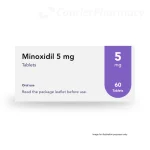
Product description: Minoxidil 5mg tablets for hair loss
Minoxidil has a bit of a “happy accident” backstory. Doctors first used it to treat high blood pressure (hypertension). It relaxes blood vessels and boosts blood flow.
Then something unexpected happened. People taking it started to notice extra hair growth. Nobody prescribed it for that at the time, but the effect was hard to miss (and yes, a few people were probably quietly delighted).
Researchers looked closer at how minoxidil affects hair follicles. They found it can help support the hair growth cycle in some people. That’s why clinicians now use minoxidil to treat hair loss, especially pattern hair loss (androgenetic alopecia).
In short: minoxidil began life as a blood pressure medicine, but it became famous for hair regrowth.
What’s in Minoxidil 5mg tablets?
Minoxidil 5mg tablets contain 5mg of minoxidil per tablet as the active ingredient. For hair loss, prescribers often use low doses. Many patients take between 0.625mg and 5mg per day. These doses sit well below the amounts used for blood pressure treatment.
A quick note on “off-label” use (and why it matters)
When a prescriber uses oral minoxidil for hair loss, they prescribe it off-label. That means the medicine’s licence covers a different use, but the prescriber uses clinical evidence and judgement to prescribe it safely for hair loss.
Off-label prescribing is common in UK medicine. It doesn’t automatically mean “risky” or “experimental”. It means your prescriber takes responsibility for choosing the right option for you. The evidence for low-dose oral minoxidil in hair loss also continues to grow.
Why some people prefer oral minoxidil for hair loss
Topical minoxidil can work well, but it asks a lot of your routine. You need to apply it once or twice a day, massage it in, let it dry, and avoid it rubbing off on pillows or clothes.
That routine can feel like a full-time job. It’s even harder if you have long hair, a busy schedule, or a sensitive scalp. A once-daily tablet can feel simpler and easier to stick with. And in hair loss, consistency matters.
At a glance
Prescription-only tablet with 5mg minoxidil per tablet
Prescribers may use it off-label for hair loss, supported by growing evidence
Can suit people who struggle with topical application
Available from courierpharmacy.co.uk after a UK prescriber assessment
Additional information
Quantity
1 x 60, 2 x 60, 3 x 60, 4 x 60, 5 x 60, 6 x 60
MOJO WISDOM
Take control of your health by understanding your condition and what this medication is doing for you.
READ:
More information about this treatment.
UK-based doctors and pharmacists
Discreet and Confidential
UK-based doctors and pharmacists
Free, Expert Advice
No video link provided.
No video link provided.
UK-based doctors and pharmacists
Free, expert advice
Discrete and confidential
Fast delivery
Giving you trusted clinical advice for over 40 conditions
A UK regulated pharmacy providing safe, effective treatments online since 2014
The oral option that changed the conversation about hair loss treatment.
You have probably seen minoxidil in a bottle or a foam. You spray it on, rub it in, wait for it to dry, and hope for the best. But there is another way to take minoxidil — and it has been quietly gaining serious clinical attention. Low-dose oral minoxidil tablets are being prescribed off-label for hair loss with growing evidence behind them, and at Courier Pharmacy, we want to make sure you have everything you need to understand whether this option might be right for you.
This is not a fringe treatment. It is not a hack or a workaround. It is a legitimate clinical approach that dermatologists and hair loss specialists across the UK and internationally are increasingly recommending for patients who have not responded to topical treatment, or who simply cannot make topical application work in their daily life.
Key takeaways
Low-dose oral minoxidil is being used off-label for hair loss with a growing evidence base behind it
It works through the same mechanism as topical minoxidil but is absorbed systemically, which means different dosing considerations apply
It is a Prescription Only Medicine — a prescriber must assess your suitability before it can be supplied
Side effects differ from topical minoxidil and include unwanted hair growth in other areas, fluid retention, and cardiovascular considerations
At Courier Pharmacy, prescribing decisions are made by UK-qualified prescribers following individual clinical assessment
Overview: Minoxidil 5mg tablets for hair loss
Hair loss is one of the most common reasons people seek medical help, yet it remains one of the most undertreated. The NHS estimates that around half of all men will experience some degree of male pattern baldness by the age of 50, and female hair loss — though less visible in public conversation — is equally prevalent and often more emotionally distressing. For many years, the mainstay of topical medical treatment has been minoxidil solution or foam applied directly to the scalp. But a quieter revolution has been happening in dermatology clinics — and it involves the same molecule, taken as a tablet instead.
The story of oral minoxidil for hair loss began as an accidental observation. Patients taking minoxidil tablets for hypertension — where it has been licensed since the 1970s — consistently reported one particular side effect: hair grew where it was not wanted. Unwanted facial and body hair — hypertrichosis — was so common that it was listed as a very frequent side effect affecting the majority of patients. Dermatologists noticed. If minoxidil could stimulate hair growth in places where it was not desired, perhaps the same effect could be harnessed deliberately, at much lower doses, to encourage growth where it was very much wanted.
That insight eventually led to topical minoxidil — the liquid and foam formulations that became the first over-the-counter hair loss treatment approved by regulators. But topical minoxidil has its limitations. Scalp absorption is variable. The application is fiddly and time-consuming. Some patients develop scalp irritation from the alcohol or propylene glycol in the vehicle. Others simply cannot maintain the twice-daily routine that some topical treatments demand. For these patients, oral minoxidil offers a meaningful alternative.
The evidence base for low-dose oral minoxidil in hair loss has expanded significantly in recent years. A systematic review by Suchonwanit and colleagues, published in 2019, summarised the growing literature on minoxidil’s use across a range of hair disorders, including androgenetic alopecia in both men and women, alopecia areata, and other forms of hair loss. Studies have consistently shown meaningful improvements in hair density and coverage with oral minoxidil at low doses, with a tolerability profile that is generally acceptable when patients are properly selected and monitored.
At Courier Pharmacy, we take the prescribing of oral minoxidil seriously. It is not a treatment to hand out without proper assessment. Your cardiovascular history matters. Your current medicines matter. Your blood pressure matters. But for the right patient — one whose hair loss is causing real distress, whose topical treatment has not worked or cannot be sustained, and whose clinical profile supports the safe use of oral minoxidil — this can be a genuinely useful option.
Summary
Oral minoxidil for hair loss is an off-label use supported by a growing body of clinical evidence, including randomised controlled trials and large observational studies
Low doses — typically 0.625mg to 5mg daily depending on sex and individual response — are used, far below the antihypertensive doses in the licensed indication
The primary advantage over topical minoxidil is simplicity — one tablet daily removes the complexity and inconsistency that undermines topical treatment for many patients
Side effects differ from topical formulations and include unwanted hair growth, fluid retention, and cardiovascular considerations that require prescriber assessment
Not everyone is suitable — cardiovascular history, blood pressure, and current medicines all need to be reviewed before prescribing
Why compounding?
What compounding means
Compounding is when a licensed pharmacy makes a medicine to order for one specific patient. It’s not a mass-made, one-size-fits-all product. In the UK, compounding sits within a regulated framework and should only be supplied when it’s clinically appropriate.
Why compounding matters
Some people choose a compounded dutasteride + minoxidil liquid because there isn’t a standard licensed product that combines dutasteride 0.1% with minoxidil 5% in a traditional spray solution. For some patients, that exact combination — at a mid-range dutasteride strength, in a spray format — is what best fits their clinical needs.
Others choose compounding because they want dutasteride’s more complete DHT-blocking effect at a carefully selected strength, delivered in a direct, efficient liquid. And for many, the big benefit is flexibility: if your plan needs to change over time, compounding makes it easier to adjust the formula rather than forcing you into whatever exists off the shelf.
Personalised medicine, in real life
Hair loss isn’t identical from person to person. What works well for one patient may be the wrong mix, strength, or format for another. Compounding allows a prescriber to choose a combination like dutasteride 0.1% + minoxidil 5% in a liquid base — a product you simply can’t pick up as a standard licensed option — when an assessment shows it’s the most suitable route.
Put simply: the medicine is shaped around the patient, not the other way round.
Why this two-ingredient combination can be a smart choice
Some patients need both key mechanisms covered:
DHT suppression (to slow the hormonal driver of pattern hair loss)
Follicle stimulation (to support growth and improve density)
Dutasteride blocks type 1 and type 2 5?alpha reductase, which can reduce DHT more broadly than finasteride. If finasteride is like easing off the brake, dutasteride can be like easing off both brakes at once. Minoxidil then works alongside it by encouraging follicle activity and supporting the growth phase.
For patients whose TrichoTest suggests a moderate to strong anti-androgen requirement, plus a likely good response to minoxidil (often linked to the SULT1A1 pathway), this combination in an efficient spray format can be a very targeted option.
And if your plan needs to evolve — for example, adding tretinoin for extra benefit, or adjusting the dutasteride strength — compounding makes that possible without starting from scratch.
TrichoTest: personalising the approach
TrichoTest helps reduce guesswork. It’s a pharmacogenetic test that looks at 26 genetic variants linked to nine treatment pathways relevant to hair loss. It doesn’t replace clinical judgement, but it can help a prescriber choose ingredients, strengths, and delivery methods that are more likely to suit your biology.
How TrichoTest can inform your hair loss choice
This two-ingredient formula can draw on several TrichoTest pathways at once:
SULT1A1 (sulphotransferase) pathway: helps predict likely response to minoxidil. People with higher activity may benefit more from minoxidil at 5%.
Anti-androgen pathway: helps guide whether dutasteride is a good fit, and whether 0.1% is the right strength for your profile.
That means a prescriber can arrive at a mid-range dutasteride strength with more confidence — not just default to it and hope for the best.
The nine pathways TrichoTest analyses
Prostaglandins and sulphotransferase (minoxidil/latanoprost processing)
Mineral absorption (zinc, magnesium, iron, selenium)
Oxidative stress and antioxidant needs
Beyond ingredient selection
TrichoTest can also flag nutritional and metabolic factors that affect hair health alongside topical treatment. For example, if your results suggest reduced iron or zinc handling, your prescriber may recommend targeted support alongside your hair loss plan.
TrichoTest can’t guarantee results — but it can help make the plan more personalised and more deliberate.
The Gro hair loss range
What is Gro?
Gro is the compounded hair loss range created by Courier Pharmacy. It exists for one simple reason: hair loss treatment shouldn’t feel like a one-size-fits-all gamble.
Some people want a classic spray they can apply in seconds. Others need a foam that fits better into daily life. And some scalps just don’t get on with standard bases (hello, irritation), so they need a gentler option without losing the active ingredients. Gro is built to make those choices practical — and to match the treatment to the person using it, not the other way round.
Why Gro is different
Gro was designed around three real-world goals:
Choice of formulation: liquid spray, foam, or Trichosol solution
Personalisation: single, dual, and triple-ingredient options across multiple strengths
Better tolerability: formats and bases chosen to reduce the “friction” that makes people stop treatment
Because in hair loss, consistency is the not-so-glamorous secret. If a product stings, flakes, smells strong, or takes ages to apply, people don’t stick with it — and even the best formula can’t work if it lives in the bathroom cupboard.
The three formulation types
1) Topical hair loss liquid (spray solution)
This is the traditional format: a liquid spray base containing alcohol and propylene glycol. It’s well established and can help with efficient scalp penetration. It’s also designed for measured dosing — for example, six sprays can deliver a consistent 1ml dose (depending on the pump).
This format suits patients who want a direct, familiar approach and prefer a spray application.
2) Hair loss foam
Foam is lighter, tends to dry faster, and is often easier to apply without dripping. Many people find it fits into daily routines better, especially if they’re applying treatment before work or after a shower.
This format suits patients who want the same clinical intent, but with a more “user-friendly” application.
3) Trichosol topical solution (alcohol-free, propylene glycol-free)
Trichosol is designed for people with sensitive or reactive scalps who struggle with standard excipients. It avoids alcohol and propylene glycol while still allowing the same active ingredients to be delivered in a liquid format.
This format suits patients who want results but need a gentler base to stay consistent.
Ingredients used across the Gro range
Depending on what’s clinically appropriate, Gro formulations may include:
Dutasteride
Finasteride
Minoxidil 5%
Tretinoin 0.01%
These can be prescribed alone or in combination, and at different strengths, based on your consultation and (where used) TrichoTest results.
Gro product options (overview)
Gro includes a structured set of options across:
Single-ingredient formulas (e.g., minoxidil-only or dutasteride-only)
Each option can be supplied as a liquid, foam, or Trichosol solution, depending on the product.
Pricing and supply (simple and predictable)
Each Gro product is supplied as a 30ml bottle designed to last around one month. Pricing is £29.99 for up to three active ingredients, which works out at less than £1 a day for a prescription-only, made-to-order treatment.
In simple terms
Gro makes personalised hair loss treatment more accessible and more realistic to stick with. You get:
A one-month supply (30ml)
A formula chosen for you (single, dual, or triple ingredient)
A format that fits your scalp and routine (liquid, foam, or Trichosol)
Clear, consistent pricing
If you want a hair loss plan that fits your biology, your treatment stage, and your day-to-day life — not a generic protocol — Gro gives you more than one route without making it complicated.
Buy Gro treatments (prescription only)
Gro treatments are Prescription Only Medicines. You can request them from courierpharmacy.co.uk by completing a short online consultation. A UK-qualified prescriber will review your answers for suitability and safety. If appropriate, Courier Pharmacy will dispense the compounded treatment and deliver it discreetly.
Complete the online consultation
Prescriber reviews your answers for safety and suitability
Prescription issued if clinically appropriate
Treatment is dispensed and delivered discreetly
If the treatment isn’t suitable, this will be explained clearly, and the next best option may be suggested.
Active ingredient: Minoxidil 5mg tablets for hair loss
The active ingredient is minoxidil, a pyrimidine derivative that acts as a potassium channel opener in smooth muscle cells. In the context of hair loss, minoxidil's most clinically relevant action occurs at the hair follicle level. Minoxidil — or more precisely, its active metabolite minoxidil sulphate, produced within the body — appears to act on the potassium channels in dermal papilla cells. This promotes follicle activity, prolongs the anagen (growth) phase of the hair cycle, and encourages follicles that have miniaturised under the influence of dihydrotestosterone (DHT) to produce thicker, more robust hair shafts.
When taken orally, minoxidil is well absorbed from the gastrointestinal tract — at least 90% of the dose is absorbed, and peak plasma levels are reached within approximately 60 minutes. Crucially, oral delivery ensures consistent systemic exposure to the drug, which means consistent delivery to hair follicles across the entire scalp — and indeed across the body — which is why unwanted hair growth elsewhere is a recognised side effect. The half-life in plasma is around four hours, but the effects on hair follicles persist for longer, which is why once-daily dosing is often sufficient.
What are Minoxidil 5mg tablets used for?
Minoxidil 5mg tablets are licensed for the treatment of severe hypertension. Their use for hair loss is off-label — meaning the prescriber is applying clinical evidence and professional judgment to use the medicine in a context that falls outside its licensed indication. This is entirely legal and ethically appropriate when supported by evidence, and it is an everyday part of clinical practice in dermatology and many other specialities.
In the context of hair loss, oral minoxidil is most commonly prescribed for androgenetic alopecia — the most prevalent form of hair loss in both men and women. In men, androgenetic alopecia typically presents as a receding hairline, thinning at the crown, or both. In women, it more often manifests as diffuse thinning across the top of the scalp, with the frontal hairline usually preserved. Both patterns are driven by a combination of genetic susceptibility and DHT's effects on vulnerable follicles — a process that causes follicles to miniaturise progressively over time.
Oral minoxidil does not address the DHT component of hair loss — it is not an anti-androgen and does not block the hormonal pathway that drives follicle miniaturisation. What it does is stimulate follicle activity and extend the growth phase of the hair cycle, helping follicles that are still capable of producing hair to do so more effectively. For this reason, it works best when treatment begins before significant follicle loss has occurred. It cannot restore follicles that have completely miniaturised or disappeared. But for patients with active, ongoing hair loss — particularly those who have not responded to topical minoxidil or cannot use it consistently — it represents a worthwhile therapeutic option.
How do Minoxidil 5mg tablets work for hair loss?
The mechanism by which minoxidil promotes hair growth centres on its action as a potassium channel opener. Within hair follicles, minoxidil sulphate — the active metabolite formed after the drug is absorbed and metabolised — activates ATP-sensitive potassium channels in the dermal papilla cells that sit at the base of each follicle. These cells play a central role in regulating follicle cycling and hair shaft production.
When these channels are opened, the flow of potassium out of the cells changes the electrical environment within the dermal papilla. The result is a shift in follicle behaviour. The anagen phase — the active growth phase of the hair cycle — is prolonged. Follicles that have been pushed into premature telogen (shedding) phase, or that are cycling too rapidly to produce hair of meaningful length, are encouraged back into and through a fuller growth cycle.
Oral minoxidil also has vasodilatory properties — it widens small blood vessels, including those that supply the scalp and hair follicles. Improved microcirculation around the follicle may enhance nutrient and oxygen delivery, supporting follicle health and activity. This vascular component is thought to contribute to minoxidil's hair-promoting effects, though the potassium channel mechanism is generally considered primary.
One of the advantages of the oral route over topical application is the consistency of systemic exposure. With topical minoxidil, scalp absorption varies considerably depending on application technique, hair density, scalp condition, and whether the product is applied to wet or dry hair. Oral minoxidil bypasses these variables entirely — the medicine is absorbed from the gut and distributed systemically, reaching follicles across the entire scalp regardless of application technique.
It is worth understanding that oral minoxidil, like its topical counterpart, does not address the underlying hormonal driver of androgenetic alopecia. DHT continues to exert its miniaturising influence on genetically susceptible follicles even during minoxidil treatment. For patients with significant androgenetic alopecia, oral minoxidil is often most effective when used alongside an anti-androgen — finasteride or dutasteride in men, or spironolactone or other appropriate agents in women — to address both the hormonal and follicular dimensions of hair loss simultaneously.
How to use it: Minoxidil 5mg tablets for hair loss
Oral minoxidil for hair loss is taken once daily, at a dose determined by your prescriber.
Unlike topical minoxidil, there is no application technique to master with the oral form. Take the tablet once a day, at a consistent time, with or without food. Consistency matters — missing doses regularly will undermine the treatment's effectiveness, just as inconsistent topical application does. Hair loss treatment of any kind requires patience. Most people begin to see meaningful improvement after three to six months of consistent use, and the full benefit of treatment typically takes twelve months or more to become apparent.
It is important to keep your prescriber informed of any new symptoms during treatment, particularly anything relating to your cardiovascular system or fluid balance. If you notice unexpected weight gain, swelling in your ankles or legs, changes in your blood pressure readings, or a persistently elevated heart rate, these should be reported promptly. While these effects are most commonly associated with the higher doses used for hypertension, they can occur at the lower doses used for hair loss and should not be ignored.
Warnings and precautions with Minoxidil 5mg tablets for hair loss
Although the doses of oral minoxidil used for hair loss are considerably lower than those used for hypertension, the precautions associated with the medicine remain relevant and should be understood before starting treatment.
Cardiovascular assessment is an essential part of the prescribing process. Minoxidil is a vasodilator — it lowers blood pressure and causes the heart to compensate by beating faster. At the low doses used for hair loss this effect is generally modest in patients with normal cardiovascular function, but in patients with pre-existing heart disease, a history of cardiac arrhythmia, low blood pressure, or other relevant conditions, the risk profile changes. A thorough medical history and, where appropriate, baseline blood pressure measurement form part of the assessment before prescribing.
Fluid retention can occur with oral minoxidil even at hair loss doses. Patients who notice swelling — particularly in the legs and ankles — should report this to their prescriber. This side effect is more likely in patients with underlying renal impairment or heart failure, and these conditions require particular care in prescribing.
Hypertrichosis — unwanted hair growth — affects many patients taking oral minoxidil. At the doses used for hair loss this is generally less marked than at antihypertensive doses, but it remains a real consideration. Hair growth on the face, arms, and legs is the most commonly reported location. In women, this can be particularly distressing and should be discussed clearly before starting treatment.
Oral minoxidil is not recommended during pregnancy or breastfeeding. Women of childbearing potential should use effective contraception during treatment. The medicine should not be used by patients with phaeochromocytoma. Those with lactose intolerance should note that each tablet contains lactose monohydrate.
Side effects with Minoxidil 5mg tablets for hair loss
The side effect profile of oral minoxidil for hair loss differs from that of topical minoxidil in important ways. With topical treatment, side effects are largely limited to local scalp reactions — dryness, irritation, and contact dermatitis from the vehicle. With oral treatment, the side effects are systemic and reflect the drug's pharmacological properties.
Hypertrichosis is the most widely reported and anticipated side effect at hair loss doses. Unwanted hair growth — typically on the face, particularly the sideburns and temples in women, and on the arms, legs, and torso in both sexes — affects a significant proportion of patients. At the low doses used for hair loss, this is usually mild to moderate, but it is a factor that patients need to weigh up before starting treatment. Some find it manageable or even insignificant. Others find it unacceptable. The conversation about this should happen before the prescription is written, not after.
Fluid retention and peripheral oedema are reported less commonly at hair loss doses than at antihypertensive doses, but they do occur. Puffiness in the ankles and lower legs is the most typical presentation. In most cases this resolves with dose reduction or stopping treatment, but it should be reported to a prescriber rather than managed independently.
Cardiovascular effects — including a modest increase in heart rate — can occur even at low doses. Most patients with normal cardiovascular function tolerate this without significant difficulty. However, patients with underlying cardiac conditions need careful assessment before starting, and any new palpitations, chest discomfort, or breathlessness during treatment should be reviewed promptly.
Scalp shedding in the first few weeks of oral minoxidil treatment is reported by some patients, in the same way that initial shedding occurs with topical treatment. This is a temporary phenomenon related to the synchronisation of hair follicles entering a new growth cycle and is not a sign that the treatment is failing. It typically settles within the first two to three months.
Any suspected adverse reaction should be reported via the MHRA Yellow Card scheme at www.mhra.gov.uk/yellowcard.
Drug interactions with Minoxidil 5mg tablets for hair loss
Oral minoxidil has an additive blood pressure-lowering effect when combined with other medicines that reduce blood pressure. This is clinically relevant even at the low doses used for hair loss. Patients already taking antihypertensive medicines should flag this clearly during their consultation, as the combination may produce a more significant reduction in blood pressure than either medicine would achieve alone.
The interaction with guanethidine and betanidine — older sympathetic blocking agents — is particularly significant and can produce severe hypotension. These are not commonly prescribed medicines, but patients should disclose all current medications during consultation regardless.
Other medicines that may interact with oral minoxidil include vasodilators used for other purposes, erectile dysfunction treatments such as phosphodiesterase type 5 inhibitors, and some antidepressants that have blood pressure-lowering activity. The general principle is straightforward — any medicine that affects blood pressure or heart rate is worth flagging to the prescriber.
Women taking spironolactone alongside oral minoxidil for hair loss — a combination increasingly used in female pattern hair loss — should be aware that spironolactone also has blood pressure-lowering properties. This combination is used clinically, but it requires careful monitoring and should only be managed under prescriber supervision.
A complete and accurate medication list — including supplements and over-the-counter medicines — should be shared with the prescriber at consultation and kept updated at every review.
FAQs: Minoxidil 5mg tablets for hair loss
Can Minoxidil 5mg tablets be used for hair loss?
Yes — though this is an off-label use, meaning it falls outside the licensed indication for the tablet. Oral minoxidil at low doses is increasingly prescribed for androgenetic alopecia and other forms of hair loss by dermatologists and hair loss specialists, supported by a growing body of clinical evidence.
How do Minoxidil 5mg tablets help with hair loss?
Minoxidil promotes hair growth by prolonging the anagen (growth) phase of the hair cycle and stimulating activity in dermal papilla cells through potassium channel activation. It also improves microcirculation around hair follicles. Together these effects encourage follicles to produce thicker, longer hair and to cycle more productively.
What dose of Minoxidil 5mg tablets is used for hair loss?
Doses are considerably lower than those used for hypertension. In men, 2.5mg to 5mg once daily is most commonly used in the published literature. In women, doses are typically lower — 0.625mg to 2.5mg once daily — to minimise the risk of unwanted hair growth. Your prescriber will determine the most appropriate dose based on your individual situation.
Is oral minoxidil better than topical minoxidil for hair loss?
Neither is universally better — they suit different patients for different reasons. Topical minoxidil delivers the medicine directly to the scalp with less systemic exposure and fewer systemic side effects. Oral minoxidil offers a simpler daily routine, more consistent delivery across the scalp, and may be more effective in patients whose scalp absorption of topical formulations is poor. The choice depends on your specific circumstances, and a prescriber can help you weigh up the options.
How long does it take to see results with oral Minoxidil 5mg tablets for hair loss?
Most patients begin to notice improvement after three to six months of consistent use. The full benefit takes longer — usually twelve months or more — to become apparent. As with all hair loss treatments, patience and consistency are essential. An initial period of increased shedding in the first few weeks is normal and does not mean the treatment is not working.
Will oral Minoxidil 5mg tablets cause unwanted hair growth?
This is one of the most common side effects. Hypertrichosis — hair growth in places other than the scalp — affects many patients, though at the low doses used for hair loss it is generally less pronounced than at antihypertensive doses. The face — particularly the temples and sideburns — is the most common location reported by women. This side effect reverses when treatment is stopped.
Can women take Minoxidil 5mg tablets for hair loss?
Yes, and oral minoxidil is increasingly used in women with androgenetic alopecia and other forms of hair loss. Lower doses are typically used in women. The risk of facial hair growth is a significant consideration and should be discussed before starting. Women who are pregnant or trying to become pregnant must not use minoxidil.
Do I need to take anything else alongside oral minoxidil for hair loss?
Unlike oral minoxidil for hypertension — where a diuretic and beta-blocker are sometimes prescribed together — the lower doses used for hair loss do not typically require routine co-prescribing of supporting medicines. However, for patients with androgenetic alopecia, combining oral minoxidil with an anti-androgen such as finasteride, dutasteride, or spironolactone may produce better results by addressing both the hormonal and follicular dimensions of hair loss. Your prescriber will advise.
Is oral minoxidil safe for hair loss?
When prescribed and monitored appropriately, oral minoxidil at low doses has a generally acceptable safety profile in suitable patients. The key is proper prescriber assessment upfront — identifying any cardiovascular risk factors, current medicines, or other conditions that would affect suitability — and ongoing monitoring during treatment.
Can oral minoxidil cause low blood pressure?
At the doses used for hair loss, significant blood pressure reduction is uncommon in patients who start with normal blood pressure. However, patients already taking antihypertensive medicines are at greater risk of an additive effect, and anyone who notices dizziness, lightheadedness, or fainting during treatment should report this promptly.
What happens if I stop taking Minoxidil 5mg tablets for hair loss?
Hair loss will typically resume after stopping oral minoxidil, as it does after stopping topical minoxidil. The treatment manages rather than cures androgenetic alopecia. Most patients who stop treatment will notice a gradual return to their pre-treatment pattern of hair loss over the following months.
Can oral minoxidil be used with finasteride or dutasteride?
Yes — this combination is used clinically in men with androgenetic alopecia and is supported by evidence. Oral minoxidil addresses follicle activity and hair cycle duration, while finasteride or dutasteride reduces the hormonal driver of follicle miniaturisation. Used together, they target hair loss from two different angles. Your prescriber will assess whether this combination is appropriate for you.
Can oral minoxidil be used with spironolactone?
This combination is increasingly used in women with androgenetic alopecia and diffuse hair loss. Spironolactone provides anti-androgen activity alongside minoxidil's follicle-stimulating effect. Both medicines have blood pressure-lowering properties, so monitoring is important. This should only be managed under prescriber supervision.
How does oral minoxidil compare with Gro compounded topical formulations?
At Courier Pharmacy, our Gro range offers compounded topical minoxidil solutions, foams, and Trichosol formulations across a range of ingredient combinations and concentrations. These deliver minoxidil directly to the scalp, which suits many patients well. Oral minoxidil offers an alternative route for patients who cannot maintain topical application consistently, or for whom topical formulations have not produced adequate results. The two approaches can also be complementary — though combining them requires prescriber guidance.
Will I need regular monitoring while taking oral Minoxidil 5mg tablets for hair loss?
Yes. Regular reviews with your prescriber are an important part of using oral minoxidil safely. Blood pressure and any new symptoms — particularly those relating to fluid retention or cardiovascular function — should be reviewed at follow-up appointments. Your prescriber will advise on the appropriate frequency of monitoring based on your individual profile.
Can I take oral minoxidil if I have high blood pressure?
This requires careful prescriber assessment. Patients with high blood pressure who are already taking antihypertensive medicines may experience an additive blood pressure-lowering effect from oral minoxidil, even at hair loss doses. This is not necessarily a reason to exclude oral minoxidil, but it does require careful monitoring and potentially adjustment of existing medicines.
Is there an age limit for taking Minoxidil 5mg tablets for hair loss?
There is no specific age cut-off, but older patients require more careful assessment because of the increased risk of orthostatic hypotension and the greater likelihood of co-existing cardiovascular conditions or multiple medicines. The prescriber will assess suitability on an individual basis.
What should I do if I experience side effects from oral minoxidil for hair loss?
Report any new or concerning symptoms to your prescriber promptly rather than waiting for a scheduled review. This is particularly important for cardiovascular symptoms — including palpitations, chest discomfort, or breathlessness — unexplained weight gain or ankle swelling, or significant unwanted hair growth. Do not stop treatment suddenly without prescriber guidance.
Does oral minoxidil work for all types of hair loss?
Most of the clinical evidence relates to androgenetic alopecia in men and women. There is also emerging evidence for its use in other conditions including alopecia areata and telogen effluvium. Whether oral minoxidil is appropriate for your specific type and pattern of hair loss is a clinical question that your prescriber will assess as part of the consultation.
Can I get Minoxidil 5mg tablets for hair loss from Courier Pharmacy?
Yes — following a UK prescriber assessment. Complete the online consultation at courierpharmacy.co.uk, and a qualified prescriber will review your suitability. If oral minoxidil is appropriate for you, a prescription will be issued and your medicine dispensed and delivered discreetly.
Disclaimer
This article is for informational purposes only and does not constitute medical advice. Always consult a qualified healthcare professional before starting any new treatment.
[3] Suchonwanit, P., Thammarucha, S. and Leerunyakul, K. (2019) 'Minoxidil and its use in hair disorders: a review', Drug Design, Development and Therapy, 13, pp. 2777–2786. Available at: https://pmc.ncbi.nlm.nih.gov/articles/PMC6691938/ (Accessed: 21 April 2026).