Home » Treatment » Finasteride 0.1% topical hair loss liquid
Finasteride 0.1% topical hair loss liquid
from£29.99
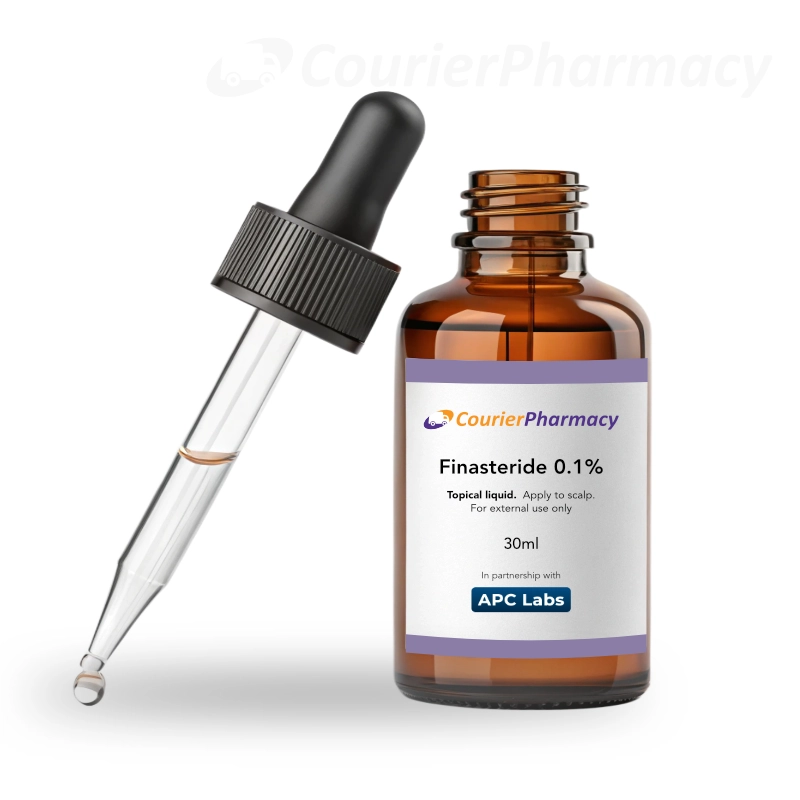
Finasteride 0.1% topical hair loss solution is a prescription topical treatment for male pattern hair loss. Used on the scalp as directed, it aims to reduce DHT’s impact on hair follicles and support hair maintenance and regrowth over time.
Available as: 30ml topical solution with expiry of 180 days
Finasteride 0.1% topical hair loss solution is a compounded topical treatment. It is designed to support men with male pattern hair loss [2]. The idea is straightforward: deliver finasteride directly to the scalp. Here it can reduce the effect of DHT (dihydrotestosterone) on hair follicles [3],[4].
Compared with oral finasteride tablets, a topical solution is often chosen by men who want a scalp-first approach, or who are trying to minimise whole-body exposure. Topical finasteride has been studied in clinical trials, including research showing it can reduce scalp DHT after short-term use (note: published studies often use different topical strengths and formats, but they support the same mechanism) [4].
Because this is a compounded product, the exact directions can vary depending on the prescriber’s plan and the base used. The big thing that doesn’t change is consistency. Finasteride works while you use it. If you stop, the underlying process of hair loss can restart over time [3].
Key features of finasteride 0.1% topical hair loss solution:
Topical application targets the scalp directly [4].
Often supplied in a dropper or pump bottle to help apply it to thinning areas.
Best suited to ongoing use, because benefits are maintained with continued treatment [3].
Prescription-only; requires a clinical suitability check [2].
Additional information
Quantity
1 x 30ml, 2 x 30ml, 3 x 30ml, 4 X 30ml, 5 x 30ml, 6 x 30ml
MOJO WISDOM
Take control of your health by understanding your condition and what this medication is doing for you.
READ:
More information about this treatment.
UK-based doctors and pharmacists
Discreet and Confidential
UK-based doctors and pharmacists
Free, Expert Advice
No video link provided.
No video link provided.
UK-based doctors and pharmacists
Free, expert advice
Discrete and confidential
Fast delivery
Giving you trusted clinical advice for over 40 conditions
A UK regulated pharmacy providing safe, effective treatments online since 2014
Finasteride 0.1% topical hair loss solution: Your complete guide to topical hair regrowth
This guide explains what finasteride 0.1% topical hair loss solution is, how it works, how to use it, and what to look out for. It’s written in plain English, but it sticks to the evidence, so you can decide if it’s a good option for you [1].
Five key takeaways
Finasteride 0.1% topical hair loss solution is designed to reduce DHT activity at the scalp, which is a key driver of male pattern hair loss [2], [3].
Hair growth is slow, so studies of finasteride usually look at results over months rather than days or weeks [3], [5].
It’s a prescription-only treatment used for male pattern hair loss (androgenetic alopecia) in men [2].
With topical use, the most commonly reported issues tend to be local scalp effects such as irritation (this can depend on the base used in the formulation [5].
Apply to clean, dry scalp as directed by your prescriber, allow it to dry fully, and avoid contact with eyes and other sensitive areas [3].
Overview: Finasteride 0.1% topical hair loss solution
Male pattern hair loss is strongly linked to DHT and follicle miniaturisation [2]. Finasteride works by inhibiting 5?alpha reductase, the enzyme that converts testosterone into DHT [3].
Topical finasteride has clinical evidence behind it. In a randomised study of a topical finasteride 0.25% solution, once?daily application reduced scalp DHT by 70% from baseline after one week [4]. For longer-term outcomes, a phase III trial of topical finasteride spray solution found it improved hair count compared with placebo over 24 weeks, with a lower reduction in serum DHT than oral finasteride (suggesting lower systemic exposure) [5].
The practical takeaway: hair growth takes time. Most studies measure meaningful change over months, and you’ll usually need consistent use to judge whether it’s working for you [5]. If you stop, the benefit tends to fade over time [3].
Active ingredient: Finasteride 0.1% topical hair loss solution
The active ingredient is finasteride, a Type II 5?alpha reductase inhibitor [3]. It reduces the conversion of testosterone to DHT, which is central to male pattern hair loss [2],[3].
Your topical solution may also include excipients (for example, solvents such as propylene glycol) depending on the formulation [3].
What is finasteride 0.1% topical hair loss solution used for?
Finasteride is used for male pattern hair loss (androgenetic alopecia) in men [2]. It is not indicated for women, and women who are pregnant or may become pregnant should avoid exposure to finasteride [3].
How does finasteride 0.1% topical hair loss solution work?
Finasteride blocks 5?alpha reductase, reducing DHT [3]. In topical form, studies show it can reduce scalp DHT after short-term use [4]. Clinical trials also support improvements in hair growth measures over time with topical finasteride compared with placebo [5].
Finasteride isn’t a shot in the dark. It’s been studied for years, and the results are consistent: for many men, regular use can slow hair loss and, in some cases, stop further thinning [6].
In one large clinical trial, 83% of men taking 1mg finasteride daily maintained their hair count over two years, compared with 28% in the placebo group [6]. In plain terms: it helped far more men keep the hair they already had.
And it’s not only about maintenance. Many men also see regrowth. Research suggests that after 12 months of daily use, around 66% of men had visible new hair growth [6]. The reason is simple: by lowering DHT’s impact on the scalp, finasteride can give miniaturised follicles a chance to recover and re-enter a healthier growth cycle [6].
How to use finasteride 0.1% topical hair loss solution
Using finasteride 0.1% topical hair loss solution correctly matters for both safety and results.
The usual dose is to apply 1ml using the dropper bottle onto the scalp and leave overnight and wash off in the morning.
1) Prep the scalp
Wash your hair if needed and dry it fully. A wet or damp scalp can change how the solution spreads and absorbs. Part your hair so you can reach the thinning areas.
2) Apply the solution
Measure the prescribed amount using the applicator provided. Apply it to the scalp (not the hair), then gently spread it with fingertips. Avoid vigorous rubbing, especially if your scalp is sensitive.
3) Let it dry
Allow it to dry fully before hats, pillows, styling products, or other scalp treatments. Wash hands after application.
Warnings and precautions: Finasteride 0.1% topical hair loss solution
Before using finasteride, tell your prescriber if you have a history of prostate cancer or benign prostatic hyperplasia (BPH), liver disease, or if you’re having PSA testing, because finasteride can affect PSA levels [3].
Women should not use finasteride, particularly if pregnant or planning to become pregnant. Exposure during pregnancy may affect the development of male foetuses [3].
Mood changes (including depression) have been reported with finasteride. If you notice persistent low mood or suicidal thoughts, stop treatment and seek medical advice urgently [3].
If your partner is pregnant or could become pregnant, discuss precautions with your prescriber. Small amounts of finasteride have been detected in semen, and the SmPC advises caution [3].
Side effects: Finasteride 0.1% topical hair loss solution
Like all medicines, finasteride can cause side effects, although not everybody gets them. Some side effects may improve as treatment continues, or resolve after stopping treatment [3].
With topical use, side effects may include local scalp irritation (for example itching, redness, or dermatitis), depending on your skin and the formulation base [3],[5].
Finasteride can also cause systemic side effects (more commonly discussed with oral finasteride), including sexual side effects such as reduced libido, erectile dysfunction, and ejaculation disorders. In the SmPC for oral finasteride, these are listed as uncommon (may affect up to 1 in 100 people) [3].
Stop using finasteride and get urgent medical advice if you develop:
Signs of an allergic reaction (swelling of lips, face, tongue or throat; difficulty swallowing; hives; breathing difficulties) [3].
Tell your doctor promptly if you notice changes in breast tissue (lumps, pain, enlargement, or nipple discharge), as these can be signs of a serious condition [3].
If any side effect becomes severe, or you notice anything not listed, speak to your doctor or pharmacist. It can help to note what happened, when it started, and how long it lasted [3].
Drug interactions: Finasteride 0.1% topical hair loss solution
Finasteride has few significant drug interactions, and with topical use systemic absorption may be lower. Still, you should tell your prescriber about all medicines you take [3],[5].
Do not combine topical finasteride with oral finasteride or dutasteride unless your prescriber specifically advises it, as this may increase the risk of side effects [3].
If you use other scalp products (for example minoxidil, topical steroids, or retinoids), ask your prescriber or pharmacist how to space applications to reduce irritation risk [2].
Frequently asked questions about finasteride 0.1% topical hair loss solution
How long does finasteride 0.1% topical hair loss solution take to work?
Hair growth takes time. Trials typically measure outcomes over months, so you’ll need consistent use before judging results.
Can women use finasteride 0.1% topical hair loss solution?
No. Finasteride is not indicated for women, especially during pregnancy or if pregnancy is possible.
What’s the difference between topical and oral finasteride?
Topical finasteride is applied to the scalp and has been studied for reducing scalp DHT and improving hair outcomes, with evidence suggesting lower systemic DHT reduction than oral finasteride in at least one phase III trial.
Will hair loss restart if I stop using finasteride 0.1% topical hair loss solution?
Finasteride works while you use it. If you stop, the underlying process of hair loss can restart over time.
Can I use finasteride 0.1% topical hair loss solution with minoxidil?
Possibly, but check with your prescriber first. NICE discusses both finasteride and minoxidil as options for male pattern hair loss.
What should I do if I miss a dose?
Apply it when you remember unless it’s close to your next dose. Don’t double up.
How should I store finasteride 0.1% topical hair loss solution?
Follow the label directions. For finasteride products, standard advice is to store as directed, keep the container closed, and keep out of reach of children.
Disclaimer
This article is for information only and is not a substitute for medical advice. Always speak to a qualified clinician or pharmacist before starting, stopping, or changing treatment.
[3] Organon Pharma (UK) Limited (2024) Propecia 1 mg Film-Coated Tablets: Summary of Product Characteristics (SmPC). Available at: https://www.medicines.org.uk/emc/product/2194/smpc (Accessed: 24 February 2026).
[4] Caserini, M., Radicioni, M., Leuratti, C., Terragni, E., Iorizzo, M. and Palmieri, R. (2016) Effects of a novel finasteride 0.25% topical solution on scalp and serum dihydrotestosterone in healthy men with androgenetic alopecia. International Journal of Clinical Pharmacology and Therapeutics. Available at: https://pubmed.ncbi.nlm.nih.gov/26636418/ (Accessed: 24 February 2026).
[5] Piraccini, B.M., Alessandrini, A., Starace, M., Bruni, F., Iorizzo, M., Tosti, A. and Rossi, A. (2022) Efficacy and safety of topical finasteride spray solution for male androgenetic alopecia: a phase III, randomized, controlled clinical trial. Available at: https://pmc.ncbi.nlm.nih.gov/articles/PMC9297965/ (Accessed: 24 February 2026).