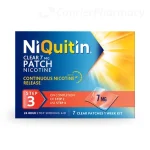
NiQuitin Clear Patch 7mg, 7 patches, Step 3 is the lowest-strength patch in the NiQuitin step-down programme, delivering 7mg of nicotine continuously over 24 hours via Smart Control Technology.
Used in the final two weeks of a ten-week quit course for smokers of ten or more cigarettes per day, or as the concluding two weeks of an eight-week programme for lighter smokers.
NiQuitin Clear Patch 7mg, 7 patches, Step 3 is a transdermal nicotine replacement therapy (NRT) patch. It is designed for the concluding phase of a structured stop-smoking programme.
Each patch is a 7 sq.cm transparent system containing 36mg of nicotine in total, releasing a nominal 7mg over 24 hours through a rate-controlling polyethylene membrane.
Like all patches in the NiQuitin Clear range, it is near-invisible on the skin and designed for continuous 24-hour wear, with the option to remove before sleep if preferred. The patch is marked NCQ 7 on its surface for identification.
The Step 3 patch
At 7mg, this is the gentlest dose in the NiQuitin step-down system. By the time you reach Step 3, your brain has already spent eight weeks adjusting to lower and steadier nicotine levels than cigarettes provide.
The neural pathways that drive craving have quietened substantially. The role of this patch is not to carry a heavy pharmacological load, but to ease the transition over the final fortnight, keeping background withdrawal manageable while your body moves toward independence from external nicotine altogether.
The Smart Control Technology patch
The Smart Control Technology that runs through all three NiQuitin Clear strengths delivers an initial faster release of nicotine after application, then settles into the sustained controlled release for the day.
At the 7mg dose, even the initial burst is modest, reflecting how far your body’s nicotine requirements have dropped. What you’re getting is precisely calibrated support for a system that is nearly ready to function without it.
Each pack contains 7 individually sealed patches. No tar, no carbon monoxide, no ammonia. Just the amount of nicotine your body still needs, cleanly and continuously.
Product specifications
Active ingredient: nicotine 7mg per 24 hours
Total nicotine content per patch: 36mg
Patch size: 7 sq.cm, transparent, rate-controlled membrane system
Patch identification: marked NCQ 7
Pack size: 7 patches (two-week supply at one per day)
Delivery: transdermal, 24-hour continuous wear
Technology: Smart Control Technology for rapid onset then sustained release
Classification: General Sale List (GSL)
Manufacturer: Omega Pharma Limited (a Perrigo company)
Suitable for adults and adolescents aged 12 and over (those aged 12-17 should seek professional guidance)
MOJO WISDOM
Take control of your health by understanding your condition and what this medication is doing for you.
READ:
More information about this treatment.
UK-based doctors and pharmacists
Discreet and Confidential
UK-based doctors and pharmacists
Free, Expert Advice
No video link provided.
No video link provided.
UK-based doctors and pharmacists
Free, expert advice
Discrete and confidential
Fast delivery
Giving you trusted clinical advice for over 40 conditions
A UK regulated pharmacy providing safe, effective treatments online since 2014
You’ve done the hard work. Step 3 is where you cross the finish line.
Reaching Step 3 means you’ve already navigated six weeks of full-strength NRT and two weeks of the middle dose. That’s real progress, and it deserves to be said plainly. NiQuitin Clear Patch 7mg, 7 Patches, Step 3 is the lowest-strength patch in the NiQuitin range, designed for the final two weeks of the ten-week quit programme. At just 7mg of nicotine over 24 hours, it delivers enough to keep residual withdrawal quiet while your brain completes its adjustment to a nicotine-free baseline. At Courier Pharmacy, we believe healthcare should fit the person, not the other way round. Whatever has brought you to this point, whether a health scare, a long-held goal, or finally reaching a moment where quitting feels possible, we’re here with honest information and genuine support for the last stretch.
Five key takeaways
NiQuitin Clear Patch 7mg, Step 3 delivers 7mg of nicotine continuously over 24 hours via Smart Control Technology, making it the lowest-strength option in the three-step programme.
It is the final stage of the ten-week programme for smokers of ten or more cigarettes per day, used for two weeks after completing Steps 1 and 2.
Light smokers completing an eight-week programme also use the 7mg patch as their Step 2 (final) stage, for two weeks after six weeks on the 14mg patch.
Each pack of 7 patches provides a one-week supply at one patch per day, covering the full Step 3 period in a single purchase.
It is a General Sale List (GSL) medicine manufactured by Omega Pharma Limited, requiring no prescription.
The full dosing schedule is set out in the NiQuitin Clear SmPC on the Electronic Medicines Compendium. Step 3 is the terminal stage in either the standard ten-week or light-smoker eight-week programme.
Ten-week programme for smokers of ten or more cigarettes per day
Step 1 (21mg): one patch daily for six weeks
Step 2 (14mg): one patch daily for two weeks
Step 3 (7mg): one patch daily for the final two weeks
Eight-week programme for light smokers (fewer than ten cigarettes per day)
Step 1 equivalent (14mg): one patch daily for six weeks
Step 2 equivalent / Step 3 (7mg): one patch daily for the final two weeks
Apply one fresh patch each morning at the same time. Press it firmly to clean, dry, hairless skin on the upper arm, shoulder, hip, or chest for ten seconds immediately after removing from the sachet. Wear for 24 hours, rotating the application site each day. Do not return to the same skin site for at least seven days.
The SmPC notes that the full ten-week course should be completed for best results, but treatment can be extended beyond ten weeks for people who need additional time to achieve abstinence. Those who have successfully stopped smoking but find it difficult to discontinue the patches should seek guidance from a healthcare professional rather than simply stopping abruptly.
Overview of NiQuitin Clear Patch 7mg, 7 patches, Step 3
Five things worth knowing
At 7mg, the patch is delivering a level of nicotine that is substantially below what cigarettes provided, reflecting how far your dependence has already come down across the programme.
Step 3 is also the point where the psychological work of quitting becomes more prominent. The physical withdrawal is largely managed; the habits, triggers, and emotional associations are what remain to be addressed.
The 7-patch pack covers the Step 3 period in two purchase, with no patches left over and none to scramble to replace mid-course.
Combination NRT, continuing to use a fast-acting product such as a NiQuitin mini lozenge alongside the patch for moments of acute craving, remains appropriate and supported at Step 3.
Once Step 3 is complete, stopping the patch should be straightforward for most people, as the dose is already very low and the neurological adjustment is largely done.
Arriving at Step 3 is genuinely significant. Nicotine dependence is classified as a substance use disorder with a well-documented neurobiological basis, and the first weeks of quitting are when withdrawal is most severe and relapse risk is highest. By the time you’re wearing a 7mg patch, you’ve navigated that most difficult window. Your dopamine system has been recalibrating for the better part of two months. The finish line is in sight.
What Step 3 can feel like is deceptively easy, or deceptively hard, depending on the person. For some, the final two weeks pass almost without notice, a gentle background hum of nicotine that they stop needing without much ceremony. For others, this is where the psychological dimension of quitting reasserts itself, because the physical crutch is almost gone but the habitual triggers remain. Both experiences are normal. If you find Step 3 harder than you expected, that’s not failure; it’s information about what additional support might help.
Continuing with a behavioural support programme or even informal support, such as our free drop-in clinics at Insomnia, Derby, from 10 am to 12 pm, can make a real difference at this stage. The evidence consistently shows that combined pharmacological and behavioural support outperforms either alone.
The transparency of the Clear patch continues to matter even at Step 3, when some people feel more comfortable being open about their quit attempt and others still prefer privacy. At 7 sq.cm, the patch is the smallest in the range: compact, flat, and nearly invisible even on the most visible skin. You can wear it through gym sessions, summer clothing, meetings, and social events without it declaring itself to anyone.
Finally, once you’ve finished Step 3 and stopped the patches, give yourself a realistic timeline for the lingering psychological cravings. These typically fade over weeks to months rather than disappearing instantly. Having a plan for your most common triggers, whether stress, alcohol, social situations, or particular times of day, is the last piece of the puzzle that the patch alone can’t address.
Reaching Step 3 is exactly the kind of achievement that the healthcare system often fails to acknowledge, because you’re not presenting with an acute problem. You’re doing something quietly hard and doing it well. At Courier Pharmacy, that’s precisely the kind of patient we’re built to support. Our clinical approach, embodied in Dr Ada Jex-Cori and her frank, community-rooted philosophy, starts from the position that you already have the motivation. Our job is to give you the clearest possible information and get out of your way.
Purchasing NiQuitin Clear Patch 7mg, 7 patches, Step 3 through Courier Pharmacy means having access to a GPhC-registered pharmacy team that understands the full clinical context of where you are in your quit journey. If you have a long-term condition, if you’re managing other medicines, or if quitting has been bound up with managing stress, mental health, or social pressures, we take all of that seriously. Healthcare that fits you means healthcare that sees the whole person.
And we’re here even when you’re not buying anything. Our free fortnightly drop-in talks at Insomnia, Derby, from 10 am to 12 pm are open to everyone, no appointment needed and nothing to purchase. Whether you’re finishing Step 3 or figuring out what comes after, the community is there. Learn more about our community talks at courierpharmacy.co.uk.
NiQuitin Clear Patch 7mg, 7 patches, Step 3 is a General Sale List (GSL) medicine in the UK. No prescription is required. Add it to your basket and complete your order for discreet delivery to your door.
If you have any questions about how to finish the programme, whether you can extend beyond the standard two weeks, or what to expect when the patches stop, our pharmacist team is ready to help.
If it isn’t suitable for you, we’ll explain why and suggest the next best option.
Active ingredient in NiQuitin Clear Patch 7mg, 7 patches, Step 3
The active ingredient is nicotine. Each 7 sq.cm patch contains a total of 36mg of nicotine, releasing approximately 7mg over a 24-hour period through a rate-controlling polyethylene membrane. The excipient list includes an ethylene vinyl acetate copolymer drug reservoir, a polyethylene terephthalate / ethylene vinyl acetate occlusive backing, and a polyisobutylene adhesive laminate.. The patch contains no latex. If you have a known sensitivity to any of these components, review the full patient information leaflet or speak to a pharmacist before starting.
Nicotine is a naturally occurring alkaloid found primarily in tobacco. At the 7mg therapeutic dose delivered transdermally, it maintains just enough of a blood nicotine signal to suppress residual withdrawal symptoms without re-establishing dependency or producing the rapid spikes that make smoking neurologically reinforcing. At this concentration and route of delivery, the dose is specifically low enough that discontinuation at the end of the two-week Step 3 course typically causes only minimal disruption to the body.
What is NiQuitin Clear Patch 7mg, 7 patches, Step 3 for?
NiQuitin Clear Patch 7mg, Step 3 is licensed to relieve and prevent nicotine withdrawal symptoms and cravings in people who are dependent on nicotine from tobacco. As the final step in the NiQuitin three-step programme, its specific purpose is to complete the graduated reduction in nicotine dose that allows the brain to normalise its receptor systems gently, rather than experiencing the abrupt crash of going cold turkey from a higher dose.
For light smokers completing the shorter eight-week programme, the 7mg patch serves the same concluding function but arrives earlier in their timeline, after just six weeks of 14mg rather than eight weeks of 21mg followed by two weeks of 14mg. In both cases, the patch marks the penultimate phase before full nicotine independence.
The SmPC also confirms that the 7mg patch can support temporary abstinence, situations where smoking is not possible or desirable for an extended period, and that it is indicated for pregnant and lactating women making a quit attempt. Women who are pregnant should ideally quit without NRT if possible; if NRT is necessary, use should be agreed with a midwife or GP, and the SmPC recommends removing the patch before bed during pregnancy to reduce total nicotine exposure.
How does NiQuitin Clear Patch 7mg, 7 patches, Step 3 work?
By Step 3, the physiological mechanism is one of completion rather than rescue. Earlier in the programme, the 21mg patch was doing heavy lifting: replacing most of the nicotine your body expected from cigarettes, preventing the sharp dopamine crash that makes early-stage withdrawal so physically uncomfortable. The 14mg Step 2 patch began reducing that input, signalling to the brain that the external supply was diminishing. Now, at 7mg, the patch is providing just enough nicotine to prevent residual withdrawal while the brain's receptor systems complete their normalisation.
The neuroscience of this process centres on the nicotinic acetylcholine receptors (nAChRs) that tobacco smoking upregulates over time. Regular nicotine exposure causes the brain to increase the density and sensitivity of these receptors as a compensatory adaptation. When nicotine input is removed or reduced, the excess receptors create the withdrawal signal. The step-down approach works because it gives those receptors time to return toward their baseline numbers gradually rather than all at once.
Smart Control Technology provides an initial faster nicotine release after application each morning, reaching effective blood levels sooner than a standard membrane patch would. At 7mg, this initial burst is modest, but it still helps prevent the subtle morning withdrawal that can build as overnight blood nicotine levels taper. The sustained controlled release then maintains a steady plateau through the rest of the day.
At the end of the Step 3 course, most people can remove the final patch and find that the remaining discomfort is manageable, because the neurological adaptation has largely been completed across the preceding ten weeks. This is why the step-down structure works more reliably than abrupt cessation: it exploits the brain's own plasticity, giving it time to undo the changes that nicotine imposed.
How to use NiQuitin Clear Patch 7mg, 7 patches, Step 3
Apply one fresh patch each morning at the same time, preferably on waking. Remove the patch from its sealed sachet immediately before use. Choose a clean, dry, hairless area of skin on the upper arm, shoulder, hip, or chest. Press the adhesive side firmly against the skin with the palm of your hand for ten seconds. Avoid crease areas and any skin that is broken, red, or irritated. Wash your hands with water only after handling the patch.
Wear the patch for 24 hours. If sleep disturbance or vivid dreams occur, remove the patch before bed and apply a fresh one in the morning. This is slightly less common at the 7mg dose than at higher strengths, but it can still happen. Removing overnight is a reasonable practical adjustment that does not significantly compromise the programme's overall effectiveness.
Rotate the application site every day and do not return to the same spot for at least seven days. If a patch falls off during bathing, swimming, or exercise, apply a replacement to a new skin site. Do not try to re-stick a detached patch. Dispose of used patches by folding them adhesive-side inward before placing in a household bin. Even at 7mg, used patches contain residual nicotine that can be harmful to children or pets if chewed or swallowed. Store unused patches in their sealed sachets below 30°C.
Warnings and precautions for NiQuitin Clear Patch 7mg, 7 patches, Step 3
The SmPC is clear that the risks of NRT are substantially outweighed by the well-established dangers of continued smoking. At the 7mg dose, this balance is even more strongly in favour of use, as the pharmacological load is minimal. The same precautions that apply to higher-strength NiQuitin patches apply here.
People with stable cardiovascular disease can use the patch safely; continued smoking carries a far greater cardiac risk than low-dose NRT. Those currently admitted to hospital for a heart attack, severe dysrhythmia, or stroke who are haemodynamically unstable should not use NRT without direct medical supervision. People with diabetes should monitor their blood glucose more closely than usual, as stopping smoking can alter catecholamine levels and affect medication requirements. Those with moderate to severe liver or severe kidney impairment should use the patch with caution.
People with a history of epilepsy, phaeochromocytoma, or uncontrolled hyperthyroidism should seek medical advice before using any nicotine patch. The patch must not be used by non-smokers, occasional smokers, or children under 12. It must not be used by anyone with a known hypersensitivity to nicotine or any of the excipients. People with chronic widespread skin conditions including psoriasis, chronic dermatitis, or urticaria should not use transdermal patches. Keep all patches, used and unused, away from children and animals. Remove the patch before any MRI scan.
Side effects of NiQuitin Clear Patch 7mg, 7 patches, Step 3
Side effects at the 7mg dose are generally milder than at higher strengths, though the profile is similar across the NiQuitin range. The most commonly reported effects are local: redness, mild itching, burning, or tingling at the application site. These typically clear within 24 hours of patch removal. Daily site rotation significantly reduces both the frequency and severity of these reactions.
Systemic effects can include headache, dizziness, nausea, dry mouth, increased sweating, palpitations, and gastrointestinal disturbance including indigestion or stomach discomfort. Sleep disturbance and vivid dreams are possible with 24-hour wear, though less common at 7mg than at the 21mg or 14mg strengths. Removing the patch before bed is a straightforward solution if sleep is affected.
Less commonly, some people experience tremor, shortness of breath, joint or muscle pain, tiredness, or photosensitivity at the application site. Hypersensitivity reactions including contact dermatitis have been reported. If redness at the patch site spreads beyond the patch edge, becomes more severe, or fails to improve after removal, stop using the patch and speak to a pharmacist or GP.
Rare but serious reactions include angioedema and urticaria. Very rare anaphylactic-type reactions, including sudden wheeziness, chest tightness, rash, and faintness, have been documented with NRT patches. Remove the patch immediately and seek emergency care if these occur. Report any suspected adverse effect to the MHRA via the Yellow Card scheme at yellowcard.mhra.gov.uk.
Drug interactions with NiQuitin Clear Patch 7mg, 7 patches, Step 3
No clinically definitive pharmacokinetic interactions between NiQuitin Clear 7mg and other medicines have been formally established. The most important interaction risk at this stage of the programme relates to the cumulative effect of stopping smoking on liver enzyme activity, rather than anything specific to the 7mg patch itself.
If you have been on any prescription medicines throughout your quit programme, you may already have had relevant doses adjusted. If not, it's worth flagging to your GP or pharmacist that you are completing your NRT course, as the enzyme changes that began when you stopped smoking may still be evolving. Tobacco smoke induces CYP1A2, an enzyme responsible for metabolising several important medicines. As smoking stops and the induction fades, blood levels of drugs metabolised by this pathway can rise. Medicines in this category with narrow therapeutic windows include theophylline, clozapine, and ropinirole; others in the broader pathway include tacrine, olanzapine, warfarin, and caffeine.
By Step 3, most of the clinically significant CYP1A2 de-induction will already have occurred, as this process largely plays out in the first days to weeks after smoking stops. However, monitoring should continue where relevant, particularly for narrow-therapeutic-window medicines. There are no known interactions between NiQuitin Clear 7mg and common over-the-counter medicines at recommended doses.
What is NiQuitin Clear Patch 7mg, Step 3 used for?
It is the final step in the NiQuitin three-step quit programme, delivering 7mg of nicotine over 24 hours to gently complete the reduction in nicotine dose. It is used for the final two weeks of a ten-week programme for heavier smokers, or as the concluding two weeks of an eight-week programme for light smokers.
How long do I use NiQuitin Clear Patch 7mg, Step 3?
The standard Step 3 duration is two weeks, following two weeks of Step 2 (14mg). For light smokers on the eight-week programme, Step 3 also lasts two weeks, after six weeks of Step 1 equivalent (14mg).
Does one pack of 7 patches cover the full Step 3 course?
No. Step 3 lasts two weeks at one patch per day, requiring exactly 14 patches. So, you will need two single packs of NiQuitin Clear Patch 7mg, 7 patches. Step 3 covers the complete final stage of the programme with nothing left over.
What happens after I finish Step 3?
After completing the two-week Step 3 course, most people can stop the patches without significant withdrawal, as the neurological adjustment has largely been completed across the ten weeks. Psychological cravings from habit and trigger associations may continue for weeks or months; behavioural strategies and occasional support are helpful during this period.
Can I extend Step 3 if I don't feel ready to stop?
The SmPC confirms that treatment can be extended beyond ten weeks if needed to maintain abstinence. If you have successfully stopped smoking but find it difficult to discontinue the patches, the advice is to seek guidance from a healthcare professional rather than continuing indefinitely without review.
Can I wear the 7mg patch overnight?
Yes. The patch is designed for 24-hour wear, which provides protection against morning cravings. If vivid dreams or sleep disturbance occur, remove the patch before bed and apply a fresh one in the morning. This is less common at 7mg than at higher strengths.
Do I need a prescription to buy NiQuitin Clear Patch 7mg?
No. NiQuitin Clear Patch 7mg is a General Sale List (GSL) medicine in the UK, available without a prescription from pharmacies and many general retailers.
Can I still use a fast-acting NRT alongside the 7mg patch?
Yes. Combining the patch with a fast-acting product such as a NiQuitin mini lozenge for acute breakthrough cravings is appropriate and supported at all stages of the programme, including Step 3. The patch provides background coverage; the lozenge handles acute peaks.
Where should I apply the NiQuitin 7mg patch?
Apply to a clean, dry, hairless area of skin such as the upper arm, shoulder, hip, or chest. Avoid broken, irritated, or crease-prone skin. Rotate the site daily and do not return to the same spot for at least seven days.
What if my patch falls off during the day?
Apply a replacement to a new, clean, dry skin site and continue the programme as normal. Do not try to re-stick the detached patch. Water does not harm the patch if it was properly applied initially.
How is NiQuitin Clear different from standard NiQuitin at Step 3?
NiQuitin Clear uses a transparent backing, making it nearly invisible on the skin. Standard NiQuitin patches are opaque and beige. The nicotine content, Smart Control Technology, and step-down strengths are identical across both ranges at Step 3. The choice between them is cosmetic.
Can I use NiQuitin Clear 7mg during pregnancy?
The patch is indicated for pregnant women making a quit attempt. The SmPC recommends removing it before bed during pregnancy to reduce total nicotine exposure. Ideally, cessation should be achieved without NRT; if NRT is needed, use it under guidance from your midwife or GP.
Is the 7mg patch suitable for teenagers?
The patch is not for use in children under 12. Adolescents aged 12 to 17 should seek advice from a healthcare professional before starting. They should not use any NiQuitin patch for more than ten weeks without professional guidance.
Can I smoke while wearing the 7mg patch?
You should not smoke while wearing the patch. If you do smoke, remove the patch first. Combining the patch with cigarettes increases nicotine exposure and can cause excess symptoms. One cigarette is not a reason to abandon the programme; recommit and continue.
Will stopping the patch after Step 3 cause withdrawal?
For most people, stopping the 7mg patch at the end of Step 3 causes only minimal discomfort, because the dose is already low and the neurological adaptation has largely been completed across the preceding weeks. Some mild residual psychological craving may continue, but this typically fades over weeks to months.
What if I still have cravings during Step 3?
Mild residual cravings during Step 3 are normal and expected. Adding a fast-acting NRT such as a NiQuitin mini lozenge for acute moments is appropriate. If cravings are severe enough to feel unmanageable at the 7mg level, speak to a pharmacist; it may be worth returning to Step 2 temporarily.
How do I dispose of used NiQuitin 7mg patches safely?
Fold the used patch adhesive-side inward and place it in a household bin. Do not flush it. Even at 7mg, used patches contain residual nicotine that can be harmful to children and pets if chewed or swallowed. Keep all patches, used and unused, away from children.
Does NRT improve quit rates at Step 3?
Yes. The evidence base for NRT covers the full step-down programme, and completing the course including Step 3 is associated with better long-term outcomes than stopping NRT early. A Cochrane review confirmed all forms of NRT increase the odds of successful cessation by approximately 1.5- to 2-fold compared with unaided attempts.
What should I do if I get a skin reaction from the 7mg patch?
Mild redness, itching, or tingling is common and typically clears within 24 hours of removal. Rotate sites daily. If the reaction spreads beyond the patch edge, becomes severe, or persists, stop using the patch and speak to a pharmacist or GP. People with psoriasis, chronic dermatitis, or urticaria should not use transdermal patches.
Is there a risk of becoming dependent on the 7mg patch?
Transferred dependence on NRT is possible but rare, and substantially less harmful than tobacco dependence. At the 7mg dose, the risk is very low. The graduated programme is specifically designed to make discontinuation straightforward. Those who find it difficult to stop the patches should seek pharmacist or GP guidance.
Disclaimer: This article is for general information only and isn’t a substitute for personal medical advice, diagnosis, or treatment. Always check with a GP, pharmacist, or specialist before starting a new supplement if you have a medical condition or take regular medicines.
More than a prescription: our community
Finishing a quit programme is something worth celebrating. But we also know that the weeks just after the patches stop can be when the psychological work of quitting becomes most visible, when the pharmacological support is gone and the habitual triggers remain. This is exactly when community matters most.
Every fortnight, our team runs free drop-in talks at Insomnia, Derby, from 10 am to 12 pm. No appointment, no cost, no sales pitch. Whether you're mid-programme, freshly finished, or simply figuring out the next step, you're welcome. Our pharmacists are there to answer real questions, and the room is there for honest conversation with people who get it.
If you're in Derbyshire and want to connect in person, we would genuinely love to see you. Learn more about our community talks at courierpharmacy.co.uk.
How this content was created
Written by the Courier Pharmacy editorial team and reviewed by a GPhC-registered pharmacist. Grounded in the latest NHS, NICE, BNF and EMC guidance, peer-reviewed studies, and the real questions patients bring to our drop-in clinics in Derby.
[4] Silagy C, Lancaster T, Stead L, Mant D and Fowler G (2004) Nicotine replacement therapy for smoking cessation. Cochrane Database of Systematic Reviews, Issue 3. Available at: https://pubmed.ncbi.nlm.nih.gov/15266423/
[6] Bhatt DL et al. (2022) Nicotine patch alters patterns of cigarette smoking-induced dopamine release. Nicotine and Tobacco Research, 24(10), pp.1597-1606. Available at: https://www.ncbi.nlm.nih.gov/pmc/articles/PMC9575980/
[7] Theodoulou A et al. (2023) Different doses, durations and modes of delivery of nicotine replacement therapy for smoking cessation. Cochrane Database of Systematic Reviews. Available at: https://www.ncbi.nlm.nih.gov/pmc/articles/PMC10278922/
[8] Medicines and Healthcare products Regulatory Agency (MHRA) (2024) Yellow Card: report a side effect or incident. Available at: https://yellowcard.mhra.gov.uk/