

The standard dutasteride dose for hair loss is 0.5 mg once daily. That’s the most common and best-studied starting point for male pattern hair loss, and it’s the dose used in the main clinical trials.
If you’re reading this after spotting more scalp in the mirror, more hair in the shower, or a widening crown in photos, you’re not alone. Dutasteride often comes up after people try to make sense of finasteride, minoxidil, shedding, side effects, and conflicting advice online. This guide covers what the dose is, how dutasteride works, what results you can realistically expect, where topical versions fit in, and how to use it safely in the UK with proper medical support.
-
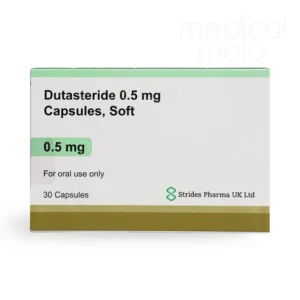 Dutasteride 0.5mg capsulesPrice range: £22.79 through £81.99
Five key takeaways
- Standard dose: The evidence-backed oral dose for hair loss is 0.5 mg once daily [1].
- It’s off-label in the UK: Doctors and prescribers may still use it for male pattern hair loss when appropriate.
- It works on DHT: Dutasteride lowers the hormone that drives follicle miniaturisation.
- Patience matters: Hair treatment is slow. Early stabilisation usually matters before visible thickening.
- Safety comes first: Good prescribing includes checking your history, discussing side effects, and planning follow-up.

How does dutasteride work to stop hair loss
Hair loss treatment makes more sense when you understand the target. In androgenetic alopecia, often called male pattern hair loss, the main problem isn’t that hair suddenly vanishes. The problem is that hair follicles become more sensitive to DHT, a hormone made from testosterone.
Why DHT matters
Think of DHT as a key that slowly locks down vulnerable follicles. Each cycle, the follicle produces a thinner, shorter hair. Over time, the growing phase shortens, the follicle shrinks, and the hair becomes wispy.
Dutasteride works by blocking the enzyme that helps make DHT. A simple way to picture it is this. If 5-alpha reductase is the factory that produces the key, dutasteride shuts down far more of that factory than finasteride does. That stronger DHT control is why dutasteride gets attention in men with more stubborn hair loss.
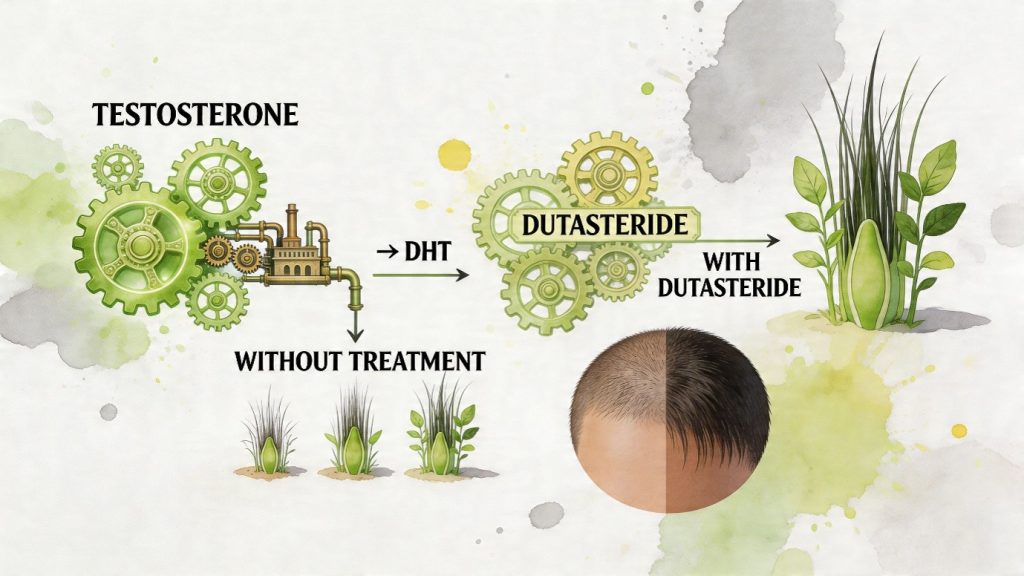
A quick visual of the DHT pathway—why follicles shrink without treatment, and why dutasteride can help protect them.
If you want a broader look at other scalp signals involved in male pattern baldness, this article on the link between prostaglandin D2, mast cells and male pattern baldness adds useful context.
Practical rule: Dutasteride helps best when follicles are still alive but shrinking. It cannot revive a smooth, shiny area where follicles are no longer active.
What dutasteride can and cannot do
Expectations need to stay sensible. Dutasteride doesn’t create brand-new follicles. It protects vulnerable follicles and can help some of them produce thicker, healthier hair again.
That’s why men often report the first win as less of an ongoing loss, not instant regrowth. A treatment can be working even before your mirror proves it.
What tends not to work well is inconsistency. Taking it for a few weeks, stopping in panic, restarting, then checking your hairline every morning is a poor recipe for clear results. Hair biology moves slowly, and the scalp responds over months, not days.
A few practical signs that treatment may be helping include:
- Less shedding: Fewer hairs on the pillow, in the sink, or after washing.
- Better texture: Existing hair may feel less wispy before density looks different.
- Slower progression: The hairline or crown may stop worsening even if regrowth is modest.

The standard dutasteride dose for hair loss
A common UK scenario is this. Someone has read about dutasteride online, seen different schedules in forums, and wants to know what dose is used in practice. For male pattern hair loss, the usual oral starting point is 0.5 mg once daily.
That is the dose with the clearest clinical use behind it for androgenetic alopecia, even though dutasteride is off-label for hair loss in the UK. In day-to-day prescribing, the goal is consistency and sensible monitoring, not chasing a higher dose in the hope of faster regrowth.
The dose used most often
Prescribers did not arrive at 0.5 mg by trial and error in the clinic. It became the standard reference dose because it is the oral regimen most often studied and the one most clinicians have in mind when they discuss dutasteride for hair loss.
Earlier research cited in this article found better hair count improvement with dutasteride 0.5 mg daily than with placebo over six months. That same evidence also showed very strong suppression of DHT. For hair loss, that is the practical reason this dose is used. It lowers the hormonal signal driving follicle miniaturisation to a level that is usually meaningful.
For readers comparing options, the commonly supplied oral form is dutasteride 0.5 mg capsules.
| Dose question | Practical answer |
| What is the standard oral dose? | 0.5 mg once daily |
| Why that dose? | It is the best-established oral dose for hair loss and the one most often used in specialist practice |
| Is it licensed for hair loss? | No. In the UK, this is generally an off-label use |
| Can people use other schedules? | Yes, sometimes. Some prescribers adjust frequency for tolerability, previous side effects, or a cautious start, but that should be individualised |
What does off-label mean in practice
Off-label does not mean experimental or casual prescribing. It means the medicine is licensed for a different condition, and a prescriber uses it for hair loss because the evidence, the patient’s history, and the risk-benefit balance support that decision.
In the UK, that matters more than many patients realise. Dutasteride is not a tablet to copy from a discussion board and hope for the best. Safe prescribing means checking whether the pattern of loss fits androgenetic alopecia, reviewing current medicines, asking about sexual side effects, fertility plans, liver history, and whether follow-up is realistic.
A specialist service can add value. A pharmacy such as Courier Pharmacy can work with prescribers to personalise treatment, explain the off-label position clearly, and help patients stay on a plan that is monitored rather than improvised.
Off-label prescribing works best when the dose, the reason for treatment, and the follow-up plan are all clear from the start.
What is the usual dutasteride dose for hair loss?
The standard oral dose used for male pattern hair loss is 0.5 mg once daily.
Is dutasteride approved for hair loss in the UK?
No. It is generally prescribed off-label, with a clinician assessing whether it is appropriate and how it should be monitored.
What results you can realistically expect and when
A common UK scenario is this. A patient starts dutasteride, checks the mirror every morning for two weeks, sees little change, and assumes it is not working. That is usually the wrong time frame.
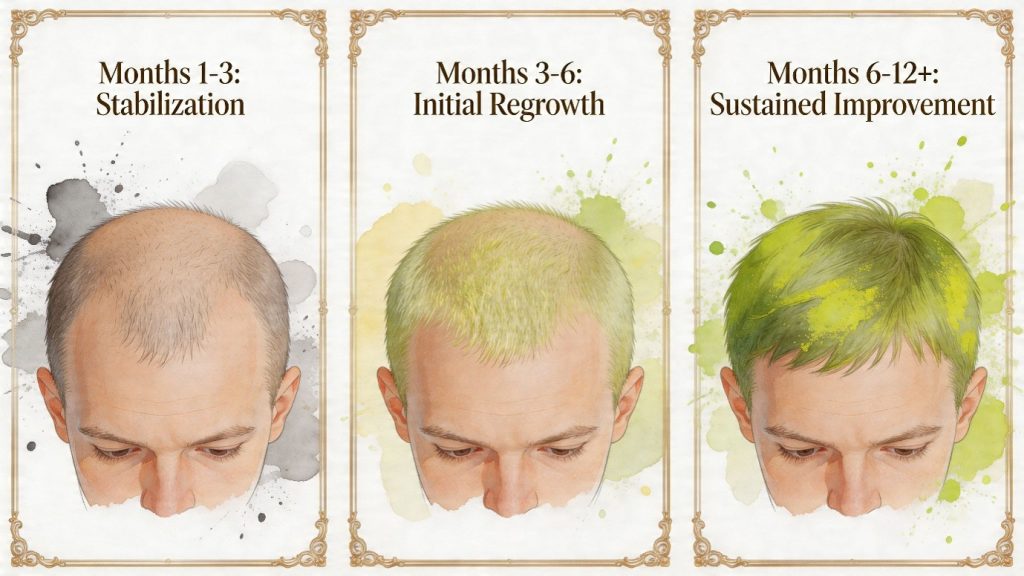
Hair changes take time. Many people notice stabilisation first, then gradual thickening later with consistent treatment and review.
Dutasteride works slowly because hair follicles cycle slowly. In practice, the first realistic goal is often stabilisation. There will be:
- less ongoing miniaturisation.
- reduces shedding. Less progression in the crown or mid-scalp, and
- visible thickening, if it comes, usually follows later.
A realistic timeline
Early improvement is often subtle. Hair may feel easier to style, the parting may look a little narrower, or the scalp may show less under bright light. Patients who expect dramatic regrowth in a month often miss these early signs.
By the time treatment has been underway for several months, some men notice greater density in thinning areas, especially at the crown. Areas that have been completely bald for a long time are less likely to recover well. That trade-off matters when setting expectations, because dutasteride is better at preserving and strengthening vulnerable follicles than recreating follicles that have effectively stopped producing useful hair.
Results are also easier to judge if treatment is not being used in isolation. Some prescribers discuss combination plans where appropriate, particularly if someone wants to target both DHT-driven loss and growth support. For readers comparing options, this guide on using dutasteride and minoxidil together in the UK explains where combination treatment may fit.
What tends to improve first
The usual pattern is:
- First: Reduced shedding or slower ongoing loss
- Next: Slightly better coverage in thinning areas
- Later: More noticeable improvement in density and styling, usually easiest to see in repeat photos
That sequence is more realistic than expecting a new hairline.
How to judge progress properly
Memory is unreliable here. Patients often feel they look worse or better based on haircut length, lighting, or stress, rather than true follicle change.
Use a simple review method:
- Take baseline photos: Front, temples, top, and crown
- Keep the conditions the same: Same room, same lighting, similar hair length
- Review monthly, not daily: Frequent checking creates noise, not clarity
- Note shedding as well as density: Stabilisation still counts as a benefit
In specialist UK practice, follow-up makes a real difference. A monitored plan helps distinguish normal early fluctuations from a true lack of response, and it provides space to review side effects, adherence, and whether the treatment still aligns with the patient’s priorities. That is particularly important with an off-label medicine, where the right question is not just “is hair growing?” but “is the overall balance still worth it for this patient?”
How long does dutasteride take for hair loss?
Hair treatment usually needs months, not weeks. Reduced shedding may appear before visible thickening.
Will dutasteride regrow a fully bald area?
Usually not to a meaningful degree. It tends to work better where follicles are still active but thinning.
Dutasteride vs finasteride a key comparison
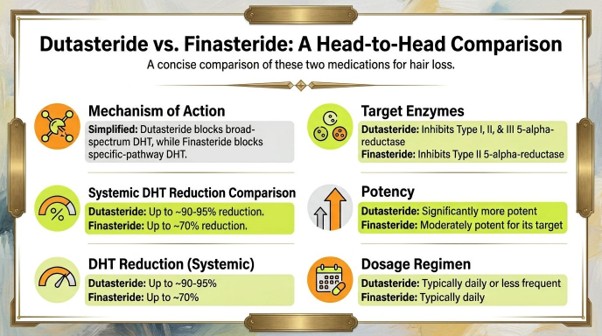
Dutasteride and finasteride both reduce DHT, but they don’t work in exactly the same way—this chart lays out the key differences at a glance.
A common UK scenario is a patient who has taken finasteride consistently, feels the result is only partial, and wants to know whether dutasteride is the next sensible step. That is a reasonable question, but it needs more than a simple “stronger equals better” answer.
Dutasteride vs finasteride at a glance
| Feature | Dutasteride | Finasteride |
| Enzyme action | Blocks type I and type II 5-alpha reductase | Blocks type II 5-alpha reductase |
| Standard hair loss dose | 0.5 mg once daily | 1 mg once daily |
| DHT reduction | Greater DHT suppression | Lower DHT suppression |
| Hair loss status in UK practice | Off-label for hair loss | Commonly used for male pattern hair loss |
| When prescribers may consider it | Limited benefit from finasteride, or a patient accepts a more intensive off-label option after review | Often discussed earlier in treatment decisions |
What matters in practice
Finasteride is usually the starting point because it is the more familiar option for male pattern hair loss. Dutasteride tends to come up later, especially if hair loss is still progressing, density gains have plateaued, or the patient wants to discuss a treatment with broader 5-alpha reductase blockade.
That said, switching is not a reflex decision. In practice, I would want to know how long finasteride has been used, whether it has been taken regularly, what the baseline photos showed, and how concerned the patient is about side effects. Those details often matter more than online before-and-after claims.
-
Product on sale
 Minoxidil 2.5mg tabletsPrice range: £24.99 through £149.99
 -
Product on sale
 Minoxidil 5mg tabletsPrice range: £29.99 through £199.99
A few practical trade-offs help frame the decision:
- If the priority is stronger DHT suppression, dutasteride is usually the medicine discussed.
- If the priority is staying with the more established first-line route, finasteride often remains the better fit.
- If side effects are the main concern, it may be better to review the dose strategy, consider topical treatment, or reassess whether oral treatment still matches the patient’s goals.
- If UK prescribing access matters: dutasteride needs a prescriber who is comfortable managing an off-label plan and arranging suitable follow-up.
That last point is often missed. NHS information pages can explain what the medicines are, but they rarely cover the practicalities of off-label prescribing, monitoring, and customised supply. In specialist pharmacy practice, this may include checking for contraindications, discussing fertility plans, reviewing side effects at follow-up, and arranging a personalised option through a specialist UK compounding pharmacy if a standard approach does not suit.
The better treatment is the one that gives an acceptable chance of benefit with a level of risk and monitoring that the patient is genuinely prepared to accept.
Is dutasteride stronger than finasteride for hair loss?
Yes. Dutasteride suppresses DHT more strongly and is often considered when finasteride has not given enough benefit.
Should I switch from finasteride to dutasteride?
Possibly, but only after a proper review of response, side effects, consistency, and whether an off-label treatment is appropriate in your case.
Exploring topical and compounded dutasteride
A common consultation goes like this. Someone wants a stronger option for hair loss but is uneasy about taking dutasteride by mouth daily and wants to know whether a scalp treatment could be a safer middle ground.
Topical and compounded dutasteride can fill that gap in selected cases. In UK practice, this usually sits outside the standard, off-the-shelf route. It needs a prescriber who is comfortable with off-label treatment and a pharmacy that can accurately prepare and supply the formulation.

Why some patients ask for topical treatment
Topical dutasteride is used to target the scalp directly. The aim is simple. Get local DHT reduction at the hair follicle while limiting whole-body exposure as much as possible [2].
That makes it attractive for a specific group of patients. Especially for people who:
- felt hesitant about oral treatment from the outset.
- who stopped tablets because of side effects or anxiety about side effects.
- with scalp sensitivity who may need a more carefully chosen vehicle.
The trade-off is between evidence and practicality. Oral dutasteride has a more established dosing pattern. Topical dutasteride is less standardised, and outcomes can depend on the strength, base, application routine, and how consistently it is used. It can still be a reasonable option, but patients should understand that a compounded topical is not a like-for-like substitute for a licensed tablet.

Different routes, same goal: a plan you can stick to.
What compounding means in practice
Compounding means a medicine is prepared for an individual prescription rather than supplied as a standard manufactured product. With dutasteride, that may involve changing the strength, selecting a different topical base, or avoiding an ingredient the patient cannot tolerate.
This matters more in the UK than many people realise. Dutasteride for hair loss is already off-label. A compounded version adds another layer of clinical judgement, so the process should be deliberate. The prescriber needs a clear reason for choosing it, and the pharmacy needs to make the product to an appropriate standard.
For readers comparing options, this overview of a specialist UK compounding pharmacy explains how personalised formulations are prepared and supplied.
A few examples where compounding may come up:
- Scalp irritation with standard liquids: some patients do better with a different vehicle if alcohol-heavy products sting or dry the scalp.
- Need for a customised strength: a clinician may want a specific concentration rather than using a one-size-fits-all formula.
- Concern about excipients: allergies, sensitivities, or religious or personal preferences sometimes affect formulation choice.
Pharmacist’s tip: Ask what base the topical uses before starting. The active ingredient matters, but the vehicle often decides whether the product is comfortable enough to use consistently.
Pharmacist’s tip: Apply topical dutasteride to a clean, dry scalp and let it dry properly before adding other hair products. Rushing that step often reduces adherence because the routine becomes messy.
What is topical dutasteride used for? It is used off-label as a scalp-applied option for androgenetic hair loss, usually when a prescriber decides oral treatment is not the best fit or a personalised approach is needed.
Can a pharmacy make a custom dutasteride formula?
Yes, if a prescriber requests it and the pharmacy provides compounding services. The formula should match a clear clinical need, not just preference alone.

Potential side effects and managing risks safely
This is the part many people skip until they feel anxious. It’s better to deal with it properly at the start.
What patients usually worry about
Most concerns fall into three groups. Sexual side effects, mood changes, and physical changes such as breast tenderness or testicular discomfort. Not everyone gets side effects, but anyone taking dutasteride should know what to watch for.
The key is not to catastrophise and not to dismiss symptoms. If something changes after starting treatment, note it and discuss it.
A calm approach looks like this:
- Sexual symptoms: Reduced libido, changes in erections, or lower semen volume can happen with 5-alpha reductase inhibitors. If symptoms appear, talk to your prescriber rather than stopping and restarting on your own.
- Mood symptoms: If you feel persistently low, flat, or unlike yourself, take that seriously.
- Breast changes: New lumps, swelling, or nipple discharge need prompt review.
Small symptoms are easier to assess when you write them down early rather than trying to remember them months later.
Pharmacist’s tip: Keep a simple symptom diary for the first months. Note your dose, any new symptoms, and whether it’s stable, improving, or worsening.
Pharmacist’s tip: Don’t change the dose on your own because of one bad week. Hair treatment and side effects both need context.
When to contact your prescriber promptly
Contact your prescriber soon if you notice ongoing sexual side effects, troublesome mood changes, breast symptoms, or anything else that feels clearly new after starting the medicine. Men who are having PSA blood tests should also tell the clinician that they take dutasteride, because it can affect PSA interpretation. The verified data notes that prescribers may monitor PSA changes and that dutasteride can reduce PSA by about half [3].
Seek urgent medical help if you develop signs of an allergic reaction, severe swelling, or feel at risk because of severe mood symptoms.
A few things that often work better than panic:
- Use one prescriber or one coordinated team so advice stays consistent.
- Review the full hair plan including other medicines or supplements.
- Avoid doom-scrolling forums where every symptom gets treated like a certainty.
What usually doesn’t work is self-diagnosis by Reddit thread. Hair forums can be useful for shared experience, but they’re not a substitute for medication review.
Pharmacist’s tip: Tell your clinician about dutasteride before blood tests or prostate assessment. It changes the context of PSA results.
What side effects can dutasteride cause?
Possible side effects include sexual symptoms, mood changes, and breast-related symptoms. If symptoms appear, speak to your prescriber promptly.
When should I seek urgent help?
Get urgent help for severe allergic symptoms, major swelling, or severe mental health symptoms that make you unsafe.


Getting started with dutasteride in the UK
Starting dutasteride safely in the UK should feel structured, not rushed.
What a safe prescribing journey looks like
A proper journey usually starts with a consultation, even if it happens online. The prescriber should ask about your pattern of hair loss, age, other medicines, health history, and whether there are reasons not to use dutasteride [2].
Because dutasteride is off-label for hair loss, good prescribing matters even more. You want a clinician who explains why it suits you, how to take it, what to monitor, and when to review progress.
If you’re using a regulated online provider, look for a service that uses secure clinical questionnaires and human review. This overview of an online pharmacy in the UK shows what that model can look like.

A practical UK example
A gym-goer in his thirties may worry that anything affecting hormones will wreck training, mood, or sex drive. That concern is common and worth discussing properly. A good consultation would focus on his hair loss pattern, expectations, fertility plans if relevant, current supplements, and whether he’d cope better with oral treatment or a more individualised route.
Another person may want convenience with proper oversight. In that case, a specialist service such as Courier Pharmacy may be one route, where secure questionnaires are reviewed by prescribers and treatment can be adjusted when clinically appropriate.
A sensible checklist before starting:
- Get clear on the goal: Stabilising loss is a good outcome, even before regrowth.
- Take baseline photos: You’ll need them later.
- Know your review point: Don’t expect a verdict after a few weeks.
- Ask about monitoring: Especially if blood tests or PSA testing may matter in your case.
In plain English, dutasteride can be a very useful hair loss treatment, but it works best when a professional helps you choose the right format, explains the risks clearly, and follows up properly.

If you’re considering dutasteride for hair loss and want a UK-regulated route with prescribing review and access to personalized formulations where appropriate, Courier Pharmacy is one option to explore. The safest starting point is always a proper consultation, clear advice on risks and expectations, and a plan for follow-up rather than trial and error.
Summary
The standard dutasteride dose for hair loss is 0.5 mg once daily [1]. It’s an off-label treatment in the UK, but it has a solid evidence base for male pattern hair loss. Dutasteride works by reducing DHT, the hormone that drives follicle miniaturisation. Results take time, and early success often means stabilising further loss. Topical and compounded options may suit people who want a more individualised plan. The safest route is proper prescribing, clear counselling, and follow-up.
Dutasteride FAQs
What is the best dutasteride dose for hair loss?
For most men using oral dutasteride for male pattern hair loss, the evidence-backed dose is 0.5 mg once daily. That’s the main dose used in the strongest clinical trial evidence [1].
Is dutasteride stronger than finasteride?
Yes. Dutasteride blocks both type I and type II 5-alpha reductase, while finasteride mainly blocks type II. In the verified data, dutasteride reduces serum DHT by about 98%, compared with 71% for finasteride [1].
How long should I take dutasteride before judging results?
You need patience. Hair treatment usually needs several months before a fair review. Focus on consistent use and regular photos rather than day-to-day mirror checks.
Can I take dutasteride every other day?
Some prescribers may personalise treatment because dutasteride has a long half-life, but the standard evidence-based starting regimen is 0.5 mg daily [1]. Don’t adjust the schedule without medical advice.
Is dutasteride legal to prescribe for hair loss in the UK?
Yes, but it’s generally prescribed off-label for hair loss. That means a prescriber can use it when they judge it clinically appropriate and explain the risks and benefits clearly.
Does dutasteride work for a receding hairline and crown?
It can help both, but the response varies. In practice, thinning areas with active follicles usually respond better than long-standing smooth bald patches.
What if I’m worried about side effects?
Tell your prescriber before you start, not after you’re already anxious. That opens the door to a proper risk discussion and, in some cases, consideration of topical or compounded options.
Is topical dutasteride an alternative to capsules?
Yes, for some patients. Topical dutasteride is designed to act more locally on the scalp and may suit those who want lower systemic exposure [2].
Can women use dutasteride for hair loss?
That needs specialist assessment. Topical routes may come up more often in discussion, especially when systemic exposure is a major concern, but treatment choice must be individualised.
How this content was created
This article was written using the verified clinical data supplied in the brief, supported by peer-reviewed and professional reference material, then edited for UK patient readability and safety. A clinical reviewer checked the dosing, off-label context, and risk wording before publication.
Disclaimer: This article is for information only and isn’t a substitute for personal medical advice. Always speak to a qualified prescriber before starting or changing treatment.
References
[1] Eun, H.C., Kwon, O.S., Yeon, J.H., Shin, H.S., Kim, B.Y., Ro, B.I., Jang, H.S., Suh, D.H., Kang, J.S., Kim, J.H. and Sung, K.J. (2010) ‘Efficacy, safety, and tolerability of dutasteride 0.5 mg once daily in male patients with male pattern hair loss’. Journal reference via PubMed. Available at: https://pubmed.ncbi.nlm.nih.gov/20605255/
[2] Courier Pharmacy (2026) Dutasteride hair loss UK patient guide (2026). Available at: https://courierpharmacy.co.uk/dutasteride-hair-loss-uk-patient-guide-2026/ (Accessed: 16 May 2026).
[3] Electronic Medicines Compendium (emc) (n.d.) [Product name not specified] – Summary of Product Characteristics (SmPC). Available at: https://www.medicines.org.uk/emc/product/9277/smpc (Accessed: 16 May 2026).
mation (NCBI Bookshelf) (accessed for verified brief data on statin-associated muscle symptoms and CoQ10 use), available at: https://www.ncbi.nlm.nih.gov/books/NBK531491/