

If you’re reading this, there’s a fair chance you’ve noticed your hairline creeping back, your crown showing more scalp, or your usual styling tricks no longer doing the job. That can feel frustrating, and for many people, a bit unsettling.
Yes, dutasteride can help with male pattern hair loss, and studies show it produces stronger hair growth results than finasteride. In the UK, doctors sometimes prescribe it off-label for hair loss, which means it isn’t licensed specifically for that use, but a prescriber may still use it when they judge it appropriate.
This guide explains how dutasteride works, why it may be used for hair loss, how oral and topical versions differ, what “off-label” really means, what side effects to watch for, and how to get treatment safely in the UK.
Table of contents
- Five key takeaways
- What is dutasteride, and why do people use it for hair loss
- Why do people look at dutasteride?
- Why does dutasteride attract so much attention in the UK
- How does dutasteride hair loss treatment work on the scalp
- Why do results take time
- Why the long half-life matters in practice
- Dutasteride vs finasteride
- Why is dutasteride off-label in the UK
- Oral dutasteride and topical dutasteride
- About the Gro hair loss range
- Who may be a suitable candidate for dutasteride for hair loss?
- A common UK patient scenario
- What results can you realistically expect
- Side effects and safety
- Combining dutasteride with other hair loss treatments
- How to get dutasteride safely in the UK
- Red flags to avoid
- Questions people often ask in pharmacy
- Summary
- FAQs
- References
-
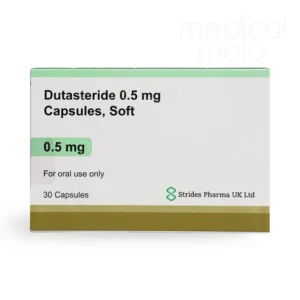 Dutasteride 0.5mg capsulesPrice range: £22.79 through £81.99
Five key takeaways
If you are quickly scanning before deciding whether to read about dutasteride, these are the points to hold onto.
- Dutasteride targets the hormone linked to male pattern hair loss. Its job is to reduce DHT, the signal that gradually shrinks susceptible hair follicles.
- It may work better than finasteride for some men. That is one reason it gets so much attention in hair loss clinics and online pharmacy consultations.
- It is off-label for hair loss in the UK. That means a prescriber can still use it, but they need a clear clinical reason and a proper safety check.
- Oral and topical dutasteride are different options. Oral treatment affects the whole body. Topical treatment is used on the scalp and is often discussed by people trying to limit wider exposure.
- How you get it matters. In the UK, the safest route is a regulated prescriber and pharmacy service with pharmacist or clinician review, rather than buying from an unverified website.
The practical point is simple. Dutasteride is not a casual hair product. It is a prescription medicine that can be appropriate for the right person, especially when standard options have not given enough benefit, but it should be chosen with the same care you would want for any treatment that affects hormones.

What is dutasteride, and why do people use it for hair loss
A common UK hair loss journey goes like this. Someone tries over-the-counter products, sees little change, then starts reading about prescription options and keeps coming across dutasteride.
Dutasteride is a prescription medicine that blocks 5-alpha reductase, the enzyme that changes testosterone into DHT, or dihydrotestosterone. DHT is the hormone most closely linked with male pattern hair loss, also called androgenetic alopecia.
A useful way to picture this is a thermostat turned too high. In people with genetically sensitive scalp follicles, DHT keeps the pressure on those follicles for years. The follicles gradually shrink, and the hairs they produce become finer, shorter, and less visible. Clinicians call this miniaturisation.

Why do people look at dutasteride?
People usually do not ask about dutasteride because they want a stronger hair loss solution. They ask about it because they have learned that male pattern hair loss is primarily a hormonal sensitivity issue in the scalp.
That point matters. If the underlying driver is DHT, a treatment that lowers DHT levels can make more sense than products aimed only at the hair surface.
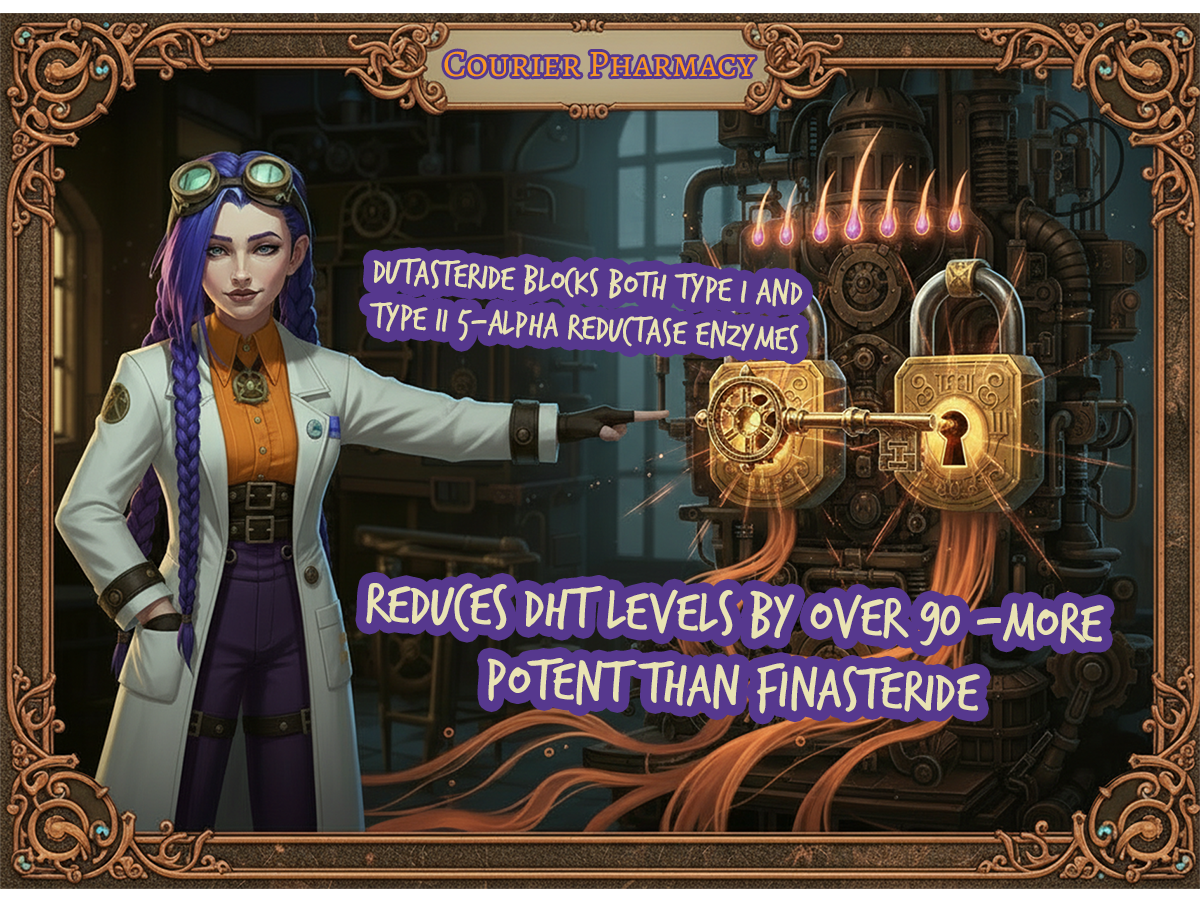
A recent study summary reported that dutasteride, as a dual inhibitor of type I and type II 5?-reductase, reduces scalp DHT by approximately 90%, compared with about 70% for finasteride, based on direct follicle measurements [1].
Dutasteride is a dual DHT receptor blocker; it blocks both type 1 and 2 five alpha reductase enzymes responsible for the conversion of testosterone into DHT. While finasteride blocks only the type 2 five alpha reductase enzyme.
In practical terms, that stronger DHT suppression is why dutasteride gets discussed in hair clinics and pharmacist-led online consultations, especially when someone feels their hair loss is still progressing.

Why does dutasteride attract so much attention in the UK
Dutasteride is better known as a treatment for an enlarged prostate. In the UK, hair loss use is off-label, which means a prescriber may still choose it if it is clinically appropriate, but they need a sound reason and proper safety checks.
That is often the point that confuses patients. Off-label does not mean unlicensed, fake, or unsafe. It means the medicine has a UK licence for one condition, while a prescriber is using their professional judgement to prescribe it for another.
A 24?week study looked at 917 men aged 20–50 with male pattern hair loss, which is mainly driven by the hormone DHT. The men were given either dutasteride (three different doses), finasteride 1 mg, or a placebo (a dummy tablet). By week 24, dutasteride improved hair count and hair thickness more as the dose increased, and the 0.5 mg dose worked better than finasteride and placebo in key measures, including photo ratings of hair growth from the front [2].
For a UK patient, the takeaway is simple. Dutasteride gets attention because it may help some men more than finasteride, but it should be approached as a proper prescription treatment, with clinician review, discussion of side effects, and a safe supply route through a regulated pharmacy service rather than an unverified website.

How does dutasteride hair loss treatment work on the scalp
A useful way to understand dutasteride is to picture the hair follicle as a mini factory. In androgenetic hair loss, DHT keeps sending that factory the wrong instructions, so each cycle produces finer, shorter hair. Dutasteride lowers that signal in the scalp, giving vulnerable follicles a chance to function more normally again.
The aim is to preserve and improve follicles that are still active. Follicles that have been inactive for a long time are less likely to respond, which is why starting treatment earlier often increases the chance of keeping more hair.
The key mechanism in plain English
Each follicle goes through a repeating cycle. It grows a hair, rests, sheds, then starts again. With male pattern hair loss, DHT gradually shortens the growth phase and increases miniaturisation. Over time, thick terminal hairs are replaced by softer, finer hairs that give less coverage.
Dutasteride changes the conditions around those follicles. With less DHT acting on them, some follicles can stay in the growth phase for longer and produce thicker strands. In day-to-day terms, that may mean slower thinning, less scalp showing under bright light, and better density through the crown or mid-scalp.
Many UK patients focus only on regrowth, but pharmacists and prescribers also look for whether hair loss has stopped accelerating. If a treatment slows further miniaturisation, that is often a meaningful result, especially for someone who has noticed steady shedding over the past year.
Why do results take time
Hair responds slowly because the follicle cycle is slow. The medicine can begin lowering DHT before you can see any visible difference, so the early phase often feels uneventful.
A practical way to view the timeline is as a sequence:
| What’s happening in the scalp | What you may notice |
| DHT activity is reduced | No clear change at first |
| Follicles are under less pressure | Ongoing shedding may settle |
| New cycles begin under better conditions | Hair may start to feel stronger |
| Thicker hairs gradually replace finer ones | Coverage can improve over time |
This delay is one reason online prescribing for hair loss in the UK should involve proper follow-ups and counselling, not just a quick checkout page. Patients do better when they know what the medicine can and cannot do, and when to review progress rather than stopping too early.
Why the long half-life matters in practice
Dutasteride stays in the body much longer than finasteride; its half-life, the time taken for the body to eliminate 50%, can be as long as 3-9 days after a single dutasteride 0.5mg dose, compared to 6 hours for finasteride [3], [4]. However, after continuous dosing, the half-life of dutasteride can increase to 3-5 weeks [3].
If you forget a dose, blood levels fall slowly, so a missed dose is usually not a disaster. On the other hand, if you develop a side effect, the medicine can take longer to wash out than a shorter-acting option.
That is part of the UK patient journey with dutasteride. The decision is not only about potency. It is also about whether the person understands the trade-off between being properly screened and getting advice through a regulated prescription route rather than an unverified seller.
Dutasteride vs finasteride
A common real-world UK question is simple: if both medicines target DHT, why would a prescriber choose one over the other?
The short answer is that finasteride and dutasteride work on the same hormone pathway, but dutasteride blocks it more broadly. Finasteride mainly blocks type 2 5-alpha reductase. Dutasteride blocks type 1 and type 2. You can picture that as turning down one tap versus turning down two taps feeding the same sink. Less DHT reaching the follicle can mean better control of ongoing miniaturisation.
Is dutasteride stronger than finasteride for hair loss?
Yes. Dutasteride usually lowers DHT more than finasteride, and studies have shown better hair growth outcomes in some men with androgenetic alopecia.

What does that mean in practice
For a patient, “stronger” does not automatically mean “better for everyone”.
Finasteride is often the more familiar starting point in UK hair loss treatment because prescribers have long experience with it, and some men do well on it. Dutasteride may come into the conversation if hair loss is still progressing, if response to finasteride has plateaued, or if a prescriber feels the likely benefit outweighs the extra considerations around side effects and the longer time it stays in the body.
That practical difference matters. In a regulated online prescribing journey, including services such as Courier Pharmacy, where treatment should follow a clinical review, the decision is usually less about chasing the strongest option and more about choosing the medicine that fits the person in front of you. This ties in with our guiding principle that the treatment should fit you and not the other way round. You should not be shoehorned into a treatment that is not suitable for you.
Quick comparison table
| Feature | Dutasteride | Finasteride |
| Enzyme action | Blocks type 1 and type 2 | Blocks mainly type 2 |
| DHT suppression | Stronger | Less strong |
| Hair growth evidence | Often more effective in comparative studies | Effective for many men |
| UK hair loss use | Off-label | More familiar first-line option |
| Time in the body | Much longer | Much shorter |
How pharmacists often explain the choice
A useful way to frame it is this:
- Finasteride is often the first medicine discussed because it is a more established starting option for male pattern hair loss.
- Dutasteride may be considered when a stronger DHT-lowering effect is wanted, and the patient understands the trade-offs.
- The “best” option depends on the person, not just the medicine. Age, pattern of loss, previous treatment response, medical history, and tolerance of risk all matter.
A man in his late 30s might say, “Finasteride slowed the shedding, but my crown is still getting thinner.” That is the sort of situation where a prescriber may review whether dutasteride is appropriate.
Another patient may want the most potent medical treatment straight away. That can be understandable, especially if thinning feels sudden or distressing. Still, a safe UK prescribing approach is to confirm the diagnosis first, carefully check suitability, and ensure the person knows that dutasteride for hair loss is an off-label choice rather than a routine over-the-counter product.
Dutasteride can offer a stronger effect on DHT. Finasteride remains a reasonable option for many men. The right choice is usually the one that balances likely benefit with safety, follow-up, and how comfortable you are with the plan.
Why is dutasteride off-label in the UK
“Off-label” often sounds riskier than it is. In reality, it means the medicine is being used for a condition that isn’t on the product licence.
It does not mean illegal, fake, or experimental in the everyday sense.
What does off-label mean for dutasteride hair loss treatment?
It means a UK prescriber may legally prescribe dutasteride for hair loss even though the medicine isn’t licensed specifically for that use.
Why that happens
Medicines usually get licensed for specific conditions first. Sometimes, later evidence supports use in other conditions, but the licence doesn’t always catch up.
Dutasteride is licensed for benign prostate enlargement, not hair loss. Even so, hair specialists and some prescribers use it for androgenetic alopecia because the evidence for DHT-driven hair loss is strong.
What matters more than the label
Safe off-label prescribing should include:
- A proper diagnosis so you’re treating male pattern hair loss, not something else
- A discussion of benefits and risks in plain language
- A review of medicines and health history
- A plan for follow-up, especially if you notice side effects or no benefit
Pharmacist’s tip: If a website lets you buy dutasteride with no medical questions at all, treat that as a warning sign. Safe prescribing needs a clinical review.
Oral dutasteride and topical dutasteride
A lot of confusion starts here, because “dutasteride” can mean two quite different treatment routes.
One is a capsule you swallow. The other is a scalp product applied to the thinning areas. The active ingredient is the same, but the journey through the body is different, and that affects both the evidence base and the safety conversation.
Oral dutasteride
Oral dutasteride is the form most prescribers mean unless they say otherwise. After you swallow the capsule, the medicine is absorbed into the bloodstream and lowers DHT throughout the body, including in the scalp.
That whole-body effect is part of why oral dutasteride has the clearer clinical track record in hair loss practice. It is also why UK prescribers usually spend more time checking suitability, discussing side effects, and explaining the off-label nature of treatment before issuing a prescription.
Topical dutasteride
Topical dutasteride is designed to place the medicine onto the scalp rather than send as much of it around the body. It works a bit like watering the plant at the roots instead of spraying the whole garden. The aim is local action where follicles are sensitive to DHT.
Studies suggest topical dutasteride may reduce scalp DHT while causing a smaller drop in blood DHT than oral treatment [5]. That sounds appealing, especially for patients who are cautious about systemic exposure, but it comes with a catch. Topical dutasteride is less standardised, and products can differ in strength, base, and absorption.
Which is better, oral or topical dutasteride?
The practical answer depends on what matters most to you.
If someone wants the option with the better-established evidence and is comfortable discussing whole-body exposure, oral dutasteride is usually the reference point. If someone is more focused on minimising systemic absorption, topical dutasteride may be worth asking about, but only if the prescriber is confident in the formulation and follow-up plan.
| Form | Main appeal | Main drawback |
| Oral dutasteride | Better established evidence and predictable dosing | More systemic exposure |
| Topical dutasteride | Scalp-focused approach | Less standardised, often made by specialist compounders |
Pharmacist’s tip: In the UK, topical dutasteride is often a compounded product rather than a widely standardised licensed medicine. Ask three simple questions before starting. What strength is it? How often do I apply it? How will we review whether it is working and whether I am absorbing too much systemically?

About the Gro hair loss range
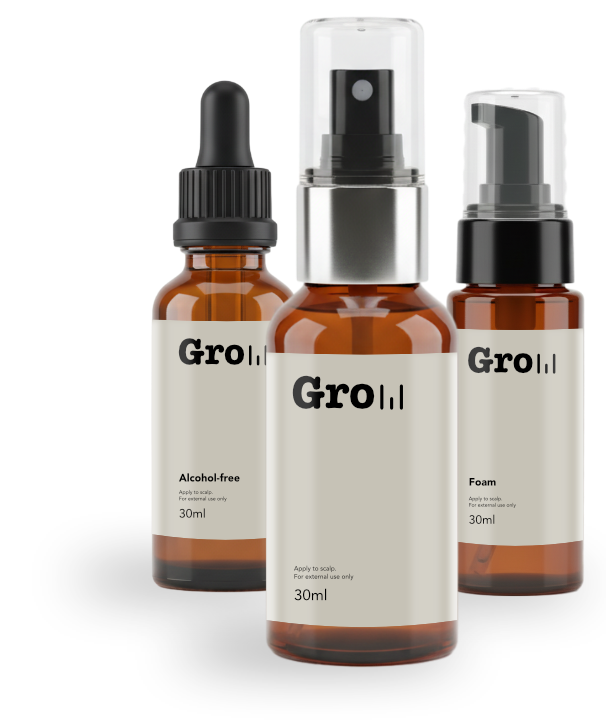
Gro is the compounded hair loss range from Courier Pharmacy. It exists because pattern hair loss is rarely identical from one person to the next, and the right combination of ingredients, concentration, and vehicle for one patient is often wrong for another.
Every Gro product comes in a 30ml bottle designed to last one month, at £29.99 for up to three active ingredients. That’s less than £1 a day for a personalised compounded treatment.
The range is built around three things:
- Choice of formulation: traditional topical liquid (alcohol and propylene glycol base), lighter foam, or Trichosol (propylene glycol-free and alcohol free) for sensitive or reactive scalps
- Personalisation: single, dual, and triple-ingredient combinations across multiple concentrations
- Better tolerability: every format is designed to remove the friction that stops people from sticking to their routine
Available active ingredients include dutasteride, finasteride, minoxidil, and tretinoin, prescribed alone or in combination depending on your clinical profile and, where used, your TrichoTest results. All Gro products are Prescription Only Medicines, supplied after an online consultation reviewed by a UK-qualified prescriber.
Who may be a suitable candidate for dutasteride for hair loss?
You notice more scalp in the mirror under bright bathroom lighting. The corners are creeping back, the crown looks thinner in photos, and finasteride has not done as much as you hoped. That is often the point where dutasteride comes into the conversation in UK pharmacy practice.
A suitable candidate is usually someone with a pattern that fits androgenetic alopecia, also called male pattern hair loss, and who is willing to treat it as a medical decision rather than a quick add-on. Because dutasteride is off-label for hair loss in the UK, the right starting point is a proper prescriber review. That means checking the diagnosis, your medical history, your current medicines, and whether the balance of possible benefit and side effects makes sense for you.
People who may want to discuss it with a prescriber
Dutasteride may be worth discussing if:
- You have clear male pattern hair loss, especially thinning at the temples, hairline, or crown
- Your hair loss is still progressing, rather than having been stable for years
- You had limited benefit from finasteride, or you responded at first and then continued to lose ground
- You understand that use for hair loss is off-label in the UK
- You want to try a medical treatment before considering a hair transplant
In practical terms, dutasteride is often considered when finasteride has not been enough, not because finasteride has “failed” in a dramatic sense, but because the result has been incomplete. It works a bit like using a stronger tap control when the flow of DHT still seems too high for your scalp.

People who need a more careful review
Some patients need a slower, more individual discussion before starting. That includes anyone who:
- has concerns about sexual side effects
- is trying to conceive with a partner and wants specific advice
- takes other medicines that could affect suitability
- has breast symptoms or other unexplained hormonal concerns
- is not clearly showing androgenetic alopecia
This last point matters more than many people realise.
Hair loss can look similar from a distance. Stress shedding, iron deficiency, thyroid problems, scalp inflammation, and traction from tight hairstyles can all be mistaken for male pattern loss. If the diagnosis is wrong, the treatment choice can be wrong too.
The safest route is to confirm what type of hair loss you actually have before starting an off-label medicine.
-
Dutasteride 0.5mg capsulesPrice range: £22.79 through £81.99
A common UK patient scenario
A man in his 30s may order treatment online after noticing extra shedding during a stressful period at work. Stress may be part of the picture, but if the thinning is mainly at the temples and crown, that pattern often points to androgenetic alopecia. A pharmacist prescriber would usually want clear photos, a short medical questionnaire, and sometimes advice to get other causes checked first if the story does not fit neatly.
That step matters with online prescribing as well. A legitimate UK service should not treat dutasteride like a routine retail product. It should look more like a clinical screening process, with follow-up advice and clear safety checks. That is especially important with off-label treatment, where informed consent and good counselling are part of safe care.
In short, the better candidate is not just the person who wants stronger treatment. It is the person with the right pattern of hair loss, realistic expectations, and a prescriber who has checked that dutasteride is a sensible option.
What results can you realistically expect
Set expectations before you start. Dutasteride can improve hair loss treatment outcomes, but the usual goal is to keep the hair you still have and, in some cases, thicken miniaturising hairs. A full return to a much younger hairline is uncommon.
That distinction matters because hair treatment is usually more like slowing a leak than refilling an empty bucket overnight. If shedding settles and your crown looks less see-through over time, that can count as a good response.
Results also tend to show up slowly. Hair grows in cycles, so changes are easier to spot over months than in the mirror each morning. Some men notice less shedding first. Others mainly notice better density on the crown or improved coverage in photos. Stabilisation on its own can still be worthwhile, especially if the main aim is to stop things getting worse.
Earlier research discussed in the article suggests that dutasteride may outperform finasteride for some men, but individual response varies. Your age, how long the thinning has been going on, the area affected, and whether follicles are still active all influence what you may see.
How to judge results
A practical way to judge progress is to make the comparison fair:
- take photos in the same lighting
- use the same angles each time
- compare wet hair with wet hair, or dry with dry
- keep haircut length similar
- leave a few months between photo checks
This is particularly useful in the UK online prescribing journey, where follow-up reviews may rely on your images as well as your own description of change. A pharmacist prescriber can only judge progress properly if the starting point and follow-up photos are comparable.
Pharmacist’s tip: Before starting treatment, take clear photos of the hairline, crown, and top of the scalp in daylight. It sounds basic, but it often makes the difference between guessing and knowing whether the medicine is helping.
Side effects and safety
Safety matters just as much as hair growth. Dutasteride can help some men keep or thicken hair, but it is still a prescription medicine that needs a proper risk check first.
The side effects people usually ask about are sexual ones, such as reduced libido, difficulty getting or keeping an erection, or changes in ejaculation. Earlier in the article, the research summary linked these effects with dutasteride, so the useful question in practice is what that risk means for you as an individual, not whether the medicine is completely free of downsides.
A simple way to view it is this. Dutasteride lowers DHT very effectively, and DHT is the hormone driving male pattern hair loss. Lowering that signal can protect scalp follicles, but hormones do more than one job in the body. That is why benefit and side effects can sit in the same treatment decision.
Some men take dutasteride without any noticeable problems. Others notice side effects early, and for some, the issue is enough to make treatment not worth continuing. That is why a UK prescriber or pharmacist should ask about your medical history, your current medicines, whether you may be trying for a baby with a partner, and how you feel about the possible trade-off before prescribing.
Mild can still matter
A side effect does not need to be dangerous to be important.
For example, a small change in libido may sound minor on paper, but it may affect confidence, relationships, or whether you feel comfortable staying on treatment long term. A pharmacist-led review should make room for that. Safe prescribing is not only about spotting red flags. It is also about checking whether the treatment still fits your life.
Questions that often help are:
- How much is my hair loss affecting me now?
- How concerned am I about sexual side effects?
- Have I had problems with similar medicines before?
- Would I rather discuss a topical option first?
- If side effects happen, would I want to stop straight away or review the dose and plan first?
When you should get medical advice promptly
Get urgent medical help if you develop:
- signs of an allergic reaction, such as swelling, wheezing, or trouble breathing
- a new breast lump or nipple discharge
- severe low mood, suicidal thoughts, or other worrying mental health symptoms
- any symptom that feels sudden, severe, or unsafe
For non-urgent problems, contact your prescriber or pharmacist rather than stopping and restarting on your own. That stop-start pattern often creates more confusion, because it becomes harder to tell whether a symptom is medicine-related, coincidental, or linked to anxiety about treatment.
For UK patients using an online prescribing service, this safety step matters even more. Off-label treatment should still come with clear screening, a way to report side effects, and follow-up if the balance of benefit and risk changes. If the process feels rushed or there is no obvious pharmacist or prescriber review, that is a warning sign.
If a side effect appears, pause and ask for a medication review. A calm, documented review is safer than guessing.
Combining dutasteride with other hair loss treatments
Many treatment plans use dutasteride as one part of the routine, not the whole routine. That makes sense because male pattern hair loss usually has more than one practical problem. One part is the hormone signal driving miniaturisation. Another is keeping follicles in a better growth phase for long enough to see a visible difference.
A prescriber may suggest dutasteride alongside:
- Minoxidil, which supports hair growth through a different mechanism
- Microneedling, which is sometimes used in clinic-led plans with topical treatment
- Topical dutasteride or other scalp treatments, if a more local approach suits the patient better
- Hair transplant planning, where medicine can help protect the non-transplanted hair around the grafts
The simplest way to understand combination treatment is this. Dutasteride helps turn down the signal that is shrinking vulnerable follicles. Minoxidil helps encourage those follicles to stay active. They are doing different jobs, so in some people they can work well together.
Microneedling
Microneedling is more specialised. It is not a DIY add-on for everyone, and it is usually more relevant when a clinician is building a plan around topical treatment. If it is used badly, it can irritate the scalp rather than help. That is one reason pharmacist and prescriber input matters, especially in the UK where dutasteride for hair loss is already an off-label decision.
Hair transplants
Hair transplant planning is another area where combinations come up often. A transplant can move hairs, but it does not stop ongoing loss in the surrounding native hair. Medicines such as dutasteride may be used to help maintain what is still there, so the overall result ages more naturally.
A practical point matters here. The best combination is usually the one you can follow safely for months, not the most complicated one on paper.
Pharmacist’s tip: If you are getting treatment through a UK online prescribing service, ask who is reviewing the full plan, not just approving a single product. Combining treatments can be reasonable, but it should still be suited to your scalp, your medical history, and how much routine you will realistically keep up.
How to get dutasteride safely in the UK
Practical steps matter. The internet makes access easier, but it also makes it easier to buy from sellers who shouldn’t be selling medicines at all.
What a safe route looks like
A safe UK route should include:
- A regulated pharmacy
- A real prescriber reviewing your case
- Questions about your health, medicines, and symptoms
- Clear information about off-label use
- A way to ask follow-up questions
If a provider offers dutasteride after a proper online consultation and prescriber review, that can be a reasonable pathway. For example, Courier Pharmacy is a UK-regulated online pharmacy that offers dutasteride 0.5 mg capsules and a range of dutasteride topical solutions and foam that can be combined with minoxidil 5% and tretinoin. These options are only available after clinical screening, alongside follow-up support where appropriate.
Red flags to avoid
Be cautious if a site:
- sells prescription medicine without a consultation
- hides who prescribes it
- doesn’t show UK pharmacy registration details
- makes dramatic promises about guaranteed regrowth
- offers no safety advice at all
A simple UK checklist
| Check | Why it matters |
| UK pharmacy regulation | Helps confirm legal supply |
| Prescriber review | Reduces unsafe self-treatment |
| Clear product details | Avoids mystery formulations |
| Follow-up process | Helps manage side effects and expectations |
Questions people often ask in pharmacy
A common pharmacy conversation starts like this. Someone has read about dutasteride online, feels hopeful, then gets stuck on the practical questions. How long does it take, can it regrow hair, and is topical treatment the safer option?
How long does dutasteride take to work for hair loss?
Dutasteride works slowly because hair grows in cycles, not all at once. Many men first notice that shedding or thinning seems to settle, while visible thickening usually takes longer.
Can dutasteride regrow hair?
It can improve hair density and thickness in some men with male pattern hair loss. Results differ from person to person, and stabilising further loss is often a good result in its own right.
Is topical dutasteride safer than oral dutasteride?
Topical dutasteride may lead to lower whole-body exposure than oral treatment, but it is not automatically risk-free. It still needs proper prescribing, because strength, absorption, and formulation can differ between products.
Summary
If you are in the UK and considering dutasteride for hair loss, the practical question is usually not just “does it work?” It is “am I a sensible candidate, and how do I get it safely?”
Dutasteride is used because it lowers DHT more strongly than finasteride, which can make it a reasonable option for some men with male pattern hair loss. In UK practice, the key point is that hair loss use is off-label. That does not mean improper or unusual. It means a prescriber needs to make an individual clinical decision, explain the reasoning, and check that the treatment suits you.
DHT is for long term management of hair loss
For many patients, the most useful way to view dutasteride is as a long-term management option rather than a quick fix. Hair follicles behave more like slow-growing plants than a switch you can flick on overnight. A good early outcome may be less shedding or a slower rate of thinning. Visible thickening, if it happens, usually takes longer.
Formulation matters
Choice matters too. Oral dutasteride has the clearest real-world use and tends to have the strongest effect on DHT. Topical dutasteride interests people who want a scalp-first approach, but it still needs proper prescribing because formulations, absorption, and safety checks are not all the same.
Only buy from regulated pharmacies
The right route is a regulated UK prescribing service, with clear screening, follow-up advice, and a pharmacist or prescriber who will answer straightforward questions. Services such as Courier Pharmacy fit into that patient journey when they assess suitability properly and supply treatment through a legal prescription pathway.
The bottom line is simple. Dutasteride can be a useful option for the right person, but the best results come from matching the medicine to the patient, setting realistic expectations, and putting safety first.
Disclaimer: This article is for information only and isn’t a substitute for personal medical advice, diagnosis, or treatment.
FAQs
Is dutasteride good for hair loss?
It can be a useful option for some men with male pattern hair loss, especially if a prescriber thinks stronger DHT reduction may help protect the follicles. In simple terms, it turns down one of the main hormonal signals that makes susceptible follicles shrink over time.
Is dutasteride stronger than finasteride?
Yes. Dutasteride blocks more of the enzyme activity involved in making DHT, so its effect is usually stronger than finasteride’s. That stronger effect is one reason some patients ask about it after reading about slower thinning or better maintenance.
Is dutasteride licensed for hair loss in the UK?
No. In the UK, dutasteride is generally prescribed for hair loss on an off-label basis. For patients, the practical point is that you should only get it through a proper prescribing service where your medical history, current medicines, and hair loss pattern are checked first.
How long does dutasteride stay in the body?
Quite a long time. Dutasteride remains in the body much longer than finasteride, which matters if you develop side effects or need your treatment reviewed, because any change is not as quick to wash out.
Can I use topical dutasteride instead of oral dutasteride?
Sometimes, yes, but it is not a simple swap. Topical treatment appeals to people who want a scalp-focused approach, yet the formula, dose, and absorption can vary between providers, so a UK prescriber still needs to assess whether it is appropriate.
What side effects can dutasteride cause?
The questions pharmacists hear most often are about sexual side effects, such as reduced libido or changes in sexual function. Some people also ask about breast tenderness or mood changes. If side effects happen, the right step is to speak to the prescriber rather than guessing whether to continue.
Can I take dutasteride with minoxidil?
Often, yes. They work in different ways. Dutasteride lowers DHT, while minoxidil helps support the growth phase of the hair cycle, so they are commonly used together when suitable.
What if finasteride didn’t work for me?
That is one of the common reasons dutasteride comes up in consultation. A prescriber may review whether you gave finasteride enough time, whether the diagnosis is definitely androgenetic alopecia, and whether a stronger medicine is a sensible next step.
Is dutasteride suitable for everyone with thinning hair?
No. It is usually considered for androgenetic alopecia, not every type of hair shedding. If the cause is stress-related shedding, low iron, a scalp condition, or another medical issue, treating the trigger usually matters more than blocking DHT.
Byline
Written by: Courier Pharmacy Editorial Team, patient education writers
Clinical review: UK-registered pharmacist, independent prescriber
How this content was created
This article was written using the verified evidence provided, with a focus on UK patient safety, plain-English explanation, and pharmacist-style counselling points. A clinician-reviewed editorial process checked the content for readability, balance, and factual consistency.
References
[3] Electronic Medicines Compendium (eMC) (n.d.) [Summary of Product Characteristics for product 9277]. Available at: https://www.medicines.org.uk/emc/product/9277/smpc (Accessed: 1 May 2026).
[4] Electronic Medicines Compendium (eMC) (n.d.) [Summary of Product Characteristics for product 3493]. Available at: https://www.medicines.org.uk/emc/product/3493/smpc (Accessed: 1 May 2026).