

The DUTCH Test, explained
See not just how much hormone you make — but what your body actually does with it. Because your hormones aren’t one-size-fits-all, and your care shouldn’t be either.

01 · The full picture
A single test that gives you the full picture
One simple sample, collected at home, maps both the hormones you make and how you metabolise them — six windows into your health from a single collection.
Meet Dr Ada Jex Cori
Dr Ada is Courier Pharmacy’s guide to personalised medicine — named for Ada Lovelace, Sophia Jex-Blake and Gerty Cori. She’s here to make complex science make sense, so the testing leads to care that fits you.
Dr Ada is A Fictional Brand Ambassador.

02 · Why it’s useful
A blood test is a snapshot. DUTCH is the whole plumbing diagram
It’s not a slogan we bolt on Standard blood or saliva tests tell you roughly how much of a hormone is circulating right now. Useful — but only half the story. Two people can have an identical oestrogen level for opposite reasons: one makes a little and clears it slowly, the other makes plenty and clears it fast. Same number, very different biology — and very different risks.
The DUTCH test (Dried Urine Test for Comprehensive Hormones) is run on a few drops of dried urine collected on filter paper at set times across a day — no needles, no clinic visit, posted back in an envelope. Because urine carries the breakdown products of your hormones, it shows what blood can’t: the end. It’s the order we do things in, and the things we refuse to skip.
Production and clearance together — how much you make and how efficiently you process it.
The daily cortisol rhythm — four to five points across the day, not one moment.
Oestrogen detoxification pathways — which route your oestrogen takes as it leaves (the heart of this guide).
Androgen metabolism — relevant to acne, hair thinning, PCOS and more.
A full picture for personalised care — perimenopause, menopause, HRT support, fatigue, mood, sleep and cycle issues. — how much you make and how efficiently you process it.
The one-line version
Blood tells you the water level. DUTCH shows you the taps and the drain — and that’s what lets us build treatment around you.
03 · The bathtub metaphor
Think of your hormones as water in a bath
Dr Ada explains
This is the simplest way to picture what the test shows. Stay with me — once you see the bath, the whole report makes sense.
The taps are production. Your ovaries or testes and your adrenal glands pour hormones in. Turn the taps up, more flows in.
The daily cortisol rhythm — four The water is what’s circulating. The level in the tub is the active hormone in your body — roughly what blood or saliva measures.
The drain is metabolism and clearance. Your liver, gut and kidneys break hormones down and carry them out. A wide drain clears fast; a narrow one clears slowly.
The plug is a blockage in that drain. If metabolism is sluggish, the water backs up — hormones accumulate even when the taps are set perfectly normally.
Here’s why measuring only the water level misleads: a “normal” level can hide two opposite situations — low taps with a blocked drain, or high taps with a wide-open drain. To know what’s really happening, and what to do about it, you need to see the taps and the drain. That’s exactly what DUTCH adds.
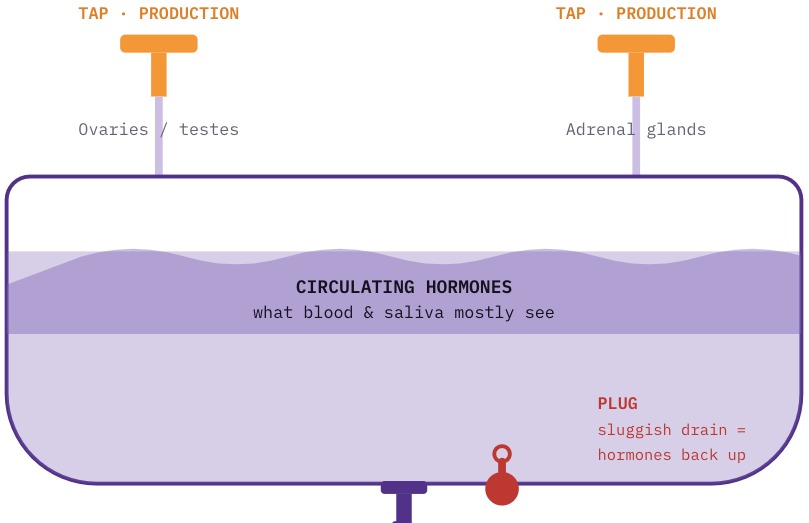
Fig 1 — Taps in, water level, drain out. DUTCH measures all three; blood measures mostly the level.
04 · The three drains for oestrogen
Your oestrogen leaves down one of three channels — and they’re not equal
When the body breaks oestrogen down (the first step of the “drain”), it sends it along one of three routes, named for where the chemistry happens on the molecule: 2-OH, 4-OH and 16-OH. DUTCH shows the proportion going down each. Picture the single drain splitting into three pipes:
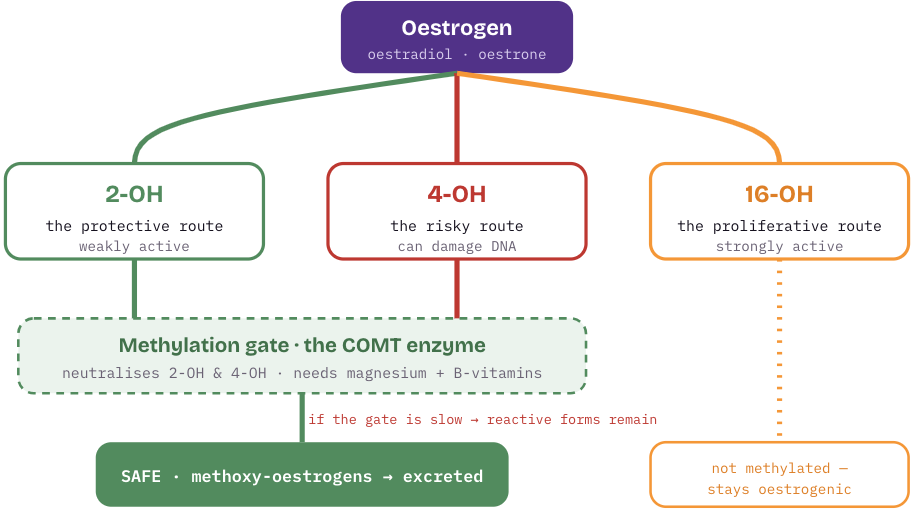
Fig 2 — One source, three pipes, one safety gate. The balance between them is what DUTCH reveals.
~70%
2-OH — protective
Weakly oestrogenic and generally the preferred route. You want a good share heading here.
low
4-OH — keep small
Can form reactive by-products that damage DNA if not quickly neutralised. Lower is better.
moderate
16-OH — keep in check
A strong, growth-promoting oestrogen. Fine in small amounts; too much drives proliferation.
DUTCH also shows the methylation gate (the COMT enzyme). Even if some oestrogen goes down the 4-OH pipe, efficient methylation converts it into harmless “methoxy” forms that are easily excreted. A fast gate makes 4-OH far less of a concern; a slow gate is where the risk lives.
05 · Why 4-OH and 16-OH matter
The danger isn’t oestrogen itself — it’s where too much of it ends up going
4-OH — keep small
If 4-OH oestrogens aren’t promptly methylated and neutralised, they can form reactive “quinone” molecules that bind directly to DNA and cause damage (DNA adducts). Over time this is associated with an increased risk of oestrogen-related cancers such as breast cancer. The take-home: a lot of oestrogen down the 4-OH pipe with a slow methylation gate is the combination worth catching early.
16-OH — the proliferative route
16-OH oestrogen is a potent, growth-promoting hormone. A high share means a stronger overall oestrogenic “push” on tissues that respond to oestrogen — relevant not only to cancer risk in some research but to fibroids, endometriosis and heavy or painful periods. The protective-versus-proliferative balance is often summarised as the 2:16 ratio.
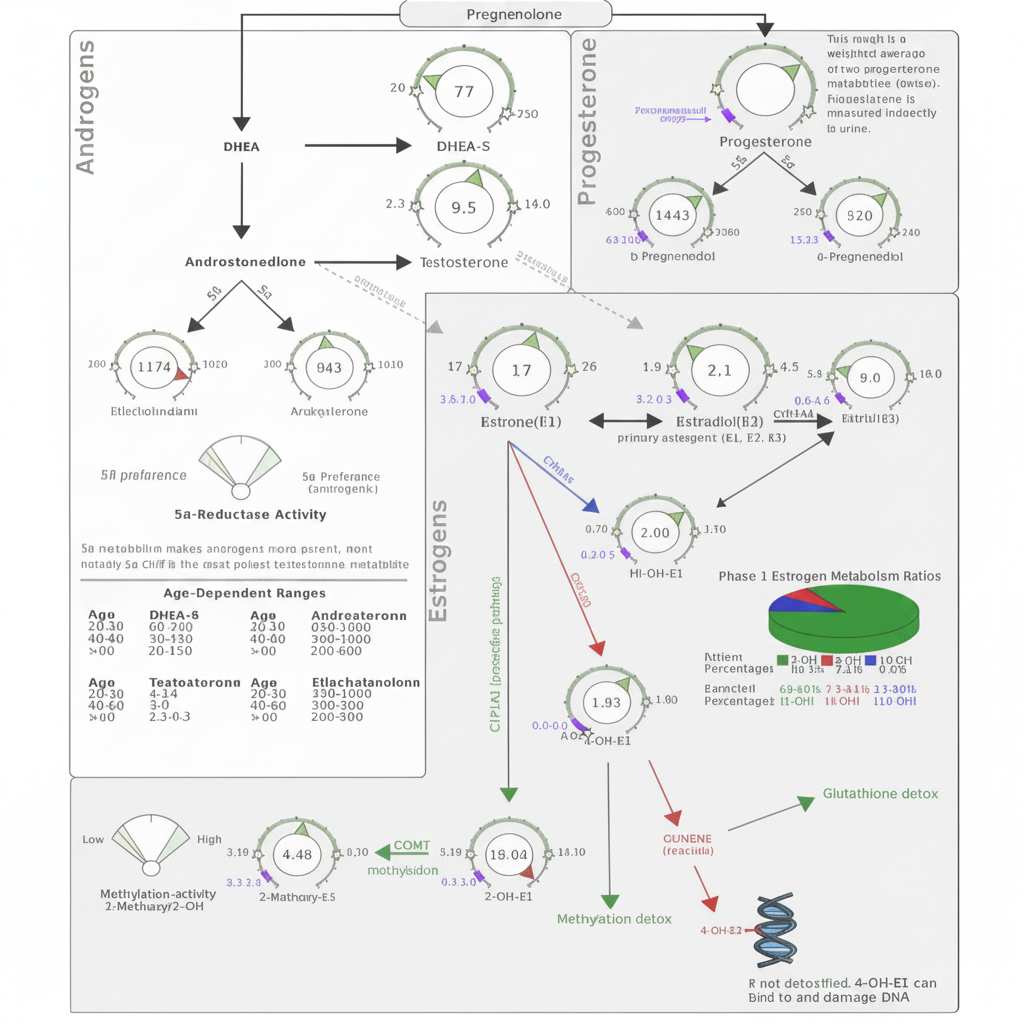
Fig 3 From a real DUTCH report — the full hormone metabolism map. Follow the red 4-OH pathway to the note: “if not detoxified, 4-OH-E1 can bind to and damage DNA.” This is the pathway the bathtub’s drain is all about.
An honest word on the science
The chemistry of these pathways is well established. How strongly any single ratio predicts disease in one person is still an area of active research, so these markers are best read as one informative input alongside your history, symptoms and other tests — not a diagnosis on their own. That’s exactly why we review DUTCH results with you.
06 · What a real report looks like
Reading the dials
DUTCH reports show each marker as a circular dial: a coloured ring with your value in the centre and the reference range around it. The principle is simple — where the marker lands tells you the pattern at a glance.

How to read it: the ring runs from low on the left, through the optimal zone, to high on the right. The number in the middle is your result; the marker shows where you sit.
Dozens of these dials make up the report pages below — one for every hormone and metabolite measured.
Here are real sample pages so you know what to expect (fictional sample patients, for illustration):
Hormone testing summary
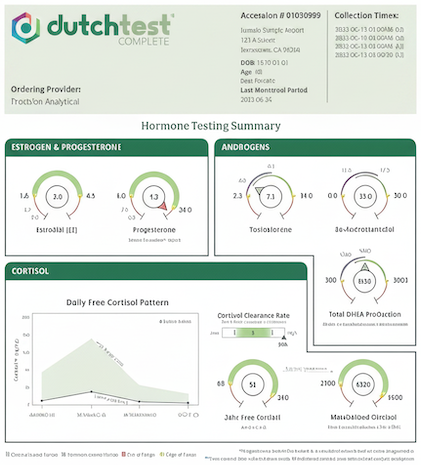
The one-page overview: oestrogen & progesterone production, androgens, and the daily cortisol pattern, all on a single sheet.
Parent hormones & metabolism
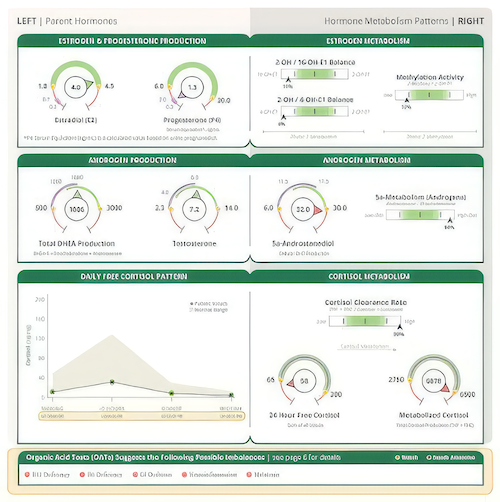
Production on the left, metabolism on the right — including the 2-OH / 4-OH / 16-OH balance and methylation activity.
Cortisol with CAR

The daily free-cortisol curve plus the cortisol awakening response (CAR) — the morning spike that should follow waking.
Adrenal cascade

How stress travels from brain to adrenal gland to make DHEA and cortisol — and how that cortisol is then cleared.
And the same oestrogen-metabolism idea, simplified, the way we’d talk it through with you:
58%
2-OH route
Protective share — a touch below the preferred zone.
14%
4-OH route
Elevated, and methylation is slow — flagged for attention.
28%
16-OH route
Slightly high; adds to overall oestrogenic load.
07 · Turning results into action
The point is to act early — while everything is still changeable
The real value of seeing the drain, not just the water level, is that almost everything it reveals is modifiable. If too much oestrogen heads down the 4-OH or 16-OH pipes, or the methylation gate is slow, there are specific steps to take — then you re-test to confirm they worked. Typical levers:
Shift toward 2-OH: cruciferous vegetables and compounds like DIM / I3C nudge oestrogen toward the protective route.
Speed up the methylation gate: magnesium, B6, B12 and folate support COMT; moderating alcohol preserves methyl groups.
Neutralise reactive forms: glutathione support (e.g. NAC, sulforaphane) and good sleep help mop up 4-OH by-products.
Open the exit: fibre, a healthy gut and avoiding constipation ensure oestrogen actually leaves the body rather than recirculating.
Lower the load: reducing alcohol and everyday “xenoestrogen” exposures eases the whole system.
Mind the taps: body composition and exercise influence how much oestrogen is made in the first place.
Treatment that fits you
Proactive, personalised — not one-size-fits-all
This is the shift the test makes possible: instead of waiting for a problem to declare itself, we find an unfavourable pattern early and steer it back — with food, lifestyle, targeted support and, where it helps, compounded treatment tailored to your needs and sensitivities — then re-test to prove the change. Always reviewed with a UK-regulated pharmacist or prescriber.
08 · Hormones never act alone
One bath, but the plumbing connects every room in the house
No hormone should be read in isolation — they’re in constant conversation, a phenomenon often called cross-talk. A single out-of-range marker is frequently a downstream symptom of something elsewhere. A few of the most important conversations:
The shared production line. Cortisol and your sex hormones are built from the same raw materials. Under chronic stress the body prioritises cortisol, leaving less for progesterone and other sex hormones — so a “low progesterone” result may really be a stress story.
Oestrogen and progesterone as a pair. It’s the balance between them that drives how you feel, far more than either number alone.
Androgens become oestrogens. An enzyme called aromatase converts androgens into oestrogen — more body fat means more conversion, linking weight, androgens and oestrogen.
Blood sugar pulls the strings. Insulin influences how much free testosterone is available — central to PCOS — tying metabolism to your hormone picture.
Cortisol touches everything. The daily cortisol rhythm interacts with thyroid function, sleep and sex hormones alike.
This is why a comprehensive panel matters. Reading oestrogen, progesterone, androgens, their metabolites and the cortisol rhythm together tells a coherent story — where spot-checks of single hormones can send you chasing the wrong number.
In one sentence
Your hormones aren’t separate baths — they’re one connected system of pipes. DUTCH was built to read the whole network at once, so your care can fit the whole you.
Ready when you are
Healthcare built around you, not the other way round
If you’d like to understand your hormones properly — and get treatment that actually fits — our team can talk you through whether DUTCH is right for you and review every result with you.
Free fortnightly drop-in talks — join Dr Ada and the Courier Pharmacy team at Insomnia, Derby, every fortnight, 12–1pm. Open discussion on long-term conditions and personalised care. No pressure, no cost — just real support.
Important
This guide is for general education and is not medical advice, diagnosis or treatment. The sample report pages shown are illustrative examples with fictional sample data and don’t represent any real patient. Hormone results should always be interpreted by a qualified, UK-regulated healthcare professional in the context of your full history, symptoms and other investigations. Don’t start, stop or change any medication, supplement or HRT on the basis of this material. Dr Ada Jex Cori is a fictional brand ambassador representing Courier Pharmacy’s values. “DUTCH” and “Dried Urine Test for Comprehensive Hormones”, and the sample report pages, are products of Precision Analytical, Inc., reproduced here for patient education.

