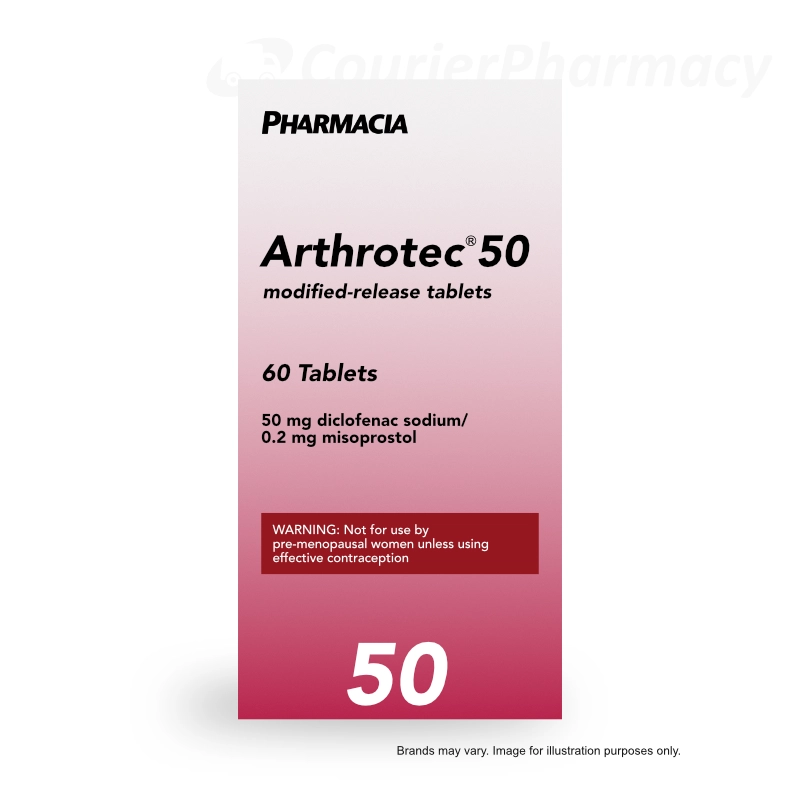
A modified-release combination tablet containing lower-dose diclofenac and misoprostol, used for inflammatory joint conditions in patients at risk of NSAID-induced stomach ulcers.
Arthrotec 50 is prescribed at Courier Pharmacy after a careful online consultation reviewed by a UK clinician, then dispensed and delivered discreetly.
Arthrotec 50 tablets are a prescription combination medicine for adults who need NSAID treatment for chronic joint inflammation, but who also have a higher risk of stomach ulcers or GI bleeding. It combines an anti-inflammatory medicine with a stomach-protecting medicine in one tablet. So, it can be a sensible option when standard NSAIDs cause problems.
Each tablet contains diclofenac sodium 50mg (for pain and inflammation) and misoprostol 200 micrograms (to help protect the stomach). Packs often contain 60 tablets. Depending on your dose, that can cover around 20 days (if taken three times daily) or around 30 days (if taken twice daily).
Arthrotec 50 releases its two ingredients in different places. Diclofenac sits in a gastro-resistant core, which passes through the stomach and releases the medicine in the small intestine. Misoprostol sits in an outer layer and releases in the stomach. As a result, misoprostol can start protecting the stomach lining straight away.
Misoprostol helps by increasing mucus and bicarbonate production and supporting blood flow to the stomach lining. In other words, it helps reduce the ulcer risk that NSAIDs can cause in some people.
Arthrotec 50 differs from Arthrotec 75 mainly in dose flexibility. Because each tablet contains 50mg diclofenac, your prescriber can split the daily dose into two or three doses. This can help in two common situations. First, it suits people who don’t need the full 150mg daily dose that Arthrotec 75 can deliver.
Second, it can help if the twice-daily 75mg pattern causes more misoprostol-related diarrhoea than smaller doses spread through the day. However, your prescriber will decide the safest dosing plan for you.
At Courier Pharmacy, a UK-registered prescriber reviews every Arthrotec 50 prescription before we dispense it. We take extra care because Arthrotec has a strict pregnancy contraindication.
For that reason, we will ask about contraception, pregnancy plans, your GI and cardiovascular history, and what you’ve tried already. The medicine can be very useful for the right patient. So, getting that “right patient” check right really matters.
Features and specifications
Active ingredients: Diclofenac sodium 50mg + Misoprostol 200 micrograms
Form: Modified-release tablet (gastro-resistant diclofenac core with misoprostol outer layer)
Pack size: 60 tablets (typical 20–30 day supply, depending on dosing)
Class: NSAID combined with a prostaglandin E1 analogue
Prescription status: Prescription Only Medicine (POM)
Typical use: One tablet two or three times daily, with food (as directed)
Storage: Store below 25°C in the original packaging; protect from moisture
Additional information
Quantity
1 x 60, 2 x 60
MOJO WISDOM
Take control of your health by understanding your condition and what this medication is doing for you.
READ:
More information about this treatment.
UK-based doctors and pharmacists
Discreet and Confidential
UK-based doctors and pharmacists
Free, Expert Advice
No video link provided.
No video link provided.
UK-based doctors and pharmacists
Free, expert advice
Discrete and confidential
Fast delivery
Giving you trusted clinical advice for over 40 conditions
A UK regulated pharmacy providing safe, effective treatments online since 2014
Joint pain that needs ongoing anti-inflammatory treatment, but a stomach that’s already paid the price of too many NSAIDs. Arthrotec 50 is designed for this exact situation: a lower-dose NSAID paired with a built-in stomach-protecting ingredient, taken across two or three doses a day to keep effect steady. At Courier Pharmacy we want you to understand exactly how Arthrotec 50 works, who it suits, the strict pregnancy warnings around it, and why it’s often a smarter starting point than the higher-strength version.
Five key takeaways
Arthrotec 50 tablets combine diclofenac 50mg (a non-steroidal anti-inflammatory drug) with misoprostol 200 micrograms (a prostaglandin that protects the stomach lining).
They’re used for the long-term symptomatic treatment of osteoarthritis, rheumatoid arthritis, and ankylosing spondylitis in patients who need NSAID therapy but are at increased risk of stomach ulcers or bleeding.
Arthrotec 50 is the lower-strength option compared to Arthrotec 75, allowing more flexible dose titration (typically two or three times daily) and a gentler start for new users or older patients.
It is strictly contraindicated in pregnancy. Misoprostol can cause miscarriage, premature birth, birth defects, and uterine rupture, so reliable contraception is essential.
Like all NSAID-containing medicines, Arthrotec 50 carries cardiovascular, GI, and kidney risks; the lowest effective dose for the shortest possible time is the rule.
Treatment dosage Arthrotec 50 tablets
The standard adult dose for osteoarthritis is one Arthrotec 50 tablet taken two times daily, with food. For rheumatoid arthritis and ankylosing spondylitis, the dose is usually one tablet three times daily, with food. The maximum daily dose is 150mg of diclofenac and 600 micrograms of misoprostol (three Arthrotec 50 tablets daily). Doses should be taken with breakfast, lunch, and the evening meal where the three-times-daily schedule applies; for twice-daily dosing, breakfast and evening meal work best.
Swallow each tablet whole with a glass of water. Don’t chew, crush, split, or dissolve the tablets, as this disrupts the two-layer release mechanism that makes the medicine work.
The flexibility of Arthrotec 50 dosing is one of its practical advantages. If 100mg of diclofenac daily (two tablets) is adequate, that’s a meaningfully lower NSAID exposure than the 150mg per day from Arthrotec 75. If three doses a day across breakfast, lunch, and dinner are better tolerated than two larger ones, the misoprostol-related diarrhoea can sometimes settle. Your prescriber will work with you on the right pattern.
Taking the tablet with food does two things: it reduces stomach irritation and helps slow misoprostol absorption, which can ease the diarrhoea and cramping that some people experience. Antacids containing magnesium can worsen misoprostol-related diarrhoea, so if you need antacid relief, choose an aluminium-only or non-magnesium-containing product, or speak to your pharmacist.
If you miss a dose and remember within a few hours, take it with food. If your next dose is due soon, skip the missed one. Never double up. In older adults (over 65), the lowest effective dose for the shortest possible duration is particularly important because of higher risk of GI bleeding, kidney problems, and cardiovascular events. In severe liver or kidney impairment, Arthrotec is generally avoided.
Overview of Arthrotec 50 tablets
Five things worth knowing:
Arthrotec 50 is the lower-strength member of the Arthrotec family, with 50mg of diclofenac per tablet (compared to 75mg in Arthrotec 75) and the same 200 micrograms of misoprostol.
The lower diclofenac dose per tablet allows two or three times daily dosing, giving more flexibility for matching the dose to symptom severity.
It is strictly contraindicated in pregnancy. Misoprostol can cause miscarriage, premature birth, birth defects, and uterine rupture.
The misoprostol component commonly causes diarrhoea, abdominal cramps, and wind, especially in the first few weeks; symptoms often settle but can be a reason to adjust the dose or stop.
It’s most useful for patients who need ongoing NSAID therapy and have either had a stomach ulcer before or are at high risk of one (older age, history of GI bleeding, taking aspirin or steroids).
Arthrotec 50 occupies a slightly different clinical niche from Arthrotec 75. The higher strength is often used during active flares where stronger anti-inflammatory effect is needed, or where the once-twice-daily pattern is simply more practical for the patient. The lower strength is often used as a starting dose for new patients, as a step-down from Arthrotec 75 once initial inflammation has settled, or as the preferred option in older patients or anyone who’s been more sensitive to NSAID side effects in the past.
For people living with chronic inflammatory pain alongside other complex conditions, fibromyalgia, autoimmune issues, MCAS, persistent musculoskeletal pain, finding a sustainable anti-inflammatory regimen often involves a lot of trial and error. Arthrotec 50 isn’t typically a first-choice medicine. It’s a considered choice when previous NSAIDs have caused stomach problems, or where the risk of ulcer is high enough to warrant built-in protection from day one. Many prescribers prefer to start at the lower strength precisely so they can titrate up to the higher strength only if needed, rather than starting high and stepping down.
The pregnancy contraindication remains non-negotiable at this strength, just as it is for Arthrotec 75. The misoprostol dose is the same 200 micrograms per tablet, and at three tablets daily, the daily misoprostol exposure of 600 micrograms is identical to twice-daily Arthrotec 75 (2 x 200 = 400 mcg) is actually lower; at twice-daily Arthrotec 50, daily misoprostol exposure (400 mcg) matches twice-daily Arthrotec 75 (400 mcg). Either way, the medicine is contraindicated in anyone who is or could become pregnant. Reliable contraception is essential.
The diclofenac component carries the cardiovascular risk profile that comes with all NSAIDs, and the evidence on diclofenac specifically suggests it may carry slightly higher cardiovascular risk than alternatives like naproxen. This doesn’t make Arthrotec 50 a bad choice; it makes it a choice that should be deliberate rather than default, and reviewed regularly rather than left on autopilot.
For people who don’t have significant GI risk factors, simpler NSAID combinations (an NSAID plus a separate PPI) may be more appropriate. For people who do, Arthrotec 50 offers the convenience and reliability of a combined formulation in one tablet, at a flexible dose that can be matched to symptom severity.
Why choose Courier Pharmacy for Arthrotec 50 tablets
Arthrotec 50 is one of the medicines where careful prescribing genuinely matters. The pregnancy contraindication, the GI risk-versus-benefit calculation, the cardiovascular considerations, the dose-pattern decision: none of this is paint-by-numbers. At Courier Pharmacy, every Arthrotec 50 prescription is reviewed by a UK-registered prescriber who reads your answers properly, asks the questions that need asking, and explains the decision either way.
For anyone of childbearing potential, we’ll talk through contraception options and the strict requirements for safe use. We’ll also flag whether a different approach might suit you better, perhaps a separate NSAID-and-PPI combination, a non-NSAID approach entirely, or stepping up to Arthrotec 75 if symptoms aren’t controlled. For older patients or those with cardiovascular risk, we’ll have an honest conversation about the trade-offs.
Our brand guide, Dr Ada Jex-Cori, sums it up: you’re not broken. The system that’s failed you might be. We want to do the part we can do, properly, and connect you with the rest. That includes our free fortnightly drop-in clinics and talks at Insomnia in Derby, where you can ask questions face-to-face without spending a penny.
Buy Arthrotec 50 tablets (Prescription Only) from Courier Pharmacy
Arthrotec 50 tablets are a Prescription Only Medicine (POM) in the UK, which means they cannot be sold over the counter. Buying through Courier Pharmacy is straightforward and built around your time, not ours.
Here’s how it works:
Complete a quick online consultation
A UK prescriber reviews your answers
If approved, a prescription is issued
We dispense and deliver discreetly to your door
If it isn’t suitable for you, we’ll explain why and suggest the next best option.
Active ingredients in Arthrotec 50 tablets
Arthrotec 50 contains two active ingredients working together. The first is diclofenac sodium, a non-steroidal anti-inflammatory drug from the phenylacetic acid family. Diclofenac is one of the most widely used NSAIDs globally, valued for its strong anti-inflammatory and analgesic effects in arthritis and other inflammatory conditions. In Arthrotec 50, the diclofenac is enclosed in a gastro-resistant core that delays release until the medicine reaches the small intestine.
The second active ingredient is misoprostol, a synthetic prostaglandin E1 analogue. Prostaglandin E1 occurs naturally in the body and plays a role in protecting the stomach lining: it stimulates mucus and bicarbonate production, improves mucosal blood flow, and reduces acid secretion modestly. NSAIDs work in part by blocking prostaglandin production, which is also why they cause stomach ulcers. Adding misoprostol back replaces the protective prostaglandin that diclofenac would otherwise suppress.
Inactive ingredients vary by manufacturer but typically include lactose monohydrate, povidone, microcrystalline cellulose, sodium hydroxide, magnesium stearate, talc, hypromellose, and other coating polymers. The lactose content matters for some patients with rare hereditary problems of galactose intolerance, lactase deficiency, or glucose-galactose malabsorption. The formulation as a whole is complex enough that brand consistency may be helpful for people with multiple sensitivities.
What is Arthrotec 50 tablets for?
Arthrotec 50 is licensed in the UK for the symptomatic treatment of osteoarthritis, rheumatoid arthritis, and ankylosing spondylitis in patients who need NSAID therapy and who are at increased risk of developing NSAID-induced gastric or duodenal ulcers. It is not a first-line treatment for arthritis in general; it’s a considered choice when stomach protection is part of the equation from the outset.
Osteoarthritis is the wear-and-tear arthritis affecting joints over time, with knees, hips, hands, and spine most commonly involved. Rheumatoid arthritis is the autoimmune inflammatory condition that affects multiple joints and often other body systems. Ankylosing spondylitis is the inflammatory condition affecting the spine and sacroiliac joints. In all three, NSAIDs provide symptomatic relief; Arthrotec 50 adds the built-in stomach-protective component for patients at higher GI risk, at a flexible lower dose suited to ongoing maintenance use.
The patient profile where Arthrotec 50 earns its place includes: people over 65 needing NSAIDs; people with a history of peptic ulcer or GI bleeding; people who require concurrent low-dose aspirin (which adds GI risk to any NSAID); people on corticosteroids where GI bleeding risk is elevated; and people stepping down from a higher NSAID dose after initial flare control. For these patients, Arthrotec 50 can offer real benefit over an unprotected NSAID, while still being lower-dose than the alternative Arthrotec 75. For lower-risk patients without these features, simpler approaches are often preferable.
How does Arthrotec 50 tablets work?
The diclofenac component works in the same way as other NSAIDs. Pain and inflammation involve a family of enzymes called cyclooxygenases (COX-1 and COX-2). These enzymes produce prostaglandins that drive pain, swelling, and fever (mostly via COX-2) as well as protect the stomach lining and support kidney function (mostly via COX-1). Diclofenac blocks both COX-1 and COX-2, reducing inflammation but also reducing the stomach’s natural protective prostaglandins, which is why NSAIDs cause ulcers.
The misoprostol component addresses this directly. As a synthetic prostaglandin E1 analogue, misoprostol replaces the protective prostaglandins that diclofenac suppresses. In the stomach, misoprostol stimulates mucus production, increases bicarbonate secretion, improves blood flow to the stomach lining, and modestly reduces acid secretion. Together, these effects significantly reduce the risk of NSAID-induced ulcers.
The two-layer tablet design is essential to this working properly. Misoprostol is in the outer mantle, where it’s released quickly in the stomach to provide protection at the same time diclofenac is starting to circulate. Diclofenac is in the gastro-resistant inner core, which protects it from stomach acid and ensures it’s released in the small intestine for systemic absorption. Crushing or splitting the tablet destroys this design and undermines both components.
Misoprostol also causes the uterus to contract by acting on uterine prostaglandin receptors. This is why it’s contraindicated in pregnancy. In a non-pregnant person, this effect can cause cramping and is not harmful. In a pregnant person, it causes uterine contractions that can lead to miscarriage, premature labour, or uterine rupture.
For pain and inflammation, you’ll usually notice some effect within a few hours of the first dose. Full anti-inflammatory effect builds over a few days of regular use, particularly important for chronic inflammatory conditions. The stomach-protective effect of misoprostol is immediate from the first dose.
How to use Arthrotec 50 tablets
Take one Arthrotec 50 tablet two or three times daily, with food. The typical patterns are: one tablet with breakfast and one with the evening meal (twice-daily, often used for osteoarthritis), or one tablet with each of three main meals (three-times-daily, often used for rheumatoid arthritis and ankylosing spondylitis). Your prescriber will recommend the pattern that suits your condition and symptom severity.
Swallow each tablet whole with a glass of water. Don’t chew, crush, split, or dissolve the tablets, as this disrupts the two-layer release mechanism. Some patients ask whether the tablet can be broken for easier swallowing; the answer is no, because doing so means the misoprostol is no longer separated from the gastro-resistant diclofenac coating, and both ingredients are likely to behave unpredictably.
Taking the tablet with food does two things: it reduces stomach irritation and helps slow misoprostol absorption, which can ease the diarrhoea and cramping that some people experience. If you find diarrhoea is significantly worse than you can tolerate at the standard dose, talk to your prescriber rather than just stopping. Sometimes adjusting from twice-daily to three-times-daily (or vice versa) helps, and sometimes switching to Arthrotec 75 (with its higher diclofenac dose but otherwise identical formulation) gives different tolerability.
Antacids containing magnesium can worsen misoprostol-related diarrhoea, so if you need antacid relief, choose an aluminium-only or non-magnesium-containing product, or speak to your pharmacist. If you miss a dose and remember within a few hours, take it with food. If your next dose is due soon, skip the missed one. Never double up.
For long-term users, regular review is essential to confirm continued need and check for cardiovascular, kidney, and GI issues. If side effects like persistent diarrhoea, severe cramping, or any signs of GI bleeding (vomiting blood, black tarry stools) develop, stop taking Arthrotec 50 and contact your prescriber.
Warnings and precautions for Arthrotec 50 tablets
Arthrotec 50 is contraindicated in pregnancy. This is the most important warning attached to this medicine and applies absolutely. Misoprostol causes uterine contractions and can cause miscarriage, premature birth, birth defects, and uterine rupture. Anyone of childbearing potential who is prescribed Arthrotec 50 must use reliable contraception throughout treatment and for at least one menstrual cycle after stopping. A negative pregnancy test before starting is recommended, and treatment should usually only begin on the second or third day of a normal menstrual period.
Other absolute contraindications include active peptic ulcer disease or GI bleeding, severe heart failure, severe liver impairment, severe kidney impairment, known hypersensitivity to diclofenac, misoprostol, other NSAIDs, or any excipient, history of asthma or urticaria triggered by aspirin or NSAIDs, and the perioperative period of coronary artery bypass surgery.
Cardiovascular risk applies. The diclofenac component is associated with a small but real increase in cardiovascular events including heart attack and stroke, particularly at higher doses and with longer-term use. Some evidence suggests diclofenac may carry slightly higher cardiovascular risk than some other NSAIDs. People with established cardiovascular disease, uncontrolled hypertension, or significant risk factors should only use Arthrotec 50 after careful clinical consideration. The lower diclofenac dose of Arthrotec 50 compared to Arthrotec 75 may translate to slightly lower cardiovascular risk at the same time, but the risk doesn’t disappear at the lower strength.
Kidney function should be considered. NSAIDs reduce kidney blood flow and can precipitate acute kidney injury. Older adults, people with existing kidney disease, heart failure, dehydration, or those on ACE inhibitors, ARBs, or diuretics are at higher risk. Regular monitoring may be advised for long-term users.
Hepatic effects can occur with diclofenac. Liver enzyme elevations are common and usually mild, but rare cases of severe hepatic reactions including hepatitis and liver failure have been reported. Anyone developing symptoms of liver problems (jaundice, dark urine, unexplained tiredness, right-sided abdominal pain) should stop the medicine and seek medical advice. Periodic liver function monitoring may be advised for long-term users.
The dose flexibility of Arthrotec 50 has a practical safety implication. Patients should not exceed the maximum daily dose of three tablets, and combining Arthrotec 50 with Arthrotec 75 or any other NSAID is not appropriate. Some patients try to titrate their own dose; this should always be done under prescriber supervision rather than independently.
Side effects of Arthrotec 50 tablets
The most common side effects of Arthrotec 50 relate to the misoprostol component. Diarrhoea is reported by up to 1 in 4 people, especially in the first few weeks of treatment. Abdominal cramps, wind, and nausea are also common, affecting more than 1 in 100 people. Taking the tablet with food often helps these settle, and many people find symptoms improve after a few weeks. If diarrhoea is persistent or severe, the three-times-daily dosing pattern (with smaller misoprostol exposure per dose, though similar daily total) sometimes helps; switching to Arthrotec 75 (which has the same misoprostol dose per tablet but is taken less often) sometimes does the opposite. Your prescriber can guide which adjustment makes sense for you.
Other common side effects, more than 1 in 100 people, include headache, dizziness, indigestion, constipation (less commonly than diarrhoea), stomach pain, fluid retention, raised blood pressure, and rash. Sleep disturbance and mood changes are also reported.
Uncommon side effects, between 1 in 100 and 1 in 1,000 people, include drowsiness, palpitations, peripheral oedema, gastritis, vomiting, oesophagitis, mouth ulcers, increased liver enzymes, itching, hair loss, blurred vision, vertigo, tinnitus, and muscle cramps.
Rare but serious side effects, fewer than 1 in 1,000 people, need urgent attention. These include heart attack, stroke, heart failure exacerbation, GI bleeding (vomiting blood, black tarry stools), peptic ulceration despite the misoprostol protection, severe hepatic reactions (jaundice, hepatitis), acute kidney injury, and serious skin reactions including Stevens-Johnson syndrome and toxic epidermal necrolysis. Any blistering or peeling skin needs immediate medical attention.
Very rarely, Arthrotec 50 can cause severe allergic reactions including anaphylaxis with swelling of lips, mouth, throat, difficulty breathing, and a drop in blood pressure. This is a medical emergency; call 999. People with aspirin-sensitive asthma can have severe bronchospasm triggered by Arthrotec 50.
If you experience any side effect that worries you, you can report it directly to the MHRA’s Yellow Card scheme. This helps improve safety data for everyone who uses the medicine. Our pharmacy team are happy to help you submit a Yellow Card report if you’d like assistance.
Drug interactions with Arthrotec 50 tablets
Arthrotec 50 interacts with a range of other medicines. The diclofenac component is metabolised primarily through CYP2C9 in the liver, and like all NSAIDs, it has clinically important interactions affecting bleeding, kidney function, and cardiovascular outcomes.
Combining Arthrotec 50 with anticoagulants (warfarin, apixaban, rivaroxaban, dabigatran) significantly increases bleeding risk, particularly GI bleeding. The misoprostol component provides some protection against ulcers but doesn’t eliminate bleeding risk from systemic anticoagulant effects. Aspirin, even at low cardioprotective doses, increases ulcer and bleeding risk. Other NSAIDs (ibuprofen, naproxen, celecoxib, meloxicam, aceclofenac, etodolac, Arthrotec 75) should not be combined with Arthrotec 50.
ACE inhibitors, ARBs, and diuretics can have reduced blood pressure and kidney effects when combined with Arthrotec 50. The triple combination of NSAID, ACE inhibitor/ARB, and diuretic is particularly hazardous for kidney function and should be avoided where possible. Lithium and methotrexate levels can rise with NSAIDs, increasing toxicity risk.
SSRIs (sertraline, citalopram, fluoxetine) combined with NSAIDs increase GI bleeding risk; this is a common combination worth flagging to your prescriber. Corticosteroids significantly increase GI ulceration and bleeding risk when combined with NSAIDs. Ciclosporin and tacrolimus levels can be affected, and kidney function should be monitored when these are combined.
Antacids containing magnesium can worsen misoprostol-related diarrhoea; non-magnesium-containing antacids are preferred. CYP2C9 inhibitors like fluconazole can raise diclofenac levels; CYP2C9 inducers like rifampicin can reduce them. Always tell your prescriber and pharmacist about everything you take, including over-the-counter medicines, vitamins, and herbal supplements, before starting Arthrotec 50.
Frequently asked questions about Arthrotec 50 tablets
What is Arthrotec 50 made of?
Arthrotec 50 contains two active ingredients: diclofenac sodium 50mg (an NSAID) and misoprostol 200 micrograms (a prostaglandin that protects the stomach lining). They work together to reduce inflammation while protecting against the stomach ulcers NSAIDs can cause.
How is Arthrotec 50 different from Arthrotec 75?
Arthrotec 50 contains less diclofenac per tablet (50mg vs 75mg) but the same misoprostol dose (200 micrograms). This means Arthrotec 50 is typically taken two or three times daily, allowing more flexibility in matching the dose to symptoms. Arthrotec 75 is taken twice daily and delivers more diclofenac per dose.
When would my prescriber choose Arthrotec 50 over Arthrotec 75?
Arthrotec 50 is often preferred for new patients, older patients, or anyone who has been sensitive to NSAID side effects before. It’s also useful as a step-down option once an initial inflammatory flare has settled, or where the lower diclofenac dose is sufficient for symptom control.
Can I take Arthrotec 50 if I’m pregnant or trying to conceive?
No. Arthrotec 50 is strictly contraindicated in pregnancy. Misoprostol can cause miscarriage, premature birth, birth defects, and uterine rupture. If you are or could become pregnant, Arthrotec 50 should not be used. Reliable contraception is essential while taking it.
How quickly will Arthrotec 50 work?
Pain relief usually begins within a few hours of the first dose, with steady anti-inflammatory effect building over several days. The stomach-protective effect of misoprostol is immediate from the first dose.
Why does Arthrotec 50 give me diarrhoea?
Misoprostol commonly causes diarrhoea, especially in the first few weeks, because of its effect on the gut. Taking the tablet with food helps; symptoms often settle over a few weeks. If diarrhoea is persistent or severe, talk to your prescriber; sometimes adjusting the dose pattern helps.
Can I take Arthrotec 50 long-term?
Some people with chronic inflammatory arthritis need long-term NSAID treatment, and Arthrotec 50 can be part of that. Regular review is essential to check cardiovascular risk, kidney function, blood pressure, and continued need. For osteoarthritis flares, shorter courses are often preferable.
Why must I take Arthrotec 50 with food?
Taking with food reduces stomach irritation and slows misoprostol absorption, which helps reduce diarrhoea and cramping. Food also helps maintain steady absorption of diclofenac from the gastro-resistant core.
Can I crush or split Arthrotec 50 tablets?
No. Arthrotec 50 has a complex two-layer design: the misoprostol is in the outer mantle for immediate release in the stomach, the diclofenac is in a gastro-resistant inner core for release in the small intestine. Crushing or splitting destroys this design.
Can I switch between Arthrotec 50 and Arthrotec 75?
Yes, under prescriber guidance. Some patients start on Arthrotec 50 and step up to Arthrotec 75 if symptoms aren’t controlled; others start on Arthrotec 75 during a flare and step down to Arthrotec 50 for maintenance. Don’t make these switches on your own, since the dose change affects both diclofenac and misoprostol exposure.
Can I drink alcohol while on Arthrotec 50?
Moderate alcohol is usually acceptable. Heavy or regular drinking significantly increases the risk of stomach bleeding and liver problems with diclofenac. If you drink regularly, mention this to your prescriber.
Can I take Arthrotec 50 if I have a stomach ulcer history?
Arthrotec 50 was specifically designed for patients at high risk of NSAID-induced ulcers, including those with a previous ulcer. However, active ulcer disease is a contraindication; the ulcer needs to be healed first. Discuss with your prescriber.
Does Arthrotec 50 affect kidney function?
The diclofenac component can affect kidney function, particularly in older adults, those with existing kidney disease, heart failure, or those on ACE inhibitors or diuretics. Regular monitoring may be advised for long-term users.
Will Arthrotec 50 raise my blood pressure?
NSAIDs including diclofenac can raise blood pressure modestly, particularly with long-term use. If you have hypertension, regular monitoring is important. Your prescriber may adjust other medications or switch to alternatives where blood pressure rises.
Can I take Arthrotec 50 if I’ve had a heart attack?
Arthrotec 50 is generally avoided in established cardiovascular disease, particularly because diclofenac may carry slightly higher cardiovascular risk than some alternatives. The decision is individual; discuss with a clinician who knows your full cardiac history.
Can I take Arthrotec 50 with paracetamol?
Yes. Paracetamol works differently and can be combined safely with Arthrotec 50 for additional pain relief. Stick to the licensed paracetamol dose (maximum 4g daily for adults).
Why is Arthrotec 50 not available without a prescription?
The combination of NSAID and uterotonic prostaglandin requires careful clinical assessment, particularly around pregnancy risk, GI risk-benefit, and cardiovascular considerations. This level of assessment isn’t appropriate for over-the-counter sale.
Can I take Arthrotec 50 while breastfeeding?
Both diclofenac and misoprostol pass into breast milk in small amounts. Use is generally not recommended during breastfeeding, and alternative pain relief is usually preferred. Discuss with your prescriber.
Can men take Arthrotec 50 safely?
Yes. The pregnancy contraindication applies specifically to anyone who could become pregnant. Men can take Arthrotec 50 without the contraception requirements, though the cardiovascular, GI, and kidney warnings apply equally.
What should I do if I think I’m pregnant while taking Arthrotec 50?
Stop taking the medicine immediately and contact your prescriber or seek urgent medical advice. Misoprostol exposure in early pregnancy carries serious risks; medical assessment is essential.
Disclaimer: This article is for information only and isn’t a substitute for personal medical advice. Always speak to a qualified prescriber before starting or changing treatment.
References:
[1] Medicines.org.uk. (2026) Constella 290 microgram hard capsules – Summary of Product Characteristics (SmPC). electronic Medicines Compendium (emc). Available at: https://www.medicines.org.uk/emc/product/6678/smpc (Accessed: 20 May 2026).