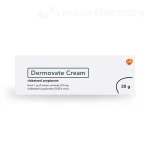
Dermovate cream (clobetasol propionate 0.05%) is a very potent prescription corticosteroid used to treat severe inflammatory skin conditions, including eczema, psoriasis, lichen planus, and lupus erythematosus. [1]
Applied as a thin layer once or twice daily, it typically shows improvement within 3-7 days.
Due to its strength, it’s only available on prescription and should be used for short periods under medical supervision to minimise side effects.
Dermovate cream is a prescription-only topical corticosteroid that tackles severe skin inflammation when gentler options haven’t worked. It contains clobetasol propionate, one of the strongest topical steroids available in the UK. [1], [2]
The cream formulation makes it ideal for areas that need quick absorption and easy application.
The medication is designed for short-term use during flare-ups of inflammatory skin conditions.
Because of its potency, your doctor will prescribe it for specific areas and a defined treatment period, usually no longer than 2-4 weeks without review.
What makes Dermovate different from over-the-counter creams is its ability to rapidly calm down overactive immune responses in the skin. When your skin cells are releasing chemicals that cause swelling, redness, and itching, Dermovate tells them to stop. This isn’t a moisturiser or a gentle treatment—it’s a clinical intervention for when your skin really needs help.
Additional information
Pack size
1 x 30g, 1 x 100g
MOJO WISDOM
Take control of your health by understanding your condition and what this medication is doing for you.
READ:
More information about this treatment.
UK-based doctors and pharmacists
Discreet and Confidential
UK-based doctors and pharmacists
Free, Expert Advice
No video link provided.
No video link provided.
UK-based doctors and pharmacists
Free, expert advice
Discrete and confidential
Fast delivery
Giving you trusted clinical advice for over 40 conditions
A UK regulated pharmacy providing safe, effective treatments online since 2014
Dermovate cream: A complete guide to treating severe skin inflammation
What you need to know about Dermovate cream
Dermovate cream is a powerful topical corticosteroid containing clobetasol propionate 0.05%. It’s prescribed for severe inflammatory skin conditions that haven’t responded to milder treatments. This guide covers everything you need to know about using it safely and effectively.
Five key takeaways
Dermovate is a very potent corticosteroid used for severe skin inflammation like eczema, psoriasis, and lichen planus
It works by reducing immune-related inflammation in the skin within days of starting treatment
Most people see improvement within 3-7 days, though some symptoms take longer to fully resolve
It should only be used short-term under medical supervision due to its strength
Common side effects include mild burning or irritation, whilst long-term use can cause skin thinning
Treatment dosage: How to use Dermovate cream
Apply a thin layer of Dermovate cream to the affected area once or twice daily, as directed by your doctor.[2]
A useful way to measure the right amount is the fingertip unit method—this is roughly the amount of cream that covers the tip of your index finger to the first crease. For most adults, this is about 0.5 grams per application.
Your doctor will advise how long to use Dermovate based on your condition and the area being treated. Generally, treatment shouldn’t exceed 4 weeks without medical review. [2]
As your skin improves, you’ll typically reduce the frequency of application or switch to a milder steroid cream. Always allow time for the cream to absorb before applying moisturiser, and wash your hands after use unless you’re treating your hands.
Never apply Dermovate to broken skin, infected areas, or around your eyes without specific medical instruction. If you’re using it on your face, limit treatment to 5 days maximum, as facial skin is thinner and absorbs more of the medication. Don’t cover treated areas with airtight dressings unless your doctor specifically advises this, as it increases absorption and the risk of side effects.
Overview: Understanding Dermovate cream
Dermovate cream represents a significant step up in corticosteroid strength. It belongs to the “very potent” category of topical steroids, meaning it’s roughly four times stronger than moderately potent options.[3] This makes it incredibly effective for severe flare-ups, but also why it requires careful, supervised use.
When skin inflammation flares up, it’s usually because your immune system is overreacting. This might happen due to eczema, psoriasis, autoimmune conditions, or contact dermatitis. Your skin cells start releasing inflammatory chemicals like cytokines and histamines, which cause the redness, swelling, and itching you experience.[3]
Dermovate works by suppressing this immune response at the cellular level, telling your skin to calm down and stop producing these inflammatory signals.
The beauty of Dermovate is its speed. Many people notice improvement within the first 3 days of starting treatment.[2] Redness and swelling typically reduce faster than itching or scaling, which might take a week or two to fully resolve. This rapid action is why it’s so valuable during acute flare-ups when you need relief quickly.
Because Dermovate is so potent, it’s not suitable for long-term continuous use. Prolonged use can lead to skin atrophy (thinning), stretch marks, and systemic absorption of the steroid, which can affect your whole body.[2] This is why your doctor will always prescribe it for a specific duration and review your progress. The goal is to use the minimum effective dose for the shortest time needed.
It’s also worth knowing that Dermovate isn’t suitable for all skin conditions. It won’t help with acne, rosacea, or mild itching without inflammation.[2] Your doctor will have assessed your condition carefully before prescribing it, so it’s important to use it exactly as directed and not extend treatment beyond what’s recommended.
Active ingredient: Clobetasol propionate explained
Clobetasol propionate is a synthetic corticosteroid that mimics the action of cortisol, a hormone your body naturally produces. [2] At 0.05% concentration in Dermovate cream, it's one of the most potent topical steroids available. This doesn't mean it's dangerous—it simply means a small amount goes a long way, which is why you only need a thin layer.
The molecule works by binding to glucocorticoid receptors in skin cells.[2] Once bound, it suppresses the genes responsible for producing inflammatory proteins. This is why it's so effective at reducing swelling, redness, and itching—it's literally telling your cells to stop making the chemicals causing these symptoms. The effect is rapid because corticosteroids work at the genetic level, not just on the surface of the skin.
What is Dermovate cream for? Conditions it treats
Dermovate cream is prescribed for several severe inflammatory skin conditions that haven't responded to milder treatments. [1] ,[3] The main conditions include psoriasis, where thick, scaly patches of inflamed skin develop, often with a silvery appearance. It's also used for eczema, particularly atopic eczema when it's moderate to severe and affecting quality of life.
Lichen planus is another common indication—this is a condition causing itchy, flat-topped bumps, usually on the wrists, forearms, or lower legs. Discoid lupus erythematosus, an autoimmune skin condition causing scarring and increased sun sensitivity, also responds well to Dermovate. Additionally, it's used for dermatitis and other inflammatory skin conditions that haven't improved with gentler steroid creams.[2]
The key point is that Dermovate is reserved for situations where milder options haven't worked.[2] Your doctor won't prescribe it as a first-line treatment because of the side effects with long-term use. It's the clinical equivalent of bringing out the big guns when you really need them—effective, but something you want to use strategically and for as short a time as possible.
How does Dermovate cream work? The mechanism explained
Dermovate works through multiple mechanisms that all converge on one goal: stopping skin inflammation.[2] When you apply the cream, clobetasol propionate penetrates the outer layers of skin and enters cells. Once inside, it binds to glucocorticoid receptors, which are like locks that control inflammatory genes.
By activating these receptors, clobetasol essentially tells your skin cells to stop producing inflammatory cytokines—the chemical messengers that cause swelling and itching.[2] It also suppresses the activity of immune cells like T-lymphocytes and macrophages that gather in inflamed skin. The result is a rapid reduction in the inflammatory cascade that was causing your symptoms.
This is why Dermovate works so quickly compared to gentler treatments. It's not just soothing the skin surface—it's intervening at the cellular and genetic level. Within hours of application, the inflammatory response begins to quieten down. Within days, visible improvements in redness and swelling become apparent.
The downside of this powerful mechanism is that prolonged use can suppress normal skin function. Your skin needs some level of inflammation to maintain its barrier and fight infection. [2] This is why using Dermovate longer than necessary increases the risk of side effects like skin thinning and increased infection risk. It's a powerful tool that needs respect and careful timing.
How to use Dermovate cream: Step-by-step guidance
Start by washing your hands thoroughly with soap and water.[2] This removes any dirt or bacteria that might be transferred to the affected area. Next, gently cleanse the skin you're treating—use lukewarm water and a mild cleanser if the area is dirty, then pat dry completely. Damp skin can increase absorption of the cream.
Apply a thin layer of Dermovate directly to the affected area using your fingertip.[2] Gently rub it in until it disappears into the skin. Don't massage vigorously or apply more than needed—a little goes a long way with such a potent product. If you're treating multiple areas, use a separate fingertip unit for each area to avoid cross-contamination.
After application, wash your hands again unless you're treating your hands as part of the prescribed area. Allow the cream to absorb fully before applying any other products like moisturisers. Your doctor might recommend waiting 15-30 minutes. If you're using an emollient (moisturiser), apply it after the Dermovate has absorbed to help lock in hydration without diluting the steroid's effect.
Warnings and precautions: Important safety information
Don't use Dermovate if you're allergic to clobetasol propionate or any of the other ingredients listed on the packaging. [2] Tell your doctor if you've had allergic reactions to other steroids in the past. Also, avoid using it on children under 1 year old, as their skin is extremely thin and absorbs medications more readily. [2]
Certain skin conditions can worsen with Dermovate, so it's crucial that your doctor has properly assessed your skin. Don't use it for acne, rosacea, perioral dermatitis (spotty rash around the mouth), or itching around the genitals or anus. If your skin is infected, don't apply Dermovate unless you're simultaneously treating the infection with an antibiotic or antifungal medication. [2]
Be particularly careful if you have psoriasis, as there's a rare risk of developing pustular psoriasis (raised bumps with pus) during or after treatment. [2] If you notice this developing, stop using the cream immediately and contact your doctor. Similarly, if your condition worsens, spreads beyond the original treatment area, or you develop a generalised rash, stop treatment and seek medical advice.
Don't apply Dermovate to your face unless your doctor specifically instructs you to, and if you do, limit it to a maximum of 5 days.[2] Never apply it around your eyes or eyelids, as it can cause cataracts or glaucoma if it repeatedly enters the eye. If the cream accidentally gets in your eyes, rinse immediately with plenty of cold water and contact your doctor.
Side effects: What to expect and when to worry
The most common side effect is a mild burning, stinging, or itching sensation at the application site, affecting up to 1 in 10 people.[2] This usually settles within a few days as your skin adjusts. If it persists or worsens, contact your doctor—it might indicate an allergic reaction or infection.
Less common side effects include skin thinning and visible blood vessels becoming more prominent under the skin.[2] These are more likely with prolonged use or if you're using the cream under airtight dressings. Skin thinning can lead to stretch marks and increased fragility, so it's another reason to use Dermovate only as long as necessary.
Very rare side effects from long-term use include weight gain, moon-shaped face rounding, skin wrinkling, and changes in skin colour. [2], [3] You might also experience increased body hair or hair loss. These systemic effects suggest the steroid is being absorbed into your bloodstream in significant amounts, which is why your doctor will have reviewed your treatment plan well before these develop.
If you notice any unusual symptoms whilst using Dermovate—such as blurred vision, bone pain, or signs of infection—contact your doctor immediately. Stop using the cream if you develop a generalised rash, severe itching, or signs of pustular psoriasis. Report any side effects to your doctor or pharmacist, and you can also report them to the Yellow Card Scheme via the MHRA website.
Drug interactions: What to tell your doctor
Tell your doctor if you're taking ritonavir or itraconazole, as these medications can increase how much Dermovate your body absorbs.[2] This increases the risk of side effects, so your doctor might adjust your treatment plan or monitor you more closely.
If you're using other topical medications on the same area, inform your doctor before starting Dermovate. Some products can interfere with the cream's effectiveness or increase absorption. This includes other steroid creams, retinoids, or certain acne medications. Your doctor will advise on the best way to use multiple treatments if necessary.
If you're taking oral corticosteroids (like prednisolone) or immunosuppressants for another condition, let your doctor know. Combining Dermovate with these medications increases the risk of serious infections because your immune system becomes more suppressed. Your doctor will need to weigh the benefits against the risks and might recommend additional precautions.
FAQs: Your Dermovate cream questions answered
How quickly does Dermovate cream work?
Most people notice improvement in redness and swelling within 3 days of starting treatment. Itching and scaling might take a week or two to fully resolve. If you're not seeing any benefit after 2 weeks, contact your doctor—you might need a different treatment approach.
Can I use Dermovate on my face?
Only if your doctor specifically prescribes it for facial use. If approved, limit treatment to 5 days maximum, as facial skin is thin and absorbs more medication. Never apply it around your eyes or eyelids.
How long can I use Dermovate cream?
Generally, treatment shouldn't exceed 4 weeks without medical review. Your doctor will advise on the specific duration for your condition. As your skin improves, you'll reduce the frequency or switch to a milder steroid.
What's the difference between Dermovate cream and ointment?
The cream absorbs faster and is better for areas that need quick absorption or where you don't want a greasy feel. The ointment is thicker, more moisturising, and better for very dry skin. Your doctor will recommend what is best for your condition.
Can I use Dermovate whilst pregnant or breastfeeding?
Inform your doctor if you're pregnant, planning pregnancy, or breastfeeding. If using whilst breastfeeding, don't apply it to your breast area to prevent accidental ingestion by your baby. Your doctor will assess whether the benefits outweigh the risks.
What should I do if I accidentally use too much?
If you've applied significantly more than the prescribed amount, wash the area gently and contact your doctor or pharmacist for advice. Don't panic—topical overdose is usually not dangerous, but your doctor should know.
Can I use Dermovate under occlusive dressings?
Only if your doctor specifically instructs you to. Airtight dressings increase absorption significantly, raising the risk of side effects. Your doctor might recommend this for thick psoriasis plaques, but only for short periods.
What are fingertip units, and how do I measure them?
A fingertip unit is the amount of cream from the tip of your index finger to the first crease. For most adults, this equals about 0.5 grams. Your doctor will advise how many units to use per application based on the area being treated.
Is Dermovate suitable for children?
Not for children under 1 year old. For children over 1 year, use should be limited to 5 days and reviewed weekly by a doctor. Children's skin is thinner and absorbs more medication, so careful supervision is essential.
What should I do if my skin gets worse while using Dermovate?
Stop using the cream and contact your doctor immediately. Worsening could indicate an allergic reaction, infection, or that your condition requires different treatment.
Can I apply other products over Dermovate cream?
Allow the cream to absorb fully (15-30 minutes) before applying moisturisers or other products. This prevents dilution of the steroid and ensures optimal absorption. Your doctor will advise on the best sequence if you're using multiple treatments.
What's the difference between the potency levels of steroids?
Topical steroids are classified as mild, moderately potent, potent, or very potent. Dermovate is very potent, meaning a small amount is highly effective. This is why you use much less compared to milder steroids, and why it's reserved for severe conditions.
How should I store Dermovate cream?
Keep it below 25°C, away from direct sunlight, and out of reach of children. Don't use it after the expiry date printed on the tube. Ask your pharmacist about proper disposal of unused medication.
Will my skin become dependent on Dermovate?
Your skin won't become "addicted," but stopping suddenly after prolonged use can cause rebound inflammation. This is why your doctor will advise gradually reducing frequency or switching to milder steroids rather than stopping abruptly.
Can I buy Dermovate over the counter?
No, Dermovate is prescription-only in the UK. Your doctor must assess your condition and prescribe it specifically for you. This ensures it's used safely and appropriately.
What's the difference between Dermovate and hydrocortisone cream?
Hydrocortisone is a mild steroid, whilst Dermovate is very potent—roughly 600 times stronger. Hydrocortisone is suitable for mild inflammation, whilst Dermovate is reserved for severe conditions that haven't responded to gentler options.
Can I use Dermovate if I have sensitive skin?
If you have sensitive skin, tell your doctor before starting Dermovate. The cream contains propylene glycol and cetostearyl alcohol, which can irritate sensitive skin. Your doctor might recommend the ointment instead or suggest additional precautions.
What should I do if I miss a dose?
Apply the cream as soon as you remember. If it's nearly time for your next application, skip the missed dose and continue with your regular schedule. Never double up to make up for a missed application.
How do I know if Dermovate is working?
You should see visible improvement in redness and swelling within 3-7 days. [1] Itching typically improves within the first week. If you're not seeing any benefit after 2 weeks, contact your doctor—your condition might need reassessment.
Disclaimer: This article is for informational purposes only and does not constitute medical advice. Always consult a healthcare professional for diagnosis and treatment of medical conditions.
This article was created by the team at courierpharmacy.co.uk and reviewed by our registered pharmacy professionals. It's based on clinical guidelines from the NHS, NICE, and the MHRA, combined with real-world patient experience. We've aimed to make complex medical information accessible without oversimplifying—because you deserve to understand your treatment.