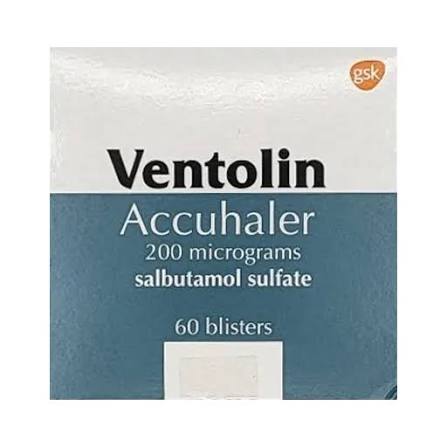
Product description: Ventolin Accuhaler (salbutamol 200 micrograms per dose)
Ventolin Accuhaler is the dry powder version of the well known Ventolin (salbutamol) blue reliever inhaler. It’s made by GSK and is used to quickly relieve asthma symptoms such as wheeze, tight chest, shortness of breath, and cough caused by airway narrowing.
Each Ventolin Accuhaler contains 60 pre?measured doses. Each dose delivers 200 micrograms of salbutamol (as salbutamol sulfate) when you inhale through the mouthpiece.
Ventolin Accuhaler is a prescription only medicine (POM).
What Ventolin Accuhaler is used for
Ventolin Accuhaler is used:
To relieve asthma symptoms quickly (a “rescue” inhaler)
Before exercise if you get exercise?induced symptoms
For short?term relief of bronchospasm in conditions like asthma (and sometimes COPD, if prescribed)
It works fast, but it does not treat the underlying airway inflammation. That’s the job of your preventer inhaler.
How salbutamol works (simple explanation)
Salbutamol is a short acting beta 2 agonist (SABA). In plain English, it relaxes the muscles around your airways.
What you can expect:
Onset: usually within 1–3 minutes
Peak effect: around 15–30 minutes
Duration: about 4–6 hours
So, it’s great for quick relief, but it’s not a “long term control” medicine.
How the Accuhaler device works
The Accuhaler is a breath actuated dry powder inhaler (DPI). That means:
You don’t press and breathe in at the same time
Your breath pulls the powder into your lungs
It uses a sliding lever mechanism:
Open the device and slide the lever to prepare a dose
Breathe out away from the mouthpiece
Seal lips around the mouthpiece
Inhale sharply and deeply
Hold your breath briefly, then breathe out slowly
A built in dose counter shows how many doses are left (from 60 down to 0).
Ventolin Accuhaler vs Ventolin Evohaler: what’s the difference?
Both contain salbutamol, but the device and technique are different.
Ventolin Accuhaler (dry powder inhaler):
No propellant (no spray)
No shaking needed
Breath actuated (less coordination)
Needs a forceful inhalation to pull the powder in
No “cold spray” feeling
Ventolin Evohaler (pressurised inhaler / pMDI):
Uses a propellant and needs press and breathe coordination
Often works very well with a spacer, especially for children or during attacks
So, the “best” option is usually the one you can use correctly every time.
Who the Accuhaler is (and isn’t) ideal for
Ventolin Accuhaler can be a great fit if you:
Prefer a dry powder inhaler
Like having a clear dose counter
Find press and breathe inhalers fiddly
Can inhale strongly enough to activate the device
However, a DPI may be less reliable if:
You’re having a severe asthma attack and can’t inhale forcefully
You’re a younger child who can’t generate enough airflow
You tend to breathe out into the device (powder + moisture = not best mates)
In those situations, a pMDI (often with a spacer) may deliver more reliably.
Important reliever inhaler advice (the bit that keeps people safe)
If you’re needing your blue reliever often, it can be a sign your asthma isn’t well controlled.
As a general rule, speak to a clinician if:
You need your reliever more than 3 times a week
Symptoms wake you at night
You’re using more doses than usual, or it’s not working as well
You may need a review of your preventer treatment.
How we supply Ventolin Accuhaler at Courier Pharmacy
At Courier Pharmacy, Ventolin Accuhaler is supplied only against a valid prescription and reviewed by a UK pharmacist. We’ll ask about your asthma control, how often you use your reliever, and whether the Accuhaler device is the right fit for your technique and situation.
Key features and specifications
Active ingredient: Salbutamol sulfate (equivalent to 200 micrograms salbutamol per inhalation)
Form: Dry powder inhaler (DPI), multi dose blister based device
Pack size: 60 doses per Accuhaler, with dose counter
Manufacturer: GSK (GlaxoSmithKline)
Class: Short acting beta 2 agonist (SABA) reliever inhaler
Legal status (UK): Prescription only medicine (POM)
Typical use (as directed): 1–2 inhalations as needed for symptoms; may be used before exercise
Storage: Store below 30°C and keep dry
Additional information
Quantity
1 x Ventolin Accuhaler, 2 x Ventolin Accuhalers
MOJO WISDOM
Take control of your health by understanding your condition and what this medication is doing for you.
READ:
More information about this treatment.
UK-based doctors and pharmacists
Discreet and Confidential
UK-based doctors and pharmacists
Free, Expert Advice
No video link provided.
No video link provided.
UK-based doctors and pharmacists
Free, expert advice
Discrete and confidential
Fast delivery
Giving you trusted clinical advice for over 40 conditions
A UK regulated pharmacy providing safe, effective treatments online since 2014
The blue salbutamol inhaler is the most recognisable medicine in respiratory care, but most people picture the pressurised metered-dose inhaler (pMDI) — the canister you shake and press. The Ventolin Accuhaler is a different device entirely.
Same active ingredient, same purpose, completely different technique. Maybe your asthma nurse has suggested switching to the Accuhaler because your pMDI coordination isn’t reliable.
Maybe you find the cold puff of the pMDI uncomfortable. Maybe you’ve been given an Accuhaler after a hospital stay and aren’t sure how it differs from your old blue inhaler. Maybe you’re switching from a Symbicort to a separate ICS plus a reliever and the Accuhaler is what your prescriber has chosen.
Ventolin Accuhaler is a dry powder inhaler (DPI) delivering 200 micrograms of salbutamol per dose, breath-actuated, with a built-in dose counter. At Courier Pharmacy we want to explain how the device differs from the pMDI, the forceful-inhalation technique it requires, and how to integrate it into the rest of your asthma plan.
Five key takeaways
Ventolin Accuhaler contains salbutamol 200 micrograms per blister dose in a multi-dose dry powder inhaler. It is a reliever (SABA — short-acting beta-2 agonist) used to relieve acute asthma symptoms and as pre-exercise prevention. Unlike the pMDI, it has no propellant — the powder is inhaled by your own breath.
60 doses per Accuhaler with a built-in dose counter — you can see exactly how many doses remain, which is more reliable than the “feels empty” test some patients use with pMDIs. The dose counter starts at 60 and counts down with each dose taken.
The technique is different from a pMDI. There is no shaking, no propellant timing, no slow inhalation. The Accuhaler requires a forceful, deep breath in through the mouthpiece to draw the powder into the lungs. Slow tidal breathing does not deliver an adequate dose.
Like all relievers, Ventolin Accuhaler works within minutes. Onset 1-3 minutes after a dose, peak effect 15-30 minutes, duration 4-6 hours. The dose is typically 1-2 inhalations as needed for symptoms or 15 minutes before exercise.
Reliever overuse is a serious warning sign. Using Ventolin Accuhaler more than 3 times a week (apart from before exercise) means your asthma is not well controlled and you need a review of your preventer treatment. The Accuhaler is for breakthrough symptoms, not daily routine use. Made by GSK.
Treatment Dosage for Ventolin Accuhaler
The dose depends on the situation:
Standard adult use:
For acute symptoms: 1-2 inhalations as needed, repeated up to every 4-6 hours
Before exercise: 1-2 inhalations 15 minutes before exercise
Acute attack at home: up to 10 inhalations over 10-20 minutes; if not relieved, call 999
Children:
Aged 4-12: usually 1 inhalation as needed; 2 if 1 is insufficient
Aged under 4: typically not Accuhaler — pMDI with spacer is the standard paediatric approach
Step-by-step Accuhaler technique:
Hold the Accuhaler horizontally
Open the cover by sliding the thumb grip away from you until it clicks (this exposes the mouthpiece)
Push the lever back as far as it will go until you hear a click (this loads a new dose into the airflow channel)
Hold the Accuhaler level
Breathe out gently, away from the inhaler, to empty your lungs
Place the mouthpiece between your lips, ensuring you do not block the air vents
Breathe in steadily and as deeply as possible through the mouthpiece — forcefully but not too aggressively
Hold your breath for 10 seconds or as long as is comfortable
Remove the inhaler and breathe out gently through your nose
Close the cover by sliding the thumb grip back toward you
The dose counter has advanced — you can see how many remain in the window
The forceful inhalation point:
This is the single most important technique difference from a pMDI:
pMDI: slow inhalation (about 30 L/min) — like sipping through a straw
Accuhaler: forceful inhalation (about 60+ L/min) — like deep diving in
The forceful breath provides the energy to draw the powder out of the blister and into your airway. Slow tidal breathing through the Accuhaler delivers very little drug. This is why children under 5 typically can’t use DPIs effectively — they can’t generate the flow rate.
If you can’t take a forceful breath (severe attack, breathlessness, very young children), the Accuhaler isn’t the right device for that moment. A pMDI with spacer is more reliable in severe attacks because the spacer holds the dose while you take multiple tidal breaths.
Frequency:
As-needed for symptoms: there is no fixed schedule; use when you need to
Pre-exercise: 15 minutes before strenuous exercise that triggers symptoms
Maximum frequency: not more often than every 4 hours under normal circumstances
Acute attack: 1-2 inhalations every 10 minutes for up to 10 doses while waiting for help
Reliever frequency as an asthma warning sign:
The number of times per week you use your reliever is one of the most important indicators of asthma control:
0-2 times a week: good control
3-7 times a week: poorly controlled — see your asthma nurse or GP
More than once daily: significantly poor control — review urgently
Empty Accuhaler within 1-2 months: too much use; needs assessment
The aim of preventer treatment is to make reliever almost unnecessary except for occasional breakthrough or pre-exercise use.
Practical tips:
Track usage: the dose counter tells you how many doses remain; track when you started a new Accuhaler
Carry spare: when the counter shows 10 or fewer, get a replacement
Storage: keep dry; moisture damages the powder
Don’t blow into the mouthpiece: this scatters the powder; only inhale, never exhale into the device
Don’t load multiple doses at once: each push of the lever loads one dose; opening multiple in advance wastes them
First use: you don’t need to “prime” the Accuhaler — it’s ready to use after loading the first dose
Disposal: empty Accuhaler when the counter reaches 0
Cold air-triggered symptoms: use before going outside in cold weather if cold is a trigger
Allergen exposure: useful pre-emptively if you know you’ll be exposed (e.g. cat allergy and visiting a cat owner)
Severe attack: up to 10 puffs over 10 minutes; if not relieved, call 999; consider whether the device is reaching your lungs (if too breathless to inhale forcefully, this is a 999 situation)
Travel: keep in hand luggage; the Accuhaler is robust and travels well
Air travel: cabin pressure doesn’t affect the Accuhaler significantly
Don’t use Ventolin Accuhaler if:
You have known hypersensitivity to salbutamol or any component
You are unable to take a forceful breath in (severe attack, very young child, severe COPD) — use pMDI with spacer instead
Use with care if:
You have severe cardiovascular disease (salbutamol can increase heart rate)
You have uncontrolled hyperthyroidism
You have severe untreated hypokalaemia
You have diabetes (salbutamol can raise blood glucose at high doses)
You are pregnant or breastfeeding (salbutamol generally considered acceptable; uncontrolled asthma is the bigger risk)
You have a history of seizures (high-dose salbutamol can lower seizure threshold)
You are taking beta-blockers (theoretical interaction)
When to seek further advice:
Reliever needed more than 3 times a week (apart from before exercise)
Symptoms worsening despite reliever use
Night waking with cough or wheeze
Peak flow dropping below 80% of personal best
Severe attack not relieved by 10 inhalations over 10 minutes — call 999 immediately
Chest pain, palpitations, or significant tremor after dosing (suggests overdose or sensitivity)
An Accuhaler emptying within 4 weeks (too much use)
Five things worth knowing:
The Accuhaler is the same medicine as the Ventolin Evohaler (pMDI), but the device changes the technique. If you’ve been switched from a pMDI to an Accuhaler, your old habit of slow inhalation needs to change — the Accuhaler needs a forceful breath in. The change in technique is the main thing to focus on.
The 60-dose count with built-in counter is one of the Accuhaler’s practical advantages. The “shake it and listen” approach to checking if a pMDI is empty is unreliable. The Accuhaler tells you exactly. You can also see at a glance whether you’ve used 1, 5, or 20 doses in a week.
DPIs work well in cold weather where pMDIs sometimes deliver inadequate doses because of low canister temperature. If you live somewhere cold or work outdoors in winter, the Accuhaler reliably delivers full doses across a wider temperature range.
The Accuhaler isn’t suitable for everyone or every situation. Very young children can’t generate the inspiratory flow. Patients in severe attack may not be able to either. Patients with severe COPD or other conditions that limit inspiratory effort may do better with a pMDI plus spacer. Your prescriber’s choice of device matters.
The number of times you use your reliever is one of the most important pieces of information about your asthma. The dose counter on the Accuhaler makes this easy to monitor. Three or more uses a week (apart from before exercise) is a signal to review preventer treatment, not to stockpile more reliever.
The asthma management ladder (BTS/SIGN and NICE NG80):
Step 1: SABA (e.g. Ventolin Accuhaler) as needed for mild intermittent symptoms
Step 2: add regular low-dose ICS preventer; SABA continues as needed
Step 3: increase to combined ICS+LABA, or moderate-dose ICS
Step 4: high-dose ICS in combined inhaler, possibly leukotriene antagonist
Step 5: specialist referral; biologics, oral steroids, other options
Ventolin Accuhaler sits at step 1 for mild intermittent asthma. Beyond step 1, it should be paired with a preventer; using only a reliever for established asthma is not appropriate.
Why choose Courier Pharmacy for Ventolin Accuhaler
Reliever inhalers are the most-prescribed asthma medication, but they’re also the most over-relied-on. Every Ventolin Accuhaler supply at Courier Pharmacy is reviewed by a UK pharmacist who reads your situation properly — and what they’re looking for is whether you actually need more reliever, or whether you need a preventer review instead.
We’ll ask about your reliever frequency. Three or more times a week (apart from before exercise) is the threshold beyond which you need an asthma review, not just another inhaler. Some of our most important interventions are encouraging patients to see their GP or asthma nurse rather than ordering another Accuhaler.
We’ll discuss the technique. The Accuhaler uses a different breath than a pMDI. If you’ve been switched from a pMDI to an Accuhaler, your old technique needs to change. We’ll walk through the forceful inhalation that’s needed and confirm you’re delivering the full dose.
We’ll explain what reliever inhalers can and can’t do. They reverse bronchospasm; they don’t treat the underlying inflammation. They work within minutes; they don’t prevent the next attack. They’re for breakthrough use; they’re not your daily treatment.
We’ll talk about your action plan. Every patient with asthma should have a written personal asthma action plan — what doses to take when stable, when to step up, when to seek help. Asthma + UK has templates; your GP or asthma nurse can fill one in with you. We can point you toward this support.
Our brand guide, Dr Ada Jex-Cori, sums it up: you’re not broken. The system that’s failed you might be. We want to do the part we can do, properly, and connect you with the rest. That includes our free fortnightly drop-in clinics and talks at Insomnia in Derby, where you can ask questions face-to-face without spending a penny.
Buy Ventolin Accuhaler from Courier Pharmacy
Ventolin Accuhaler is a prescription only medicine in the UK. Buying through Courier Pharmacy is straightforward and built around your time, not ours.
Here’s how it works:
Complete a quick online consultation about your asthma history and current control
A UK pharmacist prescriber reviews your information
If suitable, a prescription is issued
We dispense and deliver discreetly to your door
If it isn’t suitable for you, we’ll explain why and suggest the next best option.
Active ingredients for Ventolin Accuhaler
The active ingredient is salbutamol (in the salbutamol sulfate salt form), the prototypical short-acting beta-2 agonist.
Chemical and pharmacological class:
Salbutamol sulfate
Short-acting beta-2 adrenergic agonist (SABA)
Synthetic catecholamine derivative
Selective for beta-2 over beta-1 (at therapeutic doses; selectivity decreases at higher doses)
Developed in the 1960s; the prototype SABA
Mechanism of action:
Salbutamol works through beta-2 adrenoceptors:
Binds to beta-2 receptors on airway smooth muscle cell membranes
cAMP activates protein kinase A, which phosphorylates myosin light chain kinase to reduce calcium-mediated smooth muscle contraction
Result: smooth muscle relaxation, bronchodilation
Effect within 1-3 minutes
Maximum effect at 15-30 minutes
Duration 4-6 hours
The beta-2 selectivity matters because beta-1 receptors are predominantly in the heart. The selectivity isn't absolute — at higher doses, beta-1 activation contributes to tachycardia, palpitations, and tremor.
Salbutamol also has other effects beyond pure bronchodilation:
Mild reduction in mast cell degranulation
Small increase in mucociliary clearance
Inhibition of vascular leak in airway mucosa
These are minor contributions compared to the bronchodilator effect
Pharmacokinetics:
Lung deposition: 10-25% of the dose with good DPI technique
Onset: bronchodilation within 1-3 minutes
Peak effect: 15-30 minutes
Duration: 4-6 hours
Systemic absorption: from both lung deposition and swallowed portion; some first-pass metabolism
Half-life: approximately 4-6 hours
Excretion: urinary excretion of metabolites
What salbutamol doesn't do:
Doesn't treat the underlying inflammation of asthma
Doesn't prevent future attacks
Doesn't reduce mucus hypersecretion significantly
Doesn't address airway remodelling
Doesn't improve lung function beyond reversing the acute bronchospasm
This is why "reliever-only" management of asthma is inappropriate beyond very mild intermittent symptoms — it doesn't address the underlying pathology.
The ?-2 receptor desensitisation concern:
With frequent salbutamol use, beta-2 receptors on airway smooth muscle can downregulate (reduced number or sensitivity), which:
Reduces the bronchodilator effect of subsequent doses
May increase reliance on the reliever as effectiveness wanes
Contributes to the "loss of control" pattern in poorly managed asthma
This is part of why excessive reliever use is a warning sign — the situation can deteriorate further as receptors desensitise.
The Accuhaler powder formulation:
The Accuhaler contains salbutamol sulfate blended with lactose monohydrate as a carrier. Each blister contains a precisely measured dose. Lactose is the carrier in many DPIs — patients with severe milk protein allergy (note: not lactose intolerance, which is different) need to discuss with a prescriber.
What is Ventolin Accuhaler for?
Ventolin Accuhaler is used in adults and children able to use a DPI for:
Pre-exercise prevention of exercise-induced asthma
Allergen exposure prophylaxis when known triggers are anticipated
As-needed bronchodilation for COPD-related bronchospasm (off-label but common)
Acute exacerbation management with up to 10 doses over 10 minutes while awaiting help (alongside calling for emergency care)
It is appropriate for:
Mild intermittent asthma as the sole treatment (step 1)
All other steps of asthma management, alongside appropriate preventer therapy
Pre-exercise use to prevent exercise-induced bronchospasm
Patients who can generate sufficient inspiratory flow to use a DPI
Ventolin Accuhaler is not appropriate for:
Patients who cannot generate forceful inhalation (very young children, severe attacks where breath flow is limited)
Sole asthma treatment beyond very mild intermittent disease — must be paired with preventer
Patients with severe milk protein allergy (lactose carrier consideration)
Patients with known salbutamol hypersensitivity
Acute severe asthma where pMDI plus spacer or nebulised salbutamol is more reliable
COPD with severe inspiratory flow limitation
As a substitute for preventer treatment in established asthma
How does Ventolin Accuhaler work?
Asthma attacks involve two main components:
Acute bronchospasm: smooth muscle around the airways contracts, narrowing the airway lumen
Underlying inflammation: chronic airway inflammation increases susceptibility to bronchospasm and contributes to mucus hypersecretion and mucosal swelling
Reliever inhalers like Ventolin address the bronchospasm rapidly:
Within seconds of inhalation:
Salbutamol particles deposit on airway surfaces
Drug is absorbed into smooth muscle around airways
Binds beta-2 adrenoceptors
Within 1-3 minutes:
Receptor activation drives cyclic AMP production
Smooth muscle relaxes
Airway lumen widens
Patient feels easier breathing
Within 15-30 minutes:
Peak bronchodilation achieved
Wheeze and chest tightness substantially reduced
Peak flow improvement evident
Over 4-6 hours:
Effect gradually wears off as the drug is metabolised
Repeat dose needed if symptoms return
Receptor sensitivity normally resets between doses
What it doesn't change:
The acute bronchospasm is reversed, but:
The underlying inflammation continues
Susceptibility to future attacks remains
Mucus and inflammatory mediators in the airways persist
The pattern that allowed the attack to develop hasn't changed
This is why asthma management beyond step 1 requires daily preventer treatment alongside the reliever.
Associated with increased hospital admission and death
The 2014 National Review of Asthma Deaths (NRAD) showed a majority of asthma deaths had documented reliever overuse and preventer underuse
The pattern of escalating reliever use without escalating preventer use is the most concerning pattern in asthma management. Any patient using more than one canister/Accuhaler per month should be reviewed urgently.
Acute exacerbation:
If an attack isn't responding to your normal reliever dose:
1-2 inhalations every minute, up to 10 inhalations
If not improving, call 999
Don't wait several hours hoping it'll settle
Hospital treatment with nebulised salbutamol, oral or IV steroids, and oxygen may be needed
Cardiovascular effects:
At standard doses, salbutamol causes mild increases in heart rate and small fall in diastolic blood pressure. At higher doses or with repeated dosing:
Tachycardia
Tremor (especially hands)
Palpitations
Headache
These are usually transient and resolve as the drug is metabolised. Persistent or severe symptoms warrant medical review.
Hypokalaemia:
Salbutamol can lower serum potassium, particularly at higher doses (e.g. during an acute exacerbation with multiple repeated doses). Effects are usually small and transient but worth knowing about in patients with risk factors:
Concurrent diuretic use
Already-low potassium
Chronic kidney disease
Pregnancy and breastfeeding:
Asthma control matters more than concerns about salbutamol
Salbutamol used widely in pregnancy with no consistent evidence of harm
For breastfeeding, salbutamol is generally considered compatible
Paradoxical bronchospasm:
Rarely, salbutamol can cause bronchospasm rather than relieving it (paradoxical bronchospasm). If you notice your symptoms worsen immediately after using the Accuhaler, stop and seek medical attention.
If you experience signs of an allergic reaction (rash, swelling, difficulty breathing other than asthma), stop using the product and seek immediate medical attention.
Side effects for Ventolin Accuhaler
Salbutamol is generally well-tolerated at standard doses. Side effects are typically mild and dose-related.
Common side effects, between 1 in 100 and 1 in 10 people, include tremor (especially hands), headache, palpitations, fast heart rate (tachycardia), and mild throat irritation from the powder.
Uncommon side effects, between 1 in 1,000 and 1 in 100 people, include muscle cramps, irritation of the mouth and throat, and low potassium with high doses.
Rare side effects, fewer than 1 in 1,000 people, include arrhythmias, paradoxical bronchospasm, and behaviour disturbance (especially in children at high doses).
Very rare and serious side effects include myocardial ischaemia in susceptible patients, severe hypokalaemia, anaphylaxis, and severe paradoxical bronchospasm.
If you experience any side effect that worries you, you can report it directly to the MHRA's Yellow Card scheme. This helps improve safety data for everyone who uses the product. Our pharmacy team are happy to help you submit a Yellow Card report if you'd like assistance.
Drug interactions for Ventolin Accuhaler
Significant interactions:
Beta-blockers (especially non-selective like propranolol): blunt the effect of salbutamol and can worsen asthma; non-selective beta-blockers should be avoided in asthma
Diuretics (loop and thiazide): additive hypokalaemic effect
Corticosteroids: additive hypokalaemic effect at high doses
Theophylline: additive cardiac and hypokalaemic effects
Other beta-agonists: cumulative effect
MAOIs and tricyclic antidepressants: theoretical cardiovascular interactions
Digoxin: hypokalaemia from salbutamol can increase digoxin toxicity risk
Practical considerations:
Most antibiotics are compatible
ACE inhibitors and ARBs are compatible
Statins are compatible
Diabetes medications: monitor glucose during high-dose use; oral glucose-lowering effect of insulin may need adjustment
Tell your pharmacist about all medicines you take when starting any new treatment.
Frequently Asked Questions
What is Ventolin Accuhaler used for?
It is a reliever inhaler containing salbutamol 200 micrograms per dose, used for the relief of acute asthma symptoms (wheeze, breathlessness, chest tightness, cough) and for pre-exercise prevention of exercise-induced bronchospasm.
How is the Accuhaler different from the Evohaler (pMDI)?
Same medicine, different device. The Accuhaler is a dry powder inhaler with 60 doses and a built-in dose counter, breath-actuated — no shaking, no propellant, no slow inhalation. The Evohaler is a pressurised metered-dose inhaler — shake, slow inhalation, coordinate with actuation.
How quickly does it work?
Within 1-3 minutes. Peak effect at 15-30 minutes. Duration 4-6 hours.
How often can I use it?
As needed for symptoms, up to every 4 hours under normal circumstances. In an acute attack, up to 10 inhalations over 10 minutes. If you need it more than 3 times a week (apart from before exercise), see your GP or asthma nurse.
How do I know when it's empty?
The dose counter on the side of the device shows how many doses remain. Starts at 60, counts down to 0. Replace when it's low — don't wait for empty.
Can children use the Accuhaler?
Children over 5 who can generate sufficient inspiratory flow can use the Accuhaler. Younger children typically use pMDI with a spacer because they can't generate enough flow for a DPI.
Why does it need a forceful breath?
The Accuhaler is breath-actuated — your breath provides the energy to pull the powder out of the blister and into your lungs. Slow tidal breathing delivers very little drug. A forceful, deep inhalation is essential.
Can I use it during pregnancy?
Yes — well-controlled asthma is more important for you and the baby than concerns about salbutamol. Continue using as needed.
Is it safe while breastfeeding?
Yes — generally considered compatible. Limited transfer into breast milk; inhaled doses produce limited systemic exposure.
Why do I get tremor or palpitations after using it?
Salbutamol can cause hand tremor, fast heart rate, or palpitations, particularly at higher doses or with repeated dosing. These are usually transient. If severe or persistent, talk to your prescriber.
What if I have an asthma attack?
Up to 10 inhalations over 10 minutes. If symptoms aren't easing, call 999. Don't continue cycling through doses for hours hoping it'll settle.
Can I use the Accuhaler with my preventer?
Yes — preventer (e.g. brown Clenil) is daily, reliever (e.g. blue Accuhaler) is as needed. They have different mechanisms and complement each other.
Why is reliever overuse a problem?
It indicates poorly controlled asthma — your preventer treatment isn't doing its job. It's also associated with worse outcomes (more attacks, higher hospital admission, higher death risk). The pattern of needing reliever frequently while not stepping up preventer is the most concerning pattern in asthma management.
What's the difference between Accuhaler and Easyhaler?
Both are DPIs containing salbutamol. The Accuhaler has 60 blister doses with lever loading; the Easyhaler has 200 doses with twist-and-click loading. Same medicine, slightly different device.
How is the Accuhaler different from a Turbohaler?
Turbohaler is a DPI for terbutaline (a different SABA, similar effect to salbutamol). Twist-loaded mechanism. The Bricanyl Turbohaler is the most common terbutaline DPI.
Can I exercise while using the Accuhaler?
Yes — using it 15 minutes before exercise is a key preventive use. The effect lasts 4-6 hours.
What if I forget to use it before exercise?
If symptoms develop, take 1-2 inhalations during exercise. For next time, set a reminder or include it in your warm-up routine.
Does the Accuhaler contain lactose?
Yes — lactose monohydrate is the carrier powder. Patients with severe milk protein allergy (a different condition from lactose intolerance) should discuss with a prescriber. Lactose intolerance is not a contraindication to DPI use because the dose is so small.
What if the Accuhaler gets wet?
Damaged. Moisture affects the powder formulation. Replace if it's been significantly wet. Keep the cover closed when not in use.
How long should I take Ventolin?
Indefinitely if needed. SABAs are appropriate as needed forever — what changes over time is the preventer treatment. The aim is for reliever use to remain at "occasional" levels.
Disclaimer: This information is for education only and isn’t a substitute for personal medical advice. Always follow your prescriber’s instructions.