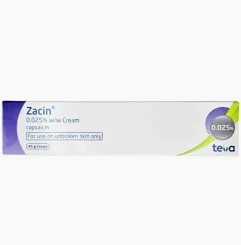
Osteoarthritis affects around 8.5 million people in the UK. After all, it’s the most common form of arthritis, and the most common cause of disability in older adults. So treatment options matter — but the standard ladder of oral painkillers comes with real downsides: stomach issues from NSAIDs, the addiction risk of opioids, and the limited evidence for paracetamol in osteoarthritis. Topical treatments like Zacin cream 0.025% offer a different route that avoids systemic side effects.
Topical capsaicin has a particular place in osteoarthritis. Specifically, it doesn’t work the same way as anti-inflammatory creams (Voltarol Emulgel, ibuprofen gel) — those reduce inflammation, while Zacin cream 0.025% reduces pain signalling at the nerve level. So the two approaches can work alongside each other, and some people use both at different times of day.
Where Zacin fits in UK osteoarthritis treatment
The UK approach to osteoarthritis follows NICE NG226 (2022):
Step 1: Self-management — patient education, weight loss if needed, exercise (the strongest evidence-based intervention)
Step 2: Physical activity and structured exercise programmes
Step 3: Topical NSAIDs (Voltarol Emulgel, ibuprofen gel) — first-line drug treatment for knee and hand osteoarthritis
Step 4: Topical capsaicin (Zacin) — particularly for knee osteoarthritis, especially where topical NSAIDs aren’t suitable or sufficient
Step 5: Oral NSAIDs (ibuprofen, naproxen, celecoxib) at the lowest dose for the shortest time, with stomach protection if needed
Step 6: Paracetamol or weak opioids (codeine) for short-term flare management (limited evidence in osteoarthritis)
Step 7: Joint injections (steroid or hyaluronic acid) for specific joints
Step 8: Joint replacement surgery for severe disease not responding to other treatments
Zacin sits at Step 4. So it’s a reasonable choice for people who haven’t responded fully to topical NSAIDs, or who can’t tolerate them. After all, NICE NG226 specifically supports topical capsaicin for knee osteoarthritis.
Zacin vs Axsain — the key comparison
Both contain capsaicin, but at different strengths for different conditions:
Zacin 0.025% (this product): lower strength, licensed for osteoarthritis pain
Zacin’s burning is generally milder due to the lower strength
Both work through the same substance P depletion mechanism
In short, picking the right strength matters. After all, using Zacin for nerve pain usually doesn’t work, and using Axsain for arthritis is unnecessarily strong.
Zacin vs Voltarol Emulgel
Both are topical treatments for osteoarthritis, but they work differently:
Voltarol Emulgel (diclofenac 1.16% or 2.32%): a topical anti-inflammatory that reduces swelling and inflammation
Zacin 0.025% (capsaicin): depletes substance P at nerve endings over weeks
Voltarol has a quicker onset (days, not weeks)
Zacin builds up effect more gradually
Voltarol is available over-the-counter; Zacin is POM
The two can be used at different times of day if needed
NICE NG226 supports topical NSAIDs as first-line, with capsaicin as next step
Many UK GPs start with Voltarol Emulgel and add Zacin if benefit isn’t enough. After all, the two work through different routes, so combining can give better results than either alone.
Zacin vs oral pain medicines
Oral options have different trade-offs:
Oral NSAIDs (ibuprofen, naproxen, diclofenac): effective but stomach, kidney, heart concerns with long-term use
Paracetamol: limited evidence in osteoarthritis; NICE no longer routinely recommends it
Codeine and other weak opioids: addiction risk; NICE generally cautions against routine use
Strong opioids: not recommended for osteoarthritis
Zacin: no systemic side effects, but slower onset and the burning sensation
In short, topical Zacin particularly suits people who want to avoid the systemic risks of oral pain medicines. So this matters most for older adults, those with kidney issues, those on blood thinners, or people with stomach problems.
Zacin vs Qutenza
Qutenza is a much stronger capsaicin product:
Qutenza: 8% capsaicin patch (320 times stronger than Zacin)
Applied in a clinic setting, not at home
Single application lasting 30-60 minutes provides relief for up to 3 months
Requires local anaesthetic preparation because of intense burning
Licensed for severe nerve pain, not osteoarthritis
Specialist pain clinic treatment, not a routine prescription
So Zacin is the home-use option for arthritis, while Qutenza is the specialist clinic version for severe nerve pain. The two serve different conditions and shouldn’t be confused.
Who Zacin suits well
This cream may suit people who:
Have osteoarthritis pain in specific joints (knee, hand, hip, fingers, spine)
Want a localised treatment rather than oral pain medicines
Have tried topical NSAIDs without enough benefit
Can’t take oral NSAIDs because of stomach, kidney, or heart concerns
Take blood-thinning medicines (warfarin, DOACs) where oral NSAIDs would be risky
Are committed to applying the cream 4 times daily
Can manage the initial burning sensation
Don’t have asthma severely flared at the time
Have intact skin in the area to be treated
Who might suit other options better
Other options may work better for people who:
Have nerve pain (post-shingles, diabetic neuropathy) — Axsain 0.075% has that role
Haven’t yet tried weight loss and exercise — these are the strongest evidence-based interventions for osteoarthritis
Haven’t yet tried topical NSAIDs — Voltarol Emulgel is first-line for knee OA
Can’t tolerate any burning sensation
Have severe asthma — capsaicin vapour can worsen breathing
Have broken, weeping, or inflamed skin in the application area
Have a known allergy to capsaicin, chilli peppers, or any base ingredient
Are children — Zacin isn’t suitable for under-18s
Are pregnant or breastfeeding — speak to GP first
Need fast pain relief — Zacin works over weeks, not minutes
Have severe joint damage where joint replacement may be appropriate
Courier Pharmacy supply
Zacin Cream 0.025% is a UK Prescription-Only Medicine (POM). So supply only happens after our UK-qualified prescriber reviews your online consultation. In short, if our prescriber decides another approach would suit better — Voltarol Emulgel first, oral medicines, or specialist referral — we’ll explain that clearly.
Key features and specs
Active ingredient: capsaicin 0.025% w/w
Form: white cream
Pack size: 45g aluminium tube
Application: pea-sized amount, 4 times daily, at least 4 hours apart
Age range: adults only; not suitable for children
Apply to: unbroken skin only
Don’t apply: near eyes, on broken skin, or under tight bandages
Important: wash hands immediately after application (unless treating hands)
Avoid: hot baths or showers immediately before or after application
Onset: pain relief usually begins in the first week
Full effect: builds up over 2-8 weeks of regular use
Legal status: Prescription-Only Medicine (POM)
Storage: below 25°C
MOJO WISDOM
Take control of your health by understanding your condition and what this medication is doing for you.
READ:
More information about this treatment.
UK-based doctors and pharmacists
Discreet and Confidential
UK-based doctors and pharmacists
Free, Expert Advice
No video link provided.
No video link provided.
UK-based doctors and pharmacists
Free, expert advice
Discrete and confidential
Fast delivery
Giving you trusted clinical advice for over 40 conditions
A UK regulated pharmacy providing safe, effective treatments online since 2014
Zacin 0.025% Cream is a UK licensed prescription-only medicine (POM) for the symptomatic relief of pain associated with osteoarthritis. So the active ingredient is capsaicin — the same compound that makes chilli peppers hot — at a low strength of 0.025%. As a result, the cream works by slowly depleting substance P (a pain-signalling chemical) from nerve endings in the affected joint area. Important: pain relief builds gradually with regular use, typically starting within the first week and reaching maximum benefit at 2-8 weeks. Made by Ennogen IP Ltd. The cream comes in a 45g aluminium tube.
At Courier Pharmacy, we believe in treatment that fits the person.
This page covers what Zacin is, who it suits, how the burning sensation works, and the practical points that matter when using capsaicin cream for osteoarthritis.
Five key takeaways
Zacin Cream 0.025% is a UK Prescription-Only Medicine (POM). So supply only happens after our UK-qualified prescriber reviews your situation and confirms suitability
Active ingredient is capsaicin 0.025% — the natural compound from chilli peppers. So it works by depleting substance P (a pain-signalling chemical) from nerve endings over 2-8 weeks of regular use
Licensed for the symptomatic relief of pain from osteoarthritis. In short, it suits people with painful knee, hand, hip, or other joint osteoarthritis who want a topical option
Apply a pea-sized amount 4 times daily, evenly spaced (at least 4 hours apart). After all, pain relief typically begins within the first week and builds up over 2-8 weeks — this isn’t a quick fix
Important practical points: an initial burning sensation is normal. So hand washing immediately after application matters. Avoid hot baths or showers around application time, and never apply near the eyes
Why choose Courier Pharmacy for Zacin Cream
At Courier Pharmacy, our approach starts with a simple idea: treatment should fit the person, not force the person to fit the system.
Dr Ada Jex-Cori
Our service is shaped by the philosophy of Dr Ada Jex-Cori, our brand pharmacist.
Dr Ada represents the spirit of the pharmacy: evidence-led, community-rooted, and willing to challenge the one-size-fits-all approach to medicine. She is named in honour of three pioneering women in science: Ada Lovelace, the mathematician and visionary; Sophia Jex-Blake, the first female doctor in the UK who fought the medical establishment; and Gerty Cori, the biochemist and Nobel Prize winner.
In our fictional world of Etherwell, Dr Ada fights against pharma’s standardised approach to medicine. In the real world, she represents what we stand for. Her view is straightforward: you are not broken. The system is. And we are here to change that.
Honest framing about the burning sensation
Many online providers gloss over the initial burning. Courier Pharmacy is different. So we’ll be straight with you:
The burning is real and noticeable, especially in the first week
It’s milder with Zacin (0.025%) than with Axsain (0.075%), but still happens
Some people find it tolerable, especially knowing it settles with time
Others find it genuinely difficult and stop treatment before benefit develops
You need to be ready for this before committing to a course
If you can’t tolerate the burning, other options (Voltarol Emulgel, oral medicines) exist
There’s no shame in deciding the trade-off isn’t right for you
After all, knowing what you’re signing up for matters more than soft-pedalling to make the sale.
Honest framing about osteoarthritis treatment
Some uncomfortable truths about osteoarthritis treatment:
Exercise and weight management have the strongest evidence — stronger than any medicine
No medicine reverses the underlying joint damage
All pain medicines for osteoarthritis have trade-offs
Combining approaches (topical + exercise + lifestyle) usually works better than any single intervention
Joint replacement is reserved for severe cases not responding to other measures
Zacin is one useful tool, not the whole answer
So our prescriber will discuss the wider picture, not just whether to issue the cream. After all, a treatment that fits the whole person matters more than a quick prescription.
Osteoarthritis and the bigger picture
Joint pain often connects to wider health patterns. So our pharmacist can discuss:
Weight management and joint loading — particularly important for knee and hip OA
Physical activity and structured exercise programmes
Sleep and pain — poor sleep worsens pain sensitivity
Mood and pain — depression and anxiety can amplify pain perception
Vitamin D status — relevant for bone and joint health
Mast cell activation syndrome (MCAS) and joint symptoms
Pacing, mobility aids, and self-management strategies
Sometimes the joint pain is the visible part of a wider picture — and that’s worth talking through.
Pharmacist support before and after purchase
Our pharmacist is here to discuss:
Whether Zacin is the right choice for your situation
How to use it safely (the hand-washing matters)
Managing the initial burning sensation
How to combine with other pain treatments
When to ask for prescriber review
Other options if Zacin doesn’t suit
This is free and on hand before and after purchase.
Trust earned, not claimed
We are GPhC-regulated, and our content is grounded in NICE NG226 on osteoarthritis, the BNF, and the real experience of patients using topical capsaicin.
If Zacin isn’t the right answer for your situation, we’ll tell you honestly. After all, prescribing the right treatment matters more than fulfilling a request.
How to buy Zacin Cream from Courier Pharmacy
Zacin Cream 0.025% is a UK Prescription-Only Medicine (POM). So supply needs a prescription, which our prescriber issues after an online consultation.
How our service works
Add Zacin Cream to your basket and complete the online consultation. The consultation covers your osteoarthritis history, prior treatments tried, current medicines, allergies, and other relevant medical history
Our UK-qualified prescriber reviews your answers to confirm whether Zacin is suitable. So if extra information is needed, or if a different treatment would suit better, we’ll get in touch
Once approved, your prescription is dispensed and sent out in plain, unbranded packaging
Free pharmacist and prescriber support is on hand before and after your purchase
When other options might suit better
If Zacin isn’t right, we’ll explain why. Other options may include:
Voltarol Emulgel 1.16% or 2.32% (topical diclofenac): first-line for knee and hand OA
Ibuprofen 10% gel: another topical NSAID option
Piroxicam 0.5% Gel: an alternative topical NSAID
Movelat Relief Gel: a combination topical anti-inflammatory
Axsain 0.075% capsaicin: for nerve pain, not osteoarthritis
Oral NSAIDs (ibuprofen, naproxen, celecoxib): for short-term flare management
Methocarbamol 750mg: for OA-associated muscle spasm
Exercise and weight management referral: strongest evidence-based intervention
Specialist referral: for severe disease where joint replacement may be appropriate
Our community service
Our free fortnightly drop-in clinics at Insomnia, Derby run every other week from 10am to 12pm.
Healthcare shouldn’t only happen when you’re paying for it. So we show up, even when it’s free.
We cover osteoarthritis, chronic pain, fibromyalgia, MCAS, CFS, dermatology, eczema, psoriasis, allergies, asthma, hair loss, men’s and women’s health, digestive health, weight management, and whatever else people bring through the door. No appointment needed, no charge, no pressure.
Active ingredient
Zacin Cream contains:
Capsaicin 0.025% (0.25mg per gram of cream)
Why capsaicin
Capsaicin is the active compound from chilli peppers:
Naturally occurring plant compound
Same molecule that makes chilli peppers hot
Extracted from the Capsicum plant family
Used medically for pain relief for decades
Works locally on nerve endings — minimal systemic uptake
Very low absorption into the bloodstream when applied topically
Different mechanism from paracetamol, ibuprofen, and other pain relievers
Complementary to other pain management approaches
In short, capsaicin gives a way to target pain locally without systemic side effects. After all, oral pain medicines affect the whole body — Zacin acts where you apply it.
Why 0.025% strength
This is the lower of two available capsaicin strengths:
Zacin: capsaicin 0.025% — licensed for osteoarthritis
Axsain: capsaicin 0.075% (three times stronger) — licensed for post-herpetic neuralgia and diabetic neuropathy
The 0.025% strength gives good balance of efficacy and tolerability for osteoarthritis
Lower strength means milder initial burning sensation
Suits regular 4-times-daily long-term use
Better tolerated than higher-strength options for most patients
Studies show the 0.025% strength works for osteoarthritis pain relief
After all, more isn't always better with capsaicin. So the 0.025% strength fits the osteoarthritis situation where regular consistent use over weeks matters more than immediate strong effect.
How the burning sensation works
This is honest framing that helps set expectations:
Capsaicin activates TRPV1 receptors on nerve endings
TRPV1 receptors normally respond to heat above 43°C
Activating them causes the sensation of heat or burning
This is why chilli peppers feel hot — same mechanism
The burning sensation isn't tissue damage — the skin isn't actually being burned
Roughly one third to nearly half of patients notice burning initially
The burning typically settles as treatment continues
Burning is more noticeable if you use too much cream
Burning is worse near baths, showers, or heat sources
In short, the burning is part of how capsaicin works — not a side effect to worry about. However, if it's severe or doesn't settle, talk to our prescriber.
Other ingredients
Zacin cream also contains standard cream base ingredients including:
White soft paraffin
Cetostearyl alcohol
Polyoxyl 40 stearate
Sorbic acid
Purified water
Notably, Zacin doesn't contain menthol or other counterirritants. So the effect comes from capsaicin alone. Mention any known allergies to our prescriber during consultation.
Pack details
Zacin Cream comes in:
45g aluminium tube
Polypropylene spiked cap
White to off-white cream
Epoxyphenolic-lined tube for stability
What is Zacin cream 0.025% used for?
This cream is for adults with osteoarthritis pain on intact skin. So it especially suits people who:
Have mild to moderate osteoarthritis pain in specific joints
Want to avoid or supplement oral anti-inflammatory medicines
Can't tolerate oral NSAIDs because of stomach, kidney, or heart concerns
Have already tried topical NSAIDs (Voltarol, ibuprofen gel) without enough benefit
Prefer a localised treatment rather than oral pain medicines
Can manage the initial burning sensation while the treatment takes effect
Are committed to applying the cream 4 times daily for at least 2-4 weeks
What does Zacin do?
Zacin works by acting on nerve endings in the skin near the affected joint. First, capsaicin activates TRPV1 receptors — the same receptors that respond to heat and chilli. This causes the initial burning sensation. However, with repeated use, capsaicin gradually depletes substance P from these nerve endings. Substance P is one of the main chemicals that transmits pain signals to the brain. As a result, fewer pain signals reach the brain, and joint pain gradually reduces.
What Zacin doesn't do
Zacin doesn't cure osteoarthritis. After all, osteoarthritis involves cartilage damage that topical treatment can't reverse. In addition, Zacin doesn't treat the inflammation directly the way NSAID gels (like Voltarol gel) do. Also, Zacin doesn't work quickly — the effect builds over weeks of consistent use. Finally, Zacin isn't suitable for children, isn't a treatment for rheumatoid arthritis specifically, and isn't a replacement for weight management, exercise, and physiotherapy in osteoarthritis care.
How does Zacin cream 0.025% work?
Capsaicin works in a particular way — and understanding it helps explain why the burning sensation eventually gives way to pain relief.
The TRPV1 mechanism
Capsaicin works at a specific receptor on nerve endings called TRPV1:
Applied cream brings capsaicin into contact with sensory nerve endings in the skin
Capsaicin binds to TRPV1 receptors — the same receptors that detect heat above 43°C
This activation triggers nerves to send pain and heat signals to the brain
That's why the initial application feels burning or hot
With repeated activation, the nerve endings gradually release their stores of substance P
Substance P is the main chemical messenger nerves use to signal pain
Once depleted, the nerve has less ability to send new pain signals
Over weeks of regular use, the treated nerves become less able to transmit ongoing pain
Importantly, this isn't damage to the nerve — it's depletion of its pain-signalling chemicals. So if treatment stops, substance P levels rebuild over time and the original pain may return.
Why the burning settles
The burning sensation isn't a side effect — it's the treatment working. Specifically:
As substance P depletes, the nerves become less responsive to capsaicin too
Most users find the burning much less noticeable after the first week
By 2-3 weeks, the burning has usually faded substantially
In the same time-frame, pain relief starts to become noticeable
In short, the burning and the eventual pain relief come from the same biological process. After all, you have to push through the early discomfort to get to the benefit on the other side.
Why osteoarthritis pain responds to topical capsaicin
Osteoarthritis pain has several components:
Mechanical pain from the joint surface itself
Inflammation around the joint (especially during flares)
Nerve sensitisation as pain signals build up over time
Substance P is involved in both pain transmission and inflammation
Reducing substance P locally addresses both pain and some inflammatory aspects
This is why topical capsaicin can help where some other treatments don't
How to use the Zacin cream 0.025%
This summary is for reference only. The definitive guide is the patient information leaflet supplied with the cream. So if anything isn't clear, contact our pharmacist or prescriber.
Standard application
How to apply Zacin effectively:
Wash your hands thoroughly with soap and water before applying
Make sure the application area is clean, dry, and intact (no broken skin)
Squeeze a pea-sized amount onto your fingers
Gently rub into the affected joint area until no cream is visible on the surface
Wash your hands immediately afterwards — soap and water, scrubbing under nails
If you're treating your hands, wash 30 minutes after application
Apply 4 times daily, with at least 4 hours between applications
Continue for at least 2-4 weeks before judging effectiveness
Spacing the applications
The 4 times daily schedule needs planning:
Wake up: first application
Mid-morning: second application (at least 4 hours after first)
Mid-afternoon: third application
Bedtime: fourth application
Don't apply more than 4 times daily — this increases burning without improving effect
Spacing is important — at least 4 hours between applications
Crucial application warnings
Some specific things to avoid:
Don't apply more than 4 times daily
Don't apply immediately before or after hot baths or showers — heat increases burning significantly
Don't apply under tight bandages, occlusive dressings, or tight clothing — this concentrates capsaicin and intensifies effects
Don't apply near the eyes, nose, mouth, or genitals
Don't apply to broken, damaged, irritated, or recently sun-exposed skin
Don't share the tube between household members
Hand washing matters — really
This is the safety point most often missed. So:
Capsaicin transfers easily from hands to anything you touch afterwards
Contact with eyes causes severe burning
Touching the face after applying can cause significant discomfort
Wash hands with plenty of soap and water for at least 30 seconds
Pay particular attention to under fingernails and around cuticles
Even after washing, residue can remain — so be cautious around eyes and face for several hours
When you should see improvement
Capsaicin takes time:
Week 1: burning is most noticeable; pain relief may just be starting
Weeks 1-2: burning starts to settle
Weeks 2-4: noticeable reduction in pain for most responders
Weeks 4-8: peak benefit usually reached
If no improvement by 4-6 weeks, contact our prescriber for review
Stopping early because of the burning misses the relief that comes later
If you miss an application
Don't worry. Just apply at the next scheduled time and continue normally. So don't double up. However, consistent application matters because the substance P depletion only builds up with regular use.
Food, drink, and lifestyle
Zacin is for external use only:
Avoid hot baths or showers around application time — heat increases capsaicin's effect
Loose cotton clothing over the treated joint is more comfortable than tight or synthetic fabric
Avoid sunbed use over treated areas
Spicy food doesn't interact with the cream, although personal sensitivity can vary
Alcohol doesn't interact directly
Exercise and weight management still matter — these address the underlying joint issue
Warnings and precautions with Zacin cream 0.025%
Don't use Zacin if you
Don't use Zacin if you:
Have a known allergy to capsaicin, chilli peppers, or any base ingredient
Are under 18 — this cream isn't suitable for children
Have severe asthma actively flared — capsaicin vapour can trigger breathing problems
Have broken, weeping, infected, or severely inflamed skin in the application area
Have recent sunburn or sun-damaged skin where you plan to apply
Use with care if you
Talk to our prescriber before using if you:
Have asthma or other airway conditions — capsaicin vapour can occasionally worsen these
Have very sensitive skin or eczema
Are pregnant, planning pregnancy, or breastfeeding
Are using other topical treatments on the same area
Have allergies to other plant-derived compounds
Have known sensitivity to benzyl alcohol (a preservative in the cream)
The asthma consideration
This is an important practical point:
Capsaicin can vaporise slightly from skin or hands after application
Inhaling capsaicin vapour can cause coughing, sneezing, runny eyes
In people with asthma, this can trigger wheezing or worsen symptoms
Apply in well-ventilated areas
Avoid leaning closely over treated skin while it's still drying
If you develop breathing difficulty after applying, stop using the cream and seek medical advice
The eye contact warning
Capsaicin in eyes is very painful. So if accidental contact happens:
Rinse the eye thoroughly with cool water for at least 15 minutes
Don't rub the eye
Don't use eye drops to try to wash it out
If significant pain or redness persists, seek medical advice urgently
The pain usually settles within 30-60 minutes once thoroughly rinsed
Use in older adults
Older adults are the main users of Zacin because osteoarthritis is more common with age. So practical points:
Skin can be more fragile, so apply gently
Reduced sensation in some older adults can make it harder to judge how much burning is too much
Polypharmacy makes interactions worth checking, although topical capsaicin has few
Hand washing matters even more in older adults whose dexterity may make this harder
Use in children
Zacin isn't suitable for under-18s. So children with joint pain need paediatric assessment rather than this product. After all, childhood joint pain has different causes (juvenile idiopathic arthritis, growing pains, injury) that need different treatments.
Use in pregnancy and breastfeeding
Talk to your GP first:
Safety in pregnancy and breastfeeding hasn't been formally established
However, transdermal absorption of capsaicin is very low
Dietary capsaicin intake (from chilli-containing foods) is typically much higher than what's absorbed from the cream
If breastfeeding, don't apply to the breast area
Alternatives may be preferred during pregnancy if practical
Driving and machinery
Zacin has no effect on driving or operating machinery.
Side effects of Zacin cream 0.025%
Most Zacin side effects relate directly to its mechanism. So burning is expected and usually settles.
Common side effects
Burning or stinging sensation at the application site — especially in the first 1-2 weeks
Skin redness or warmth in the treated area
Local skin irritation, dryness, or itching
Less common side effects
Sneezing, coughing, or runny eyes from vapour
Persistent burning beyond the expected adjustment period
Skin blistering or significant irritation (usually from too much cream or applying after heat exposure)
Worsening of asthma symptoms
Contact dermatitis (allergic reaction)
Rare but serious side effects
Severe allergic reactions (swelling of face, lips, tongue, throat; breathing difficulty) — medical emergency
Significant asthma worsening or breathing difficulty
Wheezing or chest tightness (dyspnoea)
Severe skin reactions with blistering or peeling
Stop and seek urgent medical help if
You develop signs of severe allergic reaction
Significant breathing difficulty or wheezing develops
Severe skin reaction with blistering develops
Asthma symptoms worsen and don't settle
Severe eye contact happens and pain persists after rinsing
Yellow Card reporting
If you notice any side effects, please report them through the MHRA Yellow Card scheme at https://yellowcard.mhra.gov.uk/, or talk to our pharmacist.
Drug interactions with Zacin cream 0.025%
Zacin is for external use only with low systemic absorption. So significant drug interactions are unusual.
Skin-related considerations
The main interactions are with other topical products:
Other topical pain treatments (lidocaine patches, NSAID gels, compounded creams): don't apply to the same area at the same time
Heat-applying products (rubefacient creams, deep heat sprays): avoid combining — could intensify burning significantly
Topical steroids: usually fine, but apply at separate times
Emollients: can be used to surrounding skin, but apply at separate times
Sunscreens: apply to surrounding skin, not the Zacin-treated area
Not relevant interactions
Generally no interactions with:
Most oral medications, including for blood pressure, diabetes, depression
Spicy food (although personal capsaicin sensitivity varies)
Frequently asked questions
Why does the cream burn so much?
The burning is the treatment working. Specifically:
Capsaicin activates the same nerve receptors that detect heat above 43°C
Taken at the right time, it feels like burning, even though the skin isn't actually hot
With repeated applications, the nerves become less responsive
Most people find the burning much less noticeable after the first week
By 2-3 weeks, the burning has usually faded substantially
If burning remains intolerable after 2 weeks, talk to our prescriber about alternatives
How quickly will it relieve my pain?
Capsaicin builds up effect over weeks:
Week 1: burning is most noticeable; pain relief may just be starting
Weeks 1-2: burning starts to settle
Weeks 2-4: noticeable pain reduction for responders
Weeks 4-8: peak benefit usually reached
If no improvement by 4-6 weeks, contact our prescriber
Can I use it for nerve pain?
No — use Axsain 0.075% for that. So Zacin 0.025% is licensed for osteoarthritis only. Nerve pain typically needs the higher strength to deplete substance P effectively. Using Zacin for nerve pain usually doesn't work, and our prescriber will steer you toward Axsain if nerve pain is the issue.
Is the burning worse with Zacin or Axsain?
Axsain is more intense:
Zacin (0.025%): milder burning, generally tolerable for most users
Axsain (0.075%): three times the strength, with proportionally more intense burning
Both settle with regular use
Zacin's milder burning is one reason it's well-suited to long-term osteoarthritis management
Can I use it on my face or eyelids?
No. Specifically:
Don't apply near eyes, nose, mouth, or genitals
Facial skin is more sensitive and more vulnerable to burning
Risk of accidental eye transfer is much higher with face application
Facial joints aren't typically affected by osteoarthritis in the way larger joints are
Can I use it after a shower?
Wait. So:
Hot showers or baths increase capsaicin's burning effect significantly
Wait at least 1-2 hours after a hot shower before applying
Wait at least 1-2 hours after applying before bathing
Lukewarm showers are less of an issue than hot ones
Cool water immediately after application can cause skin reactions too
Will it stain my clothes?
Possibly slightly. So:
Capsaicin can leave a faint yellow tinge on light-coloured fabrics
Let the cream fully absorb before dressing
Loose cotton clothing is better than tight or synthetic fabrics
Don't apply under tight elastic, waistbands, or supports
Wash treated clothing separately from white loads to be safe
Can I use Zacin with my other pain medicines?
Usually yes. So:
Oral painkillers (paracetamol, NSAIDs): can be used alongside
Topical NSAIDs (Voltarol, ibuprofen gel): use at different times of day if combining
Glucosamine, chondroitin supplements: no interaction
Other topical treatments to the same joint: avoid combining at the same application
Talk to our pharmacist about any combination to be safe
Can I use it during pregnancy?
Talk to your GP first. So safety in pregnancy hasn't been formally established. However, very little capsaicin is absorbed through the skin — dietary intake from chilli foods is typically much higher. The benefit-risk balance depends on your individual situation, which is why GP consultation matters.
Can I use it on broken skin?
No. So:
Application to broken skin causes severe burning
Increased absorption raises the risk of irritation
Wait until skin is fully healed before applying
If your osteoarthritis is in an area with ongoing skin damage, talk to our prescriber about alternatives
Does the cream contain real chilli?
Yes, in essence. So capsaicin is the same compound that makes chilli peppers hot, although it's purified and standardised for medical use rather than extracted directly from peppers. People with severe chilli sensitivity may want to start cautiously.
What if I get the cream in my eyes?
Don't panic — it's painful but settles. So:
Rinse the eye thoroughly with cool water for at least 15 minutes
Don't rub the eye
Don't use eye drops to try to flush it out
Severe pain usually settles within 30-60 minutes once thoroughly rinsed
If significant pain or redness persists, seek medical advice
Will it slow down my joint damage?
No — and any product claiming this is overpromising. So Zacin manages pain rather than disease progression. After all, exercise and weight management are what protect the joint from further damage. So Zacin is best thought of as a quality-of-life treatment rather than a disease-modifying one.
Can I use it long-term?
Yes:
Zacin doesn't have a maximum course length like some medicines
Long-term use for chronic osteoarthritis pain is established practice
Regular review (every 6-12 months) is sensible
Some people use it continuously; others use it in flares
If you stop, pain may return as substance P levels rebuild
How should I store Zacin?
Storage:
Below 25°C
Don't refrigerate
Replace the cap securely after use
Keep out of sight and reach of children
Don't use after the expiry date
How do I order from Courier Pharmacy?
Add Zacin Cream to your basket on courierpharmacy.co.uk and complete the online consultation. Our prescriber will review and confirm whether Zacin is suitable for your situation. Your order goes out in plain, unbranded packaging.
More than a prescription: our community
Healthcare shouldn't only happen when you're paying for it.
Every fortnight we run free drop-in talks and clinics at Insomnia, Derby, from 10am to 12pm. So we show up, even when it's free.
Disclaimer: This article is for informational purposes only and does not replace professional medical advice.
[2] National Institute for Health and Care Excellence (2022) Osteoarthritis in over 16s: diagnosis and management — NICE guideline NG226. Available at: https://www.nice.org.uk/guidance/ng226