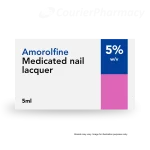
A topical antifungal nail lacquer used for the treatment of mild to moderate fungal nail infections without involvement of the nail base.
Pack size of 5ml
Amorolfine 5% nail lacquer is supplied at Courier Pharmacy after a brief online consultation reviewed by a UK pharmacist, then dispensed and delivered to your door.
Amorolfine 5% nail lacquer is a topical antifungal treatment for mild to moderate fungal nail infection (onychomycosis) in adults, when the nail matrix (the growth area at the base of the nail) is not involved. Each millilitre contains 50mg of amorolfine (as hydrochloride).
You’ll usually get a 2.5ml or 5ml bottle, plus the bits that make it work properly over time: disposable nail files, cleansing pads, and reusable applicator spatulas. Treatment takes patience, because nails grow slowly. So, think in months, not days.
What fungal nail infection looks like
Fungal nail infections most often affect the toenails. They usually start at the edge of the nail and creep inwards. Common signs include:
Yellow, brown, or white discolouration
Thickening of the nail
Brittle or crumbly edges
The nail lifting away from the nail bed
It’s not always painful at first. However, it can become uncomfortable as the nail thickens. For many people, the biggest impact is how the nail looks (and how confident you feel in sandals).
How amorolfine nail lacquer works
Amorolfine is an antifungal from the morpholine group. In simple terms, it disrupts the fungus’s cell membrane so it can’t grow properly, and it may also kill the fungus.
The key benefit is the lacquer format. Creams and sprays struggle to reach the fungus under and within the nail plate. A nail lacquer is designed to stick to the nail and penetrate into the nail, which is where the fungus actually lives.
Who can use amorolfine (and when it may not be enough)
In the UK, amorolfine 5% nail lacquer is a Pharmacy (P) medicine. That means you can buy it without a prescription, but a pharmacist should check it’s suitable first.
Amorolfine can be a good option if:
Only one or a few nails are affected
The infection looks mild to moderate
The base of the nail (matrix) doesn’t seem involved
However, you may need a GP assessment (and sometimes an oral antifungal) if:
Many nails are affected
The infection involves the nail base
You have diabetes, poor circulation, or are immunosuppressed
The nail changes might be something else (like psoriasis, trauma, or lichen planus)
How we supply amorolfine at Courier Pharmacy
At Courier Pharmacy, every amorolfine order is reviewed by a UK pharmacist. We’ll ask about what the nail looks like, how long it’s been going on, and what you’ve tried already. If it doesn’t sound like straightforward fungal nail infection, we’ll be honest and point you to the right next step.
Key features and specifications
Active ingredient: Amorolfine 5% (50mg/ml as hydrochloride)
Form: Clear, colourless to slightly yellow lacquer solution
Pack size: 5ml bottle, plus nail files, cleansing pads, and applicators
Class: Topical morpholine antifungal
Legal status (UK): Pharmacy (P) medicine
Typical use: Apply once weekly (some products advise twice weekly at first), after filing the nail and cleansing with an alcohol pad (as directed)
Storage: Store below 30°C; keep bottle tightly closed; do not refrigerate
MOJO WISDOM
Take control of your health by understanding your condition and what this medication is doing for you.
READ:
More information about this treatment.
UK-based doctors and pharmacists
Discreet and Confidential
UK-based doctors and pharmacists
Free, Expert Advice
No video link provided.
No video link provided.
UK-based doctors and pharmacists
Free, expert advice
Discrete and confidential
Fast delivery
Giving you trusted clinical advice for over 40 conditions
A UK regulated pharmacy providing safe, effective treatments online since 2014
A nail that’s gone yellow, thickened, and crumbled at the edges over the past year or so. Something you’ve been quietly ashamed of, that you don’t want to mention at the GP but keep noticing every time you put on socks or sandals.
Fungal nail infections are common, treatable, and far less dramatic to deal with than most people expect. Amorolfine 5% nail lacquer is one of the longest-established topical antifungals for fungal nail infections, available through UK pharmacies without prescription.
At Courier Pharmacy we want you to understand exactly how it works, who it suits, the realistic treatment timeline (longer than most people hope), and the practical application steps, so the choice feels properly yours.
Five key takeaways
Amorolfine 5% nail lacquer is a topical antifungal medicine applied directly to fungal-infected nails to treat onychomycosis (fungal nail infection) caused by susceptible organisms.
It’s available in UK pharmacies as a Pharmacy (P) medicine, supplied after a brief pharmacist consultation, rather than needing a prescription from your GP.
Treatment is long: typically 6 months for fingernails and 9 to 12 months for toenails, with applications once or twice weekly throughout. There’s no shortcut.
The application process involves filing the nail surface first (with a disposable file), wiping with the supplied alcohol pad, and brushing on the lacquer like nail polish. This isn’t fiddly but does need a routine.
Amorolfine works for mild to moderate cases without nail-matrix involvement. For severe infections affecting more than half the nail, the nail base (matrix), or multiple nails, oral antifungal treatment (terbinafine, itraconazole) is usually needed.
Treatment dosage Amorolfine 5% nail lacquer
The standard application is once weekly for both fingernails and toenails. Some products recommend twice-weekly application for the first month before reducing to once weekly; check the patient information leaflet for the specific brand you’ve been supplied.
Treatment duration is the most important number to commit to before starting. Fingernails grow at around 0.1mm per day; toenails grow more slowly at around 0.05mm per day. Because amorolfine treats the fungus that’s living in the existing nail, the visibly damaged nail material can’t be cured — it has to grow out and be replaced by healthy nail. This takes:
Fingernails: typically 6 months of weekly application
Toenails: typically 9 to 12 months of weekly application, sometimes longer for the big toenails
Stopping treatment too early is the most common reason for treatment failure and recurrence. Even when the nail looks better, there may still be fungus in the nail bed waiting to re-emerge. Complete the full course as recommended.
The application process matters as much as the duration:
File the infected nail surface using one of the supplied disposable nail files. Gently file the top layer of the nail down to remove the surface (the lacquer needs direct contact with the nail material to penetrate). File until the surface feels slightly rough or dull, not until it bleeds or hurts.
Wipe the filed nail with one of the supplied alcohol cleansing pads. This removes any residual lacquer from previous applications and any nail debris.
Use the same nail file only once. Don’t use a single file across multiple nails (this can spread the infection from infected nails to uninfected ones). Don’t share nail files with other people (the same risk).
Open the lacquer bottle Use one of the supplied reusable spatulas to dip into the lacquer.
Apply the lacquer in a thin layer across the entire infected nail surface, including the small free edge under the tip and the cuticle area. Let the lacquer dry for around 3 to 5 minutes; it forms a thin, transparent film.
Clean the spatula after each use with an alcohol pad, so it’s ready for the next application. Replace the cap of the bottle tightly.
Wait at least 10 minutes before putting on shoes or socks, to allow full drying.
The lacquer is designed to remain on the nail through normal washing, bathing, and showering between weekly applications. If you want to use cosmetic nail polish, this can be applied over the amorolfine after the medicine has dried for at least 10 minutes. Remove the cosmetic polish with normal nail polish remover, then reapply amorolfine on the scheduled day.
If you miss a weekly application, apply it as soon as you remember and continue with the original weekly schedule. Don’t double up to compensate.
Overview of Amorolfine 5% nail lacquer
Five things worth knowing:
Amorolfine works against most dermatophytes (the most common cause of nail infections), many yeasts including Candida, and some non-dermatophyte moulds.
Cure rates with amorolfine alone for mild to moderate onychomycosis are around 50-70% in clinical trials. This is lower than oral terbinafine (75-85%) but with the significant advantage of avoiding systemic side effects and drug interactions.
The medicine is most effective for distal (edge-of-nail) infections without matrix involvement; if the nail base (the white half-moon area, called the lunula) is affected, oral treatment is usually needed.
Compliance is genuinely difficult with such long treatment courses. Around half of patients stop treatment early, which is a major reason for the cure-rate gap with the higher-effort oral alternatives.
For severe cases, combination therapy (oral terbinafine plus topical amorolfine) can produce higher cure rates than either alone.
Amorolfine sits among a small group of topical antifungals used for nail infections. Other UK options include tioconazole 28% nail solution (Trosyl) and the over-the-counter Curanail brand (which is amorolfine 5% under a different name, also available without prescription). Other countries have efinaconazole and tavaborole nail solutions, but these aren’t available in the UK.
For mild to moderate onychomycosis, amorolfine is a reasonable first-line topical choice. NICE Clinical Knowledge Summaries recognise amorolfine as a treatment option for mild distal onychomycosis affecting 50% or less of the nail, without matrix involvement. For more extensive disease, oral antifungals (terbinafine, itraconazole) are usually preferred because of their higher cure rates.
For people living with fungal nail infections alongside other complex conditions, fibromyalgia, ME/chronic fatigue, MCAS, autoimmune issues, the topical-only nature of amorolfine has real advantages. Many people in these groups have multiple medication sensitivities and are nervous about adding systemic medicines. The topical route means minimal absorption (less than 1% reaches the bloodstream), no drug interactions, and no need for liver function monitoring (which is required for oral terbinafine and itraconazole). The trade-off is the longer treatment duration and lower cure rate.
The realistic conversation about cure rates matters. Roughly 50-70% of mild-to-moderate cases respond to amorolfine alone, meaning 30-50% don’t fully clear. Of those who do respond, recurrence rates are around 20-30% over 5 years, particularly if the underlying risk factors (foot moisture, athlete’s foot, communal pool/shower use) aren’t addressed. Treating the toenail without treating the foot environment is like mopping the floor while the tap is still running.
Why choose Courier Pharmacy for Amorolfine 5% nail lacquer
Fungal nail infections are one of those conditions where embarrassment delays treatment. The whole point of an online pharmacy consultation is that you don’t have to take your shoes off in front of anyone, repeatedly, to access a treatment that doesn’t actually require complex medical input. Every amorolfine order at Courier Pharmacy is reviewed by a UK pharmacist who reads your answers, considers whether topical treatment is the right approach, and explains the decision either way.
We’ll ask about how many nails are affected, how much of each nail is affected, and whether the nail base (lunula) is involved. For straightforward mild-to-moderate cases, amorolfine is a sensible self-treatment option. For more severe cases — multiple nails, matrix involvement, immunosuppression, diabetes with poor circulation — we’ll discuss whether a GP consultation for oral antifungal treatment would be more appropriate. We’ll also discuss the realistic 6 to 12-month treatment timeline so you can plan around it rather than starting and stopping.
Our brand guide, Dr Ada Jex-Cori, sums it up: you’re not broken. The system that’s failed you might be. We want to do the part we can do, properly, and connect you with the rest. That includes our free fortnightly drop-in clinics and talks at Insomnia in Derby, where you can ask questions face-to-face without spending a penny.
Buy Amorolfine 5% nail lacquer from Courier Pharmacy
Amorolfine 5% nail lacquer is a Pharmacy (P) medicine in the UK, which means it can be sold without prescription but only after a brief consultation with a pharmacist. Buying through Courier Pharmacy is straightforward and built around your time, not ours.
Here’s how it works:
Complete a quick online consultation
A UK pharmacist reviews your answers
If suitable, supply is approved with guidance on application and duration
We dispense and deliver discreetly to your door
If it isn’t suitable for you, we’ll explain why and suggest the next best option.
Active ingredient in Amorolfine 5% nail lacquer
The active ingredient is amorolfine, a synthetic morpholine antifungal developed in the 1980s. It’s chemically distinct from the older azole antifungals (clotrimazole, miconazole, ketoconazole) and from the allylamines (terbinafine), which means it works through a different mechanism and has a different resistance profile.
Amorolfine inhibits two enzymes in the fungal cell membrane biosynthesis pathway. Both are involved in producing ergosterol, the main sterol in fungal cell membranes (equivalent to cholesterol in human cell membranes). By blocking ergosterol production at two different steps, amorolfine causes accumulation of intermediate sterols that disrupt the integrity of the fungal cell membrane. The fungus can’t grow normally (fungistatic effect) and at higher concentrations the membrane becomes leaky enough to kill the fungus (fungicidal effect).
This dual-enzyme inhibition is one of amorolfine’s distinctive features. The older azoles inhibit just one enzyme, and terbinafine inhibits another (squalene epoxidase). The differences matter for resistance and for activity against specific organisms.
Each millilitre of amorolfine 5% nail lacquer contains 50mg of amorolfine (as hydrochloride). The vehicle of the lacquer is what makes it work practically: it contains the active ingredient plus film-forming polymers, organic solvents, and stabilisers that allow the medicine to penetrate into the nail keratin and form a thin, lasting film. The exact excipient profile varies slightly by manufacturer, but typically includes triacetin, ethyl acetate, butyl acetate, ethanol, and methacrylic acid copolymers.
After application, amorolfine penetrates the nail plate over the days following application, with concentrations remaining in the nail throughout the week between applications. Systemic absorption is very low — less than 1% of the applied dose reaches the bloodstream — which is why drug interactions and systemic side effects are minimal.
What is Amorolfine 5% nail lacquer for?
Amorolfine 5% nail lacquer is licensed in the UK for the treatment of onychomycosis (fungal nail infections) caused by susceptible organisms in adults. The licensed scope is specifically for:
Mild to moderate cases of onychomycosis
Cases without involvement of the nail matrix (the nail base, including the white half-moon area called the lunula)
Generally cases affecting 50% or less of the nail plate
Typically affecting up to two fingernails and toenails (more than this and oral treatment is usually preferred)
The medicine works against the common fungal causes of nail infection: dermatophytes (especially Trichophyton rubrum and Trichophyton mentagrophytes), yeasts including Candida species, and some non-dermatophyte moulds (Scopulariopsis, Aspergillus, Fusarium).
Amorolfine is not licensed or appropriate for:
Severe onychomycosis with matrix involvement
Onychomycosis affecting more than 50% of the nail plate
Multiple nail involvement (more than 2 nails, especially in toenails)
Total dystrophic onychomycosis (where the whole nail is involved)
Children under 18
Pregnancy or breastfeeding (without prescriber input)
Nail changes from non-fungal causes (psoriasis, lichen planus, trauma, age-related changes)
If your nail changes don’t fit a typical fungal infection, or if multiple severe nails are affected, your prescriber or pharmacist may recommend a nail clipping for fungal microscopy and culture before starting treatment. This isn’t always essential but can be useful for unusual cases, immunocompromised patients, or where treatment hasn’t responded as expected.
How does Amorolfine 5% nail lacquer work?
Fungal nail infections involve fungi growing within the nail keratin itself. The fungus penetrates from the edge of the nail (usually the free distal edge or the side edge) and grows backwards through the nail towards the cuticle. The nail itself isn’t alive — it’s keratinised dead cells — but the fungus uses the keratin as food and produces enzymes that further damage the structure of the nail. This is what produces the thickening, discolouration, and crumbling.
For an antifungal medicine to work on a nail infection, it needs to reach the fungus living within the nail keratin. This is harder than it sounds. The nail plate is dense, relatively impermeable, and continually growing outward. Topical creams designed for skin penetrate poorly into nails. Older nail lacquers used a film that had to be removed and reapplied frequently. Amorolfine’s lacquer formulation is specifically designed to penetrate the nail keratin and maintain therapeutic concentrations for a week between applications.
Once amorolfine reaches the fungus within the nail, it blocks two enzymes in the fungal cell membrane synthesis pathway. Both enzymes are needed for the fungus to produce ergosterol, the main sterol in its cell membrane. Without ergosterol, the cell membrane becomes leaky and structurally unstable. The fungus stops growing (fungistatic effect) and at higher concentrations dies (fungicidal effect).
The medicine doesn’t make the existing infected nail look better. The damaged nail keratin can’t be repaired; it’s dead tissue with fungal damage. What amorolfine does is kill the fungus so that as new nail grows from the matrix, it grows in clean and uninfected. Over the months of treatment, the new healthy nail gradually replaces the damaged one, working from the cuticle outward. This is why treatment is so long: the nail needs to grow all the way out.
Cure is usually defined as both clinical cure (the nail looks normal) and mycological cure (no fungus found on nail testing). The two don’t always coincide exactly — some nails look normal after treatment but still have minimal fungus, while others have residual cosmetic damage even after the fungus is gone.
Application frequency (weekly) was chosen based on pharmacokinetic studies showing therapeutic amorolfine concentrations within the nail for at least a week after application. More frequent application doesn’t usually improve efficacy and isn’t recommended in the standard regimen.
How to use Amorolfine 5% nail lacquer
The first application matters because it sets the routine you’ll follow for the next 6 to 12 months. Build this around a regular weekly habit: same day of the week, same time, so you don’t forget. Sunday evening before bed is a common choice — there’s time for the lacquer to dry properly before sleep.
Step-by-step application:
Gather your supplies: the amorolfine bottle, a fresh disposable nail file, a fresh alcohol cleansing pad, the reusable spatula, and a clean surface to work on.
Wash and dry your hands thoroughly. Make sure the nail to be treated is clean and dry. Remove any cosmetic nail polish before starting (acetone-based remover is fine).
Take a disposable nail file and gently file the surface of the infected nail. The goal is to remove the top layer of nail material, exposing the keratin underneath where the fungus is. File until the surface feels slightly rough; don’t file aggressively or until it bleeds.
Use a fresh file for each nail you’re treating. Don’t reuse a file across multiple nails. Don’t share files with other people.
Wipe the filed nail with the alcohol cleansing pad. This removes any nail dust, residual previous lacquer, and any surface debris.
Open the lacquer bottle. Dip the reusable spatula into the lacquer; pick up a small amount.
Apply the lacquer in a thin layer across the entire infected nail surface. Cover the free edge of the nail (the small lip that grows beyond the finger or toe), the surface, and right up to the cuticle. Don’t apply to surrounding skin (it’s not harmful but isn’t helpful either, and can be wasteful).
Allow the lacquer to dry for 3 to 5 minutes. It forms a thin, transparent or slightly tinted film that’s barely visible.
Clean the spatula with another alcohol pad — important so it’s ready for next time without contamination.
Replace the cap on the bottle tightly. Store the bottle at room temperature.
Wait at least 10 minutes (or longer where practical) before putting on socks, tights, or shoes, to ensure the lacquer is properly dry.
Between applications:
Normal washing, bathing, showering, and swimming don’t usually remove the lacquer between weekly applications
Cosmetic nail polish can be applied over the medicine after it’s dried for 10 minutes — apply your usual polish on top, and remove it before the next medical application
Avoid using harsh nail products or vigorous nail filing between weekly applications, which can disrupt the medicated film
Keep your nails reasonably short to reduce trauma and to make sure the lacquer reaches the entire infected area
Foot hygiene matters alongside treatment:
Treat any athlete’s foot at the same time (with an antifungal cream like clotrimazole or terbinafine)
Keep feet dry; change socks daily; dry between the toes thoroughly after washing
Don’t share towels, nail clippers, or files
Avoid walking barefoot in communal areas (changing rooms, swimming pool sides)
Replace shoes that may be heavily contaminated with fungus
If you have diabetes or circulatory problems affecting your feet, keep these well-controlled
Track your progress:
Take a photo of the affected nail every 2 to 4 weeks at the same angle and lighting
This makes gradual improvement visible (week-to-week change is hard to see)
The nail typically improves from the cuticle outward as the new healthy nail grows
If treatment is going well, you should see new healthy nail emerging from the cuticle within 3 to 4 months. If after 6 months of consistent application there’s no visible improvement at all, contact your prescriber or pharmacist to discuss whether oral antifungal treatment would be more appropriate.
Treatment dosage Amorolfine 5% nail lacquer
The standard application is once weekly for both fingernails and toenails. Some products recommend twice-weekly application for the first month before reducing to once weekly; check the patient information leaflet for the specific brand you’ve been supplied.
Treatment duration is the most important number to commit to before starting. Fingernails grow at around 0.1mm per day; toenails grow more slowly at around 0.05mm per day. Because amorolfine treats the fungus that’s living in the existing nail, the visibly damaged nail material can’t be cured — it has to grow out and be replaced by healthy nail. This takes:
Fingernails: typically 6 months of weekly application
Toenails: typically 9 to 12 months of weekly application, sometimes longer for the big toenails
Stopping treatment too early is the most common reason for treatment failure and recurrence. Even when the nail looks better, there may still be fungus in the nail bed waiting to re-emerge. Complete the full course as recommended.
Warnings and precautions for Amorolfine 5% nail lacquer
Amorolfine is contraindicated in known hypersensitivity to amorolfine or any excipient in the lacquer.
Use is not licensed in children and adolescents under 18. There is limited data on amorolfine use in this age group, and fungal nail infections are less common in children; if a child has nail changes that look fungal, a paediatric assessment to confirm the diagnosis is appropriate.
Use during pregnancy and breastfeeding should be discussed with a prescriber. Systemic absorption is very low (less than 1%), and amorolfine has not been associated with significant fetal effects in animal studies, but human data are limited. Many clinicians prefer to defer cosmetic treatment of nail fungus until after pregnancy and breastfeeding.
Use with care in:
Diabetes mellitus, particularly with peripheral vascular disease or peripheral neuropathy — nail problems in this group can be more serious than they appear, and any worsening (pain, swelling, redness around the nail) needs urgent assessment
Immunocompromised patients — fungal infections can be more aggressive and may need oral treatment
Patients with poor peripheral circulation
Patients who have had previous foot or nail surgery
If you develop a rash, itching, burning, or redness on the skin around the treated nail, stop using the lacquer and contact your prescriber. This may indicate an allergic or irritant reaction.
If the nail changes worsen significantly during treatment (rapid progression, severe pain, redness extending up the toe or finger, signs of infection), seek prompt medical advice. While these symptoms aren’t typical of routine fungal nail infections, they can occur in mixed infections or where the diagnosis isn’t actually fungal.
Practical safety considerations:
The lacquer is flammable until dry, so keep it away from flames and don’t smoke during application
Avoid contact with eyes, ears, and mucous membranes
Don’t swallow the lacquer (very rare risk, but worth flagging for households with young children)
Store out of reach of children
Don’t use other nail products that contain similar antifungal medicines simultaneously without checking with your prescriber. If you’ve already tried tioconazole (Trosyl) nail solution and it hasn’t worked, switching to amorolfine is reasonable; combining them isn’t recommended.
If you have other unaffected nails on the same hand or foot, use a fresh file and fresh alcohol pad for each treated nail, and avoid the lacquer contacting the healthy nails (it’s harmless but wasteful).
Side effects of Amorolfine 5% Nail Lacquer
Amorolfine 5% Nail Lacquer is well-tolerated for most patients. Side effects are usually local and mild.
Common side effects, between 1 in 100 and 1 in 10 people, include mild local irritation around the nail, burning sensation on application, and mild erythema.
Uncommon side effects, between 1 in 1,000 and 1 in 100 people, include nail dystrophy (changes in nail appearance separate from the fungal infection), nail discoloration, broken or split nails, and contact dermatitis around the nail.
Rare side effects, fewer than 1 in 1,000 people, include severe allergic contact dermatitis requiring discontinuation, and significant skin irritation extending beyond the application area.
Very rare side effects include severe allergic reactions including anaphylaxis (exceptionally rare with topical antifungals).
The most common practical issue isn’t really a side effect — it’s the long treatment duration and the gradual visible improvement, which can be frustrating but doesn’t indicate the treatment isn’t working.
If you experience any side effect that worries you, you can report it directly to the MHRA’s Yellow Card scheme. This helps improve safety data for everyone who uses the product. Our pharmacy team are happy to help you submit a Yellow Card report if you’d like assistance.
Drug interactions with Amorolfine 5% nail lacquer
Because systemic absorption of amorolfine is less than 1% of the applied dose, clinically meaningful drug interactions are essentially non-existent. This is one of the practical advantages of topical antifungal treatment compared to oral options like terbinafine or itraconazole, which have substantial interaction profiles.
There are no significant interactions with:
Anticoagulants (warfarin, apixaban, rivaroxaban)
Statins
Antidepressants
Diabetes medicines
Contraceptives
Blood pressure medicines
Cardiac medicines
Concurrent use of other topical nail products (cosmetic nail polish, nail-strengthening treatments) is generally compatible, although it makes sense to apply cosmetic products over the amorolfine after it’s dried, not before.
If you’re prescribed oral antifungal medicines (terbinafine, itraconazole) by a specialist as combination therapy for difficult-to-treat nail infections, the topical amorolfine can be used alongside these without interaction concerns.
Always tell your pharmacist about everything you take, including over-the-counter medicines, vitamins, supplements, and herbal products, before starting amorolfine, even though clinically significant interactions are very unlikely. This is good general practice.
Frequently asked questions about Amorolfine 5% nail lacquer
What is amorolfine used for?
Amorolfine 5% nail lacquer is used to treat fungal nail infections (onychomycosis) in adults. It works against the most common fungi that cause these infections, including dermatophytes, yeasts, and some moulds.
Do I need a prescription for amorolfine?
No. It’s available as a Pharmacy (P) medicine in the UK after a brief pharmacist consultation. The 5% strength is the only form available.
How long does treatment take?
Around 6 months for fingernails and 9 to 12 months for toenails. This is because the medicine kills the fungus but doesn’t fix the damaged nail — that has to grow out and be replaced by healthy new nail, which takes time.
How often do I apply it?
Once weekly is the standard. Some products recommend twice weekly for the first month before reducing to once weekly. Check the patient information leaflet for the specific brand you’ve been supplied.
Why do I need to file the nail first?
Filing removes the top layer of nail surface, allowing the medicine to penetrate into the deeper nail keratin where the fungus actually lives. Filing also removes the previous week’s medicine film so the new application can penetrate properly.
Do I have to use a new file every time?
You need a new file for each nail (don’t share files between nails — this can spread infection). Some people use one file per nail per treatment session. Many products come with enough disposable files for the full course.
Can I wear cosmetic nail polish over amorolfine?
Yes. Apply the cosmetic polish after the amorolfine has dried for at least 10 minutes. Remove the cosmetic polish with regular nail polish remover before the next medical application.
Can I have a manicure or pedicure during treatment?
Avoid aggressive nail filing or buffing that would disrupt the medicated film. Cosmetic services that don’t involve heavy nail surface work (cuticle care, polish application) are generally fine, but tell the technician you’re using a medicated nail product.
How will I know if it’s working?
Track your progress with photos every 2 to 4 weeks. New healthy nail growing in from the cuticle is the main sign of improvement. The damaged nail material can’t heal; it has to grow out. If after 6 months there’s no improvement at all, treatment may not be working and a different approach may be needed.
What if I miss a weekly application?
Apply as soon as you remember and continue with your regular schedule. Don’t double up.
Can I swim, shower, or go to the gym during treatment?
Yes, normal washing and water exposure don’t usually remove the lacquer between weekly applications. Wear flip-flops in communal showers and changing rooms to reduce reinfection risk.
What if I have athlete’s foot too?
Treat the athlete’s foot at the same time with an antifungal cream like clotrimazole or terbinafine cream. Treating the nail without treating the skin can lead to reinfection of the nail from the surrounding skin.
Can I use amorolfine during pregnancy?
Use during pregnancy should be discussed with your prescriber. Systemic absorption is very low (less than 1%), but human pregnancy data are limited. Many clinicians prefer to defer treatment until after pregnancy and breastfeeding.
Can I use amorolfine while breastfeeding?
Discuss with your prescriber. Systemic absorption is very low, so any transfer to breast milk should be minimal, but data are limited and deferring treatment is sometimes preferred.
Can children use amorolfine?
No, it’s not licensed for children under 18. Fungal nail infections in children are uncommon and may need different assessment.
What if amorolfine doesn’t work?
For cases that don’t respond, oral antifungal treatment (terbinafine or itraconazole) is usually the next step. Your prescriber or pharmacist can discuss this. Sometimes combination treatment (oral plus topical) is used for difficult cases.
Will my nail look normal after treatment?
The aim is yes, but it depends on the severity of the original infection and how completely treatment works. Some nails return to looking entirely normal; others have residual cosmetic changes (slight thickening, mild discolouration) even after the fungus is cleared.
Can I use amorolfine on multiple nails at once?
Yes, but each nail needs its own fresh file. The licensed scope is generally for up to two fingernails and toenails; if more are affected, oral treatment is usually preferred.
Can I share the bottle with my partner if we both have nail fungus?
We don’t recommend sharing the bottle (the spatula goes back into the lacquer after touching a nail and could theoretically carry fungus between users). Each person should have their own bottle and supplies. Both partners can be assessed for treatment.
Why is fungal nail infection so common in toenails?
Toenails are more often affected because the toes are usually enclosed in warm, dark, sometimes damp environments (socks and shoes) where fungi thrive. Athlete’s foot (between the toes) often coexists with fungal nail infection and serves as a reservoir for reinfection.
Crawford, F. and Hollis, S. (2007) ‘Topical treatments for fungal infections of the skin and nails of the foot’, Cochrane Database of Systematic Reviews, (3), CD001434. Available at: https://pubmed.ncbi.nlm.nih.gov/17636672/