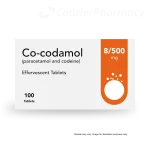
Co-Codamol 8/500 effervescent tablets in the 100 pack size is prescription only medicine (POM).
Contains 8mg codeine phosphate and 500mg paracetamol per tablet..
The 100 pack size is a larger supply appropriate only for patients with a defined ongoing pain management plan, supervised by a pharmacist or prescriber.
Codeine combinations including Co-Codamol must not be used for more than 3 days continuously without medical review, due to the risk of physical dependence.
The effervescent format carries a meaningful sodium load that matters in patients with high blood pressure or heart conditions.
Available from Courier Pharmacy after a pharmacist-led consultation.
Co-Codamol 8/500 Effervescent Tablets is a UK Pharmacy (P) medicine for the short-term relief of mild to moderate pain when paracetamol or ibuprofen alone hasn’t helped enough. Each effervescent tablet contains codeine phosphate 8mg and paracetamol 500mg. You dissolve the tablet in water, then drink it.
Because it combines paracetamol with a low dose of codeine, Co-Codamol 8/500 sits one step above standard paracetamol on the pain ladder. Paracetamol helps reduce pain signals in the central nervous system. Meanwhile, your body converts codeine into morphine using the liver enzyme CYP2D6, which adds extra pain relief through opioid receptors.
Importantly, 8/500 is the lowest-strength licensed codeine + paracetamol combination you can buy without a prescription in the UK. However, it still needs careful use. So, keep it short-term and follow the dose guidance.
Why choose the effervescent format?
Effervescent tablets can suit you if you struggle to swallow solid tablets. Plus, the medicine has already dissolved in the glass, so it may start working a little faster than a standard tablet.
This format can be helpful after dental work, with a sore throat, or if swallowing feels difficult (for example, with oesophagitis or a stricture). It can also suit older adults with dry mouth, or anyone who simply prefers a drinkable option.
Why the 100-pack matters
A 100-pack is much larger than the standard 32-tablet pack. For that reason, it should only be used when you have a clear, defined pain plan and a clinician has confirmed that a larger pack is appropriate.
In other words, don’t use a larger pack as a workaround for the 3-day continuous use limit on codeine combinations. Instead, use it with clear criteria, planned review points, and a stop date.
How we supply it at courierpharmacy.co.uk
At courierpharmacy.co.uk, we supply Co-Codamol 8/500 Effervescent Tablets (100 pack) from a UK-registered pharmacy after a pharmacist-led consultation.
During the consultation, we review:
Your pain history and current symptoms
Whether a 100-pack is appropriate for you
Contraindications and safety risks
Your current medicines and relevant health conditions
Your agreed plan, including review and stop-date guidance
Key features and specifications
Active ingredients: codeine phosphate 8mg + paracetamol 500mg (per tablet)
Form: effervescent tablets (dissolve in water before drinking)
Pack size: 100 tablets
Indication: short-term relief of mild to moderate pain not controlled by paracetamol or ibuprofen alone
Standard adult dose: 1–2 tablets every 4–6 hours (max 8 tablets in 24 hours)
Maximum continuous use: 3 days without medical review
Sodium content: approx. 388–427mg per tablet (significant — see warnings)
Legal category: Prescription only medicine (POM)
Supplied by: Courier Pharmacy (UK GPhC-registered), after pharmacist-led consultation via courierpharmacy.co.uk
MOJO WISDOM
Take control of your health by understanding your condition and what this medication is doing for you.
READ:
More information about this treatment.
UK-based doctors and pharmacists
Discreet and Confidential
UK-based doctors and pharmacists
Free, Expert Advice
No video link provided.
No video link provided.
UK-based doctors and pharmacists
Free, expert advice
Discrete and confidential
Fast delivery
Giving you trusted clinical advice for over 40 conditions
A UK regulated pharmacy providing safe, effective treatments online since 2014
When a tablet won’t go down comfortably, or when you’re managing pain in a context where solid tablets aren’t practical (after dental surgery, with a sore throat, with swallowing difficulties, or simply because you prefer a dispersible format), Co-Codamol 8/500 effervescent tablets give you the same paracetamol and low-dose codeine combination as the standard tablet form, dissolved into a pleasant drink. The 100 pack size is for patients who have been managing chronic pain on Co-Codamol 8/500 for a defined period and need a larger pack as part of a managed treatment plan.
At Courier Pharmacy, we believe pain care should suit the person, not the marketing budget. Whether you’re managing post-operative pain, headache, musculoskeletal pain, period pain, or background pain that doesn’t quite respond to paracetamol alone, this page is here to help you decide whether Co-Codamol 8/500 effervescent tablets in the 100 pack are right for your situation, and how to use them well and safely.
Five key takeaways
Co-Codamol 8/500 effervescent tablets is a UK Pharmacy (P) medicine combining 8mg codeine phosphate and 500mg paracetamol per tablet, dissolved in a glass of water before drinking.
The 100 pack size is a larger pack and should not be confused with a short-term self-treatment supply. It is appropriate only for patients with a defined ongoing pain management plan, supervised by a pharmacist or prescriber, with a clear plan for review.
Standard adult dose: 1 to 2 tablets dissolved in water, taken every 4 to 6 hours as needed, to a maximum of 8 tablets in 24 hours.
Codeine combination products including Co-Codamol must not be used for more than 3 days continuously without medical review, due to the risk of physical dependence with codeine, regardless of pack size.
The effervescent format contains a meaningful sodium load (around 388 to 427mg sodium per tablet), which matters for patients with high blood pressure, heart failure, or kidney disease and should always be considered when choosing this format over standard tablets.
Always follow the dosing instructions from your pharmacist or prescriber. The information below is based on standard BNF and SmPC guidance for codeine-paracetamol 8/500 combinations.
For adults and adolescents 16 years and over: 1 to 2 tablets dissolved in a glass of water (approximately 150 to 200ml), taken every 4 to 6 hours as needed, to a maximum of 8 tablets in 24 hours.
For adolescents aged 12 to 15: codeine combinations should generally be avoided. The MHRA restricted the use of codeine in this age group in 2013 because of the risk of severe respiratory depression in CYP2D6 ultra-rapid metabolisers. If pain relief in adolescents requires an opioid, this should be done under specialist advice, not through a Pharmacy supply.
For children under 12: codeine is contraindicated. Do not use.
Stir the tablets in water until they have fully dissolved. The drink should be clear or slightly cloudy with no visible undissolved fragments. Drink within a few minutes of preparation; do not save dissolved tablets for later. Take after meals if possible, with a glass of water to follow.
Do not exceed the maximum daily dose. 8 tablets in 24 hours delivers 4g of paracetamol (the maximum safe daily dose) and 64mg of codeine. Exceeding either component can cause harm: paracetamol overdose can cause severe and potentially fatal liver injury, and codeine overdose can cause respiratory depression. The safe upper limit of 8 tablets in 24 hours is a hard ceiling, not a guideline.
Do not use for more than 3 days continuously without medical review. The MHRA restricted codeine combination products in 2009 to short-term use only, because of the risk of physical dependence and addiction with continuous codeine use. If your pain has not improved after 3 days of regular use, contact your prescriber for a review rather than continuing on the same regime. The 100 pack size does not change this 3-day rule; the larger pack is for repeated short courses or for intermittent use, not for continuous longer-term use.
The 100 pack at the standard maximum dose (8 tablets daily) provides 12.5 days of supply if used continuously. In practice, intermittent use makes the pack last considerably longer. The pack size is calibrated for managed pain plans where short courses are repeated over time, not for indefinite continuous use.
Do not stop codeine combinations abruptly after several days of continuous use. Some patients experience mild withdrawal symptoms (sweating, restlessness, gastrointestinal symptoms) when they stop codeine after a few days of use. Tapering down (1 to 2 tablets per dose less per day) over a couple of days is usually more comfortable than stopping cold.
If you have taken more than the recommended dose, seek medical advice immediately, even if you feel well. Paracetamol overdose damage to the liver can be silent for the first 24 to 48 hours, and prompt treatment (within 8 hours of overdose) can prevent serious harm. Bring the pack with you so the medical team can see exactly what has been taken.
Overview of Co-Codamol 8/500 effervescent tablets — 100 Pack
Where Co-Codamol 8/500 sits in the pain care toolkit
Pain management in the community typically progresses through a stepped approach. Step 1 is paracetamol and/or topical NSAIDs for mild pain. Step 2 adds a weak opioid like codeine (or low-dose tramadol) where paracetamol alone is not enough. Step 3 moves to stronger opioids under prescription, alongside ongoing assessment for non-pharmacological approaches.
Co-Codamol 8/500 sits at the lower end of Step 2. The codeine dose at 8mg per tablet is small, intended to provide a modest additional analgesic effect rather than a substantial opioid effect. For patients whose pain has not responded fully to paracetamol or ibuprofen, the addition of low-dose codeine sometimes makes a meaningful difference. For patients whose pain is more substantial, higher-strength codeine combinations (15/500 or 30/500, both POM) may be more appropriate. Our prescriber can supply the higher strengths through a separate prescriber-led service.
The effervescent format offers no clinical advantage in pain control over standard tablets at the same dose. The decision to choose effervescent over standard is practical: ease of swallowing, faster onset where that matters, patient preference, or context (after dental surgery, with sore throat). For patients without a specific reason to choose effervescent, standard tablets are often preferred because of the lower sodium load.
The 100 pack and the 3-day rule
The MHRA’s 2009 restrictions on over-the-counter codeine combination products limited their use to short-term relief of acute moderate pain that has not been adequately relieved by paracetamol or ibuprofen alone, with a maximum continuous use of 3 days before medical review. The restrictions also limited pack sizes to a maximum that would not encourage long-term use.
Larger pack sizes (the 100 pack being one example) are legitimately supplied for patients with established intermittent or recurrent pain conditions, where short courses are repeated over time as needed. Examples include chronic migraine with episodic flares, recurrent musculoskeletal pain in patients with osteoarthritis who use codeine combinations during flares, and post-operative pain management where the patient needs more than the 32-tablet pack provides over the recovery period.
The 100 pack does not authorise continuous daily use beyond 3 days. The continuous use limit is a regulatory and clinical safety limit driven by the risk of codeine dependence with daily use. The larger pack provides convenience for patients who have a clear pattern of intermittent or repeated short-course use, without forcing them to re-purchase a smaller pack every few weeks.
Our pharmacist will assess whether the 100 pack is appropriate for your specific pain pattern during the consultation. If it isn’t (for example, if you are using codeine combinations daily over weeks or months), we will suggest a different approach, which may include a prescriber-led review for chronic pain management, switching to a non-codeine pain pathway, or referral to your GP for a comprehensive pain assessment.
The dependence and addiction conversation
Codeine carries a small but real risk of physical dependence and psychological addiction with regular use. The 2009 MHRA restrictions and the 3-day continuous use limit are designed to minimise this risk in over-the-counter supply. The 100 pack size, while not in itself implying long-term use, is the kind of supply pattern where dependence can develop if the pack is being used continuously rather than intermittently.
If you find yourself using codeine combinations more than you intended, taking them to relieve symptoms other than pain (anxiety, low mood, sleep), feeling unsettled when you have not taken them, or noticing that you need to take more for the same effect, these are warning signs that should prompt a review. Our pharmacist will discuss this honestly during the consultation. There is no shame in codeine dependence; it can develop in patients who started with a clear short-term pain need, and there are well-established pathways for stepping down and managing the transition.
At Courier Pharmacy, our whole approach is built around the idea that healthcare should fit the person. For Co-Codamol 8/500 in the 100 pack format specifically, that means careful, pharmacist-led assessment of whether the larger pack is appropriate for your pain pattern and whether the effervescent format is the right choice given your medical history. Our service is shaped by the philosophy of Dr Ada Jex-Cori, our brand pharmacist, who has built her practice around accessible, honest, personalised care. Her view is straightforward: you are not broken. The system is the problem. We are here to change that.
The 100 pack is not for everyone, and we treat that seriously. Patients with continuous daily pain over weeks or months are not best served by ongoing over-the-counter codeine supply; they need a comprehensive pain assessment, potentially including a prescriber-led review for stronger or different analgesics, non-pharmacological approaches, and consideration of whether codeine dependence is a factor. Our pharmacist will work through this with you honestly during the consultation. If the 100 pack isn’t right for your situation, we will explain why and suggest alternatives.
For patients with intermittent recurrent pain (osteoarthritis flares, recurrent migraine, post-surgical recovery) where the 100 pack is genuinely appropriate, the supply comes with explicit review intervals, a clear stop date if there is one, and ongoing access to our pharmacist for questions and concerns. The effervescent format is a real practical advantage for some patients, and we’ll help you decide whether that format fits your situation or whether standard tablets (with their lower sodium load) are the better choice.
Trust is the part that has to be earned, not claimed. We’re GPhC-regulated, we ground our content in NHS, NICE, BNF, and peer-reviewed sources, and we follow MHRA guidance on codeine combination supply scrupulously. We will tell you honestly if Co-Codamol 8/500 isn’t the right answer for your situation. We would rather lose a sale than supply a codeine pack to someone who needs a different kind of help.
Co-Codamol 8/500 effervescent tablets is a Pharmacy (P) medicine in the UK, supplied under pharmacist supervision. The 100 pack format is a larger supply that requires careful pharmacist-led assessment.
Here is how our service works:
Complete a quick online consultation answering questions about your pain situation, medical history, current medications, and pain management plan.
A UK-qualified pharmacist reviews your answers to confirm Co-Codamol 8/500 in the 100 pack is appropriate for your situation.
If approved, your order is prepared for dispatch with clear treatment plan information and review guidance.
We dispense and deliver discreetly to your door.
If Co-Codamol 8/500 in the 100 pack isn’t suitable for you, we will explain why and suggest the next best option. That might be:
The standard 32-tablet pack of Co-Codamol 8/500, more appropriate for a one-off acute pain episode.
Standard tablets rather than effervescent, if the sodium load is a concern.
A higher-strength codeine combination (Co-Codamol 15/500 or 30/500, both POM) through our prescriber-led service if your pain has not responded to 8/500.
A non-codeine pain approach (paracetamol with ibuprofen, naproxen, topical NSAIDs, compounded pain creams) if codeine isn’t the right answer for you.
A referral to your GP for a comprehensive pain assessment if continuous daily pain or developing dependence is a concern.
Our free fortnightly drop-in clinics at Insomnia, Derby run every other week from 10am to 12pm. Pain management, codeine use and dependence concerns, chronic pain, post-operative pain, MCAS-related pain, fibromyalgia, and the wider questions about how to manage pain well are all conversations we have regularly at these sessions. No appointment needed, no charge, no pressure.
Summary
Co-Codamol 8/500 contains 8mg codeine phosphate and 500mg paracetamol per tablet, with the codeine providing a small additional analgesic effect on top of paracetamol.
The effervescent format dissolves in water before drinking, which is easier for patients with swallowing difficulties and produces a marginally faster onset of analgesia.
The 100 pack is a larger supply requiring pharmacist-led assessment of a defined ongoing pain management plan, with explicit review intervals.
The 3-day continuous use limit applies to all codeine combinations including this 100 pack; the larger pack supports intermittent or repeated short-course use, not continuous use.
The sodium load in effervescent tablets (388 to 427mg per tablet) is clinically significant for patients with high blood pressure, heart
failure, or kidney disease, and is one of the most common reasons to choose standard tablets over the effervescent format.
Active ingredients in Co-Codamol 8/500 effervescent tablets
Codeine phosphate 8mg per tablet
Codeine is a naturally occurring opioid alkaloid found in the opium poppy. Pharmacologically, codeine itself has very weak direct opioid effects; its analgesic action depends almost entirely on its metabolism to morphine by the liver enzyme CYP2D6. Approximately 5 to 15% of administered codeine is converted to morphine in patients with normal CYP2D6 activity. The resulting morphine then provides mu-opioid receptor-mediated analgesia.
This metabolic dependence has important clinical consequences. Patients with reduced or absent CYP2D6 activity (CYP2D6 poor metabolisers, around 7 to 10% of UK Caucasians) produce very little morphine from codeine and get little analgesic benefit. Conversely, CYP2D6 ultra-rapid metabolisers (around 1 to 2% of UK Caucasians, higher in some other populations) convert codeine to morphine much faster and produce higher morphine levels than expected, with a higher risk of opioid side effects and respiratory depression. The latter is the reason for the MHRA's 2013 restrictions on codeine in children and adolescents and in breastfeeding women.
At 8mg per tablet, the codeine dose is modest. Two tablets deliver 16mg codeine, which produces around 1 to 2mg morphine equivalent in normal metabolisers. This is a small opioid dose, but enough to add a meaningful analgesic increment in many patients when combined with paracetamol.
Paracetamol 500mg per tablet
Paracetamol (acetaminophen in US terminology) is one of the most widely used analgesics in the world. Its precise mechanism of action is still debated but is thought to involve central inhibition of cyclooxygenase enzymes (COX-3 in particular) and modulation of the endocannabinoid and serotonergic pain pathways. Unlike NSAIDs, paracetamol has no significant peripheral anti-inflammatory effect.
The 500mg per tablet dose gives a maximum daily paracetamol intake of 4g at the maximum 8-tablet daily dose, which sits at the licensed safety ceiling. Paracetamol's safety profile is excellent at therapeutic doses but its overdose risk is real and serious: doses above 4g daily, particularly with alcohol use, fasting, or low body weight, can cause hepatic necrosis through depletion of glutathione stores that normally detoxify a toxic intermediate metabolite (NAPQI).
Excipients and the sodium load
The effervescent format requires sodium bicarbonate and/or sodium carbonate to produce the effervescence when the tablet is dropped in water. This produces a meaningful sodium load per tablet. The exact sodium content varies between manufacturers but is typically 388 to 427mg sodium per tablet. At the maximum daily dose of 8 tablets, this delivers around 3.1 to 3.4g of sodium daily, which is comparable to the entire WHO daily sodium intake recommendation (5g salt = 2g sodium).
For patients with normal blood pressure and normal kidney function, occasional short-course use is unlikely to cause harm. For patients with high blood pressure, heart failure, kidney disease, or those on sodium-restricted diets, the effervescent format is generally not the best choice. Standard tablets at the same paracetamol-codeine dose should be considered instead.
What are Co-Codamol 8/500 effervescent tablets — 100 Pack used for?
Co-Codamol 8/500 effervescent tablets is licensed in the UK for the short-term relief of mild to moderate pain that has not been adequately relieved by paracetamol or ibuprofen alone. Specific situations where the 100 pack format is commonly appropriate include:
Chronic intermittent pain (osteoarthritis flares, recurrent musculoskeletal pain) where short courses are repeated as needed during flares.
Post-operative pain management where the standard 32-tablet pack does not provide enough supply over the recovery period.
Migraine with frequent episodes, where codeine combinations are used intermittently during attacks alongside specific antimigraine treatment (although for migraine, codeine combinations are not the most evidence-based first-line treatment; specialist migraine medicines may be more appropriate).
Dental pain in the days after major dental work, where the effervescent format helps with swallowing.
Period pain (dysmenorrhoea) not adequately controlled by ibuprofen or naproxen alone.
Sore throat pain where the effervescent format is more comfortable than swallowing tablets, although this use is typically short and the 100 pack would not be the right supply for an isolated sore throat episode.
Patients with swallowing difficulties (post-stroke, with oesophageal stricture, with significant dry mouth) where the effervescent format is the practical pain medicine option.
It is not appropriate for:
Continuous daily use beyond 3 days without medical review.
Patients under 12 years of age (codeine contraindicated).
Patients aged 12 to 15 except under specialist advice (MHRA 2013 restrictions).
Breastfeeding women (codeine can cause serious respiratory depression in CYP2D6 ultra-rapid metaboliser infants).
Pregnancy without specific obstetric advice (codeine is not absolutely contraindicated but the risks and benefits need individualised assessment).
Patients with significant high blood pressure, heart failure, or kidney disease where the sodium load is problematic.
Patients with a history of opioid dependence or who are currently using other opioids.
Patients on MAOI antidepressants (or within 2 weeks of stopping them).
Patients with severe respiratory disease, acute asthma attack, or paralytic ileus.
Patients with known CYP2D6 ultra-rapid metaboliser status.
How do paracetamol and codeine work together for pain relief?
The two active ingredients work through complementary mechanisms.
Paracetamol reduces pain signal perception centrally through poorly understood mechanisms involving COX-3 inhibition and modulation of endocannabinoid and serotonergic pathways. The effect builds over about 30 to 60 minutes after a dose, lasts around 4 to 6 hours, and is consistent and reliable.
Codeine, after metabolism to morphine, acts on mu-opioid receptors in the central nervous system to reduce pain signal transmission and pain perception. The opioid effect adds to the paracetamol effect rather than duplicating it, so the combination produces meaningfully more analgesia than either component alone at the same dose. The onset of codeine's effect is slightly delayed compared to paracetamol because of the metabolism step (typically 30 to 90 minutes), but the duration is similar at 4 to 6 hours.
The clinical rationale for combining the two is that you can get a useful analgesic boost from a low codeine dose by adding paracetamol's separate mechanism, without needing to escalate the codeine dose to levels where opioid side effects become more problematic. The 8/500 combination is designed to be a modest step up from paracetamol alone, not a substantial opioid dose.
In the effervescent format, both drugs are already in solution when you drink them. Absorption from the gut into the bloodstream is slightly faster than from a solid tablet, which can speed up onset of effect by maybe 10 to 15 minutes. This is the main pharmacological reason patients sometimes prefer the effervescent format for migraine or acute pain situations where rapid onset matters.
How to use Co-Codamol 8/500 effervescent tablets
Take 1 to 2 tablets dissolved in approximately 150 to 200ml of water, every 4 to 6 hours as needed for pain, up to a maximum of 8 tablets in 24 hours.
Step-by-step
Drop 1 or 2 tablets into a glass containing roughly half a glass of water (150 to 200ml).
Wait for the effervescence to complete (around 1 to 2 minutes). The tablets should fully dissolve, leaving a clear or slightly cloudy solution with no visible undissolved fragments.
Stir gently if needed to complete dissolution.
Drink the entire glass within a few minutes of preparation. Do not save dissolved solution for later.
Follow with an additional glass of plain water if you wish.
Take after a meal where possible to reduce the chance of mild nausea, particularly during the first few doses.
General use rules
Do not exceed 8 tablets in 24 hours.
Allow at least 4 hours between doses.
Do not use for more than 3 days continuously without medical review.
Do not combine with other paracetamol-containing products (some cold and flu remedies, other pain medicines, prescription products). Always check labels.
Do not combine with other codeine-containing products or other opioids.
Reduce alcohol intake while taking Co-Codamol. Combining alcohol with paracetamol can increase liver risk; combining alcohol with codeine increases the risk of drowsiness and respiratory depression.
Avoid driving or operating heavy machinery if you experience drowsiness or dizziness from codeine.
If your pain has not improved by day 3 of regular use, stop and contact your prescriber for a review.
When to stop and seek help
Stop using Co-Codamol and seek medical advice if you develop:
New or worsening symptoms despite regular use
Severe nausea, vomiting, or abdominal pain
Significant drowsiness, confusion, or difficulty breathing
Skin rash or signs of allergic reaction
Constipation that has not responded to dietary measures
Any signs that you are using more than intended or relying on Co-Codamol for non-pain reasons
Warnings and precautions for Co-Codamol 8/500 effervescent tablets — 100 Pack
Sodium load
The effervescent format contains around 388 to 427mg sodium per tablet, which is clinically significant. At the maximum daily dose of 8 tablets, this delivers around 3.1 to 3.4g of sodium daily. This amount of sodium can:
Raise blood pressure in patients with hypertension or pre-hypertension.
Worsen fluid retention in patients with heart failure.
Worsen oedema or contribute to electrolyte imbalance in patients with chronic kidney disease.
Exceed advised sodium intake limits in patients on sodium-restricted diets.
For patients with any of these conditions, standard Co-Codamol tablets (which contain negligible sodium) are usually a better choice. Our pharmacist will discuss this during the consultation.
Codeine dependence and addiction
All codeine combination products carry a small but real risk of physical dependence and psychological addiction with regular use, regardless of pack size. The 3-day continuous use limit is the main safeguard against this risk in over-the-counter supply. The 100 pack does not change this rule; the larger pack is for repeated short-course or intermittent use, not for daily continuous use.
Warning signs of developing codeine dependence include using more than the recommended dose, using more frequently than the intervals suggest, taking codeine for non-pain reasons (anxiety, low mood, sleep), feeling unsettled when you have not taken it, needing more for the same effect, and finding it difficult to stop. If any of these apply, stop using Co-Codamol and contact our pharmacist or your GP for a supportive review.
CYP2D6 metaboliser status
Codeine is metabolised to morphine by the liver enzyme CYP2D6, and individual variation in this enzyme matters clinically. Approximately 7 to 10% of UK Caucasians are CYP2D6 poor metabolisers, who produce very little morphine and get little benefit. Approximately 1 to 2% of UK Caucasians (higher in some Middle Eastern, North African, and East Asian populations) are CYP2D6 ultra-rapid metabolisers, who produce much more morphine than expected and have a higher risk of serious respiratory depression.
If you have been told you are a CYP2D6 ultra-rapid metaboliser, do not use Co-Codamol. If you have noticed unusually strong opioid effects from codeine in the past (severe drowsiness, vomiting, slowed breathing) or have had family members who have, mention this during the consultation. We will use a non-codeine pain pathway instead.
Breastfeeding
Codeine is not recommended in breastfeeding because of the risk of CYP2D6 ultra-rapid metaboliser status in the mother, which can lead to dangerously high morphine levels in breast milk and serious respiratory depression in the infant. There have been documented infant deaths. If you are breastfeeding, do not use Co-Codamol; alternative pain pathways (paracetamol alone, ibuprofen alone, or other non-codeine options) are available.
Pregnancy
Codeine is not absolutely contraindicated in pregnancy but should be used only after discussion with a prescriber or midwife. The risks and benefits should be individualised. Paracetamol alone is generally the first choice for pain in pregnancy. If codeine combinations are used, the dose and duration should be the minimum necessary.
Children and adolescents
Co-Codamol is contraindicated in children under 12. In adolescents 12 to 17, codeine is only used after specialist advice because of the CYP2D6 ultra-rapid metaboliser risk and the MHRA 2013 restrictions. Co-Codamol over the counter is for adults only.
Renal and hepatic impairment
In significant kidney impairment, codeine accumulation can cause excessive opioid effects, including respiratory depression. The dose and frequency should be reduced or codeine combinations avoided altogether. In significant liver impairment, paracetamol clearance is reduced and there is a higher risk of paracetamol-related liver injury; the maximum daily dose should be reduced, often to 2 to 3g daily, under prescriber guidance.
MAOI antidepressants
Codeine should not be used with monoamine oxidase inhibitor antidepressants (phenelzine, tranylcypromine, isocarboxazid) or within 2 weeks of stopping them, because of the risk of serotonin syndrome and severe opioid effects.
Other contraindications
Do not use Co-Codamol if you have:
Acute asthma attack or significant chronic respiratory disease with respiratory insufficiency.
Paralytic ileus or significant bowel obstruction.
Increased intracranial pressure or head injury.
A known hypersensitivity to codeine, paracetamol, or any excipient.
Older patients
Older patients are more sensitive to opioid effects (sedation, confusion, constipation) and may have reduced renal clearance of codeine metabolites. The lower end of the dose range (1 tablet rather than 2) and longer dosing intervals are often more appropriate.
Driving and machinery
Codeine can cause drowsiness, dizziness, and impaired judgement, particularly during the first few days of use. Do not drive or operate heavy machinery if you feel affected. UK drug driving laws apply to codeine; carrying evidence of a legitimate medicine supply is sensible, particularly with the larger 100 pack format.
Side effects of Co-Codamol 8/500 effervescent tablets
Common side effects (affecting up to 1 in 10 patients)
Drowsiness, dizziness, light-headedness
Constipation
Nausea, mild stomach discomfort
Dry mouth
Sweating
Skin itch
Mild headache
Less common side effects
Vomiting
More significant drowsiness or sedation
Difficulty passing urine (urinary retention, particularly in older men or those with prostate enlargement)
Mood changes (mild euphoria, low mood)
Skin rash
Mild allergic reactions (itching, mild swelling)
Worsening of constipation in patients prone to it
Rare but serious side effects
Severe allergic reactions (anaphylaxis, severe skin reactions including Stevens-Johnson syndrome with paracetamol)
Significant respiratory depression (more likely in CYP2D6 ultra-rapid metabolisers, in overdose, or with concurrent alcohol or sedatives)
Severe liver injury from paracetamol component (in overdose, with chronic alcohol use, or with low body weight and reduced glutathione stores)
Severe codeine dependence requiring formal withdrawal support
Stop and seek urgent medical help if you develop:
Difficulty breathing, severe drowsiness that is hard to rouse from, or blue lips or fingertips
Severe skin rash, blistering, or peeling
Sudden severe abdominal pain with vomiting
Confusion or disorientation
Yellowing of skin or eyes (signs of liver problems)
Signs of allergic reaction (swollen lips, face, tongue, difficulty breathing)
Yellow Card reporting
Suspected adverse drug reactions can be reported to the MHRA via the Yellow Card scheme at yellowcard.mhra.gov.uk. Reporting helps build the safety picture for everyone, particularly for over-the-counter combination products where adverse effects may otherwise go unreported.
Drug interactions with Co-Codamol 8/500 effervescent tablets
Critical interactions (avoid combination)
MAOI antidepressants (phenelzine, tranylcypromine, isocarboxazid) and within 2 weeks of stopping them: risk of serotonin syndrome and severe opioid effects.
Other opioids (morphine, oxycodone, tramadol, fentanyl, codeine in other formulations): additive opioid effects, risk of respiratory depression.
Significant interactions (use with caution)
Sedatives and benzodiazepines (diazepam, lorazepam, zolpidem, antihistamines like chlorphenamine and promethazine): additive sedation and respiratory depression risk.
Antiepileptics (carbamazepine, phenytoin, phenobarbital): induce liver enzymes and may alter codeine metabolism; may also affect paracetamol-related liver risk.
St John's Wort: induces liver enzymes including CYP3A4 and may alter codeine and paracetamol metabolism.
Other CYP2D6 inhibitors (paroxetine, fluoxetine, bupropion, quinidine): can reduce conversion of codeine to morphine and reduce analgesic effect.
Warfarin: regular paracetamol use (particularly above 2g daily for several days) can increase INR. Occasional doses are unlikely to be problematic, but if you are on warfarin and using Co-Codamol regularly, your INR should be monitored.
Cholestyramine: can reduce paracetamol absorption if taken at the same time. Separate doses by 1 hour.
Metoclopramide and domperidone: increase rate of paracetamol absorption.
Other considerations
Lithium: codeine can affect lithium levels in some patients; check with the prescriber managing your lithium.
Antihypertensives: the sodium load from effervescent tablets can reduce the effect of blood pressure medicines. Standard tablets are preferred for patients on antihypertensive treatment.
List all your medicines (prescription, over-the-counter, and herbal) during the consultation so the pharmacist can check for interactions.
Co-Codamol 8/500 is used for the short-term relief of mild to moderate pain that has not been adequately controlled by paracetamol or ibuprofen alone. Examples include musculoskeletal pain, headache, dental pain, period pain, and pain after minor surgery.
Why the 100 pack rather than the 32 pack?
The 100 pack is a larger supply appropriate for patients with intermittent recurrent pain conditions (osteoarthritis flares, recurrent migraine, post-surgical recovery) where short courses are repeated over time. It is not for continuous daily use beyond 3 days. The 32 pack is more appropriate for one-off acute pain episodes.
Is the 100 pack the same as a long-term supply?
No. The 3-day continuous use limit on codeine combinations applies regardless of pack size. The 100 pack supports repeated short-course or intermittent use, not continuous daily use over weeks or months. If you find yourself using Co-Codamol continuously, contact our pharmacist for a review.
Why is there so much sodium in effervescent tablets?
The effervescence requires sodium bicarbonate or sodium carbonate, which releases CO2 when the tablet hits water. This produces around 388 to 427mg sodium per tablet. At the maximum 8-tablet daily dose, that delivers 3.1 to 3.4g sodium daily, which is comparable to the WHO daily salt limit and clinically significant for patients with high blood pressure, heart failure, or kidney disease.
Should I choose effervescent or standard tablets?
The clinical effect is essentially the same. Choose effervescent if you have swallowing difficulties, need a slightly faster onset (after dental surgery, migraine), prefer the format, or are using it for sore throat pain. Choose standard tablets if you have high blood pressure, heart failure, kidney disease, or are on a sodium-restricted diet.
How quickly does Co-Codamol work?
Paracetamol typically starts to act within 30 to 60 minutes. The codeine component is converted to morphine in the liver, which takes 30 to 90 minutes for full effect. The effervescent format speeds onset by maybe 10 to 15 minutes compared to standard tablets, because dissolution has already happened in the glass.
How long can I take Co-Codamol for?
No more than 3 days continuously without medical review. The 3-day rule applies to all codeine combinations and all pack sizes. For repeated intermittent use over weeks or months, the supply pattern is acceptable as long as each individual course is short and there are clear gaps between courses.
Can I take Co-Codamol with other painkillers?
Yes for ibuprofen and naproxen (different mechanisms, no significant interaction). No for any other paracetamol-containing product (Calpol, Lemsip, Sudafed branded products, Anadin Extra, many others) because of the risk of paracetamol overdose. No for any other codeine-containing or opioid-containing product. Always check labels of any other medicine you take.
Can I drink alcohol while taking Co-Codamol?
It is best avoided. Alcohol increases the risk of paracetamol-related liver injury and adds to codeine's sedative and respiratory depressant effects. Occasional moderate alcohol with very occasional Co-Codamol is generally not a major concern, but regular use of both together is.
Can I drive after taking Co-Codamol?
Codeine can cause drowsiness, dizziness, and impaired judgement. Do not drive if you feel affected. UK drug driving laws apply to codeine; if you are driving while taking Co-Codamol, keep evidence of the legitimate supply (the pack, the consultation record) with you.
What if I take too much?
Seek medical advice immediately, even if you feel well. Paracetamol overdose can cause severe liver damage that may not show symptoms for 24 to 48 hours, and prompt treatment (within 8 hours of overdose) can prevent serious harm. Take the pack with you so the medical team can see exactly what has been taken. The NHS 111 service can advise; call 999 for severe symptoms.
Can I get addicted to Co-Codamol?
Physical dependence and psychological addiction to codeine can develop with regular use, including with Co-Codamol. Warning signs include taking more than recommended, using more frequently than intended, taking codeine for non-pain reasons, feeling unsettled when you have not taken it, and finding it hard to stop. If any of these apply, contact our pharmacist or your GP. Help is available; there is no shame in needing it.
Can I take Co-Codamol if I'm pregnant?
Discuss with your prescriber or midwife. Paracetamol alone is the first choice for pain in pregnancy. Codeine combinations are not absolutely contraindicated but should be used only when paracetamol alone is not enough, at the lowest dose for the shortest duration.
Can I take Co-Codamol if I'm breastfeeding?
No. Codeine is not recommended in breastfeeding because of the risk of serious respiratory depression in CYP2D6 ultra-rapid metaboliser infants through breast milk. Use paracetamol or ibuprofen alone instead. There have been documented infant deaths from breastfeeding-related codeine exposure; this is a hard line.
Can children take Co-Codamol?
No for children under 12 (contraindicated). For adolescents 12 to 17, only under specialist advice. Co-Codamol from a Pharmacy supply is for adults only.
Can people with MCAS use Co-Codamol effervescent?
Some MCAS patients are sensitive to codeine because codeine is a histamine-releasing opioid. Reactions can include itching, flushing, hives, and rarely more severe responses. Other opioids (such as oxycodone) are less histamine-releasing and may be better tolerated, although they are prescription-only and stronger. Discuss this during the consultation. The effervescent format also adds excipient considerations (citric acid, sodium bicarbonate, sweeteners), which can matter for some MCAS patients.
What if Co-Codamol 8/500 isn't strong enough?
If you have used the maximum dose of 8/500 for 3 days and your pain has not been adequately controlled, the next step is a review rather than continuing on 8/500. Options include switching to the higher-strength Co-Codamol 15/500 or 30/500 (both POM, requiring a prescriber-led service), adding a different pain medicine (NSAID, topical treatment), or pursuing a different management approach. Our prescriber-led service can supply higher-strength codeine combinations after consultation if appropriate.
Can I stop Co-Codamol suddenly?
If you have used it for only a few days, yes. If you have used it for longer (several weeks of regular intermittent use), some patients experience mild withdrawal symptoms (restlessness, sweating, mild gastrointestinal upset) when they stop suddenly. A taper over a couple of days (reducing the per-dose number of tablets, then reducing the daily frequency) is usually more comfortable.
How should I store Co-Codamol effervescent tablets?
Store at room temperature, below 25°C, in the original packaging to protect from moisture. The effervescent tablets are particularly moisture-sensitive; keep the tube tightly closed when not in use. Keep out of sight and reach of children. Do not use after the expiry date.
How do I order Co-Codamol 8/500 Effervescent 100 Pack from Courier Pharmacy?
Complete the online consultation at courierpharmacy.co.uk. A UK-qualified pharmacist will review your answers, assess whether the 100 pack format is appropriate for your pain pattern, and approve supply if it is. Free pharmacist support is available before and after you order.
Disclaimer: This article is for information only and isn’t a substitute for personal medical advice. Always speak to a qualified prescriber before starting or changing treatment.
More than a prescription: our community
Healthcare shouldn't only happen when you're paying for it. Every fortnight we run free drop-in talks and clinics at Insomnia, Derby, from 12pm to 1pm. Bring a question, bring a friend, bring a stack of bewildering letters from another clinic; we'll sit with you. We cover pain management, codeine use and dependence concerns, chronic pain, post-operative pain, hair loss, men's health, MCAS, fibromyalgia, low-dose naltrexone, and whatever else people bring through the door. No appointment. No cost. No pressure. Learn more about our community talks.
How this content was created
Written by the Courier Pharmacy editorial team and reviewed by a GPhC-registered pharmacist. Grounded in the latest NHS, NICE, BNF, EMC, and MHRA guidance on codeine combination supply, peer-reviewed studies, and the real questions patients bring to our drop-in clinics in Derby.
References
[1] Electronic Medicines Compendium (emc) (n.d.) [Product name not specified] – Summary of Product Characteristics (SmPC). Available at: https://www.medicines.org.uk/emc/product/4470/smpc (Accessed: 17 May 2026).