Home » Treatment » Constella 290 microgram hard capsules
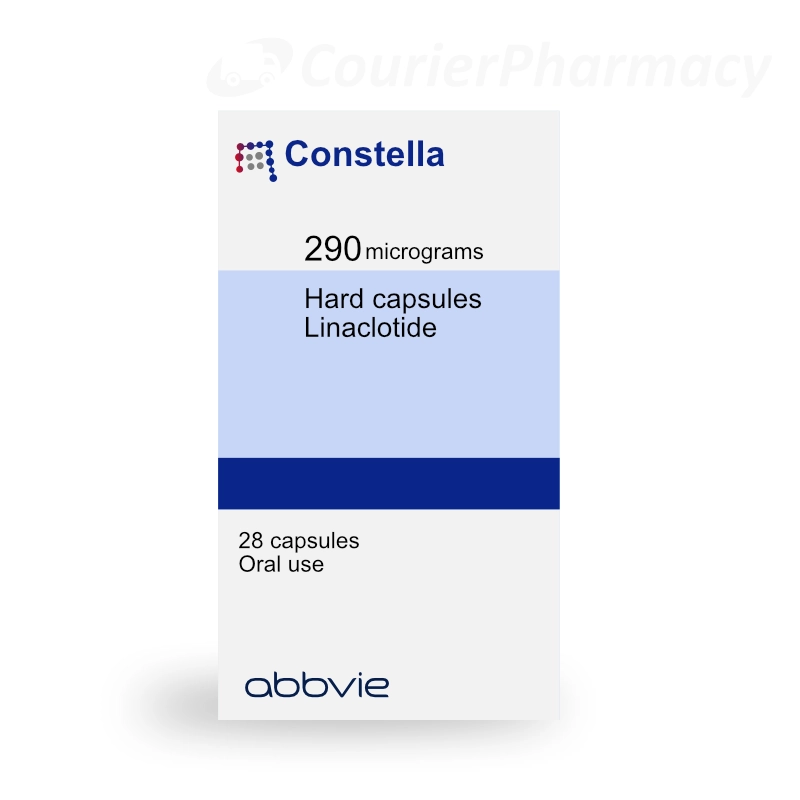
Constella 290 microgram hard capsules
from£79.99
A prescription medicine containing linaclotide, used for the symptomatic treatment of moderate to severe irritable bowel syndrome with constipation (IBS-C) in adults.
Constella 290 microgram hard capsules are prescribed at Courier Pharmacy after a careful online consultation reviewed by a UK clinician, then dispensed and delivered to your door.
Constella 290 microgram Hard Capsules (linaclotide)
Constella 290 microgram hard capsules contain linaclotide. Doctors prescribe it to treat symptoms of moderate to severe irritable bowel syndrome with constipation (IBS?C) in adults. Each capsule provides 290 micrograms of linaclotide.
Constella is the only branded linaclotide product in the UK at this strength. In the United States, people know the same medicine as Linzess. Most packs contain 28 capsules, so you get a four?week supply when you take one capsule daily.
How Constella works
Constella works in a different way from many medicines. After you swallow the capsule, linaclotide works locally in the gut. It does not travel through your bloodstream in any meaningful amount.
Because of this, Constella targets symptoms where they start (in the intestine). As a result, it avoids whole?body effects that some medicines can cause.
Side effects: what to expect
Constella mainly affects the gut, so it can cause gut-related side effects. However, it tends to cause fewer “whole?body” side effects than medicines that circulate widely.
Even so, bowel changes can still happen. So, follow your prescriber’s advice and the patient leaflet.
Prescriber review and suitability
At Courier Pharmacy, a UK?registered prescriber reviews every Constella prescription before we dispense it. We take extra care with IBS?C because you need the right diagnosis before you start a targeted treatment.
Constella often helps when you have well?established moderate to severe IBS?C and you have already tried other steps. For example, you may have tried diet changes, lifestyle changes, and standard laxatives without enough relief.
If you have not had a proper IBS assessment yet, speak with your GP first. That way, you can rule out other causes and choose the right treatment.
Features and specifications
Active ingredient: Linaclotide 290 micrograms
Form: Hard capsule (white to off?white/orange, marked “290” in grey)
Pack size: 28 capsules (typical four?week supply)
Class: Guanylate cyclase?C agonist (secretagogue)
Prescription status: Prescription Only Medicine (POM)
Typical use: 1 capsule once daily, at least 30 minutes before your first meal
Storage: Store below 30°C in the original packaging. Keep the bottle tightly closed and protect from moisture.
Additional information
Quantity
1 x 28, 2 x 28, 3 x 28, 4 x28, 5 x 28, 6 x 28
MOJO WISDOM
Take control of your health by understanding your condition and what this medication is doing for you.
READ:
More information about this treatment.
UK-based doctors and pharmacists
Discreet and Confidential
UK-based doctors and pharmacists
Free, Expert Advice
No video link provided.
No video link provided.
UK-based doctors and pharmacists
Free, expert advice
Discrete and confidential
Fast delivery
Giving you trusted clinical advice for over 40 conditions
A UK regulated pharmacy providing safe, effective treatments online since 2014
Constipation that won’t shift no matter what you try. Bloating that turns trousers into a daily negotiation. Stomach pain that’s been part of life for so long it feels normal. If you’ve been diagnosed with moderate to severe IBS with constipation and conventional laxatives haven’t worked, Constella 290 microgram hard capsules are a prescription option that works in a different way. At Courier Pharmacy we want you to understand exactly how Constella works, who it suits, and what to expect, so the choice feels properly yours.
Five key takeaways
Constella 290 microgram hard capsules contain linaclotide, prescribed for moderate to severe irritable bowel syndrome with constipation (IBS-C) in adults.
It works locally in the gut by activating a receptor called guanylate cyclase-C, which increases fluid in the intestine and helps stool move through more easily.
The standard adult dose is one capsule (290 micrograms) once daily, taken at least 30 minutes before the first meal of the day.
Most people who respond to Constella notice improvement within 4 weeks, although some respond later, up to 12 weeks. NICE recommends stopping treatment if there’s no adequate response by 12 weeks.
Diarrhoea is the most common side effect; it tends to settle but can be a reason to pause or stop treatment if severe or prolonged.
Treatment dosage Constella 290 microgram hard capsules
The standard adult dose is one Constella 290 microgram capsule taken once daily, at least 30 minutes before the first meal of the day. This is the only licensed dose in the UK; there is no lower-dose option, so dose reduction isn’t a strategy if side effects are troublesome. If Constella isn’t tolerated at this dose, the next step is usually a temporary pause or stopping the medicine entirely.
Taking the capsule on an empty stomach (at least 30 minutes before food) makes a real difference. A clinical study showed that taking Constella immediately after a high-fat meal led to more frequent and looser stools and more gastrointestinal side effects compared with taking it before food. The timing isn’t a polite suggestion; it’s part of how the medicine is meant to work.
Swallow the capsule whole with a glass of water. Don’t open, chew, or break the capsule. The bottle contains a desiccant (a small sachet to absorb moisture) which should be kept inside and not eaten.
For older adults, no dose adjustment is needed, but treatment should be monitored carefully and reviewed regularly since older patients can be more vulnerable to dehydration if diarrhoea develops. No dose adjustment is required for people with kidney or liver problems, since the medicine isn’t absorbed into the bloodstream to be processed by these organs.
If you’ve not had any improvement in symptoms after 4 weeks, contact your prescriber. The medicine may still work between 4 and 12 weeks for some people, but if there’s no meaningful response by 12 weeks, NICE recommends stopping treatment and exploring alternatives. Don’t double up if you miss a dose; just take the next dose at the usual time the following day.
Overview of Constella 290 microgram hard capsules
Five things worth knowing:
Constella was first authorised in the EU in 2012 and the UK in 2013 specifically for IBS with constipation; it isn’t a general laxative.
It works on a receptor called guanylate cyclase-C (GC-C), which is found on the lining of the intestine.
Constella is almost entirely unabsorbed, which is why it has very few systemic side effects despite working powerfully on the gut.
Diarrhoea is the most common side effect, reported in around 20% of people in trials. It’s usually mild to moderate but can occasionally be severe.
NICE (Technology Appraisal TA318) recommends Constella for adults with moderate to severe IBS-C when other treatments haven’t worked, with a 12-week review point.
Constella sits in a small group of medicines designed specifically for IBS subtypes rather than constipation in general. For decades, the management of IBS-C relied on lifestyle changes, dietary fibre adjustments, antispasmodics for pain, and laxatives that worked through bulking, osmotic, or stimulant mechanisms. None of these were designed for the underlying physiology of IBS-C, which involves both reduced gut motility and visceral hypersensitivity (your gut signalling pain at lower thresholds than it should).
Linaclotide approached the problem differently. It mimics the action of a natural intestinal hormone (guanylin) at GC-C receptors on the gut lining. Activating these receptors increases fluid secretion into the intestine and accelerates transit. The same pathway also appears to reduce visceral pain signalling, which is why Constella tends to help both the constipation and the abdominal pain of IBS-C, not just one of them.
For people living with IBS-C alongside other complex conditions such as fibromyalgia, ME/chronic fatigue, MCAS, or autoimmune issues, gut symptoms often sit within a wider story that GPs don’t always have time to unpack. Constella isn’t a cure for IBS, and it doesn’t address everything that drives gut symptoms in these complex presentations. What it can do is take some of the day-to-day load off, so the deeper work (whether that’s working with a gastroenterologist, a dietitian, or someone who handles MCAS) becomes more possible.
The medicine has been studied in two large Phase 3 trials with more than 1,600 patients, with treatment durations of up to 26 weeks. Around half of patients respond meaningfully within 4 weeks. Of those who haven’t responded by 4 weeks, around 1 in 6 will still respond to abdominal pain improvement between weeks 4 and 12, and around 1 in 10 for bowel frequency. This is why the NICE 12-week review is sensible: it gives the medicine a fair chance without continuing indefinitely if it isn’t helping.
Why choose Courier Pharmacy for Constella 290 microgram hard capsules
IBS-C is a diagnosis that gets dismissed more often than it should. People are told to “manage stress” or “eat more fibre” and sent home with vague advice for a condition that can be genuinely disabling. Every Constella prescription at Courier Pharmacy is reviewed by a UK-registered prescriber who reads your answers properly, asks about how the diagnosis was made, what you’ve tried, and what’s actually getting in the way of daily life.
We’re particularly thoughtful about Constella because it’s a specific medicine for a specific condition. If your IBS hasn’t been properly characterised (is it definitely IBS-C, or have alternative diagnoses been considered?), or if you haven’t yet tried first-line approaches, we’ll often suggest those steps first rather than prescribing Constella reflexively. If Constella is the right choice, we’ll dispense it and check in at 4 and 12 weeks, in line with NICE guidance, to see whether it’s actually working.
Our brand guide, Dr Ada Jex-Cori, sums it up: you’re not broken. The system that’s failed you might be. We want to do the part we can do, properly, and connect you with the rest. That includes our free fortnightly drop-in clinics and talks at Insomnia in Derby, where you can ask questions face-to-face without spending a penny.
Buy Constella 290 microgram hard capsules (Prescription Only) from Courier Pharmacy
Constella 290 microgram hard capsules are a Prescription Only Medicine (POM) in the UK, which means they cannot be sold over the counter. Buying through Courier Pharmacy is straightforward and built around your time, not ours.
Here’s how it works:
Complete a quick online consultation
A UK prescriber reviews your answers
If approved, a prescription is issued
We dispense and deliver discreetly to your door
If it isn’t suitable for you, we’ll explain why and suggest the next best option.
Active ingredient in Constella 290 microgram hard capsules
The active ingredient is linaclotide, a synthetic peptide made up of 14 amino acids. It’s chemically similar to a natural intestinal hormone called guanylin, which the body produces to regulate fluid and electrolyte balance in the gut. Linaclotide binds to the guanylate cyclase-C (GC-C) receptor on the surface of intestinal cells, where it triggers a cascade of events that pulls fluid into the gut and increases motility.
Each capsule contains 290 micrograms of linaclotide. The capsule contents also include microcrystalline cellulose, hypromellose, calcium chloride dihydrate, and leucine as inactive ingredients. The capsule shell contains gelatin, titanium dioxide, red iron oxide, yellow iron oxide, and polyethylene glycol. The capsule is marked “290” in grey ink (containing shellac and other minor ingredients).
For people who can’t take gelatin for dietary or religious reasons, this is worth flagging. The capsule shell is animal-derived, and there isn’t currently a vegetarian alternative formulation of linaclotide in the UK. If gelatin matters to you, mention this during the consultation so we can talk through alternatives.
What are Constella 290 microgram hard capsules used for?
Constella is licensed in the UK for one specific indication: the symptomatic treatment of moderate to severe irritable bowel syndrome with constipation (IBS-C) in adults. It is not licensed for general constipation, chronic idiopathic constipation, mild IBS-C, or use in children and adolescents under 18.
IBS-C is one of the recognised subtypes of irritable bowel syndrome. The diagnosis usually rests on the Rome IV criteria, which require recurrent abdominal pain (at least one day per week over the previous three months on average) associated with bowel habit, with stools that are predominantly hard or lumpy (Bristol Stool Chart types 1 or 2) on more than a quarter of bowel movements. Other organic conditions (coeliac disease, inflammatory bowel disease, bowel cancer, thyroid disease) should be ruled out before the diagnosis is made.
NICE Technology Appraisal TA318 recommends linaclotide as an option for adults with moderate to severe IBS-C when other treatments such as antispasmodics, laxatives, and linaclotide-alternatives haven’t provided adequate relief, and when symptoms are persistent. NICE also recommends stopping treatment if there hasn’t been adequate response by 12 weeks.
Constella is not appropriate for IBS-D (diarrhoea-predominant IBS), IBS-M (mixed type with both diarrhoea and constipation), or constipation without IBS features. Using it in these situations risks making symptoms worse rather than better.
How does Constella 290 microgram hard capsules work?
Your gut lining is covered with receptors that respond to chemical signals. One of these is the guanylate cyclase-C (GC-C) receptor, which normally responds to natural signalling molecules (guanylin and uroguanylin) produced by the gut itself. When GC-C is activated, it triggers the production of a signalling molecule called cyclic GMP (cGMP) inside intestinal cells. The cGMP then opens chloride channels (specifically the CFTR channel, the same one that’s faulty in cystic fibrosis), pushing chloride and bicarbonate out into the gut. Water follows by osmosis, softening stool and making the gut work more efficiently.
Linaclotide binds to GC-C receptors and activates this pathway powerfully. The result is increased intestinal fluid, faster transit of contents through the gut, softer stool, and easier bowel movements. This explains the constipation-relieving effect.
There’s also a second mechanism that helps explain why Constella tends to reduce abdominal pain alongside constipation. The cGMP produced inside intestinal cells doesn’t just open chloride channels; it also crosses out into the gut wall, where it appears to dampen the activity of pain-sensing nerves. People with IBS-C typically have heightened pain signalling from the gut (visceral hypersensitivity), and linaclotide seems to quiet that signalling down. This dual effect on both bowel movements and pain is what makes Constella useful for IBS-C specifically, rather than just being another laxative.
Because linaclotide is a peptide (a small chain of amino acids), it’s broken down by the same digestive enzymes that break down dietary protein. By the time it reaches the lower intestine, almost none of it remains intact, and very little crosses into the bloodstream. This is why Constella acts locally and has very few systemic side effects.
You’ll typically notice the bowel-movement effect within hours of the first dose, sometimes the same day. The abdominal pain and bloating effects tend to take longer to build, usually 1 to 4 weeks of regular daily use.
How to use Constella 290 microgram hard capsules
Take one Constella 290 microgram capsule once daily, at least 30 minutes before the first meal of the day. For most people, this means taking it as soon as you wake up with a glass of water, then waiting at least half an hour before having breakfast.
Swallow the capsule whole with water. Don’t open, chew, or break the capsule. If you do open it accidentally (or someone else does), wash hands thoroughly and don’t ingest the contents directly; the medicine is designed to be released within the intact capsule for predictable absorption patterns.
Consistency matters. Once-daily timing helps your gut establish a more predictable pattern, and taking the medicine at the same time each day usually works better than varying it. If your morning schedule is unpredictable, pick the time of day that’s most reliable and use that consistently.
If you miss a dose, skip it and take the next dose at the usual time the following day. Don’t double up. Taking two doses at once doesn’t deliver more therapeutic effect; it just increases the risk of diarrhoea.
If diarrhoea is becoming a problem, talk to your prescriber before stopping the medicine. Sometimes adjusting timing or pausing for a few days helps. If diarrhoea is severe or prolonged (more than a week), stop the medicine and seek medical advice. Staying well hydrated is important if you do experience diarrhoea, particularly if you’re older or have any underlying heart or kidney conditions.
The bottle contains a desiccant sachet to absorb moisture. Keep this in the bottle, keep the lid tightly closed, and don’t refrigerate the medicine. Linaclotide is sensitive to moisture, so dampness or open packaging can reduce effectiveness.
Warnings and precautions for Constella 290 microgram hard capsules
Constella isn’t suitable for everyone. It is contraindicated in people with known or suspected mechanical gastrointestinal obstruction, severe inflammatory conditions of the intestinal tract (such as active inflammatory bowel disease or toxic megacolon), and hypersensitivity to linaclotide or any of the capsule ingredients. It is not licensed for use in children or adolescents under 18.
The most important practical safety consideration is diarrhoea. Most people experience some loosening of stool, and around 20% develop diarrhoea proper. In most cases this settles or resolves with continued treatment, but in some people it becomes severe or prolonged. Severe diarrhoea can lead to dehydration, low potassium, low bicarbonate, dizziness, and orthostatic hypotension (drops in blood pressure on standing). If diarrhoea is severe, prolonged (more than a week), or accompanied by these symptoms, stop the medicine and seek medical advice promptly.
Lower gastrointestinal bleeding has been reported in a small number of patients. Anyone who notices blood in the stool or rectal bleeding while taking Constella should stop the medicine and contact their prescriber for assessment.
Caution is needed in people who are particularly vulnerable to electrolyte or fluid disturbances. This includes older adults, anyone with significant heart failure, kidney disease, or conditions causing existing diarrhoea or dehydration. It also includes people on diuretics, ACE inhibitors, or other medicines that can affect kidney function or potassium balance.
Constella should not be used in pregnancy. There are no adequate human data, and although the medicine isn’t significantly absorbed, the manufacturer advises avoidance. If you become pregnant while taking Constella, stop the medicine and tell your prescriber. Constella should also be avoided during breastfeeding, since although systemic exposure is low, there are no data on transfer into breast milk in humans.
A significant safety signal exists for very young children. In animal studies, linaclotide caused deaths in very young animals through severe dehydration. While this isn’t relevant to adult prescribing, it’s a reminder that the capsules should be stored safely and never given to children. Constella should be kept well out of reach of children at all times, with the bottle securely closed.
If you have a diagnosis of IBS, it’s worth flagging any change in symptoms during treatment. If symptoms shift in character (new pain, blood in the stool, weight loss, fever, signs of obstruction), it’s important not to assume these are just IBS or Constella effects. They need medical assessment.
Side effects of Constella 290 microgram hard capsules
Constella’s side effect profile is dominated by gut-related effects, which is consistent with how the medicine works. Diarrhoea is the most common and the most clinically important to know about.
Very common side effects, affecting more than 1 in 10 people, are diarrhoea. In clinical trials, around 20% of patients reported diarrhoea, mostly mild to moderate. For many, this settles with continued use. For others, it doesn’t, and the medicine needs to be paused or stopped.
Common side effects, affecting between 1 in 100 and 1 in 10 people, include abdominal pain, abdominal distension or bloating, flatulence, viral gastroenteritis (sometimes hard to distinguish from medicine-related diarrhoea), nausea, headache, dizziness, and feeling generally light-headed. Many of these may settle with continued treatment, but persistent or worsening symptoms should be reported.
Uncommon side effects, between 1 in 1,000 and 1 in 100 people, include rectal bleeding, faecal incontinence, urgency to open the bowels, low potassium (hypokalaemia), dehydration, low bicarbonate (metabolic acidosis), orthostatic hypotension, fainting on standing, raised liver enzymes, rash, hives, and itching.
Rare and very rare side effects include severe allergic reactions including anaphylaxis, severe diarrhoea-related dehydration requiring hospital treatment, and gastrointestinal haemorrhage. These need urgent medical attention. Call 999 if you experience severe swelling of the face, lips, throat, or difficulty breathing.
A note on hair loss: alopecia is not listed as a recognised side effect of Constella in the UK SmPC or EMA EPAR. If you notice unexplained hair loss while taking Constella, this is much more likely to have another cause (thyroid dysfunction, iron deficiency, hormonal changes, stress, other medicines) and warrants investigation in its own right rather than being assumed to be the medicine.
If you experience any side effect that worries you, you can report it directly to the MHRA’s Yellow Card scheme. This helps improve safety data for everyone who uses the medicine. Our pharmacy team are happy to help you submit a Yellow Card report if you’d like assistance.
Drug interactions with Constella 290 microgram hard capsules
Because linaclotide is essentially not absorbed, it doesn’t interact with most medicines in the way that systemically absorbed drugs do. There are no significant interactions through liver enzymes, plasma protein binding, or kidney transporters.
The main practical interaction considerations involve other medicines that affect the gut. Other laxatives, particularly stimulant laxatives like senna or bisacodyl, will compound Constella’s effect and significantly increase the risk of diarrhoea. Stool softeners and bulking agents may be safer if additional support is needed, but talk to your prescriber before combining.
Antibiotics that commonly cause diarrhoea (such as broad-spectrum penicillins, cephalosporins, or clindamycin) may significantly worsen the diarrhoea risk while you’re on Constella. Sometimes pausing the linaclotide during a course of antibiotics is sensible.
Medicines that affect fluid and electrolyte balance need consideration. Diuretics, ACE inhibitors, ARBs, NSAIDs, and certain antidiabetic medicines (such as SGLT2 inhibitors) can all amplify the risk of dehydration or electrolyte disturbance if Constella causes diarrhoea. The combination is often manageable but worth flagging so your prescriber can monitor accordingly.
Proton pump inhibitors and antacids don’t appear to significantly affect Constella’s effectiveness, since the medicine doesn’t depend on stomach acid for activation. That said, taking Constella before food (as licensed) gives the most predictable response, and timing matters more than the presence of other gut-acting medicines.
Always tell your prescriber and pharmacist about everything you take, including over-the-counter medicines, supplements, and herbal products, before starting Constella. Even though systemic interactions are rare, gut-level interactions can affect how the medicine works for you.
Frequently asked questions about Constella 290 microgram hard capsules
What is Constella used for?
Constella is licensed for the symptomatic treatment of moderate to severe irritable bowel syndrome with constipation (IBS-C) in adults. It isn’t licensed for general constipation, mild IBS-C, IBS with diarrhoea, or use in children. NICE recommends it when other treatments such as laxatives, antispasmodics, and dietary changes haven’t worked.
How does Constella differ from a laxative?
Conventional laxatives work by bulking stool, drawing water in (osmotic), or stimulating the gut (stimulant). Constella works by activating a specific receptor (guanylate cyclase-C) in the gut lining, which both increases fluid and reduces visceral pain signalling. The dual effect on both constipation and abdominal pain is what makes Constella useful for IBS-C specifically.
How quickly will Constella work?
Many people notice an effect on bowel movements within hours of the first dose, often the same day. The effect on abdominal pain and bloating tends to build more gradually, over 1 to 4 weeks of regular use. Some people respond between weeks 4 and 12; if there’s no meaningful response by 12 weeks, NICE recommends stopping treatment.
Why must I take Constella before food?
A clinical study showed that taking Constella immediately after a high-fat meal led to more frequent and looser stools and more gastrointestinal side effects. Taking it on an empty stomach, at least 30 minutes before food, gives the most predictable and tolerable response.
What if I get diarrhoea on Constella?
Diarrhoea is the most common side effect, affecting around 20% of people. Mild diarrhoea often settles with continued use. Moderate diarrhoea may need a temporary pause. Severe or prolonged diarrhoea (more than a week) should prompt you to stop the medicine and contact your prescriber, with attention to staying well hydrated.
Is there a lower-dose option?
No. The 290 microgram capsule is the only UK strength, so dose reduction isn’t an option if side effects are troublesome. The alternatives are dose timing adjustments (within licensed instructions), temporary pauses, or stopping and trying a different medicine.
Can I take Constella with other medicines?
Most medicines are compatible because linaclotide isn’t significantly absorbed. The main practical considerations are other laxatives (which can compound the effect), antibiotics that commonly cause diarrhoea, and medicines that affect fluid or electrolyte balance. Always share your full medication list with your prescriber.
Can I take Constella long-term?
Constella has been studied for up to 6 months in trials, and many people continue it long-term with prescriber oversight. NICE recommends a review at 12 weeks for response, and periodic re-assessment thereafter. There isn’t strong evidence of tolerance (the medicine losing effect) over time.
Can I take Constella during pregnancy?
Constella should not be used in pregnancy. Although it isn’t significantly absorbed, there are no adequate human data and the manufacturer advises avoidance. If you become pregnant while taking it, stop the medicine and tell your prescriber.
Is Constella safe while breastfeeding?
It’s not recommended during breastfeeding. Systemic exposure is very low but there are no data on transfer into human breast milk. Alternatives may be preferred during this period.
Can children take Constella?
No. Constella is not licensed for anyone under 18. Animal studies showed serious harm in very young animals from severe dehydration, so the medicine should be kept well out of reach of children and never given to them. Adult tablets are not appropriate for paediatric constipation.
Do I need to drink more water on Constella?
Staying well hydrated is sensible, particularly if you experience any loosening of stool or diarrhoea. There isn’t a specific fluid requirement, but the usual advice to drink to thirst (and a bit more if symptoms are present) applies.
What if Constella isn’t working after 4 weeks?
Talk to your prescriber. The medicine may still work between weeks 4 and 12 for some people, especially for abdominal pain symptoms. If there’s no meaningful response by 12 weeks, NICE recommends stopping treatment and exploring alternatives such as different prescription options or specialist referral.
Does Constella interact with the contraceptive pill?
There’s no known significant interaction. Linaclotide isn’t absorbed systemically and doesn’t affect liver enzymes that metabolise the pill. However, if you experience severe diarrhoea while on Constella, the absorption of the contraceptive pill may be reduced, in which case additional contraceptive precautions are sensible until the diarrhoea resolves.
Can I take antacids or PPIs with Constella?
Yes. Antacids and proton pump inhibitors like pantoprazole or esomeprazole don’t significantly affect how Constella works. The timing rule (taking Constella at least 30 minutes before food) remains the important consideration.
What if my IBS symptoms change while on Constella?
If symptoms shift in character (new pain, blood in stool, weight loss, fever, signs of obstruction), don’t assume these are just IBS or Constella effects. They need medical assessment to rule out other conditions. Your prescriber will want to know.
Why does the bottle contain a desiccant?
Linaclotide is sensitive to moisture. The desiccant absorbs ambient moisture and helps keep the capsules effective. Keep the desiccant in the bottle, keep the lid tightly closed, and don’t refrigerate the medicine.
Will Constella affect my driving?
No. Constella has no or negligible influence on the ability to drive or use machines. If you do experience dizziness or light-headedness (uncommon side effects), use your judgement until those symptoms settle.
Is Constella suitable for older adults?
Yes, but with careful monitoring. No dose adjustment is needed, but older adults are more vulnerable to dehydration and electrolyte disturbance if diarrhoea develops. Regular review and attention to hydration is sensible.
How does Constella compare to other IBS-C treatments?
In the UK, prucalopride and plecanatide (in some private settings) are other options for IBS-C or chronic constipation. Each works differently and has its own profile. NICE recommends linaclotide specifically for moderate-to-severe IBS-C after first-line approaches haven’t worked. The right choice depends on individual response, side effect tolerance, and how the diagnosis fits.
Disclaimer: This article is for information only and isn’t a substitute for personal medical advice. Always speak to a qualified prescriber before starting or changing treatment.