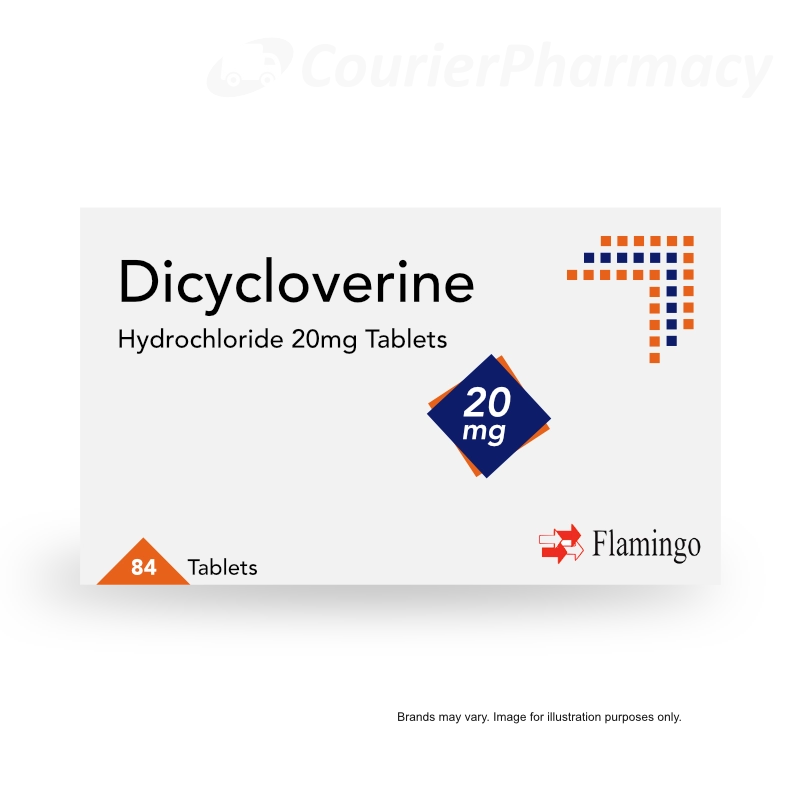
A smooth-muscle antispasmodic used to relieve abdominal cramps and pain in IBS, diverticular disease, and other functional bowel conditions.
Dicycloverine 20mg tablets are prescribed at Courier Pharmacy after a brief online consultation reviewed by a UK clinician, then dispensed and delivered to your door.
Dicycloverine 20mg tablets are an antispasmodic medicine used to relieve painful cramps caused by spasm in the gut. Doctors often prescribe them for irritable bowel syndrome (IBS). They can also help with diverticular disease and other functional bowel conditions where cramping is a key symptom. They suit adults and adolescents aged 12 and over.
Each tablet contains dicycloverine hydrochloride 20mg. The tablet is scored, which can make it easier to swallow. However, the score doesn’t guarantee two equal half-doses, so don’t split it unless your prescriber tells you to. Packs often come as 84 or 100 tablets, which can cover around a month at the higher end of the usual dose range.
Dicycloverine has been used since the 1950s, so clinicians know it well. NICE also recommends antispasmodics like this as part of first-line symptom management for IBS abdominal pain. In other words, it’s an established option with decades of real-world safety data.
Dicycloverine works differently from many other gut medicines. It doesn’t reduce stomach acid like a PPI, and it doesn’t act like a laxative. Instead, it relaxes the muscle layer of the bowel wall. As a result, it can ease the contractions that drive cramping pain. So, if your IBS symptoms are mainly spasm and cramp (rather than constipation or diarrhoea), this targeted approach can be a good fit.
At Courier Pharmacy, a UK-registered prescriber reviews every dicycloverine prescription before we dispense it. We look at your symptoms, other health conditions, and the medicines you already take. Because dicycloverine has anticholinergic effects, it isn’t always suitable for everyone. For example, it may not be the best choice if you have glaucoma, prostate enlargement, reflux-related hiatus hernia, or certain neurological conditions. For that reason, we’d rather have that conversation upfront.
Features and specifications
Active ingredient: Dicycloverine hydrochloride 20mg
Form: White to off-white, round, flat-bevelled scored tablet (debossed “S” and “20”)
Pack size: Typically 84 or 100 tablets
Class: Smooth muscle antispasmodic with anticholinergic action
Prescription status: Prescription Only Medicine (POM) at the 20mg strength
Typical use: One or two tablets three times daily, before meals (as directed)
Storage: Store below 25°C in the original packaging
Additional information
Quantity
1 x 84, 2 x 84, 3 x 84
MOJO WISDOM
Take control of your health by understanding your condition and what this medication is doing for you.
READ:
More information about this treatment.
UK-based doctors and pharmacists
Discreet and Confidential
UK-based doctors and pharmacists
Free, Expert Advice
No video link provided.
No video link provided.
UK-based doctors and pharmacists
Free, expert advice
Discrete and confidential
Fast delivery
Giving you trusted clinical advice for over 40 conditions
A UK regulated pharmacy providing safe, effective treatments online since 2014
Stomach cramps that grip without warning. The kind of pain that has you doubled over wondering if you can make it through the next meeting, the school run, or just the rest of the afternoon. If you’ve been diagnosed with IBS or another functional bowel condition where smooth muscle spasm drives the pain, dicycloverine 20mg tablets are a long-established antispasmodic option. At Courier Pharmacy we want you to understand exactly how dicycloverine works, who it suits, and what to watch for, so the choice feels properly yours.
Five key takeaways
Dicycloverine 20mg tablets are a smooth-muscle antispasmodic used for the symptoms of irritable bowel syndrome and other functional bowel disorders.
The active ingredient (dicycloverine hydrochloride) works in two ways: a direct relaxing effect on intestinal smooth muscle, plus an anticholinergic effect that blocks the nerve signals driving spasm.
Standard adult dosing is one or two 20mg tablets three times daily before meals; doses are typically tailored to symptom severity.
Side effects are usually mild but can include dry mouth, blurred vision, dizziness, and urinary hesitancy, all reflecting the medicine’s anticholinergic action.
It is the same molecule as dicyclomine (the US name); UK formulations are sold under the brand name Merbentyl and as generic dicycloverine.
Treatment dosage Dicycloverine 20mg tablets
For adults and adolescents over 12, the standard dose is one or two 20mg tablets three times daily, taken about 15 to 30 minutes before meals. The maximum recommended daily dose is 60mg in three divided doses, although many people manage well on lower doses. The goal is the lowest dose that controls symptoms, since side effects (which are mostly anticholinergic) are dose-related.
Take the tablet with a glass of water. The tablet is scored to help with swallowing, but the medicine isn’t designed to be split into half-doses for dose adjustment. If you need a lower dose than 20mg, the 10mg tablet (also available) is the appropriate option, alongside the 10mg/5ml oral solution where swallowing tablets is difficult.
Timing matters. Taking dicycloverine 15 to 30 minutes before food means the medicine is already in your system and working on smooth muscle when meal-triggered cramping would otherwise hit. For people whose pain mainly comes on after eating, this pre-meal timing is the most useful pattern. If your cramps come on at unpredictable times, your prescriber may suggest a different timing approach.
In older adults (over 65), dicycloverine should be used with care because anticholinergic side effects (confusion, urinary hesitancy, falls from dizziness, constipation) tend to be more pronounced. The lowest effective dose, shortest necessary course, and regular review are particularly important in this age group.
No dose adjustment is generally needed for mild kidney or liver impairment. In severe impairment, caution and lower doses are sensible. Don’t double up if you miss a dose. If you remember within an hour or two and a meal is coming, take it; if it’s almost time for the next dose, skip the missed one.
Overview of Dicycloverine 20mg tablets
Five things worth knowing:
Dicycloverine has a dual mechanism: it relaxes smooth muscle directly and blocks muscarinic (acetylcholine) receptors that signal gut contraction.
It reaches peak blood levels around 1 to 1.5 hours after dosing, so the effect builds over the next hour and lasts approximately 4 hours.
The 20mg tablet is the higher strength; 10mg tablets and a 10mg/5ml oral solution are also available where lower or liquid dosing suits better.
Anticholinergic side effects (dry mouth, blurred vision, urinary hesitancy, constipation, dizziness) reflect the same mechanism that helps with cramps, so they’re often unavoidable and need balancing against benefit.
It is contraindicated or used with caution in glaucoma, prostate enlargement, urinary retention, myasthenia gravis, paralytic ileus, severe ulcerative colitis, hiatus hernia with reflux oesophagitis, and certain heart conditions.
Dicycloverine sits among a small group of medicines used specifically for the painful, spasm-driven part of functional bowel disorders. Other UK options in this space include mebeverine, hyoscine butylbromide (Buscopan), peppermint oil capsules, and alverine. Each works slightly differently, and choice often comes down to individual response and tolerance of side effects.
For people living with IBS alongside other complex conditions, fibromyalgia, ME/chronic fatigue, MCAS, or autoimmune issues, abdominal cramps and spasm can be a daily background of life rather than an occasional flare. The medicines that help one person often don’t help the next, and a careful trial of different antispasmodics is often part of working out what suits. Dicycloverine has a slightly broader anticholinergic effect than mebeverine, which can be either a feature or a drawback depending on the person.
The dual mechanism is worth understanding because it explains both why dicycloverine helps and why it has the side effects it does. The direct smooth muscle relaxant effect calms intestinal contractions. The anticholinergic effect blocks acetylcholine, the nerve signal that tells smooth muscle to contract. Both effects work together in the gut to reduce cramping, but the anticholinergic effect also acts on smooth muscle in other parts of the body (eyes, bladder, salivary glands, heart), which is where the recognised side effects come from.
This isn’t a medicine that needs to be taken indefinitely. For some people, dicycloverine is used as needed during flares; for others, regular three-times-daily dosing over several months helps stabilise symptoms before stepping down. The decision rests on how persistent your cramping is and how well the medicine works for you in practice. Regular review with your prescriber helps avoid unnecessary long-term use without losing the benefit when you genuinely need it.
Why choose Courier Pharmacy for Dicycloverine 20mg tablets
Antispasmodics for IBS look routine on paper. In practice, they involve real choices: which antispasmodic, at what dose, how long for, whether the side effect profile fits the person, and whether anticholinergic medicines are sensible given everything else. Most online pharmacies don’t have the time or inclination to think this through. We do.
Every dicycloverine prescription at Courier Pharmacy is reviewed by a UK-registered prescriber who reads your answers properly, asks follow-up questions where needed, and explains the decision either way. If you’ve already tried mebeverine without success and want to try dicycloverine, we’ll check what else you’re taking and whether the broader anticholinergic effect makes sense. If you have glaucoma, prostate enlargement, reflux, or a condition where dicycloverine isn’t a good fit, we’ll say so and suggest alternatives.
Our brand guide, Dr Ada Jex-Cori, sums it up: you’re not broken. The system that’s failed you might be. We want to do the part we can do, properly, and connect you with the rest. That includes our free fortnightly drop-in clinics and talks at Insomnia in Derby, where you can ask questions face-to-face without spending a penny.
Buy Dicycloverine 20mg tablets (Prescription Only) from Courier Pharmacy
Dicycloverine 20mg tablets are a Prescription Only Medicine (POM) in the UK at this strength, which means they cannot be sold over the counter. Buying through Courier Pharmacy is straightforward and built around your time, not ours.
Here’s how it works:
Complete a quick online consultation
A UK prescriber reviews your answers
If approved, a prescription is issued
We dispense and deliver discreetly to your door
If it isn’t suitable for you, we’ll explain why and suggest the next best option.
Active ingredient in Dicycloverine 20mg tablets
The active ingredient is dicycloverine hydrochloride. It’s the same molecule that’s known internationally as dicyclomine; UK and European naming uses dicycloverine while US and some other countries use dicyclomine. Both names refer to identical medicines.
Dicycloverine is a tertiary amine with both antimuscarinic (anticholinergic) and direct smooth-muscle relaxant properties. After oral administration, it’s well absorbed, reaching peak plasma concentrations around 1 to 1.5 hours after dosing, with a duration of action of about 4 hours. Bioavailability from the oral route is comparable to intravenous administration, so the tablet is an efficient way to deliver the medicine.
Each 20mg tablet also contains inactive ingredients, including lactose monohydrate (around 134mg per tablet) and other excipients depending on the manufacturer. This matters for people with rare hereditary problems of galactose intolerance, the Lapp lactase deficiency, or glucose-galactose malabsorption, who shouldn’t take this medicine. If you have a known lactose intolerance, mention it to your prescriber so the brand or formulation can be reviewed. The oral solution contains fructose, glucose, and sucrose, which is important if diabetes management is a factor; this is a particular reason some people prefer the tablet over the solution.
For people with multiple chemical sensitivities or MCAS, our pharmacy team can often source a particular brand or explore alternatives if a specific excipient is an issue.
What are Dicycloverine 20mg tablets used for?
Dicycloverine 20mg tablets are licensed in the UK for the symptomatic treatment of functional conditions involving smooth muscle spasm of the gastrointestinal tract. The most common indication is irritable bowel syndrome (IBS), where cramping pain is part of the symptom picture.
IBS comes in subtypes (IBS-C with predominant constipation, IBS-D with predominant diarrhoea, IBS-M with mixed pattern, and IBS-U unclassified). Dicycloverine targets the cramping pain component regardless of subtype, so it can be used across IBS presentations. NICE guidance for IBS recommends antispasmodics including dicycloverine as part of first-line symptom management, alongside dietary advice (such as low-FODMAP approaches), fibre adjustments, and lifestyle measures.
Other licensed and commonly accepted uses include diverticular disease, where dicycloverine can help reduce the painful spasm sometimes associated with diverticular pockets in the colon, and other functional bowel disorders presenting with smooth muscle spasm. It’s sometimes used off-label for dysmenorrhoea (period cramps) given the smooth-muscle relaxant effect, although this isn’t a primary licensed indication and is usually a clinician-led decision.
Dicycloverine is not licensed for general non-specific abdominal pain, inflammatory bowel disease flares (where it can sometimes be unhelpful), or for use in infants under 6 months. The historical use of dicycloverine for infantile colic has been substantially restricted because of rare but serious side effects in very young children, and modern UK practice avoids using it in this age group entirely.
How do Dicycloverine 20mg tablets work?
Your gut wall has a layer of smooth muscle that contracts rhythmically to move contents along. This is called peristalsis. The contractions are coordinated by a network of nerves embedded in the gut wall, which receive signals through acetylcholine binding to muscarinic receptors. When everything works smoothly, the muscle contracts and relaxes in waves that move food and waste through without you noticing.
In IBS and related functional bowel disorders, this rhythm becomes disordered. Smooth muscle can over-contract or contract at the wrong times, producing the cramping pain that’s the hallmark of these conditions. The cause involves complex interactions between gut motility, visceral sensitivity (how much pain signals are amplified), gut microbiome, stress, diet, and the brain-gut axis. Antispasmodics like dicycloverine don’t fix all of this, but they can interrupt the muscle-contraction part of the cycle.
Dicycloverine works in two complementary ways. First, it has a direct relaxant effect on smooth muscle, calming the contraction independent of any nerve signal. Second, it acts as an antimuscarinic agent, blocking the muscarinic receptors where acetylcholine would normally bind to trigger contraction. By cutting off both the muscle’s intrinsic activity and the nerve signals telling it to contract, dicycloverine produces a more thorough relaxant effect than either mechanism alone would achieve.
The downside of this approach is that muscarinic receptors aren’t only in the gut. They’re also in the eye (controlling pupil size and lens focus), the salivary glands, the bladder neck, the heart, and the sweat glands. Dicycloverine isn’t fully selective for gut muscarinic receptors, so it can produce mild anticholinergic effects elsewhere: dry mouth, blurred vision when focusing on near objects, urinary hesitancy, reduced sweating, and occasionally a slightly increased heart rate.
Some newer antispasmodics (like mebeverine) work more selectively on gut smooth muscle without the anticholinergic effect, and these can be preferable for people who are particularly sensitive to dry mouth, blurred vision, or other antimuscarinic side effects. Dicycloverine remains a good choice for many people because the dual mechanism can give more reliable cramping relief, and the side effects, while present, are usually mild and tolerable.
The medicine starts working within about 30 to 60 minutes of taking it, with peak effect around 1 to 1.5 hours, lasting roughly 4 hours. This is why three-times-daily before-meals dosing works well: it covers the times of day when meal-triggered cramping is most likely.
How to use Dicycloverine 20mg tablets
Take one or two 20mg tablets three times daily, ideally about 15 to 30 minutes before each main meal. Swallow each tablet whole or, if you find swallowing difficult, the score line can be used to break the tablet for easier swallowing. The score line isn’t designed to give two equal half-doses, so if you need 10mg, the dedicated 10mg tablet or the oral solution is the better choice.
Taking dicycloverine before food rather than with or after it means the medicine has time to reach peak effect by the time eating triggers any cramping. For people whose pain mainly comes on after meals, this timing is essential. If your symptoms are less meal-related, talk to your prescriber about whether the standard timing or an adjusted schedule suits you better.
Consistency matters for chronic conditions. If you’re using dicycloverine to manage ongoing IBS rather than for occasional flares, the regular three-times-daily schedule helps maintain a steady effect. Skipping doses tends to mean cramping returns until the next dose builds back up.
If you miss a dose, take it as soon as you remember if your next dose is still several hours away. If it’s nearly time for the next dose, skip the missed one and continue normally. Never double up.
Driving and operating machinery can be affected if dicycloverine causes dizziness or blurred vision. These side effects are usually mild and often improve as your body adjusts, but be cautious until you know how the medicine affects you, particularly in the first few days.
Alcohol can potentiate the dizziness and drowsiness that some people experience with dicycloverine. Moderate alcohol is usually fine, but heavy or regular drinking is best avoided while you’re using the medicine regularly. Hot weather, exercise, or anything that makes you sweat heavily can sometimes feel worse on dicycloverine because the medicine slightly reduces the ability to sweat. Staying well hydrated and avoiding prolonged heat exposure is sensible.
Warnings and precautions for Dicycloverine 20mg tablets
Dicycloverine is generally well-tolerated but isn’t suitable for everyone. It is contraindicated in people with known hypersensitivity to dicycloverine or any excipient, and it must be avoided or used with great caution in certain conditions where the anticholinergic effect could cause harm.
Use is contraindicated or strongly cautioned in: angle-closure glaucoma (where dicycloverine can trigger an acute attack by dilating the pupil); urinary retention or significant prostatic enlargement (BPH, where it can worsen retention); myasthenia gravis (where it can worsen muscle weakness); paralytic ileus, intestinal obstruction, severe ulcerative colitis, or toxic megacolon (where slowing gut motility can be dangerous); hiatus hernia with reflux oesophagitis (where reduced lower oesophageal sphincter tone can worsen reflux); and certain unstable heart conditions including significant tachyarrhythmias and acute haemorrhage with unstable cardiovascular status.
Use with care in people with: hyperthyroidism, congestive heart failure, coronary artery disease, hypertension, raised cholinergic tone, and autonomic neuropathy. Older adults are at higher risk of anticholinergic side effects including confusion, falls, urinary retention, and constipation, so the lowest effective dose and regular review are particularly important in this group.
In pregnancy, epidemiological studies in pregnant women using dicycloverine at doses up to 40mg/day have not shown an increased risk of fetal abnormalities when used in the first trimester. However, the risk of teratogenicity cannot be excluded with absolute certainty for any medicine, and dicycloverine should be used in pregnancy only if the benefit outweighs the risk and after discussion with a clinician familiar with your situation. It is not known whether dicycloverine is secreted in human breast milk; caution should be exercised when using it during breastfeeding, and alternatives may be preferred.
The historical use of dicycloverine for infantile colic in babies under 6 months has been substantially restricted because of rare but serious reports of apnoea, respiratory difficulty, and seizures. Dicycloverine should not be used in infants under 6 months, and modern UK practice generally avoids it in young children entirely except under specialist guidance.
If your IBS or bowel symptoms change in character (new pain pattern, blood in stools, weight loss, fever, persistent diarrhoea, signs of obstruction), don’t assume these are just antispasmodic-related effects. They need medical assessment to rule out other conditions.
Side effects of Dicycloverine 20mg tablets
Most people tolerate dicycloverine well at the standard dose. Where side effects do occur, they reflect the anticholinergic mechanism that also delivers the benefit, so they tend to be dose-related and predictable.
Common side effects, affecting more than 1 in 100 people, include dry mouth, thirst, dizziness, drowsiness, and blurred vision (particularly with near focus). Many people find these mild and adjust to them within a few days. Reducing the dose, taking the medicine with a small drink to ease dry mouth, and being careful with driving until you know how it affects you can all help.
Uncommon side effects, between 1 in 100 and 1 in 1,000 people, include constipation, urinary hesitancy, palpitations, flushing, dry skin, reduced sweating, headache, mild nausea, and difficulty focusing on close objects. Some people notice a slightly faster heart rate, which is usually harmless but worth mentioning to your prescriber if it persists.
Rare side effects, fewer than 1 in 1,000 people, include urinary retention (more common in older men with prostatic enlargement), acute angle-closure glaucoma in susceptible individuals, confusion or hallucinations (particularly in older adults), agitation, mood changes, and skin rash. Confusion or memory issues in older adults on dicycloverine should prompt a review of whether the medicine is still appropriate, since other antispasmodics with less central nervous system effect may be preferable.
Very rare but serious side effects include severe allergic reactions (anaphylaxis with swelling of lips, mouth, throat, and difficulty breathing), severe gastrointestinal effects (paralytic ileus, toxic megacolon, particularly in vulnerable patients), and severe heart rhythm disturbances. Anaphylaxis is a medical emergency; call 999.
If you experience any side effect that worries you, you can report it directly to the MHRA’s Yellow Card scheme. This helps improve safety data for everyone who uses the medicine. Our pharmacy team are happy to help you submit a Yellow Card report if you’d like assistance.
Drug interactions with Dicycloverine 20mg tablets
Dicycloverine has fewer clinically significant interactions than many medicines, partly because it isn’t extensively processed through major liver enzymes. The interactions that do matter are mostly pharmacodynamic, meaning they involve combining anticholinergic effects or combining gut-slowing effects.
Combining dicycloverine with other anticholinergic medicines significantly increases the risk of side effects. This includes tricyclic antidepressants (such as amitriptyline, nortriptyline, dosulepin), older antihistamines (chlorphenamine, promethazine, hydroxyzine), some antipsychotics (chlorpromazine, clozapine), some Parkinson’s medicines, oxybutynin and other bladder antispasmodics, and hyoscine in any form. The combined anticholinergic burden can produce significant dry mouth, confusion (especially in older adults), urinary retention, constipation, and falls.
Combining dicycloverine with opioid pain medicines (codeine, morphine, oxycodone, tramadol) increases the risk of significant constipation and ileus. Be particularly cautious if you’re on regular opioids for chronic pain.
Antacids can reduce dicycloverine absorption if taken at the same time. Separating doses by 1 to 2 hours helps avoid this. Medicines that depend on stomach acid for absorption (such as ketoconazole or itraconazole) may have reduced absorption, since dicycloverine can slightly reduce gastric emptying and acid secretion.
Alcohol can potentiate the drowsiness and dizziness of dicycloverine, so moderation is sensible. Cannabis use similarly compounds anticholinergic and sedating effects.
Always tell your prescriber and pharmacist about everything you take, including over-the-counter medicines, vitamins, supplements, and herbal products, before starting dicycloverine. Many over-the-counter cold-and-flu remedies contain antihistamines or other compounds with anticholinergic effects, and combining them with dicycloverine isn’t usually a good idea.
Frequently asked questions about Dicycloverine 20mg tablets
Is dicycloverine the same as dicyclomine?
Yes. They are different international names for the same molecule (dicycloverine hydrochloride). UK and European naming uses dicycloverine; US and some other countries use dicyclomine. The medicine is identical in both.
How quickly will dicycloverine work?
You’ll usually notice an effect within 30 to 60 minutes, with peak benefit around 1 to 1.5 hours after the dose. The effect lasts approximately 4 hours, which is why three-times-daily dosing keeps blood levels in the useful range.
Should I take dicycloverine with food or before food?
Before food, ideally 15 to 30 minutes earlier. This means the medicine is already working on smooth muscle by the time eating triggers cramping. Taking it with or after food still works but tends to be less effective for meal-related symptoms.
Can I take dicycloverine long-term?
Some people use dicycloverine for months or years to manage IBS-related cramping, and that can be appropriate. Regular review with your prescriber is sensible to check whether it’s still needed and whether the dose is still right. For occasional flares, short courses are usually enough.
What’s the difference between dicycloverine 10mg and 20mg?
The 10mg tablet is the lower strength, typically used for people who need lower doses or who are starting out. The 20mg tablet is the higher strength, usually for people who need more for symptom control. The oral solution (10mg/5ml) offers liquid dosing flexibility for those who can’t swallow tablets.
Can I take dicycloverine if I have glaucoma?
Dicycloverine is contraindicated in angle-closure glaucoma because it can trigger an acute attack. If you have open-angle glaucoma, dicycloverine may still be used cautiously under specialist advice. Always tell your prescriber about any glaucoma diagnosis before starting.
Can I take dicycloverine if I have an enlarged prostate?
Dicycloverine should be used with caution in significant prostatic enlargement (BPH) because it can worsen urinary hesitancy or precipitate retention. For mild BPH without significant urinary symptoms, it may still be appropriate; for severe BPH, alternatives are usually preferred. Discuss with your prescriber.
Can I drink alcohol while on dicycloverine?
Moderate alcohol is usually fine. Alcohol can potentiate the drowsiness and dizziness some people experience with dicycloverine, so go carefully, especially when first starting the medicine. Heavy or regular drinking is best avoided.
Will dicycloverine affect my driving?
It can, particularly in the first few days, because of possible dizziness or blurred vision. Be cautious until you know how the medicine affects you. If you notice significant drowsiness or visual changes, don’t drive until they settle.
Can I take dicycloverine during pregnancy?
Epidemiological studies have not shown increased fetal abnormalities at standard doses, but the risk of teratogenicity can’t be excluded for any medicine. Use during pregnancy should only happen after discussion with a clinician familiar with your situation, weighing the benefits against the risks.
Is dicycloverine safe while breastfeeding?
It’s not known whether dicycloverine is secreted in human breast milk. Caution is advised, and alternatives may be preferred during breastfeeding. Discuss with your prescriber.
Can I give dicycloverine to my child?
Dicycloverine is licensed for adults and adolescents over 12. It should not be used in infants under 6 months because of rare but serious reports of apnoea, respiratory difficulty, and seizures. Use in children between 6 months and 12 years is generally avoided in modern UK practice except under specialist guidance.
Does dicycloverine cause weight gain?
Weight gain isn’t a recognised common side effect. If you notice unexpected weight changes while on dicycloverine, this is more likely to have another cause and worth investigating in its own right.
Can I take dicycloverine with other IBS medicines?
It depends on the other medicine. Combining dicycloverine with another antispasmodic isn’t usually appropriate. Combining with Constella, loperamide, or laxatives is possible but should be reviewed by your prescriber to make sure the combination makes sense for your symptom pattern.
What if dicycloverine isn’t working for me?
Talk to your prescriber. It may be that the dose needs adjusting, that another antispasmodic (like mebeverine, hyoscine, or peppermint oil) suits you better, or that a different approach to symptom management is needed. Don’t keep escalating doses or combining medicines without clinical input.
Can dicycloverine help with period pain?
It can sometimes be useful for menstrual cramping because period pain involves smooth muscle spasm in the uterus. This is an off-label use rather than a primary licensed indication, and your prescriber will weigh whether it’s the best option compared to other approaches like mefenamic acid or paracetamol-based regimens.
Why is my mouth so dry on dicycloverine?
Dry mouth is the most common side effect and reflects the anticholinergic effect on salivary glands. Sipping water through the day, sugar-free gum, and good oral hygiene help. If dry mouth is severe enough to affect eating or sleeping, the dose may need adjusting or a different antispasmodic considered.
Can I stop dicycloverine suddenly?
Yes. Dicycloverine doesn’t need to be tapered. You can stop when symptoms allow or when your prescriber advises. If cramping returns and is troublesome, speak to your prescriber about whether to restart, adjust, or try something different.
How does dicycloverine compare to mebeverine?
Both are antispasmodics for IBS, but they work slightly differently. Dicycloverine has a dual mechanism including anticholinergic effects, which can give more thorough cramping relief but also more side effects (dry mouth, blurred vision). Mebeverine acts more selectively on gut smooth muscle without the anticholinergic effect, which often means fewer side effects but sometimes less reliable relief. Individual response varies.
How does dicycloverine compare to Buscopan (hyoscine butylbromide)?
Both are antimuscarinic antispasmodics. Buscopan is poorly absorbed from the gut, which means it acts more locally and has fewer systemic anticholinergic effects than dicycloverine. Buscopan is widely available without prescription for occasional use; dicycloverine 20mg is prescription only and usually used for more sustained symptom management.
Disclaimer: This article is for information only and isn’t a substitute for personal medical advice. Always speak to a qualified prescriber before starting or changing treatment.