Asthma affects roughly 5.4 million people in the UK. After all, asthma isn’t just a childhood condition — it affects adults too, and around 1,400 people die from asthma attacks in the UK each year. So having the right reliever inhaler that you can actually use properly matters. The trouble is that inhaler technique is genuinely challenging. Studies suggest 70-90% of patients don’t use their pressurised inhalers correctly — timing the press with the breath is harder than it looks.
The Easyhaler was designed to solve that problem. Specifically, breath-actuated dosing means the device fires when you breathe in, so timing isn’t an issue. As a result, patients who struggle with pressurised inhalers often find the Easyhaler easier to use. In addition, the audible click and clear dose counter give reassurance that the dose has actually been delivered. However, DPIs require a strong inhale — so during a severe attack when patients can’t breathe forcefully, a pressurised inhaler with a spacer may work better.
Where Salbutamol Easyhaler fits in asthma management
The UK approach to asthma follows a stepped path:
Step 1: Diagnosis confirmation and trigger identification
Step 2: Reliever inhaler only — for very mild intermittent asthma (now often paired with low-dose ICS in MART approach)
Step 3: Regular preventer inhaler (inhaled corticosteroid) added — for symptoms more than 2-3 times a week
Step 4: LABA or leukotriene receptor antagonist added — if preventer alone isn’t enough
Step 5: MART inhalers (combined ICS/formoterol) or higher-dose preventer
Step 6: Higher-dose combined therapy plus additional add-ons
Step 7: Continuous or frequent use of oral steroids
Step 8: Specialist referral and biologic therapies
So Salbutamol Easyhaler sits primarily at Step 2 as the reliever. In short, it’s used throughout all steps as the quick-acting rescue medicine, alongside whatever preventer treatment is appropriate for the asthma severity.
In contrast, Atrovent is SAMA (short-acting muscarinic antagonist) — blocks a different pathway
Salbutamol has faster onset (3-5 minutes vs 15-30 minutes for Atrovent)
However, Atrovent lasts longer (6-8 hours vs 4-6 hours for salbutamol)
Atrovent suits COPD patients particularly well
Also, some patients use both together during acute episodes under prescriber guidance
In general, salbutamol is the first-line reliever for asthma
Salbutamol Easyhaler vs MART inhalers
Different approaches to combined care:
Salbutamol Easyhaler: pure reliever, separate from preventer treatment
In contrast, MART inhalers (Symbicort, Fostair) combine a preventer (inhaled corticosteroid) with a fast-acting LABA (formoterol)
MART = Maintenance And Reliever Therapy
MART inhalers replace both the preventer and reliever in one device
MART approach can reduce overall inhaler complexity
However, MART isn’t suitable for all patients
Salbutamol Easyhaler can still be used as extra rescue in some MART regimens
Talk to your asthma nurse or GP about whether MART might suit you better
Who Salbutamol Easyhaler suits well
This product may suit:
Adults with asthma needing a reliever
Children 4-11 with asthma who can use a DPI
Adolescents with asthma
Adults with COPD needing short-term airway relief
Patients who struggle with pressurised inhaler timing
Patients who prefer clear dose counters and audible click feedback
Patients who can breathe in strongly and quickly
Patients wanting a propellant-free option (environmental reasons)
Patients using Easyhaler preventer inhalers who want a matching reliever device
Who might suit other options better
Other options may suit better for:
Children under 4 — since the Easyhaler isn’t licensed for this age group
Patients who can’t breathe in strongly enough for a DPI (elderly, severely unwell)
Patients during severe asthma attacks — since a pMDI with spacer often works better
Patients with severe milk protein allergy — since lactose carrier contains trace milk protein
Patients with rare galactose intolerance
Patients who prefer press-and-breathe pressurised inhalers
Patients on MART regimens where a separate reliever isn’t recommended
Patients with known allergy to salbutamol or any ingredient
Patients with unstable heart conditions — talk to prescriber
Patients with severe uncontrolled hyperthyroidism — talk to prescriber
Patients where terbutaline or another SABA has worked better in the past
Pregnant women — talk to your GP first
Breastfeeding women — talk to your GP first
Courier Pharmacy supply
Salbutamol Easyhaler is a UK Prescription-Only Medicine (POM). So supply only happens after our UK-qualified prescriber reviews your situation through an online consultation. In short, if our prescriber decides another approach would suit better — a preventer inhaler review, a different reliever, MART consideration, or GP/asthma nurse review — we’ll explain that clearly.
Key features and specs
Active ingredient: salbutamol (as salbutamol sulfate)
Strength options: 100 micrograms or 200 micrograms per puff
Form: dry powder inhaler (DPI) with click-load mechanism
Salbutamol Easyhaler — Dry Powder Reliever Inhaler for Asthma and COPD
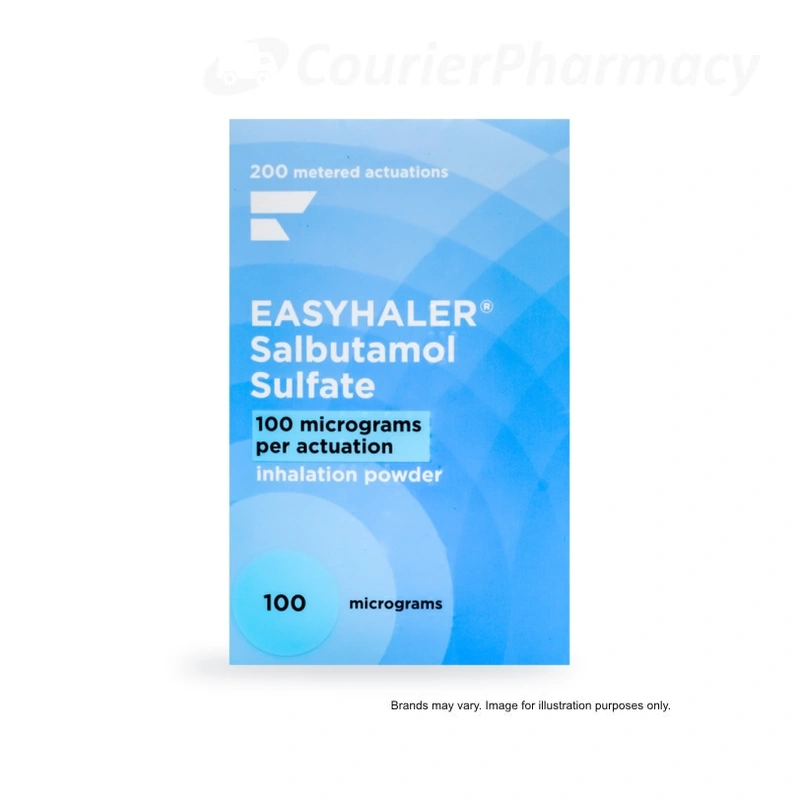
Salbutamol Easyhaler is a UK licensed prescription-only medicine (POM) reliever inhaler for the quick relief of bronchospasm (tight airways) in asthma, COPD, and other reversible airway conditions. So it contains salbutamol (as salbutamol sulfate), the same active ingredient as Ventolin, in a breath-actuated dry powder inhaler (DPI) format. Each puff gives either 100 micrograms or 200 micrograms of salbutamol, depending on the strength your prescriber selects. Important: this is a reliever, not a preventer. As a result, if you’re using it more than 3 times a week, your asthma may need review. Made by Orion Pharma. Available in 100-dose and 200-dose devices.
At Courier Pharmacy, we believe in treatment that fits the person.
This page covers what Salbutamol Easyhaler is, who it suits, how the DPI device compares to pressurised inhalers, and the practical points that matter when using a reliever inhaler for asthma or COPD.
Five key takeaways
Salbutamol Easyhaler is a UK licensed Prescription-Only Medicine (POM) reliever inhaler. So supply happens after our UK-qualified prescriber or pharmacist reviews your situation through an online consultation, including confirmation of your asthma or COPD diagnosis
Available in two strengths: 100 micrograms per puff or 200 micrograms per puff. In general, the 100mcg strength suits most adults and children over 4, with the 200mcg strength reserved for patients needing higher single-puff doses
Dry powder inhaler (DPI) format means no propellant gas, no shaking, and breath-actuated dosing. So the device fires as you breathe in — no press-and-breathe timing needed. However, you must breathe in quickly and deeply for the powder to reach your lungs
Fast onset (3-5 minutes) and short duration (4-6 hours). After all, this is a reliever for symptoms — not a preventer that stops symptoms from starting. Preventer inhalers (with steroids like beclometasone or budesonide) do that different job
Important safety point: using a reliever more than 3 times a week, waking at night with symptoms, or needing more doses than usual are warning signs your asthma isn’t well controlled. So an asthma review matters more than just getting more reliever
The Salbutamol Easyhaler is a dry powder inhaler containing the same salbutamol (a short-acting beta-2 agonist or SABA) found in Ventolin, but delivered through Orion Pharma’s Easyhaler device — a simple press-and-click loading mechanism with a built-in dose counter. At Courier Pharmacy we want to explain exactly how to use it, how it compares to the other reliever inhalers, and the reliever-use threshold (more than three times a week) that signals your asthma needs review.
Treatment dosage of Salbutamol Easyhaler
The technique is the entire product. Get the click and the forceful inhalation right and the medicine works. Miss either step and the dose isn’t delivered properly.
Standard adult use:
100 micrograms strength: 1-2 inhalations as needed for symptom relief, up to 4 times daily
200 micrograms strength: 1 inhalation as needed for symptom relief, up to 4 times daily
Before exercise: 1-2 inhalations 15 minutes before activity
The Easyhaler technique step by step:
Hold the Easyhaler upright (mouthpiece pointing up) — this is essential; tilted devices may not load correctly
Remove the dust cap
Shake gently (Easyhaler is one of the few DPIs that benefits from a brief shake to loosen the powder)
Press the device down firmly once until you hear a click — this loads one dose into the inhalation channel
Exhale fully away from the mouthpiece (don’t blow into the device — moisture damages the powder)
Place the mouthpiece between your teeth and seal your lips around it
Inhale deeply and forcefully through the mouthpiece — the inhalation should be quick and strong, not slow
Hold your breath for 5-10 seconds
Exhale slowly, away from the device
Replace the dust cap
Frequency:
As needed for symptom relief
For exercise-induced symptoms: 15 minutes before exercise
Repeat doses after at least 4-6 hours between regular doses (more frequent dosing only in acute exacerbations)
Maximum routine daily use generally 8 puffs (100mcg) or 4 puffs (200mcg) — above this, urgent medical review needed
Why the upright orientation matters:
The Easyhaler’s loading mechanism uses gravity to move a measured dose of powder from the reservoir into the inhalation channel. If the device is tilted, the dose may not load correctly, leading to under-dosing or missed dose. The hold-upright rule is genuinely important — it’s not a casual instruction.
Why the forceful inhalation matters:
Like all DPIs, the Easyhaler delivers powder; the patient’s inhalation provides the energy to lift the powder off the surface and carry it into the lungs. A weak or slow breath leaves the dose in the device or deposits it in the mouth and throat rather than reaching the bronchioles.
The inhalation should be:
Fast at the start (drag the powder up)
Deep (carry the powder deep into the lungs)
Continued strongly until the lungs are full
Followed by a 5-10 second breath hold
This is different from the slow gentle inhalation used with pressurised metered-dose inhalers (pMDIs like Ventolin Evohaler). DPI technique is faster and more forceful.
Practical tips:
Check the dose counter regularly — it shows remaining doses, helping you avoid being caught short
The click confirms loading — no click, no dose. Press firmly until you hear and feel it
Don’t shake after loading — once the dose is in the inhalation channel, shaking can lose it
Don’t breathe into the device — moisture from your breath damages the dry powder
If you use a spacer for other inhalers — Easyhaler doesn’t fit a spacer and doesn’t need one
Replace the device when the counter reaches zero or the device is past its expiry
Carry your reliever with you at all times if your asthma is symptomatic
Keep an in-date spare in important places (work, car, bedside)
For specific situations:
Exercise-induced symptoms: 1-2 puffs 15 minutes before exercise; warm-up exercises also help
Cold air triggers: use scarf/buff over mouth, plus pre-emptive reliever before exposure
Allergy season: ensure preventer (ICS) is consistent; the reliever shouldn’t be the main response
At night: more than 1 nocturnal wakening per week with symptoms = inadequate control; see GP
During colds/chest infections: increased reliever use is expected briefly; if it continues beyond the cold, asthma management needs review
Severe acute asthma attack:
If symptoms are severe (struggling to speak, blue lips, peak flow significantly down, reliever not working):
Call 999 or attend emergency department
Use reliever every 60 seconds, up to 10 puffs while waiting
Don’t lie down — sit upright
Loosen tight clothing
Don’t drive yourself to hospital
A severe asthma attack is a medical emergency. The reliever is a temporary bridge to medical care, not a replacement.
Don’t use Salbutamol Easyhaler if:
You have known hypersensitivity to salbutamol or any excipient (lactose)
You have severe lactose intolerance (DPI carrier is lactose; sensitivity rare but possible)
You are unable to generate sufficient inspiratory flow (very severe COPD, post-stroke weakness, severe acute attack)
Use with care if:
You have hyperthyroidism (beta-2 agonists can worsen)
You have cardiovascular disease, angina, or arrhythmia
You have severe hypokalaemia (salbutamol lowers potassium)
You have diabetes (salbutamol raises blood glucose)
You are pregnant or breastfeeding (use generally considered acceptable; uncontrolled asthma is worse for both than careful inhaler use)
When to seek medical attention:
Reliever use more than 3 times a week (other than pre-exercise) — asthma review needed
Nocturnal asthma symptoms more than 1 night a week — review needed
Reliever doesn’t relieve symptoms within 5-10 minutes — possible severe attack
Increasing need for reliever despite consistent preventer use
Peak flow falling significantly below your personal best
The Easyhaler is one of several DPI device platforms used to deliver salbutamol. It does the same job as Ventolin Accuhaler or any other salbutamol DPI — the choice between devices is usually about which one you can use reliably and confidently. There’s no clinical advantage to one over another assuming each is used correctly.
The click is non-negotiable. Without the audible and tactile click during loading, no dose moves from the reservoir to the inhalation channel. Pressing tentatively or stopping at the first resistance leaves the device empty. Press firmly until you hear and feel the click; then inhale.
The “more than three times a week” threshold is the most important number in inhaler therapy. Reliever use above this level, other than as pre-exercise preventive dosing, is the recognised marker that asthma is not adequately controlled. It’s the threshold that should prompt urgent review, not gradual creep. Most asthma deaths involve patients who had been escalating reliever use without seeking review.
DPIs require forceful inhalation to work. This means they may underperform during severe acute attacks where breathing is shallow. For severe attacks, a pMDI with spacer (which doesn’t require inspiratory effort) may deliver more reliably. Patients prone to severe attacks may benefit from having both a DPI for routine reliever use and a pMDI-plus-spacer combination available for emergencies.
The reliever is a symptom-management tool. It does not address the underlying inflammation in asthma. Patients who use their reliever consistently without a preventer (or with an inadequate preventer) are treating the surface while the underlying disease worsens. The British Thoracic Society and NICE strongly recommend that any patient using a SABA more than 3 times a week should be on a preventer.
The current UK asthma treatment landscape (NICE NG80, BTS/SIGN):
The aim: complete control — no symptoms day or night, no reliever use beyond pre-exercise, normal activity, normal lung function
Salbutamol Easyhaler sits at Step 1-2 as the reliever component. By Steps 3-5, the SABA still has a role but its overuse is the warning sign for inadequate control.
For people living with asthma or COPD, the Easyhaler is one of several reliever options. The clinical pharmacist or specialist nurse review of your inhaler technique — particularly the click and the forceful inhalation — is what makes the difference between effective and ineffective therapy.
Why choose Courier Pharmacy for Salbutamol Easyhaler
Inhalers are the most under-explained category of medicine in primary care. Patients receive prescriptions with brief verbal instructions and rarely have their technique observed or corrected. Studies consistently show 60-80% of patients using inhalers incorrectly. Every Salbutamol Easyhaler supply at Courier Pharmacy is reviewed by a UK pharmacist who confirms you can use the device, knows the technique points, and understands the threshold for review.
We’ll discuss the device. The Easyhaler is one of several DPI options; if you’re choosing or switching between Easyhaler, Turbohaler, and Accuhaler, we can explain the differences and what suits your hands and your inhalation capacity. The “best” inhaler is the one you can use reliably.
We’ll explain the technique points that matter. The upright orientation. The audible click. The forceful inhalation. The 5-10 second breath hold. None of these are optional. We can walk through them, recommend technique videos, and arrange a brief check at one of our community drop-ins if you’d like a face-to-face look at your technique.
We’ll be clear about the reliever-overuse threshold. More than 3 reliever uses per week (other than pre-exercise) means your asthma is not adequately controlled. This is not a soft target — it’s the recognised threshold associated with severe attacks and asthma deaths. If you’re at or above this level, the answer isn’t more reliever; it’s a preventer review.
We’ll discuss the relationship between reliever and preventer. The reliever fixes symptoms in the moment; the preventer prevents them in the first place. Many patients underestimate or skip their preventer, then overuse the reliever. The 2014 NRAD review made this association central — high SABA use plus low preventer use is the deadly combination.
We’ll explain when DPIs may underperform. Severe acute attacks with very shallow breathing reduce DPI delivery. Patients with such attacks may need pMDI-plus-spacer as an emergency option, even if their routine reliever is a DPI.
Our brand guide, Dr Ada Jex-Cori, sums it up: you’re not broken. The system that’s failed you might be. We want to do the part we can do, properly, and connect you with the rest. That includes our free fortnightly drop-in clinics and talks at Insomnia in Derby, where you can ask questions face-to-face without spending a penny.
Buy Salbutamol Easyhaler from Courier Pharmacy
Salbutamol Easyhaler is a prescription only medicine in the UK. Buying through Courier Pharmacy is straightforward and built around your time, not ours.
Here’s how it works:
Complete a quick online consultation about your asthma or COPD and your inhaler use
A UK pharmacist prescriber reviews your information
If suitable, a prescription is issued
We dispense and deliver discreetly to your door
If it isn’t suitable for you, we’ll explain why and suggest the next best option.
Active ingredients in Salbutamol Easyhaler
The active ingredient is salbutamol, a short-acting beta-2 adrenergic receptor agonist.
Chemical and pharmacological class:
Salbutamol (also called albuterol in the US)
Short-acting beta-2 agonist (SABA)
First synthesised in 1968 by Glaxo (now GSK)
The reference SABA against which others are measured
Binding to beta-2 receptor triggers a cascade through G-protein, adenylyl cyclase, and cyclic AMP (cAMP)
Elevated cAMP activates protein kinase A
Protein kinase A phosphorylates myosin light chain kinase, reducing its activity
Smooth muscle relaxation results
The constricted airway opens
Airflow improves within minutes
Selectivity:
Salbutamol is preferentially beta-2 selective (over beta-1), which means it primarily affects bronchial muscle rather than the heart. Older bronchodilators (isoprenaline, adrenaline) acted on both beta-1 (cardiac) and beta-2 (bronchial) receptors, with significant cardiac effects. Salbutamol's selectivity reduced these effects substantially though they remain present at high doses.
Pharmacokinetics:
Absorption: rapid into bronchial mucosa from inhaled dose; smaller proportion swallowed and absorbed orally
Onset: 3-5 minutes for inhaled administration
Peak effect: 30-60 minutes
Duration of action: 4-6 hours
Half-life: 4-6 hours
Metabolism: hepatic, mainly via sulphate conjugation
Easyhaler uses lactose as a powder carrier. The active drug particles (typically 1-5 microns) are adsorbed onto larger lactose particles (50-100 microns). On inhalation, the airflow lifts the carrier-drug mixture; the smaller drug particles separate and penetrate deep into the lungs, while the larger lactose particles deposit in the throat (where they're swallowed and have no clinical effect).
This is why DPIs taste mildly sweet — the lactose. Patients with severe lactose intolerance (very rare with inhaled doses) may need alternative inhaler systems.
Other excipients in the Easyhaler include the lactose carrier and the device materials. Specific excipients are on the patient information leaflet.
What is Salbutamol Easyhaler for?
Salbutamol Easyhaler is used in adults and children (5+) for:
Symptomatic relief of asthma — wheeze, cough, breathlessness, chest tightness
Exercise-induced bronchospasm — preventively before activity
Chronic obstructive pulmonary disease (COPD) — relief of breathlessness in stable disease
Reversible airway diseases generally — including bronchiectasis flares with bronchospasm component
It's appropriate for:
Adults and older children who can use a DPI correctly (forceful inhalation, click loading)
Patients who struggle with pMDI coordination
Patients with arthritic hands who find Turbohaler twist difficult
Patients who want a robust, reliable reliever device with dose counter
Salbutamol Easyhaler is not appropriate for:
Patients with severe acute attacks where inspiratory flow is too weak for DPI delivery (pMDI plus spacer preferred)
Children under 5 generally (limited evidence for reliable DPI technique below this age)
Patients with severe lactose hypersensitivity
Use as a preventer (only for symptomatic relief, not for daily preventive therapy)
Use as a substitute for an ICS preventer when one is needed
NICE NG80 and BTS/SIGN guidance both position SABA as the reliever component of asthma therapy, with strong emphasis on preventer use (ICS or ICS-LABA) for any patient using the SABA more than 3 times a week.
How does Salbutamol Easyhaler work?
Asthma is characterised by:
Inflammation of the airways (chronic, driven by the asthmatic immune response)
Hyperreactivity (over-twitchy airways that constrict in response to triggers)
Variable bronchoconstriction (the constricting that causes symptoms)
Mucus hypersecretion in many patients
The reliever (SABA) addresses the bronchoconstriction directly:
Inhaled salbutamol reaches the bronchial mucosa within seconds
Binds to beta-2 receptors on the bronchial smooth muscle
This effect lasts 4-6 hours, then the airway returns to its baseline state. If the underlying inflammation isn't being treated by a preventer, the cycle of constriction returns and the reliever is needed again.
Time course:
0-30 seconds: drug deposits in airways
1-5 minutes: smooth muscle relaxation begins
5-15 minutes: noticeable symptomatic improvement
30-60 minutes: peak bronchodilation
4-6 hours: gradual return to pre-dose state
What it doesn't do:
Doesn't treat the underlying inflammation (that's the preventer's role)
Doesn't prevent future attacks (only relieves current symptoms)
Doesn't have systemic anti-inflammatory action
Doesn't address mucus hypersecretion specifically
Doesn't substitute for preventer therapy when one is needed
How to use Salbutamol Easyhaler
The technique is the entire treatment. A perfectly prescribed inhaler used badly delivers nothing.
Standard technique:
Hold the Easyhaler upright
Remove the dust cap
Shake gently
Press the device down firmly until you hear a click (loads one dose)
Exhale fully away from the device
Place mouthpiece in your mouth, seal lips around it
Inhale deeply and forcefully through the mouthpiece (quick and strong, not slow)
Hold breath for 5-10 seconds
Exhale slowly away from the device
Replace the dust cap
For each dose:
One click = one dose
If your prescription is for 2 puffs, repeat the full cycle (click, exhale, inhale, hold) for the second dose
Don't try to "double click" to get 2 doses in one inhalation
Practical tips:
First-time priming — when starting a new device, check the manufacturer instructions; some devices need priming clicks (without inhalation) before first use
Verify by sound and feel — the click should be audible and tactile
The dose counter — check it before and after; it should drop by 1 with each loaded dose
Mouth rinse not required — unlike ICS preventers, no rinse-and-spit needed after SABA use
Cleaning — wipe the mouthpiece weekly with a dry tissue; don't immerse in water
Storage — keep at room temperature, away from humidity (don't leave in steamy bathroom)
Expiry — check the date; expired inhalers may underperform
When the inhaler may not work as expected:
Empty device — check the counter
Damp inhaler — left in bathroom or wet, the powder clumps
Insufficient inhalation force — weak or slow breath; ensure forceful inhalation
Wrong orientation — tilted device may not load
No click registered — repeat the loading press until you hear and feel it
Severe acute attack — DPIs may underperform when breathing is very shallow; emergency care needed
When to seek further medical advice:
Reliever use more than 3 times a week (other than pre-exercise) — definite review needed
Symptoms waking you at night more than 1 time per week
Reliever not relieving symptoms within 5-10 minutes
Increasing reliever use over weeks
Peak flow falling
Worsening symptoms despite consistent preventer use
Warnings and precautions for Salbutamol Easyhaler
Salbutamol is generally well-tolerated. Specific considerations:
Contraindicated in:
Known hypersensitivity to salbutamol or any excipient
Severe lactose intolerance (lactose carrier; very rare clinical issue with inhaled doses)
Use with care in:
Hyperthyroidism (worsened by beta-2 agonists)
Cardiovascular disease (angina, arrhythmia)
Severe hypokalaemia (salbutamol lowers potassium; combination with thiazide diuretics, theophylline, or steroids can be additive)
Diabetes (salbutamol can raise blood glucose; rarely a clinical problem with normal use)
Pregnancy and breastfeeding (use generally considered acceptable; uncontrolled asthma is worse for mother and baby than appropriate inhaler use)
The reliever-overuse warning:
Beta-2 agonist overuse is associated with:
Severe asthma attacks
Asthma deaths
Cardiac arrhythmias
Tremor and palpitation
Tolerance (diminished response to the same dose over time)
The 2014 National Review of Asthma Deaths (NRAD) identified high SABA use without preventer use as the most consistent modifiable risk factor in UK asthma deaths. The threshold of "more than 3 times a week" is the established marker for inadequate control needing review.
The tachycardia and tremor warning:
Beta-2 agonists at higher doses cause:
Increased heart rate (tachycardia)
Hand tremor
Palpitations
Restlessness
These are common with high-dose use (e.g. multiple puffs during an attack) and resolve as the dose wears off. They're not dangerous in themselves but are a sign of beta-2 receptor activation.
Hypokalaemia warning:
High doses of salbutamol can lower serum potassium. This is rarely clinically significant with intermittent use but can be relevant in:
Severe asthma attacks treated with multiple high doses
Patients also on diuretics, theophylline, or steroids (additive)
ICU/ED settings where IV salbutamol may be used
Pregnancy and breastfeeding:
Inhaled salbutamol use is generally considered safe in pregnancy and breastfeeding. The asthma itself, if uncontrolled, poses a greater risk to mother and baby than the medication. Most asthma specialists encourage continued and optimal inhaler use throughout pregnancy.
Drug interactions:
Other beta-agonists: additive effect; usually only relevant in acute medical management
Beta-blockers: can antagonise salbutamol's effect (non-selective beta-blockers worse than cardioselective)
MAOIs and tricyclic antidepressants: theoretical caution; rarely clinically significant
Cardiac drugs: increased risk of arrhythmia at high salbutamol doses
If you experience signs of an allergic reaction (rash, swelling, difficulty breathing) seek immediate medical attention.
Side effects of Salbutamol easyhaler
Salbutamol is well-tolerated for most patients. Side effects are dose-related and usually self-limiting.
Common side effects, between 1 in 100 and 1 in 10 people, include tremor (especially fine hand tremor), tachycardia (increased heart rate), palpitations, headache, mild irritation of the throat or mouth, and muscle cramps.
Uncommon side effects, between 1 in 1,000 and 1 in 100 people, include mouth and throat irritation, taste disturbance, and dizziness.
Rare side effects, fewer than 1 in 1,000 people, include hypokalaemia (low potassium), peripheral vasodilation, arrhythmia, and hyperactivity in children.
Very rare and serious side effects include severe allergic reactions including anaphylaxis (very rare), paradoxical bronchospasm (worsening of wheeze immediately after inhaler use — switch to alternative), myocardial ischaemia (in vulnerable patients), and lactic acidosis (with high parenteral doses).
If you experience any side effect that worries you, you can report it directly to the MHRA's Yellow Card scheme. This helps improve safety data for everyone who uses the product. Our pharmacy team are happy to help you submit a Yellow Card report if you'd like assistance.
Drug interactions with Salbutamol easyhaler
Clinically relevant interactions:
Beta-blockers (non-selective) (propranolol etc.): antagonise salbutamol effect; can worsen asthma. Avoid in asthmatic patients. Cardioselective beta-blockers (bisoprolol, atenolol) are usually safer but caution still needed
Other beta-2 agonists (LABA, intravenous): additive cardiovascular and metabolic effects
Theophylline: additive risk of hypokalaemia and arrhythmia at high doses
Loop and thiazide diuretics: additive hypokalaemia risk
Corticosteroids (oral or IV): additive hypokalaemia risk
Digoxin: salbutamol-induced hypokalaemia can precipitate digoxin toxicity
Inhalational anaesthetics: additive cardiovascular effects under general anaesthesia
Tell your pharmacist about all medicines you take when starting any new inhaler.
Frequently asked questions
What is Salbutamol Easyhaler used for?
Salbutamol Easyhaler is a reliever inhaler containing salbutamol, used for the rapid symptomatic relief of asthma and COPD symptoms — wheeze, cough, breathlessness, chest tightness — and for preventing exercise-induced bronchospasm.
How does it work?
Salbutamol is a short-acting beta-2 agonist (SABA). It activates beta-2 receptors on the bronchial smooth muscle, causing the muscle to relax. The constricted airway opens, and airflow improves within minutes.
How quickly does it work?
Onset of effect is within 3-5 minutes, with peak bronchodilation around 30-60 minutes after a dose.
How long does the effect last?
4-6 hours of bronchodilation, after which the effect wears off and another dose may be needed if symptoms return.
How is it different from Ventolin?
Salbutamol is the active ingredient in both Ventolin and Salbutamol Easyhaler. Ventolin is GSK's brand of salbutamol available in pMDI (Evohaler) and DPI (Accuhaler) forms. Easyhaler is Orion Pharma's DPI device. Same drug, different device.
How is the Easyhaler different from the Turbohaler?
Both are dry powder inhalers, but the loading mechanism differs. Turbohaler uses a twist action; Easyhaler uses a press-down click action. Bricanyl Turbohaler contains terbutaline; Salbutamol Easyhaler contains salbutamol — different SABAs of similar effect.
How is it different from the Accuhaler?
Both are dry powder inhalers, but Accuhaler is disc-shaped with a lever-actuated loading mechanism; Easyhaler is upright with a click loading. Ventolin Accuhaler contains salbutamol; Salbutamol Easyhaler also contains salbutamol — same drug, different device shape.
Why is the upright orientation important?
The Easyhaler's loading mechanism uses gravity to move the metered dose into the inhalation channel. Tilting the device during loading can result in under-dosing or missed dose. Always hold upright when clicking.
How do I know the dose loaded?
Three confirmations: the audible click during pressing, the tactile feel of the click, and the dose counter dropping by 1. If any of these is missing, repeat the loading.
How often can I use my reliever?
As needed for symptoms, typically 1-2 puffs at a time, repeated after 4-6 hours if needed. But more than 3 reliever uses per week (other than pre-exercise) is a warning sign that your asthma is not adequately controlled — see your GP for review.
Can I use Salbutamol Easyhaler before exercise?
Yes — 1-2 puffs 15 minutes before exercise is the standard preventive use for exercise-induced asthma. This doesn't count toward the "3 times a week" threshold.
What if my reliever doesn't relieve the symptoms?
Take a second dose. If symptoms persist after 5-10 minutes, this could be a severe asthma attack — call 999 or attend the nearest emergency department. Use the reliever every 60 seconds up to 10 puffs while waiting.
Why do I feel shaky after using my reliever?
Tremor is a common side effect of beta-2 agonists at higher doses. It resolves as the drug wears off and is not dangerous, but it's a sign you've taken a substantial dose. Persistent tremor with regular use means you're using a lot of reliever — see your GP.
Why does my heart race after using my reliever?
Tachycardia and palpitations are common beta-2 agonist effects. They resolve as the drug wears off. If they bother you or feel severe, mention to your GP — beta-2 selectivity isn't perfect and some patients are more sensitive.
Can I use Easyhaler during pregnancy?
Yes. Inhaled salbutamol is generally considered safe in pregnancy and breastfeeding. Uncontrolled asthma during pregnancy is more dangerous to mother and baby than appropriate inhaler use. Don't stop or reduce your asthma medication without specialist advice.
What if I can't generate a strong inhalation?
DPIs require forceful inhalation to work. Patients with severe airflow limitation, severe acute attacks, or weakness may underperform with DPIs. If this applies, a pMDI with spacer (which doesn't require inspiratory effort) may be more reliable. Discuss with your GP or pharmacist.
Can children use Salbutamol Easyhaler?
Generally from age 5+, depending on the child's ability to use the device correctly. Younger children typically use pMDI plus spacer with mask, which doesn't require coordinated technique.
How should I clean the device?
Wipe the mouthpiece weekly with a dry tissue. Don't immerse in water, don't blow into the device, don't expose to humidity (avoid steamy bathroom storage).
Where should I store my Easyhaler?
Room temperature, away from humidity and direct sunlight. Avoid storing in bathrooms (steam) or cars (heat). Keep with you so you have it during exposure to triggers.
How do I know when it's empty?
The dose counter shows remaining doses. When it reaches zero, the device should be replaced — even if you can still produce some powder feel during loading, the dose is no longer guaranteed.
What's the rinse-and-spit rule about and does it apply here?
Rinse-and-spit applies to inhaled corticosteroids (ICS like Clenil or the ICS component in Seretide/Symbicort). Salbutamol Easyhaler is a SABA-only reliever, so the rinse-and-spit isn't needed. But if you also use a preventer with ICS, rinse and spit after THAT inhaler.
Why is reliever overuse so dangerous?
Because the reliever treats only the surface symptom (bronchospasm) without addressing the underlying inflammation. Patients who rely on the reliever without an effective preventer have unmanaged inflammation, which leads to severe attacks and, in some cases, death. The 2014 National Review of Asthma Deaths identified SABA overuse without preventer use as the most consistent modifiable risk factor in asthma deaths.
Disclaimer: This information is for education only and isn’t a substitute for personal medical advice. Always follow your prescriber’s instructions.