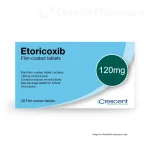
Etoricoxib 120mg tablets are a prescription-only anti-inflammatory medicine that helps relieve pain and swelling during an acute gout attack.
Each film-coated tablet delivers 120mg of etoricoxib. Etoricoxib targets COX?2, which helps your body turn down inflammation. As a result, it may reduce joint pain, heat, and swelling during a flare.
If you’ve had gout before, you’ll know timing matters. When you treat early (and safely), you often settle symptoms sooner. However, your health history and other medicines still matter. So we check suitability first, rather than pushing you towards a quick fix.
Etoricoxib sits among the first-line options for acute gout, alongside other NSAIDs, colchicine, and sometimes a short course of oral steroids. Even so, it won’t suit everyone. For example, some people need extra care if they have high blood pressure or certain heart, kidney, or stomach problems.
Key features and specifications
Active ingredient: Etoricoxib 120mg
Form: Film-coated oral tablets
Medicine class: COX?2 selective NSAID (non-steroidal anti-inflammatory drug)
UK licence at 120mg: Treats acute gouty arthritis for short-term use only (maximum 8 days)
Also licensed: Short-term pain after dental surgery (usually 90mg once daily for up to 3 days)
Prescription status: POM (Prescription Only Medicine)
Pharmacy: You’ll receive your medicine from Courier Pharmacy, a UK GPhC?registered pharmacy
MOJO WISDOM
Take control of your health by understanding your condition and what this medication is doing for you.
READ:
More information about this treatment.
UK-based doctors and pharmacists
Discreet and Confidential
UK-based doctors and pharmacists
Free, Expert Advice
No video link provided.
No video link provided.
UK-based doctors and pharmacists
Free, expert advice
Discrete and confidential
Fast delivery
Giving you trusted clinical advice for over 40 conditions
A UK regulated pharmacy providing safe, effective treatments online since 2014
A gout flare doesn’t wait for a convenient moment. It can wake you at 3 am with a joint that feels like it’s been set on fire, and the only thing that matters is making it stop. Etoricoxib 120mg tablets are a high-strength, prescription-only COX-2-selective anti-inflammatory, designed for exactly that kind of acute, intense, time-limited pain.
At Courier Pharmacy, we believe pain relief should fit the person sitting with it, whether that’s someone managing recurrent gout, recovering from dental surgery, or living with the cumulative weight of chronic illness. You’re not broken. The inflammation roaring through your joint is. Here’s how this tablet works, who it suits, and how we’ll help you decide if it belongs in your medicine cabinet.
Five key takeaways
Etoricoxib 120mg tablets are a prescription-only COX-2 selective NSAID licensed in the UK for short-term treatment of acute gouty arthritis flares and moderate postoperative dental pain in adults.
The 120mg strength is the highest licensed daily dose and is strictly time-limited: maximum 8 days for gout, and dental pain dosing typically uses the 90mg strength for up to 3 days.
Etoricoxib selectively targets the COX-2 enzyme, which means faster, focused anti-inflammatory action with less impact on the stomach-protective COX-1 pathway.
Cardiovascular, renal and blood-pressure risks rise with dose and duration, so a prescriber-led assessment is essential before any 120mg course.
At Courier Pharmacy, every Etoricoxib 120mg prescription is reviewed by a UK prescriber and dispensed by a GPhC-registered pharmacist, with personalised follow-up and free community clinics in Derby.
Treatment dosage Etoricoxib 120mg Tablets
For an acute gout flare, the recommended dose is one 120mg tablet taken once daily, used only during the acutely painful period and limited to a maximum of 8 days of treatment. The tablet is swallowed whole with water and can be taken with or without food. On an empty stomach the onset of effect may be a little faster, which often matters more during a flare than at any other time.
For postoperative dental pain, etoricoxib is licensed at 90mg once daily for a maximum of 3 days, so the 120mg tablet is not the appropriate strength for that indication. Some patients may also need additional postoperative analgesia during that short window, which your dentist or prescriber will coordinate.
Older adults don’t usually need a dose change based on age alone, although prescribers tend to be more cautious about cardiovascular and renal monitoring. People with mild liver impairment should not exceed 60mg daily, and those with moderate liver impairment should not exceed 30mg once daily, which means etoricoxib 120mg is not appropriate for them. Etoricoxib is contraindicated in severe liver impairment and in anyone with a creatinine clearance below 30 ml/min, which is why your prescriber will ask carefully about kidney and liver history during your consultation.
The guiding principle, echoed throughout NICE and BNF guidance, is to use the lowest effective dose for the shortest time necessary to control symptoms. Etoricoxib 120mg is a short-course, high-strength option, not a long-term painkiller. We’ll always check in with you, both at the point of prescribing and after the flare has settled, to make sure your wider gout management plan is on track.
Etoricoxib 120mg and gout
Gout is often described as the most painful form of arthritis there is, and people who live with it tend to agree. It’s driven by uric acid crystals forming inside a joint, most often at the base of the big toe, where they trigger an intense immune-driven inflammatory response. Etoricoxib 120mg targets the inflammation side of that equation, switching off the COX-2 enzyme that drives much of the prostaglandin signalling involved.
Etoricoxib 120mg maximum strength
The 120mg strength sits at the highest licensed end of the dosing range. NICE guidance advises any NSAID for acute gout at maximum effective dose, started as soon as possible after the flare begins, and continued only until symptoms resolve. That matches how we work. A medicine that’s earning its place during a flare should be stopped promptly once the flare has settled, not left running in the background.
The safety profile of COX-2 inhibitors
It’s worth saying clearly: COX-2 inhibitors are not safer in every way than traditional NSAIDs. They reduce certain gastrointestinal risks but do not eliminate them, and cardiovascular risks rise with both dose and duration. At 120mg, that risk profile is higher than at lower strengths, which is precisely why the licensed course is capped at 8 days.
Lifetstyle advice
Many of our patients arrive after years of being told their pain is being over-reported, or that gout is simply a lifestyle problem. We don’t subscribe to that framing. Gout has genetic, metabolic and renal components, and treating a flare effectively is the first step toward a better long-term plan. Whether you’re navigating recurrent gout, working through dental recovery, or managing a more complex chronic pain pattern, the goal is to find a regimen that respects your body’s signals rather than overriding them.
The bigger picture for gout involves longer-term urate-lowering therapy where appropriate, hydration, dietary attention, weight management and review of medicines that can push urate levels up. Tablets for a flare are a tool, not the whole toolkit. Our community work in Derby is one way we try to live up to that, but the spirit of it travels with every prescription we send out.
Why choose Courier Pharmacy for Etoricoxib 120mg Tablets
We started Courier Pharmacy because too many people were being handed prescriptions like takeaway flyers, with no conversation, no follow-up, and no sense that anyone had actually listened. Personalisation means looking at your blood pressure history, your kidney function, your other medicines and your wider gout picture, then deciding together whether etoricoxib 120mg fits your specific flare. It doesn’t mean clicking through a tickbox form and waiting for the parcel.
Guidance carries through after the prescription is issued. Our GPhC-registered pharmacists are reachable, not just for emergencies but for the smaller questions that often go unasked: should I keep taking this if I’m starting a new blood pressure medication? Is this stomach ache the tablet or the diet I’ve changed during the flare? Should I be thinking about urate-lowering therapy after this attack? You can ask. We’ll answer. Our medical lead, the figure behind much of our clinical thinking, is Dr Ada Jex-Cori, an evidence-led, community-rooted clinician who built her practice on the belief that people in chronic pain deserve to be heard before they’re prescribed.
Trust is the part that has to be earned, not claimed. We’re a UK-regulated pharmacy, we publish our processes, we tell you when something isn’t suitable, and we’d rather lose a sale than place a medicine where it doesn’t belong. Whether you’re navigating recurrent gout, fibromyalgia support, MCAS care, or chronic fatigue care that fits your life, we’ll meet you where you are, not where the system wishes you were.
Buy Etoricoxib 120mg Tablets (Prescription Only) from Courier Pharmacy
Etoricoxib 120mg Tablets are a Prescription Only Medicine (POM). That means you cannot buy them over the counter, and we cannot dispense them without a prescriber’s assessment. This isn’t bureaucracy; it’s the protection that stands between you and a cardiovascular event you didn’t know was coming. Here’s how the process works at Courier Pharmacy:
Complete a quick online consultation
A UK prescriber reviews your answers
If approved, a prescription is issued
We dispense and deliver discreetly to your door
If it isn’t suitable for you, we’ll explain why and suggest the next best option. Sometimes that’s a different medicine, sometimes a non-drug approach, sometimes a referral. We also run free fortnightly drop-in clinics and talks at Insomnia, Derby, 12 to 1pm, where you can sit down with a member of our team in person and ask anything you like. No appointment, no cost, no obligation.
Summary
A prescription-only COX-2 selective NSAID, licensed at 120mg for the short-term treatment of acute gouty arthritis (maximum 8 days)
Works by reducing inflammation-driving prostaglandins, rapidly easing the pain, heat, redness and swelling of a gout flare
Carries cardiovascular, blood pressure and renal considerations that intensify at higher doses, so prescriber assessment is essential
Most effective when started early in a flare, alongside rest, ice, hydration and any longer-term urate-lowering plan
Available from Courier Pharmacy with full prescriber review, GPhC-registered pharmacist oversight, and follow-up
Active ingredient in Etoricoxib 120mg Tablets
The active ingredient is etoricoxib, a selective inhibitor of cyclooxygenase-2 (COX-2). COX-2 is one of two enzymes that produce prostaglandins, the chemical signals that drive inflammation, pain and fever. By targeting COX-2 while largely sparing COX-1, etoricoxib reduces inflammatory pain without the same impact on the stomach-protective prostaglandins or on platelet function that older non-selective NSAIDs cause.
Each tablet also contains pharmaceutical excipients used in the film-coat and tablet core. If you have known intolerances or are managing conditions like mast cell activation syndrome (MCAS) where excipients matter, ask us during your consultation. We'll review the full ingredient list with you and, where appropriate, discuss whether a compounded alternative might suit you better.
What is Etoricoxib 120mg Tablets for?
At the 120mg strength, Etoricoxib is licensed in the UK for the short-term symptomatic relief of acute gouty arthritis in adults. That covers the rapid-onset joint inflammation, redness, swelling, heat and severe pain that defines a gout flare, most commonly affecting the big toe but capable of attacking the ankle, knee, wrist or finger joints too. The 120mg dose is used only during the painful flare and is capped at 8 days.
Etoricoxib is also licensed for short-term postoperative dental pain, although the recommended dose for that indication is 90mg once daily for up to 3 days, not 120mg. Lower strengths of etoricoxib (30mg, 60mg, 90mg) are licensed for chronic conditions including osteoarthritis, rheumatoid arthritis and ankylosing spondylitis. The 120mg tablet is the acute-pain workhorse of the range, not a daily long-term medicine.
A note on chronic illness contexts. People living with fibromyalgia, CFS/ME or MCAS sometimes ask whether a high-dose NSAID will help. The honest answer is: only when inflammation is the dominant driver of the specific pain episode, which is rarely the case in those conditions. Etoricoxib 120mg is designed for acute, inflammation-led pain like gout, and using it outside its licensed indications is a conversation to have with a clinician who understands your full picture, not a self-directed decision.
How does Etoricoxib 120mg Tablets work?
Pain and inflammation are coordinated by tiny chemical messengers called prostaglandins. When tissues are injured or, in the case of gout, when uric acid crystals trigger an immune cascade inside a joint, the COX-2 enzyme ramps up prostaglandin production. That sensitises nerves, dilates local blood vessels and recruits an army of immune cells. The result is the familiar bundle of redness, swelling, heat and pain. Etoricoxib slots into the active site of COX-2 and blocks it, so the inflammatory signal is dialled down at the source.
What sets COX-2 selective inhibitors apart from older NSAIDs is what they leave alone. COX-1, the sister enzyme, makes prostaglandins that help maintain the stomach lining and support normal platelet function. Traditional NSAIDs like ibuprofen, naproxen and diclofenac inhibit both COX-1 and COX-2, which is part of why long-term use carries a meaningful risk of gastric irritation and bleeding. Etoricoxib's preferential action on COX-2 means it tends to be gentler on the stomach lining, although it does not eliminate gastrointestinal risk entirely.
After you swallow the tablet, etoricoxib is absorbed from the gut, reaches peak blood levels within roughly one hour on an empty stomach, and has a half-life of around 22 hours. That long half-life is why once-daily dosing works, and it's part of why people often notice a meaningful drop in flare pain within the first day of starting a course. Steady anti-inflammatory effect builds over the first two to three days.
The trade-off worth understanding is cardiovascular. Because COX-2 inhibitors don't reduce platelet aggregation the way non-selective NSAIDs do, they don't provide the small anti-clotting effect that some older drugs offer. Combined with prostaglandin pathway effects on blood pressure and the kidneys, this is why the MHRA advises careful cardiovascular risk assessment before prescribing any COX-2 inhibitor, and especially before a 120mg short course.
For most adults without cardiovascular disease, well-controlled blood pressure and good kidney function, a short 120mg course for an acute gout flare is generally a reasonable option. For others, especially those with established heart disease or significant risk factors, a different approach to flare management may be safer. We'll go through your specific risk factors during your consultation and explain, in plain language, where you sit on that spectrum.
How to use Etoricoxib 120mg Tablets
Take one 120mg tablet by mouth once a day, swallowed whole with water. You can take it with or without food, but on an empty stomach the onset of effect may be a little faster, which often matters during an acute flare. Try to take it at roughly the same time each day. Routine helps, both for memory and for steady blood levels.
Start the course as soon as a flare begins. The evidence consistently shows that NSAIDs work better the earlier they're started in a gout flare, ideally within the first 12 to 24 hours of symptoms. Continue once daily until the flare has clearly resolved, then stop. The maximum licensed course is 8 days. Don't be tempted to stretch the course further or to use leftover tablets for unrelated pain; the cardiovascular risk profile of high-dose NSAIDs makes that genuinely unwise.
Practical tips from our pharmacists: keep the pack accessible if you have a history of recurrent gout flares (kitchen counter, not bathroom cabinet); pair the dose with an existing habit like morning coffee or brushing your teeth; if you miss a dose, take it as soon as you remember unless it's nearly time for the next one, in which case skip the missed dose. Never double up to catch up. Store at room temperature, away from direct sunlight, and out of reach of children.
Warnings and precautions for Etoricoxib 120mg Tablets
Etoricoxib is not suitable for everyone, and the list of cautions matters more at the 120mg strength than at lower doses. It is contraindicated in active peptic ulceration or active gastrointestinal bleeding, severe heart failure, established ischaemic heart disease, peripheral arterial disease, cerebrovascular disease, uncontrolled hypertension where blood pressure persistently sits above 140/90 mmHg, severe liver impairment and severe kidney impairment (creatinine clearance below 30 ml/min). It is also not recommended during pregnancy or while trying to conceive.
Blood pressure deserves special attention. Etoricoxib can raise blood pressure, and the risk rises with dose. NICE and the MHRA recommend that blood pressure is checked before starting any NSAID and monitored during treatment, then periodically thereafter. For a short 120mg course, your prescriber will weigh up your blood pressure history before approving treatment, and we recommend a simple home check during the course if you have a monitor available.
Cardiovascular risk factors deserve specific consideration. People with diabetes, high cholesterol, smoking history, family history of early heart disease or established cardiovascular disease should only take etoricoxib after a careful weighing of benefits and risks. Tell your prescriber about every medication and supplement you take, including herbal products, and any history of stomach ulcers, asthma, or allergic reactions to NSAIDs or aspirin.
Rare but serious skin reactions, including Stevens-Johnson syndrome and toxic epidermal necrolysis, have been reported with etoricoxib. These usually appear in the first month of treatment, which means even a short 8-day course can be the window in which they emerge. If you develop a new rash, blistering, peeling, or mucosal involvement (eyes, mouth, genitals), stop the tablet and seek urgent medical attention. The same applies to symptoms of liver problems, including yellowing of the skin or eyes, dark urine, or persistent nausea.
If you become pregnant while taking etoricoxib, or are planning a pregnancy, contact us. The medicine is not recommended in pregnancy, particularly in the third trimester. Breastfeeding caution applies because excretion in human milk hasn't been fully characterised.
Side effects of Etoricoxib 120mg Tablets
Most people taking a short etoricoxib 120mg course tolerate it well, although side effects tend to be more frequent at higher doses than at lower ones. Common side effects, occurring in up to one in ten people, include headache, dizziness, palpitations, raised blood pressure, indigestion, abdominal discomfort, nausea, fluid retention (ankle or leg swelling), and feeling generally fatigued or flu-like. Many of these settle as the course ends, but tell us early if they don't, or if anything escalates.
Less common effects, occurring in fewer than one in a hundred, include sleep disturbance, mood changes, blurred vision, taste changes, tinnitus, mouth ulcers, constipation, diarrhoea, muscle cramps, raised liver enzymes on blood tests, and changes in kidney function. Rarer effects include serious gastrointestinal events such as ulcer or bleeding, severe skin reactions, hepatitis, kidney failure, and hypersensitivity reactions including angioedema.
Cardiovascular events, including heart attack, stroke and worsening heart failure, are recognised risks of all NSAIDs, including COX-2 selective inhibitors. The absolute risk for any individual depends heavily on baseline cardiovascular risk, dose and duration, and rises at the 120mg dose. This is one of the most important reasons we won't issue a 120mg course without a proper assessment.
If something feels wrong, trust that signal. Stop the tablet if you experience symptoms suggesting a serious reaction (chest pain, shortness of breath, sudden weakness or speech difficulty, severe rash, severe abdominal pain, vomiting blood, black stools, swelling of the face or throat) and seek emergency medical attention.
Suspected side effects can and should be reported to the MHRA via the Yellow Card scheme at yellowcard.mhra.gov.uk. Reporting helps build the safety picture for everyone. We can help you complete a Yellow Card report if you'd like a hand.
Drug interactions with Etoricoxib 120mg Tablets
Etoricoxib interacts with a range of medicines, and the interactions are worth taking seriously, particularly at high doses. Warfarin and other oral anticoagulants need close INR monitoring when etoricoxib is introduced or stopped, because etoricoxib can raise INR and the bleeding risk that goes with it. Direct oral anticoagulants like rivaroxaban, apixaban, edoxaban and dabigatran are not formally restricted, but combined bleeding risk should be weighed up by a clinician, especially over an 8-day course.
Blood pressure medicines, including ACE inhibitors (such as ramipril, lisinopril), angiotensin II receptor blockers (such as losartan, candesartan) and diuretics, can have their effect blunted by etoricoxib. The combination also raises the risk of acute kidney injury, particularly in older adults or those who become dehydrated. Dehydration during a gout flare is not uncommon, so good fluid intake during a 120mg course matters more than it might during a quieter spell.
Other NSAIDs, including over-the-counter ibuprofen and aspirin at anti-inflammatory doses, should not be combined with etoricoxib because the gastrointestinal risk compounds without much extra benefit. Low-dose aspirin used for cardiovascular protection is a different question and is usually allowed, but discuss it with your prescriber. Methotrexate levels may rise on co-administration with etoricoxib, so people on methotrexate need careful supervision.
Hormonal contraception, lithium, ciclosporin, tacrolimus, rifampicin and some antifungals can also interact with etoricoxib in clinically meaningful ways. People taking gout-specific medicines like allopurinol, febuxostat or colchicine should let us know during the consultation, as combination therapy is often appropriate but needs sensible co-ordination. Always give a full medicines history during your consultation, including supplements, herbal products and recreational substances.
Alcohol doesn't directly interact pharmacokinetically with etoricoxib, but heavy or regular drinking adds to stomach, liver and cardiovascular risks, and alcohol is itself a known trigger for gout flares. Cutting back during a flare, and reviewing intake afterwards, is part of the bigger picture.
Frequently asked questions about Etoricoxib 120mg Tablets
Is Etoricoxib 120mg Tablets an opioid?
No. Etoricoxib is a non-steroidal anti-inflammatory drug (NSAID), specifically a selective COX-2 inhibitor. It works on inflammation-driving prostaglandins, not on opioid receptors. It isn't addictive in the way opioids are, doesn't cause respiratory depression, and isn't a controlled drug. That said, the 120mg strength is potent and isn't risk-free, which is why it remains prescription-only and tightly time-limited.
How quickly does Etoricoxib 120mg start working in a gout flare?
Many people notice some pain relief within one to two hours of the first dose, particularly when taken without food, because peak blood levels are reached around one hour after swallowing. The full anti-inflammatory effect typically builds over the first 24 to 48 hours of regular dosing, which is when most people start to feel the flare clearly easing.
How long can I take Etoricoxib 120mg for?
The 120mg dose is licensed for acute gouty arthritis at a maximum of 8 days. It is not a long-term medicine. If your flare hasn't resolved within that window, contact your prescriber rather than continuing on your own. Recurrent flares are usually a sign that longer-term urate-lowering therapy needs reviewing.
Can I take Etoricoxib 120mg with paracetamol?
In most cases, yes. Paracetamol works on a different pathway and is often combined with NSAIDs for layered pain relief during a flare. Stick to standard paracetamol dosing (no more than 4g per 24 hours in adults) and let us know during your consultation if you're already taking paracetamol-containing combination products.
Can I take ibuprofen at the same time?
No. Combining etoricoxib with another NSAID like ibuprofen, naproxen or aspirin at anti-inflammatory doses significantly increases the risk of stomach ulcers, bleeding and kidney problems without adding meaningful benefit. Low-dose cardiac aspirin (75mg) is a different conversation, and your prescriber will guide you.
Does Etoricoxib 120mg raise blood pressure?
It can. Etoricoxib affects renal prostaglandins involved in sodium balance and vascular tone, which is why blood pressure can rise, and the risk increases with dose. The MHRA recommends blood pressure monitoring before starting and during treatment. For a short 8-day course this is usually manageable, but anyone with uncontrolled hypertension should not take etoricoxib 120mg.
Can I drink alcohol while taking Etoricoxib 120mg?
There is no direct pharmacokinetic interaction, but alcohol increases the risk of stomach irritation, liver stress and cardiovascular complications, and is a well-known trigger for gout flares. Most clinicians recommend avoiding alcohol entirely during a flare and reviewing intake afterwards as part of long-term gout management.
Can I drive while taking Etoricoxib 120mg?
For most people, yes. A minority experience dizziness, drowsiness or blurred vision, particularly during the first few days. If you notice any of these, don't drive or operate machinery until they settle, and contact us for advice. The DVLA does not list etoricoxib as a notifiable medication for driving.
Is Etoricoxib 120mg safe to use for every gout flare?
It depends on the individual. For people with low cardiovascular risk, well-controlled blood pressure and good kidney function, a short 120mg course is generally a reasonable option for recurrent flares. For people with higher cardiovascular risk, repeated short courses still add up, and a longer-term plan involving urate-lowering therapy is often the better answer.
What's the difference between Etoricoxib 120mg and ibuprofen?
Ibuprofen inhibits both COX-1 and COX-2, while etoricoxib selectively inhibits COX-2. That selectivity tends to make etoricoxib gentler on the stomach but doesn't reduce cardiovascular risk in the same way. Etoricoxib is also taken once daily rather than three or four times a day, which can improve adherence during a painful flare.
Can I take Etoricoxib 120mg if I have asthma?
People with NSAID-sensitive asthma or aspirin-exacerbated respiratory disease should generally avoid all NSAIDs, including COX-2 selective ones, unless a specialist has assessed and approved use. Tell your prescriber if you've ever had asthma worsen after taking ibuprofen, aspirin or any other NSAID.
Does Etoricoxib 120mg work for postoperative dental pain?
Etoricoxib is licensed for short-term postoperative dental pain, but the recommended dose for that indication is 90mg once daily for up to 3 days, not 120mg. If you've been advised an etoricoxib course for dental pain, the 90mg strength is the appropriate one. Talk to your dentist or prescriber if there's any uncertainty.
What should I do if I miss a dose?
Take the missed dose as soon as you remember unless it's nearly time for the next one. In that case, skip the missed dose and continue with your regular schedule. Don't take a double dose to make up. Missing the occasional dose is rarely a clinical issue, but missing several may slow the resolution of a flare.
Are there alternatives to Etoricoxib 120mg for gout?
Yes. NICE guidance lists NSAIDs (including etoricoxib), colchicine and short courses of oral corticosteroids as first-line options for an acute gout flare, with the choice depending on your comorbidities, other medicines and preferences. We'll talk through which best fits your situation during the consultation rather than defaulting to one option.
Can I take Etoricoxib 120mg with antidepressants?
It depends on the antidepressant. SSRIs (such as sertraline, citalopram, fluoxetine) can increase bleeding risk when combined with NSAIDs, particularly in older adults or those on other antiplatelets. Tell your prescriber about every antidepressant, including those you've recently stopped, so the combined risk can be weighed.
Is Etoricoxib 120mg available on the NHS?
Yes, etoricoxib is available on NHS prescription where clinically appropriate, although prescribing is generally restricted to specific indications and after other options have been considered. If you'd rather avoid waiting lists during an acute flare, a private online consultation is one route to access.
Can people with MCAS take Etoricoxib 120mg?
Some people with MCAS tolerate etoricoxib well; others react to either the active or to excipients in the tablet. We always review the full excipient list during your consultation if you have known mast cell reactivity, and where appropriate we can discuss whether a compounded, simpler formulation is a better fit.
How is Etoricoxib 120mg stored?
Store at room temperature, below 30°C, in the original pack, away from direct sunlight and moisture. Keep out of sight and reach of children. Don't use beyond the expiry date printed on the pack, and return any unused tablets to a pharmacy for safe disposal.
Does Etoricoxib 120mg affect fertility?
Like other NSAIDs, etoricoxib may affect fertility and is not recommended for women actively trying to conceive. The effect is generally reversible on stopping the medicine. If you're planning a pregnancy, talk to us before continuing.
How do I order Etoricoxib 120mg Tablets from Courier Pharmacy?
Complete the short online consultation on our site, and a UK prescriber will review your answers. If etoricoxib 120mg is suitable, a prescription is issued, our GPhC-registered pharmacy dispenses your tablets and delivers them discreetly to your door. If it isn't suitable, we'll tell you why and suggest a next step. You can also drop into our free fortnightly clinic at Insomnia, Derby, to ask in person.
Disclaimer: This article is for general information only and isn’t a substitute for personal medical advice, diagnosis, or treatment. Always check with a GP, pharmacist, or specialist before starting a new supplement if you have a medical condition or take regular medicines.
More than a prescription: our community
Healthcare shouldn't only happen when you're paying for it. Every fortnight we run free drop-in talks and clinics at Insomnia, Derby, from 12pm to 1pm. Bring a question, bring a friend, bring a stack of bewildering letters from another clinic; we'll sit with you. We cover chronic pain, gout, hair loss, men's health, MCAS, fibromyalgia, low-dose naltrexone, and whatever else people bring through the door. No appointment. No cost. No pressure. Learn more about our community talks.
How this content was created
Written by the Courier Pharmacy editorial team and reviewed by a GPhC-registered pharmacist. Grounded in the latest NHS, NICE, BNF and EMC guidance, peer-reviewed studies, and the real questions patients bring to our drop-in clinics in Derby.
Joint Formulary Committee (2026) British National Formulary: Etoricoxib. London: BMJ Group and Pharmaceutical Press. Available at: https://bnf.nice.org.uk/drugs/etoricoxib/