Home » Treatment » Finasteride 0.1%, minoxidil 5% topical hair loss liquid
Finasteride 0.1%, minoxidil 5% topical hair loss liquid
from£29.99
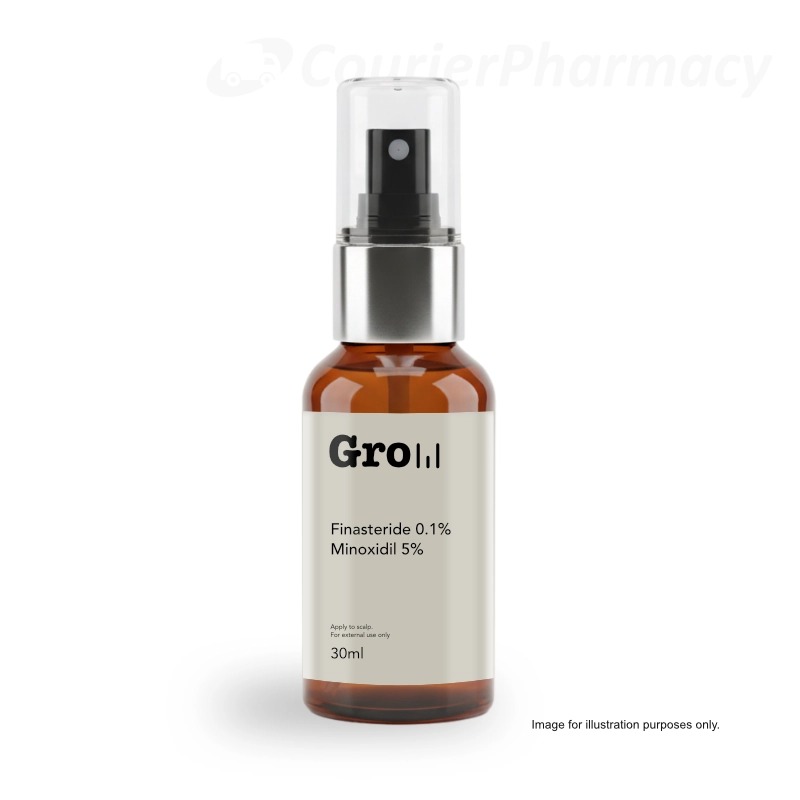
A personalised topical hair loss liquid containing finasteride 0.1% and minoxidil 5% in a traditional alcohol and propylene glycol base. Designed for adults who need a focused two-ingredient approach targeting the hormonal and circulatory drivers of pattern hair loss — with finasteride at a clinically considered mid-range concentration — delivered with the precision of a spray applicator and the efficient absorption of a well-established liquid base. Applied as six sprays (1ml) to the scalp at night and washed off in the morning.
Hair loss is easy to dismiss — until it happens to you. The visible signs are familiar: thinning at the crown, a wider parting, a hairline moving in the wrong direction. The less visible impact is often harder to carry. Confidence drops. Self-consciousness builds. The worry that things are getting worse — and that nothing tried so far has made a real difference — becomes part of daily life.
The problem with doing nothing
Pattern hair loss does not pause while you consider your options. Follicles continue to miniaturise under the influence of DHT, scalp circulation declines, and the window for effective treatment narrows over time. Many people spend months on products that are not matched to their biology, see little result, and quietly give up — not because treatment cannot work, but because they were never on the right treatment to begin with.
Why this two-ingredient combination?
Pattern hair loss has more than one driver. DHT miniaturises follicles through the hormonal pathway. Poor scalp circulation and reduced follicle activity then accelerate visible thinning.
This formula addresses both dimensions directly. Finasteride 0.1% targets the hormonal driver at a clinically considered mid-range compounded strength. Minoxidil 5% stimulates follicle activity and improves scalp circulation. Together, they form a considered two-ingredient approach — not a default combination, but a formula selected because clinical assessment and, where used, TrichoTest results indicate this is the most appropriate treatment for the individual.
Why a traditional liquid base?
The liquid format uses alcohol and propylene glycol — a well-established combination in topical hair loss treatment. These excipients are effective penetration enhancers. They carry active ingredients through the scalp barrier efficiently and have decades of clinical use behind them in this context.
For patients who tolerate this base well, it offers a direct, no-fuss format that gets on with the job — delivering both active ingredients efficiently to the follicles that need them.
A dose you can measure
The spray applicator delivers exactly 1ml across six sprays. No estimating. No guesswork. Each spray lands precisely where you direct it — on the areas of thinning, not across the entire scalp. That controlled, consistent delivery matters when you are applying finasteride at a clinically selected mid-range concentration alongside minoxidil night after night.
Why 0.1% finasteride?
The finasteride concentration in this formula is 0.1%. This is a clinically considered mid-range compounded strength. The prescriber selects it when clinical assessment indicates this is the most appropriate concentration.
Whether as a starting point for patients whose profile suggests a moderate anti-androgen requirement, or as an ongoing concentration supported by TrichoTest results. The concentration is not a default. It is a clinical decision made for you specifically.
A medically responsible route
At Courier Pharmacy, treatment starts with a proper assessment. Suitability is checked. The decision to prescribe this compounded liquid is a clinical one — based on your scalp, your history, and your goals.
Prescription-only compounded topical liquid for pattern hair loss
Traditional spray format with precise, measured delivery
Finasteride 0.1%, minoxidil 5% — a clinically considered two-ingredient combination
Reviewed for suitability by a UK-qualified prescriber
Additional information
Quantity
1 x 30ml, 2 x 30ml, 3 x 30ml, 4 x 30ml, 5 x 30ml, 6 x 30ml
MOJO WISDOM
Take control of your health by understanding your condition and what this medication is doing for you.
READ:
More information about this treatment.
UK-based doctors and pharmacists
Discreet and Confidential
UK-based doctors and pharmacists
Free, Expert Advice
No video link provided.
No video link provided.
UK-based doctors and pharmacists
Free, expert advice
Discrete and confidential
Fast delivery
Giving you trusted clinical advice for over 40 conditions
A UK regulated pharmacy providing safe, effective treatments online since 2014
What is Finasteride 0.1%, Minoxidil 5% topical hair loss liquid?
This compounded topical hair loss liquid contains finasteride 0.1% and minoxidil 5% in a traditional alcohol and propylene glycol base. It is designed for adults with pattern hair loss who need a focused two-ingredient approach — targeting the hormonal driver of hair loss at a mid-range finasteride concentration and supporting follicle activity — particularly those whose clinical profile indicates this combination is the most appropriate starting point, or those who want both active ingredients delivered efficiently via a precise spray applicator.
Two active ingredients working together to target DHT and support follicle activity
Traditional spray liquid format for precise, measured delivery
Finasteride at 0.1%, minoxidil at 5% — a clinically considered mid-range combination
May suit people with androgenetic alopecia with a moderate anti-androgen requirement who want a direct, efficient liquid format
Safe prescribing still matters — hair loss treatment needs proper screening, review, and follow-up
Part of the Gro hair loss range, designed for personalised treatment at less than £1 per day
Pattern hair loss is personal
Pattern hair loss is common, but that does not make it any less personal. Many people first notice extra shedding, reduced density, or a hairline that seems to be quietly retreating. Many then try a product that does not match their biology, see little result, and quietly give up — not because treatment cannot work, but because they were never on the right treatment to begin with.
A formula for people who need a mid-range anti-androgen approach delivered directly
This liquid is aimed at people who need a carefully considered two-ingredient approach — addressing the hormonal and circulatory drivers of pattern hair loss at a mid-range finasteride concentration — delivered in a traditional format that absorbs efficiently and applies with precision. It is particularly relevant for those whose TrichoTest results indicate a moderate anti-androgen requirement alongside a strong minoxidil response profile, and those who want the precision of a spray applicator to deliver both active ingredients exactly where they are needed.
The goal of treatment
Hair loss affects more than appearance. It chips away at confidence. It makes ordinary moments feel oddly loaded — a harsh bathroom mirror, a photo taken from an unexpected angle, a windy day when you would rather not think about what is visible.
The goal of treatment is not perfection. It is to slow loss, support healthier growth, and help you feel more in control — with a plan that addresses the full picture at the most clinically appropriate strength and a format that delivers both active ingredients efficiently, night after night.
The traditional liquid advantage
Precise dosing with every application
The spray applicator removes the guesswork entirely. Six sprays deliver exactly 1ml — the standard prescribed dose of finasteride at the mid-range concentration alongside minoxidil — every single time. You direct each spray to the areas of thinning. No pooling. No drift. That precision makes consistent, accurate delivery of both active ingredients straightforward and repeatable night after night.
An established vehicle with a proven track record
Alcohol and propylene glycol are effective penetration enhancers with decades of clinical use in topical hair loss treatment. They carry active ingredients through the scalp barrier efficiently — and for a two-ingredient formula at a mid-range finasteride concentration, efficient delivery of both active ingredients matters. For patients who tolerate this base well, it offers a direct, no-fuss route that gets on with the job.
Adherence is everything
Both active ingredients work best with sustained, consistent use. If six precise sprays at the same time each evening is a routine you can maintain without difficulty, the liquid format has a clear practical advantage — and that advantage builds steadily over the months that treatment requires.
Why the liquid vehicle matters
The alcohol and propylene glycol base is clinically relevant as well as practically efficient. It acts as an effective penetration enhancer — promoting scalp absorption and helping both active ingredients reach the follicles that need them. The spray applicator ensures a precise, consistent dose with every application. For patients who tolerate this base well, it offers a direct and efficient route for delivering this two-ingredient formula.
Why compounding?
What compounding means
Compounding means a medicine is prepared to order by a licensed pharmacy for an individual patient. It is not a mass-produced one-size-fits-all product. In the UK, this sits within a regulated framework and should only be supplied when clinically appropriate.
Why compounding matters for this formula
Some people choose this compounded liquid because no standard licensed product combines finasteride at 0.1% and minoxidil in a traditional spray liquid — and this specific combination, at a mid-range finasteride concentration, delivered efficiently via a spray applicator, is what their clinical profile requires. Others come to compounding because they want a clinically tailored two-ingredient approach at a precisely selected finasteride concentration in a direct, efficient liquid format. Others want the clinical flexibility to adjust their formula over time as their treatment plan evolves.
Personalised medicine in practice
Hair loss is not identical from one person to the next. The right combination of ingredients, concentrations, and format for one patient is not right for another. Compounding makes it possible to prescribe finasteride 0.1% and minoxidil 5% together in a liquid base — a formulation that simply does not exist in any standard licensed product — when clinical assessment indicates that this is the most appropriate approach. The medicine is shaped around the patient, not the other way around.
Why this two-ingredient combination can be the right choice
Some patients need both mechanisms addressed — DHT suppression and follicle stimulation — at a mid-range finasteride concentration. Finasteride at 0.1% turns down the hormonal signal at a clinically considered strength. Minoxidil stimulates follicle activity and improves scalp blood flow. For patients whose TrichoTest results indicate a moderate anti-androgen requirement alongside a strong minoxidil response via the SULT1A1 pathway, this combination delivered in an efficient liquid spray may be the most clinically targeted approach.
If tretinoin or other ingredients would add further benefit, or if the finasteride concentration needs to adjust over time, TrichoTest and clinical assessment will guide that decision. Compounding makes either path possible.
TrichoTest: personalising the approach
TrichoTest reduces guesswork. It is a pharmacogenetic test that analyses 26 genetic polymorphisms linked to nine key treatment pathways relevant to hair loss. Rather than prescribing from standard protocols alone, TrichoTest combines your genetic profile with your medical history to predict which ingredients, dosages, and delivery methods are most likely to work for your biology.
How the TrichoTest informs this formula
This two-ingredient formula draws on multiple TrichoTest pathways simultaneously. The sulphotransferase (SULT1A1) pathway predicts minoxidil response — patients with high SULT1A1 expression are strong responders to minoxidil and may benefit particularly from its inclusion at 5%. The anti-androgen metabolism pathway identifies how effectively a patient responds to finasteride — and whether 0.1% is the most appropriate concentration for their genetic profile.
TrichoTest can identify all of these factors before treatment begins — allowing the prescriber to arrive at the mid-range finasteride concentration with clinical confidence, rather than defaulting to it or arriving at it only after months of trial and adjustment.
How the TrichoTest informs this formula more broadly
If TrichoTest identifies that a different finasteride concentration — lower or higher — would be more appropriate for the individual’s anti-androgen requirement, the prescriber can adjust accordingly. If results suggest that tretinoin or additional ingredients would add meaningful benefit, the prescriber can incorporate these from the outset or over time.
The nine pathways TrichoTest analyses
Prostaglandins and sulphotransferase — how you process minoxidil and latanoprost
Anti-inflammatory response — your reaction to glucocorticoids and immunomodulators
Anti-androgen metabolism — how effectively you respond to dutasteride, finasteride, and 17?-oestradiol
Circulation stimulation — response to vasodilators
Collagen synthesis capacity
Insulin-like Growth Factor (IGF-1) response
Vitamin absorption — A, B7, B9, B12, C, D, E
Mineral absorption — zinc, magnesium, iron, selenium
Antioxidant needs and oxidative stress profile
Beyond ingredient selection
TrichoTest also identifies nutritional gaps and metabolic factors that affect hair health independently of topical treatment. If genetic variants reduce zinc or iron absorption, the prescriber can recommend targeted supplementation alongside this liquid formula — moving treatment from guesswork towards something shaped by your actual biology.
TrichoTest does not guarantee results, but it gives the prescriber better information to decide whether this specific two-ingredient liquid formula at 0.1% finasteride is right for you, or whether something different would serve you better.
The Gro hair loss range
What is the Gro brand?
Gro is the compounded hair loss range created by Courier Pharmacy and Medical Mojo. It exists because hair loss treatment should not feel one-size-fits-all.
Some people want a traditional liquid spray — direct, efficient, and familiar. Some prefer a foam. Others need an alcohol-free and propylene glycol-free base because their scalp reacts to standard excipients. Gro brings those options together under one brand, matching treatment to the person using it, not the other way around.
Each Gro product comes in a 30ml bottle designed to last one month. Every option costs £29.99 for up to three active ingredients — less than £1 a day.
Why Gro is different
Gro was built around three practical goals:
Choice of formulation: topical liquid, topical foam, or Trichosol solution (propylene glycol free and alcohol free)
Personalisation: single, dual, and triple-ingredient combinations across multiple concentrations
Better tolerability: every format is designed to reduce the friction that stops people from maintaining their routine
The three formulation types
Topical hair loss liquid — a traditional spray solution containing alcohol and propylene glycol. Well-established, with efficient scalp penetration. Six sprays deliver a precise 1ml dose. This is the formulation described on this page. Chosen by patients who want a direct, proven format for their two-ingredient combination.
Hair loss foam — lighter, faster-drying, and easier to apply without dripping. Chosen by patients who want clinical results in a format that fits more easily into daily life.
Trichosol topical solution — propylene glycol free and alcohol free. Designed for patients with sensitive or reactive scalps who need a gentler base but want the same two active ingredients at the same concentrations.
Ingredients used across the Gro range
Depending on the product selected, Gro formulations may include:
Dutasteride
Finasteride
Minoxidil 5%
Tretinoin 0.01%
These can be prescribed alone or in combination, and at varying concentrations, depending on the individual treatment plan.
Gro product options
The Gro range includes the following compounded hair loss options, each supplied as a 30ml one-month bottle at £29.99.
Dutasteride 0.05%, minoxidil 5% in Trichosol — topical solution
Dutasteride 0.1%, minoxidil 5% — topical liquid
Dutasteride 0.1%, minoxidil 5% — topical foam
Dutasteride 0.1%, minoxidil 5% in Trichosol — topical solution
Dutasteride 0.2%, minoxidil 5% — topical liquid
Dutasteride 0.2%, minoxidil 5% — topical foam
Dutasteride 0.2%, minoxidil 5% in Trichosol — topical solution
Finasteride + Minoxidil
Finasteride 0.05%, minoxidil 5% — topical liquid
Finasteride 0.05%, minoxidil 5% — topical foam
Finasteride 0.05%, minoxidil 5% in Trichosol — topical solution
Finasteride 0.1%, minoxidil 5% — topical liquid
Finasteride 0.1%, minoxidil 5% — topical foam
Finasteride 0.1%, minoxidil 5% in Trichosol — topical solution
Finasteride 0.2%, minoxidil 5% — topical liquid
Finasteride 0.2%, minoxidil 5% — topical foam
Finasteride 0.2%, minoxidil 5% in Trichosol — topical solution
In simple terms
Gro makes personalised hair loss treatment accessible and practical.
You get a 30ml bottle for one month, £29.99 pricing, up to three active ingredients at a concentration chosen for you, and a choice of liquid, foam, or Trichosol alcohol-free and propylene glycol-free solution. If you want a treatment that fits your biology, your treatment stage, and your daily life — not a generic protocol — the Gro range gives you more than one route without making the choice unnecessarily complicated.
This is a Prescription Only Medicine. You can request it from courierpharmacy.co.uk by completing a quick online consultation, reviewed by a UK-qualified prescriber for suitability and safety. If appropriate, Courier Pharmacy will dispense the compounded liquid and deliver it discreetly.
Complete the online consultation
Prescriber reviews your answers for suitability and safety
Prescription issued if clinically appropriate
Dispensed and delivered discreetly to your door
If the treatment is not suitable, this will be explained clearly and the next best option may be suggested.
Summary
Prescription-only compounded two-ingredient treatment for pattern hair loss
Targets DHT via finasteride and supports follicle activity via minoxidil
Traditional spray liquid format with precise, measured dosing
Finasteride at 0.1% — a clinically considered mid-range concentration — minoxidil at 5%
May help patients with a moderate anti-androgen requirement or those who want efficient delivery via a spray liquid base
Good outcomes depend on consistency, review, and realistic expectations
Comes in a convenient 30ml bottle designed to last around one month, at less than £1 per day
Finasteride 0.1%, Minoxidil 5% topical hair loss liquid — Active ingredients
Finasteride 0.1%
Finasteride is a 5-alpha reductase inhibitor. It reduces the conversion of testosterone to dihydrotestosterone, or DHT — the key hormonal driver of androgenetic alopecia in susceptible hair follicles. Unlike dutasteride, finasteride selectively blocks type 2 5-alpha reductase. At 0.1%, this is a clinically considered mid-range concentration — not a default, but a considered choice based on the individual's profile, history, and TrichoTest results where used. The concentration is not a compromise. It is a clinical decision made for the individual.
Minoxidil 5%
Minoxidil is a topical vasodilator and follicle stimulant. It supports hair growth by prolonging the anagen (growth) phase of the hair cycle, improving blood supply to follicles, and stimulating follicle cells to produce thicker, healthier hair. At 5%, this is the standard compounded concentration for adults with pattern hair loss.
Why the liquid vehicle matters
The alcohol and propylene glycol base is clinically relevant as well as practically efficient. It acts as an effective penetration enhancer — promoting absorption and helping both active ingredients reach the follicles efficiently. The spray applicator ensures a precise, consistent dose with every application. For patients who tolerate this base well, it offers a direct and efficient route for delivering this two-ingredient formula to the follicles that need treatment.
What is the Finasteride 0.1%, Minoxidil 5% topical hair loss liquid used for?
Pattern hair loss in men and women
This product treats pattern hair loss, also called androgenetic alopecia. In men, this often appears as a receding hairline or thinning at the crown. In women, it may present as diffuse thinning or a widening parting. The aim is to support hair retention and encourage healthier growth where clinically appropriate.
The problems of hair loss
The practical problem is visible thinning. The internal problem is the loss of confidence that builds quietly alongside it. The deeper issue is that people should not have to feel dismissed or left to navigate treatment alone for something that so clearly affects daily life.
Who this formula is for
Some patients come to this formula because their clinical profile indicates that both drivers of hair loss — hormonal and circulatory — need to be addressed at a mid-range finasteride concentration, and they want both delivered in a precise, efficient liquid spray format. Others arrive because their TrichoTest results demonstrate both a moderate anti-androgen requirement and strong SULT1A1 activity, making this two-ingredient liquid combination the most clinically targeted approach. Others still come after finding that previous approaches have not delivered adequate results — and this carefully considered liquid formula offers the right concentration in the most direct available format. In all cases, a compounded liquid at finasteride 0.1% and minoxidil 5% offers a more purposeful path than anything available off the shelf.
How does the Finasteride 0.1%, Minoxidil 5% topical hair loss liquid work?
Pattern hair loss is driven by multiple overlapping processes. This formula targets two of the most important directly.
Finasteride: blocking the hormonal signal
In pattern hair loss, follicles gradually shrink under the influence of DHT. Finasteride blocks type 2 5-alpha reductase — reducing the conversion of testosterone into DHT at the follicle. At 0.1%, the concentration reflects a clinical judgment that this is the right mid-range strength for the individual. Think of finasteride as turning down the hormonal signal — reducing the DHT-driven pressure that causes follicles to miniaturise over time.
Minoxidil: stimulating the follicle
Minoxidil is a potassium channel opener and vasodilator. Applied topically, it improves blood flow to follicles, prolongs the growth phase of the hair cycle, and stimulates follicle cells to produce thicker, healthier hair. It works through an entirely different mechanism from finasteride — addressing the circulatory and follicle-stimulating side of the equation rather than the hormonal side. Think of minoxidil as waking up the follicles — improving the conditions at the scalp so that existing follicles can produce more and healthier hair.
How do you use the Finasteride 0.1%, Minoxidil 5% topical hair loss liquid?
This formulation is a topical liquid and should only be used exactly as prescribed. The usual direction is:
Apply 1ml (6 sprays) to the scalp daily
A dose you can control
Six sprays deliver a consistent, measured 1ml dose of finasteride at the mid-range concentration alongside minoxidil every time. You direct each spray precisely to the areas of thinning, then massage gently with your fingertips to distribute evenly. No estimating. No concern about whether you applied the right amount. The liquid works overnight and washes off as part of a normal morning routine.
The right formula for you
Because this is a compounded medicine, the prescriber selects each ingredient and concentration based on your individual clinical profile and, where used, TrichoTest results. The 0.1% finasteride concentration reflects a clinical judgment that a mid-range anti-androgen approach is right for you. Minoxidil at 5% is the standard compounded concentration. The formula may adjust over time — stepping the concentration up or down, or adding tretinoin if indicated — as your treatment plan evolves.
Building a routine that works
Many people find it easiest to apply as part of their evening routine — after a shower, before bed. The liquid works overnight and washes off as part of a normal morning routine. Applied consistently at the same time each night, treatment has the best possible conditions to deliver results.
What to do if you miss a dose
Resume at the next usual time. Do not apply extra to make up for it. Consistent daily use over months matters far more than compensating for a missed night.
Finasteride 0.1%, Minoxidil 5% topical hair loss liquid — Warnings and precautions
Who should not use this product
This product is not suitable for everyone. Extra care is needed if you are pregnant, trying to become pregnant, breastfeeding, have a scalp condition affecting absorption, or have a history of allergy to any ingredient in the formulation — including alcohol or propylene glycol.
Finasteride warnings
Finasteride affects hormone pathways. Women who are pregnant or may become pregnant must not use this product — it can affect male foetal development. Men with a history of prostate cancer, BPH, or elevated PSA levels need careful assessment before starting. Finasteride lowers PSA levels, which may mask early prostate cancer. Baseline PSA screening may be required. Post-finasteride syndrome (PFS) — persistent sexual dysfunction, mood changes, or other symptoms after stopping — is a rare but recognised concern. The prescriber will discuss this risk during consultation.
Minoxidil warnings
Minoxidil is a vasodilator. Patients with a history of cardiovascular disease, low blood pressure, or cardiac conditions need careful assessment before starting. Systemic absorption is lower with topical use than oral minoxidil, but cardiovascular status will still be reviewed.
A note on the liquid base
Some patients find alcohol and propylene glycol-based products cause scalp dryness, stinging, or irritation — particularly those with more sensitive skin. If you have previously reacted to products containing these excipients, discuss this with the prescriber before starting. Alternative formats — including the foam and the Trichosol alcohol-free and propylene glycol-free solution — are available within the Gro range at the same concentrations and may be more appropriate.
A note on concurrent treatments
If you are using other topical hair loss agents alongside this liquid, disclose this during consultation. Concurrent use of multiple topical hair loss agents is not usually recommended without prescriber guidance.
Compounded does not mean casual
The traditional liquid format and two-ingredient formula do not reduce the need for proper prescribing review. The same thorough safety and suitability checks apply here as with any other prescription treatment. A full medical history — including cardiovascular status, prostate health, pregnancy status, previous medication reactions, and mood or sexual function concerns — will be reviewed during consultation.
Finasteride 0.1%, Minoxidil 5% topical hair loss liquid — Side effects
Common side effects
Common side effects may include scalp irritation, dryness, redness, itching, flaking, or temporary shedding early in treatment. The alcohol and propylene glycol base may cause more noticeable dryness or a mild stinging sensation in some patients. Early shedding is common when starting minoxidil — it occurs as follicles shift through the hair cycle and usually settles within a few months.
Finasteride-related effects
Finasteride at 0.1% topical strength may cause sexual dysfunction in some patients — including reduced libido, erectile dysfunction, or ejaculation disorders. These effects are uncommon with topical application but have been reported. Mood changes, depression, or anxiety have also been documented. Post-finasteride syndrome remains a recognised concern. The prescriber will discuss this during consultation. Report mood changes, persistent sexual dysfunction, or any other concerning symptoms promptly.
Minoxidil-related effects
Topical minoxidil may cause unwanted facial hair growth if the product spreads beyond the scalp. Apply only to the scalp and avoid contact with the face. Systemic effects are uncommon with topical use but can include dizziness, palpitations, fluid retention, or low blood pressure.
If the base causes persistent irritation
If scalp dryness or irritation from the alcohol and propylene glycol base becomes a consistent problem, do not push through. Ask for a review. The foam or Trichosol version of this two-ingredient formula at the same concentrations may be a more suitable alternative. One of the genuine advantages of compounded treatment is that the format can be adjusted when tolerability becomes an issue — without changing the clinical approach or the finasteride concentration.
When to seek advice
Seek advice if you develop chest pain, dizziness, palpitations, swelling, marked irritation, signs of allergy, severe mood changes, persistent sexual dysfunction, or unwanted hair growth in areas other than the scalp.
Finasteride 0.1%, Minoxidil 5% topical hair loss liquid — Drug interactions
Why interactions matter with this formula
Both active ingredients carry interaction considerations. Thorough review before starting is essential.
Finasteride interactions
Finasteride is metabolised via the CYP3A4 pathway. Strong CYP3A4 inhibitors may increase finasteride levels; enzyme inducers may reduce them. Topical absorption is lower than oral finasteride, but relevant medicines will be reviewed during consultation.
Minoxidil interactions
Topical minoxidil may have an additive effect in patients taking antihypertensive medicines, potentially causing blood pressure to fall further. Patients taking medicines for cardiovascular conditions, blood pressure, or fluid balance should discuss this with the prescriber before starting.
Other scalp products
Other scalp treatments, harsh exfoliants, or irritating cosmetic products may increase the risk of local reactions. Concurrent use of multiple topical hair loss agents is not usually recommended without prescriber guidance. All current products should be disclosed during consultation.
Finasteride 0.1%, Minoxidil 5% topical hair loss liquid — FAQs
How long does it take to see results?
Hair loss treatment needs patience. Most people need several months of consistent use before visible improvement becomes apparent. Early shedding in the first few weeks is common with minoxidil and is not a sign that treatment is failing. The spray applicator makes consistent nightly dosing straightforward — and consistency is what treatment outcomes depend on.
Is this suitable for both men and women?
It may suit some adults, but the prescriber will assess this carefully. Women who are pregnant or trying to become pregnant must not use this product — it contains finasteride, which is contraindicated in pregnancy. Suitability is always assessed individually.
Why does this formula contain two ingredients rather than three?
Some patients need finasteride and minoxidil together without tretinoin at this stage — whether because the prescriber wants to assess response to this combination before expanding the formula, or because clinical judgment indicates that two ingredients are the most appropriate approach. If tretinoin or other additions are indicated over time, the formula can be adjusted.
Why is the finasteride concentration 0.1%?
0.1% is a mid-range compounded finasteride concentration. The prescriber selects it when clinical assessment — and where used, TrichoTest results — indicates a moderate anti-androgen requirement. It is not a default. It is the appropriate concentration for the individual being treated.
How does the spray applicator work?
Six sprays deliver exactly 1ml — the standard prescribed dose of finasteride at the mid-range concentration alongside minoxidil. Direct each spray to the areas of thinning, then massage gently with your fingertips to distribute evenly. This measured delivery ensures both active ingredients reach the right areas in the right amount, every night.
How is finasteride different from dutasteride?
Both are 5-alpha reductase inhibitors that reduce DHT. Finasteride selectively blocks type 2 5-alpha reductase. Dutasteride blocks both type 1 and type 2. TrichoTest can help identify which is the more appropriate anti-androgen for the individual's genetic profile. The prescriber will discuss the most suitable option.
Can tretinoin be added to this formula later?
Yes. One of the advantages of compounded treatment is that the formula can evolve over time. If clinical assessment or TrichoTest results indicate that tretinoin or other ingredients would add meaningful benefit, the prescriber can adjust the formula accordingly. Discuss this during your consultation or at review.
What is compounding and why does it matter?
Compounding is the preparation of a medicine to order for an individual patient by a licensed pharmacy. This specific two-ingredient combination at 0.1% finasteride in a liquid base does not exist in any standard licensed product — compounding is what makes it possible.
What if the liquid base causes dryness or irritation?
Some patients find alcohol and propylene glycol-based products cause scalp dryness or stinging. If this becomes a persistent problem, ask for a review. The foam or Trichosol version of this two-ingredient formula at the same concentrations may be a more suitable alternative.
Can I use it if standard hair loss products have irritated my scalp?
If you have previously reacted to alcohol or propylene glycol-based products, discuss this with the prescriber before starting. A foam or Trichosol alternative at the same concentrations within the Gro range may be more appropriate.
How can TrichoTest help with this treatment?
TrichoTest analyses 26 genetic markers across nine key pathways. It helps the prescriber identify whether finasteride is the most appropriate anti-androgen, whether 0.1% is the right concentration for the individual's anti-androgen metabolism profile, and whether minoxidil response is likely to be strong via the SULT1A1 pathway — all before treatment begins.
Does TrichoTest guarantee the right treatment?
No. It reduces guesswork and supports more informed prescribing, but it does not guarantee results. Genetic testing works best alongside clinical assessment and your personal treatment history.
Will I need a prescription?
Yes. This is a Prescription Only Medicine. A UK-qualified prescriber must review suitability before supply. The consultation can be completed online at courierpharmacy.co.uk.
Can I stop if I see improvement?
Do not stop or change treatment without advice. Hair loss often returns to its previous pattern if treatment stops, even when results have been encouraging.
What is the Gro hair loss range?
Gro is the compounded hair loss brand from Courier Pharmacy and Medical Mojo. It offers liquid, foam, and Trichosol formulations, all priced at £29.99 for up to three active ingredients — less than £1 per day.
How much does this cost?
£29.99 for a 30ml bottle, designed to last around one month. Less than £1 per day.
How long does a 30ml bottle last?
Around one month when applied as directed — 1ml (six sprays) to the scalp at night.
What is the difference between liquid, foam, and Trichosol?
Liquid is a traditional spray solution containing alcohol and propylene glycol — efficient absorption, precise spray delivery. Foam is lighter, faster-drying, and easier to apply without dripping. Trichosol is a propylene glycol free and alcohol free option for patients with sensitive or reactive scalps. All are available across the Gro range.
Is liquid better than foam or Trichosol for this formula?
It depends on your scalp, your sensitivities, and what you find workable in daily use. The liquid base offers efficient absorption and precise spray delivery of both active ingredients. The foam and Trichosol options suit patients who find the liquid base uncomfortable. The prescriber can help you decide which format fits your scalp and your routine best.
Can I use other hair loss products at the same time?
Concurrent use of multiple topical hair loss agents is not usually recommended without prescriber guidance. Disclose all current treatments during consultation.
I have a heart condition — can I use topical minoxidil?
Disclose any cardiovascular history during consultation. The prescriber will assess suitability carefully. Topical minoxidil carries lower systemic absorption than oral forms, but cardiovascular status is always reviewed before prescribing.
What if I have had problems with finasteride before?
Disclose this during consultation. Any previous adverse effects from finasteride — including post-finasteride syndrome — are essential information for the prescriber to assess your suitability safely.
Disclaimer
This article is for informational purposes only and does not constitute medical advice. Always consult a qualified healthcare professional before starting any new treatment.
Written by the Courier Pharmacy clinical content team and reviewed in line with UK pharmacy standards.
How this content was created
This content was created using UK clinical guidance, peer-reviewed evidence, and patient-focused healthcare writing principles. It supports safe understanding, not self-prescribing, and has been reviewed in line with pharmacy standards.
Download patient leaflet
Finasteride 0.1%, minoxidil 5% topical hair loss liquid