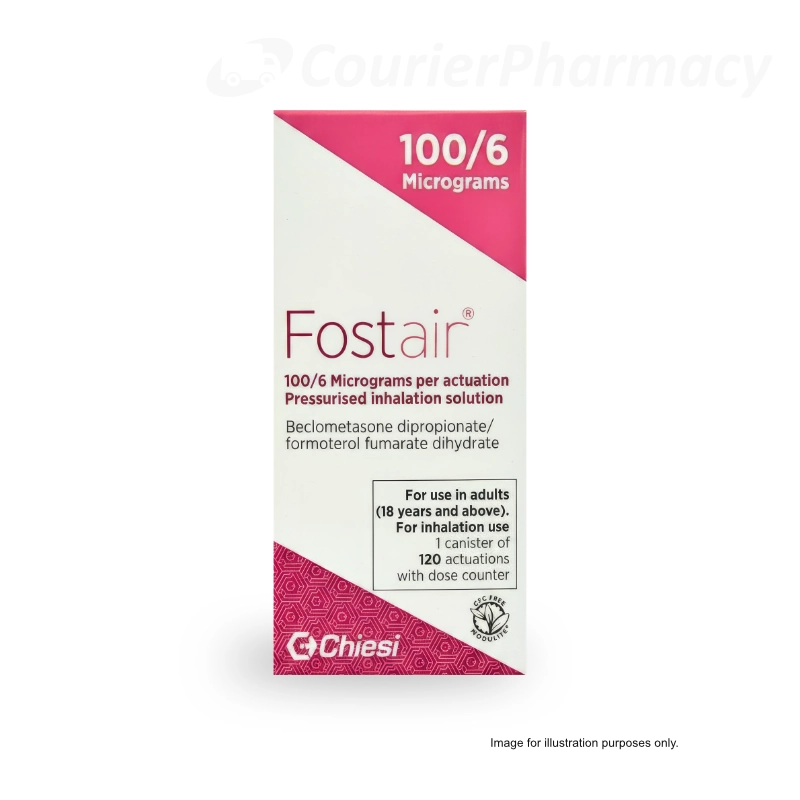
A combination pressurised metered-dose inhaler containing beclometasone (an inhaled steroid) and formoterol (a long-acting bronchodilator), used for the regular treatment of asthma and the symptomatic treatment of severe COPD.
Fostair 100/6 inhaler is prescribed at Courier Pharmacy after a brief online consultation reviewed by a UK clinician, then dispensed and delivered to your door.
Fostair 100/6 inhaler is a prescription combination inhaler used for asthma in adults and young people aged 12 and over. Doctors also use it for severe COPD in adults. Each puff delivers two medicines: beclometasone dipropionate 100 micrograms (an inhaled steroid that reduces inflammation) and formoterol 6 micrograms (a long acting bronchodilator that helps open the airways).
Fostair 100/6 comes as a pressurised metered dose inhaler (pMDI), which is the classic “aerosol” style inhaler. Each inhaler provides 120 puffs. So, depending on your dose, one inhaler often lasts around a month.
How Fostair 100/6 works
Fostair 100/6 combines two actions in one inhaler. The steroid part (beclometasone) helps calm swelling and irritation in the airways. Meanwhile, formoterol relaxes the airway muscles, which makes breathing feel easier. As a result, it can help prevent symptoms and reduce flare?ups when used regularly.
What makes Fostair different (extra fine particles)
Fostair uses extra fine particle technology. The particles are smaller than many older inhalers, so they can travel deeper into the smaller airways. This matters because a lot of asthma and COPD inflammation sits in those smaller airways. In other words, Fostair can give good control at a lower “label dose” of steroid than older beclometasone inhalers. For example, 100 micrograms in Fostair can be roughly similar in effect to 200 micrograms of some older beclometasone formulations.
How to use Fostair 100/6 for asthma (including MART)
For asthma, your prescriber may use Fostair 100/6 in different ways. Some people use a fixed daily dose (for example, 1–2 puffs twice daily). However, many adults and adolescents now use a plan called MART (Maintenance And Reliever Therapy). With MART, you use the same inhaler for daily prevention and for extra puffs when symptoms flare. So, you don’t always need a separate “blue reliever” inhaler.
Fostair 100/6 is one of the inhalers licensed for MART in the UK. That said, your prescriber will decide whether MART is right for you.
How to use Fostair 100/6 for COPD
For COPD, you use Fostair 100/6 on a fixed schedule only (usually 2 puffs twice daily). You do not use it as MART for COPD. Also, the 100/6 strength is the only Fostair pMDI licensed for COPD. The higher 200/6 strength is for asthma only.
How we supply Fostair 100/6 at Courier Pharmacy
At Courier Pharmacy, a UK registered prescriber reviews every Fostair request before we dispense it. We also focus on inhaler technique, because technique is one of the biggest reasons inhalers don’t work as well as they should. For that reason, we can signpost you to technique videos, and we may recommend a spacer if it suits your inhaler and routine.
The two ingredients work in complementary but different ways: beclometasone reduces airway inflammation (taking days to weeks to reach full effect), while formoterol relaxes airway muscles within a few minutes (and lasts about 12 hours).
Formoterol is unusual among long-acting beta2-agonists in having a rapid onset of action — within 1 to 3 minutes — which is why it can serve as both a maintenance bronchodilator and a reliever in the MART regime.
The MART regime is now recommended by NICE and the British Thoracic Society/GINA as first-line for moderate persistent asthma; the older paradigm of separate preventer and reliever inhalers is being phased out for most patients on combination treatment.
For COPD, inhaled corticosteroids are associated with a small increase in pneumonia risk; this needs balancing against the benefit in exacerbation reduction in patients with severe COPD and frequent exacerbations.
Inhaler technique is the single biggest determinant of how well a Fostair inhaler works for you. Even with a perfectly chosen medicine, poor technique can mean 80% of the dose ends up in your mouth and stomach rather than your lungs.
What is MART therapy?
MART therapy stands for Maintenance and Reliever Therapy. It’s an asthma treatment plan where you use one combination inhaler (usually an inhaled steroid plus a fast?acting long?acting bronchodilator, such as budesonide/formoterol) for both:
your regular daily preventer dose (maintenance), and
your as?needed “rescue” puffs when symptoms flare (reliever).
In simple terms, MART means you treat symptoms with an inhaler that also delivers extra anti?inflammatory steroid at the same time, which can help reduce flare?ups and keep asthma control steadier. It isn’t suitable for every inhaler or every patient, so it needs to match the right medicine and a clear action plan.
Where Fostair fits in with other inhalers
Fostair sits within the broader landscape of combination ICS-LABA inhalers used for asthma and COPD. Other commonly prescribed combinations in the UK include Seretide (fluticasone with salmeterol), Symbicort (budesonide with formoterol), Relvar Ellipta (fluticasone furoate with vilanterol), and Trimbow (the triple-therapy version of Fostair with the addition of a long-acting muscarinic antagonist). Each has slightly different properties — onset of action, particle size, device type, dosing schedule — and choice often comes down to specific clinical features, prescriber preference, and patient ability to use the device correctly.
For people living with asthma alongside other complex conditions, fibromyalgia, ME/chronic fatigue, MCAS, autoimmune issues, the choice of inhaler matters more than usual. Many in these groups have heightened sensitivity to medications, find inhaled steroids worsen reflux or oral symptoms, or have specific issues with propellants or excipients.
Fostair contains lactose-free formulations (an advantage for some), uses a relatively well-tolerated propellant (norflurane/HFA-134a), and the extra-fine particle technology means less throat deposition. These are practical advantages even if they don’t address all the individual sensitivities.
The pneumonia association in COPD deserves a brief honest mention. Multiple large studies have shown that ICS use in COPD is associated with around a 25-50% relative increase in pneumonia rates, although absolute numbers are smaller. For patients with severe COPD and frequent exacerbations, the benefit (reduced exacerbations, improved quality of life) usually outweighs the risk. For milder COPD without frequent exacerbations, the equation may not favour ICS use, and treatment may be different.
The cardiovascular profile of formoterol is worth understanding. Like all beta 2-agonists, formoterol can produce mild side effects related to its stimulant action — increased heart rate, mild tremor, palpitations, headache. These are usually mild and transient.
People with significant cardiac arrhythmias, ischaemic heart disease, or severe heart failure need careful consideration before starting any LABA. Many patients tolerate Fostair without significant cardiovascular issues, but the conversation is worth having.
Why choose Courier Pharmacy for Fostair 100/6 inhaler
Inhaler prescribing isn’t routine in the way many people assume. The choice of device, the regime (fixed dose vs MART), the spacer recommendation, the technique check — these matter enormously to whether your asthma or COPD stays controlled. Every Fostair prescription at Courier Pharmacy is reviewed by a UK-registered prescriber who reads your answers properly, asks about your current control and previous inhaler experience, and explains the decision either way.
We’re particularly attentive to whether MART is right for you. The MART regime works extremely well for most adults and adolescents with moderate persistent asthma, but it isn’t right for everyone. If you have COPD, MART isn’t appropriate — fixed-dose regimes are. If you have severe asthma needing high-dose treatment, an alternative inhaler may be more appropriate. If your asthma control is poor, the answer might not be just a higher dose of Fostair but a wider review of your treatment.
We’ll also signpost you to inhaler technique resources. Asthma UK has excellent video guides for every common inhaler type, and we can recommend in-person inhaler technique checks at community pharmacies. If you’d benefit from a spacer, we’ll discuss this.
Our brand guide, Dr Ada Jex-Cori, sums it up: you’re not broken. The system that’s failed you might be. We want to do the part we can do, properly, and connect you with the rest. That includes our free fortnightly drop-in clinics and talks at Insomnia in Derby, where you can ask questions face-to-face without spending a penny.
Buy Fostair 100/6 inhaler (Prescription Only) from Courier Pharmacy
Fostair 100/6 inhaler is a Prescription Only Medicine (POM) in the UK, which means it cannot be sold over the counter. Buying through Courier Pharmacy is straightforward and built around your time, not ours.
Here’s how it works:
Complete a quick online consultation including details about your asthma or COPD control
A UK prescriber reviews your answers
If approved, a prescription is issued
We dispense and deliver discreetly to your door
If it isn’t suitable for you, we’ll explain why and suggest the next best option.
Active ingredients in Fostair 100/6 inhaler
Fostair contains two active ingredients working in complementary ways. The first is beclometasone dipropionate (BDP), an inhaled corticosteroid that’s been used for over 50 years for asthma treatment. BDP is a synthetic glucocorticoid that, when delivered to the airways, suppresses the chronic inflammation that drives asthma symptoms and exacerbations. The molecule works by binding to glucocorticoid receptors in airway cells, which leads to suppression of inflammatory gene expression and reduction of inflammatory cell recruitment.
What’s distinctive about Fostair’s beclometasone is its formulation in an HFA-134a propellant solution rather than the suspension form used in older inhalers. The solution formulation produces extra-fine particles (around 1.5 micrometres) rather than the larger particles (3 to 5 micrometres) of older suspension inhalers. The smaller particles penetrate further into the small airways, where inflammation is concentrated in asthma. This is why Fostair’s nominal beclometasone dose (100 micrograms per puff) is clinically comparable to higher doses of older beclometasone formulations.
The second active ingredient is formoterol fumarate dihydrate, a long-acting beta2-agonist that relaxes the smooth muscle of the airways and opens them up. Formoterol works by stimulating beta2-adrenergic receptors on airway smooth muscle, which triggers a cascade leading to muscle relaxation. The duration of action is around 12 hours, which is why twice-daily dosing maintains continuous bronchodilation.
Formoterol’s unusual feature among LABAs is its rapid onset of action: within 1 to 3 minutes of inhalation, comparable to the short-acting salbutamol. This is what makes the MART regime possible — formoterol can serve as both the maintenance bronchodilator (long duration) and the reliever (rapid onset). Other LABAs like salmeterol have a slower onset (around 10-15 minutes) and aren’t suitable for MART use.
Each Fostair 100/6 inhaler delivers 120 actuations. The 100/6 designation refers to micrograms per actuation. Inactive ingredients include norflurane (HFA-134a propellant), ethanol, and hydrochloric acid. The formulation is essentially lactose-free, which can be relevant for people with severe lactose intolerance.
What is Fostair 100/6 inhaler for?
Fostair 100/6 inhaler is licensed in the UK for two main indications:
Asthma:
Used in adults and adolescents aged 12 years and over for the regular treatment of asthma where a combination of inhaled corticosteroid and long-acting beta2-agonist is appropriate. This includes patients who are not adequately controlled with inhaled corticosteroids alone plus a short-acting reliever, and patients who are already adequately controlled on both a separate ICS and a separate LABA. The 100/6 strength is licensed for both fixed-dose maintenance and the MART regime.
COPD:
Used in adults for the symptomatic treatment of patients with severe COPD (FEV1 less than 50% predicted normal) and a history of repeated exacerbations, who have significant symptoms despite regular therapy with long-acting bronchodilators. Only the 100/6 strength of Fostair pMDI is licensed for COPD; the 200/6 strength is not.
Fostair is not licensed for:
Mild or intermittent asthma where regular preventer treatment isn’t needed
The relief of acute asthma attacks if not in a MART regime (use a short-acting reliever like salbutamol)
Mild or moderate COPD (where the evidence for ICS benefit is less clear and the pneumonia risk balance is less favourable)
Children under 12 (for the 100/6 strength pMDI)
In MART, the inhaler functions as both maintenance and reliever for asthma symptoms. In fixed-dose regimes, a separate short-acting reliever (typically salbutamol) should still be available for breakthrough symptoms.
How does Fostair 100/6 inhaler work?
Asthma and COPD are both characterised by chronic inflammation and airway obstruction, but the pathology differs. Asthma involves variable, reversible airway obstruction driven by inflammation typically of an eosinophilic or allergic nature. Triggers (allergens, exercise, cold air, infections) provoke smooth muscle contraction, mucus production, and increased inflammation, narrowing the airways and causing wheezing, breathlessness, and cough. COPD involves more fixed airway obstruction driven by neutrophilic inflammation (largely from smoking or other inhaled irritants), with chronic bronchitis (excess mucus) and emphysema (destruction of alveolar walls) as common features.
Fostair addresses two layers of these conditions through its two active ingredients:
Beclometasone (inhaled corticosteroid):
The steroid suppresses the underlying airway inflammation. In asthma, it reduces the inflammatory eosinophil and lymphocyte activity that drives symptoms. In COPD, it modulates inflammation to a more modest degree. The effect builds over days to weeks of regular use, which is why ICS therapy needs to be taken regularly even when symptoms are well controlled. The inflammation-suppressing effect reduces airway sensitivity, mucus production, and the underlying tendency to bronchoconstriction.
Formoterol (long-acting beta2-agonist):
The bronchodilator relaxes airway smooth muscle, opening up the airways and improving airflow. Onset of action is within 1 to 3 minutes, with peak effect at around 30 minutes, and duration around 12 hours. This is why twice-daily dosing maintains continuous bronchodilation. Formoterol acts at beta2-adrenergic receptors on smooth muscle, triggering a signalling cascade that ultimately reduces intracellular calcium and relaxes the muscle.
The combination works better than either ingredient alone for two reasons. First, the inflammation suppression from beclometasone reduces the muscle reactivity that formoterol counteracts. Second, formoterol’s bronchodilation makes airway delivery of beclometasone more efficient by opening up the small airways where the extra-fine particles can deposit. The two ingredients are synergistic rather than just additive.
The extra-fine particle technology of Fostair is genuinely distinctive within the inhaler landscape. Particles around 1.5 micrometres deposit much further down the airway tree than the larger particles of older inhalers. Small airway disease is increasingly recognised as a central feature of both asthma and COPD, particularly in moderate to severe cases, so reaching these airways matters.
For patients on the MART regime in asthma, formoterol’s rapid onset means using the inhaler for sudden symptoms provides effective relief within minutes — comparable to salbutamol but with the added benefit of inhaling a small dose of corticosteroid alongside, which helps treat the inflammatory cause rather than just the bronchoconstriction. This is why MART has been shown to reduce severe exacerbations in moderate persistent asthma.
How to use Fostair 100/6 inhaler
Inhaler technique is the most important determinant of how well Fostair works for you. Even the right medicine at the right dose can fail if it’s not getting into the lungs. The basic technique for a pMDI like Fostair:
Before your first use of a new inhaler, prime it by spraying 4 puffs into the air, away from your face. This ensures the metering valve is properly primed. If you haven’t used your inhaler for 14 days or more, prime it again with 1 puff into the air.
For each dose:
Shake the inhaler gently for 5 seconds (this is recommended even though Fostair is a solution rather than a suspension — it ensures consistent particle distribution)
Remove the cap and check the mouthpiece is clean
Hold the inhaler upright (mouthpiece down)
Breathe out fully, away from the inhaler, to empty your lungs
Place the mouthpiece in your mouth and close your lips firmly around it
Start to breathe in slowly and deeply through your mouth
While still breathing in, press the top of the canister firmly to release one puff
Continue breathing in slowly and deeply until your lungs feel full
Hold your breath for about 10 seconds, or as long as comfortable
Breathe out slowly through your nose
If a second puff is needed, wait 30 seconds and repeat from step 1
Replace the cap
After your inhaler use, rinse your mouth out with water (or brush your teeth) and spit out — don’t swallow. This significantly reduces the risk of oral thrush (candidiasis), which is the most common side effect of inhaled steroid use. Mouth rinsing is essential after the morning and evening doses; less important after as-needed MART reliever puffs during the day, although a sip of water afterwards is sensible.
Using a spacer (Aerochamber Plus or similar): A spacer is a chamber that holds the medicine briefly after the puff is released, allowing you to breathe it in slowly without needing precise coordination of the puff with your breath. Spacers significantly improve drug delivery to the lungs (around 41% more beclometasone, 45% more formoterol with Aerochamber Plus) and reduce throat deposition. The Aerochamber Plus is specifically validated for use with Fostair. For one puff:
Shake the inhaler
Attach the inhaler to the back of the spacer
Place the spacer mouthpiece in your mouth
Press the inhaler to release one puff into the spacer
Take 5 slow, deep breaths from the spacer (or 1 slow breath held for 10 seconds for adults)
If a second puff is needed, wait 30 seconds and repeat
Spacers should be cleaned weekly with warm soapy water and air-dried (don’t rub them dry, which generates static and traps medicine).
Cleaning the inhaler: Wipe the mouthpiece weekly with a dry cloth or tissue. Don’t wash the inhaler itself with water — this can damage the metering valve. If the mouthpiece needs deeper cleaning, the manufacturer’s instructions describe how to remove and rinse it.
Tracking usage: Fostair inhalers come with a dose counter that shows the number of puffs remaining. Order a new prescription when the counter shows 20 or fewer puffs remaining; running out of medicine before the next supply is one of the most preventable causes of asthma flare-ups.
Consistency in technique matters across every dose. Even regular users benefit from periodic inhaler technique checks — pharmacy reviews, GP appointments, or asthma nurse visits all provide opportunities to refine the technique.
Warnings and precautions for Fostair 100/6 inhaler
Fostair is contraindicated in: known hypersensitivity to beclometasone, formoterol, or any excipient.
The most important practical safety issues are around paradoxical bronchospasm, oral thrush, and the use of LABA in asthma without ICS.
Paradoxical bronchospasm is a rare but serious side effect of any inhaled medicine where breathing in the medicine causes immediate wheeze and breathlessness rather than relieving it. If this happens, stop using the inhaler immediately, take your short-acting reliever (if not on MART) or another reliever inhaler, and seek urgent medical advice.
Oral thrush (candidiasis) is the most common side effect of inhaled steroids and is largely preventable. Always rinse your mouth out with water after using the inhaler (particularly after morning and evening doses). If white patches develop in the mouth, the tongue feels coated, or oral discomfort develops, see your pharmacist or prescriber for assessment and treatment with an antifungal mouthwash or oral antifungal if needed.
Hoarseness or voice changes (dysphonia) can occur with inhaled steroids and may be more pronounced with some inhalers than others. Using a spacer reduces this risk by reducing throat deposition.
LABA use without an inhaled corticosteroid in asthma is dangerous and contraindicated. If you’ve been prescribed Fostair for asthma, the inhaler must be used as directed, never as just a reliever. Stopping the beclometasone component while continuing the formoterol component (which would happen if you switched to a LABA-only inhaler) significantly increases the risk of severe asthma attacks and death. This is a class warning for all LABAs.
Asthma deterioration: an increase in your use of MART reliever puffs, especially over multiple days, is a sign of worsening asthma control rather than just a bad day. If you’re consistently using more than 8 puffs in 24 hours, or if your usual symptoms aren’t responding to the same number of puffs, contact your prescriber. Don’t simply use more puffs and assume it’s normal variation.
Caution is advised in:
Cardiovascular conditions including ischaemic heart disease, significant arrhythmias, severe heart failure, uncontrolled hypertension, hypertrophic obstructive cardiomyopathy, idiopathic subvalvular aortic stenosis, and known prolongation of the QTc interval
Diabetes (formoterol can affect blood glucose; ICS can theoretically also)
Hyperthyroidism
Phaeochromocytoma
Severe hypokalaemia (low potassium), as beta2-agonists can lower potassium further
Hepatic impairment, where ICS systemic exposure may be increased
Glaucoma and cataracts (rare class effects of inhaled corticosteroids)
Adrenal suppression with prolonged high-dose ICS use
Tuberculosis (active or latent), where ICS can theoretically worsen
Pregnancy and breastfeeding: Fostair use should be reviewed, with the lowest effective dose used. Untreated asthma in pregnancy is itself a significant risk; switching off treatment is generally not appropriate. Discuss with a clinician familiar with your case
For COPD patients, the small increased risk of pneumonia with ICS use needs balancing against benefit. Any new respiratory symptoms (worsening breathlessness, fever, productive cough with discoloured sputum) should be reported promptly.
The inhaler should not be punctured, burned, or exposed to temperatures above 50°C, even when empty, as the pressurised canister could explode.
Side effects of Fostair 100/6 inhaler
Common side effects, between 1 in 100 and 1 in 10 people, include oral candidiasis (thrush), dysphonia (hoarseness or voice changes), throat irritation, throat pain, cough, and headache.
Uncommon side effects, between 1 in 1,000 and 1 in 100 people, include palpitations, tachycardia (raised heart rate), tremor, muscle cramps, nausea, dry mouth, mild upper respiratory tract infections, sinusitis, rhinitis, raised blood glucose, raised triglycerides, sleep disturbance, anxiety, dizziness, dyspnoea, asthma exacerbation, paradoxical bronchospasm, and skin reactions.
Rare side effects, fewer than 1 in 1,000 people, include atrial fibrillation, ventricular extrasystoles, angina, hypokalaemia (low potassium), peripheral oedema, hypersensitivity reactions, glaucoma, cataracts, and adrenal suppression.
Very rare side effects include severe allergic reactions including anaphylaxis (swelling of lips, mouth, throat, difficulty breathing), Stevens-Johnson syndrome, and severe paradoxical bronchospasm. Anaphylaxis is a medical emergency; call 999.
Specific to COPD use: pneumonia is a recognised effect of ICS use in COPD. The relative risk increase is around 25-50% in clinical trials, though absolute numbers depend on the underlying pneumonia rate in the population studied. Symptoms of pneumonia (worsening breathlessness, fever, productive cough with discoloured sputum) need prompt assessment.
Psychiatric effects (anxiety, sleep disturbance, mood changes) are recognised as potential class effects of inhaled corticosteroids, even though they’re rarely reported. If you notice mood changes that you suspect could be linked to the inhaler, mention them to your prescriber.
For COPD patients on long-term ICS therapy, periodic monitoring of bone density, eye health (cataracts, glaucoma), and adrenal function is sometimes considered.
If you experience any side effect that worries you, you can report it directly to the MHRA’s Yellow Card scheme. This helps improve safety data for everyone who uses the medicine. Our pharmacy team are happy to help you submit a Yellow Card report if you’d like assistance.
Drug interactions with Fostair 100/6 inhaler
The interaction profile of Fostair is relatively well-characterised. Most interactions involve other medicines that affect beta-adrenergic signalling, prolong the QT interval, or interact with the corticosteroid metabolism.
Beta-blockers (atenolol, bisoprolol, metoprolol, propranolol, carvedilol) can antagonise formoterol’s bronchodilator effect. Non-selective beta-blockers (propranolol, carvedilol) should be avoided in asthma. Cardioselective beta-blockers (bisoprolol, metoprolol) can sometimes be used with caution in patients with asthma or COPD where they’re clinically necessary, but the prescriber needs to weigh up the risk-benefit balance.
Medicines that prolong the QT interval can be additive with formoterol’s mild QT effect. This includes some antiarrhythmics (amiodarone, sotalol), some antipsychotics (haloperidol, ziprasidone), some antibiotics (clarithromycin, moxifloxacin), some antifungals (fluconazole at high doses), some antimalarials, and some tricyclic antidepressants. The combinations are sometimes still appropriate but need careful consideration.
Diuretics, particularly thiazide and loop diuretics, can lower potassium levels. Combined with formoterol (which can also lower potassium), the risk of hypokalaemia increases. Periodic potassium monitoring may be sensible.
Sympathomimetic medicines (decongestants like pseudoephedrine, some weight-loss medicines) can compound formoterol’s cardiovascular effects.
MAO inhibitors (rasagiline, selegiline, moclobemide, phenelzine) and tricyclic antidepressants can sensitise the cardiovascular system to formoterol’s effects. Caution is needed.
CYP3A4 inhibitors (ketoconazole, itraconazole, ritonavir, clarithromycin) can increase systemic exposure to beclometasone, potentially increasing the risk of corticosteroid side effects. Strong inhibitors should generally be avoided with high-dose Fostair use.
Anti-arrhythmics, digoxin, and other cardiac medicines may need monitoring when combined with Fostair, particularly in patients with pre-existing arrhythmias.
Insulin and oral antidiabetic medicines may need adjustment, since formoterol can raise blood glucose.
Levodopa, levothyroxine, oxytocin, and alcohol can reduce cardiac tolerance to beta2-agonists.
Always tell your prescriber and pharmacist about everything you take, including over-the-counter medicines (some cold remedies contain sympathomimetics), vitamins, supplements, and herbal products, before starting Fostair.
Frequently asked questions about Fostair 100/6 inhaler
What is Fostair 100/6 used for?
Fostair 100/6 is used for the regular treatment of asthma in adults and adolescents 12 and over, and for the symptomatic treatment of severe COPD in adults with significant symptoms despite long-acting bronchodilators.
What’s the difference between Fostair 100/6 and 200/6?
Both contain formoterol 6 micrograms, but the beclometasone (steroid) dose differs: 100 micrograms in the 100/6 and 200 micrograms in the 200/6. The 100/6 strength is licensed for both asthma and COPD, and is the only Fostair strength approved for the MART regime. The 200/6 strength is licensed for asthma only at higher doses where greater steroid is needed.
What is MART, and is it right for me?
MART (Maintenance And Reliever Therapy) is a regime where you use the same inhaler for both daily prevention and as-needed reliever for sudden symptoms. It works because formoterol acts within a few minutes despite being a long-acting bronchodilator. MART is now recommended by NICE and GINA as first-line for moderate persistent asthma. It isn’t for COPD, isn’t for severe asthma needing high-dose treatment, and isn’t appropriate if you don’t use your inhaler well.
How quickly does Fostair work?
The formoterol component provides bronchodilation within 1 to 3 minutes of inhalation. The beclometasone (anti-inflammatory) effect builds over days to weeks, which is why regular daily use is essential rather than just when symptomatic.
Do I need a spacer?
A spacer isn’t essential but it significantly improves how much medicine reaches your lungs (around 40% more). It’s particularly useful if you have trouble coordinating the puff with your breath, if you have children using the inhaler, or if you experience throat irritation or thrush. The Aerochamber Plus is specifically approved for Fostair.
Why do I need to rinse my mouth after using Fostair?
To prevent oral thrush (candidiasis), the most common side effect of inhaled steroids. Steroid that deposits in your mouth and throat can encourage yeast growth. Rinsing and spitting reduces this risk. Brushing your teeth after the morning dose is also effective.
Can I use Fostair for an asthma attack?
If you’re on the MART regime, yes — you can use additional Fostair puffs for sudden symptoms. Formoterol acts within a few minutes. If you’re on a fixed-dose regime, no — you should have a separate short-acting reliever (typically salbutamol) for sudden symptoms. For severe asthma attacks, always seek urgent medical help even if you’ve used your reliever.
What if I need more than 8 puffs of Fostair in a day?
This is a signal that your asthma control isn’t as good as it should be. Use your reliever for the immediate symptoms, but contact your prescriber the same day or the next morning for a review. Don’t simply continue using more puffs and assume it’s normal.
Can children use Fostair 100/6?
The 100/6 inhaler is licensed for adolescents 12 and over, not for younger children. For asthma in younger children, the Fostair NEXThaler dry-powder inhaler (used with Aerochamber Plus) is sometimes used at age 5-11, although this is at higher prescriber discretion.
Can I use Fostair if I’m pregnant?
Untreated asthma in pregnancy is itself a significant risk, often worse than the small risks of inhaled medications. The general principle is to maintain good asthma control with the lowest effective dose. Discuss with a clinician familiar with your case rather than stopping treatment.
Can I use Fostair while breastfeeding?
Inhaled doses produce very small amounts of medicine in breast milk, with limited evidence of significant effects on the infant. Continued use is generally appropriate, but discuss with your prescriber.
How long does a Fostair inhaler last?
Each inhaler delivers 120 actuations. At the typical asthma dose of 2 puffs twice daily, this is 30 days. At MART maintenance only (1 puff twice daily = 2 puffs/day), this is 60 days. The dose counter shows actuations remaining.
Why do I get a hoarse voice on Fostair?
Steroid that deposits in the throat can cause local irritation and affect the vocal cords. Using a spacer significantly reduces this. Rinsing your mouth after each dose also helps.
Can Fostair cause pneumonia?
In COPD specifically, ICS use is associated with around a 25-50% relative increase in pneumonia rates. This is significant but needs balancing against the benefits in reducing exacerbations. Any new symptoms of pneumonia (worsening breathlessness, fever, productive cough with discoloured sputum) need prompt assessment. Pneumonia risk in asthma is much smaller.
Can I drink alcohol while using Fostair?
Generally yes, but alcohol can compound some of formoterol’s cardiovascular effects in sensitive individuals. Moderate alcohol is usually fine.
Will Fostair affect my driving?
Fostair doesn’t typically affect alertness or cognition. Most people drive normally on Fostair. If you experience any dizziness or tremor that affects function, take appropriate precautions.
Why do I need to prime a new inhaler?
The first few puffs of a new inhaler can be inconsistent in dose because the metering valve hasn’t been used. Priming (4 puffs into the air for a new inhaler, 1 puff for an inhaler unused for 14+ days) ensures consistent dosing from the first usable puff.
Can I store the inhaler in my bathroom?
Bathrooms can get humid and warm during showers, which isn’t ideal for inhaler storage. Storing at room temperature in a bedroom drawer or living room is preferable. Don’t expose the inhaler to direct sunlight or freezing temperatures.
What if my inhaler stops working before the dose counter shows zero?
Sometimes the canister empties slightly before the counter shows zero. If you’re getting fewer puffs than the counter suggests, contact your pharmacy. Sometimes new inhalers prime late and need a few priming puffs to start working properly.
Can I switch between Fostair brands or generic versions?
Several generic versions of beclometasone-formoterol pMDIs are now available (such as Proxor). They contain the same active ingredients at the same doses, but some have different excipients, different dose counters, or slightly different propellants. Most patients can switch without issues, but if you’re stable on Fostair, switching shouldn’t be done without prescriber input. Some patients notice differences in how the inhaler feels or works on switching.
Disclaimer: This article is for information only and isn’t a substitute for personal medical advice. Always speak to a qualified prescriber before starting or changing treatment.