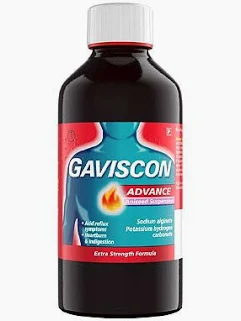
Gaviscon Advance is the stronger formulation in the Gaviscon range. The active ingredients sodium alginate and potassium bicarbonate work together to produce a physical reflux barrier on top of the stomach contents.
Furthermore, the mechanism is fundamentally different from acid-suppressant medicines. PPIs (omeprazole, esomeprazole, pantoprazole, lansoprazole) and H2 antagonists (famotidine) work by reducing how much acid the stomach makes. In contrast, Gaviscon Advance physically prevents the existing stomach contents from refluxing up into the oesophagus.
The Gaviscon range explained
The Gaviscon brand covers several distinct products with different formulations and use cases:
Gaviscon Original Aniseed Relief: standard formulation with 250mg sodium alginate, 133.5mg sodium bicarbonate, and 80mg calcium carbonate per 5ml. Available as liquid and tablets. Suitable for routine heartburn and reflux symptoms
Gaviscon Advance Aniseed (this product) and Gaviscon Advance Mint Liquid: stronger formulation with 500mg sodium alginate (double Original) and 100mg potassium bicarbonate per 5ml. Suitable for patients with more persistent symptoms or where Gaviscon Original hasn’t been enough
Gaviscon Advance Mint Chewable Tablets: tablet formulation of the Advance strength, useful where a portable format is preferred over the liquid
Gaviscon Double Action: combines reflux suppressant (alginate) with antacid (calcium carbonate, magnesium carbonate, sodium bicarbonate) for both reflux protection and rapid acid neutralisation
The Gaviscon Advance formulation suits patients whose symptoms aren’t fully controlled on Gaviscon Original. Furthermore, the double alginate concentration produces a stronger and more durable reflux barrier.
Where Gaviscon Advance fits in modern UK practice
Modern UK guidance for gastro-oesophageal reflux disease (GORD) and heartburn includes:
Lifestyle measures: weight management, avoiding trigger foods (chocolate, fatty foods, caffeine, alcohol, citrus), avoiding large meals before bed, raising the head of the bed, smoking cessation
Antacids and alginates: rapid on-demand relief for occasional or breakthrough symptoms (Gaviscon Original, Gaviscon Advance, simple antacids like Rennie or Alka-Seltzer)
H2 receptor antagonists: famotidine for moderate symptoms or alongside other treatments
Proton pump inhibitors (PPIs): omeprazole, esomeprazole, pantoprazole, lansoprazole, rabeprazole for moderate to severe persistent symptoms
Investigation: endoscopy where red flag features or persistent symptoms despite treatment
Specialist input: for refractory disease, complications (Barrett’s oesophagus, strictures, severe oesophagitis), or for surgical assessment (fundoplication for selected patients)
How Gaviscon Advance compares to other reflux treatments
Each treatment class addresses reflux through a different mechanism:
Alginates (Gaviscon Advance): physical reflux barrier; rapid onset within minutes; up to 4 hours duration; no significant systemic absorption
Simple antacids (Rennie, Alka-Seltzer, Tums): neutralise existing stomach acid; rapid onset; short duration (typically 30 to 60 minutes); no protective barrier
H2 antagonists (famotidine): reduce stomach acid production; onset 30 to 60 minutes; duration around 10 to 12 hours; suitable for once or twice daily dosing
PPIs (omeprazole, esomeprazole, pantoprazole): more powerful reduction of stomach acid production; onset over 2 to 3 days; full effect over 1 to 2 weeks; suitable for once-daily dosing; the most effective acid-suppressant class
The treatments are complementary rather than competing. As a result, many patients with significant reflux benefit from combining approaches. For example: daily PPI for sustained acid suppression plus Gaviscon Advance after meals and at bedtime for additional reflux barrier protection.
Who Gaviscon Advance suits well
This product suits patients who:
Have heartburn or acid reflux that needs faster on-demand relief than PPIs can provide
Use a PPI daily but still experience breakthrough symptoms
Find Gaviscon Original isn’t providing enough relief
Have heartburn of pregnancy (where alginate is preferred over PPIs in many situations)
Have hiatus hernia with reflux symptoms
Want a non-systemic treatment with no significant absorption into the bloodstream
Need flexibility to use as needed rather than on a fixed schedule
Prefer liquid format over tablets
Have reflux symptoms that flare after specific meals or in specific situations
Who might suit alternatives better
Alternatives may suit:
Patients with severe persistent reflux who need stronger acid suppression: PPIs (omeprazole, esomeprazole, pantoprazole, lansoprazole) are usually more effective for severe daily symptoms
Patients on strict low-sodium diets, severe heart failure, or severe renal impairment: alternative alginate formulations or PPIs may suit better
Children under 12: not recommended without medical advice; paediatric reflux should be assessed by a GP or paediatrician
Patients with significant hypercalcaemia or recurrent calcium-containing renal calculi: the calcium content matters
Patients with paraben allergy: paraben-free alternatives exist
Patients with reduced kidney function who need to limit potassium intake: caution with the potassium content
Courier Pharmacy supply
Gaviscon Advance Aniseed Oral Suspension is a Pharmacy (P) medicine. As a result, the supply does not require a prescription. However, the pharmacist will check that the use is appropriate for your situation.
Key features and specifications
Active ingredients: sodium alginate 1000mg and potassium bicarbonate 200mg per 10ml (500mg and 100mg respectively per 5ml)
Pack size: 500ml bottle (provides 50 to 100 doses depending on dose taken)
Licensed indications: treatment of symptoms of gastro-oesophageal reflux such as acid regurgitation, heartburn, and indigestion (e.g. after meals, during pregnancy, or with other reflux-related symptoms)
Adult and child 12+ dose: 5ml to 10ml (1 to 2 teaspoonfuls) after meals and at bedtime, up to 4 times daily, maximum 40ml per 24 hours
Children under 12: only on medical advice
Onset of action: within minutes (physical raft formation)
Gaviscon Advance is one of the most established reflux suppressants in UK pharmacy, with a distinctive mechanism that physically blocks acid reflux rather than reducing acid production. As a result, it provides faster onset than acid-suppressant medicines like PPIs or H2 antagonists. Furthermore, the Advance formulation contains double the sodium alginate concentration of Gaviscon Original, producing a stronger reflux barrier. The aniseed flavour and convenient 500ml suspension format make this a practical option for patients managing persistent reflux symptoms.
At Courier Pharmacy, we believe in treatment that fits the person.
That means matching the reflux treatment to your specific pattern of symptoms rather than defaulting to one product. Furthermore, it means honest framing of where Gaviscon Advance fits compared to PPIs, H2 antagonists, lifestyle changes, and other approaches. This page covers what Gaviscon Advance is, how it differs from other Gaviscon products, who it suits best, and the practical safety considerations that matter.
Five key takeaways
Gaviscon Advance Aniseed Oral Suspension is a UK Pharmacy (P) medicine containing sodium alginate 1000mg and potassium bicarbonate 200mg per 10ml. The active ingredients form an alginic acid gel raft on top of stomach contents that physically prevents reflux for up to 4 hours per dose
This is the stronger formulation: Gaviscon Advance contains double the sodium alginate concentration of Gaviscon Original. As a result, it produces a stronger and more durable reflux barrier, particularly useful for patients with more persistent or breakthrough symptoms
Standard adult dose: 5ml to 10ml (1 to 2 teaspoonfuls) after meals and at bedtime, up to 4 times daily. Maximum 40ml per 24 hours. Onset is rapid (within minutes) and duration is up to 4 hours per dose
The mechanism is physical rather than systemic. As a result, Gaviscon Advance complements rather than replaces PPIs (omeprazole, esomeprazole, pantoprazole) and H2 antagonists (famotidine). Many patients use Gaviscon Advance for breakthrough symptoms or fast on-demand relief alongside daily PPI therapy
Several practical considerations apply. Specifically: not for children under 12 without medical advice; high sodium content matters for patients on low-salt diets, heart failure, or kidney problems; the 2-hour interval rule means leaving 2 hours between Gaviscon and certain other oral medicines (tetracyclines, fluoroquinolones, iron, thyroid hormones, bisphosphonates)
Why choose Courier Pharmacy for Gaviscon Advance
At Courier Pharmacy, our approach starts with a simple idea: treatment should fit the person, not force the person to fit the system.
Dr Ada Jex-Cori
Our service is shaped by the philosophy of Dr Ada Jex-Cori, our brand pharmacist.
Dr Ada represents the spirit of the pharmacy: evidence-led, community-rooted, and willing to challenge the one-size-fits-all approach to medicine.
She is named in honour of three pioneering women in science: Ada Lovelace, the mathematician and visionary; Sophia Jex-Blake, the first female doctor in the UK who fought the medical establishment; and Gerty Cori, the biochemist and Nobel Prize winner.
In our fictional world of Ethrewell, Dr Ada fights against pharma’s standardised approach to medicine. In the real world, she represents what we stand for. Her view is straightforward: you are not broken. The system is. And we are here to change that.
Honest framing of where Gaviscon Advance fits
Gaviscon Advance is one option within the wider reflux treatment landscape. Furthermore, it works best as part of a broader approach rather than alone.
For mild occasional heartburn, Gaviscon Original or simple antacids may be sufficient. For persistent moderate to severe reflux, PPIs (omeprazole, esomeprazole, pantoprazole) are usually more effective for sustained acid suppression.
Gaviscon Advance’s distinctive niche: rapid on-demand relief through a physical barrier, suitable for breakthrough symptoms alongside daily acid suppression, useful in pregnancy, and stronger than Gaviscon Original for patients whose symptoms need more support.
Treatment that fits, not one-size-fits-all
Most online pharmacies supply reflux treatments based on what patients ask for. Courier Pharmacy is different.
We think through your situation: what symptoms you have, what triggers them, what you’ve already tried, your wider health picture, current medicines, and what fits with your life.
Gaviscon Advance may be the right answer for you. Alternatively, optimising your existing PPI dosing may suit better. Furthermore, lifestyle measures may be what’s really worth focusing on. Or specialist assessment may be appropriate if symptoms aren’t following the expected pattern.
Pharmacist support before and after purchase
Our pharmacist is available to discuss:
Whether Gaviscon Advance is right for your reflux pattern, or whether another approach would suit better
How to combine Gaviscon Advance with PPI or H2 antagonist treatment for best effect
Timing doses around meals and bedtime
Managing the 2-hour interval rule with your other medicines
Lifestyle measures that complement medicine treatment
Whether your symptoms warrant GP review, endoscopy, or specialist assessment
Reflux management in pregnancy
This is free and available before and after purchase.
Care for specific patient groups
We provide tailored support for:
Patients with persistent reflux not fully controlled on PPIs alone
Pregnant women with heartburn looking for safe effective relief
Patients with hiatus hernia and significant reflux symptoms
Patients with night-time reflux symptoms disrupting sleep
Patients on multiple medicines where careful dose timing matters
Patients with MCAS, CFS, fibromyalgia, or other long-term conditions where reflux overlaps with the broader picture
Older patients with reflux and multiple comorbidities
Coordination with your GP and other care
If you have a GP, gastroenterologist, dietitian, or other healthcare professional involved in your care, we are happy to coordinate.
For patients with chronic reflux, joined-up care across primary care, pharmacy, and specialist services produces better outcomes than fragmented care.
Trust earned, not claimed
We are GPhC-regulated. Furthermore, we ground our content in NHS, NICE, BNF, and EMC guidance.
We will tell you honestly if Gaviscon Advance isn’t the right answer for your situation. We would rather give you the right advice than a quick sale.
How to buy Gaviscon Advance from Courier Pharmacy
Gaviscon Advance Aniseed Oral Suspension 500ml is a UK Pharmacy (P) medicine supplied through Courier Pharmacy under pharmacist supervision. The supply does not require a prescription, but the pharmacist will check that the use is appropriate.
How our service works
Add Gaviscon Advance Aniseed Oral Suspension to your basket and complete a brief questionnaire about your symptoms, what you’ve already tried, current medicines, relevant medical conditions, and any pregnancy or breastfeeding status
Our pharmacist reviews your answers to confirm Gaviscon Advance is suitable. If we need to ask additional questions or recommend an alternative, we will get in touch
Once approved, your order is prepared and dispatched discreetly
Free pharmacist support is available before and after your purchase
When alternatives might suit better
If Gaviscon Advance isn’t the right product for your situation, we will explain why. Alternatives may include:
Gaviscon Original Aniseed Relief if your symptoms are mild and Gaviscon Advance is unnecessarily strong
Gaviscon Advance Mint Liquid or Mint Chewable Tablets if you prefer mint flavour or tablet format
Gaviscon Double Action if you want both alginate raft plus rapid antacid effect
Famotidine 20mg or 40mg tablets as an H2 antagonist for moderate persistent symptoms
PPIs (omeprazole 10mg/20mg/40mg, esomeprazole 20mg/40mg, pantoprazole 20mg/40mg, lansoprazole 30mg) for moderate to severe persistent reflux
Simple antacids (Rennie, Alka-Seltzer, Tums) for occasional acid neutralisation without reflux barrier
Lifestyle modifications as the foundation for any reflux treatment
Combination treatment: daily PPI plus Gaviscon Advance for breakthrough symptoms
GP review for endoscopy if you have red flag features or persistent symptoms despite treatment
Specialist gastroenterology referral for refractory or complicated reflux
Our community service
Our free fortnightly drop-in clinics at Insomnia, Derby run every other week from 10am to 12pm.
Healthcare shouldn’t only happen when you’re paying for it. We show up, even when it’s free.
We cover digestive health, reflux, indigestion, IBS, allergies, asthma, MCAS, CFS, fibromyalgia, hair loss, men’s health, weight management, and whatever else people bring through the door. No appointment needed, no charge, no pressure.
Active ingredients
Each 10ml of Gaviscon Advance Aniseed Oral Suspension contains:
Sodium alginate 1000mg (active ingredient): a polysaccharide derived from brown seaweed. Forms a viscous gel in the presence of gastric acid. As a result, it produces the physical reflux barrier that defines the Gaviscon Advance mechanism. The Advance formulation contains double the alginate of Gaviscon Original
Potassium bicarbonate (potassium hydrogen carbonate) 200mg (active ingredient): provides the alkali source that reacts with stomach acid. Furthermore, it produces carbon dioxide bubbles that help the alginate raft float on the stomach contents
How the active ingredients work together
On contact with stomach acid:
Potassium bicarbonate reacts with gastric acid to produce carbon dioxide
The carbon dioxide gets trapped in the alginate gel forming a foam-like "raft"
The alginate gel forms because sodium alginate reacts with the acidic environment to produce alginic acid
The raft floats on the stomach contents because of the trapped carbon dioxide
The raft physically blocks gastric contents from refluxing up into the oesophagus
The raft persists for up to 4 hours per dose
The mechanism is physical, not systemic. As a result, the medicine works locally in the stomach without significant absorption into the bloodstream.
Excipients
Excipients include:
Calcium carbonate (200mg per 10ml)
Carbomer
Methyl parahydroxybenzoate (E218) — preservative
Propyl parahydroxybenzoate (E216) — preservative
Saccharin sodium — sweetener
Sodium hydroxide
Aniseed flavouring (containing benzyl alcohol 0.525mg per 5ml)
Purified water
Excipient considerations
Several excipient considerations matter for specific patient groups:
Sodium content: this product is considered high in sodium (approximately 106mg sodium per 10ml dose). As a result, patients on low-salt diets should be aware. This applies particularly in heart failure or significant renal impairment
Potassium content: 39.06mg (1 mmol) potassium per 5ml dose. Patients with reduced kidney function or on a controlled potassium diet should take this into consideration
Calcium content: 200mg calcium carbonate (2 mmol) per 10ml dose. Care needed in patients with hypercalcaemia, nephrocalcinosis, or recurrent calcium-containing renal calculi
Parabens (methyl and propyl parahydroxybenzoate): may cause allergic reactions (possibly delayed). Patients with paraben sensitivity should be aware
Benzyl alcohol (0.525mg per 5ml from the aniseed flavouring): patients who are pregnant or breastfeeding should ask their doctor or pharmacist for advice, since large amounts of benzyl alcohol can build up in the body and cause side effects
Manufacturer
Gaviscon Advance Aniseed Oral Suspension is manufactured by Reckitt Benckiser Healthcare (UK) Ltd. The brand has been on the UK market since the 1970s. Furthermore, it is one of the most established reflux treatments in UK pharmacy.
Where Gaviscon Advance fits in reflux treatment
Gastro-oesophageal reflux disease (GORD) and heartburn affect a substantial proportion of UK adults. Furthermore, around 1 in 5 UK adults experiences heartburn at least weekly.
Common causes and triggers
Reflux symptoms can have many contributing factors:
Eating patterns: large meals, eating close to bedtime, lying down after eating
Weight: increased abdominal pressure with overweight or obesity
Pregnancy: hormonal effects on lower oesophageal sphincter plus increased abdominal pressure
Smoking: relaxation of lower oesophageal sphincter
Alcohol: relaxation of lower oesophageal sphincter and direct mucosal effects
Hiatus hernia: anatomical predisposition to reflux
Medications: NSAIDs, calcium channel blockers, nitrates, bisphosphonates, some sedatives
Stress: contributes to symptom severity in many patients
Why reflux matters
Beyond the immediate discomfort, persistent reflux can cause:
Oesophagitis (inflammation of the oesophagus lining)
Oesophageal strictures (narrowing from chronic inflammation)
Barrett's oesophagus (precancerous change in oesophageal lining, increasing cancer risk)
Sleep disturbance from nocturnal symptoms
Dental erosion from acid contact with teeth
Chronic cough or hoarseness (reflux-related laryngitis)
Reduced quality of life and work productivity
Red flag features warranting medical assessment
Several features should prompt GP review rather than self-managed treatment:
New onset reflux symptoms in patients over 55
Difficulty swallowing or pain on swallowing
Unexplained weight loss
Persistent vomiting
Vomiting blood or coffee-ground material
Black tarry stools (possible upper GI bleeding)
Persistent abdominal pain
Iron deficiency anaemia
Family history of upper GI cancer
Symptoms not responding to standard treatment after 4 to 8 weeks
If any of these apply, contact your GP urgently rather than continuing self-treatment.
First-line: lifestyle measures plus on-demand antacids/alginates
For mild intermittent symptoms, start with:
Lifestyle modifications: weight management, avoiding trigger foods, smaller meals, eating at least 3 hours before bed, raising the head of the bed by 10 to 15 cm
On-demand antacids or alginates: Gaviscon Original or Gaviscon Advance for rapid symptom relief; simple antacids (Rennie, Alka-Seltzer) for quick acid neutralisation
For around half of patients with mild symptoms, this approach is sufficient.
Second-line: regular acid suppression
For more frequent or persistent symptoms:
H2 antagonist daily: famotidine 20mg or 40mg once or twice daily
Or PPI daily: omeprazole 20mg, esomeprazole 20mg, pantoprazole 20mg, or lansoprazole 30mg once daily
Continue Gaviscon Advance for breakthrough symptoms and additional protection
Third-line: higher-dose acid suppression
For symptoms not controlled on standard PPI dose:
Higher PPI dose: omeprazole 40mg, esomeprazole 40mg, pantoprazole 40mg once daily
Twice-daily PPI dosing for refractory symptoms under prescriber guidance
Combination of PPI plus H2 antagonist (PPI in morning, H2 antagonist at night to address nocturnal acid breakthrough)
Continue Gaviscon Advance for additional protection
Fourth-line: specialist assessment
For refractory or complicated reflux:
Endoscopy to assess oesophagitis severity, Barrett's oesophagus, hiatus hernia size
Oesophageal pH studies to confirm reflux diagnosis and quantify severity
Oesophageal manometry to assess motility
Surgical assessment for fundoplication in selected patients
Assessment for non-GORD diagnoses if symptoms are atypical
Gaviscon Advance in pregnancy
Heartburn is very common in pregnancy, affecting around half of pregnant women, particularly in the third trimester.
Gaviscon Advance is one of the preferred treatments because:
The mechanism is physical rather than systemic
Significant systemic absorption is minimal
Long-established safety record in pregnancy
Fast onset for symptomatic relief
However, pregnant women should be aware of the benzyl alcohol content (0.525mg per 5ml). Discuss with your prescriber or midwife if you have any concerns. Furthermore, lifestyle measures (smaller meals, avoiding trigger foods, raising the head of the bed) should be combined with treatment for best results.
How Gaviscon Advance works
Gaviscon Advance works through a physical mechanism rather than systemic action. As a result, the medicine acts entirely within the stomach without being absorbed into the bloodstream.
The raft formation process
On ingestion, several reactions happen rapidly in the stomach:
The sodium alginate in solution encounters gastric acid
Acid-induced precipitation converts sodium alginate into alginic acid gel
The potassium bicarbonate reacts with gastric acid to produce carbon dioxide gas
Carbon dioxide bubbles become trapped within the alginic acid gel matrix
The trapped gas makes the gel matrix less dense than the stomach contents
As a result, the gel "raft" floats on top of the stomach contents like a cork on water
The raft has a near-neutral pH (in contrast to the acidic stomach contents below)
The raft physically impedes gastric contents from refluxing up through the lower oesophageal sphincter
The raft persists for up to 4 hours. Furthermore, in severe reflux cases, the raft itself may reflux into the oesophagus in preference to the stomach contents. As a result, it produces a demulcent (soothing) effect on the inflamed oesophageal lining.
Secondary protective effects
Beyond the primary raft mechanism, in vitro evidence shows that the alginic acid gel:
Entraps bile within its structure, providing additional oesophageal protection from bile reflux
Entraps pepsin within its structure, further protecting the oesophageal lining
Provides a physical buffer against direct acid contact with the oesophageal lining
Why this matters clinically
The physical mechanism explains several distinctive features of Gaviscon Advance:
Rapid onset: the raft forms within minutes of dosing
Mechanical rather than chemical action: works regardless of how much acid the stomach is producing
Complementary to PPIs and H2 antagonists: doesn't reduce acid production, so combines well with acid-suppressant medicines
Minimal systemic absorption: doesn't significantly affect other body systems
Suitable in pregnancy: the local mechanism makes it one of the preferred reflux treatments during pregnancy
Limited drug interactions: most interactions are through the timing-related physical barrier effect rather than systemic interactions
Why Gaviscon Advance is stronger than Gaviscon Original
Gaviscon Advance contains double the sodium alginate concentration (1000mg per 10ml versus 500mg per 10ml in Gaviscon Original). As a result, the gel raft produced is denser and more durable.
Furthermore, the increased alginate concentration provides:
A larger physical barrier
More effective trapping of stomach contents
Better entrapment of bile and pepsin
More sustained reflux suppression across the up-to-4-hour duration
For patients with more persistent symptoms or where Gaviscon Original hasn't been enough, the Advance formulation is the next step within the alginate range.
How to take Gaviscon Advance
This summary is for reference only. The definitive guide is the patient information leaflet supplied with the product. If you are uncertain about any aspect of dosing, contact our pharmacist for support.
Adult and child 12+ dosing
5ml to 10ml (1 to 2 teaspoonfuls) after meals and at bedtime
Up to 4 doses per 24 hours
Maximum 40ml per 24 hours
Take after eating, not before, for best effect
Children under 12
Only on medical advice. Therefore, paediatric reflux in this age group should be assessed by a GP or paediatrician rather than self-treated.
Older patients
No specific dose modification required. Furthermore, the standard adult dose is appropriate.
However, older patients with significant renal impairment may need particular care because of the potassium and sodium content.
How to take it
Shake the bottle well before each use to ensure even mixing
Measure the dose carefully using a 5ml medicine spoon or the cap provided
Take the dose orally without diluting
Take after meals for best effect (the raft needs stomach contents to float on)
Take at bedtime for nocturnal symptom prevention
Don't lie down immediately after taking; standing or sitting upright for 30 minutes helps the raft position properly
When to expect results
Onset is rapid. Furthermore, most patients notice symptom relief within minutes of taking a dose.
The reflux barrier persists for up to 4 hours per dose. Therefore, repeat doses are appropriate after meals and before bedtime to maintain protection through the day and night.
How long to take it
Duration depends on the situation:
Occasional heartburn: as needed for individual episodes
Frequent symptoms: regular use after meals and at bedtime
Pregnancy heartburn: through the duration of symptoms (often the third trimester)
Alongside daily PPI: continue for breakthrough symptoms and additional protection
If using regularly for more than 7 days: discuss with your pharmacist or GP, particularly if symptoms are not improving or are getting worse
If symptoms persist or worsen despite regular use, contact your GP for review. Furthermore, this may indicate the need for stronger acid suppression or further investigation.
Important: the 2-hour interval rule
Gaviscon Advance can interfere with the absorption of some other oral medicines. As a result, leave at least 2 hours between Gaviscon Advance and:
The 2-hour interval allows the other medicine to be absorbed before the alginate raft has a chance to bind it.
Missing a dose
Gaviscon Advance is taken as needed rather than on a fixed schedule for most patients. As a result, there are no "missed doses" in the conventional sense.
Simply take a dose when symptoms develop or when you anticipate symptoms (after meals, at bedtime).
Stopping Gaviscon Advance
Gaviscon Advance can be stopped at any time without a taper. Furthermore, there is no withdrawal effect.
If you've been using it regularly and stop, reflux symptoms may return. As a result, consider whether the underlying cause has resolved or whether ongoing treatment is needed.
Storage
Store below 30°C. Do not refrigerate or freeze.
Use within 3 months of opening. Keep out of sight and reach of children.
Warnings and precautions for Gaviscon Advance
When not to use
Gaviscon Advance should not be used in:
Patients with known hypersensitivity to sodium alginate, potassium bicarbonate, or any excipient (including methyl and propyl parahydroxybenzoate or benzyl alcohol)
Patients on a strictly controlled low-sodium diet who would be at risk from the substantial sodium content
Patients with severe renal impairment who need to limit potassium intake
Children under 12 (only on medical advice)
When to seek medical assessment
Several situations warrant GP review rather than self-treatment:
Symptoms persisting or worsening after 7 days of regular use
New onset reflux in patients over 55
Difficulty or pain on swallowing
Unexplained weight loss
Persistent vomiting, especially with blood
Black tarry stools
Iron deficiency anaemia
Family history of upper GI cancer
Persistent abdominal pain
Sodium content
Gaviscon Advance is considered high in sodium. Each 10ml dose contains approximately 106mg of sodium.
This matters for:
Patients on low-salt diets (medical reasons, blood pressure management)
Patients with congestive heart failure
Patients with significant renal impairment
Patients with conditions where sodium restriction matters
At the maximum daily dose of 40ml, the total sodium load is approximately 424mg per day. Therefore, this exceeds the daily sodium limits for some patients on strict restriction.
Potassium content
Each 5ml dose contains 39.06mg (1 mmol) of potassium. As a result, this matters for:
Patients with reduced kidney function
Patients on a controlled potassium diet
Patients on potassium-sparing diuretics (spironolactone, amiloride, eplerenone)
Patients on ACE inhibitors or ARBs who may have raised potassium
At the maximum daily dose of 40ml, the total potassium load is approximately 312mg (8 mmol) per day.
Calcium content
Each 10ml dose contains 200mg (2 mmol) of calcium carbonate. As a result, care is needed in:
Patients with hypercalcaemia (high blood calcium)
Patients with nephrocalcinosis (calcium deposits in the kidneys)
Patients with recurrent calcium-containing renal calculi (kidney stones)
Paraben sensitivity
Gaviscon Advance contains methyl parahydroxybenzoate (E218) and propyl parahydroxybenzoate (E216) as preservatives. These can cause allergic reactions in sensitive individuals (possibly delayed).
Patients with paraben allergy should avoid this product. Alternative paraben-free reflux treatments include some PPI formulations and certain antacid tablet preparations.
Pregnancy and breastfeeding
Pregnancy: Gaviscon Advance is widely used in pregnancy and has a long-established safety record. The mechanism is physical and significant systemic absorption is minimal.
However, pregnant patients should be aware of the benzyl alcohol content (0.525mg per 5ml from the aniseed flavouring). As a result, ask your doctor, midwife, or pharmacist for advice if you have concerns. The maximum daily dose (40ml) would contain approximately 4.2mg of benzyl alcohol, which is well below levels considered concerning, but the SmPC notes that large amounts of benzyl alcohol can build up in the body and cause side effects.
Breastfeeding: similar considerations apply. The minimal systemic absorption suggests minimal transfer to breast milk. Furthermore, Gaviscon Advance is widely used during breastfeeding without concerns.
Driving and operating machinery
Gaviscon Advance has no influence on the ability to drive or use machines. As a result, no specific restrictions apply.
Side effects of Gaviscon Advance
Gaviscon Advance is generally very well tolerated. As a result, side effects are uncommon.
Uncommon side effects
Allergic reactions: skin rash, itching, swelling of the face, lips, tongue, or throat, difficulty breathing
Bloating or flatulence (carbon dioxide produced by the bicarbonate reacting with stomach acid)
Mild nausea
Changes in bowel habits (constipation or rarely diarrhoea)
Rare side effects
Severe hypersensitivity reactions including anaphylactoid reactions
Effects related to sodium content (fluid retention, raised blood pressure) in susceptible patients
Effects related to potassium content (raised blood potassium) in patients with reduced kidney function
Effects related to calcium content (hypercalcaemia, particularly with very high doses or in patients with predisposing conditions)
Stop and seek advice if
You develop signs of severe allergic reaction (significant swelling of face, lips, tongue, throat, difficulty breathing, severe rash)
You develop persistent or worsening symptoms despite regular use
You develop new red flag symptoms (difficulty swallowing, unexplained weight loss, vomiting blood, black tarry stools)
Symptoms have not improved after 7 days of regular use
Yellow Card reporting
You can report suspected adverse drug reactions to the MHRA via the Yellow Card scheme at yellowcard.mhra.gov.uk. Reporting helps build the safety picture for everyone.
Drug interactions with Gaviscon Advance
Gaviscon Advance's main interactions are physical timing-related rather than systemic. As a result, the 2-hour interval rule covers most clinically significant interactions.
Medicines requiring 2-hour interval
Leave at least 2 hours between Gaviscon Advance and these medicines:
Tetracycline antibiotics (tetracycline, doxycycline, minocycline, lymecycline): alginate can reduce absorption
Estramustine (used in prostate cancer): reduced absorption
Digoxin: theoretical absorption effects, though clinical significance is small
Significant interactions worth flagging
Potassium-sparing diuretics (spironolactone, amiloride, eplerenone): cumulative effect on potassium levels in renal impairment
ACE inhibitors and ARBs: cumulative effect on potassium levels in renal impairment
Lithium: alginate may affect lithium absorption; clinical significance usually small
Not significant interactions
PPIs (omeprazole, esomeprazole, pantoprazole, lansoprazole): no significant interaction; the combination is standard practice for many patients with persistent reflux
H2 antagonists (famotidine): no significant interaction; can be combined
Most blood pressure medicines: no significant interaction at standard doses
Most antibiotics not in the tetracycline or fluoroquinolone families
Most antidepressants, anxiolytics, antipsychotics: no significant interaction
Hormonal contraceptives: no significant interaction
Statins: no significant interaction
For patients on multiple oral medicines, our pharmacist will help you plan dose timing to maintain the 2-hour interval where needed.
Frequently asked questions about Gaviscon Advance
What is Gaviscon Advance used for?
Gaviscon Advance Aniseed Oral Suspension is licensed in the UK for the treatment of symptoms of gastro-oesophageal reflux. Specifically, this includes acid regurgitation, heartburn, and indigestion, including symptoms after meals, during pregnancy, or with hiatus hernia and other reflux-related symptoms.
How is Gaviscon Advance different from Gaviscon Original?
Gaviscon Advance contains double the sodium alginate concentration of Gaviscon Original (1000mg per 10ml versus 500mg per 10ml). Furthermore, Gaviscon Advance uses potassium bicarbonate as the alkali source rather than sodium bicarbonate used in some Original formulations.
As a result, Gaviscon Advance produces a stronger and more durable reflux barrier. It suits patients with more persistent symptoms or where Gaviscon Original hasn't been enough.
How quickly does Gaviscon Advance work?
Onset is rapid. Furthermore, most patients notice symptom relief within minutes of taking a dose.
The protective raft persists in the stomach for up to 4 hours per dose.
How is Gaviscon Advance different from antacids like Rennie?
Simple antacids (Rennie, Alka-Seltzer, Tums) neutralise existing stomach acid. As a result, they reduce acidity briefly (typically 30 to 60 minutes) but don't prevent reflux.
Gaviscon Advance forms a physical barrier on top of the stomach contents that prevents reflux for up to 4 hours. Furthermore, the alginate raft entraps acid, bile, and pepsin within the gel structure, providing additional oesophageal protection.
For occasional acid neutralisation, simple antacids work. For ongoing reflux prevention, Gaviscon Advance provides more comprehensive protection.
How is Gaviscon Advance different from PPIs like omeprazole?
PPIs (omeprazole, esomeprazole, pantoprazole, lansoprazole) reduce how much acid the stomach produces. The effect builds over 2 to 3 days and provides sustained acid suppression with once-daily dosing.
Gaviscon Advance physically blocks reflux of existing stomach contents. As a result, it provides rapid on-demand protection but doesn't reduce acid production.
The two approaches are complementary rather than competing. Many patients with significant reflux benefit from combining a daily PPI with Gaviscon Advance for breakthrough symptoms.
Can I take Gaviscon Advance with my PPI?
Yes. In fact, combining a daily PPI (omeprazole, esomeprazole, pantoprazole) with Gaviscon Advance for breakthrough symptoms is standard practice for many patients with persistent reflux.
The two work through different mechanisms and don't interfere with each other.
Can I take Gaviscon Advance during pregnancy?
Yes. Gaviscon Advance is widely used in pregnancy and has a long-established safety record. Furthermore, it is one of the preferred treatments for heartburn during pregnancy because the mechanism is physical rather than systemic.
Pregnant women should be aware of the benzyl alcohol content. As a result, discuss with your GP or midwife if you have concerns.
Can I take Gaviscon Advance while breastfeeding?
Yes. The minimal systemic absorption suggests minimal transfer to breast milk. Furthermore, Gaviscon Advance is widely used during breastfeeding without concerns.
Can older patients take Gaviscon Advance?
Yes. Standard adult dose is appropriate. However, older patients with significant renal impairment may need particular care because of the sodium, potassium, and calcium content.
Can children take Gaviscon Advance?
Children aged 12 and over: yes, at the standard adult dose. Children under 12: only on medical advice. As a result, paediatric reflux in younger children should be assessed by a GP or paediatrician rather than self-treated.
How much sodium is in Gaviscon Advance?
Approximately 106mg of sodium per 10ml dose. At the maximum daily dose of 40ml, the total daily sodium load is approximately 424mg.
This is considered high. As a result, patients on strict low-salt diets, severe heart failure, or significant renal impairment should be aware. Discuss with your GP or pharmacist if salt restriction matters for your situation.
Can I take Gaviscon Advance with my antibiotic?
It depends on the antibiotic. Leave at least 2 hours between Gaviscon Advance and tetracycline antibiotics (doxycycline, minocycline) or fluoroquinolone antibiotics (ciprofloxacin, ofloxacin, levofloxacin).
Most other antibiotics don't require special timing. Our pharmacist can help you plan dose timing if needed.
Can I take Gaviscon Advance with my thyroid medicine?
Leave at least 2 hours between Gaviscon Advance and levothyroxine or other thyroid hormones. The alginate can reduce thyroid hormone absorption if taken at the same time.
Most patients take their thyroid medicine first thing in the morning, then Gaviscon Advance after meals later in the day. As a result, this naturally maintains the 2-hour interval.
Can I take Gaviscon Advance with my iron supplement?
Leave at least 2 hours between Gaviscon Advance and iron supplements. The alginate can reduce iron absorption.
If you are taking iron for iron deficiency anaemia, careful dose timing matters to ensure adequate iron absorption.
Can I take Gaviscon Advance with my bisphosphonate?
Leave at least 2 hours between Gaviscon Advance and oral bisphosphonates (alendronic acid, risedronate, ibandronate). Bisphosphonates have specific absorption requirements (typically taken first thing in the morning on an empty stomach with water), so naturally maintaining the interval is usually straightforward.
Does Gaviscon Advance cause bloating?
Some patients experience mild bloating or flatulence after taking Gaviscon Advance. The reason: the potassium bicarbonate reacts with stomach acid to produce carbon dioxide gas, some of which is released as belching or wind.
This is usually mild and self-limiting. Furthermore, it does not indicate any medical concern.
What if Gaviscon Advance doesn't work for me?
If symptoms persist despite regular use:
Check that you are taking the right dose (5-10ml after meals and at bedtime, not before meals)
Confirm you are using lifestyle measures alongside (avoiding trigger foods, smaller meals, raising the head of the bed)
Consider whether you need additional acid suppression with a PPI (omeprazole, esomeprazole, pantoprazole)
Contact our pharmacist or your GP for review
If symptoms have not improved after 7 days of regular use, GP review is appropriate.
Can I stop Gaviscon Advance suddenly?
Yes. There is no withdrawal effect. However, reflux symptoms may return if the medicine was effectively controlling them.
How long can I use Gaviscon Advance for?
There is no specific maximum duration for Gaviscon Advance. However, if you are using it regularly for more than 7 days, GP review is appropriate to:
Confirm the diagnosis
Rule out red flag features warranting investigation
Consider whether stronger acid suppression with a PPI would be more effective
Discuss lifestyle modifications and other treatment approaches
How should I store Gaviscon Advance?
Store below 30°C. Do not refrigerate or freeze. Use within 3 months of opening. Keep out of sight and reach of children.
How do I order Gaviscon Advance from Courier Pharmacy?
Add the product to your basket on courierpharmacy.co.uk and complete the brief questionnaire. Our pharmacist will review your answers and confirm suitability. Furthermore, free pharmacist support is available before and after your order.
More than a prescription: our community
Healthcare shouldn't only happen when you're paying for it.
Every fortnight we run free drop-in talks and clinics at Insomnia, Derby, from 10am to 12pm. We show up, even when it's free.
Bring a question, bring a friend, bring a stack of bewildering letters from another clinic. We'll sit with you.
We cover digestive health, reflux, indigestion, IBS, allergies, asthma, MCAS, CFS, fibromyalgia, hair loss, men's health, weight management, and whatever else people bring through the door. No appointment. No cost. No pressure. Just real support and treatment that fits.
Disclaimer: This article is for information only and isn't a substitute for personal medical advice. Always speak to a qualified prescriber before starting or changing treatment.
How this content was created
Written by the Courier Pharmacy editorial team and reviewed by a GPhC-registered pharmacist.
The content is grounded in the latest NHS, BNF, and EMC guidance. Furthermore, it draws on the real questions patients bring to our drop-in clinics in Derby.