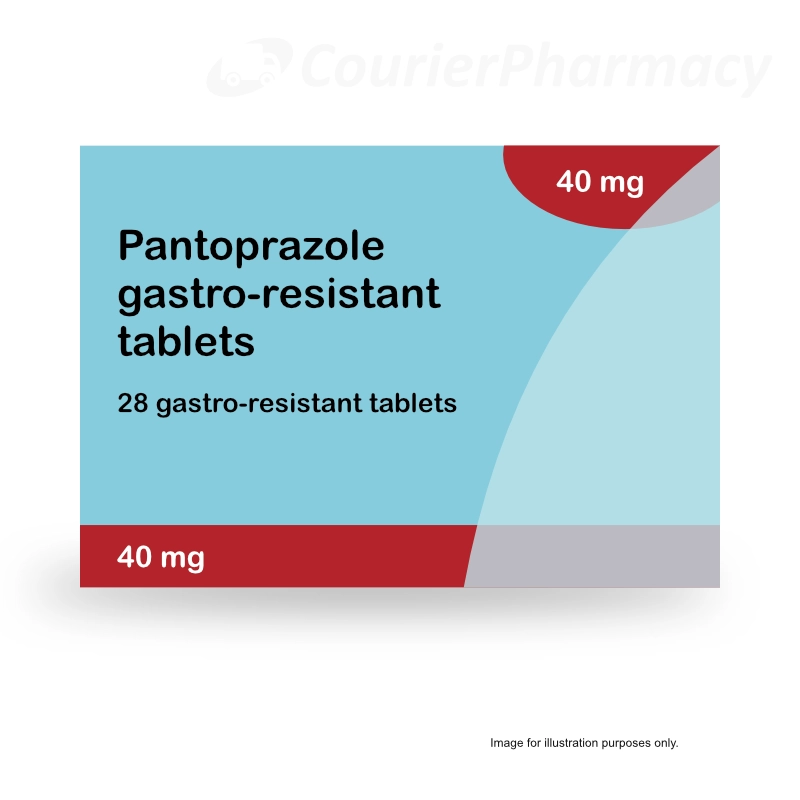
A full-strength proton pump inhibitor used to treat acid reflux, erosive oesophagitis, stomach and duodenal ulcers, and H. pylori-associated conditions.
Pantoprazole 40mg tablets are prescribed by UK clinicians at Courier Pharmacy after a quick online consultation, with the kind of guidance you don’t always get on the high street.
Pantoprazole 40mg tablets are a higher-strength proton pump inhibitor (PPI) used for acid-related conditions that need full-dose treatment. They suit adults and adolescents aged 12 and over when symptoms call for stronger acid control.
Each gastro-resistant tablet contains pantoprazole 40mg (usually as pantoprazole sodium). Most people take it once daily before food. Packs often contain 28 tablets, which matches a typical four-week course in UK practice. So, it’s easy to follow as a month-long treatment plan.
These tablets are gastro-resistant, which means a special coating protects the medicine from stomach acid. The tablet then releases pantoprazole in the small intestine, where your body absorbs it. This matters because stomach acid would break pantoprazole down too early. For that reason, swallow the tablet whole and don’t crush or chew it.
At Courier Pharmacy, a UK-registered prescriber reviews your prescription before we dispense anything. Our pharmacy team can also talk you through how to take pantoprazole, what to expect, and how to reduce it safely when the time is right. Acid problems often sit alongside other health issues, so we look at the bigger picture rather than treating reflux as a stand-alone problem.
Features and specifications
Active ingredient: Pantoprazole (as pantoprazole sodium) 40mg
Form: Gastro-resistant tablet
Pack size: 28 tablets (typical four-week course)
Class: Proton pump inhibitor (PPI)
Prescription status: Prescription Only Medicine (POM)
Typical use: Once daily, before food
Storage: Store below 25°C in the original packaging
MOJO WISDOM
Take control of your health by understanding your condition and what this medication is doing for you.
READ:
More information about this treatment.
UK-based doctors and pharmacists
Discreet and Confidential
UK-based doctors and pharmacists
Free, Expert Advice
No video link provided.
No video link provided.
UK-based doctors and pharmacists
Free, expert advice
Discrete and confidential
Fast delivery
Giving you trusted clinical advice for over 40 conditions
A UK regulated pharmacy providing safe, effective treatments online since 2014
Heartburn that ruins dinner. A burning in your chest at 2am. That sour taste at the back of your throat when you bend over to tie your shoes. Reflux wears you down, and most quick fixes only paper over the cracks. Pantoprazole 40mg tablets are a proven, well-tolerated prescription option for getting on top of acid reflux and related conditions, and at Courier Pharmacy we want you to understand exactly how they work, who they suit, and what to keep an eye on while you take them.
Five key takeaways
Pantoprazole 40mg tablets are a proton pump inhibitor (PPI) prescribed for reflux oesophagitis, gastric and duodenal ulcers, H. pylori eradication, and other acid-related conditions.
They reduce stomach acid by switching off the proton pumps in the stomach lining, giving the gut a chance to heal.
Most people feel a difference within 2 to 3 days, with full effect by around 4 weeks.
Pantoprazole has the lowest CYP2C19 interaction profile of the common PPIs, which makes it a useful option alongside clopidogrel and certain other medicines.
Long-term use can be appropriate, but should be reviewed regularly rather than left to run on autopilot.
Treatment dosage Pantoprazole 40mg tablets
The standard adult dose for reflux oesophagitis is 40mg once daily for four weeks, with a further four weeks recommended if symptoms or healing aren’t complete by then. For gastric ulcer, the usual dose is 40mg once daily for four weeks, extendable to eight. For duodenal ulcer, 40mg once daily for two weeks usually does the job, again extendable to four if needed.
For H. pylori eradication, pantoprazole 40mg is taken twice daily as part of a triple-therapy regimen with two antibiotics, usually for 7 days, occasionally extended to 14. For Zollinger-Ellison syndrome and other pathological hypersecretory conditions, the starting dose is 80mg daily, titrated up or down based on individual response.
Take your tablet about one hour before food, ideally before breakfast at the same time each day. Swallow it whole with a glass of water; don’t chew, crush, or break it. If you miss a dose, take it when you remember, unless your next dose is nearly due. Don’t double up.
Overview of Pantoprazole 40mg tablets
Five things worth knowing:
Pantoprazole has been used in the UK since the late 1990s and is one of the better-studied PPIs.
40mg is the standard healing dose; 20mg is more often used for maintenance.
It has a particularly clean interaction profile, which matters if you take other medicines.
Symptoms ease within days, but the medicine takes a few weeks to reach full effect.
Long-term use should be reviewed; stopping suddenly after months of treatment can trigger rebound acid.
Pantoprazole 40mg tablets sit within a class of medicines that has become one of the most prescribed in the UK. They are widely used because they work, and because they tackle the root of acid-related symptoms rather than just masking them. That said, “commonly prescribed” doesn’t always mean “right for everyone”, which is why we take a proper look at your circumstances before issuing a prescription.
For people living with conditions like MCAS, chronic fatigue, or fibromyalgia, reflux is often just one piece of a wider gut and nervous-system puzzle. Treating the acid is sometimes only part of the answer. Our prescribers look at why reflux might be happening, not just at how to suppress it.
If you have been on a PPI for years without a check-in, that itself is worth a conversation. Long-term acid suppression carries a small but real set of considerations, including reduced vitamin B12 and magnesium absorption and a slightly higher risk of certain infections. None of this means pantoprazole is dangerous; it means it deserves attention rather than autopilot.
One of the practical strengths of pantoprazole is its interaction profile. Unlike omeprazole and esomeprazole, which strongly inhibit the CYP2C19 enzyme, pantoprazole has very little effect on this pathway. This makes it a preferred choice for patients on clopidogrel, certain antidepressants, or other CYP2C19-sensitive medicines.
Finally, pantoprazole is generally well tolerated. Headache and diarrhoea are the most commonly reported side effects, but they often settle in the first week or two. Most people get on with it without much trouble.
Why choose Courier Pharmacy for Pantoprazole 40mg tablets
Acid reflux is common, and most of the time the prescription is straightforward. What’s less common is being treated like a person rather than a transaction. That’s where we come in. At Courier Pharmacy, your prescription is reviewed by a UK-registered prescriber who reads your answers properly, asks follow-up questions where something doesn’t quite add up, and explains the reasoning behind the decision either way.
For people with overlapping or complex conditions, such as MCAS, chronic fatigue, fibromyalgia, or long-standing chronic illness, this matters even more. Reflux is rarely an isolated story. The questions you’ve been brushed off about elsewhere are the ones we want to hear. We also have access to compounded options where excipient sensitivities are an issue, and we work as a referral partner for clinicians looking for personalised pharmacy support.
Our brand guide, Dr Ada Jex-Cori, sums up the approach better than we can: you’re not broken. The system that’s failed you might be. We do what we can do, properly, and connect you with the rest. That includes our free fortnightly drop-in clinics and talks at Insomnia in Derby, where you can ask questions face-to-face without spending a penny.
Buy Pantoprazole 40mg tablets (Prescription Only) from Courier Pharmacy
Pantoprazole 40mg tablets are a Prescription Only Medicine (POM) in the UK, which means they cannot be sold over the counter at this strength. Buying through Courier Pharmacy is straightforward and built around your time.
Here’s how it works:
Complete a quick online consultation
A UK prescriber reviews your answers
If approved, a prescription is issued
We dispense and deliver discreetly to your door
If it isn’t suitable for you, we’ll explain why and suggest the next best option.
Active ingredient in Pantoprazole 40mg tablets
The active ingredient is pantoprazole, usually formulated as pantoprazole sodium sesquihydrate. Chemically, it’s a substituted benzimidazole, similar in structure to omeprazole, lansoprazole, and esomeprazole. All proton pump inhibitors share this core chemistry, but each has slightly different pharmacokinetics, which affects how they’re metabolised and how they interact with other medicines.
Each gastro-resistant tablet also contains inactive ingredients such as mannitol, crospovidone, sodium carbonate, and various coating agents, which can vary by manufacturer. For people with sensitivities, allergies, or MCAS, this matters: the same active ingredient can be combined with quite different excipients across brands. If you react to a specific filler, our pharmacy team can often source an alternative or look at a compounded option through our partner network.
What is Pantoprazole 40mg tablets for?
Pantoprazole 40mg tablets are licensed in the UK for several acid-related conditions. The most common is gastro-oesophageal reflux disease (GORD), particularly where there’s confirmed erosive oesophagitis on endoscopy. The standard 40mg daily dose helps the oesophageal lining heal while symptoms settle.
The tablets are also used to treat gastric (stomach) and duodenal ulcers. For ulcers caused by Helicobacter pylori infection, pantoprazole is combined with two antibiotics in a short eradication course, which significantly reduces the risk of the ulcers coming back. After hospital treatment of bleeding ulcers, pantoprazole is sometimes continued orally to prevent rebleeding.
Pantoprazole 40mg is also used for Zollinger-Ellison syndrome, a rare condition where the body produces excessive amounts of stomach acid, and for other pathological hypersecretory states. In these cases, doses are individualised and can go considerably higher than 40mg daily.
How does Pantoprazole 40mg tablets work?
Your stomach lining contains specialised cells called parietal cells. Inside these cells are tiny molecular pumps known as proton pumps, or more precisely, hydrogen-potassium ATPase pumps. Their job is to push hydrogen ions into the stomach, where they combine with chloride to form hydrochloric acid.
Pantoprazole works by binding to these proton pumps and switching them off. Once a pump is blocked, it stays blocked until the parietal cell builds a new one, which takes time. That’s why PPIs don’t work instantly. The first dose starts to reduce acid output, but it takes 2 to 3 days for noticeable symptom relief and up to 4 weeks for the medicine to reach its full effect.
The gastro-resistant coating is crucial. Pantoprazole is acid-sensitive, so if it were exposed to stomach acid on the way down, much of it would be broken down before it could do its job. The coating stays intact through the stomach, dissolves in the more alkaline small intestine, and the medicine is absorbed there. From the bloodstream, it travels back to the stomach lining and locks onto the proton pumps from the inside.
Because of this mechanism, pantoprazole reduces both basal acid production (the slow trickle your stomach makes throughout the day) and meal-stimulated acid production (the surge after eating). The pH inside your stomach rises, the irritated lining gets a chance to heal, and symptoms gradually settle.
It’s worth being clear about what pantoprazole doesn’t do. It doesn’t neutralise the acid already in your stomach, so it isn’t a fast-acting rescue medicine. For sudden heartburn, antacids work better. Pantoprazole is the slower, steadier solution that addresses underlying acid production over weeks rather than minutes.
How to use Pantoprazole 40mg tablets
Take one 40mg tablet once daily, ideally about an hour before your first meal. Swallow it whole with a glass of water. Don’t chew, crush, or split the tablet, as this damages the coating and means the medicine won’t reach where it needs to go. If you’ve been told to take it twice daily (usually for H. pylori treatment), space the doses morning and evening, both before meals.
Consistency matters more than perfection. If you miss a dose, take it as soon as you remember, unless it’s almost time for the next one. Don’t double up. If you forget for several days in a row, just resume your normal schedule and let your prescriber know if symptoms come back.
Pantoprazole works best as part of a wider plan. Smaller, more frequent meals, avoiding lying down within two to three hours of eating, raising the head of the bed slightly, and reviewing trigger foods (often spicy food, coffee, alcohol, and chocolate) all help. The tablet does a lot, but it doesn’t replace the basics. If you’re a smoker, stopping makes a real difference to reflux too.
Warnings and precautions for Pantoprazole 40mg tablets
Pantoprazole isn’t suitable for everyone. Tell your prescriber if you have severe liver disease, low magnesium levels, osteoporosis, or a history of severe allergic reactions to any PPI. Stomach cancer can mimic reflux symptoms, and PPIs can mask the warning signs, so your prescriber may want to investigate further if you have any red-flag features such as unintentional weight loss, difficulty swallowing, vomiting blood, or black tarry stools.
If you’re due to have an endoscopy or a test for H. pylori, mention that you’re on pantoprazole. PPIs can interfere with results, and you may be asked to stop the medicine in advance. Don’t stop on your own after long-term use, though, because suddenly stopping can trigger rebound acid, which can feel worse than the original problem.
Long-term use (over a year) deserves regular review. Possible concerns include reduced absorption of vitamin B12, magnesium, and calcium, a slightly higher risk of certain bone fractures, and an increased susceptibility to gut infections such as Clostridioides difficile. None of this is a reason to avoid pantoprazole when it’s needed; it’s a reason to use the lowest effective dose for the shortest necessary period and to review the prescription periodically.
In pregnancy, pantoprazole has been used and the available data suggests it’s low risk, but it’s generally preferable to avoid PPIs in pregnancy unless clearly needed, and the decision should always involve a clinician. Small amounts pass into breast milk; discuss with your prescriber if you are breastfeeding.
Some people develop a rash, especially on sun-exposed skin, along with joint pain. This can be a sign of a rare condition called subacute cutaneous lupus erythematosus and should be reported to your prescriber promptly.
Side effects of Pantoprazole 40mg tablets
Most people tolerate pantoprazole well. Where side effects do occur, they tend to be mild and settle as the body adjusts. Common side effects, affecting between 1 in 100 and 1 in 10 people, include headache, diarrhoea, nausea, abdominal pain, wind, constipation, and dry mouth [9]. Taking the tablet at the same time each day and staying well hydrated can help.
Uncommon side effects, affecting between 1 in 1,000 and 1 in 100 people, include dizziness, blurred vision, itchy skin, rash, sleep disturbance, and a feeling of weakness. Most resolve when the medicine is stopped. If they affect your ability to drive or operate machinery, hold off until you feel back to normal.
Rare but serious side effects, affecting fewer than 1 in 1,000 people, need urgent attention. These include signs of liver problems (yellowing of skin or eyes, dark urine, pale stools, severe fatigue), severe persistent diarrhoea (which can indicate bowel inflammation or C. difficile infection), low magnesium (muscle cramps, abnormal heartbeat, seizures), and the rash-and-joint-pain combination of subacute cutaneous lupus erythematosus.
Very rarely, pantoprazole can cause a severe allergic reaction (anaphylaxis), with swelling of the lips, mouth, throat or tongue, difficulty breathing, and a sudden drop in blood pressure. This is a medical emergency; call 999.
If you experience any side effect that worries you, you can report it directly to the MHRA’s Yellow Card scheme. This helps improve safety information for everyone who uses the medicine. Our pharmacy team are happy to help you complete a Yellow Card if you’d like a hand.
Drug interactions with Pantoprazole 40mg tablets
Pantoprazole’s interaction profile is one of its real practical advantages. Unlike omeprazole and esomeprazole, pantoprazole has minimal effect on the CYP2C19 enzyme, so it’s generally safer to combine with medicines that depend on this pathway. The most clinically important example is clopidogrel, an antiplatelet drug used after heart attacks and strokes; the MHRA advises against combining clopidogrel with omeprazole or esomeprazole, but considers pantoprazole an acceptable PPI choice for patients who need both.
That said, pantoprazole is not interaction-free. By reducing stomach acid, it changes how some medicines are absorbed. Drugs that need an acidic stomach to dissolve properly, such as ketoconazole, itraconazole, and certain HIV medicines like atazanavir and rilpivirine, can become less effective. Rilpivirine is a particular concern and is generally not co-prescribed with PPIs.
Methotrexate, particularly at higher doses used in cancer treatment, can build up if taken with PPIs and may need a dose break. Pantoprazole can also slightly raise the effect of warfarin, so INR monitoring may be increased during the early weeks of treatment. The herbal remedy St John’s wort can speed up pantoprazole’s breakdown, reducing its effectiveness, so avoid it while on this medicine.
Always tell your prescriber and pharmacist about everything you take, including over-the-counter medicines, vitamins, and herbal supplements. We check the full picture before issuing your prescription, and the pharmacy team can flag anything that needs a closer look.
Frequently asked questions about Pantoprazole 40mg tablets
Is pantoprazole the same as omeprazole?
No, but they’re closely related. Both are proton pump inhibitors and work in much the same way. Pantoprazole tends to have a cleaner interaction profile because it has less effect on the CYP2C19 enzyme, which makes it a better choice alongside certain other medicines like clopidogrel.
How quickly will pantoprazole 40mg work?
You’ll usually notice improvement within 2 to 3 days, with full effect by around 4 weeks. If symptoms haven’t improved after a couple of weeks, contact your prescriber rather than increasing the dose yourself.
Can I take pantoprazole 40mg long term?
Some people need long-term treatment and that’s appropriate. Long-term use should be reviewed periodically to make sure the dose is still right and to keep an eye on potential issues like vitamin B12, magnesium, and bone health. We can help arrange these reviews.
Should I take pantoprazole with food?
No. Pantoprazole works best taken about one hour before a meal, ideally before breakfast [2]. Food slows its absorption and can reduce its effect.
Can I drink alcohol while on pantoprazole?
You can, but alcohol can increase stomach acid production and irritate the lining, which can undermine the medicine’s effect. Moderate intake is usually fine; heavy drinking will likely keep symptoms going.
What happens if I stop pantoprazole suddenly?
After short courses, stopping is straightforward. After long-term use, sudden withdrawal can cause rebound acid hypersecretion, with symptoms feeling worse for a few weeks. Stepping down the dose, or switching to alternate-day dosing first, usually avoids this. Speak to your prescriber for a tailored plan.
Can I take pantoprazole during pregnancy?
Pantoprazole has been used in pregnancy and current data suggests low risk, but PPIs are generally avoided in pregnancy unless clearly needed. The decision should always involve a clinician.
Does pantoprazole interact with clopidogrel?
Pantoprazole is considered the preferred PPI for people who need clopidogrel, because it has minimal effect on the CYP2C19 enzyme that activates clopidogrel. This is one of pantoprazole’s biggest practical advantages.
What’s the difference between pantoprazole 20mg and 40mg?
The 20mg dose is typically used for milder reflux or as a maintenance dose after symptoms have improved. The 40mg dose is used for healing erosive oesophagitis, ulcer treatment, and H. pylori eradication.
Can children take pantoprazole 40mg tablets?
Pantoprazole 40mg is licensed for adolescents from age 12 and for adults. Younger children use different doses and formulations under specialist care.
Why am I told to take it before food?
Pantoprazole works by attaching to active proton pumps. The pumps are most active just after a meal. Taking the tablet about an hour before eating means it’s in your bloodstream and ready to bind the pumps as they switch on.
Can I take antacids with pantoprazole?
Yes. Antacids work differently (neutralising acid that’s already there), so they can be used together if you need fast symptomatic relief while waiting for pantoprazole to take full effect.
Will I gain weight on pantoprazole?
Weight gain isn’t a recognised common side effect. Some people notice changes in appetite or bloating, but significant weight gain usually has another cause and should be checked.
Can pantoprazole affect my mood or sleep?
Uncommonly, yes. Sleep disturbance has been reported, though it’s not common. If you notice mood changes, mention them at your next review.
Does pantoprazole cause cancer?
There’s no clear evidence that PPIs cause cancer. There are theoretical concerns about long-term acid suppression and gastric changes, which is part of why long-term use should be reviewed. PPIs can also mask the early symptoms of stomach cancer, which is why red-flag features always need investigating before starting treatment.
Can I take pantoprazole with iron tablets?
You can, but stomach acid helps iron absorption, so a PPI may reduce how much iron you absorb [2]. If you’re being treated for iron deficiency, your prescriber may suggest spacing doses or monitoring iron levels.
Is pantoprazole safe with antidepressants?
For most antidepressants, yes, and because pantoprazole has minimal CYP2C19 effect, it’s often the preferred PPI for people on citalopram or escitalopram. Always share your full medication list.
Why does pantoprazole sometimes cause headaches?
Headache is one of the more commonly reported side effects, affecting between 1 in 100 and 1 in 10 people. The exact reason isn’t fully understood, but it usually settles within a week or two as the body adjusts.
Can pantoprazole interact with warfarin?
Pantoprazole can slightly increase the effect of warfarin in some people, so INR monitoring may be increased in the early weeks of treatment. Tell your prescriber and your anticoagulation clinic if you’re starting or stopping pantoprazole.
Can I get pantoprazole 40mg without a prescription?
Not at this strength. Lower-dose pantoprazole (20mg) is available as a pharmacy medicine for short-term use, but 40mg is Prescription Only in the UK. Through Courier Pharmacy, a short online consultation is all you need.
Disclaimer: This article is for general information only and isn’t a substitute for personal medical advice, diagnosis, or treatment. Always check with a GP, pharmacist, or specialist before starting a new supplement if you have a medical condition or take regular medicines.
References
Electronic Medicines Compendium (2024) Pantoprazole 40mg Gastro-Resistant Tablets: Summary of Product Characteristics. Available at: https://www.medicines.org.uk/emc/product/10663/smpc (Accessed: 14 May 2026).
Jaynes, M. and Kumar, A.B. (2019) ‘The risks of long-term use of proton pump inhibitors: a critical review’, Therapeutic Advances in Drug Safety, 10. Available at: https://pubmed.ncbi.nlm.nih.gov/31019676/ (Accessed: 14 May 2026).
Shin, J.M. and Sachs, G. (2008) ‘Pharmacology of proton pump inhibitors’, Current Gastroenterology Reports, 10(6), pp. 528-534. Available at: https://pubmed.ncbi.nlm.nih.gov/19006606/ (Accessed: 14 May 2026).