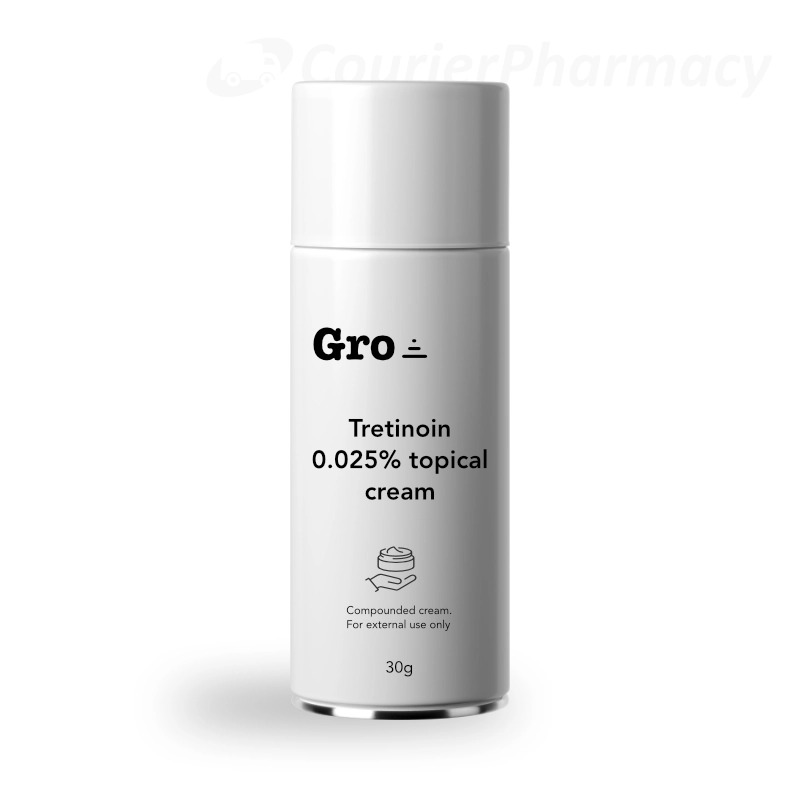
UK compounded unlicensed special — tretinoin 0.025% (all-trans retinoic acid), the gold standard prescription retinoid, in an emollient cream base
Moderate strength sitting between 0.01% starter and 0.05%/0.1% higher strengths; suits patients stepping up from OTC retinols, first-time prescription retinoid users, and those who reacted badly to stronger formulations
Prescriber-led supply with documented informed consent; treats acne, photoaging, hyperpigmentation, and uneven texture over 3-6 months of consistent use
Non-negotiable requirements: daily SPF 30+ (tretinoin significantly increases UV sensitivity) and avoidance in pregnancy and breastfeeding; part of the Gro skincare range
Pack size: 30g
Expiry date: 30 days
TREATS:
Hyperpigmentation
FORMAT:
Cream
Availability:
In stock
Our bespoke tretinoin range has been so popular that delivery now takes two weeks — because "treatment that fits you" is worth the wait.
Skin concerns affect roughly 70% of adults at some point in their lives — whether that’s acne persisting into adulthood, photoaging becoming visible in the mid-30s, or hyperpigmentation from years of sun exposure or acne scarring. After all, skin concerns aren’t just cosmetic — they affect confidence, mental health, professional life, and how people feel showing up in the world.
So effective treatment genuinely matters. The challenge is that OTC skincare (retinols, glycolic acids, vitamin C serums) can only take you so far. In short, prescription retinoids offer a step-change in efficacy that OTC alternatives can’t match.
Tretinoin has been the reference prescription retinoid for over 50 years. Specifically, it works by binding to retinoic acid receptors in skin cells, changing which genes are activated. As a result, cell turnover speeds up, pore-clogging is reduced, collagen production increases, and pigmentation improves.
However, honest framing matters: prescription retinoids require patience through the retinization phase, consistent long-term use, and non-negotiable sun protection. So this isn’t a quick fix, but the results are genuine and lasting.
Where this cream fits in skincare treatment
The UK approach to skincare treatment follows a stepped path:
Step 9: Advanced procedures (fractional laser, deep peels, subcision)
Step 10: Cosmetic surgery for advanced concerns
So tretinoin 0.025% cream typically sits at Step 4. In short, it’s the natural step up when OTC actives haven’t given enough results, but before considering oral prescription therapy or procedural treatments.
This cream vs OTC retinols
Prescription strength vs OTC alternatives:
Tretinoin 0.025%: prescription-only, active retinoic acid
In contrast, OTC retinols contain retinol at various strengths (typically 0.25% to 1%)
Retinol must be converted to retinoic acid by the skin — a two-step process that reduces potency
Tretinoin is already active — no conversion needed
Tretinoin 0.025% is roughly 20-100x stronger than typical OTC retinols
Results come faster with tretinoin
However, OTC retinols are gentler and easier to start with
Also, OTC retinols don’t require a prescription
In general, OTC retinols are a reasonable starting point; tretinoin fits when results plateau
This cream vs adapalene (Differin)
Two prescription-strength retinoids with different profiles:
Tretinoin 0.025%: first-generation retinoid, decades of evidence
In contrast, adapalene 0.1% is a third-generation retinoid available OTC as Differin
Adapalene is more selective for skin retinoid receptors
Also, adapalene is more photostable (can be used morning if wanted)
However, tretinoin has stronger anti-aging evidence
Adapalene often causes less irritation than tretinoin
Adapalene is licensed only for acne; tretinoin is used for acne AND anti-aging
In general, adapalene suits acne-only situations; tretinoin fits broader skincare goals
This cream vs tretinoin gel formulations
Same active, different base:
This cream: tretinoin in an emollient cream base
In contrast, tretinoin gels use alcohol or gel-forming bases
Gel formulations penetrate faster and are more drying
Cream formulations are more moisturising and better tolerated
Gel often suits oily or acne-prone skin
Cream often suits dry, sensitive, or anti-aging-focused skin
Cream base makes the retinization phase more manageable for most patients
In general, cream is the safer starting point for most patients
This cream vs stronger tretinoin (0.05% or 0.1%)
Different concentrations for different needs:
This 0.025% cream: moderate strength
In contrast, 0.05% and 0.1% are higher-strength options
Higher strengths give faster results in some patients
However, higher strengths cause more irritation and longer retinization
Also, higher strengths have higher rates of patients abandoning treatment
025% offers meaningful clinical results while remaining tolerable
Stepping up to 0.05% or 0.1% is easier after adapting to 0.025%
In general, 0.025% is a sensible starting or maintenance strength
This cream vs licensed Retin-A 0.025% cream
Same strength, different regulatory status:
This cream: compounded specials preparation from the Gro skincare range
In contrast, Retin-A 0.025% cream by Johnson & Johnson is licensed in the UK
Both contain tretinoin 0.025% as the active
Licensed products have full Marketing Authorisation
Compounded medicines are prepared for individual patients under Section 10 exemption
Compounded medicines can be tailored to specific patient needs (base, adjuncts, tolerability)
Licensed products come in standardised formulations
In general, licensed is preferred where it suits; compounded fits when personalisation matters
This cream vs oral isotretinoin
Topical vs systemic retinoid therapy:
This cream: topical retinoid, works only where applied
In contrast, oral isotretinoin (Roaccutane) works systemically
Isotretinoin is reserved for severe or resistant acne
Isotretinoin is specialist-initiated only in the UK (dermatologist)
Also, isotretinoin has significant side effect profile and monitoring requirements
Topical tretinoin is much lower risk
Isotretinoin can permanently improve severe acne
Topical tretinoin requires ongoing use for maintained benefit
In general, topical fits mild-to-moderate concerns; oral fits severe or resistant cases
Who this cream may suit well
This product may suit:
Adults with mild-to-moderate acne wanting prescription-strength treatment
Adults with early-to-moderate photoaging
Adults with uneven skin texture wanting improvement
Adults with post-inflammatory hyperpigmentation
Patients who’ve tried OTC retinols and want the next step
Patients wanting a moderate strength for balanced tolerability
Patients who reacted badly to higher-strength tretinoin previously
Patients wanting a cream base rather than a drying gel
Patients using effective contraception (for those of childbearing potential)
Patients committed to consistent daily SPF use
Who might suit other options better
Other options may suit better for:
Pregnant or breastfeeding women — tretinoin is contraindicated
Women planning pregnancy in the near future
Patients with severe cystic or nodular acne (specialist referral)
Patients with active rosacea (tretinoin may worsen)
Patients with active eczema or dermatitis on the treatment area
Patients with vitiligo or unstable pigmentation
Patients with known allergy to tretinoin or vitamin A derivatives
Patients under 12 years old (unless under specialist supervision)
Patients unwilling to use daily SPF (essential for safe tretinoin use)
Patients who work outdoors extensively without SPF options
Patients who can’t accept the unlicensed compounded nature
Patients who’ve had severe reactions to previous retinoids
Patients undergoing chemical peels or laser treatments (space these apart)
Courier Pharmacy supply
This is a UK Prescription-Only Medicine (POM) supplied as an unlicensed special. So supply only happens after our UK-qualified prescriber reviews your situation thoroughly. The consultation covers:
Your skin concern (acne, photoaging, pigmentation, texture)
Tretinoin 0.025% Topical Cream — Compounded Prescription Skincare from the Gro Skincare Range
This is a UK compounded preparation — a topical prescription retinoid cream containing tretinoin 0.025% in a carefully considered cream base. So each tube contains all-trans retinoic acid (the gold standard prescription retinoid) at a moderate concentration that sits between the 0.01% starter strength and the 0.05% or 0.1% higher strengths. As a result, it offers meaningful clinical results while remaining tolerable for many patients who couldn’t get on with stronger formulations. Important: this is an unlicensed compounded special — supply happens after a full prescriber consultation with documented informed consent. Part of the Gro skincare range at Courier Pharmacy. This page is gated — you’ll only see it because you’ve completed the eligibility consultation.
At Courier Pharmacy, we believe in treatment that fits the person — but only where it’s honest, safe, and consented to.
This page covers what the tretinoin 0.025% cream is, who it might suit, how it compares to other retinoid options, and the practical points that matter when starting a prescription retinoid — including the retinization phase, sun protection, and realistic timelines.
Regulatory position — please read first
Before going further, we want to be straight with you about three things:
First, this is an unlicensed compounded medicine. This specific compounded preparation is prepared for individual patients under our Specials pharmacy licence. If a licensed product would suit you better, we’ll tell you honestly.
Second, tretinoin is a prescription-only medicine. So it isn’t sold over-the-counter, and supply requires a proper consultation. In addition, tretinoin is contraindicated in pregnancy — this is a non-negotiable safety point.
Third, prescription retinoids require patience. The first 4-8 weeks often involves what dermatologists call retinisation — a period of redness, dryness, flaking, and sometimes worsening of acne (called “purging”). This isn’t the treatment failing. It’s the treatment starting. Realistic expectations matter.
If any of these points raise concerns, please pause and talk to our prescriber before proceeding. After all, informed consent is the foundation of supplying any unlicensed special — and prescription retinoid treatment requires commitment through the adjustment phase.
Five key takeaways
This is a UK unlicensed compounded special from the Gro skincare range. So supply only happens after a full prescriber consultation with documented informed consent, including discussion of the retinisation phase and sun protection requirements
Tretinoin 0.025% is a moderate-strength prescription retinoid — stronger than OTC retinols and the 0.01% starter concentration, but gentler than 0.05% and 0.1% strengths that some skin can’t tolerate
The cream base matters. In contrast to gel formulations (which tend to be more drying), a well-formulated cream base delivers the active with better emollience and barrier support. As a result, it’s typically better tolerated during the retinisation phase
Slow but steady results: retinisation phase 4-8 weeks, early texture improvements at 6-12 weeks, meaningful improvement at 3-6 months, continued improvement in pigmentation and fine lines at 6-12+ months
Important practical points: SPF 30+ every day is non-negotiable (tretinoin increases UV sensitivity significantly), the sandwich method reduces irritation, and tretinoin is contraindicated in pregnancy and breastfeeding
Why choose Courier Pharmacy for the Gro range
At Courier Pharmacy, our approach starts with a simple idea: treatment should fit the person, not force the person to fit the system.
Dr Ada Jex-Cori
Our service is shaped by the philosophy of Dr Ada Jex-Cori, our brand pharmacist.
Dr Ada represents the spirit of the pharmacy: evidence-led, community-rooted, and willing to challenge the one-size-fits-all approach to medicine. She is named in honour of three pioneering women in science: Ada Lovelace, the mathematician and visionary; Sophia Jex-Blake, the first female doctor in the UK who fought the medical establishment; and Gerty Cori, the biochemist and Nobel Prize winner.
In our fictional world of Etherwell, Dr Ada fights against pharma’s standardised approach to medicine. In the real world, she represents what we stand for. Her view is straightforward: you are not broken. The system is. And we are here to change that.
Skin concerns deserve serious attention
Prescription skincare is often gatekept behind aesthetic clinics or specialist referrals. Courier Pharmacy is different. So we recognise that:
Skin concerns affect roughly 70% of adults at some point
They affect confidence, mental health, professional life, and how people show up in the world
Depression and anxiety are significantly more common in people with visible skin concerns
OTC skincare can only take you so far — prescription-strength has a real efficacy step-change
Access to prescription retinoids is often unnecessarily complicated
Consistent daily application is what makes prescription retinoids work
The right treatment approach depends on the person, not a standard protocol
After all, skin concerns have a real impact on mental wellbeing. So our prescriber takes them seriously.
Honest framing about the retinisation phase
We’ll be straight with you about what to expect:
The first 4-8 weeks are the hardest — redness, flaking, dryness, purging
This isn’t the treatment failing — it’s the treatment starting
Most patients who abandon tretinoin do so during retinization
Building up gradually (every third night, then every other night, then nightly) helps
The sandwich method buffers irritation
Persisting through retinization is essential for reaching results
Honest framing about continuous use
This is skincare commitment, not a course:
Skin concerns are largely maintained by ongoing treatment
Stopping tretinoin gradually reverses the benefits over 3-6 months
Consider this before starting
Some patients maintain results with reduced frequency long-term
Combining with lifestyle factors (sleep, hydration, diet, sun protection) helps
Honest framing about sun protection
We won’t sugarcoat this:
Daily SPF 30+ isn’t optional with tretinoin
Tretinoin plus unprotected sun exposure causes more damage than not using tretinoin
If you won’t commit to daily SPF, this isn’t the right treatment for you
Reapplication matters during sun exposure
Consider tinted SPF for cosmetic finish plus visible light protection
Honest framing about unlicensed compounded medicines
We won’t pretend this is something it isn’t:
Licensed tretinoin products exist in the UK (Retin-A cream)
This compounded version is prepared for individual patients
Compounding allows tailoring of base and adjuncts
If a licensed product would suit you better, we’ll tell you
Informed consent matters for unlicensed specials
Regular review is essential to assess response and continue safely
Skin concerns and the bigger picture
Skin concerns rarely sit in isolation. So our prescriber can discuss:
Nutrition and skin health (omega-3s, zinc, vitamin A intake)
Sleep and skin repair cycles
Stress management and skin
Mental health impact of visible skin concerns
When to consider combination therapy vs monotherapy
When to consider procedural options (chemical peels, laser, microneedling)
When specialist referral makes sense
Realistic timeline expectations
Photographic tracking for objective assessment
Sometimes the visible skin concern is the visible part of a wider picture worth talking through.
Prescriber and pharmacist support before and after supply
Our team is here to discuss:
Whether this strength fits your skin type and concerns
Whether OTC alternatives should be tried first
Whether a licensed product would suit you better
Realistic expectations for your specific situation
How to apply the cream effectively
How to manage the retinization phase
How to build a compatible skincare routine
Regular prescriber review at 3 months and 6 months
This is included in your supply and available throughout your treatment.
Trust earned, not claimed
We are GPhC-regulated, and our content is grounded in published clinical literature on tretinoin for acne and skin renewal (over 50 years of studies), the licensed Retin-A Summary of Product Characteristics as reference, British Association of Dermatologists guidance on acne and skincare, NICE Clinical Knowledge Summary on acne, MHRA guidance on unlicensed specials, and the real experience of patients managing skin concerns.
If this cream isn’t the right answer for your situation, we’ll tell you honestly. After all, getting the right treatment matters more than fulfilling a request.
How supply works
This is a UK Prescription-Only Medicine supplied as an unlicensed compounded special. So the supply process has more steps than for OTC skincare.
How our service works
Complete the detailed eligibility consultation
Our UK-qualified prescriber reviews your responses thoroughly
The prescriber may request pre-treatment photos for baseline assessment
If approved, the prescriber issues an individualised prescription for the cream
Our Specials pharmacy partner compounds the cream to your prescription
Documented informed consent is recorded as part of the supply process — including discussion of retinization phase and SPF requirements
Your order is dispatched in plain, discreet packaging
Free prescriber and pharmacist support is available throughout treatment
Regular review at 3 months and 6 months to assess response
When other options might suit better
If this cream isn’t right, we’ll explain why. Other options may include:
OTC retinols — for patients wanting to start with a gentler option
Adapalene (Differin) — a gentler prescription-strength retinoid, available OTC in some countries
Licensed Retin-A cream 0.025% — if licensed product is preferred
Tretinoin 0.01% — for very sensitive skin or first-time retinoid users
Tretinoin 0.05% or 0.1% — for patients wanting higher strength
Tretinoin gel formulations — for oily or acne-prone skin
Combination formulas (retinoid + antibiotic for acne, retinoid + hydroquinone for pigmentation)
Azelaic acid — for rosacea-friendly acne treatment or pigmentation
Oral acne therapy (antibiotics, spironolactone) for hormonal or resistant acne
Oral isotretinoin (specialist-initiated) for severe or resistant acne
Our free fortnightly drop-in clinics at Insomnia, Derby run every other week from 10am to 12pm.
Healthcare shouldn’t only happen when you’re paying for it. So we show up, even when it’s free.
We cover skincare, acne, hair loss, dermatology, MCAS, weight management, menopause, women’s health, men’s health, chronic pain, digestive health, allergies, asthma, sleep, and whatever else people bring through the door. No appointment needed, no charge, no pressure.
Active ingredient
Each tube contains:
Tretinoin 0.025% (all-trans retinoic acid) — the gold standard prescription retinoid
Cream base with emollient and moisturising properties
Why tretinoin
Tretinoin is the most established prescription retinoid:
All-trans retinoic acid — the natural active form of vitamin A
First used clinically for acne in the late 1960s
Anti-aging effects documented from the 1980s onwards
Over 50 years of clinical evidence
Gold standard against which other retinoids are measured
Stronger and faster-acting than OTC retinols (which need conversion in the skin)
Well-characterised safety profile with decades of use
In short, tretinoin is the reference retinoid. After all, when a molecule has been used clinically for over 50 years with consistent evidence, it earns its place as the standard.
Why the 0.025% strength
The 0.025% strength is specifically chosen as a moderate concentration:
Sits between 0.01% (starter) and 0.05% or 0.1% (higher strengths)
Stronger than OTC retinols (typically 0.25% to 1% retinol, which is 20-100x weaker than tretinoin)
Gentler than 0.05% or 0.1% which some skin can't tolerate
Sensible starting strength for first-time prescription retinoid users
Appropriate step-down for patients who reacted badly to higher strengths
Balance of efficacy and tolerability that suits most patients
Widely used in dermatology practice
After all, more strength isn't automatically better — it fits the situation. So most patients get better results from a strength they can actually tolerate consistently.
Why the cream base
The base matters as much as the active:
Cream base with emollient and moisturising properties
Delivers tretinoin with better skin barrier support than gel formulations
Less drying than alcohol-based or gel formulations
Less likely to cause tight, uncomfortable feeling
Better suited to dry, sensitive, or barrier-compromised skin
Buffers some of the irritation during the retinization phase
Absorbs evenly without leaving noticeable residue
In short, the cream base makes prescription retinoid treatment more sustainable. So patients are more likely to stick with the routine long enough to see results.
Other ingredients
The cream base contains standard emollient and stabilising excipients:
Purified water
Emollient oils or moisturising agents
Skin barrier support ingredients
pH buffers for skin compatibility
Cosmetic-grade preservatives
Antioxidants for tretinoin stability
Specific excipients are listed on the individualised label. So mention any known allergies during your consultation — particularly to skincare ingredients or previous topical medications.
Pack details
The cream comes in:
Tube designed to last approximately one to two months depending on frequency of use
Opaque tube to protect tretinoin from light degradation
Sealed for freshness on delivery
Individualised label with patient name, batch number, and expiry date
How this cream is made
Important transparency points:
Compounded by a UK Specials-licensed pharmacy under Section 10 exemption arrangements
Prepared specifically for individual patients on prescriber order
Each batch made under GMP-equivalent quality standards
Tretinoin from pharmaceutical-grade sources
Quality control includes content uniformity testing
Room temperature storage — no cold chain needed
Typical shelf life 30 days preparation
What is Tretinoin 0.025% Cream for?
This compounded cream is designed for the treatment of skin concerns responsive to prescription retinoid therapy. So tretinoin is the most studied prescription retinoid, with over 50 years of clinical evidence supporting its use for acne and skin renewal. As a result, it binds to retinoic acid receptors in skin cells, normalising cell turnover, reducing comedone formation, stimulating collagen production, and helping with pigmentation.
Who might this cream suit?
This product may suit:
Adults with mild-to-moderate acne (comedonal or inflammatory)
Adults with photoaging, fine lines, or sun damage
Adults with uneven skin texture or roughness
Adults with post-inflammatory hyperpigmentation (dark marks after acne)
Adults with mild melasma
Patients wanting a moderate-strength retinoid stepping up from OTC retinols
Patients who reacted badly to 0.05% or 0.1% tretinoin previously
Patients wanting a cream base rather than a drying gel formulation
Patients who understand and accept the unlicensed compounded nature
Patients committed to consistent long-term use and proper sun protection
What tretinoin may help with
Based on decades of clinical research:
Acne — comedonal, inflammatory, and mild-to-moderate acne generally
Photoaging — fine lines, wrinkles, and sun damage
Uneven skin texture and roughness
Post-inflammatory hyperpigmentation
Mild melasma (although combinations often work better)
General skin renewal and clarity
Long-term maintenance of skin quality after initial improvement
Important honesty point: results build slowly. So this treatment maintains and improves the skin's renewal capacity rather than delivering overnight results.
What this cream doesn't claim to do
Honest framing matters:
It doesn't work overnight — meaningful results take 3-6 months
It doesn't remove deep wrinkles that need procedural interventions
It doesn't treat severe cystic acne (which usually needs oral isotretinoin or antibiotics)
It doesn't treat rosacea (although it may worsen it in some patients)
It doesn't remove scarring — only pigmentation and texture improve
It doesn't work as a one-off treatment — consistent use is essential
It doesn't guarantee response — individual variation is significant
How tretinoin works
Understanding the mechanism helps set realistic expectations for what to expect and why the retinization phase happens.
The core mechanism
Tretinoin acts at the cellular level:
Applied to the skin
Absorbed through the outer skin layer (stratum corneum)
Enters skin cells where it binds to retinoic acid receptors (RARs)
These receptors move into the cell nucleus
Change which genes are activated in the cell
Speed up the turnover of skin cells
Normalise how skin cells stick together in pores
Stimulate collagen production in the deeper skin layers
Reduce melanin transfer between skin cells
Improve the organisation of new skin as it forms
In short, tretinoin changes how your skin behaves at a fundamental level. After all, this is why the results are more meaningful than OTC alternatives — but also why patience is needed.
Why the retinization phase happens
This is critical to understand:
Your skin adapts to tretinoin over the first 4-8 weeks
Cell turnover speeds up dramatically
This causes visible flaking, dryness, and redness
Existing comedones (blocked pores) surface as "purging"
The skin barrier is temporarily disrupted
This isn't damage — it's adjustment
Persisting through retinization is essential for reaching results
Stopping during retinization means starting over next time
After all, most patients who abandon tretinoin do so during retinization. So understanding what's happening helps you stick with it.
Timeline of results
Realistic expectations by timepoint:
Weeks 1-2: no visible improvement; retinization starting
Weeks 2-6: possible dryness, flaking, and (for acne patients) purging
Weeks 6-12: retinization settling; early signs of improved texture
Months 3-4: noticeable improvement in acne, texture, and clarity
Months 4-6: meaningful improvement in most responders
Months 6-12: continued improvement in pigmentation and fine lines
Beyond 12 months: continued gradual improvement plus long-term maintenance
Consistent use maintains the benefit long-term
Why continuous use matters
This is essential to understand:
Tretinoin doesn't cure skin concerns — it manages them
Stopping treatment gradually reverses the benefits
Skin returns to its natural behaviour patterns over 3-6 months
Pigmentation may return, acne may recur, texture improvements fade
So this is a long-term skincare commitment
Some patients maintain results with reduced frequency (2-3 times weekly) long-term
How to use tretinoin 0.025% cream
This summary is for reference only. The definitive guide is the individualised patient information supplied with your prescription. So if anything isn't clear, contact our prescriber before starting.
Building up gradually
Don't jump straight to nightly application:
Weeks 1: apply every third night
Weeks 2: apply every other night if tolerated
Weeks 3 onwards: nightly application if tolerated
If irritation is severe, go back down a step and rebuild more slowly
Some patients never move beyond every other night — that is fine
Consistency at whatever frequency you can tolerate matters more than nightly application
Standard application
Cleanse your face gently with a non-stripping cleanser
Pat dry gently — don't rub
Wait 15-20 minutes for skin to fully dry (applying to damp skin increases irritation)
Apply a pea-sized amount of cream to your fingertip
Dot small amounts on forehead, cheeks, chin, and nose
Spread gently across the face using fingertips
Avoid the eye area, corners of the mouth, and nostrils
Wash hands thoroughly after application
Wait 10-20 minutes before applying moisturiser
The sandwich method for sensitive skin
If your skin is particularly sensitive, this reduces irritation:
Apply a light layer of moisturiser first
Wait 2-3 minutes
Apply pea-sized tretinoin
Wait 2-3 minutes
Apply moisturiser again
Slightly reduces efficacy but greatly improves tolerability
Once skin adapts (usually after 4-8 weeks), you can move to standard application
Sun protection is essential
This is non-negotiable with any retinoid:
Tretinoin significantly increases your skin's sensitivity to UV damage
Use broad-spectrum SPF 30+ every morning, even in winter, even when it's cloudy
Reapply throughout the day if you're outdoors
SPF is not optional — using tretinoin without SPF causes more damage than it prevents
Wear a hat and seek shade during peak UV hours
Consider tinted SPF for cosmetic finish and additional visible light protection
Simple moisturiser (ceramides, hyaluronic acid, glycerin all work well)
Broad-spectrum SPF 30+ every morning
Introduce niacinamide, vitamin C, or hyaluronic acid serums gradually if wanted
Skip acids (AHAs, BHAs) on tretinoin nights initially
Reintroduce active ingredients slowly once retinization has settled
What to avoid
Physical exfoliation (scrubs, cleansing brushes) during retinization
Waxing on tretinoin-treated areas
Chemical peels without prescriber guidance
Benzoyl peroxide at the same time (space them out or use on different days)
High-concentration acids at the same time as tretinoin
Applying to broken, sunburnt, or eczema-affected skin
Prolonged unprotected sun exposure
Tanning beds
If you miss a dose
Simply apply the next scheduled application
Don't apply extra to compensate
Missing occasional doses won't ruin treatment
Consistent missing will slow results
Storage
Store at room temperature (below 25°C)
Keep away from direct sunlight (tretinoin degrades in light)
Replace cap securely after use
Keep out of sight and reach of children
Don't share with anyone else
Use by the expiry date on the individualised label
Warnings and precautions
Don't use tretinoin if you
Are pregnant, planning pregnancy, or think you may be pregnant
Are breastfeeding
Have known allergy to tretinoin or any ingredient
Have eczema or dermatitis on the intended treatment area
Have active sunburn or windburned skin
Are under 12 years old (except under specialist supervision)
The pregnancy warning — critical
This is non-negotiable:
Tretinoin is contraindicated in pregnancy
Systemic uptake from topical use is very small, but a theoretical risk of harm to the developing baby exists
Oral retinoids (isotretinoin) are known to cause severe birth defects
So topical use is avoided out of caution
Stop tretinoin immediately if you become pregnant
Use effective contraception while using tretinoin if you're of childbearing potential
Talk to our prescriber before conceiving
The photosensitivity warning
Tretinoin significantly increases UV sensitivity:
Sun protection is essential — SPF 30+ every day
Sunburn happens faster on tretinoin-treated skin
Long-term sun exposure without SPF worsens outcomes and causes photoaging
Consider tinted SPF for cosmetic finish
Reapply SPF every 2-3 hours during sun exposure
Tretinoin plus sun exposure without SPF causes more skin damage than not using tretinoin
Use with care if you
Have sensitive, dry, or barrier-compromised skin
Have eczema, rosacea, or seborrheic dermatitis
Have vitiligo or other pigmentation conditions
Are already using other prescription topicals
Have a history of skin cancer
Spend significant time outdoors or work outdoors
Are planning waxing, laser treatment, or other cosmetic procedures
The irritation warning
Common but usually manageable:
Mild-to-moderate irritation during the first 4-8 weeks is normal
Redness, flaking, dryness, and mild burning are common
Severe irritation, blistering, or ongoing pain needs prescriber review
Reduce application frequency if irritation is severe
Use the sandwich method to buffer irritation
Persistent severe irritation may mean this isn't the right strength for your skin
The purging vs breakout distinction
An important distinction for acne patients:
Purging: temporary worsening of acne where you'd normally break out
This settles within 4-8 weeks as the follicles clear
Purging happens in areas where comedones already existed
In contrast, new breakouts appear in areas not typically affected
Also, breakouts persist beyond 8-12 weeks
Contact prescriber if new breakouts appear or acne worsens beyond week 12
The unlicensed status — what this means in practice
Being honest about implications:
If side effects occur, the Yellow Card scheme still applies (and we encourage reporting)
Some private insurers don't cover treatment with unlicensed specials
If you need to inform another healthcare professional, they should recognise tretinoin as a well-established active
Don't share the cream with anyone else — it was prescribed specifically for you
Ongoing supply requires continued prescriber review
Pregnancy and breastfeeding
Pregnancy: don't use tretinoin — contraindicated
Planning pregnancy: stop tretinoin before conceiving
Breastfeeding: don't use tretinoin
Use effective contraception during treatment if of childbearing potential
Stop immediately if you become pregnant
Systemic uptake from topical use is very small but the theoretical risk means avoidance is standard
Use in older adults
Older adults can use tretinoin with the usual considerations:
Anti-aging effects are actually more relevant with age
However, skin tends to be thinner and more sensitive with age
May need lower strengths or less frequent application
More likely to have multiple skincare products with potential interactions
SPF becomes even more important
Driving and machinery
Tretinoin cream doesn't affect driving or operating machinery.
When to see a GP urgently
Severe or persistent skin reaction
Widespread rash or blistering
Signs of allergic reaction (swelling, difficulty breathing)
Significant sunburn or heat rash
Suspected pregnancy
New moles or unusual skin changes
Signs of skin infection (increasing redness, warmth, pus, fever)
Side effects
Tretinoin is generally well-tolerated by patients who persist through the retinization phase. So most side effects are mild and settle within the first 4-8 weeks.
Common side effects
Redness at application sites
Dryness and flaking
Mild burning or stinging on application
Tightness of the skin
Temporary worsening of acne (purging) in the first weeks
Increased sensitivity to sun
Less common side effects
Persistent redness beyond retinization
Contact dermatitis
Temporary changes in skin pigmentation (usually lightening)
Peeling
Skin sensitivity to previously tolerated products
Rare side effects
Allergic reactions
Severe skin reactions
Prolonged worsening of acne beyond initial purge
Persistent hyperpigmentation from irritation
Very rare side effects
Severe allergic reactions
Widespread rash
Blistering
Stop and seek medical help if
Severe allergic reaction develops
Widespread rash or blistering develops
Signs of skin infection develop
You become pregnant
Severe or worsening irritation beyond 8 weeks
Yellow Card reporting
If you notice any side effects, please report them through the MHRA Yellow Card scheme at https://yellowcard.mhra.gov.uk/, or talk to our pharmacist.
Reporting matters particularly for unlicensed specials. After all, the safety data for compounded skincare preparations is built partly from individual case reports, so your reports help build the evidence base.
Drug interactions
Topical use means systemic drug interactions are unlikely, but skincare product interactions matter.
Skincare products to use with care
These can increase irritation when combined with tretinoin:
Benzoyl peroxide — space out or use on different days (also degrades tretinoin)
Salicylic acid (BHA) — space out or use on tretinoin-off days
Glycolic acid, lactic acid, mandelic acid (AHAs) — space out
Vitamin C serums (particularly L-ascorbic acid) — use in morning, tretinoin at night
Other prescription retinoids (adapalene, tazarotene)
Topical antibiotics (may work together but discuss timing with prescriber)
Physical exfoliants and cleansing brushes
Alcohol-based toners and astringents
Systemic medicines to tell prescriber about
Tell our prescriber if you take:
Oral retinoids (isotretinoin, acitretin) — usually contraindicated combination
Other photosensitising medications (some antibiotics, diuretics, antidepressants)
Systemic corticosteroids
Immunosuppressants
Hormonal contraception (essential for tretinoin use in childbearing-age women)
Fine line and pigmentation improvement: 6-12 months
Continued gradual improvement beyond 12 months with consistent use
Can I use this if I'm pregnant?
No — this is critical:
Tretinoin is contraindicated in pregnancy
Stop immediately if you become pregnant
Don't use if planning pregnancy in the near future
Use effective contraception during treatment if of childbearing potential
Talk to prescriber before conceiving
Can I use this while breastfeeding?
No — avoid during breastfeeding:
Systemic uptake from topical use is small but not zero
Safety in breastfeeding hasn't been established
Alternative skincare approaches suit better during this period
Restart after breastfeeding has stopped
How much SPF do I need?
Non-negotiable requirement:
Broad-spectrum SPF 30+ every morning
Reapply every 2-3 hours during sun exposure
Use even in winter and on cloudy days
Consider tinted SPF for visible light protection (helps with pigmentation)
Not using SPF while on tretinoin causes more skin damage than not using tretinoin
What if the irritation is too much?
Several options:
Reduce application frequency (every third night instead of every other)
Use the sandwich method (moisturiser, tretinoin, moisturiser)
Use a smaller amount
Apply for shorter time then wash off (short contact therapy)
Consider stepping down to 0.01% strength
Discuss with prescriber if irritation is severe or persistent
Can I use this with other skincare products?
Yes, with some care:
Simple moisturiser (ceramides, hyaluronic acid): fine at all stages
Broad-spectrum SPF: essential every morning
Niacinamide: fine and actually helps buffer irritation
Vitamin C serum: use in morning, tretinoin at night
AHAs/BHAs: space out or use on tretinoin-off nights
Benzoyl peroxide: space out (also degrades tretinoin)
Physical exfoliants: avoid during retinization
Can I use this on my neck and chest?
Under prescriber guidance:
Facial use is standard
Neck and chest use can be considered but skin is more sensitive
Start with reduced frequency in these areas
Discuss with prescriber if wanting to extend application beyond face
Will it work for scars?
Depends on scar type:
Post-inflammatory pigmentation (dark marks): improves over 6-12 months
Superficial ice-pick scars: minimal improvement
Rolling and boxcar scars: minimal improvement
Deep scarring: needs procedural treatment (subcision, microneedling, laser)
Fresh red marks: improves as normal healing
Old brown marks: improves gradually
Can I use this if I have rosacea?
Usually not first-line:
Tretinoin can worsen rosacea in many patients
Azelaic acid or ivermectin is usually preferred for rosacea
Some rosacea patients tolerate low-strength tretinoin under specialist guidance
Discuss with prescriber before use
Can I dye or bleach my hair or wax?
Some care needed:
Hair colouring is fine (doesn't affect facial skin)
Facial hair bleaching: pause tretinoin for a few days before and after
Waxing on tretinoin-treated areas: don't do it (risk of skin removal)
Threading and shaving are generally fine
Chemical peels: space by weeks and discuss with prescriber
How should I store the cream?
Simple storage:
Room temperature (below 25°C)
Away from direct sunlight (tretinoin degrades in light)
Cap on securely after use
Out of reach of children
Don't refrigerate or freeze
Use within expiry date shown on individualised label
How much does the ongoing supply cost?
Costs vary:
Specific pricing is in your individualised consultation outcome
Not available on NHS prescription (skincare treatment isn't NHS-funded for cosmetic indications)
Ongoing supply is arranged through repeat consultations
Consider ongoing cost when starting — this is a long-term commitment
Bulk supply may reduce per-month cost
Is my packaging discreet?
Courier Pharmacy ships in plain packaging:
No mention of contents on the outer packaging
Plain box with delivery details only
Suitable for delivery to home or workplace
How do I order from Courier Pharmacy?
Complete the consultation, which gates this page, and our prescriber will guide you through the rest. If you haven't yet completed the consultation, you can find it on courierpharmacy.co.uk. After the consultation, our prescriber will be in touch to discuss whether this Gro skincare range product suits your situation.
More than a prescription: our community
Healthcare shouldn't only happen when you're paying for it.
Every fortnight we run free drop-in talks and clinics at Insomnia, Derby, from 10am to 12pm. So we show up, even when it's free.
Bring a question, bring a friend, bring a stack of bewildering letters from another clinic. We'll sit with you.
We cover skincare, acne, hair loss, dermatology, MCAS, weight management, menopause, women's health, men's health, chronic pain, digestive health, allergies, asthma, sleep, and whatever else people bring through the door. No appointment. No cost. No pressure. Just real support and treatment that fits.
This page is for information only and isn't a substitute for personal medical advice. This cream is an unlicensed compounded special — supply only happens after a full prescriber consultation with documented informed consent. Important clinical points: tretinoin is contraindicated in pregnancy and breastfeeding; daily broad-spectrum SPF 30+ is non-negotiable during use; the retinization phase in the first 4-8 weeks (redness, flaking, purging) is a normal part of treatment. Always discuss any new or worsening symptoms with our prescriber, your GP, or seek urgent medical advice if symptoms are severe. Signs of severe allergic reaction (facial swelling, breathing difficulty, widespread rash) need immediate medical attention.
How this content was created
Written by the Courier Pharmacy editorial team and reviewed by a GPhC-registered prescribing pharmacist.
The content is grounded in over 50 years of published clinical literature on tretinoin for acne and skin renewal, the licensed Retin-A Summary of Product Characteristics as reference, British Association of Dermatologists guidance on acne, NICE Clinical Knowledge Summary on acne vulgaris, MHRA guidance on unlicensed specials and compounded medicines, and the real experience of patients managing skin concerns under prescriber-led care. In addition, it draws on the real questions patients bring to our consultation pathway and drop-in clinics in Derby.
References
[1] Neagu, N. et al. (2024) ‘An Update on New and Existing Treatments for the Management of Melasma’, American Journal of Clinical Dermatology. Available at: https://pmc.ncbi.nlm.nih.gov/articles/PMC11358250/ (Accessed: 22 June 2026).
[2] Markiewicz, E. et al. (2022) ‘Post-Inflammatory Hyperpigmentation in Dark Skin: Molecular Mechanism and Skincare Implications’, Clinical, Cosmetic and Investigational Dermatology, 15, pp. 2555–2565. Available at: https://www.ncbi.nlm.nih.gov/pmc/articles/PMC9709857/ (Accessed: 22 June 2026).