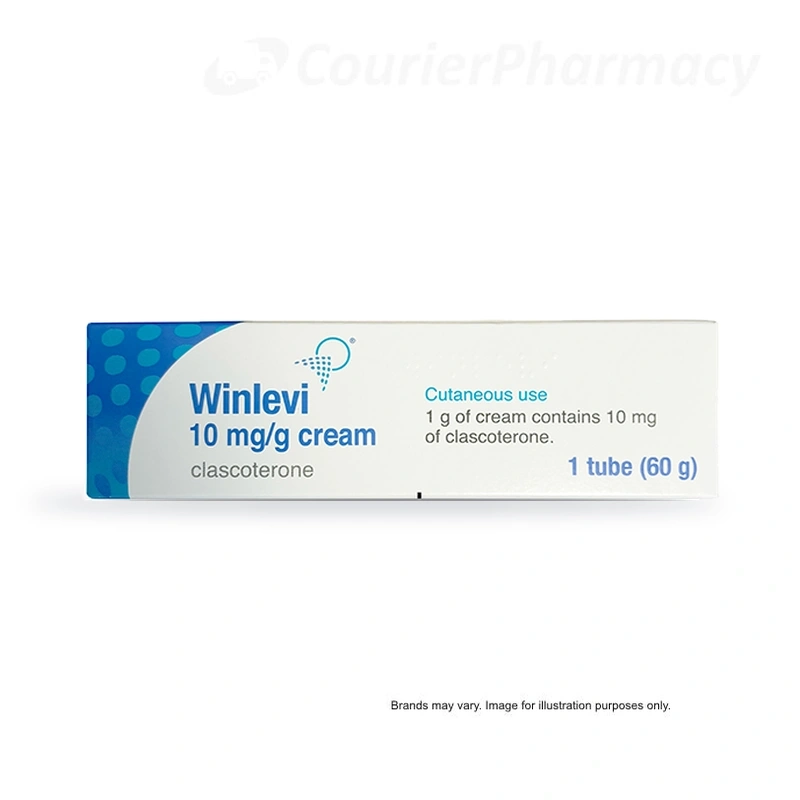
Winlevi 1% Cream
The first genuinely new topical acne treatment to reach the UK market in nearly 40 years. The one that finally goes after the hormonal driver of acne directly at the skin level, without affecting hormones systemically. The one that’s interesting precisely because it works through a different mechanism from everything that came before.
Maybe you’ve tried topical retinoids and they’ve irritated your skin. Maybe you’ve been on clindamycin/benzoyl peroxide for 12 weeks and need a maintenance option that isn’t another antibiotic. Maybe you’ve avoided spironolactone or hormonal treatments because you don’t want systemic effects. Maybe you have adult acne with a clear hormonal pattern and want something that targets that specifically without affecting the rest of your body.
Winlevi is clascoterone 1% cream, MHRA-approved in February 2025, applied twice daily, and represents a genuinely novel approach to topical acne treatment. At Courier Pharmacy we want to explain how it works, where it fits alongside established options, and what the current state of evidence supports.
Five key takeaways
- Winlevi is clascoterone 1% cream, applied twice daily, MHRA-approved in February 2025 for the treatment of acne vulgaris in patients aged 12 and older. Prescription-only medicine. Manufactured by Cosmo Pharmaceuticals and distributed in the UK by Glenmark Pharmaceuticals. The first commercially available topical androgen receptor inhibitor — a first-in-class mechanism in topical acne treatment for nearly 40 years.
- The novel mechanism. Clascoterone competes with androgens (testosterone and DHT) for binding to androgen receptors in sebaceous glands. Lower androgen activity at the gland reduces sebum production. Because the effect is local at the skin and clascoterone is rapidly broken down in the body, there are no systemic anti-androgen effects — making it safe for both men and women without affecting hormones elsewhere in the body.
- Trial evidence and realistic expectations. Two phase 3 trials in over 1,400 patients showed clascoterone produced significantly better acne improvement than placebo cream over 12 weeks. Visible improvement typically begins at 4 to 6 weeks; full benefit assessed at 12 weeks. Treats both inflammatory and non-inflammatory acne lesions. Generally well tolerated, with mild skin irritation as the most common side effect.
- Where it fits in the wider acne picture. Useful as an alternative or addition for people who haven’t tolerated retinoids, who’ve completed antibiotic courses and need non-antibiotic maintenance, or who have adult acne with a hormonal pattern but don’t want oral systemic treatment. Can be combined with other topical treatments under prescriber guidance. Not a first-line cheaper option for new mild acne — that’s still benzoyl peroxide or a topical retinoid.
- Limitations to know about. It’s new — long-term real-world data and head-to-head comparisons with established treatments are still emerging. Cost is higher than established alternatives at the moment. Not a replacement for proven treatments where those are appropriate; it’s an additional option for situations where established treatments aren’t suitable.
Treatment dosage Winlevi 1% Cream
Standard application:
- Apply twice daily — morning and evening
- Use on clean, dry skin
- Apply a thin layer covering the whole affected area
- Use a small amount — a fingertip unit is enough for the whole face
- Continue for at least 12 weeks to assess full response
- Longer-term use is acceptable as long as benefit continues and the prescriber agrees
Application technique:
- Cleanse with a gentle non-medicated cleanser
- Pat the skin dry — wait a few minutes if very damp
- Squeeze a small amount onto your fingertip (about the size of a pea for the whole face)
- Apply a thin even layer across the affected area
- Massage gently until absorbed
- Allow to absorb before applying makeup, sunscreen, or other products
- Wash hands afterward
- Repeat in the evening
Frequency:
- Twice daily — morning and evening
- Don’t reduce frequency to once daily unless directed (twice daily is the licensed dosing)
- Don’t increase to three times daily — doesn’t speed effect, increases irritation risk
Practical tips:
- Build into a fixed routine: morning cleanse ? Winlevi ? moisturiser ? sun cream ? makeup; evening cleanse ? Winlevi ? moisturiser
- Sun cream essential daily — broad spectrum SPF 30 or above
- Compatible with most non-medicated moisturisers and makeup
- Apply before sun cream and makeup; allow each layer to settle
- Pillowcases: white preferred, as some staining is possible from any topical residue
When to expect what:
- Weeks 1 to 2: skin adjusting; sometimes mild redness or dryness
- Weeks 2 to 4: subtle reduction in new lesions
- Weeks 4 to 6: visible improvement in existing inflammatory lesions
- Weeks 6 to 12: continued progressive improvement
- Beyond 12 weeks: maintenance or further improvement based on response
Combining with other treatments:
- Topical retinoid at different time of day: yes, under guidance — can be helpful for mixed acne pictures
- Benzoyl peroxide at different time of day: yes, can be combined
- Clindamycin/benzoyl peroxide combination: typically used sequentially rather than simultaneously
- Oral antibiotics: can be combined under prescriber direction
- Hormonal treatments (combined oral contraceptive, spironolactone) in women: can be combined; the local effect of clascoterone complements the systemic effect
- Isotretinoin (oral): not typically combined; either/or in most situations
Don’t use Winlevi if:
- You’re allergic to clascoterone or any excipient
- You’re pregnant or trying to conceive (limited data; avoid)
- You’re breastfeeding (limited data; avoid)
- You’re under 12 years old
- Your skin is broken, significantly inflamed (severe eczema, dermatitis), or infected in the area
Use with care if:
- You have sensitive skin (start once daily for the first week, build to twice daily)
- You have eczema or rosacea in the area
- You’re using other potentially irritating topical products
- You’re using other prescription acne treatments — discuss with prescriber
When to stop and seek medical advice:
- Severe irritation that doesn’t settle with reduced frequency
- Allergic-type reaction (widespread redness, swelling, blistering)
- Significant worsening of acne after 6 to 8 weeks
- Any unexpected systemic symptoms (very rare; report to prescriber)
Overview of Winlevi 1% Cream
Three things worth knowing:
- The novel mechanism matters but isn’t a silver bullet. Clascoterone is genuinely new in topical acne treatment, and the local anti-androgen effect at the sebaceous gland is interesting. But the magnitude of effect in trials was similar to established topicals, not dramatically better. What it offers is a useful additional mechanism for people who haven’t tolerated or responded to established treatments, particularly women with hormonal-pattern acne who want a local rather than systemic approach. It’s an addition to the toolkit, not a replacement for proven options.
- The cost reality. Winlevi is currently significantly more expensive than established alternatives like generic benzoyl peroxide, adapalene, or clindamycin/BPO combinations. For new mild acne in adolescents where established treatments would work, the cost-benefit weighs against starting here. For situations where established treatments haven’t worked or aren’t suitable, the higher cost is more justifiable. The price will likely come down over time as generic clascoterone becomes available in coming years.
- Long-term data is still emerging. Trials covered 12 weeks; real-world long-term effectiveness, safety, and comparison with established treatments are still being established. This isn’t a reason to avoid it — the trial data are sound, and 18 months of UK post-marketing experience is reassuring — but it’s a reason for measured enthusiasm rather than treating it as definitively superior to well-established options.
Why choose Courier Pharmacy for Winlevi
On the other hand, winlevi is new enough that proper guidance matters more than for established treatments. Every Winlevi supply at Courier Pharmacy involves a prescriber consultation that explains where it fits, what to expect, and how to use it well.
Therefore, we’ll discuss whether Winlevi is the right choice for your acne situation. Consequently, for some patients it’s an excellent option; for others, established treatments would work better at lower cost.
We’ll explain the mechanism honestly — what’s genuinely new about it and what the current evidence shows. However, the first-in-class story is interesting but the practical question is what works for your skin.
We’ll cover realistic expectations — the 4 to 6 week onset, the 12 week assessment point, the gradual nature of improvement.
What to know
We’ll discuss cost honestly. Moreover, winlevi is more expensive than established alternatives. In summary, for situations where established treatments haven’t worked, that’s justified. For new mild acne, established treatments at lower cost would usually be the sensible starting point.
Overall, we’ll discuss combination approaches where they make sense. Winlevi can be combined with benzoyl peroxide, retinoids, oral antibiotics, or hormonal treatments under guidance.
Notably, we’ll signpost to dermatology referral for severe acne, scarring, or situations where systemic treatment would be more appropriate.
Furthermore, our brand guide, Dr Ada Jex-Cori, sums it up: you’re not broken. The system that’s failed you might be. Specifically, we want to do the part we can do, properly, and connect you with the rest. That includes our free fortnightly drop-in clinics and talks at Insomnia in Derby.

Buy Winlevi from Courier Pharmacy
Meanwhile, winlevi is a prescription-only medicine supplied after a prescriber consultation.
Here’s how it works:
- Complete a consultation about your acne pattern, severity, and treatment history
- A prescriber reviews your information and discusses the options
- If Winlevi is suitable, a prescription is issued
- We dispense and deliver discreetly
- Follow-up at 12 weeks to assess response and plan continuation or change
In fact, if the situation isn’t suitable for Winlevi, we’ll explain why and discuss alternatives — including established treatments that may serve you better at lower cost.
Active Ingredients
Meanwhile, clascoterone 1% (10mg/g) in a cream base. Excipients include emollients, surfactants, preservatives, and water-based components typical for a cosmetic cream.
What clascoterone is:
- A topical androgen receptor inhibitor
- Structurally similar to spironolactone but designed for topical use
- First in its class to reach commercial use anywhere in the world
- FDA-approved in the US in 2020, MHRA-approved in the UK in February 2025
- The active is in-licensed by Glenmark from Cosmo Pharmaceuticals for European distribution
What it does mechanistically:
- Competes with androgens (testosterone, DHT) for binding to androgen receptors
- The binding is in the cells of the sebaceous gland
- Androgen receptor activation drives sebum production
- Inhibition of activation reduces sebum production
- Lower sebum means less follicle blockage and less environment for C. acnes
- The downstream effect is reduction in both inflammatory and non-inflammatory lesions
In fact, why it doesn't have systemic effects:
- Once absorbed into the bloodstream, clascoterone is rapidly broken down by esterase enzymes into an inactive metabolite (cortexolone)
- The active drug therefore exists primarily where applied, at the skin level
- Circulating levels are very low
- Hormone levels in the blood don't change measurably with topical use
- This is why it's safe for both men and women, unlike systemic anti-androgens
What it doesn't do:
- Doesn't act on bacteria (no antibacterial effect)
- Doesn't unblock existing comedones directly (less effective than retinoids for comedones)
- Doesn't suppress inflammation through immune mechanisms (no anti-inflammatory effect)
- Doesn't affect circulating hormones
- Doesn't fix existing scarring

What is it for?
Licensed for:
- Acne vulgaris in patients aged 12 and older
- Mild, moderate, and moderate-to-severe inflammatory and comedonal acne
- Both male and female patients
- Patients who haven't tolerated or fully responded to established topicals
Not for:
- Severe nodulocystic acne alone (still needs systemic treatment, though can be combined with oral isotretinoin in some cases)
- Acne rosacea (different condition)
- Hidradenitis suppurativa
- Folliculitis from other causes
- Hormonal disorders being treated for non-acne reasons
In particular, what types of acne respond best:
- Adult female acne with hormonal patterns (cyclical worsening, jaw and chin distribution)
- Mixed inflammatory and comedonal acne
- Patients with significant sebum production
- Patients who didn't tolerate retinoids
What types may respond less well:
In short, severe nodulocystic acne (needs systemic treatment)
Acne with significant inflammation needing rapid resolution (clindamycin/BPO works faster on inflammation specifically)

How to use it
Standard technique:
- Cleanse face morning and evening with a gentle, non-medicated cleanser
- Pat dry
- Squeeze a small amount of cream onto your fingertip (about a fingertip unit for whole face)
- Apply a thin even layer to affected areas
- Massage gently until absorbed
- Allow a few minutes before applying moisturiser, sun cream, or makeup
- Wash hands after application
- Repeat in the evening
Practical tips:
- Build into a fixed routine: this is a twice-daily product, so habit matters
- Apply before moisturiser and sun cream, not after
- Compatible with most cosmetics applied afterward
- Use a broad-spectrum SPF 30+ daily during treatment (sun exposure can affect skin tolerability)
- Be patient through the first 4 to 6 weeks
- Don't combine with other prescription topicals on the same area without prescriber direction
What progression looks like:
- Weeks 1 to 2: skin adjusting; some users notice mild dryness or redness
- Weeks 2 to 4: subtle reduction in new acne lesions
- Weeks 4 to 6: visible improvement in existing lesions
- Weeks 6 to 12: continued progressive improvement
- Maintenance phase: continue if benefit is being maintained and prescriber agrees
If treatment isn't producing the expected response by 12 weeks:
- Review with prescriber about adherence, technique, diagnosis
- Consider adding or switching to another topical
- Consider whether systemic treatment is needed
Combining with other treatments:
- Topical retinoid at different time of day: under guidance
- Benzoyl peroxide at different time of day: under guidance
- Oral antibiotic course (separate prescription): can be done together
- Oral hormonal treatment (combined oral contraceptive, spironolactone) in women: can be combined
- Isotretinoin: not typically combined

Warnings and Precautions
Don't use Winlevi if:
- You're allergic to clascoterone or any cream excipient
- You're pregnant or trying to conceive (limited data; avoid)
- You're breastfeeding (limited data; avoid)
- You're under 12 years old
- Your skin is significantly broken, infected, or eczematous in the application area
Use with care if:
- You have sensitive skin (start once daily and build to twice)
- You have eczema, rosacea, or seborrheic dermatitis in the area
- You're using other prescription topical treatments
- You're using harsh OTC actives (high-strength retinoids, exfoliating acids) — manage carefully
Pregnancy:
Limited data in pregnancy. Generally avoided. Stop before conception if planned. Similarly, discuss with prescriber if you become pregnant while using it.
Breastfeeding:
Limited data. Generally avoided. Indeed, don't apply to the chest area where contact with the baby is likely.
Children:
Licensed from age 12. Not used in younger children. Adolescent acne is one of the conditions where it's indicated.
Sun sensitivity:
As a result, less than with benzoyl peroxide or retinoids, but standard daily SPF use is appropriate during any acne treatment.
Drug interactions:
Minimal because of low systemic absorption. Generally, tell your prescriber about all medications including other topicals.

Side Effects
In addition, common (1 in 100 to 1 in 10):
- Mild local erythema (redness) at application site
- Itching
- Burning or stinging on application
- Dryness or scaling
- Application-site reactions in general
Uncommon (1 in 1,000 to 1 in 100):
- More marked irritation
- Contact dermatitis
- Acneiform reaction (paradoxical increase in spots — rare but reported)
- Mild folliculitis
Additionally, rare (less than 1 in 1,000):
- Allergic reactions
- Systemic effects (very rare given minimal absorption)
- Pigmentation changes
Notable absence:
- No significant systemic hormonal effects in trials
- No changes in serum hormones, libido, or sexual function in male users in trials
- No significant cardiovascular or metabolic effects
This favourable systemic side-effect profile is what makes clascoterone distinct from systemic anti-androgens like spironolactone.
For example, if you experience any side effect that worries you, you can report it via the MHRA's Yellow Card scheme.
Managing the common skin reactions:
- Reduce frequency to once daily for a week to allow adjustment
- Apply a gentle moisturiser after the cream absorbs
- Avoid other potentially irritating products during the first month
- Gradually build back to twice daily once tolerance is established
Drug Interactions
Importantly, minimal because of low systemic absorption. Practical considerations:
- Other prescription topicals on the same area: discuss with prescriber
- Other OTC topicals (retinoids, acids, exfoliants): apply at different times
- Oral medications: very rarely an issue
- Hormonal treatments (combined oral contraceptive, spironolactone in women): can be combined safely
- Oral isotretinoin: not typically combined (different treatment intensity level)
Tell your pharmacist and prescriber about all medications, both topical and oral, before starting.
Frequently Asked Questions

What's new about Winlevi?
It's the first topical androgen receptor inhibitor for acne — a genuinely new mechanism not previously available in topical form. In particular, it targets the hormonal driver of acne (androgen-driven sebum production) at the skin level, without affecting hormones systemically.
How long until I see results?
Visible improvement typically begins at 4 to 6 weeks. In short, full benefit assessed at 12 weeks. Similarly, the early weeks are about your skin adjusting and the underlying sebum production gradually reducing.
Will it work for hormonal acne?
This is one of the situations where it's most promising. Indeed, adult female acne with a clear hormonal pattern (cyclical worsening, jaw/chin distribution) often responds well. It offers the local anti-androgen approach without the systemic effects of oral spironolactone or hormonal contraceptives.
Can men use it?
Yes. As a result, unlike oral spironolactone (which has systemic anti-androgen effects and isn't used in men for acne), clascoterone has no systemic effects. Generally, men can use it for acne without concerns about libido, sexual function, or other anti-androgen effects.
Will it affect my hormones?
No. Once absorbed into the bloodstream, clascoterone is rapidly broken down. In addition, serum hormone levels don't change measurably in trials. Both men and women can use it without systemic hormonal effects.
How does it compare to Differin (adapalene)?
Different mechanism. Additionally, adapalene is a topical retinoid that unblocks follicles. Clascoterone reduces sebum production. For example, both effective; choice depends on the acne picture and tolerability. Adapalene is more irritating but better for comedonal acne. Clascoterone is generally better tolerated.
How does it compare to oral spironolactone in women?
Importantly, spironolactone works systemically — both ovarian and adrenal androgen production. Stronger overall effect on hormonal acne but with systemic considerations (blood pressure, potassium, contraception during use, no use in men). On the other hand, clascoterone is local-only, gentler, no monitoring needed.
Can I use it with benzoyl peroxide?
Yes, often combined. Therefore, apply at different times of day — for example, Winlevi morning and benzoyl peroxide evening, or vice versa.
Can I use it with adapalene?
Yes, often combined. Different times of day. The combination addresses both sebum (clascoterone) and follicle obstruction (adapalene).
Will it cause my acne to get worse first?
Sometimes mild initial worsening or skin adjustment in the first 1 to 2 weeks. Consequently, if acne is genuinely worse after 4 to 6 weeks, that's not a normal response and warrants prescriber review.
Is it safe long-term?
Trial data covers 12 weeks. Post-marketing experience since US approval in 2020 and UK approval in 2025 has been favourable. However, long-term real-world safety appears reassuring but is still being characterised.
Can I use it during pregnancy?
Generally not recommended. Limited data in pregnancy. Stop before conception if planned. Moreover, discuss with prescriber if you become pregnant.
Can I use it while breastfeeding?
Generally not recommended. Limited data. Don't apply to the chest area in any case.
How much does it cost?
In summary, more expensive than established alternatives like benzoyl peroxide, adapalene, or clindamycin/BPO at the moment. Generic clascoterone may emerge in coming years, reducing cost. Overall, currently a private prescription cost rather than NHS.
When is it the right choice?
Furthermore, when you haven't tolerated topical retinoids, when you've completed an antibiotic course and need non-antibiotic maintenance, when you have hormonal-pattern adult acne but don't want oral systemic treatment, or when established topicals haven't given enough benefit.
When should I look elsewhere?
For new mild acne in adolescents where benzoyl peroxide or a retinoid hasn't been tried. Specifically, for severe acne needing systemic treatment. Meanwhile, for comedonal acne where a retinoid would likely work better.
Does it work for chest and back acne?
In particular, trial data was primarily on facial acne, but the mechanism would be the same for body acne. In short, talk to your prescriber about off-licence use on chest or back if needed. The tube size may make this less practical economically than for face-only treatment.
What if it doesn't work?
Similarly, after a 12-week trial, if response is inadequate, the prescriber can review whether to add or switch treatments. Options include topical retinoid combinations, oral antibiotics, hormonal treatments (women), or specialist referral for isotretinoin in severe cases.
Is it suitable for sensitive skin?
Generally well tolerated. Indeed, start with once daily for the first week, build to twice daily as skin adjusts. As a result, gentler than topical retinoids in most cases. If significant irritation persists, alternative approaches may suit better.
Disclaimer: This information is for education only and isn’t a substitute for personal medical advice. Always follow your prescriber’s instructions.
References
[1] Electronic Medicines Compendium. Winlevi 10mg/g cream: Summary of Product Characteristics. Available at:
https://www.medicines.org.uk/emc/product/100519/pil#gref
[2] National Institute for Health and Care Excellence (NICE). (n.d.)
Acne vulgaris. NICE Clinical Knowledge Summaries. Available at:
https://cks.nice.org.uk/topics/acne-vulgaris/ (Accessed: 5 July 2026).
[3] NHS. (n.d.)
Acne. Available at:
https://www.nhs.uk/conditions/acne/ (Accessed: 5 July 2026).