Home » Treatment » Dutasteride 0.25 % Prostaquinon 4.5 % in TrichoSol
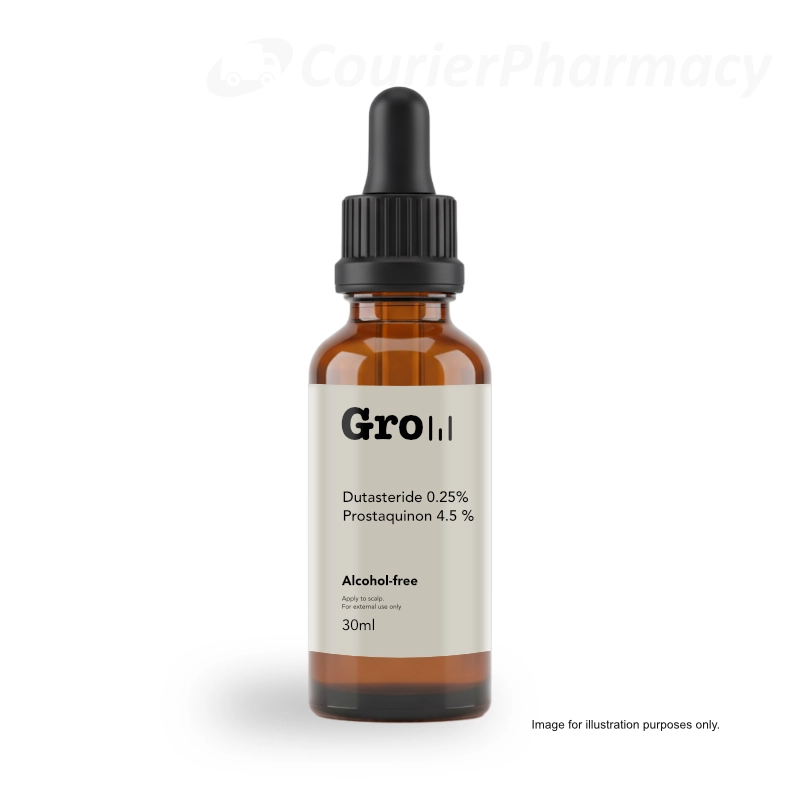
Dutasteride 0.25 % Prostaquinon 4.5 % in TrichoSol
from£29.99
A personalised topical hair loss solution containing Prostaquinon 4.5% (thymoquinone) and dutasteride 0.25% in a Trichosol base free from propylene glycol and alcohol. Designed for adults who need dual-pathway compounded hair loss treatment targeting both the hormonal (DHT) and inflammatory (PGD2) drivers. Applied using a dropper bottle at night and washed off in the morning.
Propylene glycol FREE
Alcohol FREE
Dual active ingredients targeting two biological pathways
Pack size: 100ml bottle, around three months supply
The Gro Dutasteride 0.25 % Prostaquinon 4.5 % in TrichoSol is a compounded topical hair loss preparation. APC Labs Ltd in Southampton compounds it. Each 100ml bottle contains Prostaquinon 4.5% and dutasteride 0.25% in a TrichoSol vehicle. Firstly, dutasteride is a dual 5-alpha reductase inhibitor. Additionally, Prostaquinon is a proprietary hair follicle support compound. As a result, the combination targets androgenetic hair loss through more than one pathway. The topical route reduces the risk of systemic side effects compared to oral dutasteride.
Why compounded matters
Off-the-shelf hair loss products come in fixed strengths. Meanwhile, no two scalps behave identically. Additionally, some people don’t respond to standard finasteride or minoxidil at all. However, a compounded formula lets your prescriber tailor the actives to your history. As a result, the strength, combination, and vehicle can match your case. Furthermore, compounding sits at the heart of the Gro range.
An unlicensed special
Notably, this formulation is an unlicensed special. Firstly, no fixed-strength Prostaquinon and dutasteride combination has a UK marketing authorisation. Additionally, unlicensed specials can be prescribed when a licensed alternative doesn’t meet clinical need. Meanwhile, the General Pharmaceutical Council regulates the compounding pharmacy. As a result, unlicensed does not mean unregulated. The MHRA covers the specials framework in detail.
Key features and specifications
Active ingredients: Prostaquinon 4.5% and dutasteride 0.25%
Gro Prostaquinon 4.5% + Dutasteride 0.25% in Trichosol 100ml
The problem with hair loss
Hair loss is easy to dismiss until it happens to you. Firstly, the visible signs are familiar: thinning at the crown, a wider parting, a hairline moving in the wrong direction. However, the less visible impact is often harder to carry. Confidence drops. Self-consciousness builds. Meanwhile, the worry that things are getting worse, and that nothing tried so far has made a real difference, becomes part of daily life.
The problem with standard treatments
For many people, the frustration goes beyond the hair loss itself. In particular, it’s about the experience of trying to treat it. Standard topical liquids sting on application. Additionally, the alcohol hits the scalp before the product has had a chance to absorb. Meanwhile, the propylene glycol leaves a tight, uncomfortable residue for hours afterwards. As a result, after a few weeks of that, skipping a night starts to feel like a reasonable decision. Above all, skipping nights is exactly what stops hair loss treatment from working.
Why a dual-pathway approach?
Pattern hair loss has more than one biological driver. Firstly, dihydrotestosterone (DHT) is the hormonal driver. Additionally, prostaglandin D2 (PGD2) is the inflammatory driver, elevated in the balding scalps of men with androgenetic alopecia. Meanwhile, dutasteride tackles the DHT pathway by blocking 5-alpha reductase. Furthermore, Prostaquinon tackles the PGD2 pathway by inhibiting its synthesis. As a result, the combination addresses both drivers simultaneously. Above all, this is a considered clinical approach for patients where a single pathway is not enough.
Why Trichosol?
The Trichosol base removes propylene glycol and alcohol from the equation entirely. Firstly, no stinging. Additionally, no tight, dry scalp after application. Meanwhile, no alcohol smell. As a result, just the active ingredients, delivered in a vehicle the scalp is far more likely to accept comfortably, night after night, for as long as treatment is needed.
Why 0.25% dutasteride and 4.5% Prostaquinon?
The dutasteride concentration in this formula is 0.25%. In particular, this is a considered high strength, above the standard mid-range compounded options. Meanwhile, Prostaquinon (thymoquinone from Nigella sativa) sits at 4.5%, a clinically meaningful dose for topical anti-inflammatory action at the scalp. Additionally, the prescriber selects these concentrations together when clinical assessment indicates that both stronger DHT blockade and PGD2 inhibition are needed. For some patients this reflects a poor response to lower-strength single-ingredient formulas. For others it reflects TrichoTest findings suggesting both a high anti-androgen requirement and a genetic profile that responds well to anti-inflammatory intervention. Above all, the concentrations are not defaults. They are clinical decisions made for you specifically.
A medically responsible route
At Courier Pharmacy, treatment starts with a proper assessment. Firstly, suitability is checked. Additionally, the decision to prescribe this compounded solution is a clinical one, based on your scalp, your history, and your goals.
Prescription-only compounded Trichosol solution for pattern hair loss
Propylene glycol free, alcohol free base for a gentler daily experience
Reviewed for suitability by a UK-qualified prescriber
Gro Prostaquinon 4.5% + Dutasteride 0.25% in Trichosol topical hair loss solution
This compounded topical hair loss solution contains Prostaquinon 4.5% and dutasteride 0.25% in a Trichosol base that is completely free from propylene glycol and alcohol. In particular, it is designed for adults with pattern hair loss who need a dual-pathway approach. Meanwhile, dutasteride addresses the hormonal driver by blocking DHT production. Additionally, Prostaquinon (thymoquinone) addresses the inflammatory driver by inhibiting PGD2, which is elevated in balding scalps and drives hair follicle miniaturisation. As a result, the formula tackles both the hormonal and inflammatory sides of pattern hair loss, in a base the scalp can actually tolerate.
Two active ingredients targeting the two main biological drivers of pattern hair loss
Propylene glycol free, alcohol free Trichosol base for a more comfortable daily experience
Dutasteride 0.25% (5-alpha reductase inhibitor) and Prostaquinon 4.5% (PGD2 inhibitor)
May suit people with androgenetic alopecia not responding to single-pathway formulas
Safe prescribing still matters: this formula needs proper screening, review, and follow-up
Part of the Gro hair loss range, designed for personalised treatment
Pattern hair loss is personal
Pattern hair loss is common, but that does not make it any less personal. Firstly, many people first notice extra shedding, reduced density, or a hairline that seems to be quietly moving backwards. Additionally, many then try a product that does not match their biology, see little result, and quietly give up. Meanwhile, this is not because treatment cannot work. As a result, it’s often because they were never on the right treatment to begin with.
A formula for people who need dual-pathway support
This Trichosol solution is aimed at people who want a considered, dual-pathway approach to hair loss, in a base their scalp can genuinely tolerate. In particular, it’s relevant for those whose prescriber has identified that both hormonal blockade (dutasteride) and PGD2 inhibition (Prostaquinon) are appropriate. Meanwhile, it also suits patients who have previously reacted to alcohol or propylene glycol-based products. As a result, it brings dual-pathway clinical action together with a gentler daily experience.
The goal of treatment
Hair loss affects more than appearance. Firstly, it chips away at confidence. Additionally, it makes ordinary moments feel oddly loaded, a harsh bathroom mirror, a photo taken from an unexpected angle, a windy day when you would rather not think about what is visible. Meanwhile, the goal of treatment is not perfection. As a result, it is to slow loss, support healthier growth, and help you feel more in control, with a plan that makes clinical sense and a base that makes daily use something you can actually stick to.
The Trichosol advantage
When the vehicle is the problem
For patients who have reacted badly to standard topical solutions, the problem is not always the active ingredients. In particular, it’s often the vehicle carrying them. Meanwhile, alcohol causes stinging on application and dries the scalp significantly over time. Additionally, propylene glycol is a common cause of contact irritation, particularly in patients with already sensitive or reactive scalps.
What Trichosol removes
The Trichosol base removes both of these excipients entirely. As a result, the solution absorbs without stinging, does not dry the scalp, and does not leave the tight or uncomfortable residue that causes so many people to abandon their routine. Meanwhile, the active ingredients are unchanged. Only the vehicle is different, and sometimes that difference is everything.
Why tolerability drives outcomes
A treatment only works if you use it consistently. Firstly, if the daily experience of applying it is uncomfortable, consistency breaks down. Additionally, the Trichosol base exists to remove that barrier. As a result, it makes it possible to maintain the kind of steady, sustained daily routine that hair loss treatment requires.
Why the Trichosol vehicle matters
The Trichosol base is clinically relevant as well as practically comfortable. In particular, it removes the excipients most likely to cause scalp irritation. Meanwhile, this makes it possible for patients to apply their treatment consistently. As a result, one of the most important factors in whether any hair loss treatment succeeds over time is protected.
Why compounding?
What compounding means
Compounding means a medicine is prepared to order by a licensed pharmacy for an individual patient. In particular, it is not a mass-produced one-size-fits-all product. Meanwhile, in the UK, this sits within a regulated framework and should only be supplied when clinically appropriate.
Why compounding matters for this formula
Some people choose a compounded solution because the concentration they need, such as 0.25% dutasteride combined with 4.5% Prostaquinon, does not exist in any standard licensed product. Additionally, others come to compounding specifically because standard topical bases have caused irritation and they need the active ingredients delivered in a gentler vehicle. Meanwhile, others need the clinical flexibility to combine two actives targeting different biological pathways at the strengths their profile indicates. As a result, compounding makes a formula like this one possible in the first place.
Personalised medicine in practice
Hair loss is not identical from one person to the next. Firstly, the right dutasteride concentration for one patient is not the right concentration for another. Additionally, whether Prostaquinon adds meaningful benefit depends on individual biology. Meanwhile, compounding makes it possible to prescribe dutasteride 0.25% alongside Prostaquinon 4.5% in a Trichosol base, a specific combination that does not exist in any standard licensed product. As a result, the medicine is shaped around the patient, not the other way around.
Why a dual-pathway formula can be the right choice
Not every patient responds to a single-pathway approach. In particular, for some, the hormonal driver (DHT) is only part of the picture. Meanwhile, elevated PGD2 also plays a significant role in follicle miniaturisation. Additionally, addressing both simultaneously with dutasteride and Prostaquinon may deliver better outcomes than either alone. As a result, dual-pathway treatment matches the biology of patients who need it.
TrichoTest: personalising the approach
TrichoTest reduces guesswork. In particular, it’s a pharmacogenetic test that analyses 26 genetic polymorphisms linked to nine key treatment pathways relevant to hair loss. Meanwhile, rather than prescribing from standard protocols alone, TrichoTest combines your genetic profile with your medical history. As a result, it predicts which ingredients, dosages, and delivery methods are most likely to work for your biology.
How the TrichoTest informs the dutasteride concentration
The 0.25% dutasteride concentration is one area where TrichoTest is particularly valuable. Firstly, some patients have genetic profiles that suggest a high anti-androgen requirement. Additionally, this means 0.25% is the most appropriate concentration for their biology. Meanwhile, TrichoTest can identify this before treatment begins. As a result, the prescriber can choose the right concentration from the outset rather than adjusting after months of treatment.
How the TrichoTest informs the Prostaquinon component
Prostaquinon sits within the anti-inflammatory pathway of the TrichoTest analysis. In particular, the test evaluates two variants of the GPR44 gene (also called CRTh2), which codes for the PGD2 receptor on hair follicles. Meanwhile, PGD2 binding at this receptor drives follicle miniaturisation. Additionally, patients with variants suggesting they will respond well to PGD2 inhibition are those most likely to benefit from Prostaquinon. As a result, the test helps the prescriber decide whether adding Prostaquinon to a treatment plan is likely to be genuinely useful for the individual.
The nine pathways TrichoTest analyses
Prostaglandins and sulphotransferase: how you process minoxidil and latanoprost
Anti-inflammatory response: your reaction to glucocorticoids and Prostaquinon
Anti-androgen metabolism: how effectively you respond to dutasteride, finasteride, and 17?-oestradiol
Circulation stimulation: response to vasodilators
Collagen synthesis capacity
Insulin-like Growth Factor (IGF-1) response
Vitamin absorption: A, B7, B9, B12, C, D, E
Mineral absorption: zinc, magnesium, iron, selenium
Antioxidant needs and oxidative stress profile
Beyond ingredient selection
TrichoTest also identifies nutritional gaps and metabolic factors that affect hair health independently of topical treatment. In particular, if genetic variants reduce zinc or iron absorption, the prescriber can recommend targeted supplementation alongside this Trichosol formula. As a result, treatment moves from guesswork towards something shaped by your actual biology. Meanwhile, TrichoTest does not guarantee results, but it gives the prescriber better information to decide whether this specific formula is right for you, or whether something different would serve you better.
The Gro hair loss range
What is the Gro brand?
Gro is the compounded hair loss range created by Courier Pharmacy and Medical Mojo. Firstly, it exists because hair loss treatment should not feel one-size-fits-all. Additionally, some people want a traditional liquid spray, direct, efficient, and familiar. Meanwhile, some prefer a foam. Others need an alcohol-free and propylene glycol-free base because their scalp reacts to standard excipients. As a result, Gro brings those options together under one brand, matching treatment to the person using it, not the other way around.
Why Gro is different
Gro was built around three practical goals. Firstly, choice of formulation: topical liquid, topical foam, or Trichosol solution (propylene glycol free and alcohol free). Additionally, personalisation: single, dual, and triple-ingredient combinations across multiple concentrations. Meanwhile, better tolerability: every format is designed to reduce the friction that stops people from maintaining their routine.
The three formulation types
Topical hair loss liquid: a traditional spray solution containing alcohol and propylene glycol. Well-established, with efficient scalp penetration. Chosen by patients who want a direct, familiar format.
Hair loss foam: lighter, faster-drying, and easier to apply without dripping. Chosen by patients who want clinical results in a format that fits more easily into daily life.
Trichosol topical solution: propylene glycol free and alcohol free. Designed for patients with sensitive or reactive scalps who need a gentler base. This is the formulation described on this page.
Ingredients used across the Gro range
Depending on the product selected, Gro formulations may include:
Dutasteride (various concentrations, including this higher 0.25% strength)
Finasteride (0.05%, 0.1%, or 0.2%)
Minoxidil 5%
Tretinoin 0.01%
Prostaquinon (thymoquinone from Nigella sativa, in this specific formula)
These can be prescribed alone or in combination, depending on the individual treatment plan.
Gro product options
The standard Gro range includes dutasteride-only, finasteride-only, minoxidil-only, and combination products (dutasteride + minoxidil, finasteride + minoxidil, minoxidil + tretinoin, and triple combinations) in liquid, foam, and Trichosol bases at 0.05%, 0.1%, or 0.2% concentrations. Meanwhile, standard Gro products come in 30ml bottles designed to last one month, priced at £29.99. Additionally, this Gro Prostaquinon and dutasteride formula sits alongside those options as a specialised dual-pathway preparation in a larger 100ml pack.
In simple terms
Gro makes personalised hair loss treatment accessible and liveable. Firstly, standard Gro products give you a 30ml bottle for one month at £29.99, less than £1 per day. Additionally, this specific Prostaquinon and dutasteride formulation is designed for patients who need the dual-pathway approach over a longer treatment window. As a result, whatever your scalp, your sensitivities, and your treatment history, the Gro range gives you more than one route without making the choice complicated.
Buy Gro Prostaquinon Dutasteride Trichosol (Prescription Only) from Courier Pharmacy
This is a Prescription Only Medicine. You can request it from courierpharmacy.co.uk. Firstly, complete a quick online consultation, reviewed by a UK-qualified prescriber for suitability and safety. Additionally, if appropriate, Courier Pharmacy will dispense the compounded Trichosol solution and deliver it discreetly.
Complete the online consultation
Prescriber reviews your answers for suitability and safety
Prescription issued if clinically appropriate
Dispensed and delivered discreetly to your door
If the treatment is not suitable, this will be explained clearly and the next best option may be suggested.
Summary
Prescription-only compounded dual-pathway treatment for pattern hair loss
Targets both DHT (hormonal driver) via dutasteride and PGD2 (inflammatory driver) via Prostaquinon
Propylene glycol free, alcohol free Trichosol base for better scalp tolerability
Dutasteride at 0.25% and Prostaquinon at 4.5%: considered concentrations chosen for the individual
May help patients who have not responded to single-pathway formulas
Good outcomes depend on consistency, review, and realistic expectations
Comes in a 100ml bottle designed to last around three months
Active ingredients in Gro Prostaquinon Dutasteride Trichosol
Dutasteride 0.25%
Dutasteride is a 5-alpha reductase inhibitor. In particular, it reduces the conversion of testosterone to dihydrotestosterone, or DHT, the key hormonal driver of androgenetic alopecia. Meanwhile, dutasteride blocks both Type 1 and Type 2 5-alpha reductase. As a result, it reduces scalp DHT more comprehensively than finasteride, which blocks Type 2 only. At 0.25%, this is a considered higher concentration, reflecting a clinical decision that stronger DHT blockade is appropriate for the individual.
Prostaquinon 4.5% (thymoquinone from Nigella sativa)
Prostaquinon is Fagron's trade name for thymoquinone, the principal active compound from Nigella sativa (black seed). Firstly, it works by inhibiting cyclooxygenase-2 (COX-2) and blocking the synthesis of prostaglandin D2 (PGD2). Additionally, PGD2 is elevated in the balding scalps of men with androgenetic alopecia. Meanwhile, PGD2 binds to the GPR44 receptor (also called CRTh2) on hair follicles and drives follicle miniaturisation. As a result, by reducing PGD2 levels at the scalp, Prostaquinon disrupts this inflammatory pathway that contributes to pattern hair loss. Furthermore, it also acts as a scalp anti-oxidant. Peer-reviewed studies have shown improvement in hair density with topical Nigella sativa preparations.
Why the Trichosol vehicle matters
The Trichosol base is clinically relevant as well as practically comfortable. Firstly, it removes the excipients most likely to cause scalp irritation. Additionally, this makes it possible for patients to apply their treatment comfortably and consistently. As a result, one of the most important factors in whether any hair loss treatment succeeds over time is protected.
What is Gro Prostaquinon Dutasteride Trichosol used for?
Pattern hair loss in men and women
This product treats pattern hair loss, also called androgenetic alopecia. In particular, in men this often appears as a receding hairline or thinning at the crown. In women, it may present as diffuse thinning or a widening parting. Meanwhile, addressing both the DHT and PGD2 pathways at once makes this formula suited to patients whose biology suggests single-pathway treatment may not be enough. As a result, the aim is to slow loss and support healthier growth where clinically appropriate.
The problems of hair loss
The practical problem is visible thinning. Meanwhile, the internal problem is the loss of confidence that builds quietly alongside it. Additionally, the deeper issue is that people should not have to feel dismissed or left to navigate treatment alone for something that so clearly affects daily life.
Who this formula is for
Some patients come to this formula because their clinical profile indicates that stronger DHT blockade is needed. Additionally, they may have tried lower-strength dutasteride or finasteride without holding results. Meanwhile, others arrive because their TrichoTest results suggest both a high anti-androgen requirement and a GPR44 variant that would respond well to PGD2 inhibition. In all cases, a compounded dual-pathway Trichosol solution offers a more considered, personalised path than anything available off the shelf.
How does Gro Prostaquinon Dutasteride Trichosol work?
The two biological drivers of pattern hair loss
Androgenetic alopecia is not just about one thing. In particular, research has shown two significant drivers. Firstly, dihydrotestosterone (DHT) is the well-established hormonal driver, shrinking follicles over time in genetically susceptible people. Additionally, prostaglandin D2 (PGD2) is a more recently recognised inflammatory driver, present at significantly elevated levels in balding scalps. Meanwhile, these two drivers act through completely different pathways. As a result, blocking only one can leave the other unaddressed.
Dutasteride blocks the hormonal driver
Dutasteride blocks both Type 1 and Type 2 5-alpha reductase enzymes. Firstly, this reduces conversion of testosterone into DHT. Additionally, DHT is the hormone responsible for shrinking follicles in pattern hair loss. Meanwhile, blocking DHT gives follicles the chance to recover. Above all, at 0.25%, this is a considered high compounded concentration for stronger action.
Prostaquinon blocks the inflammatory driver
Prostaquinon (thymoquinone) inhibits COX-2 and reduces PGD2 synthesis. In particular, PGD2 is significantly elevated in balding scalps. Meanwhile, PGD2 binds to the GPR44 receptor on hair follicles. Additionally, this binding drives follicle miniaturisation and blocks the maturation of stem cells into new hair. As a result, by lowering scalp PGD2 levels, Prostaquinon disrupts a key inflammatory pathway of pattern hair loss.
Two mechanisms, one delivery
Both actives are delivered together in the same Trichosol base. Firstly, this simplifies daily use to a single application. Additionally, the Trichosol vehicle carries both compounds without alcohol or propylene glycol interference. Meanwhile, this means the scalp gets both actives at the right time without the friction of standard bases. As a result, consistency becomes easier to maintain.
How long until you see results
Hair loss treatments take time. Firstly, reduced shedding may appear within 3 months. Additionally, visible density change usually takes 6 to 12 months. Meanwhile, some patients continue to see improvement into a second year of consistent use. As a result, sticking with daily application over the full timescale matters. Above all, stopping treatment usually leads to gradual loss of any gains.
This formulation is a topical solution and should only be used exactly as prescribed. The usual direction is:
Apply 1ml at night to the scalp using the dropper bottle and wash off in the morning.
A dose you can place precisely
The dropper bottle gives you direct control over where the solution goes. Firstly, you direct it to the areas of thinning, not across the entire scalp. Additionally, no spray drift. Meanwhile, no product landing where it is not needed. In a Trichosol base, the solution sits comfortably without the sting of alcohol or the heaviness of propylene glycol.
The right concentrations for you
Because this is a compounded medicine, the prescriber selects these concentrations based on your individual clinical profile. In particular, at 0.25% dutasteride and 4.5% Prostaquinon, this formula uses a considered dual-pathway combination. Meanwhile, it may be the right approach for patients whose profile indicates a high anti-androgen requirement combined with responsiveness to PGD2 inhibition.
Building a routine that works
Many people find it easiest to apply as part of their evening routine, after a shower, before bed. Additionally, the Trichosol base makes the application experience far more comfortable than a standard alcohol or propylene glycol-based product. Meanwhile, applied consistently at the same time each night and washed off in the morning, treatment has the best possible conditions to work.
What to do if you miss a dose
Resume at the next usual time. Meanwhile, do not apply extra to make up for it. Additionally, consistent daily use over months matters far more than compensating for a missed night.
Warnings and precautions for Gro Prostaquinon Dutasteride Trichosol
Caution for women of childbearing potential
Above all, dutasteride is teratogenic. In particular, it can cause serious harm to a male foetus. As a result, women of childbearing potential must not use this solution unless they are taking adequate long term contraception. . Additionally, they must not handle the bottle or a treated scalp. Furthermore, this warning applies even to broken or cracked skin contact.
Handling precautions for pregnant partners
Similarly, pregnant partners of male users must avoid contact with the treated scalp. Meanwhile, allow full drying before any skin-to-skin contact. Additionally, wash your hands thoroughly after every application. Above all, consider sleeping arrangements or timing to keep partners safe. Notably, transfer risk is highest in the hours after application.
Dutasteride warnings
Dutasteride affects hormone pathways. Firstly, men with a history of prostate cancer, BPH, or elevated PSA levels need careful assessment before starting. Additionally, dutasteride lowers PSA levels, which may mask early prostate cancer. Meanwhile, baseline PSA screening may be required. Furthermore, men with a family history of prostate cancer should discuss this with the prescriber.
Off-label status disclosure
Notably, this is an off-label use of dutasteride. Firstly, no fixed-strength topical dutasteride product carries a UK licence for hair loss. Additionally, the evidence base is smaller than for licensed products. As a result, your prescriber will explain the reasoning, evidence, and alternatives. Meanwhile, off-label prescribing is legal and appropriate when clinically justified. Furthermore, Prostaquinon (thymoquinone) is also used here without a UK marketing authorisation, on the same specials framework.
Post-finasteride syndrome
Post-finasteride syndrome (PFS) is a rare but recognised concern linked to 5-alpha reductase inhibitors, including dutasteride. In particular, it refers to persistent sexual dysfunction, mood changes, or other symptoms that may continue after stopping the medication. Meanwhile, topical dutasteride at 0.25% carries lower systemic exposure than oral forms, but the prescriber will discuss this risk during consultation. Above all, any previous adverse effects from finasteride or related compounds must be disclosed.
Nigella sativa allergy
Meanwhile, allergy to Nigella sativa (black seed) is rare but documented. In particular, patients with a history of dermatitis from herbal preparations should mention this during consultation. As a result, patch testing may be considered before starting. Additionally, discontinue if a rash or itch develops after application.
Compounded does not mean casual
The Trichosol base and personalised concentrations do not reduce the need for proper prescribing review. Firstly, the same thorough safety and suitability checks apply here as with any other prescription treatment. Additionally, a full medical history, including cardiovascular status, prostate health, previous medication reactions, allergies, and mood or sexual function concerns, will be reviewed during consultation.
Side effects of Gro Prostaquinon Dutasteride Trichosol
Common side effects
Common side effects may include scalp irritation, dryness, redness, itching, flaking, or temporary shedding early in treatment. Meanwhile, the Trichosol base reduces the likelihood of alcohol and propylene glycol-related dryness and stinging, but it does not eliminate the possibility of local reactions entirely. Additionally, early shedding can be unsettling, but it occurs as follicles shift through the hair cycle in response to treatment and usually settles with time.
Dutasteride-related effects
Dutasteride at 0.25% topical strength may cause sexual dysfunction in some patients. In particular, this includes reduced libido, erectile dysfunction, or ejaculation disorders. Meanwhile, these effects are less common with topical application than with oral use but have been reported. Additionally, mood changes, depression, or anxiety have been documented with 5-alpha reductase inhibitors, though causality remains debated.
Prostaquinon-related effects
Meanwhile, topical thymoquinone is generally well-tolerated in reported studies. However, contact dermatitis from Nigella sativa is possible in sensitive individuals. Additionally, patch testing may help identify this before treatment starts. As a result, stop use and contact the prescriber if a persistent rash develops.
When to seek advice
Seek advice if you develop marked irritation, swelling, chest symptoms, dizziness, palpitations, signs of allergy, severe mood changes, or persistent sexual dysfunction. Additionally, report mood changes or any other concerning symptoms promptly. Above all, your prescriber can help you weigh the risks and benefits based on how you're doing on treatment.
Yellow Card reporting
You can report any suspected side effects directly via the MHRA Yellow Card Scheme at https://yellowcard.mhra.gov.uk. Reporting side effects helps provide more information on the safety of this medicine.
Drug interactions with Gro Prostaquinon Dutasteride Trichosol
Why interactions still matter with topical treatment
Even in a compounded topical formula, dutasteride carries interaction considerations. Meanwhile, thorough review before starting remains important.
Dutasteride interactions
Dutasteride may interact with CYP3A4 inhibitors and inducers. In particular, strong CYP3A4 inhibitors such as ketoconazole or ritonavir may increase dutasteride levels. Additionally, enzyme inducers may reduce them. Meanwhile, topical absorption is lower than oral dutasteride, but relevant medicines will be reviewed.
Prostaquinon interactions
Meanwhile, thymoquinone has been studied mainly in oral supplements. Additionally, it may modestly affect blood pressure and blood sugar in some patients. However, topical application at 4.5% delivers much lower systemic exposure than oral use. As a result, disclose all current medicines, particularly those for blood pressure or diabetes, during consultation.
Other scalp products
Other scalp treatments, harsh exfoliants, or irritating cosmetic products may increase the risk of local reactions. Additionally, concurrent use of multiple topical hair loss agents is not usually recommended without prescriber guidance. As a result, all current products should be disclosed during consultation.
Previous finasteride reactions
If you have a history of post-finasteride syndrome or adverse effects from finasteride, disclose this before starting. Firstly, dutasteride is a related compound. Meanwhile, the prescriber will factor this into the clinical assessment.
Gro Prostaquinon Dutasteride Trichosol: FAQs
What is Prostaquinon?
Prostaquinon is the trade name for thymoquinone, the principal active compound in Nigella sativa (black seed) oil. In particular, Fagron produces it for use in compounded hair loss formulas. Meanwhile, its role in this formula is to inhibit the inflammatory driver of pattern hair loss.
How does Prostaquinon help with hair loss?
Prostaquinon works by inhibiting COX-2 and reducing prostaglandin D2 (PGD2) at the scalp. Firstly, PGD2 is significantly elevated in balding scalps. Additionally, it binds to the GPR44 receptor on hair follicles and drives follicle miniaturisation. As a result, lowering PGD2 levels helps disrupt this inflammatory pathway of pattern hair loss.
How long does it take to see results?
Hair loss treatment needs patience. Meanwhile, most people need several months of regular use before they can judge whether a treatment is helping. Additionally, reduced shedding may appear within 3 months, but visible density change usually takes 6 to 12 months.
Is this suitable for both men and women?
It may suit some adults, but the prescriber will assess this carefully. In particular, hormonal considerations and pregnancy risk are especially important. Meanwhile, women who are pregnant or may become pregnant must not use this product. Additionally, women past menopause may sometimes be considered but only after detailed prescriber assessment.
Why is this a dual-active formula?
Pattern hair loss has two main biological drivers: the hormonal pathway (DHT) and the inflammatory pathway (PGD2). Additionally, dutasteride blocks the first while Prostaquinon blocks the second. As a result, the combination addresses both drivers simultaneously, which single-pathway treatments cannot do.
Why is the dutasteride concentration 0.25%?
0.25% is a considered higher compounded dutasteride concentration. Meanwhile, the prescriber selects it when clinical assessment indicates that stronger DHT blockade is the most appropriate approach, whether because lower-strength options haven't held or because TrichoTest results indicate a high anti-androgen requirement. In particular, it is not a default. It is the right option for the right patient.
Why is this formula in Trichosol?
Trichosol removes propylene glycol and alcohol from the base entirely. Firstly, for patients who have experienced irritation, stinging, or dryness with standard topical solutions, it can make daily treatment significantly more comfortable. Additionally, comfort is what drives the consistency that good outcomes depend on.
What is compounding and why does it matter?
Compounding is the preparation of a medicine to order for an individual patient by a licensed pharmacy. In particular, it allows the ingredients, concentrations, and base to be tailored specifically to the person being treated. Meanwhile, this specific combination and concentrations do not exist in any standard licensed product.
Can I add or change ingredients later?
Yes. One of the advantages of compounded treatment is that the formula can evolve over time. Additionally, if clinical assessment or TrichoTest results indicate that adjustments would be beneficial, the prescriber can change the formula. Meanwhile, discuss this during your consultation or at review.
Can I use it if standard hair loss products have irritated my scalp?
Quite possibly. In particular, the absence of propylene glycol and alcohol removes two of the most common causes of scalp irritation in standard topical solutions. Meanwhile, suitability still needs to be assessed by a prescriber. Additionally, for patients with reactive scalps this formulation is often a more comfortable and sustainable option.
How can TrichoTest help with this treatment?
TrichoTest analyses genetic variants across nine hair loss pathways. In particular, it tests two variants of the GPR44 gene, which codes for the PGD2 receptor that Prostaquinon works on. Meanwhile, it also tests anti-androgen response variants relevant to dutasteride. As a result, TrichoTest can help the prescriber decide whether this specific dual-pathway formula is likely to work well for you.
Does TrichoTest guarantee the right treatment?
No. It reduces guesswork and supports more informed prescribing, but it does not guarantee results. Meanwhile, genetic testing works best alongside clinical assessment and your personal treatment history.
Will I need a prescription?
Yes. This is a Prescription Only Medicine. Additionally, a UK-qualified prescriber must review suitability before supply. The consultation can be completed online at courierpharmacy.co.uk.
Can I stop if I see improvement?
Do not stop or change treatment without advice. Meanwhile, hair loss often returns to its previous pattern if treatment stops, even when results have been encouraging.
Is Prostaquinon evidence-based for hair loss?
There is a growing evidence base. In particular, a 2013 University of Rome pilot study found that a topical Nigella sativa lotion produced hair density improvement in 90% of telogen effluvium patients over 3 months, compared with 30% on placebo. Additionally, laboratory research confirms that PGD2 is elevated in balding scalps and that its receptor drives follicle miniaturisation. Meanwhile, larger randomised trials in androgenetic alopecia would strengthen the picture further.
Is Prostaquinon safe?
Topical thymoquinone appears well-tolerated in published studies. Meanwhile, allergic contact dermatitis from Nigella sativa is possible in sensitive individuals but uncommon. Additionally, systemic effects from topical use at 4.5% are unlikely, but disclose all conditions and medicines during consultation.
Can I use other hair loss products at the same time?
Concurrent use of multiple topical hair loss agents is not usually recommended without prescriber guidance. Meanwhile, disclose all current treatments during consultation. Additionally, this includes over-the-counter minoxidil or any other scalp preparations.
What if I have had problems with finasteride before?
Disclose this during consultation. In particular, dutasteride is a related compound and the prescriber needs this information to assess suitability safely. Meanwhile, the topical route carries lower systemic exposure than oral 5-alpha reductase inhibitors, but risk is still not zero.
Will this affect my PSA?
Oral dutasteride can lower PSA readings by about 50%. Meanwhile, topical use has a smaller effect but is not zero. Additionally, at the 0.25% concentration this matters more than at lower strengths. As a result, tell any prescriber about topical dutasteride if you're due a PSA test.
Disclaimer
Disclaimer: This information is for education only and isn't a substitute for personal medical advice. Always follow your prescriber's instructions.
Garza LA, Liu Y, Yang Z et al (2012) Prostaglandin D2 inhibits hair growth and is elevated in bald scalp of men with androgenetic alopecia. Science Translational Medicine, 4(126), 126ra34. Available at: https://pubmed.ncbi.nlm.nih.gov/22440736/
Rossi A, Priolo L, Iorio A et al (2013) Evaluation of a therapeutic alternative for telogen effluvium: a pilot study. Journal of Cosmetics, Dermatological Sciences and Applications, 3(3A), pp. 9-16.
Zhou Z, Song S, Gao Z, Wu J, Ma J, Cui Y (2019) The efficacy and safety of dutasteride compared with finasteride in treating men with androgenetic alopecia: a systematic review and meta-analysis. Clinical Interventions in Aging, 14, pp. 399-406. Available at: https://pubmed.ncbi.nlm.nih.gov/30863034/
Download patient leaflet
Dutasteride 0.25 % Prostaquinon 4.5 % in TrichoSol