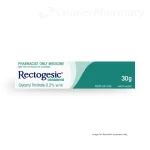
A topical glyceryl trinitrate ointment used to relieve the pain of chronic anal fissure by relaxing the internal anal sphincter.
Rectogesic 4mg/g rectal ointment is prescribed at Courier Pharmacy after a brief online consultation reviewed by a UK clinician, then dispensed and delivered discreetly to your door.
Rectogesic 4mg/g rectal ointment contains glyceryl trinitrate (GTN) 0.4%. Doctors use it in adults to relieve pain linked to a chronic anal fissure. Each gram of ointment contains 4mg GTN. It’s the same active ingredient used in some heart medicines, but here it works as a topical treatment for local action.
Rectogesic comes in a 30g tube. One tube usually provides around 60 doses, which is about a month if you use it twice daily. So, it fits neatly into a short treatment course.
What Rectogesic is used for
A chronic anal fissure is a small tear in the lining of the anal canal that hasn’t healed after about 6 weeks. The fissure often persists because the internal anal sphincter goes into spasm. This spasm reduces blood flow and keeps the tear from healing.
Rectogesic targets that spasm. As a result, it can reduce pain during and after bowel movements and support healing over time.
How Rectogesic works
Rectogesic absorbs locally into the anal sphincter muscle. The GTN then converts to nitric oxide, which relaxes smooth muscle. In other words, it helps the sphincter relax, improves blood flow, and gives the fissure a better chance to heal.
Many people prefer to try Rectogesic before more invasive options such as botulinum toxin injections or surgery. That said, your prescriber will guide you based on how severe your symptoms are and how long they’ve lasted.
Important safety checks (headaches and interactions)
Rectogesic commonly causes headaches, especially at the start. This happens because GTN can widen blood vessels. Knowing this upfront helps, because it makes the side effect less alarming and can improve your chances of sticking with treatment.
Rectogesic also has a serious interaction with PDE?5 inhibitors (medicines often used for erectile dysfunction). You must not use them together, because the combination can cause a dangerous drop in blood pressure. For that reason, your prescriber will check your medicines carefully before issuing Rectogesic.
How we supply Rectogesic at Courier Pharmacy
At Courier Pharmacy, a UK?registered prescriber reviews every Rectogesic request before we dispense it. We check your symptoms, your current medicines, and any safety risks. So, you get a proper clinical screen, not a rushed “yes/no”.
Key features and specifications
Active ingredient: Glyceryl trinitrate (GTN) 4mg per gram (0.4%)
Form: Smooth white to off?white ointment
Pack size: 30g aluminium tube
Class: Topical nitrate (smooth muscle relaxant)
Prescription status: Prescription Only Medicine (POM)
Typical use: About 375mg of ointment (2.5cm / 1 inch from the tube) applied to the anal canal every 12 hours, for up to 8 weeks (as directed)
Storage: Store below 25°C; do not refrigerate; keep the tube tightly capped
Additional information
Quantity
1 x 30g, 2 x 30g, 3 x 30g
MOJO WISDOM
Take control of your health by understanding your condition and what this medication is doing for you.
READ:
More information about this treatment.
UK-based doctors and pharmacists
Discreet and Confidential
UK-based doctors and pharmacists
Free, Expert Advice
No video link provided.
No video link provided.
UK-based doctors and pharmacists
Free, expert advice
Discrete and confidential
Fast delivery
Giving you trusted clinical advice for over 40 conditions
A UK regulated pharmacy providing safe, effective treatments online since 2014
A sharp, tearing pain every time you go to the toilet. Anxiety building before each bowel movement. Bleeding you’ve put off mentioning because the topic feels awkward. Chronic anal fissures are common, treatable, and far more frequent than most people realise. Rectogesic 4mg/g rectal ointment is one of the licensed prescription treatments designed specifically to help fissures heal by relaxing the anal sphincter muscle, and at Courier Pharmacy we want you to understand exactly how it works, who it suits, how to apply it correctly, and the safety considerations that matter, so the choice feels properly yours.
Five key takeaways
Rectogesic 4mg/g rectal ointment contains glyceryl trinitrate (GTN) 0.4%, the same active ingredient used for decades in heart medicines but here in a localised topical form for chronic anal fissures.
It works by relaxing the internal anal sphincter, which reduces the muscle spasm that prevents fissures from healing and improves blood flow to the area.
The standard adult dose is around 375mg of ointment (roughly 2.5cm or 1 inch from the tube) applied to the anal canal every 12 hours, used for up to 8 weeks.
The most common side effect is headache, sometimes severe, especially in the first week. This is a recognised effect of the GTN being absorbed into the bloodstream, not a sign of overdose.
It is strictly contraindicated alongside PDE-5 inhibitors (sildenafil, tadalafil, vardenafil), guanylate cyclase stimulators (riociguat), and in certain heart conditions, because of the risk of dangerous drops in blood pressure.
Treatment dosage Rectogesic 4mg/g rectal ointment
The standard adult dose is approximately 375mg of ointment (a strip about 2.5cm or 1 inch long, squeezed from the tube) applied to the anal canal every 12 hours. The application should continue until the pain settles or for a maximum of 8 weeks, whichever comes first.
Application technique matters. Wash your hands thoroughly. Cover your finger with a disposable finger cot, latex glove, or cling film (this protects you from accidental skin absorption on the fingers, which can cause headache and is a recognised side effect for healthcare workers). Squeeze the recommended amount of ointment onto the covered fingertip. Insert the finger gently into the anal canal to about the first knuckle, and apply the ointment in a circular motion around the inside of the anal canal. Don’t push the ointment deeper than the first knuckle; the fissure is in the lower part of the anal canal, and this is where the medicine needs to be.
Wash your hands thoroughly afterwards, even though the finger cot or glove should have prevented direct contact. GTN can be absorbed through the skin of the fingers, which is why this protective step matters.
Apply twice daily, ideally 12 hours apart. Many people find applying after a morning shower and before bed works well as a routine. Bowel movements don’t usually need to interrupt the schedule, though some people prefer to apply after a bowel movement rather than before.
Don’t apply more than the recommended amount or more frequently than every 12 hours. Higher doses don’t improve healing rates and significantly increase the risk of severe headache, dizziness, and low blood pressure.
If you miss a dose, apply the next dose at the usual time. Don’t double up.
Treatment duration is up to 8 weeks. If your fissure hasn’t healed by 8 weeks, Rectogesic should be stopped and you should be reviewed for alternative treatments (botulinum toxin injection, lateral internal sphincterotomy). Continuing beyond 8 weeks isn’t usually beneficial and exposes you to ongoing side effects unnecessarily.
Overview of Rectogesic 4mg/g rectal ointment
Five things worth knowing:
The active ingredient (glyceryl trinitrate) is the same molecule used in heart medicines, here applied topically for a localised effect on the anal sphincter rather than systemically on coronary arteries.
Healing rates with Rectogesic in clinical trials are around 50 to 60% over 8 weeks, compared to about 30 to 40% with placebo, so it works for many but not all patients.
The most common side effect is headache, sometimes severe, which is why the dose is small and twice-daily rather than continuous.
It is strictly contraindicated with PDE-5 inhibitors (sildenafil, tadalafil, vardenafil) and guanylate cyclase stimulators (riociguat), because of life-threatening hypotension risk.
NICE recognises topical GTN as a first-line medical treatment for chronic anal fissure, alongside diltiazem cream (an unlicensed but commonly compounded alternative) and the conservative measures of high-fibre diet and stool softeners.
Rectogesic sits in a small group of medical treatments for chronic anal fissure. The conservative approach (high-fibre diet, increased fluids, stool softeners like lactulose or macrogol, sitz baths, careful anal hygiene, topical lidocaine for pain) succeeds in many acute fissures. Where fissures don’t heal in 6 weeks, they’re classified as chronic, and the focus shifts to addressing the underlying sphincter spasm. Topical GTN (Rectogesic) and topical diltiazem cream are the main pharmacological options. Botulinum toxin injection and lateral internal sphincterotomy are surgical options reserved for cases that don’t respond to medical treatment.
For people living with chronic anal fissures alongside other complex conditions, fibromyalgia, ME/chronic fatigue, MCAS, autoimmune issues, the experience of an unhealed fissure can compound everything else. The pain disrupts sleep, the bleeding causes anxiety, the topic feels too embarrassing to bring up, and the underlying constipation that often contributes is itself a feature of many complex conditions. Rectogesic addresses one specific piece of this picture (the sphincter spasm), but it works best alongside attention to bowel habit and dietary changes that prevent recurrence.
The headache deserves its own thought. Up to 60% of people using Rectogesic experience headache, particularly in the first week. The mechanism is straightforward: some GTN is absorbed into the bloodstream, where it dilates blood vessels including those around the brain, causing a vascular-type headache similar to what some people experience with the heart medicine forms of GTN. The headache often settles after the first few days as the body adapts (tolerance develops). Paracetamol can help manage the headache. Some people find it severe enough to stop the medicine; for others, it’s tolerable knowing it’s expected and temporary.
The interaction with PDE-5 inhibitors (sildenafil/Viagra, tadalafil/Cialis, vardenafil/Levitra) is genuinely dangerous and worth understanding properly. Both classes of medicines lower blood pressure through nitric oxide pathways. Combining them can produce profound hypotension, fainting, heart attack, or death. Anyone using PDE-5 inhibitors for erectile dysfunction or pulmonary hypertension cannot use Rectogesic, and vice versa. If both treatments are needed clinically, alternatives have to be found.
Why choose Courier Pharmacy for Rectogesic 4mg/g rectal ointment
Anal fissures are one of those conditions where embarrassment can delay treatment for weeks or months. We get it. The whole point of an online pharmacy consultation is that you don’t have to describe the problem in person, repeatedly, to different people. Every Rectogesic prescription at Courier Pharmacy is reviewed by a UK-registered prescriber who reads your answers properly, asks the right follow-up questions, and explains the decision either way.
We’ll flag the PDE-5 inhibitor contraindication clearly and ask about any use of erectile dysfunction medicines. We’ll talk through the headache side effect so you’re prepared rather than caught out. We’ll discuss the conservative measures (bowel habit, fibre, stool softeners) that work alongside Rectogesic to give the fissure its best chance of healing. If your fissure has atypical features or your symptoms suggest something other than a simple fissure, we’ll recommend a face-to-face review with a colorectal specialist rather than dispensing online.
Our brand guide, Dr Ada Jex-Cori, sums it up: you’re not broken. The system that’s failed you might be. We want to do the part we can do, properly, and connect you with the rest. That includes our free fortnightly drop-in clinics and talks at Insomnia in Derby, where you can ask questions face-to-face without spending a penny.
Buy Rectogesic 4mg/g rectal ointment (Prescription Only) from Courier Pharmacy
Rectogesic 4mg/g rectal ointment is a Prescription Only Medicine (POM) in the UK, which means it cannot be sold over the counter. Buying through Courier Pharmacy is straightforward and built around your time, not ours.
Here’s how it works:
Complete a quick online consultation
A UK prescriber reviews your answers
If approved, a prescription is issued
We dispense and deliver discreetly to your door
If it isn’t suitable for you, we’ll explain why and suggest the next best option.
Active ingredient in Rectogesic 4mg/g rectal ointment
The active ingredient is glyceryl trinitrate (GTN), also known as nitroglycerin. It’s one of the oldest medicines in continuous use, first introduced for angina in the 1870s and used in various forms ever since. The molecule itself is the same active ingredient used in heart medicines (sublingual sprays, transdermal patches, modified-release tablets), but the formulation in Rectogesic delivers it topically for a localised effect on smooth muscle in the anal canal.
Each gram of Rectogesic ointment contains 4mg of GTN (0.4% concentration). The ointment base contains lanolin, propylene glycol, sorbitan sesquioleate, white soft paraffin, lactose, ethanol, and purified water. Lactose content matters for people with severe lactose intolerance, although the amount is small. Lanolin can occasionally cause contact sensitivity reactions in susceptible individuals.
After application, GTN is absorbed locally into the anal sphincter muscle, where it’s metabolised to nitric oxide. Nitric oxide activates the enzyme guanylate cyclase, raising cyclic GMP levels in smooth muscle cells. This causes the muscle to relax, reducing the spasm that prevents fissures from healing. A portion of the applied GTN is also absorbed into the bloodstream, which is why headache and low blood pressure can occur as side effects. Systemic exposure after a single application is modest but enough to cause symptoms in some patients.
GTN is rapidly metabolised in the liver and red blood cells, with a very short systemic half-life of around 2 minutes. The local effect on the sphincter persists for several hours after application, which is why twice-daily dosing maintains adequate sphincter relaxation throughout the day.
What is Rectogesic 4mg/g rectal ointment for?
Rectogesic is licensed in the UK for one specific indication: the symptomatic relief of pain associated with chronic anal fissure. It is not licensed for haemorrhoids (piles), other anorectal conditions, or general anal pain without a confirmed fissure diagnosis.
Anal fissures are tears in the skin of the anal canal, typically caused by passage of hard stools but sometimes by other forms of trauma. Acute fissures usually heal within 6 weeks with conservative measures (high-fibre diet, stool softeners, sitz baths, topical anaesthetics, careful anal hygiene). When fissures persist beyond 6 weeks, they’re classified as chronic, and the underlying problem is usually internal anal sphincter spasm and reduced blood flow to the area. Without addressing these, the fissure can’t heal properly.
The classic features of chronic anal fissure are: sharp, tearing pain during bowel movements, often persisting for hours afterwards; bright red blood on the toilet paper or coating the stool; a learned fear of bowel movements, which can paradoxically worsen constipation; and on examination, a posterior midline tear with classical features including a sentinel pile and hypertrophied anal papilla.
Rectogesic targets the sphincter spasm component. By relaxing the internal anal sphincter chemically (rather than surgically), the medicine improves blood flow to the area and removes the mechanical block that prevents healing. This usually allows the fissure to heal naturally, alongside continued attention to bowel habit and dietary measures.
It is important that an anal fissure diagnosis is confirmed before starting Rectogesic. Other conditions that cause anal pain (haemorrhoids, abscesses, perianal Crohn’s disease, malignancies) need different treatments. Conditions like inflammatory bowel disease, HIV, tuberculosis, syphilis, or anal carcinoma can cause atypical fissures that may need investigation rather than topical GTN. Most simple fissures can be diagnosed clinically, but if your fissure has atypical features (off the midline, multiple, irregular shape) or doesn’t fit the typical pattern, your prescriber may want a colorectal review before starting.
How does Rectogesic 4mg/g rectal ointment work?
To understand how Rectogesic works, it helps to know what’s happening in a chronic anal fissure. The anal canal is surrounded by two sphincter muscles: the external anal sphincter (under voluntary control) and the internal anal sphincter (involuntary, normally tonically contracted to maintain continence). In chronic anal fissures, the internal sphincter is in a state of pathological hyperspasm: it’s contracting more than it should, with increased resting pressure. This high pressure has two effects: it physically holds the fissure edges apart preventing healing, and it reduces blood flow through the small arteries that supply the lining of the anal canal, denying the wound the oxygen and nutrients it needs to heal.
Rectogesic works by chemically relaxing this hyperspasmic sphincter. The active ingredient glyceryl trinitrate is converted in smooth muscle cells to nitric oxide, the same signalling molecule the body uses naturally to relax blood vessels and smooth muscles. Nitric oxide activates the enzyme guanylate cyclase, raising levels of cyclic GMP inside the muscle cells. Cyclic GMP triggers a cascade that reduces calcium availability in the muscle and relaxes the sphincter fibres.
The sphincter relaxes, resting pressure drops, the fissure edges come together, and blood flow to the area improves. The fissure can then heal in the way it would have done naturally for an acute fissure, given the conditions are right.
Local effect of Rectogesic on the sphincter is reasonably specific because the ointment is applied directly where it’s needed. However, some GTN is absorbed into the bloodstream, where it relaxes smooth muscle in blood vessels throughout the body. This is what causes the headache (dilation of brain blood vessels) and the occasional dizziness or low blood pressure (general vasodilation). These systemic effects are predictable and dose-related; they don’t mean the medicine is failing, just that some of it is reaching the rest of the body.
The medicine starts working within minutes of application, with measurable reductions in resting anal pressure. Pain relief during and after bowel movements typically improves within a few days. Healing of the fissure itself takes longer, usually 4 to 8 weeks of regular twice-daily application alongside attention to bowel habit.
Approximately 50 to 60% of patients with chronic anal fissure heal during an 8-week course of Rectogesic in clinical trials. This compares to around 30 to 40% with placebo (some fissures resolve regardless of treatment), so the treatment effect is real but not universal. For people who don’t heal with Rectogesic, the next steps are usually botulinum toxin injection or lateral internal sphincterotomy.
How to use Rectogesic ointment
Always use Rectogesic exactly as your prescriber advises, and follow the instructions in the patient leaflet. Rectogesic is applied inside the anus (back passage) to help relieve pain caused by an anal fissure.
Before you start, wash your hands. If possible, gently clean and dry the area. Many people find it easiest to apply the ointment after a bowel movement, because it can be more comfortable and helps the medicine stay in place.
Using a finger covering (such as a disposable glove or finger cot), squeeze out a small measured amount of ointment and apply it just inside the anus. Only insert your finger up to the first joint. Try to spread the ointment around the inside edge rather than pushing it further in. Wash your hands afterwards, even if you used a glove.
Rectogesic can cause headaches, dizziness, or light?headedness, especially when you first start using it. For that reason, stand up slowly after applying it and avoid driving or operating machinery if you feel affected. If you accidentally use too much, or you feel faint, stop using it and seek medical advice.
If your symptoms do not improve, or if you get worsening pain, bleeding, fever, or you feel unwell, contact a clinician for review.
Warnings and precautions for Rectogesic 4mg/g rectal ointment
Rectogesic is contraindicated in: known hypersensitivity to glyceryl trinitrate, other organic nitrates, or any excipient; concurrent use of PDE-5 inhibitors (sildenafil, tadalafil, vardenafil, avanafil); concurrent use of soluble guanylate cyclase stimulators (riociguat); severe hypotension (systolic blood pressure below 90 mmHg); hypovolaemia (dehydration, blood loss); severe cerebrovascular insufficiency; raised intracranial pressure due to cerebral haemorrhage or head trauma; hypertrophic obstructive cardiomyopathy; constrictive pericarditis; cardiac tamponade; severe anaemia; angle-closure glaucoma; and concurrent use of ergot derivatives.
The PDE-5 inhibitor contraindication is particularly important to flag because both Rectogesic and PDE-5 inhibitors are commonly used. PDE-5 inhibitors (sildenafil/Viagra/Revatio, tadalafil/Cialis/Adcirca, vardenafil/Levitra, avanafil/Stendra/Spedra) are used for erectile dysfunction and pulmonary hypertension. Both classes lower blood pressure through nitric oxide pathways. Combining them can cause life-threatening hypotension, leading to fainting, heart attack, stroke, or death. Anyone using PDE-5 inhibitors regularly cannot use Rectogesic. Anyone using Rectogesic must not take PDE-5 inhibitors during treatment and should wait at least 24 hours after the last Rectogesic application before taking sildenafil or vardenafil, and at least 48 hours before taking tadalafil.
Caution is advised in: recent myocardial infarction, congestive heart failure, low blood pressure, severe liver impairment, severe kidney impairment, and migraine (where the headache can be particularly severe). Older patients are more susceptible to the dizziness and hypotension effects.
Pregnancy and breastfeeding: Rectogesic should be used in pregnancy only if the benefits clearly outweigh the risks, and discussed with a clinician. Glyceryl trinitrate crosses the placenta. Breastfeeding women should also use Rectogesic with caution; GTN does pass into breast milk in small amounts. Many clinicians prefer to delay treatment until after the breastfeeding period for elective cases.
Children and adolescents: Rectogesic is not recommended for use in children under 18.
Alcohol can enhance the hypotensive effects of GTN. Heavy or regular drinking is best avoided during treatment. Even moderate alcohol can cause dizziness in some patients on Rectogesic.
If you experience persistent severe headache, dizziness, fainting, palpitations, or any signs of severe hypotension, stop using Rectogesic and seek medical advice. Don’t suddenly stop using Rectogesic without thinking through whether the dose can be tapered if you’ve been using it for several weeks; gradual reduction over a few days can be smoother for some patients.
Side effects of Rectogesic 4mg/g rectal ointment
The side effect profile of Rectogesic is dominated by the vasodilator effects of GTN. Most are predictable and often manageable.
Very common side effects, affecting more than 1 in 10 people, include headache. This is reported by up to 60% of patients in clinical trials, particularly in the first week of treatment. The headache is usually mild to moderate, throbbing in character, and frontotemporal in location. It often settles after the first week as tolerance develops. Paracetamol helps for symptomatic management.
Common side effects, between 1 in 100 and 1 in 10 people, include dizziness, light-headedness on standing, postural hypotension, application-site reactions (burning, itching, redness around the anal area), and rectal bleeding (which can be either from the fissure itself or from the irritation of application).
Uncommon side effects, between 1 in 1,000 and 1 in 100 people, include nausea, anal discomfort, anorectal haemorrhage, fainting, and tachycardia (raised heart rate, often reflex to the blood pressure drop).
Rare side effects, fewer than 1 in 1,000 people, include hypersensitivity reactions (rash, itching, swelling), severe hypotension, syncope (fainting), bradycardia (slow heart rate, sometimes reflex), allergic contact dermatitis around the application site, and rebound effects on stopping after prolonged use.
Very rare and serious side effects include severe allergic reactions including anaphylaxis (swelling of lips, mouth, throat, difficulty breathing). Anaphylaxis is a medical emergency; call 999.
Tolerance to the systemic effects (especially headache) typically develops over the first 1 to 2 weeks of use, which is why many people find the medicine more tolerable as they continue. Tolerance to the local sphincter relaxation effect can also develop, particularly with continuous higher-dose use, which is one of the reasons treatment is limited to 8 weeks.
If you experience any side effect that worries you, you can report it directly to the MHRA’s Yellow Card scheme. This helps improve safety data for everyone who uses the medicine. Our pharmacy team are happy to help you submit a Yellow Card report if you’d like assistance.
Drug interactions (Rectogesic ointment)
Rectogesic contains glyceryl trinitrate (GTN), a nitrate medicine that relaxes blood vessels. This helps blood flow in the anal area and can reduce fissure pain. However, it can also lower blood pressure, especially when you first start treatment. Because of that, Rectogesic can interact with other medicines that affect blood pressure or blood vessels.
Do not use Rectogesic with PDE5 inhibitors (ED medicines)
Do not use Rectogesic if you take medicines for erectile dysfunction, including:
sildenafil (Viagra)
tadalafil (Cialis)
vardenafil (Levitra)
avanafil (Spedra)
Taking these with GTN can cause a sudden, severe drop in blood pressure, which may lead to fainting, collapse, or serious complications. If you have taken an ED medicine recently, tell your prescriber before starting Rectogesic.
Other nitrates and “GTN” products
Avoid using Rectogesic alongside other nitrate medicines unless your prescriber has specifically advised it. This includes treatments for angina such as:
GTN sprays or tablets
isosorbide mononitrate or isosorbide dinitrate
Using nitrates together increases the risk of headache, flushing, dizziness, and low blood pressure.
Blood pressure medicines (antihypertensives)
Rectogesic can add to the blood pressure?lowering effect of medicines used for high blood pressure or heart conditions, such as:
ACE inhibitors (e.g., ramipril) and ARBs (e.g., losartan)
This doesn’t always mean you can’t use Rectogesic, but it does mean you should take extra care with dizziness and standing up quickly, especially at the start.
Alpha?blockers (often for prostate symptoms)
Medicines such as tamsulosin, alfuzosin, doxazosin, and terazosin can also lower blood pressure. When combined with Rectogesic, they can increase the chance of postural hypotension (feeling dizzy or faint when standing).
Medicines that can increase dizziness or fainting
Rectogesic may make light?headedness more likely if you also take:
some antidepressants and antipsychotics (your prescriber can check your specific medicine)
opioid painkillers
sedating antihistamines
other medicines that commonly cause dizziness
Alcohol
Alcohol can increase the blood pressure?lowering effects of GTN. This may make headache, flushing, and dizziness worse while using Rectogesic.
What to do if you feel unwell
If you develop severe dizziness, fainting, chest pain, a racing heartbeat, or symptoms that worry you, stop using Rectogesic and seek urgent medical advice. If you are unsure whether your medicines are safe to take with Rectogesic, ask your prescriber or pharmacist before you start.
Frequently asked questions about Rectogesic 4mg/g rectal ointment
What is Rectogesic used for?
Rectogesic is licensed in the UK specifically for the symptomatic relief of pain associated with chronic anal fissures in adults. It is not licensed for haemorrhoids, other anorectal conditions, or general anal pain without a confirmed fissure diagnosis.
How does Rectogesic work?
The active ingredient glyceryl trinitrate is converted in the anal sphincter muscle to nitric oxide, which relaxes the muscle. This reduces the spasm that prevents fissures from healing and improves blood flow to the area, allowing the fissure to heal naturally.
How quickly will Rectogesic work?
Pain relief during bowel movements often improves within a few days. Healing of the fissure itself takes longer, usually 4 to 8 weeks of regular twice-daily application. Around 50 to 60% of patients heal during an 8-week course.
Why does Rectogesic give me a headache?
GTN dilates blood vessels throughout the body, including those around the brain, which causes a vascular-type headache. This is the most common side effect, affecting up to 60% of users, especially in the first week. The headache usually settles as your body adapts. Paracetamol can help.
Can I take Viagra or similar tablets while using Rectogesic?
No. PDE-5 inhibitors (sildenafil/Viagra, tadalafil/Cialis, vardenafil/Levitra, avanafil/Stendra) combined with Rectogesic can cause life-threatening drops in blood pressure. The combination is absolutely contraindicated. Wait at least 24 hours after the last Rectogesic application before sildenafil or vardenafil, or 48 hours before tadalafil.
How do I apply the ointment correctly?
Wash your hands. Cover your fingertip with a finger cot, glove, or cling film. Squeeze about 2.5cm of ointment onto the covered finger. Insert gently into the anal canal to the first knuckle and apply in a circular motion. Wash your hands afterwards. Apply twice daily, 12 hours apart.
Why do I need to cover my finger?
GTN can be absorbed through the skin of your fingers, which causes headache. The protective covering keeps the medicine where it’s needed (the anal canal) and protects you from unnecessary systemic exposure on your hands.
How long can I use Rectogesic for?
Up to 8 weeks. If the fissure has healed before then, you can stop. If it hasn’t healed by 8 weeks, the medicine should be stopped and alternative treatments (botulinum toxin injection, surgery) discussed with your prescriber or a colorectal specialist.
What if Rectogesic doesn’t heal my fissure?
About 40 to 50% of patients don’t fully heal during an 8-week course. The next steps usually involve botulinum toxin injection into the sphincter (which can give a longer relaxation effect) or lateral internal sphincterotomy (a small surgical procedure that cuts a portion of the internal sphincter). Both have higher healing rates than topical GTN but are more invasive.
Can I drink alcohol while using Rectogesic?
Moderate alcohol may be acceptable, but alcohol can enhance the dizziness and hypotension effects of GTN. Heavy or regular drinking is best avoided. If you do drink, do so well separated from application times.
Will Rectogesic make me dizzy?
Some people experience dizziness, particularly on standing, due to the blood-pressure-lowering effect of GTN. This is more common in the first few days of treatment. Move slowly when standing up, particularly after applications. If dizziness is significant, contact your prescriber.
Can I use Rectogesic during pregnancy?
Use during pregnancy should only happen after discussion with a clinician. GTN crosses the placenta. Conservative measures should be tried first where possible.
Is Rectogesic safe while breastfeeding?
GTN passes into breast milk in small amounts. Use during breastfeeding is generally avoided where possible; conservative measures are preferred. Discuss with your prescriber.
Can children use Rectogesic?
No. Rectogesic is not licensed for use in children under 18.
Does Rectogesic cure my fissure?
Rectogesic provides the conditions for healing by relaxing the sphincter and improving blood flow. The fissure itself heals naturally as a result. If you continue the lifestyle factors that contributed to the fissure (low fibre intake, dehydration, constipation, straining), the fissure can recur after treatment ends.
Can I use Rectogesic for haemorrhoids?
No. Rectogesic is licensed only for chronic anal fissures. Haemorrhoids need different treatment, typically including bulk-forming laxatives, topical preparations, or in some cases procedural treatments.
What if I have severe constipation as well?
Treating constipation alongside Rectogesic is essential. Stool softeners like lactulose, ispaghula husk, or macrogol can help. A high-fibre diet (gradually increased) and 2 litres of fluid daily are foundation measures. If constipation is part of a broader condition (IBS, low-FODMAP situations, complex IBD), additional approaches may be needed.
Can I get rebound effects when I stop?
After prolonged use, some people experience a transient return of symptoms when Rectogesic is stopped. If you’ve been using it for the full 8 weeks, tapering off over a few days can be smoother. Discuss with your prescriber if symptoms return persistently.
Can I use Rectogesic in combination with topical anaesthetics?
Topical lidocaine preparations are sometimes used for pain relief in fissures, and can be used alongside Rectogesic if needed. Apply at separate times rather than mixing them. Your prescriber can advise on the right combination.
Does Rectogesic stain clothing?
The ointment can occasionally leave residue on underwear or clothing. Using thin protective underwear during initial application periods can help. The active ingredient itself doesn’t stain.
Disclaimer: This article is for information only and isn’t a substitute for personal medical advice. Always speak to a qualified prescriber before starting or changing treatment.