Vaginal atrophy affects around half of postmenopausal women in the UK. After all, the falling estrogen levels that come with menopause don’t just affect mood, sleep, and hot flushes — they affect the vaginal tissues directly. So the lining becomes thinner, drier, less stretchy, and more prone to soreness.
As a result, sex becomes uncomfortable or painful. In addition, bladder symptoms become more common. Daily tasks like cycling, sitting for long periods, or wearing certain clothes can become uncomfortable.
Yet this condition is hugely underreported and undertreated. Specifically, surveys suggest only around 25-30% of women with vaginal atrophy ever discuss it with a healthcare professional. So embarrassment, lack of awareness that treatment exists, dismissive medical responses, and trouble getting GP appointments all contribute to leaving women without help.
However, Vagifem has been one of the well-established treatments for decades — and remains a popular option for women who prefer the prescriber route.
Where Vagifem fits in vaginal atrophy treatment
The UK approach to vaginal atrophy follows a stepped path:
Step 1: Non-hormonal vaginal moisturisers used regularly (YES VM, Replens, Hyalofemme, Sylk) — for everyday tissue hydration
Step 2: Lubricants for intimacy (YES WB, YES OB, Sylk) — for symptom relief during sex
Step 3: Lifestyle factors — such as avoiding harsh soaps, scented products, and perfumed laundry powders
Step 4: Low-dose vaginal estrogen — Vagifem, Gina, Vagirux (estradiol tablets), or Estriol Cream (estriol cream) — when moisturisers and lubricants aren’t enough
Step 6: Non-estrogen prescription option (Intrarosa prasterone) — for women who prefer to avoid estrogen
Step 7: Systemic HRT (patches, gels, tablets) — when full menopausal symptoms need addressing too
Step 8: Specialist menopause clinic referral — for complex cases or where standard treatment doesn’t fit
Vagifem sits at Step 4. So it’s a thoughtful next step when non-hormonal options haven’t been enough, or when symptoms specifically need the tissue-rebuilding effect of estrogen.
Vagifem vs Gina — the access decision
Same medicine, different routes. So this matters:
Vagifem: POM, needs prescriber consultation
Gina: P (pharmacy), needs pharmacist consultation only
Pharmacologically identical (estradiol 10mcg, same tablet, same maker)
Choice often comes down to cost route, continuity of care, and personal preference
NHS prescriptions can be free for those exempt from charges
Private prescription cost varies by service
Gina is available at a fixed retail price through pharmacies
In short, neither option is medically superior. However, the right choice depends on which route fits your situation better.
Estradiol (Vagifem) and estriol (cream) are different but related estrogens
Vagifem is generally cleaner (no cream residue) and easier to dose precisely
Estriol cream allows external vulval application as well, which some women prefer for vulval symptoms
Vagifem vs Estring (vaginal ring)
Different release approaches:
Vagifem: twice-weekly tablet inserted with applicator
Estring 7.5mcg/24hr: silicone ring that releases estradiol over 3 months
Both POM low-dose local estrogen
Estring needs less frequent attention (every 3 months)
Vagifem suits women who prefer not to leave a ring in place
Estring suits women who find regular insertion hard or awkward
Both have similar effectiveness for vaginal atrophy symptoms
Vagifem vs Intrarosa (prasterone, non-estrogen option)
For women who prefer to avoid estrogen:
Vagifem: estradiol-based, low dose, local
Intrarosa: prasterone (DHEA-based) that the body converts to local estrogen and androgen in vaginal tissue
Both POM local treatments
Intrarosa may suit women with a history that makes estrogen treatment less suitable
Vagifem has decades of clinical experience; Intrarosa is newer
Cost may favour Vagifem
Vagifem vs systemic HRT
Different problems, different treatments:
Vagifem: local vaginal treatment only — for vaginal symptoms
Systemic HRT (patches, gels, tablets): whole-body estrogen replacement — for hot flushes, sweats, mood, sleep
Systemic HRT also helps vaginal symptoms, although not always enough
Many women use both — for example, systemic HRT for whole-body symptoms plus Vagifem for any leftover vaginal symptoms
Vagifem doesn’t replace systemic HRT for women with hot flushes and other menopausal symptoms
Women with a womb on systemic HRT need progesterone too — although Vagifem alone usually doesn’t
Vagifem vs non-hormonal moisturisers (YES VM, Replens, Hyalofemme)
Different products for different needs:
Non-hormonal moisturisers (YES VM, Replens, Hyalofemme): no hormones, no consultation needed, add hydration to tissue
Vagifem: contains a tiny dose of estrogen, needs prescription, rebuilds tissue from within
So moisturisers add lubrication, while Vagifem rebuilds vaginal tissue
Moisturisers work for everyone; however, Vagifem has medical points to check (history, contraindications)
Moisturisers suit mild dryness or where hormones can’t be used
In contrast, Vagifem suits moderate to severe atrophy that hasn’t responded to moisturisers
Many women use both together — for example, moisturiser daily plus Vagifem twice weekly
So these aren’t competing products — they complement each other. After all, moisturisers handle surface lubrication while Vagifem handles the deeper tissue changes.
Who Vagifem suits well
This product may suit:
Postmenopausal women with vaginal atrophy symptoms
Women whose moisturisers and lubricants haven’t been enough
Women having painful sex linked to dryness
Women with frequent UTIs linked to vaginal tissue changes
Women already on systemic HRT who have any leftover vaginal symptoms
Women who specifically want to avoid systemic HRT but need vaginal treatment
Women who prefer the prescriber route over the pharmacy (P) route
Women already engaged with their GP about menopause
Women who can access NHS prescriptions cost-effectively
Women with medical complexities that benefit from prescriber review
Women who can manage the insertion technique using the applicator
Who might suit other options better
Other options may suit better for:
Women who haven’t yet completed menopause — needs medical assessment first
Women with unexplained vaginal bleeding — needs investigation first
Women with current or recent breast cancer (including hormone receptor-positive)
Women with current or recent womb cancer
Women with active liver disease
Women with current or recent venous thromboembolism
Women whose symptoms might point to other conditions (infections, skin problems, lichen sclerosus)
Women having hot flushes, night sweats, and wider menopausal symptoms — systemic HRT may suit better
Women with mild symptoms that respond to non-hormonal moisturisers (YES VM, Replens)
Women with significant medical complexity that needs specialist input
Women who prefer the non-prescription route — Gina (P) suits this preference
Courier Pharmacy supply
Vagifem 10mcg is a UK Prescription-Only Medicine (POM). So supply only happens after our UK-qualified prescriber reviews your situation through an online consultation. In short, if our prescriber decides another approach would suit better — non-hormonal moisturisers, Gina (P-medicine), systemic HRT, or specialist referral — we’ll explain that clearly.
Key features and specs
Active ingredient: estradiol hemihydrate equivalent to estradiol 10mcg per tablet
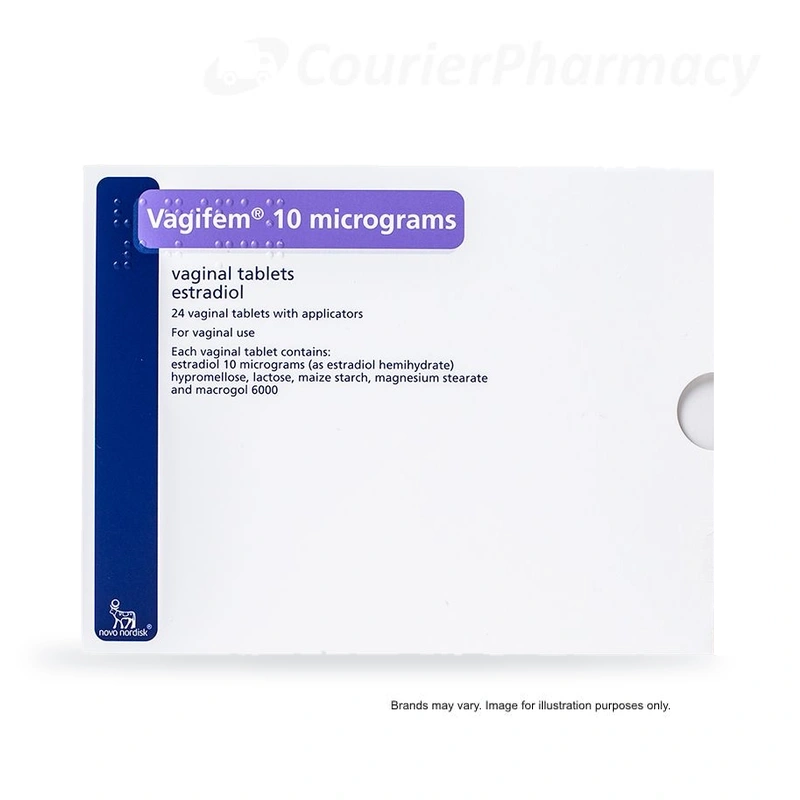
Vagifem 10mcg vaginal tablets treat vaginal atrophy — the dryness, soreness, itching, and painful sex many women experience after menopause. So the active is a tiny dose of estradiol (10 micrograms) inserted directly into the vagina with a pre-loaded applicator. As a result, the estrogen acts locally on vaginal tissue with very little reaching the bloodstream. Important: Vagifem is a UK Prescription-Only Medicine (POM) — supply needs a prescriber consultation. While Gina 10mcg (same product, same maker) is also available without prescription, many women still prefer the Vagifem route through their prescriber for various reasons. Made by Novo Nordisk.
At Courier Pharmacy, we believe in treatment that fits the person.
This page covers what Vagifem is, who it suits, how it compares to Gina and other options, and the practical points that matter.
Five key takeaways
Vagifem is a UK Prescription-Only Medicine (POM). So supply only happens after our UK-qualified prescriber reviews your situation through an online consultation
The active is estradiol 10 micrograms — a very small dose of the same estrogen the body made before menopause. After all, it works locally to restore vaginal tissue thickness, lubrication, and stretchiness, with very low absorption into the bloodstream
Licensed for postmenopausal women with vaginal atrophy due to estrogen lack. In short, it suits women whose symptoms haven’t settled with non-hormonal moisturisers alone
Dosing schedule: one tablet daily for the first 2 weeks (loading phase), then one tablet twice a week as maintenance. So the loading phase rebuilds tissue thickness, while the maintenance phase keeps it that way
Same medicine as Gina 10mcg (also made by Novo Nordisk, also estradiol 10mcg, same tablet). However, the difference is legal classification — Vagifem stays POM while Gina is the pharmacy version. Many women still choose Vagifem for NHS prescription routes, established GP relationships, or complex medical histories
Why choose Courier Pharmacy for Vagifem
At Courier Pharmacy, our approach starts with a simple idea: treatment should fit the person, not force the person to fit the system.
Dr Ada Jex-Cori
Our service is shaped by the philosophy of Dr Ada Jex-Cori, our brand pharmacist.
Dr Ada represents the spirit of the pharmacy: evidence-led, community-rooted, and willing to challenge the one-size-fits-all approach to medicine. She is named in honour of three pioneering women in science: Ada Lovelace, the mathematician and visionary; Sophia Jex-Blake, the first female doctor in the UK who fought the medical establishment; and Gerty Cori, the biochemist and Nobel Prize winner.
In our fictional world of Ethrewell, Dr Ada fights against pharma’s standardised approach to medicine. In the real world, she represents what we stand for. Her view is straightforward: you are not broken. The system is. And we are here to change that.
Women’s health deserves serious attention
Women’s symptoms — especially menopausal symptoms — have historically been dismissed, minimised, or pathologised. Courier Pharmacy is different. So we recognise that:
Vaginal atrophy affects up to half of postmenopausal women — yet most aren’t treated for it
Symptoms genuinely affect quality of life, relationships, work, exercise, and confidence
“It’s just part of getting older” isn’t an acceptable answer when effective treatment exists
Many women have been told dryness is normal or that nothing can be done — both untrue
Vagifem has been the established UK prescription option for decades — and remains a popular choice
After all, half of all postmenopausal women would benefit from treatment but only a fraction get it. So our prescriber takes these symptoms seriously, not as something to brush off.
Honest framing about Vagifem vs Gina
This is a unique situation worth being straight about:
Vagifem (POM) and Gina (P) are the same medicine — same active, same dose, same maker, same tablet
The only difference is the legal classification and route to access
Vagifem suits women who prefer the prescriber route, NHS prescription access, or established GP relationship
Gina suits women who prefer the non-prescription route via pharmacist consultation
In short, we won’t pretend one is better than the other when they’re the same medicine. After all, the choice is about access, not about effectiveness.
Honest framing about long-term use
Vaginal atrophy is chronic — and this matters for treatment expectations:
Unlike systemic HRT (which some women use for limited periods), vaginal estrogen typically needs to continue
Symptoms return within weeks or months of stopping
Most women on Vagifem continue for years, not weeks
This isn’t a sign of dependence — it’s how chronic conditions work
Annual prescriber review supports ongoing safe use
Treatment breaks can be tried, although symptoms guide whether to restart
In short, planning for long-term use is realistic. So our prescriber will be straight with you about what to expect.
Menopause and the bigger picture
Vaginal atrophy is one part of the menopause picture. So our pharmacist can discuss:
Whether systemic menopausal symptoms (hot flushes, sweats, mood, sleep) need addressing too
How vaginal estrogen fits alongside systemic HRT if you’re already on it
Non-hormonal options (YES VM, Replens, lifestyle) that can work alongside or instead
Bladder symptoms (urgency, frequency, frequent UTIs) linked to atrophy
Pelvic floor health and the role of physiotherapy
Sexual health and intimacy after menopause
Mast cell activation syndrome (MCAS) and hormonal interactions
Bone health and osteoporosis prevention
Sometimes the vaginal symptoms are part of a broader story worth talking through.
Pharmacist support before and after purchase
Our pharmacist is here to discuss:
Whether Vagifem is the right product for your symptoms
Whether Gina (the P-medicine version) might suit better given the access difference
The proper insertion technique
What to expect during the loading phase and maintenance
How to combine with non-hormonal moisturisers if helpful
When other options might suit better
This is free and on hand before and after purchase.
Trust earned, not claimed
We are GPhC-regulated, and our content is grounded in the BNF, NICE Clinical Knowledge Summary on menopause, British Menopause Society guidance, NHS guidance, and the real experience of women managing genitourinary syndrome of menopause.
If Vagifem isn’t the right answer for your situation, we’ll tell you honestly. After all, getting the right treatment matters more than fulfilling a request.
How to buy Vagifem from Courier Pharmacy
Vagifem 10mcg is a UK Prescription-Only Medicine (POM). So supply needs a prescription, which our prescriber issues after an online consultation.
How our service works
Add Vagifem to your basket and complete the online consultation
The consultation covers your menopausal status, symptoms, medical history, family history, and current medicines
Our UK-qualified prescriber reviews your answers to confirm whether Vagifem is suitable
If a different approach would suit better — Gina (P-medicine), non-hormonal moisturisers, systemic HRT, or specialist referral — we’ll get in touch
Once approved, your prescription is dispensed and sent out in plain, discreet packaging
Free pharmacist and prescriber support is on hand before and after your purchase
When other options might suit better
If Vagifem isn’t right, we’ll explain why. Other options may include:
Gina 10mcg (P-medicine): same product, pharmacy route, no prescription needed
YES VM Vaginal Moisturiser: non-hormonal, CE/UKCA medical device, no consultation needed for milder symptoms
Other non-hormonal moisturisers (Replens, Hyalofemme, Sylk)
Vaginal lubricants (YES WB, YES OB) for sex-specific dryness
Vagirux 10mcg (POM): applicator-free version of same active
Systemic HRT (patches, gels, tablets): for whole-body menopausal symptoms
GP referral for systemic HRT, complex cases, or specialist menopause input
Specialist menopause clinic referral: for treatment-resistant or complex cases
Our community service
Our free fortnightly drop-in clinics at Insomnia, Derby run every other week from 10am to 12pm.
Healthcare shouldn’t only happen when you’re paying for it. So we show up, even when it’s free.
We cover menopause, vaginal atrophy, perimenopause, HRT, MCAS, hair loss, digestive health, ADHD, autism support, dermatology, allergies, asthma, men’s and women’s health, weight management, and whatever else people bring through the door. No appointment needed, no charge, no pressure.
Active ingredient
Each Vagifem tablet contains:
Estradiol hemihydrate equivalent to estradiol 10 micrograms: the same estrogen the ovaries produced before menopause, at a very small dose
Why estradiol
Estradiol is the main estrogen in women of reproductive age. So it's the natural choice for replacing what's lost after menopause:
Identical to the body's own pre-menopausal estradiol
Acts on estrogen receptors in vaginal tissue
Rebuilds the multi-layered structure of the vaginal lining
Increases blood flow to the area
Supports natural lubrication
Helps restore the acidic vaginal pH that protects against infections
Encourages healthy lactobacillus bacteria to repopulate the vagina
In short, estradiol addresses the root cause of vaginal atrophy — falling estrogen levels — rather than just masking the symptoms.
Why 10 micrograms — the low-dose advantage
10mcg is a deliberately small dose. So it offers several specific benefits:
Effective for local vaginal symptoms
Very low absorption into the bloodstream — blood estradiol levels stay within the normal postmenopausal range
Lower theoretical risk than higher-dose vaginal estrogen products
Suitable for long-term use
Doesn't typically need extra progesterone for women with a womb
Decades of clinical experience and safety data
After all, vaginal atrophy is a local problem. So a local treatment at a low dose makes more sense than a higher systemic dose to fix a local issue.
Vagifem vs Gina — the same medicine, different access
This is the most important comparison, since Vagifem and Gina are pharmacologically identical:
Gina: P (Pharmacy medicine), needs pharmacist consultation only
So why choose Vagifem over Gina? Several reasons matter:
Available on NHS prescription — free for those exempt from prescription charges
Many women already see their GP about menopause and prefer one route
Women with complex medical history sometimes prefer prescriber review
Some prescribers and pharmacies still default to Vagifem out of habit
Women already on systemic HRT often get Vagifem added by their GP
Habit and brand familiarity for women who have been using Vagifem for years
In short, the medicine itself is the same. However, the route to obtain it differs. So picking which version to use comes down to preferences around access, cost, and continuity of care.
Other ingredients
Each tablet also contains:
Hypromellose (binder)
Lactose monohydrate
Maize starch
Magnesium stearate
Notably, Vagifem contains lactose. So women with severe lactose intolerance should mention this during consultation, although the amounts are very small.
What the tablets look like
Vagifem tablets have a specific appearance:
Small white, film-coated, biconvex tablets
6mm diameter (about the size of a small lentil)
Engraved with "NOVO 278" on one side
Pre-loaded into single-use applicators for easy insertion
Each applicator is sealed in foil packaging
Maker
Vagifem is made by Novo Nordisk Limited — a Danish pharmaceutical company founded in 1923 and now headquartered in Denmark. So Novo Nordisk has a long-established women's health portfolio, with Vagifem being one of the longest-established UK products for vaginal atrophy. The UK marketing authorisation reflects decades of clinical experience with this exact formulation.
What is Vagifem for?
Vagifem treats vaginal atrophy — also called genitourinary syndrome of menopause (GSM). So this is the group of symptoms that develops when estrogen levels fall after menopause: vaginal dryness, soreness, itching, burning, painful sex, and sometimes bladder symptoms too. The condition affects around half of postmenopausal women in the UK, although it's hugely underreported and undertreated. Vagifem addresses the deeper tissue changes rather than just masking symptoms.
Who is it for?
Vagifem may suit:
Postmenopausal women with vaginal atrophy symptoms
Women with vaginal dryness, soreness, burning, or itching
Women having painful sex (dyspareunia) from vaginal atrophy
Women whose symptoms haven't settled with non-hormonal vaginal moisturisers alone
Women having bladder symptoms (urgency, frequency, frequent UTIs) linked to vaginal atrophy
Women who want to address the deeper tissue changes, not just symptom relief
Women who prefer the prescriber route over the pharmacy (P) route
Women already engaging with their GP about menopause
Women who can access NHS prescriptions cost-effectively
What does it do?
Vagifem replaces the small amount of estrogen the vaginal tissues need to stay healthy. So after a few weeks of regular use, the vaginal lining becomes thicker, more stretchy, and better lubricated. In addition, blood flow improves. As a result, the natural acidic pH of the vagina returns, which supports healthy bacteria and reduces the risk of bladder infections. Symptoms like dryness, soreness, and painful sex gradually settle.
What it doesn't do
Vagifem isn't systemic HRT. So it doesn't treat menopausal hot flushes, night sweats, mood changes, or sleep problems — those need different treatment (usually systemic HRT with patches, gels, or tablets). In addition, Vagifem doesn't act as contraception, doesn't treat sexually transmitted infections, and doesn't replace cervical screening. Finally, while many women use Vagifem alongside non-hormonal moisturisers (like YES VM), Vagifem isn't a moisturiser itself — it rebuilds tissue, while moisturisers add lubrication.
How Vagifem works
Vagifem restores what menopause removes. So understanding how this works helps explain why it takes a few weeks to show full effect, and why ongoing use matters.
The estrogen story behind vaginal atrophy
Estrogen does many things for the vagina before menopause:
Maintains a thick, multi-layered vaginal lining
Promotes blood flow to the area
Supports natural lubrication
Encourages healthy lactobacillus bacteria
Maintains the acidic vaginal pH (around 3.5-4.5)
Keeps the tissue stretchy and comfortable
After menopause, when estrogen levels fall:
The vaginal lining becomes thin and fragile
Blood flow reduces
Natural lubrication drops hugely
Healthy bacteria reduce in number
Vaginal pH rises (becomes less acidic)
Tissue loses stretchiness, becoming prone to tearing or soreness
How Vagifem restores this
The low-dose estradiol works locally:
Each tablet dissolves in the vaginal tissue over hours
Estradiol binds to estrogen receptors in the vaginal lining
This triggers tissue regrowth — the lining gradually becomes thicker
Blood flow improves over weeks
Natural lubrication starts to return
Healthy bacteria repopulate
Vaginal pH gradually returns to the healthy acidic range
After all, this is replacement therapy in the truest sense — replacing the small amount of local estrogen the tissue needs to stay healthy.
Why ongoing use matters
Vaginal atrophy is a chronic condition:
Estrogen levels stay low after menopause for the rest of life
Tissue changes return if Vagifem is stopped
Most women experience symptom return within weeks or months of stopping
Long-term treatment is the norm rather than the exception
Some women try treatment breaks — symptoms guide whether to restart
This differs from systemic HRT, which has a different time-limited use pattern for many women
Why absorption into the bloodstream stays low
This is the key safety point:
Each tablet delivers only 10 micrograms of estradiol
Most of this stays in the vaginal tissue rather than entering the bloodstream
Blood levels of estradiol stay within the normal postmenopausal range
This is much lower than the levels seen with systemic HRT
Lower absorption means lower theoretical risks of systemic effects
It's why low-dose vaginal estrogen has such a strong safety record after decades of use
How to use Vagifem
This summary is for reference only. The definitive guide is the patient information leaflet supplied with the tablets. So if anything isn't clear, contact our pharmacist or prescriber.
Initial dosing — the loading phase
First two weeks:
Insert one tablet daily, ideally at the same time each day
Bedtime often suits — gravity helps the tablet stay in place
Continue for 14 days regardless of when symptoms start to improve
Don't double up if you miss a dose — just use the next dose at the regular time
After all, this loading phase is what rebuilds tissue thickness. So skipping or shortening it usually means slower symptom relief.
Maintenance dosing
After the loading phase:
Reduce to one tablet twice a week
Leave at least 3-4 days between doses
Many women pick fixed days (for example Tuesday and Friday evening)
Continue at this dose for as long as you find treatment helpful
Prescriber review at 3 months, then at least annually
How to insert the tablet
The pre-loaded applicator makes this straightforward:
Wash your hands thoroughly
Remove one applicator from its foil packet
Find a comfortable position — lying down with knees bent, or one foot on the toilet seat, or squatting
Hold the applicator at the thicker end
Gently insert the slim end into the vagina, pushing in until you feel a slight resistance
Press the plunger fully to release the tablet
Withdraw the applicator and dispose of it in household waste (don't flush)
Wash your hands again
Reinstating treatment after a break
If you've stopped and want to restart:
If still getting symptom relief from previous treatment: restart at twice weekly maintenance
If symptoms have returned bothersomely: restart with the 2-week loading phase, then maintenance
Prescriber consultation again before restarting is sensible after a long break
If you miss a dose
Don't worry. So:
Take it as soon as you remember
Don't double up to make up for a missed dose
Resume the normal schedule from the next planned dose
Missing the occasional dose won't undo accumulated benefit
Other practical points
Some helpful guidance:
Can be used alongside non-hormonal moisturisers (like YES VM) and lubricants
Doesn't interfere with sex — although you might want to plan inserting at a time when sex isn't immediately planned
Doesn't affect cervical screening accuracy
Don't use as contraception — it doesn't have that effect
Continue to attend your routine breast screening appointments
Food, drink, and lifestyle
Vagifem doesn't interact with food, drink, or most lifestyle factors. However:
Avoid harsh soaps, scented hygiene products, and perfumed laundry powders — these irritate sensitive vaginal tissue
Cotton underwear is more comfortable than synthetic for most women
Stay well hydrated — enough fluid intake supports tissue health
Regular sexual activity (with enough lubrication) helps maintain tissue health
Smoking worsens menopausal symptoms and tissue health — stopping helps
Excess alcohol can worsen dehydration and soreness
Storage
Store at room temperature as labelled
Don't freeze
Keep applicators in their foil pouches until use
Keep out of sight and reach of children
Don't share with other household members
Don't use after the expiry date
Warnings and precautions
Don't use Vagifem if you
Don't use Vagifem if you:
Have known, past, or suspected breast cancer
Have known, past, or suspected estrogen-dependent cancer (such as womb cancer)
Have unexplained vaginal bleeding — this needs investigation first
Have untreated endometrial hyperplasia (overgrowth of the womb lining)
Have current or past venous thromboembolism (DVT or pulmonary embolism)
Have current or recent arterial thromboembolic disease (heart attack, stroke)
Have active liver disease
Have known porphyria
Are pregnant or breastfeeding
Have a known allergy to estradiol or any other ingredient
Use with care if you
Talk to our prescriber before using if you:
Have any history of these conditions: fibroids (leiomyoma), endometriosis, history of endometrial hyperplasia
Have a family history of breast cancer or other hormone-dependent cancer
Have known risk factors for venous thromboembolism
Have hypertension (high blood pressure)
Have liver disorders (such as gallbladder problems or liver adenoma)
Have diabetes
Have migraine or severe headaches
Have systemic lupus erythematosus
Have epilepsy
Have asthma
Have otosclerosis (an inherited hearing condition)
Have a history of skin pigmentation problems linked to hormones (chloasma)
When to see a GP or come back urgently
Some symptoms need prompt review:
Any new unexpected vaginal bleeding
Significant breast changes or lumps
Unusual headaches that are severe or different from your normal pattern
Sudden visual changes or hearing loss
Yellowing of skin or eyes (possible liver problem)
Severe sudden chest pain or shortness of breath (possible blood clot)
Calf pain or swelling on one side (possible DVT)
Significant mood changes or new depression
Persistent vaginal symptoms or discharge
These can point to conditions that need different management. After all, Vagifem is safe for most postmenopausal women but isn't designed to handle every situation.
The breast cancer concern — what the evidence says
Many women worry about breast cancer risk with any HRT product:
The breast cancer risk associated with systemic HRT is well established for combined HRT (estrogen + progesterone)
Low-dose vaginal estrogen like Vagifem has very low absorption into the bloodstream
Current evidence suggests low-dose vaginal estrogen doesn't significantly raise breast cancer risk
Women with current or recent breast cancer still shouldn't use it without specialist advice
Routine breast screening should continue as normal
In short, the benefit-risk balance for low-dose vaginal estrogen is very different from systemic HRT. After all, vaginal atrophy is itself a quality-of-life issue worth addressing, and Vagifem's profile makes it suitable for most postmenopausal women.
Use in older adults
Note from the SmPC:
Vagifem is licensed for postmenopausal women
However, experience treating women older than 65 years is limited
This doesn't mean older women can't use Vagifem
Many older women do use it successfully and safely
Prescriber review and ongoing care matter, especially in older adults on multiple medicines
Pregnancy and breastfeeding
Vagifem is for postmenopausal women only:
Not suitable during pregnancy
Not suitable during breastfeeding
Don't use as contraception — it doesn't have contraceptive effects
If you're not certain you're postmenopausal, talk to your GP before using Vagifem
Driving and machinery
Vagifem has no effect on driving or operating machinery.
Side effects
Vagifem is generally well-tolerated. So most users don't experience significant side effects. When they do happen, they're usually mild and self-limiting.
Common side effects
Headache
Mild vaginal bleeding or spotting (especially in the first weeks)
Ketoconazole or itraconazole (antifungal medicines)
Tamoxifen or other estrogen receptor modulators (cancer treatment)
Most of these affect systemic estrogen levels rather than the local effects of Vagifem. So in many cases, the interaction is theoretical rather than clinically significant for vaginal estrogen specifically.
Generally no — Vagifem is for vaginal symptoms only:
Hot flushes and night sweats need systemic HRT to address effectively
Vagifem's local action doesn't reach the brain centres involved in hot flushes
If you have both vaginal and hot flush symptoms, talk to your GP about systemic HRT
Some women use Vagifem alongside systemic HRT for residual vaginal symptoms
What if I forget to insert a tablet?
Don't panic:
Take the missed dose as soon as you remember (within reason)
If it's close to the next planned dose, just skip the missed one
Don't double up to make up for missed doses
Missing the occasional dose doesn't undo accumulated benefit
Can I use Vagifem if I have endometriosis?
Talk to our prescriber:
Past endometriosis history needs assessment
Postmenopausal endometriosis can sometimes flare with estrogen treatment
Our prescriber may recommend GP review before supplying
Lower dose vaginal estrogen is generally safer than systemic HRT in this group
How discreet is the packaging?
Courier Pharmacy ships in plain, discreet packaging:
No mention of contents on the outer packaging
Plain box with delivery details only
Designed to protect privacy
Suitable for delivery to home or workplace
How should I store Vagifem?
Storage:
Room temperature as labelled
Don't freeze
Keep applicators in their foil pouches until use
Keep out of sight and reach of children
Don't share between household members
How do I order from Courier Pharmacy?
Add Vagifem to your basket on courierpharmacy.co.uk and complete the online prescriber consultation. Our prescriber will review and confirm whether Vagifem is suitable for your situation. Your order goes out in plain, discreet packaging.
More than a prescription: our community
Healthcare shouldn't only happen when you're paying for it.
Every fortnight we run free drop-in talks and clinics at Insomnia, Derby, from 10am to 12pm. So we show up, even when it's free.
Bring a question, bring a friend, bring a stack of bewildering letters from another clinic. We'll sit with you.
We cover menopause, vaginal atrophy, perimenopause, HRT, MCAS, hair loss, digestive health, ADHD, autism support, dermatology, allergies, asthma, men's and women's health, weight management, and whatever else people bring through the door. No appointment. No cost. No pressure. Just real support and treatment that fits.
This article is for information only and isn't a substitute for personal medical advice. Always speak to a qualified prescriber before starting or changing treatment. Any unusual vaginal bleeding or other unexpected symptoms while using Vagifem need prompt medical assessment, since these can sometimes point to conditions other than vaginal atrophy.
How this content was created
Written by the Courier Pharmacy editorial team and reviewed by a GPhC-registered pharmacist.
The content is grounded in the latest Novo Nordisk Summary of Product Characteristics for Vagifem 10mcg, NICE Clinical Knowledge Summary on menopause, British Menopause Society guidance, NHS guidance, and the real experience of women managing genitourinary syndrome of menopause. In addition, it draws on the real questions women bring to our drop-in clinics in Derby.