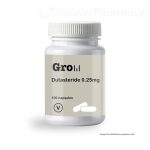
Dutasteride 0.25mg Vegetarian Capsules — Lower-Dose Dual 5-Alpha Reductase Inhibitor for Pattern Hair Loss
This is our lower-dose dutasteride option. It provides genuine 5-alpha reductase inhibition at half the standard 0.5mg dose. So it suits patients wanting gentler treatment, women needing lower doses, patients titrating up or stepping down, and those on long-term maintenance after initial response. Furthermore, evidence supports lower doses — recent Phase III trials of 0.2mg dutasteride show significant efficacy with favourable safety profile. In fact, sexual side effects are reduced at doses of 0.5mg and below. Suitable for men and women in appropriate circumstances (postmenopausal, or premenopausal with reliable contraception). Both use for hair loss is off-label in the UK. Available at Courier Pharmacy after comprehensive assessment. Our vegetarian HPMC capsules suit vegetarian, vegan, halal, kosher patients, and those with soya or peanut allergy.
At Courier Pharmacy, we believe in treatment that fits the person, but only where it’s honest, safe, and consented to.
This page covers what dutasteride 0.25mg vegetarian capsules are, why the lower dose has clinical value, when it suits over the standard 0.5mg dose, who might benefit from this option, the comprehensive safety framework, and the practical points that matter. Above all, we cover why lower doses aren’t inferior — they’re a genuinely useful part of the treatment toolkit.
The off-label prescribing gateway — please read first
Before going further, we want to be straight about how dutasteride 0.25mg supply works at Courier Pharmacy:
What off-label prescribing means
Dutasteride is MHRA-licensed in the UK for benign prostatic hyperplasia (BPH) at 0.5mg. So use for pattern hair loss is off-label. Furthermore, the 0.25mg dose is off-label both for licensed indication (BPH) and for hair loss use.
- Off-label doesn’t mean unsafe or experimental
- Extensive evidence exists for dutasteride effectiveness in pattern hair loss
- Lower-dose evidence is growing (2025 Phase III trial of 0.2mg)
- Boersma 2014 study of 3,500 women used 0.15mg with 83.3% improvement
- Widely used off-label in UK private dermatology
- Off-label status means informed consent is essential
Female use requires specific criteria
Dutasteride 0.25mg can be used for female pattern hair loss in specific circumstances:
- Postmenopausal women are the preferred candidate group
- Premenopausal women can use with strict contraception throughout treatment
- Contraception must continue for 6 months after stopping
- Reliable contraception methods preferred
- Written informed consent about teratogenic risk essential
- Lower dose fits within female-appropriate dosing evidence
- Boersma study used 0.15mg — our 0.25mg is within evidence range
What the assessment covers
Our comprehensive assessment addresses several critical areas:
- Diagnosis confirmation (photographs typically required)
- Previous treatments tried and responses
- Understanding of off-label status and informed consent
- Menopausal status assessment (for female patients)
- Contraception status and reliability (for premenopausal women)
- Any relevant medical history
- Family history of prostate cancer (for men)
- Current medications comprehensive review
- Any soya or peanut allergy (relevant for capsule choice)
- Baseline sexual function assessment
- Mental health status assessment
- Future fertility planning considerations
- Blood donation status
- Whether lower dose fits your clinical circumstances
Who this treatment isn’t suitable for
Absolute contraindications for both men and women:
- Pregnancy — teratogenic risk causing severe birth defects
- Women planning imminent pregnancy
- Premenopausal women without reliable contraception
- Breastfeeding mothers
- Children and adolescents under 18
- Adults with hypersensitivity to dutasteride or 5-ARIs
- Adults with severe hepatic impairment
- Adults in active mental health crisis
Signposting when 0.25mg isn’t right
If assessment identifies this dose isn’t right, we signpost appropriately:
- Advanced hair loss — 0.5mg or combination therapy may work better
- New patients — often start with finasteride or 0.5mg first
- Premenopausal women without reliable contraception — different pathway needed
- Complex cases — dermatology referral
- Mental health concerns — GP referral before hair loss treatment
Five key takeaways
- Dutasteride 0.25mg is our lower-dose option — half the standard 0.5mg dose. So it provides genuine 5-alpha reductase inhibition with reduced side effect burden. Furthermore, recent Phase III trials of 0.2mg dutasteride show significant efficacy with favourable safety profile
- Suits patients wanting gentler treatment, women needing lower doses within evidence (Boersma 2014 used 0.15mg), patients titrating up or stepping down, and long-term maintenance after initial response on 0.5mg
- Suitable for MEN with male pattern hair loss AND women with female pattern hair loss in specific circumstances (postmenopausal, or premenopausal with reliable contraception). Furthermore, the lower dose aligns better with female-dose evidence
- Use for pattern hair loss is OFF-LABEL in the UK — dutasteride is only MHRA-licensed for benign prostatic hyperplasia at 0.5mg. So use of 0.25mg for hair loss is doubly off-label. However, extensive evidence supports lower-dose approaches
- Same safety framework as 0.5mg but reduced side effect profile. Vegetarian HPMC capsules suit vegetarian, vegan, halal, kosher patients. Not for pregnant women, premenopausal women without contraception, children, or adults with hypersensitivity
Why choose Courier Pharmacy for dutasteride 0.25mg
At Courier Pharmacy, our approach starts with a simple idea: treatment should fit the person, not force the person to fit the system.
Dr Ada Jex-Cori
Our service is shaped by the philosophy of Dr Ada Jex-Cori, our brand pharmacist.
Dr Ada represents the spirit of the pharmacy: evidence-led, community-rooted, and willing to challenge the one-size-fits-all approach to medicine. She is named in honour of three pioneering women in science: Ada Lovelace, the mathematician and visionary; Sophia Jex-Blake, the first female doctor in the UK who fought the medical establishment; and Gerty Cori, the biochemist and Nobel Prize winner.
In our fictional world of Ethrewell, Dr Ada fights against pharma’s standardised approach to medicine. In the real world, she represents what we stand for. Her view is straightforward: you are not broken. The system is. And we are here to change that.

Lower doses have genuine clinical value
Not everything requires maximum dose. Courier Pharmacy is different. So we recognise that:
- Some patients respond well at lower doses
- Sexual side effects deserve serious consideration
- Long-term treatment benefits from careful dose optimisation
- Female patients often respond at lower doses (Boersma evidence)
- Titration allows individual response optimisation
- Maintenance doses can be lower than treatment doses
Honest framing about lower-dose treatment
The evidence picture:
- Lower doses provide meaningful but slightly less potent effect
- Some patients need to step up to 0.5mg for adequate response
- Others achieve satisfactory results at 0.25mg
- Individual response variable
- Regular review guides continuation decisions
Honest framing about limits
What we don’t offer:
- We don’t offer 0.25mg dutasteride to pregnant women
- We don’t offer to premenopausal women without reliable contraception
- We don’t offer to patients under 18
- We don’t offer without full assessment
- We don’t offer surgical hair loss options
- For any of these needs, appropriate services fit better
Hair loss and the bigger picture
Pattern hair loss rarely sits in isolation. So our prescriber can discuss:
- Comprehensive hair loss assessment
- Underlying medical factors
- For women: hormonal factors and menopausal status
- Whether higher dose would work better
- Combination treatment strategies
- Long-term management planning
Prescriber support throughout treatment
Our team is here to discuss:
- Whether 0.25mg fits your specific situation
- Whether higher dose would suit better
- Managing side effects during treatment
- Tracking progress meaningfully
- Adjusting approach based on response
- When to consider step-up to 0.5mg
- Long-term treatment planning
Trust earned, not claimed
We are GPhC-regulated, and our content is grounded in the licensed dutasteride Summary of Product Characteristics, MHRA guidance on off-label prescribing, published research including the 2025 Phase III trial of 0.2mg dutasteride, Boersma 2014 study on female patients using 0.15mg, dose-ranging studies of dutasteride, network meta-analyses, and the real experience of patients approaching hair loss through medical treatment pathways.
If 0.25mg dutasteride isn’t the right answer for your situation, we’ll tell you honestly.
More than a prescription: our community
Healthcare shouldn’t only happen when you’re paying for it.
Every fortnight we run free drop-in talks and clinics at Insomnia, Derby, from 10am to 12pm. So we show up, even when it’s free.
Bring a question, bring a friend, bring a stack of bewildering letters from another clinic. We’ll sit with you.
We cover weight management, GLP-1 therapy, MCAS, menopause, women’s health including female hair loss, men’s health including hair loss, chronic pain, digestive health, allergies, asthma, sleep, migraine, skincare, acne, alcohol use disorder support, and whatever else people bring through the door. No appointment. No cost. No pressure. Just real support and treatment that fits.
Active ingredient and capsule composition
Each capsule contains
- Dutasteride 0.25mg (as active ingredient)
- Microcrystalline cellulose (as filler)
- Standard capsule excipients supporting stability
Capsule shell composition
- Vegetarian HPMC capsules (Hydroxypropyl methylcellulose)
- Suitable for vegetarian and vegan patients
- Free from gelatin (no animal-derived components)
- Free from soybean oil (unlike branded Avodart)
- Free from common allergens (nuts, dairy, gluten, soy)
- Halal and kosher suitable
Why 0.25mg specifically
The 0.25mg dose sits strategically within the dutasteride dose spectrum:
- 0.15mg — Boersma female study dose
- 0.2mg — 2025 Phase III trial dose
- 0.25mg (this product) — our lower-dose option
- 0.5mg — standard BPH and hair loss dose
- 0.5mg — highest dose studied for hair loss
So 0.25mg represents a genuinely middle-ground option. In particular, it provides meaningful DHT reduction while minimising side effect burden. Furthermore, it fits well within evidence-supported dosing ranges.

What dutasteride 0.25mg vegetarian capsules are for
Dutasteride 0.25mg vegetarian capsules provide gentler DHT suppression for pattern hair loss treatment. So the medicine reduces the dihydrotestosterone (DHT) levels that drive follicle miniaturisation, but at half the standard dose. Furthermore, the lower dose has genuine clinical utility for specific patient circumstances.
Why a lower dose has genuine value
Lower doses aren't inferior — they're strategic:
- Reduced side effect profile at lower doses
- Sexual side effects notably lower at 0.5mg and below (studies show this)
- Suits patients cautious about medication side effects
- Better fits female dosing evidence (0.15mg-0.5mg in studies)
- Provides titration flexibility (step-up or step-down)
- Excellent for long-term maintenance after initial response
- Genuinely evidence-supported approach
The dose-response evidence
What research shows about dutasteride dosing:
- Efficacy increases dose-dependently from 0.05mg to 2.5mg daily
- However, sexual side effect rates similarly low at 0.5mg and below
- 2025 Phase III trial: 0.2mg showed significant benefit vs placebo
- 2mg dutasteride produced 21.53 additional hairs vs 5.96 placebo at vertex over 24 weeks
- So even lower doses provide clinically meaningful effect
- Twice-weekly or thrice-weekly 0.5mg regimens also studied and effective
- Our 0.25mg daily provides steady-state approach at similar total exposure
Who might benefit from the 0.25mg dose
This dose may suit adult men who:
- Want gentler dutasteride treatment
- Are concerned about sexual side effects at higher doses
- Have plateaued on finasteride but want cautious approach
- Are transitioning down from 0.5mg after good response
- Are on long-term maintenance
- Have lower body weight where lower doses may fit better
- Prefer daily dosing over intermittent 0.5mg
- Understand off-label prescribing implications
This dose may suit adult women who:
- Have confirmed female pattern hair loss diagnosis
- Are postmenopausal (preferred candidate group)
- Are premenopausal WITH reliable contraception commitment
- Prefer lower doses aligned with female-specific evidence
- Fall between the Boersma 0.15mg dose and standard 0.5mg
- Are stepping up from 0.15mg equivalent doses
- Have concerns about hormonal side effects at higher doses
- Are on long-term maintenance
Who benefits from the vegetarian format
The vegetarian HPMC capsule format specifically suits:
- Vegetarian and vegan patients avoiding animal-derived gelatin
- Halal-observant patients requiring animal-derived-free medication
- Kosher-observant patients with similar requirements
- Adults with soya allergy
- Adults with peanut allergy
- Adults preferring plant-based capsule shells generally

How dutasteride works
Same mechanism as the 0.5mg dose but at lower systemic exposure:
- Blocks 5-alpha reductase enzyme (both Type 1 and Type 2)
- This enzyme normally converts testosterone into DHT
- Reduced DHT means less follicle miniaturisation
- Follicles can recover and produce thicker, longer hairs
- At 0.25mg, DHT reduction slightly less than at 0.5mg
- Still provides clinically meaningful effect
- Long half-life (5 weeks) applies to all doses
Dose comparisons — where does 0.25mg fit
0.25mg vs 0.5mg dutasteride
Direct comparison of the two dutasteride doses:
- 5mg (standard): 90-95% DHT reduction, standard efficacy
- In contrast, 0.25mg (this product): slightly less DHT reduction, still meaningful
- 5mg produces more side effects on average
- 25mg reduces side effect burden
- Sexual side effects similarly low at both doses (research shows this)
- Efficacy dose-dependent but both effective
- Both suitable for hair loss treatment
- Choice depends on individual circumstances and preferences
0.25mg vs 0.15mg (Boersma dose)
Compared with the female-specific study dose:
- 15mg: used in Boersma 2014 study of 3,500 women (83.3% improvement)
- In contrast, our 0.25mg: slightly higher dose but similar principle
- Both fit within female-appropriate dosing range
- 25mg may provide slightly stronger response
- Both maintain low side effect profile
- Choice guided by individual response
Daily 0.25mg vs intermittent 0.5mg dosing
Alternative approaches to lower total dutasteride exposure:
- Daily 0.25mg: consistent daily dosing, steady state
- In contrast, intermittent 0.5mg (twice or thrice weekly): higher peaks, no dose some days
- Daily 0.25mg = 1.75mg per week total
- Twice-weekly 0.5mg = 1.0mg per week total
- Thrice-weekly 0.5mg = 1.5mg per week total
- Daily 0.25mg provides slightly higher weekly exposure than either intermittent regimen
- Daily dosing supports better adherence for many patients
- Choice depends on preference and clinical judgement
0.25mg vs finasteride 1mg
Different medications, similar target effect:
- Dutasteride 0.25mg: dual 5-ARI, moderate DHT reduction
- In contrast, finasteride 1mg: Type 2 only 5-ARI, 70% DHT reduction
- Finasteride licensed for hair loss (Propecia); dutasteride not
- Different half-lives (dutasteride 5 weeks, finasteride 6-8 hours)
- Different side effect duration if issues develop
- Both effective at their respective doses
Where 0.25mg fits in hair loss management
The dose has multiple useful positions:
- Titration up from starting doses (0.15mg) — natural stepping stone
- Titration down from 0.5mg — after good response for maintenance
- Long-term maintenance dose after initial response
- Cautious approach for patients concerned about side effects
- Female-appropriate dosing within evidence range
- Building block for combination therapy
- Alternative to intermittent dosing patterns
Realistic treatment expectations
Timeline for effects
What to genuinely expect:
- First month: DHT levels drop (though less than 0.5mg would)
- Months 2-3: possible initial shedding as follicles reset
- Months 3-6: hair thickening and follicle recovery begins
- Months 6-12: visible improvement in many patients
- Beyond 12 months: continued improvement or stability
- Effects lost gradually if treatment stops
- May take slightly longer to see full effect than 0.5mg
Response expectations at 0.25mg
Honest about what evidence shows:
- Somewhat less potent than 0.5mg but still meaningful
- Still outperforms placebo in dose-ranging studies
- Provides slower but genuine response
- Better tolerability than 0.5mg for many patients
- Some patients need to step up to 0.5mg for adequate response
- Others achieve satisfactory response at 0.25mg
- Individual response varies significantly
What this dose may help with
- Slowing or halting hair loss progression
- Follicle recovery and hair thickening
- Modest improvement in hair density
- Long-term maintenance after initial higher-dose response
- Gentler treatment for cautious patients
- Sustained benefit with continued treatment
What this dose doesn't claim to do
Honest framing matters:
- It doesn't provide the same potency as 0.5mg
- It doesn't work equally for all patients
- It doesn't work immediately
- It doesn't provide permanent effects — stopping reverses benefits
- It doesn't guarantee equivalent results to standard dose
- It doesn't work without daily consistent use
- It doesn't remove the need for contraception in premenopausal women
- It doesn't eliminate teratogenic risk if pregnant contact occurs
Who this treatment may suit well
Dutasteride 0.25mg may suit:
- Men wanting gentler dutasteride than the standard 0.5mg
- Men concerned about sexual side effects
- Men transitioning down from 0.5mg after good response
- Men on long-term maintenance treatment
- Postmenopausal women with female pattern hair loss
- Postmenopausal women with frontal fibrosing alopecia
- Premenopausal women with reliable contraception commitment
- Women preferring lower doses aligned with female evidence
- Older adults where lower doses may fit better
- Adults with lower body weight
- Adults with realistic expectations about modest improvement
- Vegetarian or vegan patients needing hair loss treatment
- Halal or kosher-observant patients
- Patients with soya or peanut allergy
Who might suit other options better
Other options may suit better for:
- Adults with advanced hair loss needing full potency (0.5mg or combination)
- Adults where finasteride hasn't worked (0.5mg dutasteride better first)
- Pregnant women (absolute contraindication)
- Women planning imminent conception
- Premenopausal women without reliable contraception
- Breastfeeding mothers
- Children and adolescents
- Adults with active mental health crisis
- Adults with severe hepatic impairment
- Adults with hypersensitivity to 5-ARIs
- Patients who won't engage with proper assessment
Courier Pharmacy supply pathway
Step 1: Comprehensive online assessment
Complete the hair loss consultation on courierpharmacy.co.uk. This covers:
- Diagnosis confirmation (photographs typically required)
- Duration and pattern of hair loss
- Previous treatments tried and responses
- Any dutasteride 0.5mg experience if previously used
- Menopausal status (for female patients)
- Contraception status and reliability (for premenopausal women)
- Baseline sexual function assessment
- Mental health status assessment
- Family history of prostate cancer (for men)
- Current medications comprehensive review
- Any soya or peanut allergy
- Any hepatic conditions
- Future fertility planning
- Blood donation activity
- Understanding of off-label prescribing
Step 2: Prescriber review
Your consultation goes to our UK-qualified prescriber, who assesses:
- Whether 0.25mg dutasteride is clinically appropriate for you
- Whether 0.5mg would suit better initially
- Whether finasteride first would be more suitable
- For women: whether menopausal status and contraception support treatment
- Whether any red flags need addressing
- Whether informed consent about off-label use is comprehensive
- Whether alternative treatments would suit better
Step 3: Informed consent documentation
Off-label prescribing requires documented understanding:
- Confirmation you understand off-label status
- Confirmation you understand the safety profile
- Confirmation you understand realistic expectations at lower dose
- Confirmation you understand fertility and blood donation implications
- For women: confirmation of understanding teratogenic risk
- For premenopausal women: contraception commitment documented
Step 4: Discreet delivery and ongoing support
Your order arrives in plain packaging with clear supporting materials:
- Full written instructions for daily dosing
- Side effect monitoring guidance
- When to contact us
- Red flag symptoms to watch for
- Blood donation and (for men) PSA screening reminders
- For women: contraception continuation reminder
- Free prescriber support available throughout treatment
Key features and specs
- Active ingredient: dutasteride 0.25mg
- Class: dual 5-alpha reductase inhibitor (Type 1 and Type 2)
- Form: vegetarian HPMC capsules
- Route: oral, once daily
- Standard dose: 0.25mg (one capsule) once daily
- Licensed indication: benign prostatic hyperplasia (BPH) at 0.5mg
- Off-label use: male AND female pattern hair loss at this lower dose
- Half-life: approximately 5 weeks
- Legal status: prescription-only medicine (POM)
- Assessment: full clinical review before supply
- Capsule composition: HPMC (vegetarian, halal/kosher suitable)
- Not for: pregnant women, premenopausal women without contraception, children, hypersensitivity, severe hepatic impairment

How to take dutasteride 0.25mg
Standard dosing
The straightforward dosing regimen:
- Take one 0.25mg capsule once daily
- Swallow the capsule whole with water
- Don't chew, crush, or open the capsule
- Take at approximately the same time each day
- With or without food (absorption not significantly affected)
- Continue daily to maintain benefits
- Any missed dose: take when remembered same day, or skip if late
Practical tips
- Establish a daily routine (morning or evening)
- Set a phone reminder if needed
- Take before-treatment photographs for comparison
- Track progress at 3, 6, and 12 months
- Report any concerning symptoms promptly
- Attend regular reviews with our prescriber
- Carry a medication list noting dutasteride use
- For women: maintain reliable contraception without gaps
What to combine with
Complete hair loss treatment often needs multiple elements:
- Topical minoxidil (highly synergistic)
- Regular scalp assessment
- Healthy diet and adequate nutrition
- Iron and vitamin D optimisation
- Stress management
- Sleep hygiene
What to avoid
- Sharing medication with others (particularly pregnant women)
- Blood donation during or within 6 months of treatment
- Stopping suddenly without prescriber discussion
- Doubling doses if missed
- Combining with other 5-ARIs
- For premenopausal women: contraception gaps
Storage
- Store below 25°C
- In original packaging
- Protect from light and moisture
- Keep out of sight and reach of children
- Particularly important to keep away from pregnant women
- Use by expiry date

Warnings and precautions
Absolute contraindications
- Pregnancy (teratogenic risk causing severe birth defects)
- Women planning imminent pregnancy
- Premenopausal women without reliable contraception
- Breastfeeding mothers
- Children and adolescents under 18
- Adults with hypersensitivity to dutasteride or 5-ARIs
- Adults with severe hepatic impairment
- Adults in acute mental health crisis
The teratogenic risk consideration
Critical safety point — same as 0.5mg dose:
- Dutasteride is teratogenic — causes birth defects if pregnant woman exposed
- Particular risk to male fetuses (abnormal genital development)
- Absorbed through skin from broken or leaking capsules
- Pregnant women should NEVER touch broken capsules
- For female patients: reliable contraception essential throughout
- Contraception must continue for 6 months after stopping
- Store securely away from pregnant women
- Contact us immediately if pregnant woman exposed to broken capsule
The contraception requirement (for premenopausal women)
Specific requirements:
- Reliable contraception required throughout treatment
- Contraception must continue for 6 months after last dose
- Preferred methods: IUD, contraceptive implant
- Contraception gaps require immediate treatment cessation
- Report any pregnancy immediately
The sexual side effects consideration
Reduced compared to standard dose but still possible:
- Studies show sexual side effect rates similar at 0.5mg and below
- So 0.25mg may not significantly reduce these effects
- However, individual patients respond differently
- Men: erectile dysfunction, reduced libido, ejaculatory dysfunction
- Women: reduced libido, hormonal shifts
- Effects usually reversible on stopping
- Long half-life means effects persist longer than expected
- Report any sexual side effects immediately
The mood and mental health consideration
- Depression reported with 5-ARI use
- Anxiety reported
- Suicidal ideation reported (rare but serious)
- Not for use during active mental health crisis
- Report any mood changes promptly
- Any suicidal thoughts: contact GP, NHS 111, Samaritans (116 123), or 999
The PSA screening consideration (for men)
Important for prostate cancer screening even at lower doses:
- Dutasteride reduces PSA levels (though less at lower doses)
- PSA reduction proportional to dose
- Always inform any healthcare provider
- Discuss PSA monitoring approach with our prescriber
The blood donation restriction
- Cannot donate blood while taking dutasteride
- Cannot donate for 6 months after last dose
- Applies regardless of dose taken
- Inform NHS Blood and Transplant if previously donated on dutasteride
Use with care if you
- Have moderate hepatic impairment
- Take medications interacting with CYP3A4
- Have any history of mood or mental health difficulties
- Are elderly
- Have concurrent chronic medical conditions
- Are approaching family planning stage
When to seek urgent medical help
- Signs of severe allergic reaction (facial swelling, breathing difficulty)
- Any suicidal thoughts
- Severe or persistent mood changes
- Signs of hepatitis (jaundice, dark urine, abdominal pain)
- Persistent or worsening sexual side effects
- Breast enlargement or discomfort (rare but reported)
- For women: any suspicion of pregnancy
- Any concerning symptoms during treatment

Side effects
Same side effect profile as 0.5mg but potentially reduced burden.
Common side effects (may affect up to 1 in 10 people)
- Impotence/erectile dysfunction (in men)
- Reduced libido
- Ejaculatory disorders (in men)
- Breast enlargement or tenderness
- Dizziness
Uncommon side effects (may affect up to 1 in 100 people)
- Hair loss (particularly body hair)
- Allergic reactions
- Depression
Rare side effects (may affect up to 1 in 1,000 people)
- Severe allergic reactions (angioedema)
- Testicular pain and swelling
Very rare/frequency unknown
- Anxiety
- Suicidal ideation
- Male breast cancer (very rare)
- Post-5-ARI syndrome (controversial but documented)
Yellow Card reporting
If you experience any side effects, talk to your prescriber or contact us. You can also report side effects directly via the MHRA Yellow Card scheme at https://yellowcard.mhra.gov.uk. By reporting side effects, you help provide more information on the safety of medicines.

Frequently asked questions

Why choose 0.25mg over 0.5mg?
Several genuine reasons:
- Cautious approach for side effect concerns
- Female-appropriate dosing within evidence range
- Step-down from 0.5mg after good response (maintenance)
- Step-up from lower starting doses
- Lower body weight considerations
- Better tolerability for some patients
Does 0.25mg work as well as 0.5mg?
Slightly less potent but still meaningful:
- Dose-response relationship shows less DHT reduction at 0.25mg
- Still provides clinically meaningful effect
- Some patients respond fully at 0.25mg
- Others need 0.5mg for adequate response
- Individual variation significant
Can I step up from 0.25mg to 0.5mg?
Yes, if needed:
- Discuss with prescriber if response inadequate
- Straightforward transition
- Assess response at 6-12 months first
- Some patients ultimately need 0.5mg
Can women take dutasteride 0.25mg?
In specific circumstances:
- Postmenopausal women are preferred candidates
- Premenopausal women with reliable contraception
- 25mg fits female evidence range
- Similar contraception requirements to 0.5mg
- Same 6-month post-treatment contraception
Is 0.25mg licensed in the UK?
No — it's off-label:
- Dutasteride is only MHRA-licensed at 0.5mg for BPH
- 25mg is off-label both for the strength and the indication
- Off-label prescribing permitted under GMC/GPhC guidance
- Informed consent essential
Are side effects lower at 0.25mg?
Somewhat but not dramatically:
- Studies show sexual side effects similar at 0.5mg and below
- Overall side effect burden may be reduced
- Individual response varies
- Long half-life applies to all doses
What if I have soya or peanut allergy?
Our vegetarian format helps:
- Standard Avodart contains soybean oil
- Our HPMC capsules don't
- Suitable for soya and peanut allergy
How do I order dutasteride 0.25mg?
Complete the hair loss consultation on courierpharmacy.co.uk. Our prescriber reviews your specific circumstances and confirms whether 0.25mg is appropriate. If a different dose or treatment would suit better, we'll suggest that.
Disclaimer: This page is for information only and isn't a substitute for personal medical advice. Dutasteride is a prescription-only medicine (POM) MHRA-licensed for benign prostatic hyperplasia (BPH) at 0.5mg. Use of 0.25mg for pattern hair loss is doubly off-label (dose and indication) — permitted under GMC and GPhC guidance when clinically justified with informed consent. Dutasteride can cause severe congenital defects and is ABSOLUTELY CONTRAINDICATED during pregnancy, in women planning imminent pregnancy, in premenopausal women without reliable contraception, and in breastfeeding mothers. Pregnant women must NEVER handle broken or leaking capsules. For female patients: reliable contraception is essential throughout treatment and for 6 months after stopping. Also contraindicated in children, adults with hypersensitivity to 5-ARIs, severe hepatic impairment, and acute mental health crisis. Blood donation ABSOLUTELY PROHIBITED during treatment and for 6 months after last dose. Sexual side effects may persist due to long half-life. Mood changes, depression, and suicidal ideation reported — any suicidal thoughts should trigger immediate contact with GP, NHS 111, Samaritans (116 123), or emergency services (999). For men: PSA levels reduced (proportional to dose). Signs of severe allergic reaction require immediate medical attention (999). Any suspicion of pregnancy in female patient requires immediate treatment cessation.
How this content was created
Written by the Courier Pharmacy editorial team and reviewed by a GPhC-registered prescribing pharmacist.
The content is grounded in the licensed dutasteride SmPC, MHRA guidance on off-label prescribing, GMC/GPhC guidance on responsible off-label supply, the 2025 Phase III trial of 0.2mg dutasteride (Ann Dermatol), Boersma 2014 study of 3,500 women using 0.15mg, dose-ranging studies of dutasteride, intermittent dosing evidence, and the real experience of patients at Courier Pharmacy.
References
- Courier Pharmacy (2026) Dutasteride Hair Loss UK: Patient Guide (2026). Courier Pharmacy. Available at: https://courierpharmacy.co.uk/dutasteride-hair-loss-uk-patient-guide-2026/ (Accessed: 29 July 2026).
- Electronic Medicines Compendium (no date) [SmPC] Product 9277. medicines.org.uk. Available at: https://www.medicines.org.uk/emc/product/9277/smpc (Accessed: 29 July 2026).
- Courier Pharmacy (2026) Optimal Dutasteride Dose for Hair Loss. Courier Pharmacy. Available at: https://courierpharmacy.co.uk/optimal-dutasteride-dose-for-hair-loss/ (Accessed: 29 July 2026).
- Olszewska, M. and Rudnicka, L., 2005. Effective treatment of female androgenic alopecia with dutasteride. Journal of drugs in dermatology: JDD, 4(5), pp.637-640.
- Boersma, I.H., Oranje, A.P., Grimalt, R., Iorizzo, M., Piraccini, B.M. and Verdonschot, E.H., 2014. The effectiveness of finasteride and dutasteride used for 3 years in women with androgenetic alopecia. Indian Journal of Dermatology, Venereology and Leprology, 80, p.521.