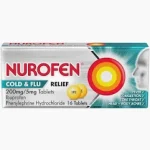
Nurofen Cold and Flu Tablets are yellow film-coated oral tablets. Each pack contains 12 or 24 tablets.
Each tablet contains two active ingredients. Ibuprofen 200mg is a non-steroidal anti-inflammatory drug (NSAID). Pseudoephedrine hydrochloride 30mg is a decongestant.
Also, the pack size sits within UK pseudoephedrine pack limits. A 24-tablet pack provides 720mg total pseudoephedrine, at the cap.
How ibuprofen and pseudoephedrine work together
Cold and flu symptoms often combine congestion with pain, headache, sore throat, and fever. Two actives target both mechanisms.
Firstly, ibuprofen addresses pain, inflammation, and fever. It blocks the enzymes that produce prostaglandins.
Also, pseudoephedrine narrows blood vessels in the nasal and sinus lining. This reduces swelling and opens blocked passages.
As a result, one tablet targets both the mechanical blockage of a stuffy nose and the pain and fever that often come with cold and flu.
However, Nurofen Cold and Flu does not contain an antihistamine. So it does not address runny nose or sneezing (which are histamine-driven).
Why non-drowsy matters
Many combined cold and flu products contain a sedating antihistamine. This causes drowsiness that can be unwanted during the day.
Firstly, Nurofen Cold and Flu contains no antihistamine. This makes it a non-drowsy option.
Also, this suits patients who need to drive, work, study, or care for others while treating cold and flu symptoms.
However, if you need help sleeping through symptoms at night, a sedating option (Night Nurse, Benylin Day and Night night tablet) may fit better for bedtime use.
A pharmacy medicine with pack size restrictions
Nurofen Cold and Flu Tablets are a pharmacy medicine (P). They can only be supplied via pharmacies with pharmacist involvement.
Firstly, the pseudoephedrine content triggers UK Misuse of Drugs Regulations pack size limits. Pharmacies usually limit purchases to one pack per transaction.
Also, this is to prevent bulk buying for illicit methamphetamine manufacture. It does not affect normal medical use.
Furthermore, at Courier Pharmacy, our pharmacist may ask a few questions before supply. This check confirms the product is suitable for your situation.
Key features and specifications
Active ingredients per tablet: ibuprofen 200mg + pseudoephedrine hydrochloride 30mg
Form: yellow film-coated oral tablets
Pack sizes: usually 12 or 24 tablets
Class: combined NSAID (analgesic, anti-inflammatory, antipyretic) and sympathomimetic decongestant
Legal status: Pharmacy medicine (P), subject to Misuse of Drugs Regulations pack size limits
Age: adults and children 12 years and over (contraindicated under 12)
A non-drowsy NSAID and decongestant combined tablet for cold and flu
Nurofen Cold and Flu Tablets are a well-known UK cold, flu, and sinus remedy. Each tablet contains two active ingredients that work together.
Firstly, ibuprofen 200mg is a non-steroidal anti-inflammatory drug (NSAID). It relieves pain, reduces fever, and calms inflammation.
Also, pseudoephedrine hydrochloride 30mg is a decongestant. It helps unblock a stuffy nose and open blocked sinuses.
However, unlike Benylin 4 Flu or Night Nurse, Nurofen Cold and Flu contains no antihistamine. This is why it is non-drowsy.
Also, this suits patients who need daytime relief and cannot afford to feel drowsy. It fits driving, working, and staying alert.
Nurofen Cold and Flu Tablets are for adults and children aged 12 years and over. It is a pharmacy medicine (P) sold only via pharmacies.
Furthermore, the pseudoephedrine content triggers UK Misuse of Drugs Regulations pack size limits. Pack size is capped and a pharmacist assessment applies.
Above all, an MHRA 2024 safety alert applies to all pseudoephedrine products. There is a rare but serious risk of PRES and RCVS (brain-blood-vessel conditions).
Also, ibuprofen carries specific NSAID-related risks. These include stomach irritation, gastrointestinal bleeding, kidney effects, and (at high doses) cardiovascular concerns.
At Courier Pharmacy, our team can help you decide whether Nurofen Cold and Flu fits your symptoms and situation.
When to see a doctor rather than self-treat
Nurofen Cold and Flu Tablets are for short-term symptom relief only. However, some symptoms need medical assessment instead of continued self-treatment.
Sudden severe headache, seizures, sudden confusion, or visual disturbance. Stop the tablets and call 999 (possible PRES or RCVS from the pseudoephedrine)
Sudden abdominal pain, rectal bleeding, black or tarry stools, or vomiting blood. Stop the tablets and seek urgent help (possible GI bleeding from ibuprofen, or rare ischaemic colitis from pseudoephedrine)
Chest pain, breathlessness, palpitations, or one-sided weakness. Call 999
Wheezing, chest tightness, or breathing difficulty after taking a tablet. Stop and seek help (possible NSAID-induced bronchospasm)
Cold or flu symptoms lasting more than 10 days despite treatment, or symptoms that improve and then worsen
Thick coloured nasal discharge with high fever, severe facial pain, or dental pain (possible bacterial sinusitis)
Severe or widespread skin rash with pustules, blistering, or peeling. Stop the tablets and seek urgent help (possible AGEP)
Facial swelling, throat swelling, hives, or difficulty breathing. Call 999 (possible severe allergic reaction)
If you are pregnant (especially in the third trimester), breastfeeding, over 60, take blood thinners, or have any of the medical conditions in the warnings section below, don’t take these without pharmacist or GP advice
Five key takeaways
Nurofen Cold and Flu Tablets contain ibuprofen 200mg + pseudoephedrine 30mg per tablet. No antihistamine, so no drowsiness.
Licensed for adults and children 12+ for cold and flu symptoms with congestion, aches, pains, headache, sore throat, and fever.
Dose: 1-2 tablets with water, then 1-2 tablets every 4 hours if needed. Max 6 tablets in 24 hours. Not more than 10 days without medical advice.
Contraindicated in aspirin or NSAID hypersensitivity, active or historical peptic ulcer, severe heart disease, severe hypertension, phaeochromocytoma, third-trimester pregnancy, and children under 12.
Do not combine with other NSAIDs (naproxen, aspirin >75mg/day), other decongestants, MAOI antidepressants, or beta-blockers.
What are Nurofen Cold and Flu Tablets: overview
Where Nurofen Cold and Flu fits in cold and flu treatment
Cold and flu produce a mix of symptoms. Options include single-active products (paracetamol, ibuprofen, plain decongestant) and combined products like Nurofen Cold and Flu.
Firstly, Nurofen Cold and Flu’s specific niche is congestion with pain or inflammation, when drowsiness must be avoided. This fits daytime use for people who need to stay alert.
However, if congestion is the only issue, plain Sudafed Decongestant Tablets or a nasal spray may fit better. If pain and fever dominate without congestion, plain ibuprofen or paracetamol may suffice.
Also, if you need cough or runny nose relief too, a product with an antihistamine (Benylin 4 Flu, Benylin Day and Night night tablet) may cover more symptoms.
Nurofen Cold and Flu vs Sudafed Sinus Pressure and Pain
Both products contain the same actives at the same doses: ibuprofen 200mg + pseudoephedrine 30mg. However, licensed minimum ages differ.
Firstly, Nurofen Cold and Flu is licensed from age 12. Sudafed Sinus Pressure and Pain is licensed from age 15.
Also, the two products are made by different manufacturers (Reckitt vs Kenvue) and marketed for slightly different symptoms. Sudafed emphasises sinus pain; Nurofen emphasises cold and flu.
However, functionally, they are the same medicine. Choose based on age of user, availability, and personal preference.
Nurofen Cold and Flu vs Sinutab Non-Drowsy
Both products contain pseudoephedrine 30mg per tablet. However, the analgesic differs.
Also, ibuprofen has stronger anti-inflammatory effects than paracetamol. This can help when sinus inflammation drives the symptoms.
However, Sinutab is safer in patients who cannot take ibuprofen (asthma with NSAID sensitivity, peptic ulcer, severe kidney disease, some cardiovascular conditions).
Nurofen Cold and Flu vs Benylin 4 Flu
Nurofen Cold and Flu contains ibuprofen + pseudoephedrine. Benylin 4 Flu contains paracetamol + pseudoephedrine + diphenhydramine (a sedating antihistamine).
Firstly, Nurofen Cold and Flu is non-drowsy. Benylin 4 Flu can cause drowsiness.
Also, Benylin 4 Flu covers more symptoms (cough, sneezing, runny nose) due to the antihistamine. Nurofen Cold and Flu covers only congestion, pain, and fever.
However, if drowsiness is unacceptable and you don’t need cough or runny nose relief, Nurofen Cold and Flu fits better.
Short-term use only
Nurofen Cold and Flu Tablets are licensed for short-term (up to 10 days) symptom relief. Symptoms that persist beyond this need medical assessment.
Firstly, prolonged NSAID use raises the risk of GI bleeding, kidney injury, and cardiovascular events.
Also, prolonged pseudoephedrine use can cause tolerance and cardiovascular strain.
However, chronic congestion or persistent cold-like symptoms have their own management. Ask your GP if symptoms recur or persist.
Self-medication with pharmacist support
Because Nurofen Cold and Flu is a pharmacy medicine, buying at Courier Pharmacy comes with pharmacist support. Firstly, this is a mandated feature of the pharmacy classification.
Also, the pharmacist can check that the product fits your symptoms and situation. They will confirm you are not on MAOI antidepressants, beta-blockers, other NSAIDs, or other interacting medicines.
However, if this product is not right for you, we will explain why. We will then suggest safer options (single-active products, paracetamol-based combinations, or a GP appointment).
Why choose Courier Pharmacy for your Nurofen Cold and Flu Tablets
Registered, independent, and patient-led
Courier Pharmacy is a UK-registered independent pharmacy. The General Pharmaceutical Council regulates us.
Firstly, even for a well-known pharmacy medicine like Nurofen, pharmacist support matters. A short conversation can prevent avoidable harm.
Also, we treat every request as a chance to check that the product fits your situation. This is not a simple retail transaction.
As a result, buying these tablets from us comes with the reassurance that a UK-qualified pharmacist has thought about your specific case.
Dr Ada Jex-Cori, our brand pharmacist
Our brand pharmacist is Dr Ada Jex-Cori. She represents the spirit of what we do. Named for Ada Lovelace, Sophia Jex-Blake, and Gerty Cori, she stands for evidence-led, unafraid-of-questions medicine. Her message is straightforward. You’re not broken. The system is. We’re here to change that.
Care that keeps showing up
Pharmacy-medicine purchases are not one-off transactions when done properly. Firstly, we are here to answer follow-up questions if the product is not working as expected.
Also, if you notice unexpected side effects or your symptoms change, contact us. If symptoms persist beyond 10 days, we can help you think through the next step.
However, we will not sell repeated packs to someone who really needs medical assessment. That is not care, it is just retail.
Buy Nurofen Cold and Flu Tablets from Courier Pharmacy
Nurofen Cold and Flu Tablets are a pharmacy medicine (P). You can order at courierpharmacy.co.uk in the 12 or 24-tablet packs.
Add Nurofen Cold and Flu Tablets to your basket at courierpharmacy.co.uk
A brief pharmacist suitability check will be conducted before supply
Your order is dispensed and dispatched promptly
Follow the pack directions carefully. Contact us if you have questions
If this product is not right for your situation, we will explain why. Options include plain paracetamol, Sinutab Non-Drowsy (paracetamol + pseudoephedrine), plain Sudafed Decongestant Tablets, or a GP appointment.
Above all, we will not dispense a pack that is not suitable for you just because it was requested.
Summary
A pharmacy-sold combined tablet containing ibuprofen (NSAID) and pseudoephedrine (decongestant).
Adult and 12+ dose: 1-2 tablets, up to 3 times a day (max 6/24h). Max 10 days without medical advice.
Non-drowsy. Contains no antihistamine, so no sedation and no anticholinergic side effects.
Contraindicated with aspirin or NSAID allergy, peptic ulcer, severe heart disease, severe hypertension, MAOIs (current or last 14 days), beta-blockers, and third-trimester pregnancy.
Subject to UK Misuse of Drugs Regulations pack size limits, usually one pack per transaction.
Active ingredients in Nurofen Cold and Flu Tablets
Ibuprofen 200mg
Ibuprofen is a non-steroidal anti-inflammatory drug (NSAID) of the propionic acid class. It blocks the cyclooxygenase (COX-1 and COX-2) enzymes.
Firstly, blocking COX reduces the production of prostaglandins. Prostaglandins mediate pain, inflammation, and fever.
Also, at the 200mg dose, ibuprofen provides moderate pain relief, reduces fever, and calms inflammation. It is one of the most widely-used OTC pain relievers.
However, blocking COX-1 also reduces the protective mucus layer in the stomach. This is why ibuprofen can cause stomach irritation and, more seriously, bleeding or ulcers.
Furthermore, ibuprofen affects platelet function and (at high doses over prolonged periods) may raise cardiovascular risk. NICE cautions on prolonged NSAID use.
Pseudoephedrine hydrochloride 30mg
Pseudoephedrine is a synthetic sympathomimetic drug. It acts primarily on alpha-adrenergic receptors on blood vessels.
Firstly, at the 30mg dose per tablet (60mg per adult dose of 2 tablets), it works as an oral decongestant. It narrows blood vessels in the nasal and sinus lining.
Also, this reduces mucosal swelling and opens the nasal passages. Sinus drainage improves too.
However, this vasoconstricting effect is not confined to the nose. Some narrowing also occurs throughout the body. This can raise blood pressure and heart rate.
Furthermore, pseudoephedrine has been controlled in the UK under the Misuse of Drugs Regulations 2001 since 2007, due to its potential misuse as a methamphetamine precursor.
Why the ibuprofen-pseudoephedrine combination fits cold and flu
Cold and flu symptoms come from two overlapping mechanisms. Blocked sinuses are a vascular and swelling problem. Pain, fever, and inflammation are prostaglandin-driven.
Firstly, pseudoephedrine addresses the vascular congestion. This reduces the mechanical blockage of a stuffy nose.
Also, ibuprofen addresses the pain, fever, and inflammation. Its anti-inflammatory action is helpful when sinus inflammation drives the symptoms.
As a result, one tablet targets both mechanisms at once. This is the value of the combined product.
What are Nurofen Cold and Flu Tablets for?
Cold and flu symptoms with congestion
Nurofen Cold and Flu is licensed for the relief of cold and flu symptoms with associated congestion. This includes aches and pains, headache, fever, sore throat, blocked nose, and sinus congestion.
Firstly, the ibuprofen addresses cold and flu aches, headache, sore throat, and fever. Also, the pseudoephedrine addresses the blocked nose and sinus congestion.
However, this product does not treat the underlying viral infection. Colds usually resolve on their own in 7 to 10 days.
Sinus congestion with headache and pain
Sinus congestion often accompanies colds and causes facial pressure, headache, and (sometimes) pain over the cheeks or forehead.
Firstly, the pseudoephedrine reduces swelling that blocks sinus drainage. Also, the ibuprofen addresses the pain and inflammation.
However, severe sinus symptoms need medical assessment. Warning signs include high fever, severe facial pain, thick coloured discharge, or symptoms lasting more than 10 days.
Sore throat with congestion and fever
Ibuprofen's anti-inflammatory action makes it well-suited to sore throat pain. Also, the pseudoephedrine addresses associated nasal congestion.
However, severe sore throat lasting more than a few days, or accompanied by high fever and difficulty swallowing, needs medical assessment.
What Nurofen Cold and Flu isn't for
This product is not for chronic pain, chronic congestion, cough as the primary symptom, or headache alone (without congestion).
Also, it is not for children under 12, or for use during the third trimester of pregnancy or breastfeeding without medical advice.
However, if symptoms are severe, sudden, unusual, or accompanied by other concerning features (see the red flags above), this product is not the right response.
Furthermore, if you have aspirin or NSAID sensitivity, peptic ulcer, severe kidney disease, severe heart disease, or take MAOI antidepressants, do not use these tablets.
How does Nurofen Cold and Flu Tablets work?
Ibuprofen's COX inhibition and prostaglandin reduction
Ibuprofen works by blocking the cyclooxygenase (COX-1 and COX-2) enzymes. These enzymes make prostaglandins from arachidonic acid.
Firstly, prostaglandins sensitise pain nerve endings and trigger inflammation. They also raise the body's temperature set-point in the brain during infection.
Also, reducing prostaglandins reduces pain, inflammation, and fever. This is why ibuprofen relieves headache, sore throat, body aches, and fever.
However, COX-1 also produces prostaglandins that protect the stomach lining and support platelet function. Blocking these effects underlies the main ibuprofen side effects.
Pseudoephedrine's alpha-adrenergic action
Pseudoephedrine narrows blood vessels in the nasal and sinus lining. Firstly, it binds to alpha-adrenergic receptors on the vessel walls.
Also, this makes the vessels tighten (vasoconstriction), reducing the swelling that causes a blocked nose. Sinus drainage improves too.
However, pseudoephedrine acts throughout the body, not just in the nose. This is why cardiovascular contraindications and cautions apply.
Furthermore, pseudoephedrine has mild CNS stimulant effects. These can help with the fatigue of a cold but can also disturb sleep if taken too late.
Why non-drowsy suits daytime use
Nurofen Cold and Flu contains no antihistamine. This means no sedation from the tablet.
Firstly, pseudoephedrine is a mild stimulant, not a sedative. It supports alertness rather than causing drowsiness.
Also, ibuprofen is neither sedating nor stimulating at therapeutic doses.
As a result, Nurofen Cold and Flu fits patients who need to drive, work, study, or stay alert while treating symptoms.
The added value of an anti-inflammatory action
Unlike paracetamol, ibuprofen has significant anti-inflammatory effects. This can be helpful when inflammation drives cold and flu symptoms.
Firstly, sore throat pain is largely inflammatory. Ibuprofen addresses this directly.
Also, sinus congestion often has an inflammatory component. Ibuprofen may help reduce that inflammation alongside the decongestant action of pseudoephedrine.
However, this anti-inflammatory effect comes with trade-offs. NSAIDs affect the stomach lining, kidneys, and platelet function.
How to take Nurofen Cold and Flu Tablets
Adult and 12+ dose
Take 1 or 2 tablets with water, then 1-2 tablets every 4 hours if needed. Do not take more than 6 tablets in any 24-hour period.
Also, leave at least 4 hours between doses. Take the lowest dose that controls your symptoms for the shortest time needed.
However, do not take these tablets for more than 10 days without medical advice.
Children under 12 (not for use)
Nurofen Cold and Flu Tablets are not for children under 12 years of age. Younger children need age-appropriate options.
However, for cold and flu symptoms in children under 12, paediatric paracetamol (Calpol) or ibuprofen for pain and fever, plus saline nasal drops for congestion, are the standard options.
How to take with food or on an empty stomach
Take with food or a glass of milk to reduce the risk of stomach irritation from ibuprofen. This is especially important if you have a sensitive stomach.
Also, swallow the tablet whole with water. Do not crush or chew.
However, taking with food may slow the onset of relief slightly. But for regular users, gastric protection outweighs this small delay.
How quickly the tablets work
Ibuprofen usually starts to reduce pain and fever within 30 to 60 minutes. Pseudoephedrine relieves congestion within about 30 minutes.
Also, peak effect for both actives is reached at about 1 to 2 hours. The effect usually lasts around 4 to 6 hours per dose.
Timing during the day
Nurofen Cold and Flu is non-drowsy, so timing is flexible. Firstly, morning and afternoon doses generally work well.
However, the pseudoephedrine has mild central nervous system stimulant effects. Avoid a dose close to bedtime as this could disturb sleep.
Also, if you take an evening dose, leave several hours before bedtime.
Missed doses and stopping
These tablets are taken as needed, not on a fixed schedule. So there is no missed-dose concern in the usual sense.
Also, you can stop the tablets whenever your symptoms have resolved. There is no need to taper.
However, if you find yourself needing them for more than 10 days, medical assessment is warranted. The underlying cause of ongoing symptoms matters.
Do not take with other NSAIDs, decongestants, or ibuprofen products
Above all, do not take Nurofen Cold and Flu alongside any other NSAID (plain ibuprofen, plain Nurofen, naproxen, diclofenac, celecoxib, mefenamic acid) or aspirin at doses above 75mg per day. Combined NSAID use greatly raises the risk of GI bleeding and kidney injury.
Also, do not combine with any other product containing pseudoephedrine, phenylephrine, or ephedrine (Sudafed products, Actifed, Beechams cold products, Sinutab, Benylin 4 Flu variants).
Furthermore, do not combine with other cold and flu products that contain ibuprofen (Nurofen Sinus Relief, Nurofen Meltlets Cold and Flu variants).
However, plain paracetamol can be taken alongside for extra pain or fever relief, provided no other paracetamol-containing product is also being used.
If in doubt, ask the pharmacist before combining any cold, flu, or pain medicines.
Warnings and precautions for Nurofen Cold and Flu Tablets
MHRA safety alert: PRES and RCVS (rare but serious)
Above all, the MHRA issued a safety alert in February 2024 for pseudoephedrine-containing medicines. Rare but serious cases of PRES and RCVS have been reported.
Firstly, PRES stands for posterior reversible encephalopathy syndrome. RCVS stands for reversible cerebral vasoconstriction syndrome.
Also, both conditions involve reduced blood supply to the brain. Symptoms include sudden severe headache, seizures, sudden confusion, visual disturbances, or slurred speech.
However, if any of these symptoms develop while taking the tablets, stop immediately. Seek urgent medical assessment (call 999 for severe symptoms).
Aspirin or NSAID hypersensitivity (contraindicated)
A proportion of patients experience wheezing, bronchospasm, rhinitis, angioedema, or urticaria when they take aspirin or another NSAID. This is called aspirin-sensitive asthma or NSAID hypersensitivity.
Firstly, do not take Nurofen Cold and Flu if you have ever had asthma, breathing problems, hives, or nasal polyps after taking aspirin or another NSAID.
However, asthma without aspirin sensitivity is a caution but not an absolute contraindication. Discuss with the pharmacist first.
Peptic ulcer and GI bleeding (contraindicated)
Ibuprofen can cause serious gastrointestinal bleeding and ulceration. Active peptic ulcer or history of NSAID-induced GI bleeding are absolute contraindications.
Firstly, stop the tablets immediately if you develop black or tarry stools, vomit blood, or notice severe stomach pain. Seek urgent medical help.
However, well-controlled reflux may not be an absolute barrier. Take the tablets with food and discuss with the pharmacist first.
Ischaemic colitis (rare but serious)
Ischaemic colitis has been reported with both ibuprofen and pseudoephedrine. This is a condition where reduced blood flow damages part of the large bowel.
Firstly, symptoms include sudden abdominal pain, rectal bleeding, bloody stools, or unusual bowel changes.
However, if these develop while taking the tablets, stop immediately and seek medical assessment.
Crohn's disease and ulcerative colitis (caution)
NSAIDs including ibuprofen can worsen inflammatory bowel disease. Firstly, do not take Nurofen Cold and Flu if you have active Crohn's disease or ulcerative colitis flare-up.
However, if you have well-controlled inflammatory bowel disease, discuss with the pharmacist. Safer options usually exist.
AGEP (rare severe skin reaction)
Acute generalised exanthematous pustulosis (AGEP) is a rare but serious skin reaction reported with ibuprofen and pseudoephedrine-containing products.
Also, AGEP usually appears within the first 2 days of treatment. Features include fever with numerous small pustules on widespread reddened skin.
However, if a severe rash appears while taking the tablets, stop them and seek urgent medical assessment.
Cardiovascular risk (caution)
NSAIDs including ibuprofen may be linked to a small increased risk of heart attack or stroke, particularly at high doses or with prolonged use.
Firstly, at the OTC dose of Nurofen Cold and Flu for short-term use, this risk is minimal for most people.
However, if you have heart disease, previous stroke, or cardiovascular risk factors, discuss with the pharmacist first.
Cardiovascular contraindications
Nurofen Cold and Flu is contraindicated in severe coronary heart disease, severe cardiovascular disorders, and severe or uncontrolled hypertension.
Firstly, both ibuprofen (through fluid retention and platelet effects) and pseudoephedrine (through vasoconstriction) can worsen these conditions.
However, if you take any regular medicine for high blood pressure or heart conditions, disclose this before buying.
Diabetes (caution)
Use with caution in diabetes. Pseudoephedrine can raise blood glucose levels through its sympathomimetic effects.
However, if you have diabetes and need cold or flu symptom relief, ask the pharmacist for safer options.
Hyperthyroidism (caution)
Patients with an overactive thyroid should use these tablets with caution. Sympathomimetic drugs can compound the effects of excess thyroid hormone.
Angle-closure glaucoma and prostatic hypertrophy (caution)
These tablets should be used with caution in narrow-angle glaucoma and prostatic hypertrophy. Pseudoephedrine can precipitate an acute glaucoma attack in susceptible patients, and worsen urinary retention.
Phaeochromocytoma (contraindicated)
Contraindicated in phaeochromocytoma (a rare tumour that affects heart rate and blood pressure). Pseudoephedrine can precipitate serious cardiovascular events in these patients.
MAOI antidepressants and beta-blockers (contraindicated)
Above all, do not take these tablets if you are on an MAOI antidepressant, or within 14 days of stopping one.
Also, MAOIs include phenelzine, isocarboxazid, tranylcypromine, and moclobemide. Rasagiline and selegiline (Parkinson's medicines) carry the same concern.
Furthermore, do not combine with beta-blockers (propranolol, atenolol, bisoprolol, metoprolol). The combination with pseudoephedrine can cause paradoxical high blood pressure.
Renal and hepatic impairment (caution)
Use with caution in kidney or liver disease. Firstly, ibuprofen can worsen kidney function and may accumulate in liver disease.
Also, severe kidney or liver disease is a contraindication.
However, mild to moderate impairment may allow use with pharmacist or GP advice.
Pregnancy (third trimester contraindicated)
Nurofen Cold and Flu is contraindicated during the third trimester of pregnancy. Ibuprofen can cause premature closure of a fetal blood vessel (ductus arteriosus) and fetal kidney problems.
Also, it can prolong labour and increase bleeding risk in mother and baby.
However, use in the first two trimesters should also be avoided without medical advice. Paracetamol at the lowest effective dose is generally preferred in pregnancy.
Breastfeeding (avoid)
Nurofen Cold and Flu should be avoided during breastfeeding. Although ibuprofen passes into breast milk in low concentrations, significant amounts of pseudoephedrine are secreted.
Also, pseudoephedrine can reduce milk production. Paracetamol is generally preferred in breastfeeding.
Fertility (reversible reduction)
Ibuprofen belongs to a group of medicines that may impair female fertility. Firstly, this effect is reversible on stopping the medicine.
Also, occasional use is unlikely to affect your chances of becoming pregnant. However, if you are having difficulty conceiving, discuss with your GP before regular use.
Alcohol (caution)
Limit alcohol while taking these tablets. Firstly, alcohol raises the risk of ibuprofen-induced GI bleeding.
Also, alcohol has its own cardiovascular effects that can add to pseudoephedrine's blood-pressure-raising effect.
Elderly patients (caution)
Use with caution in adults over 60. Firstly, older adults are more sensitive to NSAID-induced GI bleeding, kidney injury, and cardiovascular events.
Also, they are more sensitive to pseudoephedrine's cardiovascular effects.
However, if these tablets are considered in older adults, discuss with the pharmacist. Safer options usually exist.
Duration of use (short-term only)
Do not take these tablets for more than 10 days without medical advice. Ongoing symptoms need medical assessment.
Also, prolonged NSAID use raises the risk of GI bleeding, kidney injury, and (for headache) medication-overuse headache.
Colouring agents E104 and E110
Nurofen Cold and Flu Tablets contain quinoline yellow (E104) and sunset yellow (E110). These colour additives may cause allergic reactions in susceptible patients.
However, if you have a history of allergy or intolerance to food colours, discuss with the pharmacist before use.
Side effects of Nurofen Cold and Flu Tablets
Common side effects
Common side effects come from both actives. From the ibuprofen: mild stomach upset, indigestion, or nausea.
Also, from the pseudoephedrine: insomnia if taken too late, mild restlessness, mild headache, or palpitations.
However, mild dry mouth or mild dizziness can occur.
Less common but significant side effects
Some side effects need attention. Firstly, stomach pain, black stools, or vomiting blood may indicate ibuprofen-induced GI bleeding. Stop and seek help.
Also, wheezing, chest tightness, or breathing difficulty may indicate ibuprofen-induced bronchospasm. Stop and seek help.
However, palpitations or a noticeable rise in blood pressure warrant stopping the tablets.
Furthermore, difficulty passing urine (particularly in men over 50) may indicate developing acute urinary retention.
Serious side effects requiring urgent help
Above all, seek urgent medical help for signs of PRES or RCVS. These include sudden severe headache, seizures, sudden confusion, visual disturbances, or slurred speech.
Also, seek help for signs of stroke: face drooping, arm weakness, speech difficulty (FAST). Call 999.
However, severe chest pain, breathlessness, or palpitations need urgent assessment. Signs of hypertensive crisis include very severe headache, chest pain, or trouble breathing.
Furthermore, signs of severe allergic reaction (facial or throat swelling, breathing difficulty, widespread rash) need 999.
Also, severe skin reactions with pustules, blistering, or peeling need urgent assessment (possible AGEP).
Additionally, sudden abdominal pain with rectal bleeding needs urgent assessment (possible ischaemic colitis or GI bleeding).
Drug interactions with Nurofen Cold and Flu Tablets
MAOI antidepressants (contraindicated)
Above all, do not take these tablets if you are on an MAOI antidepressant, or within 14 days of stopping one.
Also, MAOIs include phenelzine, isocarboxazid, tranylcypromine, and moclobemide. Linezolid (an antibiotic) carries the same concern.
Furthermore, rasagiline and selegiline (used for Parkinson's disease) have MAOI-like activity and should not be combined.
Beta-blockers (contraindicated)
Do not combine with beta-blockers (propranolol, atenolol, bisoprolol, metoprolol, and others). Firstly, the combination with pseudoephedrine can cause paradoxical high blood pressure.
Also, this is because beta-blockade leaves pseudoephedrine's alpha-adrenergic vasoconstricting effect unopposed.
Other NSAIDs and aspirin
Do not combine with any other NSAID (plain ibuprofen, plain Nurofen, naproxen, diclofenac, celecoxib, mefenamic acid). Combined NSAID use greatly raises the risk of GI bleeding and kidney injury.
Also, avoid aspirin at doses above 75mg per day. Low-dose 75mg aspirin for cardiovascular protection is a caution: discuss with the pharmacist first.
Other pseudoephedrine or decongestant products
Do not take alongside any other product containing pseudoephedrine, phenylephrine, ephedrine, or another systemic decongestant.
Also, this includes Sudafed products, Actifed, Beechams cold products, Sinutab, Benylin 4 Flu, and other Nurofen Cold and Flu variants.
However, this also includes topical decongestant nasal sprays (xylometazoline, oxymetazoline).
Anticoagulants
Ibuprofen's antiplatelet effect adds to the effect of blood-thinning medicines. This raises the risk of serious bleeding.
Firstly, this includes warfarin, apixaban, rivaroxaban, dabigatran, edoxaban, clopidogrel, prasugrel, and ticagrelor. Do not combine without medical advice.
SSRIs
SSRIs (fluoxetine, sertraline, citalopram, escitalopram, paroxetine) can increase GI bleeding risk when combined with NSAIDs. Firstly, this is because SSRIs also affect platelet function.
However, if you take any SSRI, discuss with the pharmacist before use.
Corticosteroids
Combining ibuprofen with oral corticosteroids (prednisolone, dexamethasone) raises the risk of GI ulcers and bleeding.
However, if you take oral steroids regularly, discuss with your GP before taking Nurofen Cold and Flu.
ACE inhibitors, ARBs, and diuretics
Ibuprofen can reduce the antihypertensive effect of ACE inhibitors (ramipril, lisinopril, enalapril), ARBs (losartan, candesartan, valsartan), and diuretics.
Also, the combination can increase kidney injury risk, particularly in older adults or when dehydrated. This is called the triple whammy.
However, if you take any blood pressure medicine or diuretic, discuss with the pharmacist before use.
Lithium, methotrexate, ciclosporin, and tacrolimus
Ibuprofen can raise blood levels of lithium, methotrexate, ciclosporin, and tacrolimus. This can cause toxicity.
However, if you take any of these medicines, discuss with the pharmacist or your specialist before use.
Digoxin and sulfonylureas
Ibuprofen can raise digoxin levels and enhance the blood-glucose-lowering effect of sulfonylureas (gliclazide, glimepiride, glibenclamide).
However, if you take digoxin or a sulfonylurea for diabetes, discuss with the pharmacist before use.
Alcohol
Limit alcohol while taking these tablets. Firstly, alcohol raises the risk of ibuprofen-induced GI bleeding.
Also, alcohol has its own cardiovascular effects that can add to pseudoephedrine's blood-pressure-raising effect.
Frequently asked questions about Nurofen Cold and Flu Tablets
How quickly do these tablets work?
Ibuprofen usually starts to reduce pain and fever within 30 to 60 minutes. Pseudoephedrine relieves congestion within about 30 minutes.
Also, peak effect for both actives is reached at about 1 to 2 hours. The effect usually lasts around 4 to 6 hours per dose.
Will Nurofen Cold and Flu make me drowsy?
No. Nurofen Cold and Flu contains no antihistamine and no sedating ingredient.
However, the pseudoephedrine is mildly stimulating. This can help with the fatigue of a cold but can also disturb sleep if taken too late in the day.
Can I drive after taking these tablets?
Yes, generally. Neither ibuprofen nor pseudoephedrine impairs driving in the typical way sedating medicines do.
However, if you notice any unusual side effects (dizziness, palpitations), do not drive until they resolve.
Can I take these with paracetamol?
Yes, generally. Paracetamol and ibuprofen work through different mechanisms and can be combined for extra pain relief.
However, always follow paracetamol's own dose directions. Do not take another product that also contains paracetamol.
Can I take these with ibuprofen?
No. Nurofen Cold and Flu already contains ibuprofen 200mg per tablet. Adding more ibuprofen from another product raises the risk of GI bleeding and kidney injury without benefit.
However, always check the ingredients of any other pain or cold medicine before combining.
Can I take these with aspirin?
Not if the aspirin dose is above 75mg per day. If you take low-dose 75mg aspirin for cardiovascular protection, adding Nurofen Cold and Flu is a caution and needs pharmacist advice.
However, do not take alongside pain-relief aspirin (300mg or higher). Combined NSAID use raises GI bleeding risk substantially.
Can I take these with other cold and flu products?
No, do not combine with other cold and flu remedies without pharmacist advice. Firstly, most contain paracetamol, ibuprofen, pseudoephedrine, or phenylephrine. Combining overloads the doses.
However, plain paracetamol for extra pain or fever relief can be taken alongside, following paracetamol's own directions.
Can I take these if I take antidepressants?
Discuss with the pharmacist first. If you take an MAOI antidepressant, these tablets are contraindicated (can cause hypertensive crisis).
Also, SSRIs can increase GI bleeding risk when combined with ibuprofen. Tricyclic antidepressants can compound cardiovascular effects.
Can children take these tablets?
Yes, children aged 12 and over can take Nurofen Cold and Flu at adult doses.
However, children under 12 must not take these tablets. Younger children need age-appropriate options like paediatric paracetamol or ibuprofen.
Can I take these during pregnancy or breastfeeding?
These tablets are contraindicated during the third trimester of pregnancy. They should also be avoided during breastfeeding.
However, paracetamol alone at the lowest effective dose is generally preferred for pain and fever in pregnancy and breastfeeding. Ask your midwife, GP, or pharmacist.
How long can I take these tablets for?
Do not take these tablets for more than 10 days without medical advice. Ongoing symptoms need medical assessment.
What are PRES and RCVS?
PRES stands for posterior reversible encephalopathy syndrome. RCVS stands for reversible cerebral vasoconstriction syndrome.
Also, both are rare brain-blood-vessel conditions highlighted by the MHRA in 2024 for pseudoephedrine-containing medicines.
However, symptoms include sudden severe headache, seizures, sudden confusion, visual disturbance, or slurred speech. If any develop, stop the tablets and seek urgent medical assessment.
What's the difference between Nurofen Cold and Flu and Sudafed Sinus Pressure and Pain?
Both contain the same actives at the same doses (ibuprofen 200mg + pseudoephedrine 30mg). However, licensed ages differ.
Also, Nurofen Cold and Flu is licensed from age 12. Sudafed Sinus Pressure and Pain is licensed from age 15.
However, they are made by different manufacturers (Reckitt vs Kenvue) and marketed for slightly different symptoms.
What's the difference between Nurofen Cold and Flu and Sinutab Non-Drowsy?
Both contain pseudoephedrine 30mg. However, the pain reliever differs.
Firstly, Nurofen Cold and Flu uses ibuprofen 200mg (an NSAID with anti-inflammatory action). Sinutab Non-Drowsy uses paracetamol 500mg.
Also, ibuprofen carries NSAID-specific risks (GI bleeding, kidney effects, cardiovascular). Sinutab is safer in patients who cannot take NSAIDs.
Can I take these if I have asthma?
Only with caution. Do not take Nurofen Cold and Flu if you have ever had asthma, breathing problems, hives, or nasal polyps after taking aspirin or another NSAID.
However, asthma without NSAID sensitivity is a caution but not an absolute contraindication. Discuss with the pharmacist first.
Can I take these if I have a stomach ulcer or reflux?
Active peptic ulcer is a contraindication. History of NSAID-induced GI bleeding is also a contraindication.
However, well-controlled reflux may not be an absolute barrier. Take the tablets with food and discuss with the pharmacist first.
Are these tablets addictive?
No. Neither ibuprofen nor pseudoephedrine cause chemical dependence at therapeutic doses.
However, prolonged use of any analgesic can lead to medication-overuse headache. Stick to short-term use.
What if I've taken too many tablets?
Contact NHS 111 or A&E immediately. Firstly, ibuprofen overdose can cause serious kidney damage, GI bleeding, and metabolic disturbance.
Also, pseudoephedrine overdose can cause severe cardiovascular effects and CNS stimulation.
However, take the packaging with you so medical staff can see exactly what and how much you have taken.
Do I need a prescription for these tablets from Courier Pharmacy?
No. Nurofen Cold and Flu Tablets are a pharmacy medicine (P), not prescription-only.
However, this means they can be supplied without a prescription but only via a pharmacy with pharmacist involvement. UK pack size limits also apply.
Disclaimer
Disclaimer: This information is for education only and isn't a substitute for personal medical advice. Always follow the packaging directions, and ask your pharmacist or GP if you're unsure whether Nurofen Cold and Flu Tablets are suitable for you.