

If you’re reading this with a bottle of foam in one hand or a new prescription in your inbox, you’re probably asking the same thing most patients ask me: “What’s normal, and what’s a sign I should stop?” That’s the right question. Minoxidil can help, but it isn’t a “pop it on and forget it” treatment. The form you use, your skin, your blood pressure, and even the base ingredients all change the risk picture. This guide explains the practical trade-offs in plain English, with a UK focus.
Topical minoxidil side effects are usually local, mainly scalp irritation and redness, while oral minoxidil side effects are more body-wide, including light-headedness, fluid retention, and unwanted body hair. The numbers matter too: temporary shedding affects 55% of topical users, while oral minoxidil causes dose-dependent hypertrichosis in 28.9% of people at 0.25 to 0.75 mg/day, 30.4% at 1 to 1.25 mg/day, and 86.8% at 2.5 to 5 mg/day [1] [2].
-
Product on sale
 Minoxidil 2.5mg tabletsPrice range: £24.99 through £149.99
 -
Product on sale
 Minoxidil 5mg tabletsPrice range: £29.99 through £199.99
What minoxidil side effects usually look like
The short version
Topical minoxidil side effects commonly happen on the scalp. Think redness, irritation, itching, flaking, and sometimes an early burst of shedding. In the review data, 55% of topical users get temporary increased shedding in the first weeks, and headaches are reported in up to 7% [2].
Oral minoxidil side effects are different. Because the medicine goes through the whole body, you can see light-headedness, dizziness, changes in heart rate, fluid retention, and unwanted body hair [1]
Why the form matters
A cream on the skin and a tablet in the bloodstream don’t behave the same way. Topical treatment mostly acts where you apply it. Oral treatment acts everywhere, which is why monitoring matters more.
A simple analogy helps. Topical minoxidil is like watering one plant pot. Oral minoxidil is like turning on the sprinkler system for the whole garden.

Five key takeaways
- Topical is usually gentler systemically: standard twice-daily topical use showed no systemic side effects such as hypotension, abnormal heart rate, and weight gain in the review data [2].
- Oral has more whole-body effects: unwanted hair growth rises sharply with dose, reaching 86.8% at 2.5 to 5 mg/day [1].
- Timing gives clues: dizziness and fast heart rate tend to show up within the first week, while hypertrichosis and fluid retention may not appear for the first three months [1].
- Shedding can be normal: temporary hair shedding affects 55% of topical users early on [2].
- The base ingredients matter: propylene glycol in some topical liquids can trigger contact dermatitis in sensitive patients, and UK guidance often favours PG-free foam if irritation starts [3].
Practical rule: The side effect that matters most isn’t always the most dangerous one. A mildly irritated scalp is common. Chest pain, fainting, sudden swelling, or breathlessness are not.

Topical minoxidil side effects
What is common and what is expected
Topical minoxidil usually causes local skin problems, not body-wide ones. The most common issues are redness and scalp irritation [2].. Some people also get headaches, reported in up to 7%, and fluid retention affects 1.3% to 10% of patients, particularly women, usually within 1 to 3 months .
The most emotionally difficult effect is often shedding at the start. It feels backwards, but it can be part of the treatment settling in. In the published review, 55% of users experienced a temporary increase in shedding during the initial treatment weeks [2]..
Featured answer
Does topical minoxidil make hair fall out at first?
Yes, it can. Early shedding is common and, in many users, temporary [2]..
When the ingredient list is the real problem
Not all irritation comes from minoxidil itself. In UK practice, a frequent culprit is propylene glycol (PG) in some liquid formulations. It helps the product penetrate the skin, but it can also disrupt the skin barrier and trigger contact dermatitis in sensitive people [3].
That matters in real life. Some patients keep pushing through with a sore, itchy scalp because they think “that means it’s working”. It usually doesn’t. If the scalp becomes eczematous, sore, or persistently inflamed, the vehicle may be the issue rather than the active drug.
A UK-focused source notes that contact dermatitis from PG can affect up to 20% of sensitive patients, while PG-free foam alternatives reduce incidence to less than 5%.

| Topical issue | What it usually feels like | What often helps |
| Early shedding | More hairs in the shower or brush in the first weeks | Keep going if otherwise well, track it, review if severe or prolonged |
| Scalp irritation | Redness, itch, stinging, dryness | Check the formulation, reduce irritation triggers, ask about foam or PG-free options |
| Headache | Mild pressure or ache after use | Review timing and amount used, seek advice if persistent |
| Unwanted facial hair | Fine hair where product drips or transfers | Improve application technique, wash hands, avoid pillow transfer |
Real-life example 1
A busy parent starts a liquid minoxidil at night, then goes straight to bed with damp hair. A week later, they have an itchy forehead and flaky patches around the hairline. In practice, this often turns out to be transfer plus irritation from the liquid base, not a dangerous allergy. Better application technique, letting the product dry properly, or switching formulation often helps.
Pharmacist’s tip
If your scalp burns every time you apply a liquid, don’t keep “powering through” for weeks. Ask whether the product contains propylene glycol and whether a foam or compounded PG-free version would suit you better.
Why propylene glycol causes scalp irritation, and why the Gro Trichosol is a better option
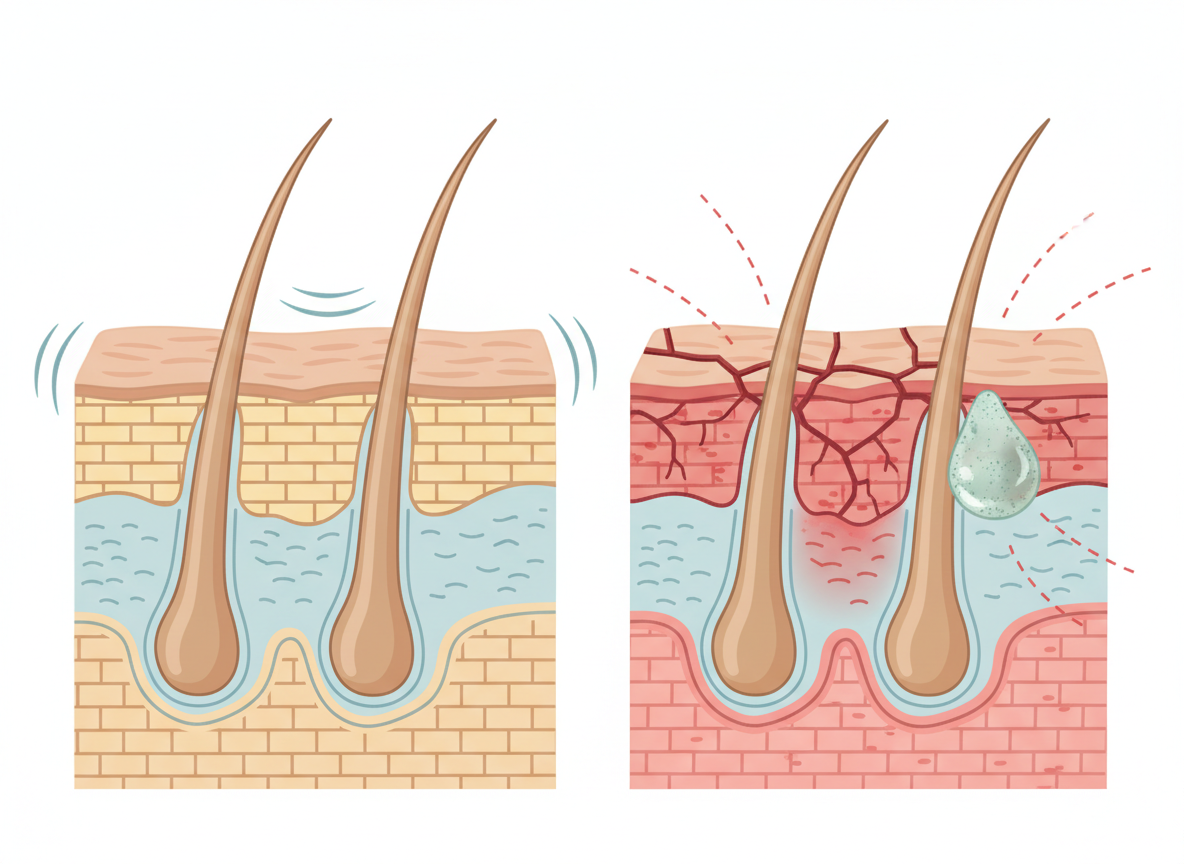
Propylene glycol is a colourless, odourless solvent used in many topical products including the standard Regaine solution and most generic minoxidil solutions. Furthermore, its job in these formulations is essential: it dissolves the minoxidil and helps it penetrate the scalp barrier to reach the hair follicles. However, this same penetration-enhancing property is what causes problems for a meaningful proportion of users.
How propylene glycol triggers irritation
Propylene glycol can cause scalp problems through several mechanisms:
- Direct irritant contact dermatitis: propylene glycol disrupts the skin barrier, causing redness, itching, and flaking. As a result, many patients develop symptoms within days or weeks of starting treatment
- Allergic contact dermatitis: a smaller proportion of users develop a true allergic sensitisation to propylene glycol. Furthermore, this is a Type IV delayed hypersensitivity reaction that can persist for years
- Cumulative dryness: combined with the ethanol content of standard minoxidil solutions, propylene glycol contributes to substantial scalp dryness, flaking, and discomfort
- Barrier disruption: as the medicine penetrates the scalp better, it can also allow other irritants to penetrate more easily
The result is a frustrating clinical picture: patients want to continue minoxidil because it’s working for their hair loss, but the scalp irritation makes daily use unbearable. As a result, propylene glycol intolerance is the single most common reason patients stop minoxidil treatment despite the medicine itself producing results.
Common symptoms of propylene glycol intolerance
Symptoms typically include:
- Persistent scalp itching that worsens through the day
- Visible scalp redness, particularly on application sites
- Flaking and dandruff-like appearance
- Burning or stinging sensation, especially shortly after application
- Tight, dry, uncomfortable scalp feeling
- Occasional small red bumps or pustules at application sites
- Reduced tolerance over time rather than improvement
Why the Gro Trichosol is the better option
The Courier Pharmacy Gro range Trichosol is specifically designed to address this problem. Furthermore, the formulation is both propylene glycol free AND alcohol free. As a result, patients who can’t tolerate Regaine because of scalp irritation can continue minoxidil treatment without the most common irritants.
Trichosol offers several advantages over standard minoxidil solutions:
- Same active minoxidil benefit: the hair loss treatment mechanism is identical to Regaine
- No propylene glycol: removes the main cause of contact dermatitis and barrier disruption
- No alcohol: removes the drying ethanol that worsens scalp dryness alongside propylene glycol
- Personalised formulation: as a compounded product, Trichosol can include additional active ingredients tailored to your specific hair loss pattern (topical finasteride, topical dutasteride, caffeine, retinol, peptides, melatonin)
- Long-term tolerability: patients who couldn’t continue Regaine often tolerate Trichosol indefinitely
- Practitioner-supported approach: part of the wider Gro range with prescriber and pharmacist input
Who benefits most from switching to Trichosol
The Trichosol alternative particularly suits patients who:
- Have developed scalp irritation after starting Regaine or generic minoxidil solutions
- Have sensitive skin generally and want to avoid potential irritants from the start
- Have failed previous minoxidil trials specifically because of scalp symptoms rather than treatment ineffectiveness
- Want a more personalised formulation including additional active ingredients
- Have eczema, contact dermatitis history, or atopic skin
- Want to combine topical minoxidil with topical finasteride or dutasteride without oral DHT blocker side effects
The honest framing
Not everyone who uses Regaine develops propylene glycol problems. Furthermore, for patients who tolerate the standard solution well, there’s no compelling reason to switch. However, for the meaningful proportion of patients who develop irritation, having a propylene glycol free alternative through the Gro range Trichosol means continuing effective minoxidil treatment rather than having to abandon it altogether.
Our pharmacist can discuss whether starting with Regaine and switching to Trichosol if irritation develops, or starting with Trichosol from the beginning, fits your situation better. As a result, the choice should match your specific scalp profile and treatment history rather than defaulting to whichever product is most familiar.

Oral minoxidil side effects
The timing matters
With low-dose oral minoxidil, the pattern over time helps us separate nuisance effects from warning signs. According to the review data, dizziness, light-headedness, hypotension, and tachycardia usually show up within the first week. Headaches tend to appear after 15 to 20 days, while hypertrichosis, fluid retention, and weight gain may not appear for the first three months.
That means you shouldn’t judge tolerance in the first few days alone. Some side effects are early and obvious. Others arrive later and need active monitoring.
Featured answer
How soon do oral minoxidil side effects start?
Some start quickly. Dizziness, low blood pressure symptoms, and fast heart rate often appear in the first week, but swelling and extra body hair may take months [1]
Why oral minoxidil needs more monitoring
Oral minoxidil can be effective, but it is not a casual add-on. In a male-only cohort, 20.6% reported headaches, 2.9% had vertigo, and 2.9% had fluid retention [1]. In UK cohort data for low-dose oral minoxidil, pedal oedema was reported in 12% to 25% at doses above 2.5 mg
Dose matters a lot. Hypertrichosis rates climb from 28.9% at 0.25 to 0.75 mg/day, to 30.4% at 1 to 1.25 mg/day, and then leap to 86.8% at 2.5 to 5 mg/day.
Oral minoxidil can work well for the right patient, but it asks more from you in return. You need to notice trends, not just one-off symptoms.
A practical UK issue is monitoring. To get around this, some practitioners recommend that off-label low-dose oral use should involve titration, with weekly blood pressure and weight checks at the start. That is sensible because swelling and blood pressure changes can creep up unnoticed.
Real-life example 2
A shift worker starts oral minoxidil and feels “a bit off” after a few days. They put the light-headedness down to poor sleep and another coffee. A home blood pressure check shows the issue more clearly. This is exactly why symptom diaries and blood pressure monitoring help. They turn vague feelings into something you can act on.
Pharmacist’s tip
If you’re using oral minoxidil, keep the same weighing day, same scale, and same time of day each week. Trends matter more than one reading.

Topical vs oral minoxidil in real life
Patients often ask me which form is “better”. That’s the wrong first question. The useful question is which form fits your risks, routine, and tolerance.
Here is the practical comparison.
| Question | Topical minoxidil | Oral minoxidil |
| Main side effect pattern | Mostly scalp irritation, redness, shedding | More body-wide effects such as light-headedness, tachycardia, oedema, hypertrichosis [1][4] |
| Monitoring burden | Usually lower | Higher, especially early on |
| Best for | People who want the more established safety profile and can manage regular application | People who can’t tolerate topical formulations or need a specialist-led plan |
| Common reason to stop | Itching, dermatitis, messy routine | Swelling, dizziness, unwanted body hair |
| Common misunderstanding | “Shedding means it’s failing” | “Low dose means no monitoring needed” |
A gym-goer may dislike greasy residue and keep missing doses after showers. They might ask about oral treatment because it feels simpler. That can be reasonable, but only if they also accept the extra monitoring and the greater chance of whole-body effects.
A person with sensitive skin may do better with foam or a PG-free compounded option rather than giving up on topical treatment altogether. The best next step isn’t always switching from topical to oral. Sometimes it’s switching the base, not the medicine.
The right option is the one you can use consistently and safely. A “stronger” option isn’t better if side effects stop you taking it.

What works for managing minoxidil side effects
What usually helps
Managing minoxidil side effects is often more about technique and formulation than brute persistence.
- Apply topical minoxidil carefully: keep it on the scalp, not the forehead, face, or pillow. This helps reduce unwanted facial hair and irritation from transfer.
- Let it dry properly: damp product spreads. Dry product stays where you put it.
- Review the vehicle: if liquid stings, a foam or PG-free option may suit sensitive skin better.
- Monitor oral treatment actively: blood pressure, pulse, and weight trends can catch problems early.
- Flag swelling early: don’t wait until shoes feel tight every evening. Mild oedema is easier to deal with than established fluid retention.

What usually does not help
Some habits make side effects worse.
- Using more than directed: extra product doesn’t magically speed up hair growth. It can increase irritation and, in some cases, raise the risk of systemic exposure.
- Ignoring a sore scalp for weeks: if the base is irritating your skin, more of the same usually won’t solve it.
- Assuming every symptom is harmless adjustment: with oral treatment, dizziness, fast heartbeat, and swelling deserve proper review.
- Chopping and changing every few days: you won’t know whether the issue is dose, timing, product base, or application method if everything changes at once.
Pharmacist’s tip
Take photos of the scalp in the same lighting every few weeks. It helps separate true worsening from the very common panic that comes with early shedding.
Pharmacist’s tip
If headaches start after beginning treatment, note when they happen in relation to application or dosing. A pattern is much easier for a clinician to assess than “I just feel odd sometimes”.
When to get urgent medical help
Most minoxidil side effects are not emergencies. A few are.
Seek urgent medical help if you develop:
- Chest pain
- Fainting
- Trouble breathing
- Rapid swelling of the face, hands, ankles, or abdomen
- Severe dizziness that makes you feel unsafe standing
- Signs of allergic reaction, such as facial swelling, wheeze, or trouble swallowing
For oral minoxidil, swelling plus breathlessness is not one to “watch and wait” on. For topical minoxidil, severe symptoms are uncommon, but if they happen, stop using it and get help.
Featured answer
When should I stop minoxidil and seek help?
Get urgent help for chest pain, breathlessness, fainting, severe swelling, or signs of allergy. Ask for prompt medical advice if you develop persistent dizziness, fast heartbeat, or worsening oedema.
Who needs extra caution in the UK
Some groups need a more individualized discussion before starting.
Women over 50 with pre-existing facial hair have a higher risk of hypertrichosis with topical treatment, especially with 5% concentrations [2]. That doesn’t mean they can’t use it. It means the risk-benefit balance and application method matter more.
Patients with sensitive skin or a history of eczema should also pause before buying the first cheap liquid they see online. UK-focused guidance highlights PG-related dermatitis as a real issue and points toward foam or compounded alternatives in selected cases.
For oral minoxidil, extra caution makes sense if you already have blood pressure problems, episodes of dizziness, fluid retention, or you take medicines that could muddy the picture. In the UK, the safest route is a clinician-led plan with proper follow-up, not informal self-experimenting.
Pharmacist’s tip
Bring a full medicine list to any oral minoxidil review, including supplements. “Natural” doesn’t always mean “irrelevant”.

Common questions patients ask me
Is shedding always a bad sign?
No. It’s often one of the more unsettling but expected early effects with topical treatment.
Is foam better than liquid?
For some people, yes. Not because it’s magically stronger, but because it may irritate the scalp less if propylene glycol is the problem.
Is oral minoxidil safe because the dose is low?
Lower dose doesn’t mean zero risk. Oral treatment still needs respect, especially for blood pressure symptoms, swelling, and unwanted body hair.
If I get side effects, does that mean minoxidil won’t suit me at all?
Not necessarily. Sometimes the fix is the formulation, dose, timing, or monitoring plan rather than stopping the medicine completely.


Summary
Minoxidil side effects depend heavily on whether you use a topical or oral form. Topical products mainly cause scalp problems such as irritation, redness, and early shedding, while oral minoxidil causes more whole-body effects like dizziness, fluid retention, and extra body hair. Timing helps. Early light-headedness and fast heartbeat can show up in the first week with oral treatment, but swelling and hypertrichosis may take longer. In UK practice, the product base matters too, especially if you react to propylene glycol. The safest approach is simple: use the right formulation, monitor properly, and ask for help early if symptoms move beyond mild irritation.
FAQs
Does minoxidil always cause side effects?
No. Many people use it without major problems. Topical treatment tends to have a more favourable safety profile at standard dosing, with side effects usually limited to the scalp.
What is the most common side effect of topical minoxidil?
The main complaints are redness and scalp irritation. Some people also notice dryness, itching, or flaking, especially with liquid formulations.
Is temporary shedding normal on minoxidil?
Yes. In the review data, 55% of topical users experienced a temporary increase in shedding during the first treatment weeks. It can be upsetting, but it isn’t automatically a sign the treatment has failed.
Does oral minoxidil cause unwanted body hair?
Yes, and the risk rises with dose. Hypertrichosis occurred in 28.9% at 0.25 to 0.75 mg/day, 30.4% at 1 to 1.25 mg/day, and 86.8% at 2.5 to 5 mg/day.
How long before oral minoxidil side effects appear?
Some appear quickly. Dizziness, light-headedness, low blood pressure symptoms, and tachycardia often show up in the first week, while hypertrichosis and fluid retention may not appear for the first three months.
Can topical minoxidil affect blood pressure?
At standard twice-daily dosing, the review data reported no systemic side effects such as hypotension, abnormal heart rate, and weight gain. However, if you feel unwell, get advice rather than assuming it’s unrelated.
What if my scalp reacts badly to liquid minoxidil?
Check whether the formulation contains propylene glycol. In sensitive patients, that ingredient can trigger contact dermatitis, and PG-free foam alternatives may be better tolerated.
When should I worry about swelling on oral minoxidil?
Take swelling seriously, especially if it is persistent, worsening, or paired with breathlessness. UK cohort data reported pedal oedema in 12% to 25% at doses above 2.5 mg.
If you’re struggling with side effects, don’t guess your way through it. A UK pharmacist or prescriber can review whether the problem is the active drug, the dose, or the formulation itself. If you need a more customized option, including advice on monitored treatment or whether a PG-free compounded minoxidil might be appropriate, seek support from a regulated UK service such as Courier Pharmacy.
Disclaimer
This article is for information only and isn’t a substitute for personal medical advice. If you have troubling symptoms, new chest pain, breathlessness, fainting, or rapid swelling, seek urgent medical help.
How this content was created
This content was written using the verified evidence supplied for this brief, with preference given to peer-reviewed and clinically focused sources. A pharmacist-style review was applied to keep the advice practical, safety-led, and relevant to UK patients.
References
[1] Jimenez-Cauhe, J et al ( 2025 ) available at: Characterization and Management of Adverse Events of Low-Dose Oral Minoxidil Treatment for Alopecia: A Narrative Review
[2] Rossi, A., Cantisani, C., Melis, L., Iorio, A., Scali, E. and Calvieri, S. (2019). Available at: Minoxidil Use in Dermatology, Side Effects and Recent Patents | Bentham Science Publishers
[3] International Society of Hair Restoration Surgery (2024) Available at: Minoxidil: Formulation, Dosage & Side-Effects – ISHRS