
There are around 10 units in a bottle of wine. More precisely, a standard 750ml at 13.5% contains 10.1, while a lighter 12% holds 9 units. That number surprises people, because the UK guideline is only 14 units a week. So one bottle over dinner uses roughly 70% of a whole week’s allowance in a single evening.
This guide covers the arithmetic, why the figure has quietly risen over the past few decades, what a home pour really contains, and what your options are if the numbers are not where you would like them to be.
Please read this first if you get shakes, sweats or bad anxiety in the morning, or you drink to steady yourself, do not cut down on your own. Sudden reductions in heavy drinking can cause seizures. Speak to your GP or alcohol service first.
Five key takeaways
- Roughly 10 units per bottle. At 13.5% you get 10.1 units. The old rule of thumb of 9 units assumed weaker wine than most people now drink.
- The maths is simple. Millilitres multiplied by ABV, divided by 1,000. For a standard bottle, just multiply the ABV by 0.75.
- One bottle is most of a week. Against the 14-unit guideline, a 13.5% bottle accounts for about 70% of it.
- Home pours are bigger than you think. A generous glass at home can hold 250ml, which is 3.4 units at 13.5% before a top-up.
- The guideline is low risk, not no risk. UK advice is 14 units a week for everyone, spread over three days or more.
How many units are in a bottle of wine?
In short, a standard bottle holds 750ml, and the answer depends entirely on strength.
At 13.5%, which covers a great many supermarket reds, you get 10.1 units. Drop to 12% and the figure falls to 9. Push up to 14%, common in warmer-climate reds, and it rises to 10.5.
However, you may have heard that a bottle contains 9 units, and that used to be a reasonable shorthand. It assumed 12% wine, though, and average strengths have climbed since. Ten is the safer modern estimate.
A standard 750ml bottle contains about 10 units at 13.5% ABV, 9 units at 12%, and 10.5 units at 14%. One bottle is roughly 70% of the UK weekly guideline of 14 units.
What is a unit of alcohol, and what does ABV mean?
Two definitions underpin everything else here, and neither takes long.
A unit is 10ml, or 8g, of pure alcohol
Britain introduced the idea in 1987 to give people a simple way of tracking drinking across wildly different products. It works because it strips out the packaging and the strength, and leaves you comparing one thing only.
That figure was not chosen at random. Roughly one unit is what an average adult processes in an hour, so in theory an hour after a single unit there is little alcohol left in the blood. In practice this varies considerably between people, and it is a rough guide rather than a rule to drive by.
ABV stands for alcohol by volume.
It is the percentage of a drink that is pure alcohol.
So a wine labelled 13% ABV is 13% pure alcohol and 87% everything else: water, acids, sugars, and the compounds that give it colour and flavour.
The “by volume” part matters, because you could measure alcohol content by weight instead and get a lower figure. Alcohol is lighter than water, so 13% by volume works out at roughly 10.5% by weight. The UK uses volume, as does most of the world.
You will find it on every label, written as 13% ABV, 13% vol, or sometimes just 13%. Anything above 1.2% alcohol has to display it by law.
Here is why it matters so much. ABV converts any volume of any drink into a comparable amount of alcohol. A pint of beer and a large glass of wine look nothing alike, yet the same sum handles both.
Typical ABVs
| Drink | Typical ABV |
| Beer and lager | 3.5% to 6% |
| Cider | 4% to 8% |
| Wine | 11% to 15% |
| Fortified wine, such as sherry or port | 15% to 22% |
| Spirits | 37.5% to 40% |
Notice the range within wine alone. Between the lightest and strongest bottle on the same shelf sits nearly four units of difference.
How to work out the units in a bottle of wine
Because one unit is 10ml of pure alcohol, the sum is straightforward.
Units = millilitres × ABV ÷ 1,000
A 175ml glass at 13% therefore gives you 175 × 13 ÷ 1,000, which is 2.3 units.
For a standard bottle there is a shortcut worth memorising. Multiply the ABV by 0.75 and you have your answer. A 13% bottle gives 9.75 units, a 14% bottle gives 10.5.
Pharmacist’s tip the ABV is printed on every label, usually as a percentage or next to the word “vol”. It is the only number you need, and it varies more between bottles than most people notice.
Units in a bottle of wine by strength
| Strength | Units per 750ml bottle | Share of weekly 14 units |
| 10% (light white) | 7.5 | 54% |
| 11% | 8.3 | 59% |
| 12% | 9.0 | 64% |
| 13% | 9.8 | 70% |
| 13.5% | 10.1 | 72% |
| 14% (many reds) | 10.5 | 75% |
| 15% (some new world reds) | 11.3 | 80% |
Notice the spread, though. Between a light white and a heavy red, the difference is nearly four units per bottle, which is most of a day’s drinking by any sensible measure.
Units in a glass versus a bottle of wine
Here the confusion multiplies, because “a glass of wine” describes at least three different amounts.
| Glass | 12% ABV | 13.5% ABV |
| Small, 125ml | 1.5 units | 1.7 units |
| Medium, 175ml | 2.1 units | 2.4 units |
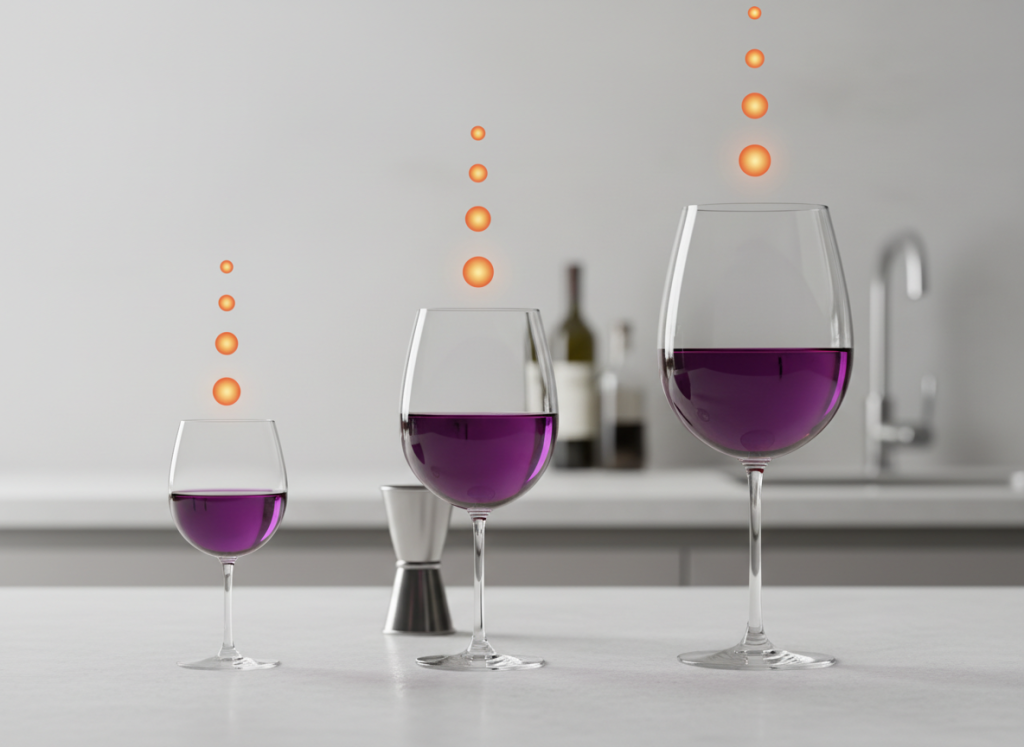
| Large, 250ml | 3.0 units | 3.4 units |
A large glass at 13.5% contains more than two units. Three of those and you have had over 10 units, which is a full bottle in all but name.
Meanwhile, home measures deserve their own warning. Pub glasses are regulated, but nobody measures at the kitchen counter, and research consistently finds home pours run larger than people estimate. If your everyday wine glass holds 250ml when filled to a comfortable level, two “glasses” is closer to half a bottle than a third of one.
Bottle of wine units versus other drinks
Wine rarely gets drunk in isolation, so context helps. These are the NHS reference figures for common measures.
Wine
| Measure | Units |
| Small glass, 125ml at 12% | 1.5 |
| Standard glass, 175ml at 12% | 2.1 |
| Large glass, 250ml at 12% | 3.0 |
Beer, lager and cider
| Measure | Units |
| Bottle, 330ml at 5% | 1.7 |
| Pint of lower strength, 3.6% | 2.0 |
| Can, 440ml at 5.5% | 2.4 |
| Pint of higher strength, 5.2% | 3.0 |
Spirits and others
| Measure | Units |
| Single small measure, 25ml at 40% | 1.0 |
| Alcopop, 275ml at 4.6% | 1.3 |
| Single large measure, 35ml at 40% | 1.4 |
A few things jump out of those numbers.
A large glass of wine equals a strong pint. Both come to 3 units, which surprises people who think of wine as the lighter option.
Spirits are the smallest single serving. A 25ml measure is 1 unit, less than any glass of wine. The risk with spirits lies in home pours, where nobody uses a 25ml optic.
Measure size varies by region. Scotland has traditionally served 35ml singles, which take the same drink from 1 unit to 1.4. Worth knowing if you order the same round in different places.
Set against a bottle of wine at roughly 10 units, that is about the same alcohol as five lower-strength pints, or ten single measures of spirits.
Why the numbers have crept up
In short, two things have changed, and neither was announced.
Wine got stronger. Warmer growing seasons and shifting tastes have pushed average strengths up. A wine that would have been 11.5% a few decades ago may now be 13.5%, which adds two units to every bottle without changing anything visible.
Glasses got bigger. The standard restaurant pour has grown, and home glassware has grown considerably more. A wine glass from the 1980s looks like a thimble beside a modern one.
So the same habit, described in the same words, now delivers noticeably more alcohol than it did. That is one reason people are genuinely surprised when they do the arithmetic for the first time.
How bottle of wine units compare with the guidelines
UK Chief Medical Officers advise not regularly drinking more than 14 units a week, and that figure applies equally to men and women. The advice also says to spread those units across three or more days, with several drink-free days.
Yet two points often get lost.
Saving them up does not work. Drinking your 14 units across one or two sessions carries more risk than spreading them, even though the weekly total matches. Six or more units in a session for women, or eight or more for men, counts as binge drinking.
Fourteen units is low risk, not no risk. The guidelines are explicit that no completely safe level exists. Fourteen is where the risk is considered small, not absent.
Against that background, a bottle of 13.5% wine on a Friday and another on a Saturday puts you at 20 units, comfortably above the weekly guideline before the working week has started.
The calories nobody counts
Alcohol carries 7 calories per gram, which is nearly as many as fat at 9. That single fact explains most of what follows.
| Drink | Calories |
| Standard 175ml glass of 12% wine | up to 158 |
| Pint of 5% beer | up to 222 |
| 275ml bottle of 4.5% alcopop | 154 |
| 50ml of 17% cream liqueur | 153 |
| 75ml of 17.5% fortified wine | 102 |
| Double 50ml measure of 40% spirits | 100 |
A full bottle of wine therefore lands somewhere around 600 to 650 calories, before anything you eat alongside it.
Stretch that across a year and the arithmetic gets striking. Four bottles of 12% wine a month comes to roughly 32,400 calories annually. Five pints of 5.2% lager a week reaches about 57,720.
Two further things work against you here.
Mixers add more. Cola, tonic and juice all carry their own calories, and nobody counts them either.
Your body deals with alcohol first. It treats alcohol as a priority, which effectively pauses other metabolism while it works through what you have drunk. So those calories are not simply added to the total, they arrive with a queue-jump.
Nobody needs guilt about a glass of wine. But if you are watching what you eat and drinking regularly, the drinks may be the largest thing you are not counting.
Practical ways to reduce the impact
- Alternate with water. A glass between drinks slows the pace and helps with dehydration.
- Eat first. Drinking on an empty stomach speeds absorption and tends to increase how much you drink.
- Step out of rounds. Buying in rounds means drinking at the pace of the fastest person there.
- Lengthen the drink. A splash of soda in white wine makes the same units last considerably longer.
- Sip rather than gulp. Obvious, and surprisingly effective.
- Cut down alongside someone. Company makes it stick better than resolve alone.

If the numbers bother you
Working out your units for the first time can be uncomfortable. That discomfort is useful information rather than a verdict on your character.
Meanwhile, a few practical things help.
Use a calculator rather than guessing. Alcohol Change UK runs a free unit and calorie calculator, and the NHS Drink Free Days app tracks over time.
Track for two weeks before deciding anything. Days, glasses, rough sizes. Memory is a poor guide, and the written version is usually different from the remembered one. Change the glass, not just the intention. Using a smaller glass reduces intake more reliably than resolving to pour less into a large one.
Give yourself several drink-free days. These do more for your risk profile than shaving a little off each evening.
Watch for the drift. If your drinking has slowly increased over years rather than jumping suddenly, that is the commonest pattern, and it is the one people notice last.
If reducing on your own has not worked, that is not a failure of willpower. Alcohol acts on reward pathways that are specifically designed to make repetition easy, which is what the next section is about.
Where Naltrexone and the Sinclair Method fit
For some people, counting is enough. For others, knowing the number changes nothing, because the pull to drink is stronger than the arithmetic.
So that is where medication becomes worth discussing.
Alcohol releases endorphins, which land on opioid receptors and deliver the reward signal that teaches your brain the experience was worth repeating. Naltrexone blocks those receptors, so the signal goes quiet. You still taste the wine, and you still get drunk. What goes missing is the reinforcement.
The Sinclair Method applies that idea on a particular schedule. Rather than a daily tablet, you take one an hour or two before you plan to drink, and nothing on days you do not. Drinking repeatedly without the usual reward gradually weakens the craving, a process called pharmacological extinction.
What Naltrexone does not do
Worth being clear, because the misconceptions put people off unnecessarily.
- It does not make you ill if you drink. You may be thinking of disulfiram, which does exactly that. Naltrexone simply removes the reward.
- It does not reduce how drunk you get. Your blood alcohol and coordination are unchanged.
- It does not undo alcohol’s effects on your body. Your units still count the same, and so does the harm.
- It is not a substitute for support. Every trial that showed benefit paired the medicine with structured help.
Who targeted Naltrexone suits
It fits people who want to cut down rather than stop, who can see drinking occasions coming, and who take no opioid painkillers, since that combination is genuinely unsafe.
It does not fit everyone. Anyone with physical alcohol dependence needs supervised withdrawal first, and anyone whose drinking is entirely unplanned will struggle with the timing.
How to start the Sinclair Method in the UK
Three routes exist, and they are not equivalent.
- Your GP. Free, and a sensible first stop. Be aware that many GPs have not come across targeted dosing, and some will only prescribe naltrexone after a period of abstinence. Ask about naltrexone and nalmefene by name rather than about the method.
- NHS alcohol services. Also free, and self-referral is usually possible without going through your GP. These wrap counselling and medical supervision around the medicine, which private services rarely match. If you have any signs of physical dependence, this is the right route rather than a shortcut.
- A private prescriber. Faster, and more likely to know the protocol. You pay for the consultation and the medicine, and the standard of follow-up varies considerably between providers.
There is a fourth option worth naming. Tracking your units for a month and cutting back deliberately works for plenty of people. Medication is a tool for when that has not worked, rather than a first move.

How the Courier Pharmacy route works
If you choose the private route with us, here is the sequence. Nothing is dispensed until a prescriber has reviewed your case.
Step one: the online consultation
This is where everyone starts, the online consultation, and it is free. It takes about ten minutes and covers your drinking pattern, your goal, your medical history, your current medicines and your mental health. There is no way around it, because a prescriber cannot make a safe decision without it.
Answer it honestly, including the awkward parts. A half picture leads either to an unsafe prescription or a rejected one, and neither helps you.
Step two: prescriber review
A UK-registered prescriber reads your answers and checks several things: whether you show signs of physical dependence, whether opioids or liver or kidney problems rule treatment out, whether nalmefene would suit you better, and whether blood tests are needed first.
Step three: the decision
Three outcomes are possible. We may approve treatment. We may come back with questions or ask for bloods before going further. Or we may decline and explain why.
A decline is not a dead end. Where physical dependence looks likely, we refer to NHS services, because supervised withdrawal is safer than anything we can offer remotely.
Step four: treatment and review
If approved, your options appear in your account, along with dosing instructions written for the schedule you agreed. A follow-up review is built in rather than left to you to remember.
What to have ready before your consultation
Two things make the consultation far more useful.
A two-week drinking diary
Days, drinks, rough sizes, times. Memory is a poor guide to your own drinking, and the written version usually differs.
A full list of your medicines
Include anything occasional, anything bought over the counter, and anything prescribed by someone else. Several ordinary pharmacy products contain opioids, and that is the commonest reason a request gets declined.
Our alcohol addiction page sets out what we can and cannot offer, and our guide to the Sinclair Method explains the approach itself, including what the evidence does and does not show.

Summary
A standard bottle holds about 10 units at typical modern strengths, which is roughly 70% of the UK weekly guideline in a single container.
The arithmetic is easy once you know it. Millilitres times ABV divided by a thousand, or simply ABV times 0.75 for a standard bottle. What catches people out is that wine has got stronger and glasses have got bigger, so an unchanged habit now delivers more alcohol than it once did.
If the numbers concern you, start by tracking honestly for a fortnight. Most people find the written record differs from the remembered one, and that gap is where useful change begins.
If cutting down alone has not worked, medication is a legitimate option worth discussing. Your GP or local alcohol service is free and a good place to start, and Courier Pharmacy offers clinician-led appointments for people who want a structured private route. Drinkline is also available on 0300 123 1110.
FAQs
How many units are there?
About 10 at 13.5% ABV, 9 at 12%, and 10.5 at 14%. Multiply the ABV by 0.75 for any standard 750ml bottle.
What does ABV stand for?
Alcohol by volume. It is the percentage of the drink that is pure alcohol, so 13% ABV wine is 13% alcohol and 87% other things.
Is a bottle of wine a week too much?
It is within the 14-unit guideline, but only if spread across several days rather than drunk in one sitting.
How many units in a large glass of wine?
A 250ml glass holds 3 units at 12% and 3.4 units at 13.5%.
How long does it take to clear a bottle of wine?
Your body processes roughly one unit an hour, so around 10 hours for a typical bottle. That is why morning-after driving is riskier than people assume.
How does a bottle of wine compare with beer?
Around 10 units is roughly five pints of lower-strength lager, or a little over three pints of stronger beer.
How many calories are in a bottle of wine?
Roughly 600 to 650, depending on strength and sweetness. A standard 175ml glass is up to 158.
Is red or white wine higher in units?
Red is often stronger, commonly 13.5% to 15%, while whites frequently sit between 11% and 13%. Check the label rather than the colour.
Does the 14-unit guideline differ for men and women?
No. It has applied equally to both since 2016.
Can naltrexone help me drink less wine?
It may. It blocks alcohol’s reward signal, which can reduce craving over months. A prescriber would need to assess whether it suits you.
Does naltrexone stop me getting drunk?
No. Your blood alcohol and impairment are unchanged. It removes the reward, not the alcohol.
This article is for general information. If you are worried about your drinking, please speak to your GP, your local alcohol service, or Drinkline on 0300 123 1110.
References
- National Health Service (2026) Alcohol units. Available at: https://www.nhs.uk/live-well/alcohol-advice/calculating-alcohol-units/ (Accessed: 8 August 2026).
- National Health Service (2026) Calories in alcohol. Available at: https://www.nhs.uk/live-well/alcohol-advice/calories-in-alcohol/ (Accessed: 8 August 2026).
- National Institute for Health and Care Excellence (2011) Alcohol-use disorders: diagnosis, assessment and management of harmful drinking (high-risk drinking) and alcohol dependence. NICE guideline CG115. Available at: nice.org.uk/guidance/cg115 (Accessed: 7 August 2026).
- Courier Pharmacy (2026) How the Sinclair Method works: the science of unlearning. Available at: https://courierpharmacy.co.uk/how-the-sinclair-method-works-the-science-of-unlearning/ (Accessed: 8 August 2026).
- Sinclair, J.D. (2001) ‘Evidence about the use of naltrexone and for different ways of using it in the treatment of alcoholism’, Alcohol and Alcoholism, 36(1), pp. 2-10. doi: 10.1093/alcalc/36.1.2.