

What is the Sinclair Method, and why does it sound so unlike every other alcohol treatment you have heard of? That is the question people arrive with, usually after a search that turned up something surprising: a tablet you take before you drink, on a plan that does not ask you to stop. This guide answers it from a pharmacist’s side of the counter. Not the marketing version, and not the textbook version either, but what the approach actually involves, what turns up in the bag, and the questions people genuinely ask once they have the box in their hand.
Some of what follows is reassuring. Some of it is less comfortable than the websites suggest. Both seem worth knowing before you start.
Please read this first if you get shakes, sweats or bad anxiety in the morning, or you drink to steady yourself, do not cut down on your own. Sudden reductions in heavy drinking can cause seizures. Speak to your GP or alcohol service first.
Five Key Takeaways
- It is one medicine used on an unusual schedule. Naltrexone, taken one to two hours before drinking, and not at all on other days.
- You keep drinking while it works. That is the design, not a loophole. The medicine has to be active during drinking for anything to happen.
- It is off-label in the UK. No UK guideline names this protocol, though naltrexone itself is licensed and NICE-recommended for daily use.
- The opioid question is the one that matters most. It is the commonest reason a request gets declined, and the reason people carry a warning card.
- Expect months. Most people who respond describe change over three to six months, not weeks.
What is the Sinclair Method?
It is a way of using naltrexone, an ordinary prescription medicine that blocks opioid receptors in the brain.
The unusual part is the schedule. Instead of a tablet every morning, you take one an hour or two before you plan to drink. If you do not drink that day, you take nothing.
Dr John David Sinclair developed the approach in Finland from the 1980s. His argument was blunt: demanding abstinence on day one fails most people, so teach the brain to lose interest in alcohol instead, while the person carries on living their life.
That is genuinely the whole protocol. One tablet, correct timing, every drinking occasion, for months.
Pharmacist’s tip the simplicity catches people out. There is no cleverness to master. The difficulty is doing something simple consistently for a long time.
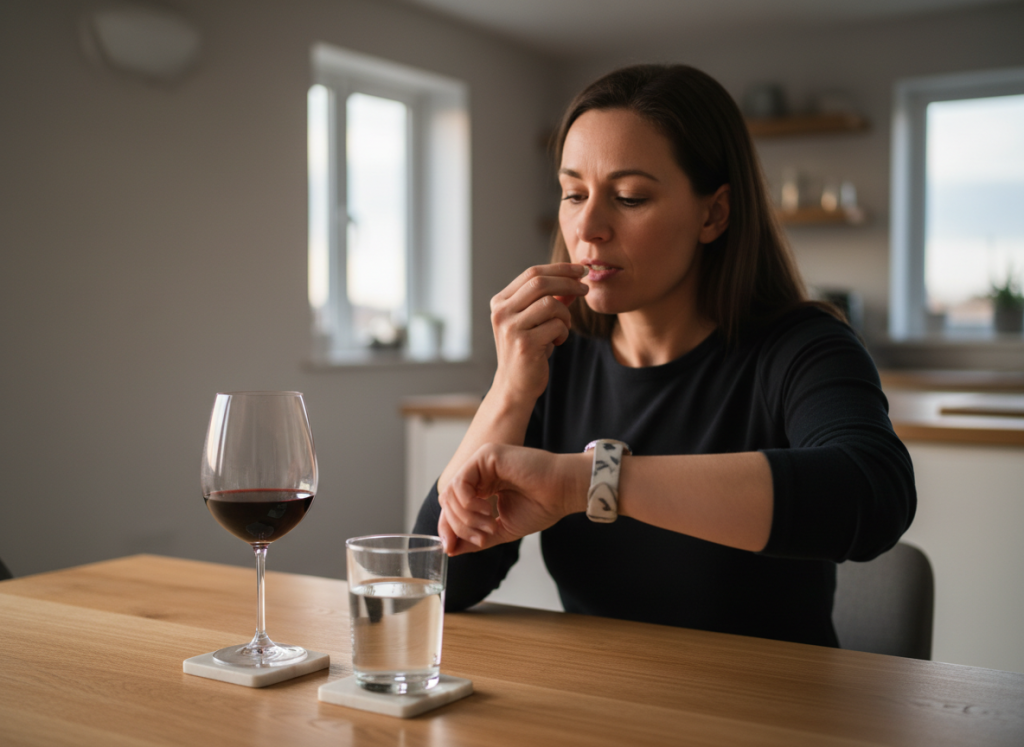
What is the Sinclair Method trying to do?
Alcohol releases endorphins, which land on opioid receptors and deliver a signal telling your brain the experience was worth repeating. Do that often enough and the habit strengthens.
Naltrexone occupies those receptors, so the signal goes quiet. You still taste the drink, and you still get drunk. What goes missing is the reward that would normally reinforce the pattern.
Drink repeatedly under those conditions and the learned craving gradually weakens. That process has a name, pharmacological extinction, and our guide to how the Sinclair Method works covers the mechanism properly.
The practical consequence is the one worth carrying: the medicine only teaches your brain anything while you are actually drinking. That is why the timing is the protocol rather than a detail of it.
The Sinclair Method uses naltrexone taken one to two hours before drinking. By blocking alcohol’s reward signal during drinking, it aims to weaken the learned craving over months, a process called pharmacological extinction.
What arrives when you start the Sinclair Method
Worth knowing, because people expect something more elaborate.
Naltrexone tablets or capsules
Most people receive licensed 50 mg tablets: oval, beige, film-coated, with a score line down both faces so they halve cleanly. Usually 28 in a box. They contain lactose, which matters only for a small group of people, covered in the next section.
Where a prescriber has identified a clinical reason the licensed tablet will not do, we can supply a compounded naltrexone 25 mg capsule instead. These are made for one named patient to that prescriber’s order, and they are suitable for vegetarians and are lactose-free.
A patient alert card
Small, and easily thrown away with the packaging. Do not. It tells emergency staff you are on an opioid blocker, which changes how they manage your pain relief.
A patient information leaflet
If you have the licensed tablets. Note that it is written for daily use in alcohol dependence rather than for this protocol, so it will not describe taking the tablet before drinking. That discrepancy alarms people who read it carefully. Your prescriber’s instructions are the ones to follow.
Compounded Naltrexone 25mg capsules
Compounded capsules work differently here. Because they are unlicensed, they come with a tailor-made patient information leaflet. Your prescriber should talk you through what taking an unlicensed medicine means before you start.
Dosing instructions from us
Specific to the schedule you agreed, for example, if you have ordered the initiation pack, then the dose will include advice on how to increase the dose safely.
That is it. No monitoring device, no supplements, no proprietary system.
If you cannot take the licensed tablet
A detail worth knowing, because it catches a small number of people out.
The licensed naltrexone tablets contain lactose. For nearly everyone that is irrelevant, since the quantity is tiny and ordinary lactose intolerance is not a problem at this scale.
However, the product information is explicit that anyone with a rare inherited sugar disorder should not take them. That covers hereditary galactose intolerance, total lactase deficiency and glucose-galactose malabsorption. These are uncommon conditions, and if you have one you will already know.
Where that applies, no licensed naltrexone product will do. A pharmacy can then prepare a lactose-free capsule for one named patient, made to a prescriber’s order. Courier Pharmacy runs a compounding service, so this route is available where a prescriber identifies the need.

Compounding at Courier
When the standard option isn’t the right fit, we can make one to order
Courier is a compounding pharmacy. Where a prescriber decides it’s appropriate for you, we can prepare bespoke, made-to-order preparations — tailored to the individual, under full clinical governance. It’s the same principle that runs through everything we do.
What is compounding and why is it used?
It is an unlicensed medicine. A compounded preparation has not been assessed by the MHRA in the way a licensed tablet has. A registered pharmacy makes it to pharmaceutical standards, but the regulator has never reviewed the finished product. So it is not an upgrade on the licensed tablet. It is a solution where the licensed tablet genuinely will not work.
A prescriber decides, not you or us. The rules only permit a special where no licensed medicine meets that patient’s clinical need. A documented intolerance qualifies. Preferring a capsule does not.
Other circumstances can justify one too: no licensed strength available (naltrexone is only available as a 50mg tablet), difficulty swallowing a tablet of that size, or a physical inability to divide tablets safely because of tremor or impaired vision.
If you think any of these apply to you, raise it in your consultation. Your prescriber will decide, record the reason, and explain what taking an unlicensed medicine means before anything is supplied.
PHARMACIST’S TIP if you follow a vegan diet, mention it at assessment. Lactose is dairy-derived, so the licensed tablets are not vegan, though they are suitable for vegetarians.
What we check before handing over the Naltrexone
The same list, every time, and it is short for a reason. Nearly all the risk sits in one place.
Opioids
Naltrexone blocks them, so taking it with opioids on board can trigger a sudden, severe withdrawal. This is the checked-twice item. It covers codeine, tramadol, morphine and methadone, and it includes things people do not think of as opioids: co-codamol from the shelf, Nurofen Plus, some cough linctus, loperamide for diarrhoea.
Liver function blood tests
Baseline liver function before starting, repeated during treatment. If someone tells me they were prescribed this with no blood test at all, I ask questions.
Being physically dependent on alcohol
Morning shakes or drinking to steady yourself changes the answer entirely, and cutting down alone becomes dangerous rather than merely difficult.
Questions people ask at the counter
These come up so consistently that they are worth answering here.
“Will it stop me getting drunk?”
No. Your blood alcohol is unchanged, and so is your coordination. If anything the drug may make divided attention harder while you drink. It removes the pleasure, not the impairment, which is a genuinely important distinction for driving.
“Can I take it after I’ve had a drink?”
No, the block needs to be in place as you start, not applied halfway through.
“What if I forget?”
Then drink anyway and the session works against you, because your brain gets the usual reward. One slip will not undo months. A pattern will stall you.
“Do I take it on days I’m not drinking?”
No, and that is the point. It also means a box lasts far longer than a daily prescription would.
“Will it make me feel flat?”
Some people notice food, exercise or sex feels less rewarding on dosing days. Taking it only before drinking keeps that to the days it is needed.
“How will I know it’s working?”
Usually by noticing you stopped after two when you would have had four, rather than by feeling anything dramatic. It is subtractive, which makes it easy to miss without a written record.
What are the side effects of naltrexone?
Honest version: mildly unpleasant for many people, and then fine.
Nausea leads the list, followed by headache, tiredness, poor sleep and sometimes a restless, slightly wired feeling. Joint and muscle aches are more common than people expect. Most of it settles within one to two weeks.
Take it with food and drink plenty of water. Both help considerably, and neither reduces how well the medicine works. Many prescribers start at half a tablet for the first week to smooth the transition. Courier Pharmacy offers an initiation pack which contains naltrexone 4.5mg capsules in addition to the naltrexone 25mg capsules. This gives you the flexibility to titrate the dose more carefully to ensure that your body adjusts to naltrexone before you start using the full dose before drinking.
Two things worth knowing. Vivid or unsettling dreams turn up quite often, and usually fade. And in one trial, side effects were markedly more common among patients told to abstain than among those who kept drinking, which raises the possibility that some early “side effects” are unrecognised alcohol withdrawal.
If something has not settled after a fortnight, that is a conversation rather than a reason to stop quietly.
Useful practice advice when starting the Sinclair Method
- Carry a tablet with you. Drinking is not always planned a day ahead. A tablet in your wallet costs nothing and saves a wasted session.
- Tell your dentist and any hospital. Standard pain relief will not work normally. This is the single most useful thing on the alert card.
- Plan transport before you take it. You should not be driving after alcohol regardless, and this medicine does not change that.
- Keep a record from day one. Days, units, whether you took the tablet. Reviews are worth infinitely more with data than without.
Where the Sinclair Method sits in UK Practice
This part is where the websites and the guidance part company, so it deserves stating plainly.
Naltrexone is licensed in the UK and recommended by NICE for alcohol dependence, taken daily alongside psychological support, after a supported withdrawal. That is the mainstream route, and it is well supported.
The Sinclair Method is not named in UK guidance. Using naltrexone on a targeted schedule is therefore off-label. That is legal and sometimes entirely appropriate, but it should be an informed decision rather than something you discover later.
There is also a licensed option that rarely gets mentioned. Nalmefene is taken on days you expect to drink, and NICE recommends it for people reducing a high level of drinking. Most UK prescribers will consider it before off-label naltrexone, and reasonably so.
For the evidence, including an honest look at the widely quoted 78% figure, see our guide to whether the Sinclair Method works.
What the Sinclair Method is not?
Clearing up the misconceptions I hear most.
- It is not a detox. If you are physically dependent, this is not your starting point, and stopping abruptly on your own can be dangerous.
- It is not Antabuse. Disulfiram makes you violently ill if you drink. Naltrexone does nothing of the sort, and confusing the two puts people off unnecessarily.
- It is not a licence to drink more. You get just as drunk, and the health harms of alcohol are unchanged.
- It is not a twelve-week course. Sinclair argued for keeping a tablet available indefinitely, since the old learning rebuilds if drinking resumes unmedicated.

Summary
So, what is the Sinclair Method? One licensed medicine, used on an unlicensed schedule, taken before drinking rather than daily, aimed at weakening a habit rather than enforcing abstinence.
The mechanism is sound and the medicine is well understood. What varies is whether the schedule fits your life, because it asks for a tablet before every drinking occasion over months rather than weeks.
From behind the counter, the things that decide how this goes are unglamorous. No opioids. Bloods done before starting. Tablet taken every time. A written record. Support alongside.
If you are worried about your drinking, your GP or local alcohol service is a good place to start. Courier Pharmacy offers clinician-led appointments for people who want a structured private route with proper follow-up.
FAQs
What is the Sinclair Method in one sentence?
Taking naltrexone one to two hours before drinking, so alcohol stops delivering its reward and the craving fades over months.
Do I have to stop drinking?
No. The approach depends on drinking while the medicine is active, which is what separates it from standard NHS use.
Is it available on the NHS?
Not as a named protocol. NHS routes are daily naltrexone after withdrawal, or nalmefene for reducing heavy drinking.
How long does it take to work?
Most people who respond describe change across three to six months, with fuller change often taking six to twelve.
Will it make me ill if I drink?
No. You may confuse it with disulfiram, which does exactly that. Naltrexone simply reduces the reward.
Can I take painkillers with it?
Paracetamol and ibuprofen are fine. Anything containing codeine or another opioid is not, including several products sold over the counter.
Do I need blood tests?
Yes are usually required before you begin.. Liver function before you start, and again during treatment.
What if it does not work for me?
That is useful information rather than a failure. Speak to your prescriber about nalmefene, daily naltrexone, or NHS support.


This article is for information only. It does not replace a clinical assessment. Naltrexone is a prescription-only medicine and should only be started by a clinician experienced in treating alcohol dependence.
References
1. Courier Pharmacy (2026) How the Sinclair Method works: the science of unlearning. Courier Pharmacy. Available at: https://courierpharmacy.co.uk/how-the-sinclair-method-works-the-science-of-unlearning/ (Accessed: 6 August 2026).
2. Courier Pharmacy (2026) Sinclair Method dosing: targeted naltrexone explained. Available at: https://courierpharmacy.co.uk/sinclair-method-dosing-targeted-naltrexone-explained/ (Accessed: 7 August 2026).
3. Heinälä, P., Alho, H., Kiianmaa, K., Lönnqvist, J., Kuoppasalmi, K. and Sinclair, J.D. (2001) ‘Targeted use of naltrexone without prior detoxification in the treatment of alcohol dependence: a factorial double-blind, placebo-controlled trial’, Journal of Clinical Psychopharmacology, 21(3), pp. 287-292. doi: 10.1097/00004714-200106000-00006.
4. Kranzler, H.R., Tennen, H., Armeli, S., Chan, G., Covault, J., Arias, A. and Oncken, C. (2009) ‘Targeted naltrexone for problem drinkers’, Journal of Clinical Psychopharmacology, 29(4), pp. 350-357. doi: 10.1097/JCP.0b013e3181ac5213.
5. Sinclair, J.D. (2001) ‘Evidence about the use of naltrexone and for different ways of using it in the treatment of alcoholism’, Alcohol and Alcoholism, 36(1), pp. 2-10. doi: 10.1093/alcalc/36.1.2.