

Most medicines come with a simple instruction: one tablet daily. Sinclair Method dosing works differently, and the difference is the entire point of it.
You take naltrexone one to two hours before you drink. On days you do not drink, you take nothing at all. That single rule follows directly from how the method is meant to work, and getting it wrong is the commonest reason people conclude it has failed them.
So this guide covers the timing, why 50 mg is the target, where the 25 mg starting dose fits, how to reach that dose, and what happens when life gets in the way.
Please read this first if you get shakes, sweats or bad anxiety in the morning, or you drink to steady yourself, do not stop or cut down on your own. Sudden cuts in heavy drinking can cause seizures. Speak to your GP or alcohol service before changing anything.
Five Key Takeaways
- No drink, no tablet or capsule. Targeted naltrexone is taken only before drinking occasions. Days without alcohol need no dose.
- One to two hours ahead. The drug peaks in the blood about an hour after you swallow it, so the block is strongest when the alcohol arrives.
- 50 mg is the target dose. Targeted dosing depends on how firmly receptors are blocked during the drinking window, so most people work up to a full tablet.
- 25 mg is a starting step, not a destination. It exists to get you past the first week without nausea, then you build up.
- A missed dose is worse than a missed day. Drinking without the tablet reinforces the habit rather than weakening it.
What Sinclair Method Dosing Actually Means
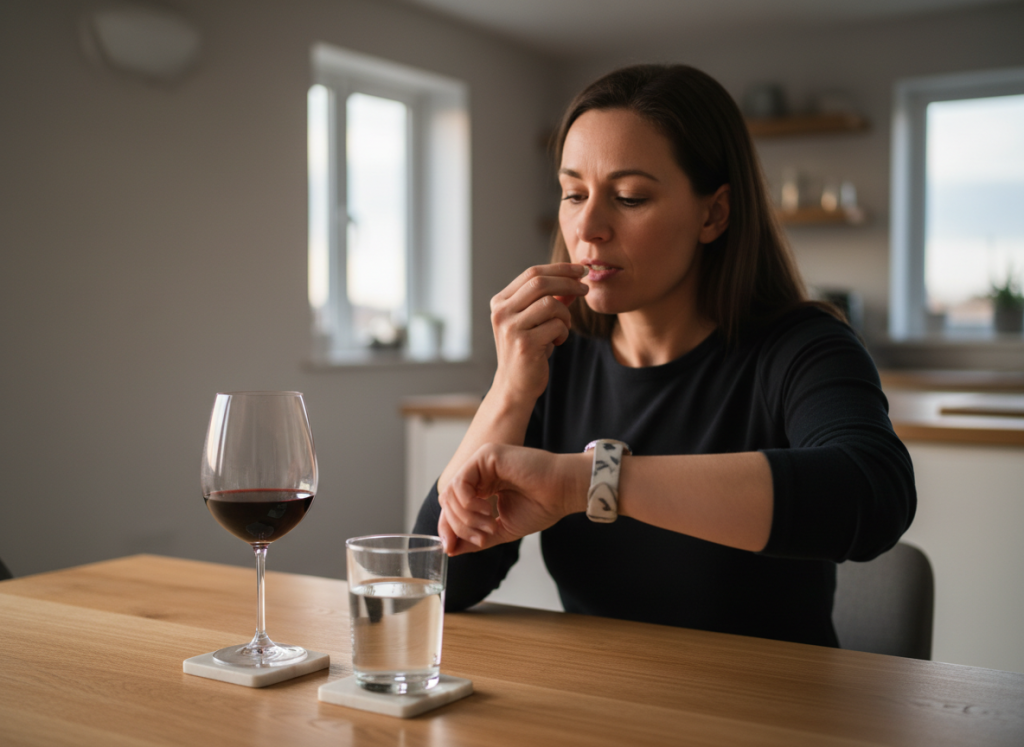
The rule is short enough to memorise. Take a tablet or capsules one to two hours before you plan to drink. Do not take one on days you do not drink.
Everything else follows from why that works.
Alcohol releases endorphins, which land on opioid receptors and deliver the reward signal that teaches your brain to want more. Naltrexone occupies those receptors, so the signal goes quiet. Drink repeatedly under those conditions, and the learned craving weakens, a process called pharmacological extinction.
Because extinction only weakens a response that is actually made, the tablet has to be working while you drink. That is why timing sits at the centre of everything here, rather than being a detail on the label.
Pharmacist’s tip: the drug does not make drinking unpleasant, unlike disulfiram. It makes drinking less rewarding, which is a different sensation entirely and far less dramatic than people expect.
Why Sinclair Method Dosing Timing Matters
Naltrexone is absorbed quickly, and blood levels peak roughly an hour after you swallow it. Taking it one to two hours ahead puts that peak right where the alcohol lands.
Take it too early, and the block is fading before you finish your second drink. Swallow it as you sit down, and the first drink arrives largely unblocked. Leave it until the following morning, and your brain learns nothing at all, because no drinking response remains to weaken.
So build a habit around the timing rather than relying on memory. Many people set an alarm or attach the dose to something fixed, like leaving work or starting to get ready.
Sinclair Method dosing means taking naltrexone one to two hours before drinking, and taking nothing on days you do not drink. The drug peaks about an hour after swallowing, so the block is strongest during the drinking session.
Why 50 mg is the Sinclair Method Dosing Target
Here, the logic differs sharply from daily use.
With daily dosing, the aim is steady background cover, and a slightly lower level still provides some of that. With targeted dosing, everything rests on how completely the receptors are blocked during the specific hours you drink. A partial block means a partial lesson.
That is why most people using this approach work up to a full Naltrexone 50 mg tablet before drinking occasions. The original protocol used 50 mg, and it remains the dose the evidence sits on.
Some people find they tolerate 50 mg poorly and settle lower with their prescriber’s agreement. That is a legitimate decision, made with someone who knows your case, rather than a default to drift into.
Where the 25 mg Sinclair Method Dosing Step Fits
Now the Naltrexone 25 mg question, which causes a lot of confusion.
The first week or two on naltrexone is when nausea, headache and tiredness show up. Those effects drive more people off this medicine than anything else, and someone who abandons treatment in week one never finds out whether it would have worked.
So many prescribers start at Naltrexone 25 mg or even lower ( Courier Pharmacy offers an initiation pack which starts with the naltrexone 4.5mg capsules). Take a half dose before your first few drinking occasions, let your body settle, then move to 50 mg once you know how you react.
Note what this is and is not. It is a tolerance step, not a lower version of the treatment. The evidence for reducing drinking sits at 50 mg, and targeted dosing in particular argues for the full dose during the drinking window.
Two further points are worth knowing. UK guidance describes the 25 mg start for daily naltrexone rather than targeted use, so applying it here is a sensible extension rather than a guideline instruction. And the licensed dose for Adepend, the UK brand, is simply 50 mg daily, which makes the whole targeted approach off-label regardless of the strength you take.
Pharmacist’s tip: keep a note of drinking days, units and side effects from day one. It turns your first review from guesswork into a conversation about what actually happened.
Getting to a 25 mg Dose
No licensed 25 mg naltrexone tablet exists in the UK. So there are two routes, and they suit different people.
Option one: splitting the licensed tablet
This is the standard route. UK naltrexone 50 mg tablets are oval and beige, with a score line on both faces, and the product information confirms they divide into equal halves. The manufacturer designed and tested the tablet for exactly this.
Use a pill splitter if you can, since they cost a couple of pounds and give a far cleaner break than thumbs. Split along the score line, which divides the tablet in two and nothing finer. Store the other half in a clean, dry pot at room temperature, and use it within a day or two.
How precise is half a tablet?
Fair question, and the honest answer has two parts.
Splitting is not exact. Halves vary in weight, and European standards allow for that, permitting no more than one-half in thirty to fall outside 85 to 115% of the expected amount. Scored tablets perform considerably better than unscored ones, and splitters beat fingers, but nobody claims perfection.
However, whether that matters depends on the drug. The research concern centres on medicines with a narrow therapeutic index, where small changes carry real consequences. Naltrexone does not belong in that group, and 25 mg is a temporary step before you move to a full tablet anyway. A few milligrams either way changes nothing here.
Option two: a compounded capsule
Sometimes a licensed tablet genuinely will not do. A pharmacy can then prepare a medicine for one named patient, made to a prescriber’s order. We call this compounding. Courier Pharmacy runs a compounding service, so this route exists where a prescriber decides it is needed.
The rules are strict. A pharmacy may only supply a compounded medicine where no licensed medicine meets that patient’s clinical need. Preference does not count, and neither does convenience. If a licensed product would do the job, you must have the licensed product, because the regulator has assessed it and has never assessed the special.
Genuine grounds include an allergy or intolerance to an ingredient, since the licensed tablets contain lactose; difficulty swallowing a tablet of that size; a physical inability to divide a tablet safely, such as significant tremor or impaired vision with nobody to help; or a dose the licensed range simply cannot produce.
Wanting to skip the splitting step is not one of those reasons. If you can halve a scored tablet, that is the route your prescriber should use, and a good prescriber will say so.
Sinclair Method Dosing Versus Daily Naltrexone
Same drug, two quite different jobs.
| Feature | Sinclair Method dosing | Daily naltrexone |
| **When taken** | 1 to 2 hours before drinking only | Every day, drinking or not |
| **Non-drinking days** | No tablet | Tablet as usual |
| **Target dose** | 50 mg before each occasion | 50 mg daily, from 25 mg |
| **Started** | While still drinking | After a supported withdrawal |
| **Goal** | Weaken the reward over months | Reduce craving, prevent relapse |
| **Guideline status** | Off-label, not in UK guidance | Recommended by NICE |
One practical consequence of taking it only on drinking days is cost. If you drink twice a week, you use eight tablets a month rather than thirty.
A less obvious consequence concerns other pleasures. Naltrexone blocks reward generally, not just from alcohol, so some people notice food, exercise or sex feels flatter on dosing days. Taking the tablet only when drinking limits that to the days it is needed.
When You Miss a Sinclair Method Dose
This matters more than in almost any other treatment, so it deserves saying plainly.
Drinking without the tablet is not a neutral gap. That session delivers the usual reward, which reinforces the habit rather than weakening it. In effect, you take a small step backwards.
Nobody manages this perfectly, and an occasional slip will not undo months of progress. A pattern of them will stall it, though, and this is the single commonest reason people report that the method did not work for them.
A few practical defences help. Carry a tablet or capsules with you rather than leaving it at home. Attach the dose to a fixed point in your routine. And if drinking looks likely but not certain, taking the tablet costs you nothing, whereas drinking without it costs you a session.
Pharmacist’s tip: If unplanned drinking is your usual pattern rather than the exception, say so at assessment. Targeted dosing suits planned drinking, and there may be a better fit for you.

Compounding at Courier
When the standard option isn’t the right fit, we can make one to order
Courier is a compounding pharmacy. Where a prescriber decides it’s appropriate for you, we can prepare bespoke, made-to-order preparations — tailored to the individual, under full clinical governance. It’s the same principle that runs through everything we do.
Safety Checks Before Sinclair Method Dosing Begins
These apply whatever dose or schedule you use.
Opioids are an absolute stop. Naltrexone blocks them, so taking it with opioids in your system can trigger a sudden severe withdrawal. That covers codeine, tramadol, morphine and methadone, including short courses after dental work. You must be completely free of opioids before starting.
It works the other way too. While taking naltrexone, opioid pain relief will not work properly, which matters if you have an accident. Carry the patient card that comes with the tablets.
Liver and kidneys. Your prescriber should test liver function before you start and monitor it during treatment. Acute hepatitis, liver failure and severe kidney impairment all rule treatment out.
It does not reduce impairment. Naltrexone blocks the reward, not the alcohol. Your blood alcohol is unchanged, and there is evidence that the drug can make divided attention harder while you drink. Plan your transport before you take the tablet.
How Long Sinclair Method Dosing Continues
Expect months rather than weeks. Most people who respond describe cravings easing across three to six months, with fuller change often taking six to twelve.
The original protocol goes further than most services mention. Sinclair argued there was no scientific reason to stop after any fixed period, and advised patients to keep a tablet available indefinitely, taking one whenever they might drink. His reasoning was that the old learning rebuilds if drinking resumes unmedicated.
So this is closer to a long-term arrangement than a twelve-week course, and you deserve to know that before you start rather than after.
Getting Assessed in the UK
Many GPs have not come across targeted dosing, and some will only prescribe naltrexone after abstinence, which excludes the people this approach was designed for.
Courier Pharmacy offers an online assessment reviewed by a UK-registered prescriber, covering your drinking pattern, opioid history, liver and kidney health, other medicines, mental health and your goal.
What happens next depends on that review rather than on what you request. Your prescriber may approve treatment, ask for blood tests first, suggest nalmefene, which is licensed in the UK for reducing heavy drinking, or refer you to NHS services where supervised withdrawal is the safer route.
Our alcohol addiction page sets out what we can and cannot offer. For the evidence behind the approach, including an honest look at the widely quoted 78% figure, see our Sinclair Method guide.
NHS alcohol services remain free, and self-referral is usually possible.

Summary
Sinclair Method dosing comes down to one instruction: a Naltrexone tablet one to two hours before drinking, and nothing on days you do not drink. That rule follows from the mechanism rather than being an arbitrary schedule, because the block has to be active while you drink for the learning to happen.
Most people aim for 50 mg before each occasion, since targeted dosing depends on how completely the receptors are covered during the drinking window. The 25 mg starting dose is a tolerance step to get past the first week, reached either by halving a scored tablet or, where a prescriber identifies a clinical need, as a compounded capsule.
Missed doses matter more here than in most treatments, and the protocol runs for months rather than weeks. Both facts are worth accepting before you begin.
If you are worried about your drinking, your GP or local alcohol service is a good place to start. Courier Pharmacy offers clinician-led appointments for people who want a structured private route with proper follow-up.
FAQs

How does Sinclair Method dosing work?
You take naltrexone one to two hours before drinking, and nothing on days you do not drink. The tablet blocks alcohol’s reward, so the craving weakens over months.
What dose should I take before drinking?
Most people aim for 50 mg, since targeted dosing depends on strong receptor blockade during the drinking window. Many start at 25 mg for the first week or two.
Do I take it on days I am not drinking?
No. That is the defining feature of targeted dosing, and it also keeps the cost down.
Can I get 25 mg tablets in the UK?
No licensed 25 mg tablet exists here. You halve a scored 50 mg tablet, or a prescriber may order a compounded capsule where there is a clinical reason.
Are the two halves exactly 25 mg?
Not exactly, and European standards allow for some variation. Naltrexone is not a drug where small differences matter, and you move to 50 mg within days.
What if I drink without taking it?
That session reinforces the habit rather than weakening it. Occasional slips are survivable, but a pattern of them stalls progress.
How long before I notice a change?
Usually three to six months, with fuller change often taking six to twelve. This is not a quick fix.
Is this approach available on the NHS?
Not as a named protocol. NHS routes are daily naltrexone after withdrawal, or nalmefene for cutting down from a high level.
This article is for information only. It does not replace a clinical assessment. Naltrexone is a prescription-only medicine and should only be started by a clinician experienced in treating alcohol dependence.
References
- Courier Pharmacy (2026) How the Sinclair Method works: the science of unlearning. Courier Pharmacy. Available at: https://courierpharmacy.co.uk/how-the-sinclair-method-works-the-science-of-unlearning/ (Accessed: 6 August 2026).
- Elliott, I., Mayxay, M., Yeuichaixong, S., Lee, S.J. and Newton, P.N. (2014) ‘The practice and clinical implications of tablet splitting in international health’, Tropical Medicine and International Health, 19(7), pp. 754-760. doi: 10.1111/tmi.12309.
- Heinälä, P., Alho, H., Kiianmaa, K., Lönnqvist, J., Kuoppasalmi, K. and Sinclair, J.D. (2001) ‘Targeted use of naltrexone without prior detoxification in the treatment of alcohol dependence: a factorial double-blind, placebo-controlled trial’, Journal of Clinical Psychopharmacology, 21(3), pp. 287-292. doi: 10.1097/00004714-200106000-00006.
- Kranzler, H.R., Tennen, H., Armeli, S., Chan, G., Covault, J., Arias, A. and Oncken, C. (2009) ‘Targeted naltrexone for problem drinkers’, Journal of Clinical Psychopharmacology, 29(4), pp. 350-357. doi: 10.1097/JCP.0b013e3181ac5213.
- Sinclair, J.D. (2001) ‘Evidence about the use of naltrexone and for different ways of using it in the treatment of alcoholism’, Alcohol and Alcoholism, 36(1), pp. 2-10. doi: 10.1093/alcalc/36.1.2.