
How does minoxidil work? The science of hair regrowth made simple. Scientists still don’t know every detail of how minoxidil grows hair, but they know a lot. This guide explains, in plain English, what minoxidil does to blood vessels and follicles, why it has to be converted in your scalp, and why it works better for some people than others.
Ever wondered how a liquid you rub on your scalp can persuade hair to grow? It does sound a bit like magic. It isn’t, but the real story is a lot more interesting than the marketing.
So, how does minoxidil work? In short, it widens blood vessels, nudges hair follicles into a longer growing phase and helps them produce thicker hairs. Scientists still argue about exactly which of these steps matters most.
This guide covers what we know, what we’re still working out and what it all means for you.
Five key takeaways
- Minoxidil widens blood vessels, and it’s often described as improving blood flow to the hair roots.
- It also seems to act directly on follicle cells, helping them stay in the growing phase for longer.
- Minoxidil has to be converted into minoxidil sulfate by an enzyme in your follicles before it works.
- That enzyme varies between people, which may explain why some respond well and others don’t.
- Minoxidil doesn’t block DHT, so it supports follicles rather than treating the root cause of pattern hair loss.
-
Product on sale
 Minoxidil 2.5mg tabletsPrice range: £24.99 through £149.99
-
Product on sale
 Minoxidil 5mg tabletsPrice range: £29.99 through £199.99
A quick tour of the hair growth cycle
To understand minoxidil, you need to know what hair does all day. Each hair follicle moves through a cycle with three main phases.
- Anagen is the growing phase. It can last years.
- Catagen is a short transition phase.
- Telogen is the resting phase, after which the hair sheds and a new one starts.
In pattern hair loss, the anagen phase gets shorter with each cycle, and the hairs get thinner. This is called miniaturisation. The follicle isn’t dead, but it’s making a weaker hair each time. Our guide on the hair growth cycle goes deeper, and it’s the key to understanding what minoxidil is aiming at.

So, how does minoxidil work?
There isn’t one single answer. The 2019 review of minoxidil in hair disorders says plainly that the exact mechanism isn’t fully understood. However, researchers have pieced together several parts of the story.
It widens blood vessels
Minoxidil is a vasodilator. That means it relaxes the muscle in the walls of small blood vessels so they open wider. NHS hospital leaflets, such as the Gloucestershire Hospitals patient leaflet, describe the benefit as increased blood flow to the hair follicle, which helps the follicle grow larger and prolongs hair growth.
It’s tempting to think this is the whole story: more blood, more nutrients, more hair. But the review notes that there’s no clear link between the amount of minoxidil in the blood or tissue and how much hair grows. So blood flow probably isn’t the full picture.
It acts on the follicle itself
Lab research suggests minoxidil affects follicle cells directly. In animal and cell studies it seems to move resting follicles into the growing phase sooner and to keep growing follicles in that phase for longer. It may also influence signals in the dermal papilla, the little cluster of cells at the base of the follicle that acts as the hair’s control centre.
Think of the dermal papilla as the site manager of a building project. Minoxidil seems to give the manager a clearer instruction to keep building.
It opens potassium channels
Minoxidil is known as a potassium channel opener. By opening these tiny gates in cell membranes, it changes how cells behave, including the smooth muscle in blood vessel walls. This is the same effect that lowers blood pressure when it’s taken as a tablet. Whether this channel effect also drives hair growth directly is still being studied.
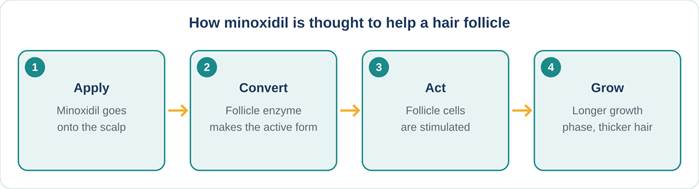
Minoxidil is a prodrug: your own follicles have to switch it on before it can work.

Why minoxidil has to be “switched on”
Here’s a detail most people never hear. Minoxidil is a prodrug. The form in the bottle isn’t the form that does the work.
The 2019 review explains that the positive effect on hair growth is mainly due to a metabolite called minoxidil sulfate. The enzyme that makes it, sulfotransferase, lives in the hair follicle. How much of this enzyme you have varies from person to person.
This matters. If your follicles make plenty of the enzyme, minoxidil is converted efficiently and you’re more likely to respond. If you make less, you may get little benefit even if you use it perfectly. The review also notes that salicylate and aspirin can inhibit this enzyme, though I’d never suggest anyone changes their medicines based on that. Always ask your doctor or pharmacist first.
How much minoxidil gets into the body?
When you apply minoxidil to the scalp, very little reaches the bloodstream. The review reports that about 1.4% of topical minoxidil is absorbed through a normal scalp. Absorption goes up with a stronger concentration, more frequent use and damaged or irritated skin. That’s one reason the leaflets say to use the recommended dose, not more.
Low-dose tablets work differently. They travel through the whole body and reach the follicles via the bloodstream. A 2021 review of oral minoxidil found it effective and well tolerated in healthy people who struggle with topical products.
The shedding phase: a clue to how it works
Many people notice extra shedding in the first few weeks. This isn’t a sign the product is damaging you. It’s actually a clue to how minoxidil works.
Minoxidil seems to push resting follicles into growth sooner. That means the old resting hairs get pushed out to make way for new ones. The shedding is usually temporary, and NHS hospital guidance says it usually settles within the first six weeks. Our own guide on how long minoxidil takes to work explains the timeline in more detail.
What minoxidil doesn’t do
It’s just as useful to know what minoxidil can’t do.
- It doesn’t block DHT, the hormone that makes follicles shrink in pattern hair loss.
- It doesn’t change your genes or cure hair loss.
- It doesn’t work instantly. Hair grows slowly, so changes take months.
- It doesn’t keep working once you stop. The benefits fade over the following months.
That’s why many people combine it with a DHT-blocking medicine. The two work on different parts of the problem. Our UK guide to minoxidil and finasteride explains how.

Why does minoxidil work better for some people?
Several things can shift the result.
- Enzyme levels: more sulfotransferase may mean better conversion.
- Stage of hair loss: follicles that are only miniaturised respond better than long-dormant ones.
- Consistency: daily use keeps the effect going.
- Strength and delivery: higher strengths and well-tolerated formulations can make a difference.
- Scalp health: irritation can make people stop early.
If you want a deeper dive into the history and the evidence, our article on minoxidil and hair growth is a good next read.
Does the form you use change how it works?
The active medicine is the same, but the way it reaches your follicles differs.
Solutions
Liquid solutions carry minoxidil in a mix of alcohol, water and propylene glycol. The alcohol helps the liquid dry quickly, and propylene glycol helps the medicine travel into the skin. The downside is that propylene glycol can irritate some scalps. The 2019 review notes that this irritation led to the development of a propylene glycol free solutions.
Foams
Foams are lighter and dry fast. Because they don’t rely on propylene glycol, many people find them gentler. The review says foam allows good delivery of the active ingredient with less irritation.
Tablets
Low-dose tablets bypass the scalp altogether. They’re an option when topical products cause irritation or when people struggle to apply them twice a day, which the 2021 review of oral minoxidil lists as a common reason for poor adherence.

What this means for your routine
Knowing the science helps you use minoxidil better. Here’s how it translates into day-to-day habits.
- Use it daily. The follicle needs steady exposure, because minoxidil only works while it’s there.
- Apply it to a dry scalp, and only where hair is thinning. This keeps absorption sensible and avoids growing hair in the wrong places.
- Don’t double up. The leaflets set a maximum daily amount, and extra won’t make follicles respond faster.
- Be patient. Follicles move through their cycle slowly, so judging results at six to twelve months is fair.
- Tell your pharmacist about any other medicines, as some can interact with minoxidil or change how your blood pressure behaves.
The short version: minoxidil is a slow, steady helper. It’s not a switch you flick.
A note on research and what we still don’t know
It’s reassuring that minoxidil has been studied for decades. Even so, some questions remain open. Researchers are still working on the precise signalling pathways it affects, why enzyme levels vary so much between people, and whether the best dose differs for men and women. An international expert panel, writing in JAMA Dermatology in 2025, said larger trials and standard guidelines for low-dose tablets are still needed.
That honesty is a good thing. A medicine can work well and still have some unanswered questions. What matters is that the safety information and the practical benefits are well understood, and they are.
The bottom line
So, how does minoxidil work? It widens blood vessels, acts on follicle cells, and extends the growing phase, after being converted into its active form in your scalp. We don’t have every answer yet. But we know enough to say it’s a well-tested medicine that supports follicles, and that it’s best used patiently and consistently.
Frequently asked questions
How does minoxidil work on hair?
It helps hair follicles stay in the growing phase for longer and grow thicker hairs. It does this partly by widening blood vessels and partly by acting directly on follicle cells.
Does minoxidil increase blood flow?
Yes. Minoxidil is a vasodilator, so it widens blood vessels. NHS leaflets describe it as increasing blood flow to the hair roots. Scientists think blood flow is only part of how it grows hair.
How does minoxidil work if it isn’t a hormone?
It works on follicles and blood vessels rather than on hormones. It doesn’t lower DHT, so it supports follicle health while hormone-blocking medicines tackle the cause.
What is minoxidil sulfate?
It’s the active form of minoxidil. Your hair follicles make it from the minoxidil you apply, using an enzyme called sulfotransferase. Without this step, minoxidil is much less effective.
Why does minoxidil work for some people and not others?
Partly because follicle enzyme levels differ. Stage of hair loss, how consistently you use it and whether your scalp tolerates the product also matter.
How does minoxidil work as a tablet?
Low-dose tablets reach follicles through the bloodstream. They use the same medicine, but because they affect the whole body, they need a prescription and a health check first.
How long does it take for minoxidil to start working?
Most people see early changes at around three to four months, with clearer thickening by six months. Hair grows slowly, so patience is essential.
Does minoxidil make hair fall out first?
It can. Extra shedding in the first weeks happens when resting hairs are pushed out by new growth. It usually settles within about six weeks, but check the leaflet if it continues.
How does minoxidil work when combined with finasteride?
Minoxidil supports the follicle and lengthens its growing phase, while finasteride lowers DHT, the hormone that shrinks follicles. Together they cover two different parts of the problem.
How does minoxidil know where to grow hair?
It doesn’t. It affects any follicle it reaches, which is why you apply it only to the thinning area and wash your hands afterwards to avoid growing hair where you don’t want it.

Disclaimer
Disclaimer: This information is for education only and isn’t a substitute for personal medical advice. Always follow your prescriber’s instructions.
References
- Akiska, Y.M. et al. (2025) ‘Low-dose oral minoxidil initiation for patients with hair loss: an international modified Delphi consensus statement’, JAMA Dermatology, 161(1), pp. 87-95. Available at: https://pubmed.ncbi.nlm.nih.gov/39565602/ (Accessed: 15 November 2026).
- Courier Pharmacy (n.d.) How long does it take for minoxidil to work? Available at: https://courierpharmacy.co.uk/how-long-does-it-take-for-minoxidil-to-work/ (Accessed: 15 November 2026).
- Courier Pharmacy (n.d.) Minoxidil and finasteride: your ultimate UK guide. Available at: https://courierpharmacy.co.uk/minoxidil-and-finasteride-your-ultimate-uk-guide/ (Accessed: 15 November 2026).
- Courier Pharmacy (n.d.) Minoxidil and hair growth: from discovery to modern mechanisms. Available at: https://courierpharmacy.co.uk/minoxidil-and-hair-growth-from-discovery-to-modern-mechansims/ (Accessed: 15 November 2026).
- Electronic Medicines Compendium (2025) Regaine for Men Extra Strength Scalp Solution 5% w/v cutaneous solution: summary of product characteristics. Available at: https://www.medicines.org.uk/emc/product/5765/smpc/print (Accessed: 15 November 2026).
- Gloucestershire Hospitals NHS Foundation Trust (2024) Minoxidil for hair loss (GHPI1647). Available at: https://www.gloshospitals.nhs.uk/documents/19870/Minoxidil_for_hair_loss_GHPI1647_01_24.pdf (Accessed: 15 November 2026).
- Gloucestershire Hospitals NHS Foundation Trust (2024) Minoxidil for hair loss (GHPI1649). Available at: https://www.gloshospitals.nhs.uk/your-visit/patient-information-leaflets/minoxidil-for-hair-loss-ghpi1649/ (Accessed: 15 November 2026).
- NHS (2024) Hair loss: treatment. Available at: https://www.nhs.uk/conditions/hair-loss/treatment/ (Accessed: 15 November 2026).
- Primary Care Dermatology Society (2025) Alopecia: male and female pattern. Available at: https://www.pcds.org.uk/clinical-guidance/alopecia-male-and-female-pattern-alopecia (Accessed: 15 November 2026).
- Randolph, M. and Tosti, A. (2021) ‘Oral minoxidil treatment for hair loss: a review of efficacy and safety’, Journal of the American Academy of Dermatology, 84(3), pp. 737-746. Available at: https://pubmed.ncbi.nlm.nih.gov/32622136/ (Accessed: 15 November 2026).
- Royal Berkshire NHS Foundation Trust (2025) Minoxidil for hair loss. Available at: https://www.royalberkshire.nhs.uk/media/n3onzj1d/minoxidil-for-hair-loss_oct25.pdf (Accessed: 15 November 2026).
- Suchonwanit, P., Thammarucha, S. and Leerunyakul, K. (2019) ‘Minoxidil and its use in hair disorders: a review’, Drug Design, Development and Therapy, 13, pp. 2777-2786. Available at: https://pubmed.ncbi.nlm.nih.gov/31496654/ (Accessed: 15 November 2026).