


What you should know about LDN for CFS
Chronic fatigue syndrome, or ME/CFS, is a long-term condition whose central feature is post-exertional malaise, the worsening of symptoms after effort. As NICE describes, it also involves debilitating fatigue not relieved by rest, unrefreshing sleep, brain fog and often pain. It is a genuine condition, not a result of being unfit or lazy, and it can be seriously disabling.
Not in the way people sometimes hope. LDN is not a cure for ME/CFS, and the evidence is limited and mostly anecdotal. Some people report improvements in fatigue or sleep, but there are no large, high-quality trials confirming a benefit. LDN is best understood as one option some people choose to explore, alongside energy management and their medical care, rather than as a treatment for ME/CFS itself.
LDN uses a low dose of naltrexone, usually about 1.5mg to 4.5mg at night, far lower than the 50mg used for addiction. As the research literature describes, it is thought to cause a rebound rise in the body’s endorphins and to have anti-inflammatory effects, though these mechanisms remain theoretical in ME/CFS. Because these strengths are not available off the shelf, LDN is compounded to order, for us by APC Labs.
No. This is really important. LDN is not a replacement for energy management or your medical care. Those recognised approaches remain the foundation of managing ME/CFS. If you choose to explore LDN, it should be alongside your usual care and your GP or service, never instead of them. We would always encourage you to keep them informed.
LDN is usually well tolerated, with mild side effects like vivid dreams or sleep disturbance early on. The most important safety point is that it must not be taken with opioid painkillers, as it blocks them and can trigger withdrawal. It also needs caution in liver disease, and is not recommended in pregnancy or breastfeeding without specialist advice. This is why it is prescriber-assessed and coordinated with your wider care.
LDN is usually started low and increased slowly, and people who do respond often describe gradual change over several weeks to a few months rather than overnight. Keeping a simple symptom and energy diary helps you and your prescriber judge whether it is genuinely making a difference. If a fair trial brings no benefit, there is no reason to continue it.
No, LDN is not a stimulant. It does not force energy the way caffeine or similar medicines might, and it will not override the need to pace. The thinking is that it may calm underlying immune and inflammatory activity, which in some people is linked to feeling a little better over time. Energy management remains the foundation, with or without LDN.
Having post-exertional malaise, where symptoms worsen after effort, does not in itself rule out LDN. It is taken as a nightly dose and does not involve exertion, so it does not work like graded exercise. It is meant to sit alongside pacing, not replace it, and careful pacing remains essential whatever else you try.
Additional information
LDN for chronic fatigue syndrome
Exhausted in a way that rest does not fix? You deserve honest answers and real support
Chronic fatigue syndrome, also known as myalgic encephalomyelitis or ME/CFS, is far more than being tired. It is a long-term condition where effort can leave you wiped out for days, where sleep does not refresh, and where many people have been doubted or dismissed along the way. It is real, and it is debilitating. At Courier Pharmacy, we believe healthcare should fit the person, not force the person to fit the system. So we work alongside your GP and any specialist service, never instead of them, and where it is right for you, we offer low dose naltrexone, or LDN, as one option some people with ME/CFS choose to explore. Healthcare that fits you, and your life with ME/CFS.

Five key takeaways
- ME/CFS is a long-term condition whose central feature is post-exertional malaise, where symptoms worsen after activity, as NICE describes.
- It is a genuine medical condition. As NICE and the NHS set out, it is not caused by laziness or deconditioning, and it should be taken seriously.
- Care is supportive and personalised. Energy management, or pacing, and treating individual symptoms are the mainstays, coordinated through your GP or an ME/CFS service.
- Low dose naltrexone is an option some explore. The evidence in ME/CFS is limited and mostly anecdotal, and LDN is used off-label here.
- LDN sits alongside your care. It never replaces your GP, specialist or energy management plan, and it is prescriber-assessed for safety.
How Courier Pharmacy helps
- Honest, personalised guidance on living with ME/CFS and your options
- Low dose naltrexone through a prescriber consultation, where it is appropriate for you
- A clear, evidence-based explanation of what LDN can and cannot do in ME/CFS
- Compounded LDN prepared to order by APC Labs, our compounding pharmacy partner
- Support that works alongside your GP and specialist service, never instead of them
ME/CFS deserves proper, respectful care. We complement that care, we do not replace it, and we will always encourage you to stay under your GP or specialist service.
What is chronic fatigue syndrome?
Chronic fatigue syndrome, or ME/CFS, is a long-term condition that affects many systems of the body. As NICE describes, its central feature is post-exertional malaise, which means a worsening of symptoms after physical, mental or emotional effort that can be delayed and can last days or longer. The effort that causes it may be small, and out of all proportion to the crash that follows.
ME/CFS is not simply being tired, and it is not caused by being unfit or lazy. As the NHS and NICE make clear, it is a genuine condition that can be seriously disabling, affecting people’s ability to work, study and take part in daily life.
The impact is often invisible. Many people look well on the outside while struggling enormously, and many have spent years being doubted. Normal test results do not mean nothing is wrong. They simply mean the cause does not show up on routine checks, which is common in conditions like this.

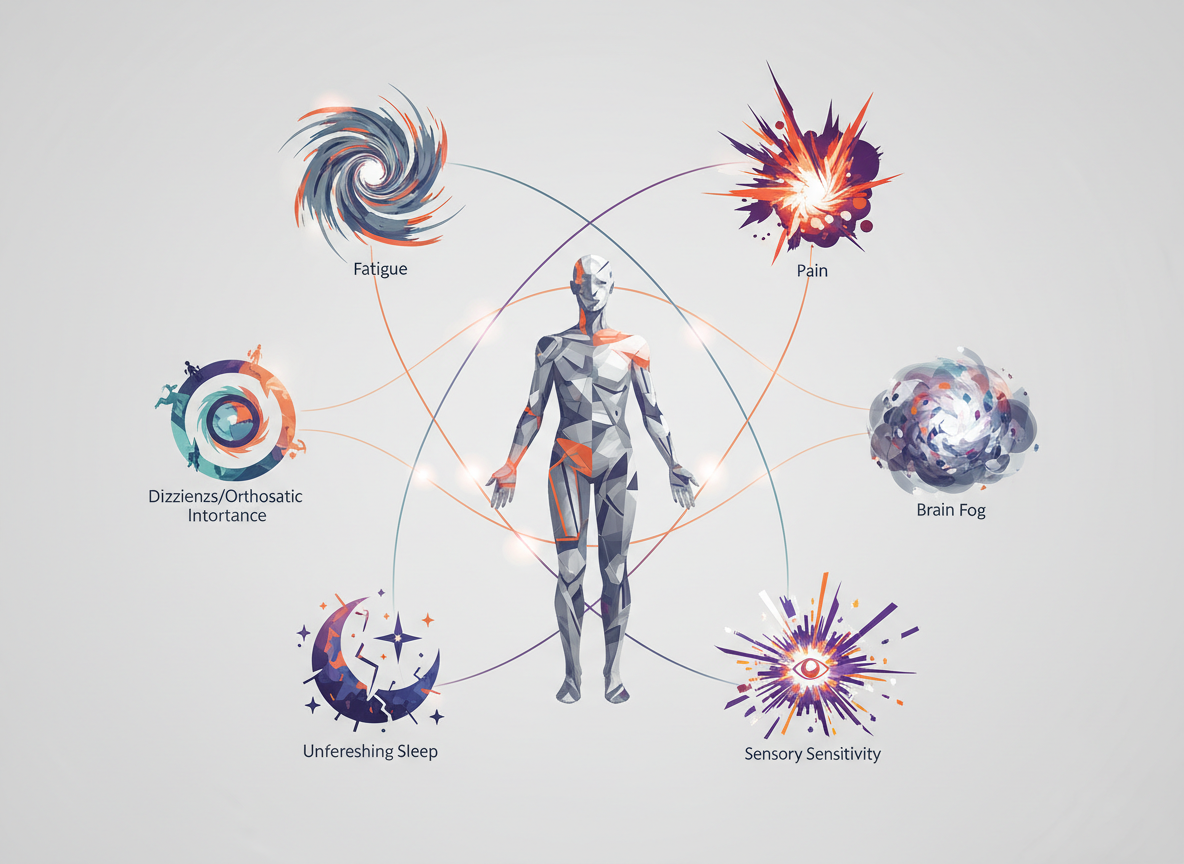
What are the symptoms of ME/CFS?
ME/CFS affects more than energy alone. As NICE and the NHS describe, common features include:
- post-exertional malaise, the worsening of symptoms after effort
- debilitating fatigue that is not relieved by rest
- unrefreshing or disturbed sleep
- problems with memory and concentration, often called brain fog
- pain in muscles or joints, and headaches
- dizziness, palpitations and feeling faint on standing
- a flu-like feeling and sensitivity to light, sound or temperature
Symptoms often flare after overexertion, then settle with rest, though recovery can be slow. Few people experience every symptom, and the pattern is personal to each individual.
What happens in the body with ME/CFS?
The exact cause of ME/CFS is not fully understood, and research is ongoing. As the research literature describes, it often begins after an infection, and proposed mechanisms include ongoing immune system disturbance and low-grade inflammation, problems with how cells produce energy, and changes in the nervous system that controls heart rate, blood pressure and the stress response.
What this means in practice is that ME/CFS behaves like a condition involving an immune and nervous system that have not settled back to normal. That is part of why treatments that aim to calm inflammation, including options like LDN, have attracted interest. It is also why pacing matters so much, because overexertion appears to set the underlying process off again.
How is ME/CFS diagnosed?
There is no single test for ME/CFS. As NICE describes, it is diagnosed from the pattern and duration of symptoms, with post-exertional malaise as a required feature, and by ruling out other causes. Your GP may arrange blood tests and other checks, not to prove ME/CFS, but to make sure nothing else is being missed, such as anaemia, thyroid problems or other conditions.
NICE recommends that diagnosis is confirmed and reviewed with appropriate clinical input, and in many areas you can be referred to a specialist ME/CFS service. Getting that proper assessment matters before settling on any long-term approach. Courier Pharmacy does not diagnose ME/CFS. What we can do is support you alongside your GP and any specialist service once you are under their care.
What are the standard approaches for ME/CFS?
There is no cure for ME/CFS, so care focuses on managing symptoms and supporting the best possible quality of life. As NICE describes, the recognised approaches include:
Energy management, or pacing
Learning to live within your energy limits, and avoiding the boom-and-bust cycle, is central. Pacing helps reduce the crashes that come from overexertion, and it is led by you with support from your team.
Managing specific symptoms
Specific symptoms can often be helped, from sleep problems and pain to dizziness on standing, coordinated through your GP or service.
Support for daily life
Practical support with work, study, activity and wellbeing all play a part. NICE is clear that care should be personalised and respectful, and that people with ME/CFS should be believed and involved in decisions about their care.
A cautious approach to activity
NICE no longer recommends fixed, increasing exercise programmes as a cure, because for many people with ME/CFS, pushing activity can make symptoms worse. Any approach to activity must respect post-exertional malaise.
These standard approaches are the backbone of managing ME/CFS. Anything else, including low dose naltrexone, is considered alongside them, not instead of them.
Low dose naltrexone (LDN) and ME/CFS
Many people with ME/CFS come across low dose naltrexone and ask whether it could help. Because it is an option we can offer, and one that generates a lot of interest, we want to explain it clearly and honestly, including its limits.
What is LDN?
Naltrexone is a medicine licensed to treat opioid and alcohol dependence, at a dose of around 50mg. Low dose naltrexone uses a much smaller dose, typically between about 1.5mg and 4.5mg, taken at night. At this low dose it is used off-label, meaning outside its licensed purpose, for a range of conditions where an immune or inflammatory process is thought to play a part. Because these low strengths are not available off the shelf, LDN is prepared as a compounded medicine, which for us is made by APC Labs, our compounding pharmacy partner.

The theory in ME/CFS
The idea behind LDN is interesting. As the research literature describes, a brief, low dose of naltrexone is thought to cause a rebound rise in the body’s own endorphins, and to have anti-inflammatory effects on immune cells, including in the nervous system. Because ME/CFS is thought to involve immune disturbance and low-grade inflammation, some clinicians have proposed that LDN might help. This is a plausible theory, and it is why LDN has attracted interest in ME/CFS, but it is important to understand that it remains theoretical.
What the evidence actually shows
Here is the honest picture, because you deserve it. The evidence for LDN in ME/CFS is limited. There are no large, high-quality clinical trials, and most of what exists is anecdotal reports, individual experience and small observational studies, alongside wider interest in LDN for other conditions. This means we cannot promise that LDN will help your ME/CFS, and we will not pretend otherwise. What we can say is that some people report benefit, often in fatigue or sleep, and that it is one option to explore with clear eyes about how thin the evidence is.
What LDN is not
This is the most important part. LDN is not a cure for ME/CFS, and it is not a replacement for energy management or your medical care. Those recognised approaches remain the foundation. If you choose to explore LDN, it should sit alongside that proper care, never instead of it, and your GP or specialist should stay informed.
Safety, and who might consider it
LDN is generally well tolerated, and side effects are usually mild, such as vivid dreams or sleep disturbance early on, and occasionally headache or stomach upset. But there are firm safety points. LDN must not be taken by anyone using opioid medicines, including many strong painkillers, because it blocks them and can trigger sudden withdrawal or stop pain relief working. It also needs caution in liver disease, and it is not recommended in pregnancy or breastfeeding without specialist advice. This is exactly why LDN is prescriber-assessed, so we can check it is safe and appropriate for you, and coordinate with your wider care.

Monitoring and ongoing care
If you and your prescriber decide LDN is worth trying, it is usually started at a low dose and increased slowly, which helps your body adjust and makes any reaction easier to spot. You will be asked how you are getting on, and whether your fatigue, sleep and daily function are changing. Because ME/CFS care often involves your GP or a specialist service, we encourage you to keep them updated, so everyone caring for you has the full picture. If LDN does not help after a fair trial, there is no benefit in continuing it.
Patient experiences and challenges
Living with ME/CFS can be a daily exercise in uncertainty. People tell us about the exhaustion that sleep does not fix, the grief of losing the life they had, and the frustration of being doubted by people who cannot see what they are going through. That is a lot to carry.
Many also tell us they have spent hours researching every possible option, including LDN, and found it hard to get a straight, honest answer, caught between overblown promises and blanket dismissal. That gap is exactly what we try to fill. You are not imagining your symptoms, and you are not giving up by staying under your GP while exploring your options. Both can be true at once.
How Courier Pharmacy helps with ME/CFS
We started Courier Pharmacy because too many people feel either dismissed or oversold, especially when they are living with a condition that others struggle to see. ME/CFS is a clear example. Your symptoms, your limits and your goals are unique, so your support should be too. That personalisation is the first of our four pillars.
The other pillars carry it through. Guidance means we give you honest, evidence-based information, including the real limits of options like LDN, so you can decide with clear eyes. Trust means we are a UK-regulated pharmacy that will always tell you when something is not a substitute for proper care. Community means we show up for people, even when there is nothing to sell.
That spirit has a face in Dr Ada Jex-Cori, the voice of our approach, whose message is simple: you are not broken, and you deserve healthcare that fits your life. For ME/CFS, that means honest support, real options, and respect for you and your care team. Healthcare that fits you, not the other way round.

Frequently asked questions about LDN for chronic fatigue syndrome
What is chronic fatigue syndrome?
Chronic fatigue syndrome, or ME/CFS, is a long-term condition whose central feature is post-exertional malaise, the worsening of symptoms after effort. As NICE describes, it also involves debilitating fatigue not relieved by rest, unrefreshing sleep, brain fog and often pain. It is a genuine condition, not a result of being unfit or lazy, and it can be seriously disabling.
Does low dose naltrexone treat ME/CFS?
Not in the way people sometimes hope. LDN is not a cure for ME/CFS, and the evidence is limited and mostly anecdotal. Some people report improvements in fatigue or sleep, but there are no large, high-quality trials confirming a benefit. LDN is best understood as one option some people choose to explore, alongside energy management and their medical care, rather than as a treatment for ME/CFS itself.
How does LDN work, and what dose is used?
LDN uses a low dose of naltrexone, usually about 1.5mg to 4.5mg at night, far lower than the 50mg used for addiction. As the research literature describes, it is thought to cause a rebound rise in the body’s endorphins and to have anti-inflammatory effects, though these mechanisms remain theoretical in ME/CFS. Because these strengths are not available off the shelf, LDN is compounded to order, for us by APC Labs.
Should I stop pacing or my usual treatment if I try LDN?
No. This is really important. LDN is not a replacement for energy management or your medical care. Those recognised approaches remain the foundation of managing ME/CFS. If you choose to explore LDN, it should be alongside your usual care and your GP or service, never instead of them. We would always encourage you to keep them informed.
Is LDN safe to take with my other medicines?
LDN is usually well tolerated, with mild side effects like vivid dreams or sleep disturbance early on. The most important safety point is that it must not be taken with opioid painkillers, as it blocks them and can trigger withdrawal. It also needs caution in liver disease, and is not recommended in pregnancy or breastfeeding without specialist advice. This is why it is prescriber-assessed and coordinated with your wider care.
How long before I know if LDN is helping?
LDN is usually started low and increased slowly, and people who do respond often describe gradual change over several weeks to a few months rather than overnight. Keeping a simple symptom and energy diary helps you and your prescriber judge whether it is genuinely making a difference. If a fair trial brings no benefit, there is no reason to continue it.

Important disclaimer
This page is for general information and education. It is not medical advice, and it is not a substitute for a consultation with a qualified healthcare professional. ME/CFS should be assessed and managed by your GP or a specialist service, and energy management and symptom management are the recognised approaches.
Low dose naltrexone is an off-label, experimental option with limited evidence in ME/CFS. It is not a cure, and it must never replace proper care or prescribed treatment.
LDN must not be taken with opioid medicines. Always speak to your GP, specialist, prescriber or pharmacist before starting, stopping or changing any treatment.
References
- Arron, H.E., Marsh, B.D., Kell, D.B., Khan, M.A., Jaeger, B.R. and Pretorius, E., 2024. Myalgic Encephalomyelitis/Chronic Fatigue Syndrome: the biology of a neglected disease. Frontiers in Immunology, 15, p.1386607.
- Chronic fatigue syndrome (CFS). Available at: https://www.nhs.uk/conditions/chronic-fatigue-syndrome-cfs/ (Accessed: 21 October 2025).
- Lim, E.J. and Son, C.G., 2020. Review of case definitions for myalgic encephalomyelitis/chronic fatigue syndrome (ME/CFS). Journal of translational medicine, 18(1), p.289.
- Lim, E.J. and Son, C.G., 2020. Review of case definitions for myalgic encephalomyelitis/chronic fatigue syndrome (ME/CFS). Journal of translational medicine, 18(1), p.289.
- Nacul, L.C., Lacerda, E.M., Pheby, D., Campion, P., Molokhia, M., Fayyaz, S., Leite, J.C., Poland, F., Howe, A. and Drachler, M.L., 2011. Prevalence of myalgic encephalomyelitis/chronic fatigue syndrome (ME/CFS) in three regions of England: a repeated cross-sectional study in primary care. BMC medicine, 9(1), p.91.
- Chu, L., Valencia, I.J., Garvert, D.W. and Montoya, J.G., 2019. Onset patterns and course of myalgic encephalomyelitis/chronic fatigue syndrome. Frontiers in pediatrics, 7, p.12.
- Blomberg, J., Gottfries, C.G., Elfaitouri, A., Rizwan, M. and Rosén, A., 2018. Infection elicited autoimmunity and myalgic encephalomyelitis/chronic fatigue syndrome: an explanatory model. Frontiers in immunology, 9, p.229.
- Behan, P.O., 1996. Chronic fatigue syndrome as a delayed reaction to chronic low-dose organophosphate exposure. Journal of Nutritional & Environmental Medicine, 6(4), pp.341-350.
- Underhill, R.A. and O’gorman, R., 2006. Prevalence of chronic fatigue syndrome and chronic fatigue within families of CFS patients. Journal of Chronic Fatigue Syndrome, 13(1), pp.3-13.
- Lerner, A.M., Ariza, M.E., Williams, M., Jason, L., Beqaj, S., Fitzgerald, J.T., Lemeshow, S. and Glaser, R., 2012. Antibody to Epstein-Barr virus deoxyuridine triphosphate nucleotidohydrolase and deoxyribonucleotide polymerase in a chronic fatigue syndrome subset. PloS one, 7(11), p.e47891.
- Blomberg, J., Gottfries, C.G., Elfaitouri, A., Rizwan, M. and Rosén, A., 2018. Infection elicited autoimmunity and myalgic encephalomyelitis/chronic fatigue syndrome: an explanatory model. Frontiers in immunology, 9, p.229.
- Behan, P.O., 1996. Chronic fatigue syndrome as a delayed reaction to chronic low-dose organophosphate exposure. Journal of Nutritional & Environmental Medicine, 6(4), pp.341-350.
- Golomb, B.A., Koslik, H.J. and Redd, A.J., 2015. Fluoroquinolone-induced serious, persistent, multisymptom adverse effects. Case Reports, 2015, p.bcr2015209821.
- Feiring, B., Laake, I., Bakken, I.J., Greve-Isdahl, M., Wyller, V.B., Håberg, S.E., Magnus, P. and Trogstad, L., 2017. HPV vaccination and risk of chronic fatigue syndrome/myalgic encephalomyelitis: a nationwide register-based study from Norway. Vaccine, 35(33), pp.4203-4212.
- Proal, A. and Marshall, T., 2018. Myalgic encephalomyelitis/chronic fatigue syndrome in the era of the human microbiome: persistent pathogens drive chronic symptoms by interfering with host metabolism, gene expression, and immunity. Frontiers in pediatrics, 6, p.373.
- Sotzny, F., Blanco, J., Capelli, E., Castro-Marrero, J., Steiner, S., Murovska, M. and Scheibenbogen, C., 2018. Myalgic encephalomyelitis/chronic fatigue syndrome–evidence for an autoimmune disease. Autoimmunity reviews, 17(6), pp.601-609.
- Newberry, F., Hsieh, S.Y., Wileman, T. and Carding, S.R., 2018. Does the microbiome and virome contribute to myalgic encephalomyelitis/chronic fatigue syndrome?. Clinical Science, 132(5), pp.523-542.
- Fluge, Ø., Tronstad, K.J. and Mella, O., 2021. Pathomechanisms and possible interventions in myalgic encephalomyelitis/chronic fatigue syndrome (ME/CFS). The Journal of Clinical Investigation, 131(14).
- Natelson, B.H., Weaver, S.A., Tseng, C.L. and Ottenweller, J.E., 2005. Spinal fluid abnormalities in patients with chronic fatigue syndrome. Clinical and Vaccine Immunology, 12(1), pp.52-55.
- De Bellis, A., Bellastella, G., Pernice, V., Cirillo, P., Longo, M., Maio, A., Scappaticcio, L., Maiorino, M.I., Bellastella, A., Esposito, K. and Montoya, J.G., 2021. Hypothalamic-pituitary autoimmunity and related impairment of hormone secretions in chronic fatigue syndrome. The Journal of Clinical Endocrinology & Metabolism, 106(12), pp.e5147-e5155.
- Hannan, K.L., Berg, D.E., Baumzweiger, W., Harrison, H.H., Berg, L.H., Ramirez, R. and Nichols, D., 2000. Activation of the coagulation system in Gulf War Illness: a potential pathophysiologic link with chronic fatigue syndrome A laboratory approach to diagnosis. Blood coagulation & fibrinolysis, 11(7), pp.673-678.
- Lim, E.J., Ahn, Y.C., Jang, E.S., Lee, S.W., Lee, S.H. and Son, C.G., 2020. Systematic review and meta-analysis of the prevalence of chronic fatigue syndrome/myalgic encephalomyelitis (CFS/ME). Journal of translational medicine, 18(1), p.100.
- Vink M, Vink-Niese A: Cognitive behavioural therapy for myalgic encephalomyelitis/chronic fatigue syndrome is not effective. Re-analysis of a Cochrane review. Health Psychol Open. 2019, 6:2055102919840614. 10.1177/2055102919840614 47.
- Larun L, Brurberg KG, Odgaard-Jensen J, Price JR: Exercise therapy for chronic fatigue syndrome . Cochrane Database Syst Rev. 2019, 10:CD003200. 10.1002/14651858.CD003200.pub8 48.
- Vink M, Vink-Niese A: Graded exercise therapy for myalgic encephalomyelitis/chronic fatigue syndrome is not effective and unsafe. Re-analysis of a Cochrane review. Health Psychol Open. 2018,
- Polo, O., Pesonen, P. and Tuominen, E., 2019. Low-dose naltrexone in the treatment of myalgic encephalomyelitis/chronic fatigue syndrome (ME/CFS). Fatigue: Biomedicine, health & behavior, 7(4), pp.207-217.
- Castro-Marrero, J., Zaragozá, M.C., López-Vílchez, I., Galmés, J.L., Cordobilla, B., Maurel, S., Domingo, J.C. and Alegre-Martín, J., 2021. Effect of melatonin plus zinc supplementation on fatigue perception in myalgic encephalomyelitis/chronic fatigue syndrome: a randomized, double-blind, placebo-controlled trial. Antioxidants, 10(7), p.1010.
- Vitetta, L., Leong, A., Zhou, J., Dal Forno, S., Hall, S. and Rutolo, D., 2018. The plasma bioavailability of coenzyme Q10 absorbed from the gut and the oral mucosa. Journal of Functional Biomaterials, 9(4), p.73.
- Courier Pharmacy (no date) Low dose naltrexone and the growing evidence across chronic conditions. Available at: https://courierpharmacy.co.uk/low-dose-naltrexone-and-the-growing-evidence-across-chronic-conditions/ (Accessed: 17 October 2026).
- Courier Pharmacy (no date) What is low dose naltrexone? A clear guide to LDN. Available at: https://courierpharmacy.co.uk/what-is-low-dose-naltrexone-a-clear-guide-to-ldn/ (Accessed: 17 October 2026).
- Courier Pharmacy (no date) What is chronic fatigue syndrome? Available at: https://courierpharmacy.co.uk/what-is-chronic-fatigue-syndrome/ (Accessed: 17 October 2026).
- Courier Pharmacy (no date) How many people in the UK have chronic fatigue syndrome? Available at: https://courierpharmacy.co.uk/how-many-people-in-the-uk-have-chronic-fatigue-syndrome/ (Accessed: 17 October 2026).


BSc Pharmacy, Independent Prescriber, PgDip Endocrinology, MSc Endocrinology, PgDip Infectious Diseases
Superintendant Pharmacist, Independent Prescriber

BSc Pharmacy
Compounding Pharmacist

