
How your body turns cholesterol into testosterone and estradiol. Every sex hormone in your body starts life as cholesterol. This guide to hormone synthesis walks you through the six steps that turn it into testosterone and oestrogen, the enzymes that do the work, and the medicines, foods and lifestyle factors that can nudge each step up or down.
Have you ever wondered why the same molecule that gets a bad press on your cholesterol test is also the raw material for your testosterone and oestrogen? Or why some men on testosterone therapy end up with high oestrogen? It all comes down to hormone synthesis, the chain of chemical steps your body uses to build sex hormones.
As pharmacists, we get asked about this more than you might think. People want to know why a breast cancer medicine can lower oestrogen, why liquorice keeps popping up in hormone forums, or whether zinc really boosts testosterone. Once you see the production line, the answers start to make sense.
So grab a cuppa. We’ll keep the chemistry light, use a few kitchen and factory metaphors, and show you exactly where each hormone comes from.
Five key takeaways
- Hormone synthesis starts with cholesterol, a 27-carbon molecule that your body trims down to 21 carbons (progesterone), then 19 (testosterone) and finally 18 (estradiol).
- Six enzymes do the main work, and the very first step, moving cholesterol into the mitochondria, is the bottleneck that controls the whole line.
- Testosterone is the direct parent of estradiol. An enzyme called aromatase makes the switch, which is why testosterone therapy can raise oestrogen levels.
- Licensed medicines such as anastrozole, finasteride and abiraterone work by blocking specific steps, while most food and supplement claims rest on lab studies that don’t hold up well in people.
- Body fat, alcohol, sleep, insulin and age all shift hormone synthesis, so lifestyle matters as much as chemistry.
What is hormone synthesis?
Hormone synthesis is the process your body uses to build hormones from simpler starting materials. For sex hormones, also called steroid hormones, that starting material is always cholesterol. Scientists call the whole process steroidogenesis, which is a mouthful, so we’ll stick with hormone synthesis.
Think of it like a car factory. Cholesterol arrives as a big block of raw metal. Each workstation (an enzyme) trims a bit off, bolts something on, or reshapes a part. By the end of the line, you’ve got a finished car: testosterone, estradiol, or one of their siblings.
Who does hormone synthesis?
Everyone does. Men make most of their testosterone in the testes. Women make oestrogen mainly in the ovaries before the menopause. Both sexes also make smaller amounts in the adrenal glands, fat tissue, skin, bone and even the brain. After the menopause, fat tissue becomes the main source of oestrogen, which surprises a lot of people.
Why should you care?
If you’re on testosterone replacement therapy (TRT), HRT, a hair loss tablet or a breast cancer medicine, you’re already using drugs that tinker with this production line. Knowing which step each one affects helps you understand side effects, blood test results and why your prescriber asks the questions they do.
Cholesterol: the raw material for every sex hormone
Cholesterol has 27 carbon atoms. Testosterone has 19 and estradiol has 18. So most of hormone synthesis is really a story of trimming carbons off and swapping small chemical groups around.
Your cells keep cholesterol in storage, a bit like a pantry. It’s packed away as cholesteryl esters inside tiny fat droplets. Before anything can happen, an enzyme called hormone-sensitive lipase unpacks it into free cholesterol.
Here’s a reassuring point if you’re watching your cholesterol. Eating less cholesterol doesn’t starve your hormone factory. Your cells can take it up from LDL in the blood or make their own, so diet isn’t the limiting factor.
The four-ring skeleton
All steroid hormones share the same shape: four rings fused together, labelled A, B, C and D. Three rings have six sides and one (ring D) has five. Each carbon has a number, from 1 to 27, and those numbers never change between hormones.
That’s handy, because two positions do most of the heavy lifting:
- Carbon 3 sits on ring A. Whether it carries an alcohol group (OH) or a ketone group (C=O) changes how the hormone behaves.
- Carbon 17 sits on ring D. It’s the master switch. A short side chain here makes a progestogen, a ketone makes a weak androgen, and an OH group makes the powerful hormones testosterone and estradiol.
Once you know about carbon 3 and carbon 17, the rest of the pathway clicks into place.
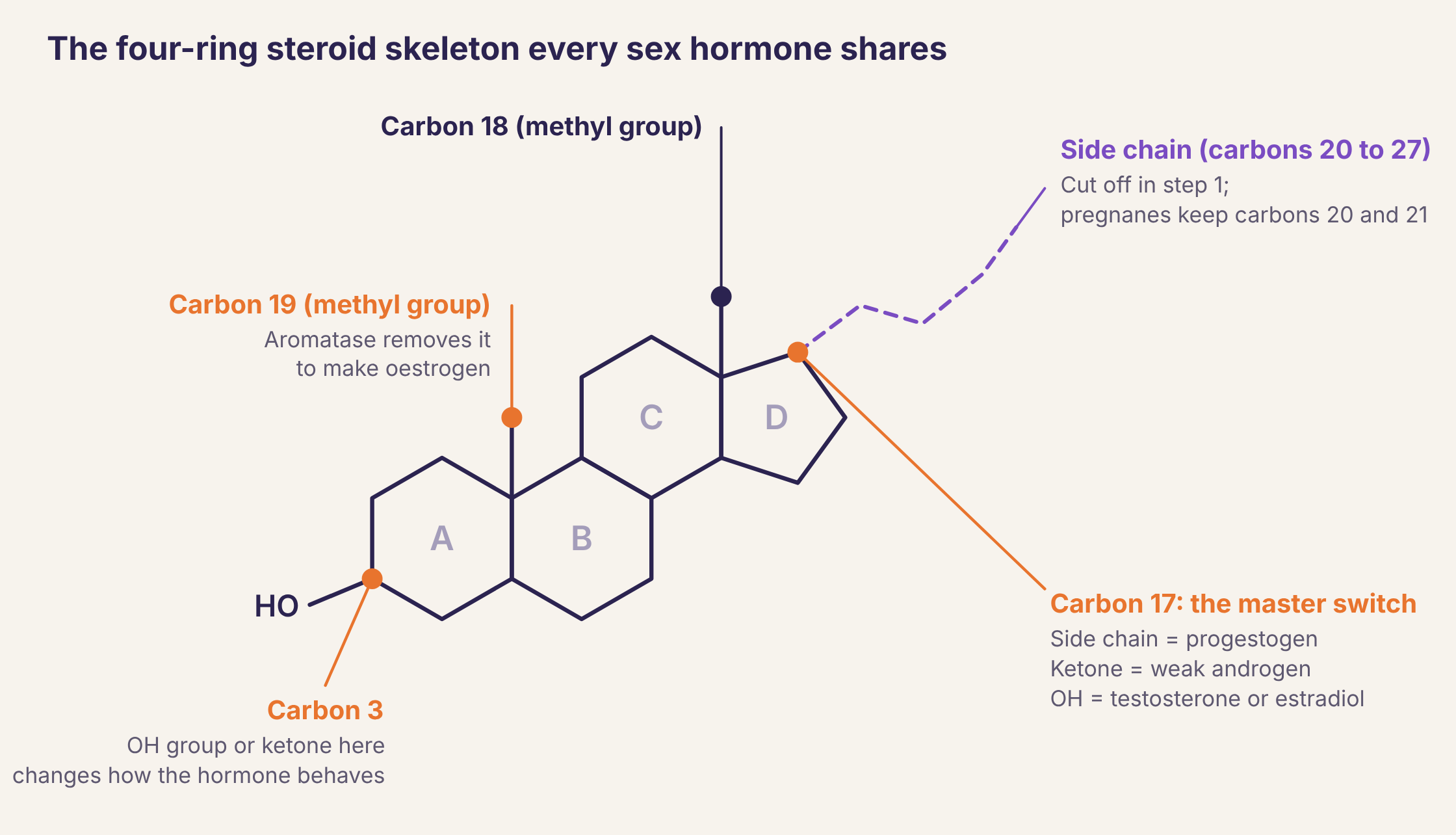
The four-ring steroid skeleton, with carbon 3, carbon 17 and the two methyl groups labelled
How hormone synthesis works: step by step
The main route runs like this: cholesterol, pregnenolone, progesterone, 17-hydroxyprogesterone, androstenedione, testosterone, estradiol. Six steps, six enzyme jobs.
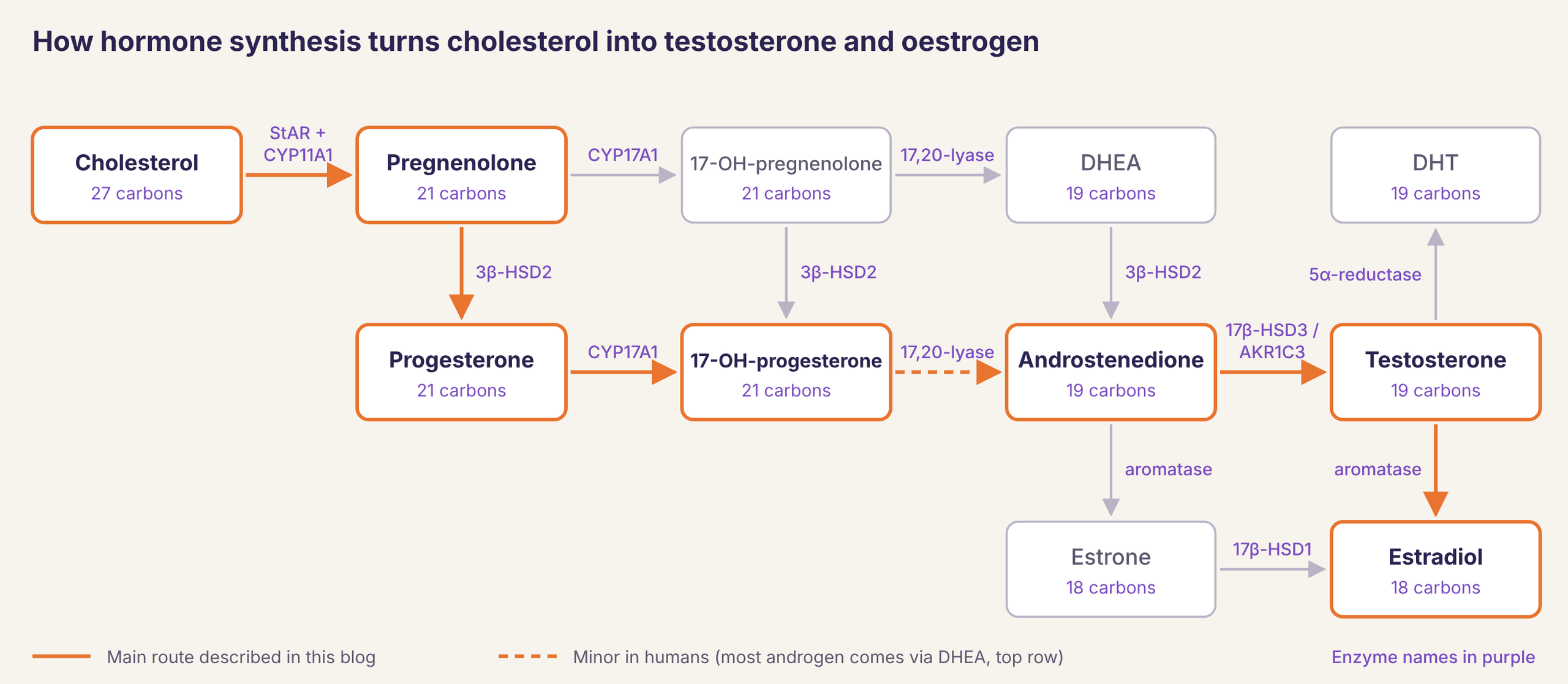
Hormone synthesis pathway from cholesterol to testosterone and estradiol, with the enzyme for each step
In the step diagrams below, orange shading marks the parts of the molecule that are removed or changed, and green marks what the enzyme creates.
Step 1: cholesterol to pregnenolone
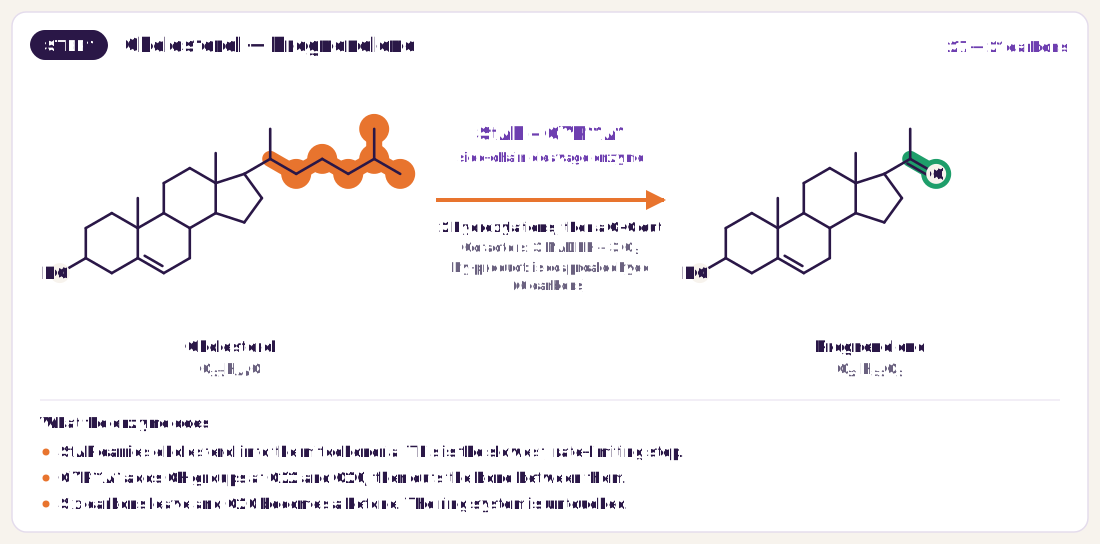
Step 1: CYP11A1 cuts the cholesterol side chain to make pregnenolone
This is the most important step in the whole pathway, and it happens in two stages.
First, a protein called StAR (steroidogenic acute regulatory protein) carries cholesterol into the inner part of the mitochondria, the cell’s power stations. This transfer is the rate-limiting step. In plain English, it’s the narrowest doorway in the factory, and it decides how fast everything else can run.
The brain controls that doorway. Luteinising hormone (LH) tells the testes and ovaries to open it, and ACTH does the same for the adrenal glands. Both can switch StAR on within minutes.
Second, an enzyme called CYP11A1 (also known as side-chain cleavage enzyme) gets to work. It adds two OH groups to the cholesterol side chain and then snips it off. Six carbons leave as a small by-product, and you’re left with pregnenolone, which has 21 carbons. Pregnenolone is sometimes called the mother hormone, because every other steroid hormone comes from it.
Step 2: pregnenolone to progesterone
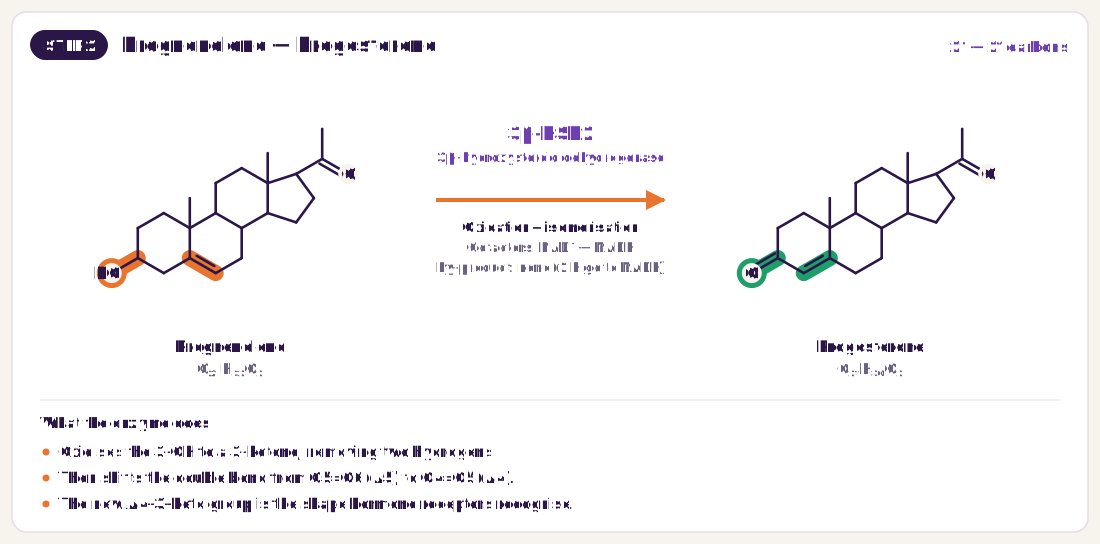
Step 2: 3 Beta-HSD2 turns the 3-OH into a ketone and moves the double bond
Next, an enzyme called 3 Beta-HSD2 does two jobs at once. It turns the OH group at carbon 3 into a ketone, then shifts a nearby double bond one position along the ring.
That might sound fiddly, but it matters. The new arrangement, chemists call it the Delta 4-3-keto group, is the shape that lets progesterone, testosterone and cortisol fit into their receptors. It’s a bit like cutting the teeth on a key.
The same enzyme turns up three times on the full map. It also converts DHEA into androstenedione, which comes in handy later.
Step 3: progesterone to 17-hydroxyprogesterone

Step 3: CYP17A1 adds a 17 alpha-OH group to progesterone
Now an enzyme called CYP17A1 adds a single OH group at carbon 17. Nothing else changes, but this tiny tweak sends the molecule down a new road.
This is a junction. In one part of the adrenal gland, 17-hydroxyprogesterone heads off to become cortisol, your stress hormone. In the testes and ovaries, it can carry on towards androgens. Without this step, progesterone goes towards aldosterone, the salt-balancing hormone, instead.
If you’ve ever heard of congenital adrenal hyperplasia (CAH), 17-hydroxyprogesterone is the marker used to screen for its most common form. When the road to cortisol is blocked, this hormone piles up behind the roadblock, like traffic on the M1.
Step 4: 17-hydroxyprogesterone to androstenedione

Step 4: CYP17A1 cuts off carbons 20 and 21 to make androstenedione
The same enzyme, CYP17A1, now swaps hats. Using its second skill, called 17,20-lyase activity, it snips off the last two side-chain carbons. They leave as acetic acid (yes, the stuff in vinegar). The molecule drops from 21 carbons to 19, and it’s officially an androgen.
This cutting job needs a helper protein called cytochrome b5. Changes in that helper, rather than the enzyme itself, explain why the adrenal glands start making androgens around age six to eight, a stage called adrenarche.
Here’s a twist worth knowing. Human CYP17A1 isn’t very good at cutting 17-hydroxyprogesterone. Most of our androgens are actually made by a parallel route: pregnenolone to 17-hydroxypregnenolone to DHEA, then DHEA to androstenedione. Both roads end at the same place, a bit like taking the A38 instead of the M1.
Step 5: androstenedione to testosterone
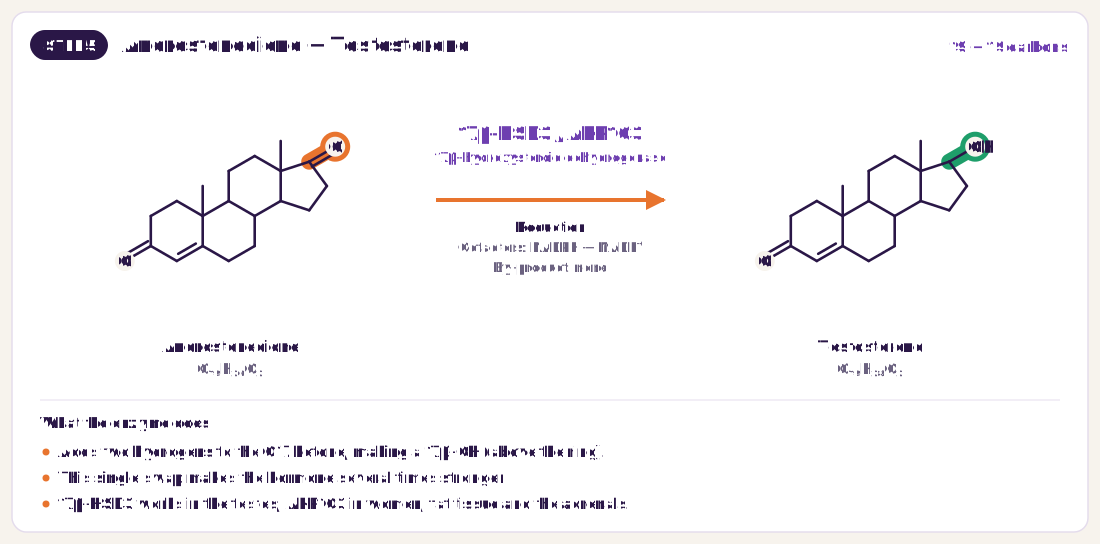
Step 5: 17 Beta-HSD3 reduces the 17-ketone to make testosterone
Now an enzyme adds two hydrogen atoms to the ketone at carbon 17, turning it into an OH group. That one swap makes the hormone several times stronger at the androgen receptor. Androstenedione is the apprentice. Testosterone is the master.
In the testes, the enzyme doing this is 17 Beta-HSD3, found almost only in Leydig cells. In women, and in fat tissue, the adrenal glands and the prostate, a cousin enzyme called AKR1C3 does the same job.
This step can also run backwards. Another enzyme, 17Beta-HSD2, turns testosterone back into androstenedione as a local off switch.
Step 6: testosterone to estradiol

Step 6: aromatase removes carbon 19 and makes ring A aromatic, forming estradiol
The final step is the one that surprises people most. Oestrogen is made directly from testosterone.
An enzyme called aromatase (CYP19A1) attacks carbon 19 three times and removes it as formic acid. Losing that carbon lets ring A rearrange into a flat, stable aromatic ring, the same type of ring found in benzene. The ketone at carbon 3 becomes an OH group, and you have estradiol, with 18 carbons.
This reaction is one way only. No human enzyme can turn oestrogen back into testosterone. Aromatase can also convert androstenedione into estrone, a weaker oestrogen, which another enzyme (17 Beta-HSD1) then upgrades to estradiol.
Aromatase lives in the ovaries, but also in fat tissue, bone, brain, skin and the testes. That’s why body fat has such a big say in oestrogen levels, in both men and women.
The DHT side road
Testosterone has another option. An enzyme called 5 alpha-reductase can convert it into dihydrotestosterone (DHT), which is a more powerful androgen. DHT drives prostate growth, body hair and male pattern hair loss, and it’s busiest in the prostate, genital skin and scalp hair follicles.
A quick summary of the six steps
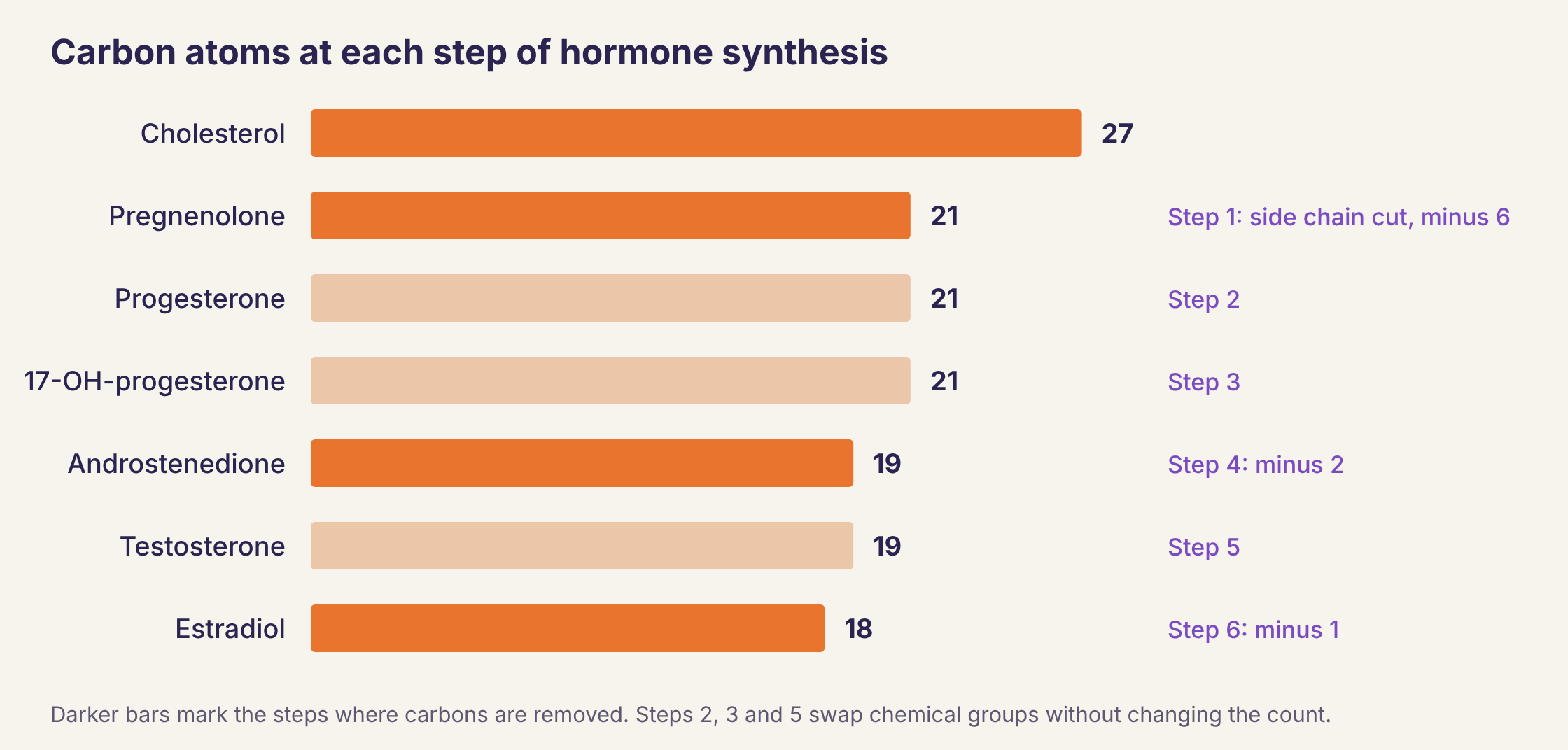
How the carbon count falls from 27 in cholesterol to 18 in estradiol
| Step | Change | Enzyme | Carbons |
| 1 | Cholesterol to pregnenolone | StAR and CYP11A1 | 27 to 21 |
| 2 | Pregnenolone to progesterone | 3 Beta-HSD2 | 21 to 21 |
| 3 | Progesterone to 17-hydroxyprogesterone | CYP17A1 (hydroxylase) | 21 to 21 |
| 4 | 17-hydroxyprogesterone to androstenedione | CYP17A1 (17,20-lyase) | 21 to 19 |
| 5 | Androstenedione to testosterone | 17 Beta-HSD3 or AKR1C3 | 19 to 19 |
| 6 | Testosterone to estradiol | Aromatase (CYP19A1) | 19 to 18 |
What speeds up or slows down hormone synthesis?
This is where the chemistry meets real life. Some factors act on the whole production line, others on a single workstation. We’ve split them into what has solid human evidence and what doesn’t.
Things that affect the whole line
Your brain sets the pace through LH and ACTH. Anything that lowers LH slows testosterone production in the testes. Common examples include:
- Taking testosterone or anabolic steroids, which tells the brain to stop sending LH
- GnRH analogues such as leuprorelin and goserelin, used for prostate cancer
- Long-term opioid use, a recognised cause of low testosterone
- Medicines that raise prolactin, such as some antipsychotics and metoclopramide
- Heavy drinking, which is directly toxic to testosterone-making cells
- Severe calorie restriction
On the plus side, losing weight if you’re living with obesity and getting enough sleep both help. Vitamin D and zinc seem to raise testosterone mainly when you were low to begin with, so they’re not a magic boost for everyone.
Step by step: what the evidence says
For step 1, high-dose ketoconazole and mitotane block hormone synthesis and are used in specific conditions. Statins may lower testosterone slightly on average, but studies are mixed.
For step 2, soy isoflavones block 3 Beta-HSD2 in the lab. However, human reviews show soy doesn’t meaningfully change testosterone in men. However, our personal experience is that soy protein can increase oestrogen levels, we will be writing about this soon.
For steps 3 and 4, abiraterone blocks CYP17A1 completely and is a licensed prostate cancer treatment. Metformin lowers ovarian androgen production indirectly by bringing insulin down, which is why it can help some women with PCOS. High insulin and LH both push this step harder, and that’s one driver of excess androgens in PCOS. Liquorice has been studied too, with one trial showing lower testosterone and a repeat trial showing no effect.
For step 6, aromatase inhibitors such as anastrozole, letrozole and exemestane are licensed for breast cancer. They’re sometimes used off-label in men on TRT, but pushing estradiol too low can harm bone density and libido, so this needs careful monitoring. Herbal products like chrysin look good in a test tube but are poorly absorbed and didn’t work in a human study.
Aromatase activity rises with more body fat, age, alcohol (especially with liver disease) and inflammation. More testosterone also means more raw material, so TRT can raise estradiol.
For the DHT side road, finasteride and dutasteride are licensed 5 alpha-reductase inhibitors for hair loss and prostate enlargement. Saw palmetto is popular, but a Cochrane review found it no better than placebo for prostate symptoms.
Our practical take
If a supplement claims to block aromatase or boost testosterone, ask whether the evidence comes from people or petri dishes. Many lab studies use doses your gut could never absorb. The things that reliably move the needle are licensed medicines, body weight, sleep, alcohol and blood sugar control.

How hormone medicines use this chemistry
Natural hormones in the pathway are alcohols, ketones, or both. Medicines often add an ester, which is a fatty acid chain attached to an OH group. Only hormones with an OH group can carry an ester, so testosterone and estradiol can, but progesterone and androstenedione can’t.
Why bother? A fatty chain makes the hormone more oil-soluble. When it’s injected into muscle as an oily depot, it trickles out slowly, and enzymes in the blood snip the ester off to release the active hormone. The longer the chain, the slower the release, a bit like a slow-release fertiliser.
| Medicine | Ester chain | Where you meet it |
| Testosterone propionate | Short (3 carbons) | Short-acting part of Sustanon |
| Testosterone enanthate | Medium (7 carbons) | Injections every 1 to 3 weeks |
| Testosterone cypionate | Medium (8 carbons) | Similar to enanthate |
| Testosterone undecanoate | Long (11 carbons) | Long-acting injection every 10 to 14 weeks, or oral capsules |
| Estradiol valerate | Medium (5 carbons) | Oral and injectable HRT |
| Medroxyprogesterone acetate | Short (2 carbons) | Depot contraceptive and HRT progestogen |
Testosterone gels such as Testogel contain plain testosterone with no ester. It passes through the skin directly. If you’d like to understand which option suits you, our testosterone replacement therapy service can talk you through it.

Frequently asked questions about hormone synthesis
1. What is hormone synthesis in simple terms?
Hormone synthesis is how your body builds hormones. For sex hormones, it starts with cholesterol, which enzymes trim and reshape in six main steps to make progesterone, testosterone and oestrogen.
2. Where does hormone synthesis happen in the body?
Most sex hormone synthesis happens in the testes, ovaries and adrenal glands. Fat tissue, skin, bone and the brain also make smaller amounts, especially of oestrogen.
3. Is oestrogen really made from testosterone?
Yes. An enzyme called aromatase converts testosterone into estradiol and androstenedione into estrone. Women and men both rely on this step to make oestrogen.
4. Does eating more cholesterol increase my hormones?
No. Your cells take cholesterol from the blood or make their own, so dietary cholesterol doesn’t limit hormone synthesis. The bottleneck is the StAR protein, which your brain controls through LH and ACTH.
5. Why can TRT raise oestrogen levels?
Testosterone is the raw material for estradiol. When you add more testosterone, aromatase has more to work with, so estradiol can rise. Body fat and alcohol can push it higher still.
6. Do statins lower testosterone?
On average, statins may cause a small fall in testosterone, but the evidence is mixed. Don’t stop a statin without speaking to your prescriber, as the heart benefits are well proven.
7. Can supplements block aromatase?
Some, like chrysin, grape seed extract and green tea extract, block aromatase in the lab. However, there’s little good human evidence they change oestrogen levels in real life.
8. Does soy lower testosterone in men?
No, not in any meaningful way. Soy compounds slow one enzyme in lab studies, but reviews of human trials show no real change in testosterone.
9. What is DHT and how is it made?
DHT (dihydrotestosterone) is a stronger androgen made from testosterone by the enzyme 5?-reductase. It drives prostate growth and male pattern hair loss, which is why finasteride and dutasteride target it.
10. How does age affect hormone synthesis?
As we age, testosterone production in men tends to drift down slowly, and the ovaries stop making most of a woman’s oestrogen at the menopause. Aromatase in fat tissue also becomes more active with age, so the balance between hormones shifts over time.

Disclaimer
Disclaimer: This information is for education only and isn’t a substitute for personal medical advice. Always follow your prescriber’s instructions.
References
- Armanini, D., Bonanni, G. and Palermo, M. (1999) ‘Reduction of serum testosterone in men by licorice’, New England Journal of Medicine, 341(15), p. 1158.
- Ahsan, S. (2026) ‘A comprehensive timeline: the development of testosterone replacement therapy’, Courier Pharmacy, 8 February. Available at: https://courierpharmacy.co.uk/a-comprehensive-timeline-the-development-of-testosterone-replacement-therapy/ (Accessed: 3 November 2026).
- Hamilton-Reeves, J.M., Vazquez, G., Duval, S.J., Phipps, W.R., Kurzer, M.S. and Messina, M.J. (2010) ‘Clinical studies show no effects of soy protein or isoflavones on reproductive hormones in men: results of a meta-analysis’, Fertility and Sterility, 94(3), pp. 997–1007.
- Josephs, R.A., Guinn, J.S., Harper, M.L. and Askari, F. (2001) ‘Liquorice consumption and salivary testosterone concentrations’, The Lancet, 358(9293), pp. 1613–1614.
- Miller, W.L. and Auchus, R.J. (2011) ‘The molecular biology, biochemistry, and physiology of human steroidogenesis and its disorders’, Endocrine Reviews, 32(1), pp. 81–151.
- National Institute for Health and Care Excellence (2015, updated 2024) Menopause: identification and management (NG23). Available at: https://www.nice.org.uk/guidance/ng23 (Accessed: 2 November 2026).
- NHS (2025) Common questions about oestrogen tablets, patches, gel and spray. Available at: https://www.nhs.uk/medicines/hormone-replacement-therapy-hrt/oestrogen-tablets-patches-gel-and-spray/common-questions-about-oestrogen-tablets-patches-gel-and-spray/ (Accessed: 2 November 2026).
- Schooling, C.M., Au Yeung, S.L., Freeman, G. and Cowling, B.J. (2013) ‘The effect of statins on testosterone in men and women, a systematic review and meta-analysis of randomized controlled trials’, BMC Medicine, 11, p. 57.
- Simpson, E.R., Clyne, C., Rubin, G., Boon, W.C., Robertson, K., Britt, K., Speed, C. and Jones, M. (2002) ‘Aromatase: a brief overview’, Annual Review of Physiology, 64, pp. 93–127.
- Tacklind, J., MacDonald, R., Rutks, I., Stanke, J.U. and Wilt, T.J. (2012) ‘Serenoa repens for benign prostatic hyperplasia’, Cochrane Database of Systematic Reviews, (12), CD001423.