

In this blog we will learn how tretinoin supports collagen and what that means for ageing skin.Topical tretinoin can encourage collagen formation and curb some UV-triggered collagen breakdown. The evidence is strongest for photoaged skin, and improvement takes time.
Collagen is one of the main structural proteins in the dermis, the layer beneath the skin’s surface. With age, and especially after repeated sun exposure, he dermal framework can become damaged and disorganised [1]. Tretinoin, a topical form of retinoic acid, is used to improve some visible signs of this damage [2]. Its collagen story has two parts: it can promote new collagen formation, and it can reduce some of the processes that degrade collagen.
Introduction
Fine lines, rough texture and loss of firmness are among the most visible signs of skin ageing, and much of that change happens beneath the surface, in the collagen-rich dermis. Of the many products marketed for ageing skin, topical tretinoin is one of the few backed by human biopsy studies and randomised controlled trials, and the relationship between tretinoin and collagen sits at the centre of how it works. [2], [5], [7]
This article explains how UV exposure shifts the collagen balance, what human studies show about retinoic acid and collagen production, how those biological changes relate to the results seen in trials of tretinoin for wrinkles, and what a realistic expectation of tretinoin for ageing skin looks like.
Key takeaways
- Tretinoin works on collagen in two ways: it encourages new collagen formation and reduces some of the UV-triggered processes that break collagen down. [3], [4]
- In a human skin experiment, pretreatment with tretinoin reduced UV-induced collagen-degrading enzyme activity by about 70–80%, but tretinoin is not a sunscreen and does not block UV. [1], [3]
- In a biopsy study, 10–12 months of daily tretinoin increased collagen I formation in sun-damaged skin by 80%, compared with a 14% decrease with vehicle cream alone. [5]
- A 2025 meta-analysis of eight randomised trials (1,361 participants) found significant improvements in fine and coarse facial wrinkles with tretinoin versus vehicle. [7]
- Improvement is gradual and partial rather than instant. Redness, peeling and stinging can occur, and daily sun protection remains essential. [1], [10]
Sunlight shifts the collagen balance
Ultraviolet (UV) exposure activates matrix metalloproteinases (MMPs), enzymes that break down components of the skin’s extracellular matrix [3]. In a human skin experiment, UV exposure increased degradation of type I collagen; repeated exposures kept collagen-degrading enzyme activity elevated [3]. When skin was pretreated with tretinoin, UV-induced MMP proteins and activity were reduced by about 70–80% in that experimental setting [3]. Tretinoin is not a sunscreen, however: this laboratory finding does not mean that applying it blocks UV or makes sun protection unnecessary [1].
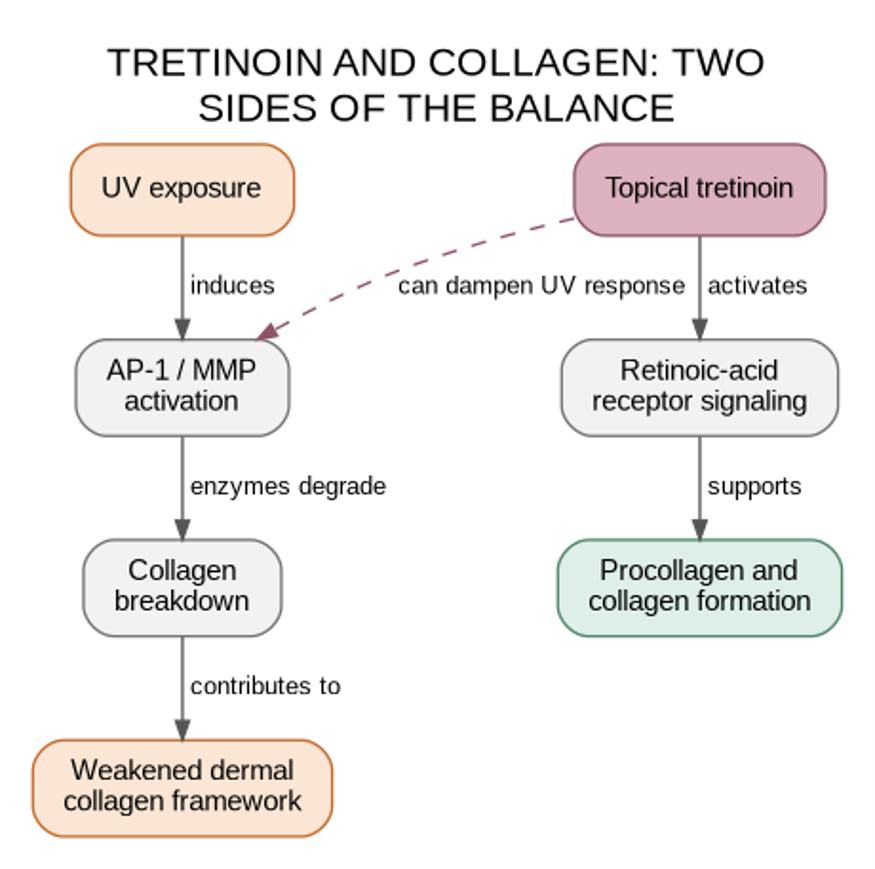
Figure 1. Mechanism diagram: UV exposure can induce collagen-degrading enzymes, while tretinoin signals through retinoic-acid receptors and can increase collagen production and dampen UV-triggered MMP activity [3], [4]. The diagram simplifies a set of biological pathways; it is not a claim that tretinoin fully prevents UV injury.
How tretinoin may support collagen formation
Tretinoin interacts with retinoic-acid receptors, which influence gene activity in skin cells. Reviews of topical retinoids describe increased procollagen production and formation of types I and III collagen [4]. Procollagen is a precursor that cells process into collagen fibres [4]. By encouraging this rebuilding while reducing some UV-triggered degradation, tretinoin may help improve the dermal support structure over time.
Human biopsy findings lend support to this mechanism [5]. In one study, collagen I formation in sun-damaged skin was 56% lower than in sun-protected skin. After daily treatment for 10–12 months, collagen I formation increased by 80% in the tretinoin group, compared with a 14% decrease in the vehicle-cream group [5]. A separate two-year randomized trial involving 204 people with facial photodamage found a significant increase in a procollagen-I marker after 12 months of tretinoin [6]. These are measured biological changes; they should not be read as a prediction of the exact visible improvement any one person will experience.
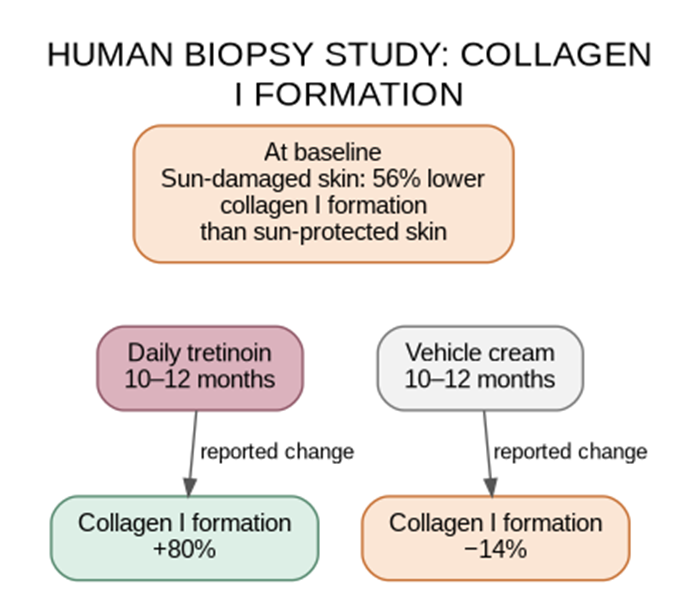
Figure 2. The study reported an 80% increase in collagen I formation with tretinoin and a 14% decrease with vehicle after 10–12 months; it also found 56% lower collagen I formation in sun-damaged than sun-protected skin at baseline [5]. Values reproduce the study’s reported relative changes and are not pooled estimates.
From collagen changes to visible results
Clinical evidence suggests that these biological effects can accompany improvements in wrinkles. A 2025 meta-analysis of eight randomized trials (1,361 participants) found statistically significant improvements in fine and coarse facial wrinkles with tretinoin versus vehicle; follow-up ranged from 16 weeks to two years [7]. A separate systematic review of seven trials also reported improvements in wrinkles and other signs of photoaging, while noting variation in formulations and outcome measures [8].
Collagen is not the whole explanation for a smoother appearance. Tretinoin also affects the outer skin layers and pigmentation [9], and early surface changes need not reflect new dermal collagen [10]. The most accurate expectation is gradual, partial improvement—particularly for sun-related changes—not instant “rebuilding,” a guaranteed result, or a halt to chronological ageing.
A realistic takeaway
Tretinoin appears to support collagen through a two-sided effect: encouraging collagen production and reducing some UV-induced collagen breakdown. Human biopsy studies and randomised clinical trials support this explanation and show improvements in photoaged skin, but they do not establish a universal response or prove that tretinoin prevents all age-related changes. Redness, peeling and stinging can occur and affect tolerability [1]. Sun protection remains important because tretinoin does not block UV exposure [1]. Anyone considering prescription tretinoin can discuss suitability and use with a clinician or pharmacist.
Disclaimer
This information is for education only and isn’t a substitute for personal medical advice. Always follow your prescriber’s instructions.
References
[1] Ogden, S. and Griffiths, C.E. (2008), Viewpoint 2. Experimental Dermatology, 17: 230-231. https://doi.org/10.1111/j.1600-0625.2007.00665_2.x
[4] S. Kang, “The mechanism of action of topical retinoids,” Cutis, 2005