


What you should know about LDN for MCAS
Mast cell activation syndrome is a condition where mast cells, part of your immune system, release their chemical mediators too easily. As Mast Cell Action describes, this causes recurring symptoms across several body systems, such as flushing, hives, gut upset, palpitations and brain fog. Symptoms often come in flares and can be set off by triggers like food, heat or stress. It is usually diagnosed and managed by an immunology or allergy specialist.
Not in the way people sometimes hope. LDN is not a cure for MCAS, and the evidence in MCAS specifically is very limited and mostly anecdotal. The theory is that LDN may calm immune activity and make mast cells less reactive, but this remains unproven in good clinical trials. LDN is best understood as one option some people choose to explore, alongside their standard treatment and specialist care, rather than as a treatment for MCAS itself.
Usually yes. LDN is not known to interact with H1 or H2 antihistamines, sodium cromoglicate or montelukast, which are the mainstays of MCAS treatment. In fact, if LDN is used at all, it is meant to sit alongside those standard treatments, not replace them. Your prescriber will still review your full medicine list to be sure it is right for you.
LDN uses a low dose of naltrexone, usually about 1.5mg to 4.5mg at night, far lower than the 50mg used for addiction. As the research literature describes, it is thought to cause a rebound rise in the body’s endorphins and to have anti-inflammatory effects, though these mechanisms remain theoretical. Because these strengths are not available off the shelf, LDN is compounded to order, for us by APC Labs.
No. This is really important. LDN is not a replacement for trigger avoidance, antihistamines, mast cell stabilisers or your specialist care. Those recognised mainstays remain the foundation of managing MCAS. If you choose to explore LDN, it should be alongside your prescribed treatment and your specialist, never instead of them. We would always encourage you to keep your specialist informed.
LDN is usually well tolerated, with mild side effects like vivid dreams or sleep disturbance early on. The most important safety point is that it must not be taken with opioid painkillers, as it blocks them and can trigger withdrawal. It also needs caution in liver disease, and is not recommended in pregnancy or breastfeeding without specialist advice. Because people with MCAS can react to fillers, your prescriber will also take care over the formulation. This is why it is prescriber-assessed.
LDN is usually started low and increased slowly, and people who do respond often describe gradual change over several weeks to a few months rather than overnight. Keeping a simple symptom diary helps you and your prescriber judge whether it is genuinely making a difference. If a fair trial brings no benefit, there is no reason to continue it.
LDN does not require intensive monitoring, but your prescriber will check it is safe for you before you start, including your other medicines and your liver health where relevant. After that, the main thing we monitor is how you are getting on, so keeping a simple symptom diary helps. If anything changes or concerns you, your prescriber can review it.
Additional information
LDN for MCAS
Living with mast cell activation syndrome and looking for every honest option? We’re here to help
Mast cell activation syndrome, or MCAS, can turn everyday life into a guessing game. One day you feel fine. The next, your body overreacts to food, heat, stress or something you cannot even name, with flushing, hives, gut pain, palpitations and brain fog. It is exhausting, and it is often misunderstood. At Courier Pharmacy, we believe healthcare should fit the person, not force the person to fit the system. So we work alongside your specialist, never instead of them, and where it is right for you, we offer low dose naltrexone, or LDN, as one option some people with MCAS choose to explore. Healthcare that fits you, and your life with MCAS.
Five key takeaways
- MCAS is a condition where mast cells release their chemical mediators too easily, causing recurring symptoms across several body systems. As the charity Mast Cell Action describes, this can affect the skin, gut, heart and more.
- Specialist assessment matters. MCAS is usually diagnosed and managed by an immunology or allergy specialist, and it needs to be told apart from similar conditions.
- Standard treatment comes first. Trigger avoidance, antihistamines and mast cell stabilisers are the recognised mainstays, as described in the medical literature.
- Low dose naltrexone is an option some explore. The evidence in MCAS is very limited and mostly anecdotal, and LDN is used off-label here.
- LDN sits alongside your care. It never replaces your specialist or your standard treatment, and it is prescriber-assessed for safety.
How Courier Pharmacy helps
- Honest, personalised guidance on living with MCAS and your options
- Low dose naltrexone through a prescriber consultation, where it is appropriate for you
- A clear, evidence-based explanation of what LDN can and cannot do in MCAS
- Compounded LDN prepared to order by APC Labs, our specials partner
- Support that works alongside your GP and specialist, never instead of them
MCAS needs proper specialist care. We complement that care, we do not replace it, and we will always encourage you to stay under your specialist team.

What is MCAS?
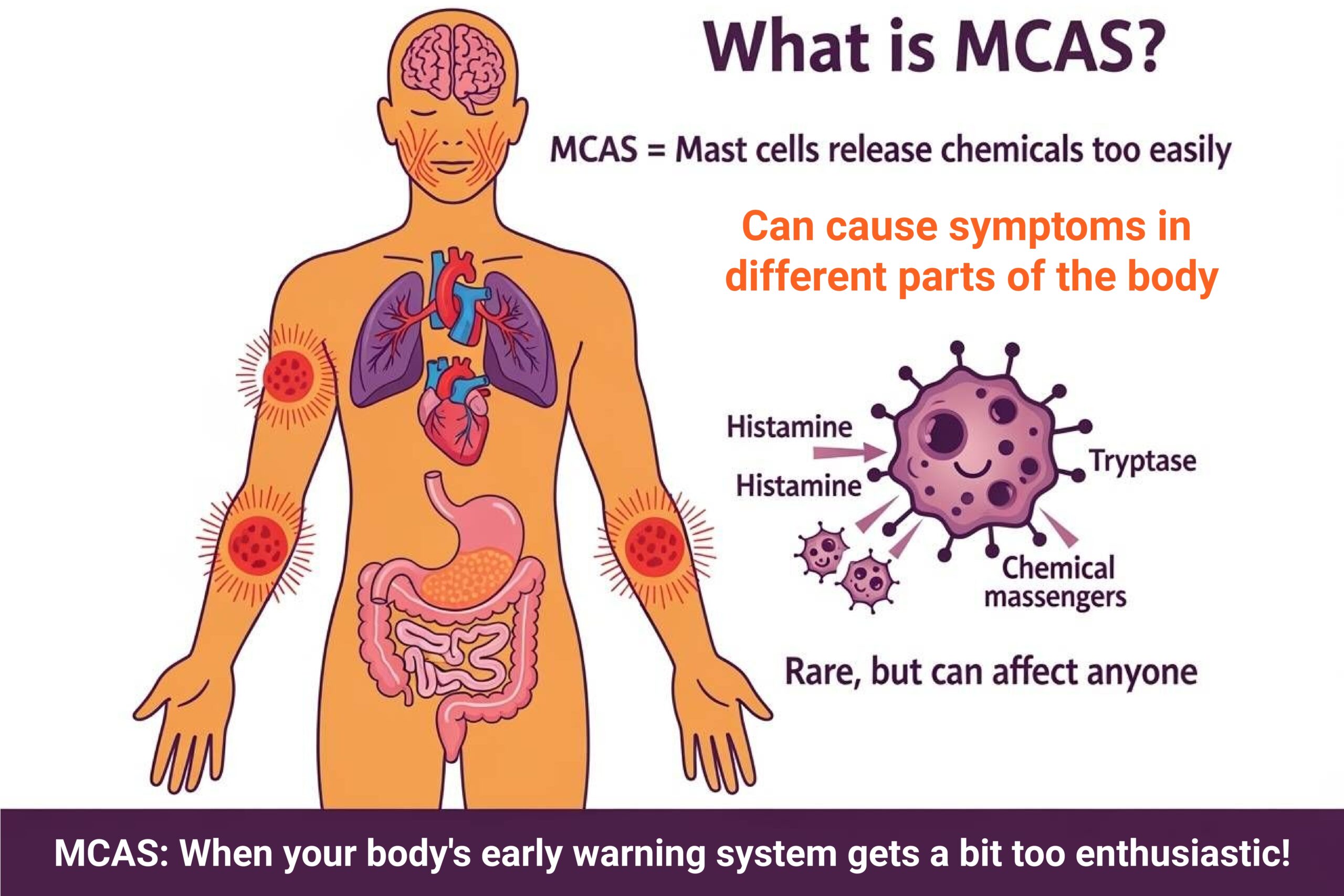
Mast cell activation syndrome is a condition where mast cells behave abnormally. Mast cells are part of your immune system. As the medical literature describes, they normally help defend the body and drive allergic responses by releasing chemical messengers called mediators, such as histamine.
In MCAS, these cells are not necessarily too many in number. Instead, they are too easily triggered, and they release their mediators when they should not. This produces recurring symptoms across more than one body system, often coming and going in episodes. As Mast Cell Action explains, the result can look like a severe, unpredictable allergy that has no single obvious cause.
MCAS is different from mastocytosis, which involves too many mast cells. It also overlaps with conditions some people have alongside it, such as certain forms of joint hypermobility and dysautonomia. This is part of why proper specialist assessment matters so much.
What are the symptoms of MCAS?
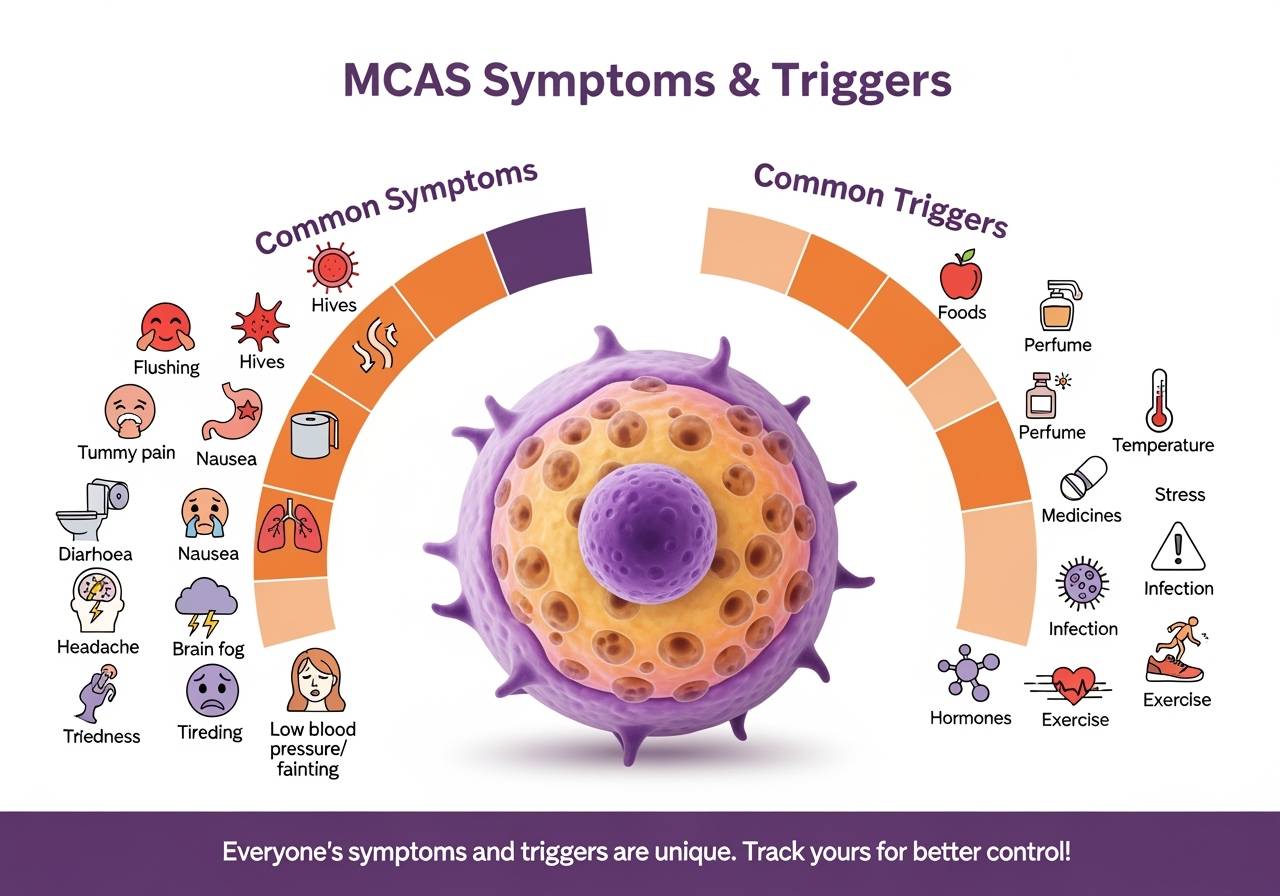
MCAS can affect many systems at once, which is one of its hallmarks. As the medical literature and patient charities describe, common symptoms include:
- flushing, itching, hives and swelling
- abdominal pain, nausea, diarrhoea and reflux
- palpitations, lightheadedness and dizziness
- headache, brain fog and fatigue
- nasal congestion, wheezing and shortness of breath
- a feeling of anxiety or impending doom during an episode
- in severe cases, anaphylaxis, which is a medical emergency
Symptoms often come in flares, then settle. They may be set off by triggers that seem unrelated, which makes the condition hard to pin down. Few people experience every symptom, and the pattern is personal to each individual.

What triggers MCAS, and what happens in the body?
When a mast cell is triggered, it releases a burst of mediators, including histamine, tryptase, prostaglandins and leukotrienes. As the research literature explains, these chemicals cause the blood vessels to widen, the gut to become irritable, and the skin to flush and itch. That burst is what you feel as a flare.
Triggers vary widely from person to person. Common ones reported by patients and described by charities include:
- certain foods and drinks, including alcohol and high-histamine foods
- heat, cold and sudden temperature change
- stress, strong emotion and lack of sleep
- infections and hormonal changes
- some medicines, fragrances and chemicals
- exercise in some people
Learning your own triggers is a central part of living with MCAS, because avoiding them reduces how often your mast cells are set off in the first place.
How is MCAS diagnosed?
MCAS is diagnosed by a specialist, usually in immunology or allergy, not online and not by any single test. As the consensus criteria described by Valent and colleagues set out, doctors generally look for three things together. First, typical recurring symptoms involving two or more body systems. Second, evidence that mast cell mediators have been released, for example a rise in blood tryptase during an episode above your own baseline, or raised mediators in urine. Third, improvement when you take medicines that target mast cells or block their mediators.
This careful approach matters because many conditions can mimic MCAS, and because the diagnosis is still evolving and sometimes debated. Getting the right diagnosis, from the right specialist, is essential before settling on a long-term treatment plan.
What are the standard treatment options for MCAS?
Treatment for MCAS follows a sensible, stepped path, and standard measures come first. As the medical literature and patient charities describe, the recognised mainstays include:
Trigger avoidance
Identifying and avoiding your personal triggers is the foundation. A symptom and food diary often helps you and your specialist spot patterns.
Antihistamines
H1 antihistamines, such as cetirizine or fexofenadine, block histamine and are often first-line. H2 antihistamines, such as famotidine, target histamine effects in the gut. These are frequently used together under specialist guidance.
Mast cell stabilisers
Medicines such as sodium cromoglicate are used to make mast cells less likely to release their mediators, and can help gut symptoms in particular.
Other targeted medicines
Depending on your symptoms, a specialist may add a leukotriene receptor antagonist such as montelukast, or other agents that target specific mediators. Anyone at risk of anaphylaxis should carry an adrenaline auto-injector and have an emergency plan.
These standard treatments are the backbone of managing MCAS well. Anything else, including low dose naltrexone, is considered alongside them, not instead of them.
Low dose naltrexone (LDN) and MCAS
Many people with MCAS come across low dose naltrexone and ask whether it could help. Because it is an option we can offer, and one that generates a lot of interest, we want to explain it clearly and honestly, including its limits.
What is LDN?
Naltrexone is a medicine licensed to treat opioid and alcohol dependence, at a dose of around 50mg. Low dose naltrexone uses a much smaller dose, typically between about 1.5mg and 4.5mg, taken at night. At this low dose it is used off-label, meaning outside its licensed purpose, for a range of conditions where an immune or inflammatory process is thought to play a part. Because these low strengths are not available off the shelf, LDN is prepared as a compounded medicine, which for us is made by APC Labs, our compounding pharmacy partner.
The theory in MCAS
The idea behind LDN is interesting. As the research literature describes, a brief, low dose of naltrexone is thought to cause a rebound rise in the body’s own endorphins, and to have anti-inflammatory and immune-calming effects. Some clinicians have proposed that these effects might, in turn, make mast cells less reactive. This is a plausible theory, and it is why some people with MCAS have tried LDN, but it is important to understand that it remains theoretical.
What the evidence actually shows
Here is the honest picture, because you deserve it. The evidence for LDN in MCAS specifically is very limited. There are no large, high-quality clinical trials in MCAS, and most of what exists is anecdotal reports and individual experience, alongside wider interest in LDN for other immune-related conditions. This means we cannot promise that LDN will help your MCAS, and we will not pretend otherwise. What we can say is that some people report benefit, and that it is one option to explore with clear eyes about how thin the evidence is.
What LDN is not
This is the most important part. LDN is not a cure for MCAS, and it is not a replacement for your standard treatment or your specialist care. The recognised mainstays, trigger avoidance, antihistamines and mast cell stabilisers, remain the foundation. If you choose to explore LDN, it should sit alongside that proper care, never instead of it, and your specialist should stay informed.
Safety, and who might consider it
LDN is generally well tolerated, and side effects are usually mild, such as vivid dreams or sleep disturbance early on, and occasionally headache or stomach upset. But there are firm safety points. LDN must not be taken by anyone using opioid medicines, including many strong painkillers, because it blocks them and can trigger sudden withdrawal or stop pain relief working. It also needs caution in liver disease, and it is not recommended in pregnancy or breastfeeding without specialist advice. One further point matters in MCAS specifically: because a compounded medicine contains a base and excipients, and because people with MCAS can react to fillers, your prescriber will take care over the formulation. This is exactly why LDN is prescriber-assessed, so we can check it is safe and appropriate for you, and coordinate with your wider care.

Monitoring and ongoing care
If you and your prescriber decide LDN is worth trying, it is usually started at a low dose and increased slowly, which helps your body adjust and makes any reaction easier to spot. You will be asked how you are getting on, and whether your symptoms, sleep and daily life are changing. Because MCAS care involves a specialist, we encourage you to keep them updated, so everyone caring for you has the full picture. If LDN does not help after a fair trial, there is no benefit in continuing it.
Patient experiences and challenges
Living with MCAS can be a daily exercise in uncertainty. People tell us about reacting to things that never used to bother them, about being told it was all in their head, and about the mental load of planning every meal, outing and journey around a flare that might come anyway. That is a lot to carry.
Many also tell us they have spent hours researching every possible option, including LDN, and found it hard to get a straight, honest answer, caught between overblown promises and blanket dismissal. That gap is exactly what we try to fill. You are not naive for asking about LDN, and you are not giving up by staying under your specialist. Both can be true at once.
How Courier Pharmacy helps with MCAS
We started Courier Pharmacy because too many people feel either dismissed or oversold, especially when they are navigating a condition that others struggle to understand. MCAS is a clear example. Your symptoms, your triggers and your goals are unique, so your support should be too. That personalisation is the first of our four pillars.
The other pillars carry it through. Guidance means we give you honest, evidence-based information, including the real limits of options like LDN, so you can decide with clear eyes. Trust means we are a UK-regulated pharmacy that will always tell you when something is not a substitute for specialist care. Community means we show up for people, even when there is nothing to sell.
That spirit has a face in Dr Ada Jex-Cori, the voice of our approach, whose message is simple: you are not broken, and you deserve healthcare that fits your life. For MCAS, that means honest support, real options, and respect for you and your specialist team. Healthcare that fits you, not the other way round.

Frequently asked questions about LDN for MCAS
What is MCAS?
Mast cell activation syndrome is a condition where mast cells, part of your immune system, release their chemical mediators too easily. As Mast Cell Action describes, this causes recurring symptoms across several body systems, such as flushing, hives, gut upset, palpitations and brain fog. Symptoms often come in flares and can be set off by triggers like food, heat or stress. It is usually diagnosed and managed by an immunology or allergy specialist.
Does low dose naltrexone treat MCAS?
Not in the way people sometimes hope. LDN is not a cure for MCAS, and the evidence in MCAS specifically is very limited and mostly anecdotal. The theory is that LDN may calm immune activity and make mast cells less reactive, but this remains unproven in good clinical trials. LDN is best understood as one option some people choose to explore, alongside their standard treatment and specialist care, rather than as a treatment for MCAS itself.
How does LDN work, and what dose is used?
LDN uses a low dose of naltrexone, usually about 1.5mg to 4.5mg at night, far lower than the 50mg used for addiction. As the research literature describes, it is thought to cause a rebound rise in the body’s endorphins and to have anti-inflammatory effects, though these mechanisms remain theoretical. Because these strengths are not available off the shelf, LDN is compounded to order, for us by APC Labs.
Should I stop my usual MCAS treatment if I try LDN?
No. This is really important. LDN is not a replacement for trigger avoidance, antihistamines, mast cell stabilisers or your specialist care. Those recognised mainstays remain the foundation of managing MCAS. If you choose to explore LDN, it should be alongside your prescribed treatment and your specialist, never instead of them. We would always encourage you to keep your specialist informed.
Is LDN safe to take with my other medicines?
LDN is usually well tolerated, with mild side effects like vivid dreams or sleep disturbance early on. The most important safety point is that it must not be taken with opioid painkillers, as it blocks them and can trigger withdrawal. It also needs caution in liver disease, and is not recommended in pregnancy or breastfeeding without specialist advice. Because people with MCAS can react to fillers, your prescriber will also take care over the formulation. This is why it is prescriber-assessed.
How long before I know if LDN is helping?
LDN is usually started low and increased slowly, and people who do respond often describe gradual change over several weeks to a few months rather than overnight. Keeping a simple symptom diary helps you and your prescriber judge whether it is genuinely making a difference. If a fair trial brings no benefit, there is no reason to continue it.
How do I start, and what will it cost?
It starts with a consultation, where a prescriber reviews your history, your current treatment and your suitability for LDN. If it is appropriate, your compounded LDN is prepared to order by APC Labs. You are welcome to speak to a pharmacist first if you have questions.
Important disclaimer
This page is for general information and education. It is not medical advice, and it is not a substitute for a consultation with a qualified healthcare professional. MCAS should be diagnosed and managed by an immunology or allergy specialist, and standard treatments such as trigger avoidance, antihistamines and mast cell stabilisers are the recognised mainstays.
Low dose naltrexone is an off-label, experimental option with very limited evidence in MCAS. It is not a cure, and it must never replace specialist care or prescribed treatment. LDN must not be taken with opioid medicines. If you are at risk of anaphylaxis, carry your adrenaline auto-injector and follow your emergency plan. Always speak to your specialist, prescriber or pharmacist before starting, stopping or changing any treatment.
References
- Valent, P., Akin, C., Hartmann, K., Nilsson, G., Reiter, A., Hermine, O., Sotlar, K., Sperr, W.R., Escribano, L., George, T.I., & Kluin-Nelemans, H.C. (2020). Mast cells as a unique hematopoietic lineage and cell system: From Paul Ehrlich’s visions to precision medicine concepts. Theranostics, 10(23), p.10743.
- Da Silva, E.Z.M., Jamur, M.C. and Oliver, C., 2014. Mast cell function: a new vision of an old cell. Journal of Histochemistry & Cytochemistry, 62(10), pp.698-738.
- Gilfillan, A.M. and Beaven, M.A., 2011. Regulation of mast cell responses in health and disease. Critical Reviews™ in Immunology, 31(6).
- Kelso, J.M., 2020. MRGPRX2 signaling and skin test results. The Journal of Allergy and Clinical Immunology: In Practice, 8(1), p.426.
- Castells, M., 2006. Mast cell mediators in allergic inflammation and mastocytosis. Immunology and Allergy Clinics, 26(3), pp.465-485.
- Courier Pharmacy. (2025) Mast cell activation syndrome and gastrointestinal symptoms. Available at: https://courierpharmacy.co.uk/mast-cell-activation-syndrome-and-gastrointestinal-symptoms/ (Accessed: 5 September 2025).
- Akin, C., Valent, P. and Metcalfe, D.D., 2010. Mast cell activation syndrome: proposed diagnostic criteria. Journal of Allergy and Clinical Immunology, 126(6), pp.1099-1104.
- Gulen, T. Using the Right Criteria for MCAS. Curr Allergy Asthma Rep24, 39–51 (2024)
- Courier Pharmacy. (2025) Mast cell activation syndrome and gastrointestinal symptoms. Available at: https://courierpharmacy.co.uk/mast-cell-activation-syndrome-and-gastrointestinal-symptoms/#h-what-is-mast-cell-activation-syndrome (Accessed: 5 September 2025).
- Valent P, Akin C, Bonadonna P, Hartmann K, Brockow K, Niedoszytko M, et al. Proposed diagnostic algorithm for patients with suspected mast cell activation syndrome. J Allergy Clin Immunol Pract. 2019;7(4):1125–33.
- Weiler, C.R., Austen, K.F., Akin, C., Barkoff, M.S., Bernstein, J.A., Bonadonna, P., Butterfield, J.H., Carter, M., Fox, C.C., Maitland, A. and Pongdee, T., 2019. AAAAI Mast Cell Disorders Committee Work Group Report: mast cell activation syndrome (MCAS) diagnosis and management. Journal of Allergy and Clinical Immunology, 144(4), pp.883-896.
- Tolar, J., Tope, W.D. and Neglia, J.P., 2004. Leukotriene-receptor inhibition for the treatment of systemic mastocytosis. New England Journal of Medicine, 350(7), pp.735-736.
- Courier Pharmacy. (2025) LDN and MCAS. Available at: https://courierpharmacy.co.uk/ldn-and-mcas/ (Accessed: 5 September 2025).
- Courier Pharmacy. (2025) How does LDN work? Available at: https://courierpharmacy.co.uk/how-does-ldn-work/ (Accessed: 5 September 2025).
- Valent, P., Akin, C. and Metcalfe, D.D., 2017. Mastocytosis: 2016 updated WHO classification and novel emerging treatment concepts. Blood, The Journal of the American Society of Hematology, 129(11), pp.1420-1427.


BSc Pharmacy, Independent Prescriber, PgDip Endocrinology, MSc Endocrinology, PgDip Infectious Diseases
Superintendant Pharmacist, Independent Prescriber

BSc Pharmacy
Compounding Pharmacist

