

Ever wondered why long COVID looks so different from one person to the next? One friend can’t stand up without their heart racing, another reacts to foods they’ve eaten for years, and someone else is flattened for days after a short walk. The answer is that long COVID causes aren’t one single thing. Researchers now think several body systems can be knocked off balance at once.
In this guide, we walk through the six contributing factors that come up most often in the research: autonomic dysfunction, mitochondrial dysfunction, mast cell activation (MCAS), endothelial dysfunction, gut dysbiosis and hormone imbalance. We’ll explain what each one means in plain English, how it might show up in your day, and what you can actually do about it.
Five key takeaways
- Long COVID causes are rarely down to one thing. Most people seem to have a mix of overlapping problems, which is why symptoms vary so much.
- Autonomic dysfunction, including POTS, is one of the most common findings and explains the racing heart, dizziness and “wired but tired” feeling many people describe.
- Mitochondrial and muscle changes help explain post-exertional malaise, the crash that follows doing too much, so pacing matters more than pushing through.
- Overactive mast cells, damaged blood vessel linings and an unsettled gut microbiome can all keep inflammation simmering long after the virus has gone.
- Hormones such as cortisol, oestrogen, progesterone and testosterone can shift after infection, and in midlife women, perimenopause can look a lot like long COVID, so it’s worth checking.

What is long COVID, and why is there no single cause?
In the UK, NICE uses “long COVID” to describe signs and symptoms that carry on or develop after the acute infection. It covers ongoing symptomatic COVID-19 (4 to 12 weeks) and post-COVID-19 syndrome (12 weeks or more), as long as nothing else explains them (NICE, 2024).
It’s not rare, either. In early 2024, an estimated 1.8 million people in England, about 3.3% of people in private households, said they had long COVID symptoms more than four weeks after infection (ONS and UKHSA, cited in UK Parliament, 2025).
Think of it like a power cut in a big building
Imagine a storm hits an office block. In one room the lights flicker, in another the heating fails, and the lift gets stuck on the third floor. It’s the same storm, but different systems fail in different places. Long COVID works in a similar way. The virus is the storm, and the six factors below are the systems that can be left damaged afterwards.
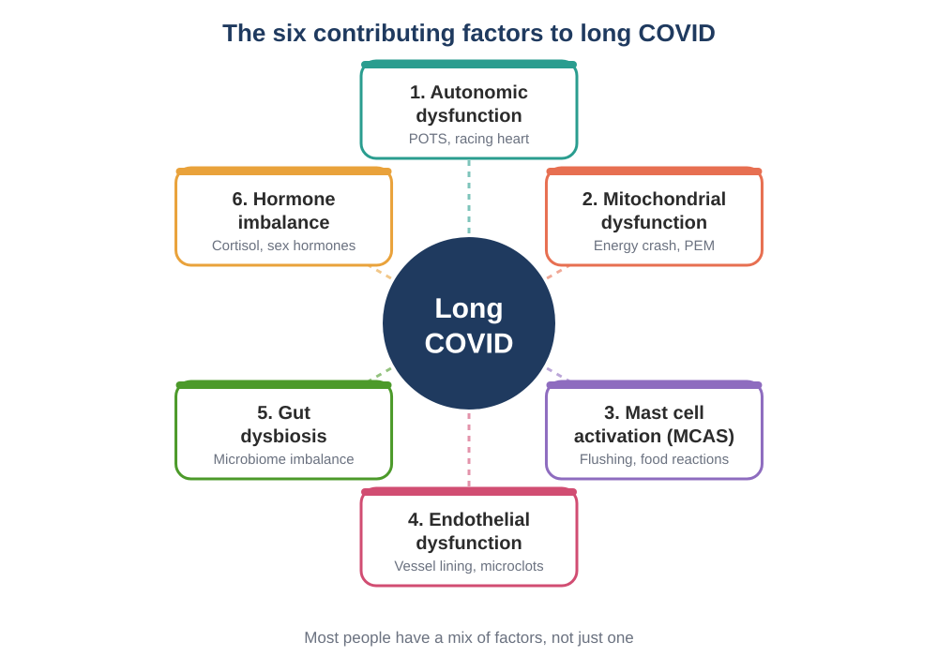
That’s why two people with long COVID can have such different stories. Major reviews describe several overlapping mechanisms, including immune changes, problems with blood vessel linings and clotting, gut microbiome changes and nerve system effects (Davis et al., 2023; Fernández-de-las-Peñas et al., 2023). Most people won’t have all six, but many have more than one.
Who is more likely to be affected?
UK data has consistently shown higher rates in women, people aged roughly 35 to 69, health and social care workers, and people with pre-existing conditions that limit day-to-day activity (ONS, 2023). Long COVID can also follow a mild infection, so “I wasn’t that ill at the time” doesn’t rule it out.
Long COVID cause 1: autonomic dysfunction (dysautonomia and POTS)
Your autonomic nervous system is the body’s autopilot. It handles everything you don’t think about, such as heart rate, blood pressure, digestion, sweating and body temperature. When it’s thrown off course, it’s called dysautonomia.
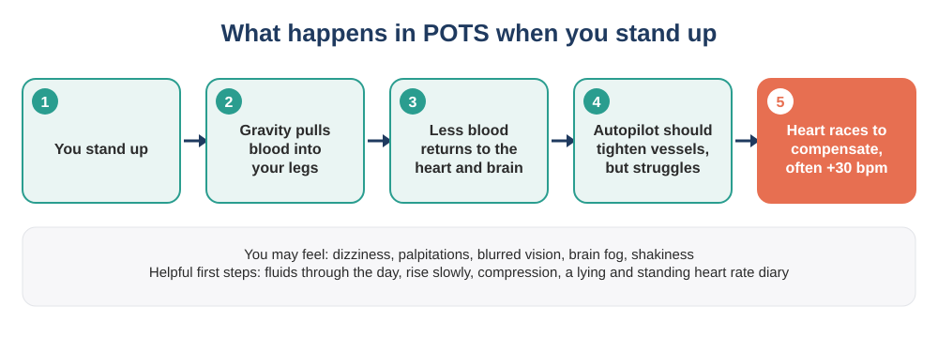
The best-known form after COVID is postural orthostatic tachycardia syndrome, or POTS. When you stand up, gravity pulls blood towards your legs. Normally, your blood vessels tighten and your heart nudges up a few beats to keep blood flowing to your brain. In POTS, the heart races to make up for it, often by 30 beats per minute or more, without a big drop in blood pressure.
How common is it in long COVID?
Pretty common, it seems. In one Australian study, 79% of people with long COVID who had autonomic testing met the criteria for POTS (Seeley et al., 2023). A Stanford follow-up of 526 adults found that around 72% still had moderate to severe autonomic symptoms, with a median of three years since infection (Eastin et al., 2025). Those were specialist and self-selected groups, so the figure in the wider population will be lower, but it shows how central this factor can be.
What it can feel like
- A pounding or racing heart when you stand, shower or queue at the shops
- Light-headedness, blurred vision or feeling faint
- Feeling “wired but tired”, especially at night
- Bloating, constipation or feeling full quickly, because the gut is on autopilot too
- Cold, purple-ish hands or feet
Practical tips
- Drink plenty of fluids through the day, unless a doctor has told you to limit them.
- Stand up slowly, and try clenching your calf and thigh muscles before you rise.
- Ask your GP or a specialist whether extra salt is right for you, as it isn’t safe for everyone, especially if you have high blood pressure or kidney problems.
- Compression socks or abdominal binders help some people.
- Keep a simple diary of heart rate on lying down and after 10 minutes of standing. It’s useful evidence to take to your GP, who can arrange an active stand test.
Long COVID cause 2: mitochondrial dysfunction and the energy crash
Mitochondria are the tiny power stations inside your cells. They turn food and oxygen into ATP, the energy currency your muscles and brain run on. If they’re not working well, it’s like trying to run a house on a phone battery.
The science, simply put
A Dutch study published in Nature Communications took muscle samples from 25 people with long COVID and 21 people who had fully recovered, before and after a 15-minute cycling test. The long COVID group had lower mitochondrial function in their muscles. After exercise, they showed more muscle tissue damage and small deposits of amyloid-like material, and their symptoms got worse for days (Appelman et al., 2024). Importantly, their hearts and lungs were working normally.
It’s a small study, and a group of UK clinicians argued in a published reply that the brain may also play a protective role in that crash. Still, it gave real biological weight to what patients had been saying for years.
Post-exertional malaise: the payback effect
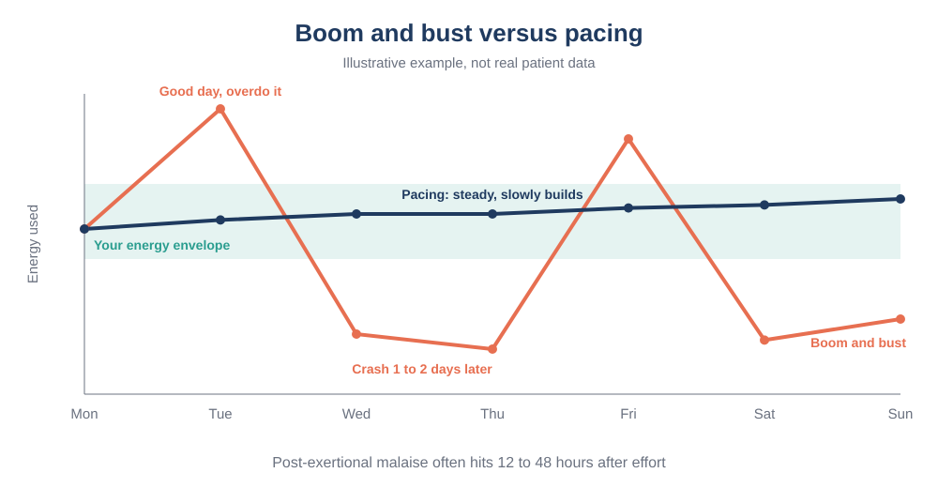
Post-exertional malaise (PEM) is a worsening of symptoms after physical, mental or emotional effort. The twist is that it often hits 12 to 48 hours later. You might feel fine at a friend’s birthday on Saturday, then spend Monday and Tuesday on the sofa.
Practical tips
- Pace yourself. Think of your energy as a daily budget, and try not to go overdrawn, even on good days.
- Break tasks into smaller chunks and rest before you feel exhausted, not after.
- Be wary of “push through it” exercise plans. The researchers behind the study above warned that some traditional rehab can backfire for people with PEM (Appelman et al., 2024).
- Gentle walking or a short spin on an e-bike may help keep some fitness, within your own limit.
Long COVID cause 3: mast cell activation (MCAS)
Mast cells are your body’s first responders. They sit in the skin, gut, lungs and around blood vessels, packed with chemicals such as histamine. When they spot a threat, they release those chemicals to raise the alarm. In mast cell activation syndrome (MCAS), they’re a bit twitchy, and they go off at things that shouldn’t bother them, such as certain foods, heat, perfume or stress (Courier Pharmacy, 2025a).
Why COVID might set them off
Researchers think the infection may leave mast cells primed and over-reactive. A US study led by Dr Leonard Weinstock compared people with long COVID, people with MCAS and healthy controls. After infection, the long COVID group’s symptoms looked almost identical to MCAS, in both type and severity (Weinstock et al., 2021).
What it can feel like
- Flushing, itching, hives or a rash that comes and goes
- New food sensitivities, often with bloating, cramps or loose stools
- A racing heart, headaches or brain fog after eating
- Blocked nose, wheeze or throat tightness
- Feeling anxious or a sense of dread during a flare
There’s a big overlap with POTS here, and many people seem to have both.
What can help
In a small Italian study, people whose long COVID symptoms were put down to mast cell activation took a combination of a H1 and a H2 antihistamine. After 20 days, symptoms had cleared completely in 29% of the treated group, and the racing heart improved too (Salvucci et al., 2023). It’s early evidence, but it’s encouraging.
- Keep a food and symptom diary for two to four weeks to spot your triggers.
- Talk to a pharmacist before starting any antihistamine, especially if you take other medicines or are pregnant.
- A short, guided trial of a lower-histamine diet may help some people, but don’t cut out whole food groups long term without support.
If you’d like to go deeper, our guide on what mast cell activation syndrome is and our complete guide to MCAS explain triggers, diagnosis and diet in more detail.
Long COVID cause 4: endothelial dysfunction and microclots
The endothelium is the thin lining of every blood vessel in your body. If you laid it out flat, it would cover a tennis court or so. It’s not just a pipe lining, though. It controls how blood vessels widen and narrow, keeps blood flowing smoothly, and stops clots forming when they shouldn’t.
SARS-CoV-2 can infect and inflame these cells. Severe COVID is now often described as a blood vessel disease as much as a lung disease.
The microclot theory
Professor Resia Pretorius and colleagues at Stellenbosch University have found tiny, unusually tough clots (sometimes called fibrinaloid microclots) in the blood of people with long COVID. These clots seemed to resist the body’s normal clot-busting system (Pretorius et al., 2021). Later work from the same group found raised markers linked to damaged vessel linings and sticky platelets. The idea is that these clots could block small vessels, so tissues get less oxygen than they need.
It’s a compelling theory, but it’s still debated. Some experts say the lab methods are hard to repeat and that we need much more evidence before acting on it.
A word of caution
You may come across clinics offering blood “washing” (apheresis) or combinations of blood thinners for microclots. These aren’t backed by solid trials yet, they can be very expensive, and blood thinners carry a real risk of bleeding. Please speak to a doctor or pharmacist before considering them.
What it can feel like, and what helps
Poor circulation can show up as cold hands and feet, brain fog, chest discomfort, breathlessness or heavy, achy legs. The usual heart-healthy basics really do support vessel linings: not smoking, staying as active as your pacing allows, eating plenty of colourful vegetables and oily fish, and keeping blood pressure, cholesterol and blood sugar in check.
Any new chest pain, sudden breathlessness, or a swollen, painful calf needs urgent medical attention. Call 999 or NHS 111.
Long COVID cause 5: gut dysbiosis
Your gut is home to trillions of bacteria, often called the gut microbiome. Think of it as a busy garden. When it’s healthy, lots of different plants grow side by side and keep the weeds in check. Dysbiosis is when that balance tips, and the weeds start to take over.
The virus that causes COVID can infect cells lining the gut, and it can unsettle that garden.
What the research shows
A Hong Kong study followed 106 people from hospital admission for six months. Those who recovered fully had gut bacteria that looked like healthy controls again by six months. Those with long COVID didn’t. They had fewer helpful, butyrate-producing bacteria such as Faecalibacterium prausnitzii, and more of some less friendly species (Liu et al., 2022). Butyrate is a fatty acid that feeds the gut lining and helps calm inflammation.
Another study, published in Cell, found lower serotonin levels in some people with long COVID. The researchers linked this to ongoing viral pieces in the gut, low-level inflammation and poorer absorption of tryptophan, the building block for serotonin (Wong et al., 2023). Serotonin isn’t just a “mood chemical”, either. It also helps signal along the vagus nerve, which links the gut and brain.
We can’t yet say whether gut changes cause long COVID or are a result of being unwell, eating differently and moving less. It’s probably a bit of both.
Practical tips for a happier gut garden
- Aim for variety. Try to eat 30 different plant foods a week, counting fruit, vegetables, beans, wholegrains, nuts, seeds, herbs and spices.
- Add fermented foods slowly if they suit you, such as live yoghurt or kefir. If you have MCAS, go carefully, because fermented foods can be high in histamine.
- Increase fibre gradually to avoid extra bloating.
- Probiotics may help some people, but evidence in long COVID is still limited. A pharmacist can help you choose one sensibly.
Long COVID cause 6: hormone imbalance
Hormones are your body’s text messages. They’re sent from glands into the bloodstream and tell organs what to do and when. After COVID, several of these message systems can go a little haywire.
Cortisol and the stress system
Cortisol is your main stress hormone. It normally peaks in the morning to help you get going, and it helps keep inflammation under control. In a Yale study of 273 people, morning cortisol was lower in people with long COVID than in those who had recovered (Klein et al., 2023). The brain’s signal to make more cortisol didn’t rise to make up for it either, which suggests the control system itself may be blunted.
Other experts have pointed out that cortisol is tricky to measure, as levels swing a lot across the day, and the timing of those blood tests matters (Alaedini, Lightman and Wormser, 2024). So low cortisol is an interesting lead, not a diagnosis. Please don’t start any steroid or “adrenal support” product without medical advice.
Oestrogen, progesterone and testosterone
Long COVID is more common in women, especially in their 40s and early 50s. That’s exactly when perimenopause tends to start. In a UK survey of 460 women with long COVID, 70% thought some of their symptoms might be linked to perimenopause or menopause (Newson, Lewis and O’Hara, 2021).
The overlap is striking: fatigue, brain fog, poor sleep, joint pain, low mood and palpitations appear on both lists. UK researchers, including menopause specialist Dr Louise Newson, have warned that some women may be told they have long COVID when perimenopause is part of the picture, and so miss out on helpful treatment (Stewart et al., 2021). Oestrogen and testosterone also help steer the immune system, which may partly explain why women are affected more often.
Men aren’t left out, either. Low testosterone can cause tiredness, low mood and reduced stamina, so it’s worth checking if those symptoms persist.
Thyroid
Viral infections can sometimes inflame the thyroid. Because an underactive or overactive thyroid can mimic long COVID, a simple thyroid blood test is a sensible part of any work-up.
Practical tips
- If you’re a woman over 40, track your periods, sleep and symptoms for a couple of months, and ask whether perimenopause could be playing a part.
- Ask your GP about basic blood tests, such as thyroid function, and, where relevant, sex hormones.
- Support your body clock with morning daylight, a regular bedtime and a wind-down routine.
How the six long COVID causes link together
These six factors don’t live in separate boxes. They talk to each other all the time, a bit like a group chat that’s got out of hand.

- Overactive mast cells release histamine, which widens blood vessels and can make POTS worse.
- Inflamed vessel linings and microclots may starve muscles of oxygen, which adds to the mitochondrial energy crash.
- An unsettled gut can feed inflammation and lower serotonin, which affects the vagus nerve and the autonomic system.
- A blunted cortisol response means inflammation is less tightly controlled, so every other problem can simmer for longer.
The good news is that this works in reverse, too. Calming one system can take pressure off the others. Someone who treats their mast cell symptoms often finds their heart rate settles a little. Better sleep and gentler pacing can help hormones and energy at the same time.
A practical starting plan
- Write it all down. Keep a two-week diary of symptoms, food, activity, sleep and, for women, your cycle. Patterns jump out quickly.
- Rule out other causes. Ask your GP about blood tests such as a full blood count, iron, vitamin D, B12, thyroid function and blood sugar. NICE advises that other causes should be considered before symptoms are put down to long COVID (NICE, 2024).
- Match tips to your main factor. If standing is your biggest problem, start with the POTS tips. If you crash after effort, focus on pacing first.
- Change one thing at a time. That way you’ll know what’s actually helping.
- Ask for help early. The NHS has over 90 adult post-COVID services in England (UK Parliament, 2025), and your GP can refer you.
Red flags: don’t wait
Get urgent help if you have chest pain, severe breathlessness, fainting, a swollen and painful leg, sudden weakness on one side of the body, or thoughts of harming yourself. Call 999 or NHS 111.
Low dose naltrexone (LDN) for long COVID
You may have seen low dose naltrexone or LDN mentioned in long COVID support groups. Here’s what it is, what the research does and doesn’t show, and who it might suit.
What is LDN?
Naltrexone has been around for decades. At the standard 50 mg dose, it’s licensed in the UK to help people stay off opioids and to support people cutting out alcohol. Low dose naltrexone uses a tiny fraction of that, usually somewhere between 0.5 mg and 4.5 mg a day. At these doses, it’s prescribed off-label and made up specially, because there’s no licensed low-dose product in the UK.
How might LDN help with long COVID?
Think of LDN as a dimmer switch rather than an on-off button. At low doses, it seems to calm overactive immune cells in the brain and nervous system, called microglia. It also briefly blocks opioid receptors overnight, and the body seems to respond by making more of its own feel-good endorphins.
That’s interesting for long COVID, because simmering inflammation is the thread running through all six factors in this guide. LDN isn’t a direct fix for POTS, an unsettled gut or low hormones. However, it may help with some of the symptoms that inflammation drives, such as fatigue, pain, brain fog and poor sleep.
What does the research say?
The evidence is promising but early, so it’s worth being honest about it.
- In an Irish study, people who’d had long COVID for a median of 11 months took LDN starting at 1 mg, increasing to 3 mg. It was well tolerated, and symptoms had improved after two months (O’Kelly et al., 2022).
- A Stanford clinic reviewed the records of 59 people with long COVID who’d been prescribed LDN. Many had fewer symptoms and better day-to-day function, with improvements in fatigue, post-exertional malaise and sleep. There was no comparison group, though (Bonilla et al., 2023).
- A 2025 systematic review pulled the small studies together. It found that LDN may improve fatigue, thinking, sleep, pain and function, but the certainty of the evidence is low (Byambasuren et al., 2025).
Proper randomised trials are under way. Until they report, LDN isn’t recommended in NICE guidance for long COVID and isn’t usually available on the NHS. It’s an option some people choose to try with a prescriber, not a proven cure.
Who might consider LDN, and who shouldn’t take it
LDN may be worth discussing if you’ve been living with long COVID fatigue, pain, brain fog or sleep problems for a while, and you’ve already worked on the basics, such as pacing and ruling out other causes.
It isn’t suitable for everyone. LDN blocks opioid painkillers, so it shouldn’t be taken with codeine, co-codamol, tramadol, morphine or similar medicines, including some cough remedies. Taking them together can stop the painkiller working, and in people used to opioids it can trigger withdrawal. You’ll need to tell your care team you take LDN before any operation. People with serious liver problems, those who are pregnant or breastfeeding, and under-18s will need specialist advice first.
Possible side effects
Most people find LDN gentle. The most common side effects are vivid dreams, trouble sleeping, headaches and mild nausea, usually in the first few weeks. They often settle as your body adjusts. If sleep is a problem, your prescriber may suggest taking your dose in the morning instead.
You can read more in our blog Can LDN help with long COVID?.
How to get LDN from Courier Pharmacy
LDN is a prescription-only medicine, so you can’t buy it over the counter. Here’s how our process works.
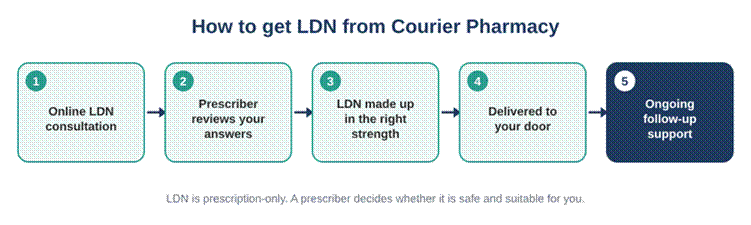
- Complete our online LDN consultation. It asks about your long COVID symptoms, your medical history and the medicines you take, including safety checks such as opioid use.
- A prescriber reviews your answers. One of our UK-registered pharmacist prescribers checks whether LDN is safe and suitable for you. They may contact you with questions, or ask for information from your GP. If LDN isn’t right for you, we’ll tell you and talk through other options.
- Your LDN is made up for you. Because there’s no licensed low-dose product, LDN is prepared as a special in different strengths. That lets your prescriber start you on a low dose and adjust it gradually.
- It’s delivered to your door. Once your prescription is approved, your medicine is dispatched to your home address.
- You get ongoing support. Follow-up consultations with our prescribers are included once you’ve started treatment, so you can review how it’s going and adjust your dose.
Tips for getting the most from LDN
- Start low and go slow. Most people build up their dose over several weeks, guided by their prescriber.
- Give it time. Some people notice changes within a few weeks, but it can take two to three months to judge properly.
- Keep a simple symptom diary, so you and your prescriber can see what’s changing.
- Let your GP know you’re taking LDN, so it’s on your record if you ever need painkillers or surgery.
Frequently asked questions about long COVID causes

What are the main long COVID causes?
The main long COVID causes being studied are autonomic dysfunction, mitochondrial dysfunction, mast cell activation, endothelial dysfunction and microclots, gut dysbiosis and hormone imbalance. Viral persistence and autoimmunity are also being researched. Most people have a mix rather than a single cause.
Can you get long COVID after a mild infection?
Yes. Many people with long COVID had a mild illness at first. Severity at the start doesn’t reliably predict who will develop lasting symptoms.
Is POTS a common cause of long COVID symptoms?
POTS is one of the most common autonomic problems seen after COVID. It’s especially likely if your heart races and you feel dizzy when you stand. Your GP can check with a simple lying and standing heart rate test.
Why do I crash a day or two after doing too much?
That’s post-exertional malaise. Research suggests that muscle mitochondria produce less energy in long COVID, and that over-exertion can cause further muscle stress. Pacing your activity is the most useful first step.
Is MCAS linked to long COVID?
Research suggests mast cell activation symptoms are much more common after COVID, and many people’s long COVID symptoms mirror MCAS. Some people improve with antihistamines, but it’s best to get advice before starting them.
Are microclots proven to cause long COVID?
Not yet. Microclots have been found in the blood of people with long COVID, but the evidence is still being debated. Treatments aimed at microclots are unproven and can carry risks, so speak to a doctor first.
Can gut health affect long COVID?
It seems so. Studies show people with long COVID often have fewer helpful gut bacteria. A varied, fibre-rich diet is a safe place to start, though it’s not yet clear whether changing the gut speeds recovery.
Could my long COVID actually be perimenopause?
It’s possible, or it could be both. The symptoms overlap a lot. If you’re a woman over 40, it’s worth asking a clinician to consider perimenopause alongside long COVID.
Is there a test for long COVID?
There’s no single test. Diagnosis is based on your symptoms and history, after other causes have been ruled out. Tests such as bloods or a standing heart rate check can help identify which factors apply to you.
Does long COVID go away?
Many people improve over time, often gradually. Recovery varies, and some people have symptoms for years. Pacing, managing your main triggers and getting the right support can all help.
Disclaimer
Disclaimer: This information is for education only and isn’t a substitute for personal medical advice. Always follow your prescriber’s instructions.
References
- Alaedini, A., Lightman, S. and Wormser, G.P. (2024) ‘Is low cortisol a marker of long COVID?’, The American Journal of Medicine.
- Appelman, B., Charlton, B.T., Goulding, R.P. et al. (2024) ‘Muscle abnormalities worsen after post-exertional malaise in long COVID’, Nature Communications, 15, p. 17. Available at: https://doi.org/10.1038/s41467-023-44432-3 (Accessed: 3 November 2026).
- Bonilla, H., Tian, L., Marconi, V.C., Shafer, R., McComsey, G.A., Miglis, M., Yang, P., Bonilla, A., Eggert, L. and Geng, L.N., 2023. Low-dose naltrexone use for the management of post-acute sequelae of COVID-19. International immunopharmacology, 124, p.110966.
- Byambasuren, O., Atkins, T., Baptista, S., Glasziou, P. and Chakraborty, S., 2026. Effect of low-dose naltrexone for long COVID: a systematic review and meta-analysis. BMJ open, 16(7), p.e111253.
- Courier Pharmacy (2025a) What is mast cell activation syndrome? Available at: https://courierpharmacy.co.uk/what-is-mast-cell-activation-syndrome/ (Accessed: 3 November 2026).
- Courier Pharmacy (2025b) Your guide to mast cell activation syndrome. Available at: https://courierpharmacy.co.uk/your-guide-to-mast-cell-activation-syndrome/ (Accessed: 3 November 2026).
- Davis, H.E., McCorkell, L., Vogel, J.M. and Topol, E.J. (2023) ‘Long COVID: major findings, mechanisms and recommendations’, Nature Reviews Microbiology, 21, pp. 133–146. Available at: https://doi.org/10.1038/s41579-022-00846-2 (Accessed: 3 November 2026).
- Eastin, E., Machnik, J., Larsen, N. et al. (2025) ‘Evaluating long-term autonomic dysfunction and functional impacts of long COVID: a follow-up study’, Neurology, 104(7 Suppl 1), p. 4290. Available at: https://www.medrxiv.org/content/10.1101/2024.10.11.24315277v1 (Accessed: 3 November 2026).
- Fernández-de-las-Peñas, C., Raveendran, A.V., Giordano, R. and Arendt-Nielsen, L. (2023) ‘Long COVID or post-COVID-19 condition: past, present and future research directions’, Microorganisms, 11(12), p. 2959. Available at: https://doi.org/10.3390/microorganisms11122959 (Accessed: 3 November 2026).
- O’Kelly, B., Vidal, L., McHugh, T., Woo, J., Avramovic, G. and Lambert, J.S., 2022. Safety and efficacy of low dose naltrexone in a long covid cohort; an interventional pre-post study. Brain, behavior, & immunity-health, 24, p.100485.
- Klein, J., Wood, J., Jaycox, J. et al. (2023) ‘Distinguishing features of long COVID identified through immune profiling’, Nature, 623, pp. 139–148. Available at: https://doi.org/10.1038/s41586-023-06651-y (Accessed: 3 November 2026).
- Liu, Q., Mak, J.W.Y., Su, Q. et al. (2022) ‘Gut microbiota dynamics in a prospective cohort of patients with post-acute COVID-19 syndrome’, Gut, 71(3), pp. 544–552. Available at: https://doi.org/10.1136/gutjnl-2021-325989 (Accessed: 3 November 2026).
- National Institute for Health and Care Excellence (2024) COVID-19 rapid guideline: managing the long-term effects of COVID-19 (NG188). Available at: https://www.nice.org.uk/guidance/ng188 (Accessed: 3 November 2026).
- Newson, L., Lewis, R. and O’Hara, M. (2021) ‘Long Covid and menopause: the important role of hormones in long Covid must be considered’, Maturitas, 152, p. 74. Available at: https://pmc.ncbi.nlm.nih.gov/articles/PMC8522980 (Accessed: 3 November 2026).
- NHS (no date) Long-term effects of COVID-19 (long COVID). Available at: https://www.nhs.uk/conditions/covid-19/long-term-effects-of-covid-19-long-covid/ (Accessed: 3 November 2026).
- Office for National Statistics (2023) Prevalence of ongoing symptoms following coronavirus (COVID-19) infection in the UK: 30 March 2023. Available at: https://www.ons.gov.uk/peoplepopulationandcommunity/healthandsocialcare/conditionsanddiseases/bulletins/prevalenceofongoingsymptomsfollowingcoronaviruscovid19infectionintheuk/30march2023 (Accessed: 3 November 2026).
- Pretorius, E., Vlok, M., Venter, C. et al. (2021) ‘Persistent clotting protein pathology in long COVID/post-acute sequelae of COVID-19 (PASC) is accompanied by increased levels of antiplasmin’, Cardiovascular Diabetology, 20, p. 172. Available at: https://doi.org/10.1186/s12933-021-01359-7 (Accessed: 3 November 2026).
- Salvucci, F., Codella, R., Coppola, A. et al. (2023) ‘Antihistamines improve cardiovascular manifestations and other symptoms of long-COVID attributed to mast cell activation’, Frontiers in Cardiovascular Medicine, 10, 1202696. Available at: https://doi.org/10.3389/fcvm.2023.1202696 (Accessed: 3 November 2026).
- Seeley, M.C., Gallagher, C., Ong, E. et al. (2023) ‘High incidence of autonomic dysfunction and postural orthostatic tachycardia syndrome in patients with long COVID: implications for management and healthcare planning’, The American Journal of Medicine. Available at: https://pmc.ncbi.nlm.nih.gov/articles/PMC10307671 (Accessed: 3 November 2026).
- Stewart, S., Newson, L., Briggs, T.A. et al. (2021) ‘Long COVID risk: a signal to address sex hormones and women’s health’, The Lancet Regional Health Europe, 11, 100242. Available at: https://doi.org/10.1016/j.lanepe.2021.100242 (Accessed: 3 November 2026).
- UK Parliament (2025) Long Covid: question for Department of Health and Social Care, HL5423, answered 17 March 2025. Available at: https://parallelparliament.co.uk/question/HL5423/long-covid (Accessed: 3 November 2026).
- Weinstock, L.B., Brook, J.B., Walters, A.S. et al. (2021) ‘Mast cell activation symptoms are prevalent in long-COVID’, International Journal of Infectious Diseases, 112, pp. 217–226. Available at: https://doi.org/10.1016/j.ijid.2021.09.043 (Accessed: 3 November 2026).
- Wong, A.C., Devason, A.S., Umana, I.C. et al. (2023) ‘Serotonin reduction in post-acute sequelae of viral infection’, Cell, 186(22), pp. 4851–4867. Available at: https://doi.org/10.1016/j.cell.2023.09.013 (Accessed: 3 November 2026).