

Introduction
For more than a decade, one question has hung over testosterone replacement therapy (TRT): does it raise the risk of heart attack, stroke or cardiovascular death? Earlier studies gave conflicting answers, and none was a large randomised trial designed around cardiovascular events. The TRAVERSE trial was set up to close that gap. [1], [2]
TRAVERSE enrolled more than 5,000 middle-aged and older men with symptoms of hypogonadism, repeatedly low testosterone, and established cardiovascular disease or high cardiovascular risk. Over a mean follow-up of 33 months, testosterone gel was noninferior to placebo for major adverse cardiovascular events (MACE), a composite of cardiovascular death, nonfatal myocardial infarction and nonfatal stroke. [2]
That result is reassuring on TRT heart safety for the men and treatment regimen studied. However, it is not proof that testosterone protects the heart, nor that it is safe indefinitely. Higher rates of atrial fibrillation, acute kidney injury, pulmonary embolism and clinical fractures in the testosterone group, alongside benefits in sexual function and anaemia, all shape how the TRAVERSE study results should be read. [2], [3], [4], [5]
This appraisal reviews the design, main findings, strengths and limits of the TRAVERSE trial, and sets out what conclusions the evidence supports.
Key takeaways
- The TRAVERSE trial randomised 5,246 men aged 45–80 with hypogonadal symptoms, two fasting testosterone levels below 300 ng/dL (about 10.4 nmol/L), and established or high cardiovascular risk to daily testosterone gel or placebo. [2]
- MACE occurred in 7.0% of men on testosterone and 7.3% on placebo (hazard ratio 0.96, 95% CI 0.78–1.17), meeting the noninferiority criterion. This rules out a large short-term increase in risk but does not show cardiovascular benefit. [2]
- Atrial fibrillation, acute kidney injury and pulmonary embolism were more common with testosterone, so these remain part of the safety discussion even though the published abstract does not give precise risk estimates. [2]
- Clinical fractures were more frequent with testosterone (3.50% versus 2.46%; HR 1.43), so TRT should not be assumed to prevent fractures. [5]
- Testosterone improved sexual activity, sexual desire and anaemia, but not erectile function, and prostate events did not differ significantly in a carefully screened population. [3], [4], [6]
What is the TRAVERSE trial?
TRAVERSE (Testosterone Replacement therapy for Assessment of long-term Vascular Events and efficacy ResponSE in hypogonadal men) was designed as a multicentre, randomised, double-blind, placebo-controlled, parallel-group noninferiority trial. Men aged 45 to 80 were eligible if they had hypogonadal symptoms, a serum testosterone below 300 ng/dL (about 10.4 nmol/L), and either existing cardiovascular disease or a raised risk of it. [1]
The investigators planned to randomise around 6,000 men to daily 1.62% transdermal testosterone gel or an identical placebo gel, with treatment expected to last up to five years. The primary outcome was cardiovascular safety, measured as major adverse cardiovascular events (MACE): a composite of cardiovascular death, nonfatal myocardial infarction and nonfatal stroke. [1]
The trial was to run until at least 256 adjudicated MACE events had occurred. That would give enough data to test whether the upper limit of the two-sided 95% confidence interval for the hazard ratio fell below 1.5, ruling out a 50% increase in risk. [1]
Secondary endpoints covered prostate safety, defined as the incidence of adjudicated high-grade prostate cancer. They also covered efficacy outcomes in sexual function, fractures, depression, anaemia and diabetes. [1]
Why the TRAVERSE trial matters
The cardiovascular safety of testosterone therapy has remained uncertain, partly because earlier evidence did not include a sufficiently large randomised trial designed around cardiovascular events. TRAVERSE was undertaken to evaluate MACE among men with symptoms of hypogonadism, repeatedly low testosterone concentrations, and pre-existing cardiovascular disease or elevated cardiovascular risk. [1], [2]
The trial is important because it provides randomised outcome data in a clinically relevant, higher-risk population. It also needs careful interpretation, because of its noninferiority design and the duration of treatment and follow-up. [1], [2]
Trial design and principal findings
TRAVERSE was a multicentre, randomised, double-blind, placebo-controlled noninferiority trial enrolling 5,246 men aged 45–80 years. Eligibility required hypogonadal symptoms and two fasting testosterone concentrations below 300 ng/dL (about 10.4 nmol/L). Participants received daily 1.62% transdermal testosterone gel, titrated to keep testosterone between 350 and 750 ng/dL (about 12.1–26.0 nmol/L), or matching placebo. [2]
The primary endpoint was the first occurrence of cardiovascular death, nonfatal myocardial infarction or nonfatal stroke. To establish noninferiority, the upper bound of the 95% confidence interval for the hazard ratio had to be below 1.5. [2]
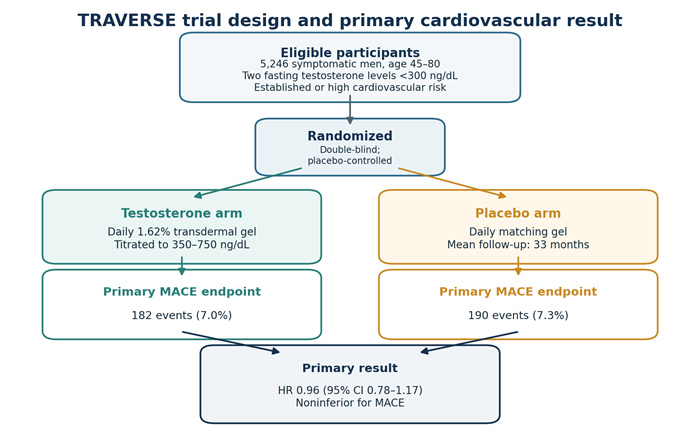
Figure 1. Trial design and primary cardiovascular outcome: participant eligibility, randomised treatment arms and the primary MACE result. [2]
Mean treatment duration was 21.7 months, and mean follow-up was 33 months. The primary endpoint occurred in 182 men assigned to testosterone (7.0%) and 190 assigned to placebo (7.3%), giving a hazard ratio of 0.96 (95% CI 0.78–1.17; P<0.001 for noninferiority). [2]
The result met the prespecified noninferiority criterion: under the studied conditions, testosterone did not produce a statistically significant excess in the primary MACE outcome compared with placebo. It does not establish a cardiovascular benefit or prove that the treatments are equivalent. The investigators also reported higher incidences of atrial fibrillation, acute kidney injury and pulmonary embolism in the testosterone group. [2]
Findings beyond the primary endpoint
Sexual function
TRAVERSE included nested studies addressing efficacy and other safety outcomes. In the sexual-function substudy, which enrolled men reporting low libido, testosterone improved sexual activity, sexual desire and hypogonadal symptoms through two years, but did not improve erectile function. [3]
Anaemia
In the anaemia analysis, anaemia resolved more often among testosterone-treated men at assessments from 6 through 36 months. The abstract reports a smaller between-group difference at 48 months without specifying whether it was statistically significant at that visit. [4]
Fractures
The fracture substudy complicates any broad description of testosterone as good for skeletal health. After a median of 3.19 years, clinical fractures occurred in 3.50% of the testosterone group and 2.46% of the placebo group (HR 1.43, 95% CI 1.04–1.97). Testosterone therefore did not reduce clinical fractures in this population, and the observed incidence was higher in the treatment group. [5]
Prostate safety
Prostate outcomes were reassuring within a carefully screened population. Men with prostate-specific antigen (PSA) above 3.0 ng/mL or severe lower urinary tract symptoms were excluded. During follow-up, adjudicated high-grade or any prostate cancer and other prostate events were uncommon and did not differ significantly between groups, although PSA rose more with testosterone. These findings should not be extrapolated to men excluded from the trial or treated beyond its follow-up period. [6]
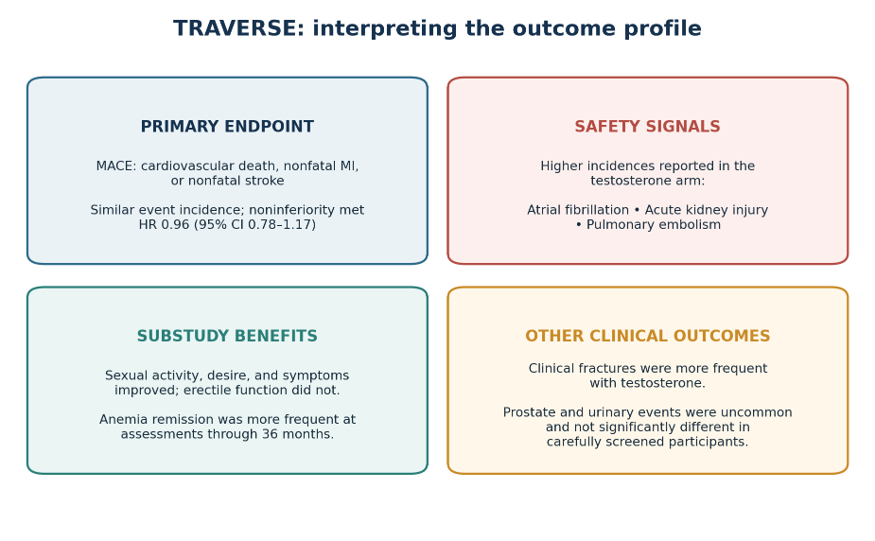
Figure 2. Outcome overview: the primary MACE result was noninferior; efficacy and other safety findings came from nested substudies. [2], [3], [4], [5], [6]
Strengths and limitations
The trial’s principal strength is its randomised, blinded design, large sample and focus on adjudicated cardiovascular events in symptomatic men with biochemical testosterone deficiency and substantial cardiovascular risk. This gives stronger evidence about testosterone replacement therapy cardiovascular risk in the studied population than observational comparisons or smaller trials not powered for clinical cardiovascular outcomes. [2]
Several limits shape the conclusions. [2]
- The noninferiority margin was relatively wide: an upper confidence limit below 1.5 satisfied the protocol criterion. Although the observed upper bound was 1.17, the design was intended to exclude a large increase in risk, not to demonstrate equivalence or rule out every clinically meaningful increase.
- Participants were treated for an average of about 22 months and followed for about 33 months, which leaves longer-term safety less certain.
- The findings apply most directly to symptomatic men aged 45–80 with two fasting testosterone values below 300 ng/dL and high cardiovascular risk who received titrated transdermal gel. They do not settle the risks of other formulations, dosing strategies, or men without clear symptoms and biochemical deficiency.
Finally, the primary MACE result should not overshadow the secondary safety outcomes. The primary trial abstract reports higher incidences of atrial fibrillation, acute kidney injury and pulmonary embolism but does not supply event counts or confidence intervals for them. On the accessible evidence, these are safety signals that warrant attention, not definitive estimates of causal risk. The link between testosterone and atrial fibrillation in particular deserves further study. The fracture result is a separate randomised finding and further cautions against assuming that improvements in surrogate skeletal measures translate into fracture prevention. [2], [5]
Clinical interpretation
TRAVERSE supports a bounded conclusion. For appropriately selected symptomatic men with confirmed low testosterone and established or elevated cardiovascular risk, testosterone gel titrated to the trial’s target range was noninferior to placebo for MACE over approximately three years. The result is reassuring against a large short-term increase in the composite cardiovascular endpoint, but it does not show that testosterone prevents cardiovascular events or establish long-term safety across all patients and formulations. [2]
The secondary findings also argue against reducing the benefit–risk discussion to MACE alone. Some men may see improvements in sexual activity, desire or anaemia, while erectile function did not improve in the sexual-function substudy and clinical fractures were more frequent in the testosterone group. The atrial fibrillation, kidney injury and pulmonary embolism findings should remain part of the safety discussion. [2], [3], [4], [5]
Conclusion
The TRAVERSE trial is a major randomised test of the cardiovascular safety of testosterone therapy in higher-risk men with symptomatic, biochemically confirmed hypogonadism. Its primary result is reassuring within the population, intervention and follow-up studied. A balanced reading, however, keeps in view the noninferiority framework, limited duration, restricted generalisability and secondary safety signals. The trial narrows uncertainty about MACE; it does not resolve every question about the long-term benefit–risk profile of testosterone treatment.
Disclaimer
This information is for education only and isn’t a substitute for personal medical advice. Always follow your prescriber’s instructions.
References
[1] S. Bhasin et al., “Effects of long-term testosterone treatment on cardiovascular outcomes in men with hypogonadism: Rationale and design of the TRAVERSE study,” American Heart Journal, 2021, doi: 10.1016/j.ahj.2021.11.016.
[2] A. Lincoff et al., “Cardiovascular safety of testosterone-replacement therapy,” New England Journal of Medicine, 2023, doi: 10.1056/NEJMoa2215025.
[3] K. Pencina et al., “Effect of testosterone replacement therapy on sexual function and hypogonadal symptoms in men with hypogonadism,” Journal of Clinical Endocrinology and Metabolism, 2023, doi: 10.1210/clinem/dgad484.
[4] K. Pencina et al., “Efficacy of testosterone replacement therapy in correcting anemia in men with hypogonadism,” JAMA Network Open, 2023, doi: 10.1001/jamanetworkopen.2023.40030.
[5] P. J. Snyder et al., “Testosterone treatment and fractures in men with hypogonadism,” New England Journal of Medicine, 2024, doi: 10.1056/NEJMoa2308836.
[6] S. Bhasin et al., “Prostate safety events during testosterone replacement therapy in men with hypogonadism,” JAMA Network Open, 2023, doi: 10.1001/jamanetworkopen.2023.48692.