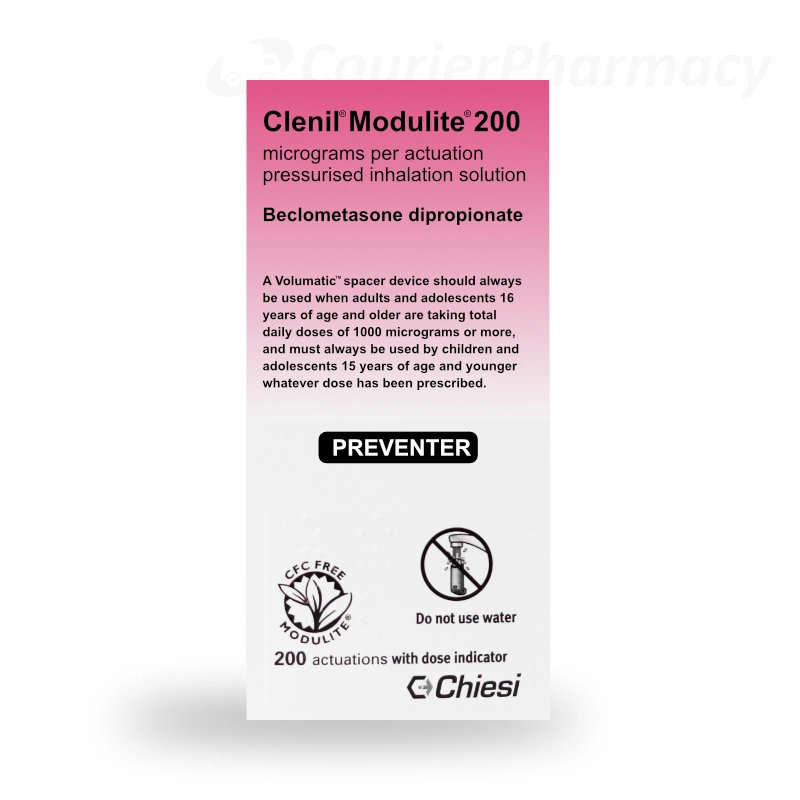
Clenil 200 modulite contains beclometasone dipropionate 200 micrograms inhaled corticosteroid (preventer) inhaler for the maintenance treatment of asthma in adults and adolescents.
Supplied at Courier Pharmacy after an online consultation reviewed by a UK pharmacist prescriber, then delivered to your door.
Notably, clenil Modulite 200 is a pressurised metered dose inhaler containing beclometasone dipropionate (an inhaled corticosteroid) at 200 micrograms per actuation. Manufactured by Chiesi Limited, it is licensed for the prophylactic management (preventer treatment) of asthma in adults and adolescents over 12 years of age. Furthermore, available in a 200-dose canister; pack details may vary.
Modulite technology
The “Modulite” technology refers to a HFA (hydrofluoroalkane) propellant solution formulation that produces a finer aerosol with smaller particles than earlier CFC-based or larger-particle inhalers. Specifically, smaller particles travel further down the bronchial tree and deposit in the smaller airways where much of the asthma-relevant inflammation occurs, with relatively less deposition in the throat.
Reliever versus preventers
What distinguishes a preventer (ICS) inhaler from a reliever:
Preventer (ICS like Clenil): taken daily to dampen airway inflammation; effect builds over 1-2 weeks; protects against future symptoms
Reliever (SABA like salbutamol or terbutaline): taken as-needed for acute symptoms; works within minutes; opens up tight airways
Both have a place in asthma management — but for different purposes; using only the reliever is dangerous, using only the preventer leaves acute episodes untreated
Together they form the foundation of most adult asthma treatment
Asthma overview
Meanwhile, what’s important to know about inhaled corticosteroids and asthma:
Asthma is fundamentally a disease of airway inflammation. In fact, in susceptible individuals, exposure to triggers (allergens, viruses, cold air, exercise, irritants) causes:
Inflammation of the airway lining — swelling, redness, mucus production
Smooth muscle constriction around the airways — bronchospasm
Increased airway sensitivity — over time, the airways become “twitchy” and react to smaller stimuli
Variable airflow obstruction — symptoms come and go, often worse at night or in early morning
Relievers
Reliever inhalers (salbutamol, terbutaline) relax the smooth muscle and open the airways within minutes, treating the bronchospasm component. In particular, but they don’t touch the underlying inflammation. Without addressing inflammation, the underlying disease persists> The airways become more sensitive, and acute episodes happen more often and more severely.
Preventers
In short, inhaled corticosteroids (like beclometasone in Clenil) dampen the inflammation:
Reduce inflammatory cell migration into airway walls
Reduce production of inflammatory mediators
Reduce mucus production
Reduce airway sensitivity to triggers over weeks of treatment
Reduce exacerbation rates by 50-70% in moderate asthma
Reduce mortality from asthma when used appropriately
Key points to remember
Similarly, the clinical evidence for ICS in asthma is extensive. The British Thoracic Society / SIGN asthma guidelines and NICE NG80 both place ICS at the centre of asthma management for any patient with anything beyond minimal symptoms.
Indeed, the relationship to other respiratory products:
Vs salbutamol relievers (Ventolin, Salamol): opposite roles — Clenil prevents, salbutamol relieves. Both have a place; combined as part of stepwise asthma management
Vs terbutaline (Bricanyl): similar to salbutamol; alternative reliever
Vs combination inhalers (Seretide, Symbicort, Fostair): combine an ICS plus a long-acting beta-agonist (LABA) in one device; used when ICS alone isn’t enough
Vs higher-dose ICS (Clenil 250, Flixotide, Pulmicort): stronger ICS for more severe asthma
Vs leukotriene receptor antagonists (montelukast): oral preventive treatment, additional or alternative to ICS in some patients
Vs newer biologics for severe asthma (omalizumab, mepolizumab, etc.): for very severe asthma not controlled by inhaled treatment
For people living with asthma — a chronic condition affecting millions in the UK — Clenil is one of the most commonly prescribed preventer inhalers. As a result, its place is well-established: daily use to keep asthma controlled, with a reliever held back for breakthrough symptoms.
At Courier Pharmacy, every Clenil supply is reviewed by a UK pharmacist. Generally, we’ll ask about your asthma control. The frequency you use your reliever, whether you’re using a spacer, and whether you’ve had a recent asthma review. The pharmacist can identify whether your asthma is well-controlled (continue as is) or whether the picture suggests you need to see your GP or asthma nurse for a review.
Features and specifications:
Active ingredient: beclometasone dipropionate 200 micrograms per actuation
Form: pressurised metered dose inhaler (pMDI)
Pack size: 200 doses per canister
Manufacturer: Chiesi Limited
Class: inhaled corticosteroid (ICS); preventer
Legal status: prescription only medicine (POM)
Typical adult use: 1-2 puffs twice daily
Storage: below 25°C; do not freeze; protect from extreme heat (do not leave in sunlight)
Additional information
Quantity
1 inhaler, 2 inhalers, 3 inhalers
MOJO WISDOM
Take control of your health by understanding your condition and what this medication is doing for you.
READ:
More information about this treatment.
UK-based doctors and pharmacists
Discreet and Confidential
UK-based doctors and pharmacists
Free, Expert Advice
No video link provided.
No video link provided.
UK-based doctors and pharmacists
Free, expert advice
Discrete and confidential
Fast delivery
Giving you trusted clinical advice for over 40 conditions
A UK regulated pharmacy providing safe, effective treatments online since 2014
Asthma that flares whenever the season changes, a chest that tightens at the gym in a way it never did when you were younger, a brown inhaler that’s been on your repeat prescription so long you’ve stopped thinking about it.
Maybe you’ve been told to take it twice a day and you do — most days. Maybe you have a salbutamol blue inhaler nearby and you use that whenever your chest plays up. Maybe you’ve been told you need to “rinse your mouth after using it” but no one really explained why.
Clenil Modulite 200 is a beclometasone dipropionate inhaler — a preventer, an inhaled corticosteroid — designed to be taken every day whether you have symptoms or not, dampening the underlying airway inflammation that causes asthma.
At Courier Pharmacy we want to explain exactly how preventer inhalers work, why daily use matters even when you feel fine, the technique that determines whether the medicine actually reaches your lungs, and why the trip-to-rinse afterwards isn’t optional.
Five key takeaways
Clenil Modulite 200 micrograms is a pressurised metered dose inhaler (pMDI) containing beclometasone dipropionate as an inhaled corticosteroid (ICS). Each actuation delivers 200 micrograms of beclometasone. Made by Chiesi Limited. Prescription-only (POM) in the UK.
Used as a preventer (maintenance) treatment for asthma in adults and adolescents. Dampens airway inflammation, reduces sensitivity to triggers, and prevents symptoms over weeks of regular use. NOT a reliever — does not treat acute breathlessness in the moment.
Take twice daily — morning and evening — every day, whether you have symptoms or not. The effect builds gradually over 1-2 weeks of regular use. Stopping suddenly because you “feel fine” often results in symptoms returning within days.
The Modulite technology gives smaller particle size than older beclometasone inhalers (such as Becotide), delivering more drug to the smaller airways and slightly less to the back of the throat. Technique still matters: shake, breathe out, press and breathe in slowly, hold for 10 seconds, breathe out gently. Rinse mouth and spit afterwards to reduce oral candidiasis risk and hoarseness.
Used together with a reliever inhaler (salbutamol — Ventolin, Salamol; or terbutaline — Bricanyl) when needed for acute symptoms. Many adults use a spacer device with their pMDI to improve drug delivery to the lungs and reduce side effects. Use of the reliever more than 3 times a week is a sign your asthma isn’t well controlled and you should see your asthma nurse or GP.
Treatment dosage Clenil Modulite 200
Additionally, the standard adult and adolescent (over 12) dose is between 200 and 800 micrograms twice daily, adjusted to the severity of asthma. For Clenil 200 micrograms per actuation:
More severe asthma needing higher ICS: switch to Clenil 250 or a higher-strength ICS, possibly combined with a long-acting beta-agonist in a combination inhaler
For example, your prescriber will specify the dose. Importantly, don’t change the dose without discussion.
Frequency:
Every day, twice a day — morning and evening, ideally 12 hours apart
Whether or not you have symptoms — preventer inhalers must be taken consistently to maintain their effect
Continue when you have a cold, flu, or other illness — these are exactly when the inflammation is most active
Don’t stop suddenly — discuss any planned reduction with your prescriber
The key mindset:
The most common reason preventer inhalers don’t work as well as they should is patients stopping or reducing them when they feel well. On the other hand, the “feeling well” is the whole point — Clenil is working. Stopping it because you feel well is like stopping seatbelts because you haven’t been in a crash recently. Therefore, the effect tails off over days to weeks, the inflammation returns, and the symptoms come back.
The mental model many asthma nurses use:
“Reliever in your bag for when you need it”
“Preventer in your bathroom for every morning and every evening”
“If you’re using the reliever more than 3 times a week, your preventer isn’t doing enough — see your asthma nurse”
Inhaler technique step-by-step:
Remove the cap and check the mouthpiece is clean
Shake the inhaler vigorously for about 5 seconds
Hold the inhaler upright with the canister at the top
Breathe out gently — but don’t force it; just empty your lungs naturally
Place the mouthpiece between your lips, sealing your lips around it (don’t bite); tilt your chin slightly up
Start to breathe in slowly and steadily through your mouth
At the same time, press the canister down once to release a dose
Continue breathing in slowly — over 4-5 seconds
Hold your breath for about 10 seconds (or as long as comfortable)
Breathe out gently through your nose
Wait at least 30 seconds before taking a second puff if prescribed
Repeat from step 2 for the second puff
Rinse mouth with water and spit out — this reduces oral candidiasis risk and hoarseness
Replace the cap
Critical technique points:
Coordinate the press with the breath in — this is what many adults struggle with on pMDI inhalers (the actuation has to come at the start of the slow inhalation, not before, not after). A spacer makes this much easier — see below.
Slow breath in — not a quick gasp. Slow and steady gives the drug time to deposit in the airways
Hold the breath — gives the medicine time to settle into the airway wall
Rinse and spit afterwards — not optional; specifically prevents oral thrush
What to know
Spacer device:
Consequently, A spacer is a plastic chamber that fits onto the inhaler. The drug puff is released into the chamber, and you breathe in from the chamber over several breaths. Advantages:
Removes the need for precise coordination between press and breath
Slows the puff down so more drug reaches the lungs and less hits the back of the throat
Reduces side effects (less throat irritation, less candidiasis)
Allows tidal breathing (several normal breaths) which suits some patients
However, common spacer brands: Volumatic, Aerochamber Plus, Optichamber. Some pharmacies stock them OTC; some require prescription.
Moreover, if you struggle with pMDI technique, ask your GP or asthma nurse to prescribe a spacer. Many adults benefit significantly. Children almost always use a spacer.
Counting doses:
In summary, the Clenil canister doesn’t have a dose counter. To know when to renew:
200-dose canister at 2 puffs twice daily = 100 days
Mark the date you opened the canister with a marker pen
Re-order well before you expect to run out
Overall, if the canister is dropped or shaken vigorously when nearly empty, it may release “puffs” of pure propellant that contain little or no drug. A canister that floats in a glass of water is empty. (Don’t routinely test this; the test is destructive of the canister.)
Don’t use Clenil if:
You have known hypersensitivity to beclometasone or any excipient
You are using it as a reliever (it doesn’t work as one)
Pregnancy and breastfeeding without prescriber discussion (most ICS are safe in pregnancy; specifically discuss with your asthma nurse)
Use with care if:
You have active or untreated pulmonary tuberculosis
You have active oral candidiasis (treat first, then resume)
You are taking strong CYP3A4 inhibitors (ritonavir, ketoconazole, itraconazole) — systemic absorption may increase
You are pregnant or breastfeeding (most ICS are safe but should be discussed)
You have severe diabetes (uncontrolled blood glucose)
You have low bone density or osteoporosis (high-dose long-term ICS can affect bone)
Notably, when to seek medical attention urgently:
Reliever inhaler needed more than 3 times a week
Reliever inhaler not working (still breathless after taking it)
Night symptoms (waking with cough, wheeze, or breathlessness)
Symptoms with normal activity (e.g. climbing one flight of stairs)
A “bad chest” cold or chest infection lasting more than a few days
Worsening of asthma control
Severe acute breathlessness (NHS 111 / 999 if severe)
Overview of Clenil Modulite 200
Five things worth knowing:
Clenil is a preventer, not a reliever. This is the single most important thing to understand about your inhaler. If you’re breathless or wheezy now, Clenil won’t help in the moment. The blue reliever (salbutamol/Ventolin/Salamol or terbutaline/Bricanyl) is what addresses acute symptoms. Clenil is taken every day to prevent symptoms from happening.
Daily use even when you feel fine is the whole point. Asthma is a chronic inflammatory disease; the inflammation is there even when you don’t feel anything. Clenil dampens it. Stopping because you feel well is the most common reason asthma deteriorates.
The Modulite formulation has different deposition characteristics from older beclometasone inhalers. Becotide CFC-propellant inhalers and Modulite HFA inhalers are not directly interchangeable on a microgram-for-microgram basis. If your dose has been switched between Becotide and Clenil, the prescriber has accounted for this. Don’t compare doses across products.
Technique matters enormously. Studies consistently show that 40-70% of patients have suboptimal inhaler technique. Half the drug ending up in the back of the throat instead of the lungs is a common pattern. A spacer device, used properly, can transform the effective dose to your airways without changing the prescribed dose. Ask if you’re uncertain.
Rinse your mouth and spit after every Clenil dose. Inhaled steroid that lands in the throat can cause oral candidiasis (thrush) and dysphonia (hoarseness). Rinsing reduces both. It’s not optional, even though many patients skip it.
The asthma medication landscape with Clenil’s place:
Step 1 — symptoms-only or very mild asthma: previously SABA alone, now in most adults a low-dose ICS with as-needed SABA or ICS-formoterol
Step 2 — established asthma: regular ICS (Clenil 200 or equivalent) plus as-needed reliever
Step 3 — moderate: combination inhaler ICS + LABA (Seretide, Symbicort, Fostair) or higher-dose ICS
Step 5 — severe: refer to specialist; biologics for eosinophilic asthma; oral steroids when needed
Furthermore, for people living with asthma long-term, Clenil is one of the most-prescribed and most-studied preventer inhalers. Used properly, it dramatically reduces flare-ups, hospital admissions, and the longer-term decline in lung function that uncontrolled asthma can cause.
Why choose Courier Pharmacy for Clenil Modulite 200
Asthma is a long-term condition, and preventer inhaler use is a long-term commitment. In short, every Clenil supply at Courier Pharmacy is reviewed by a UK pharmacist who pays attention to the bigger picture, not just the dispensing.
We’ll ask about your asthma control. Similarly, how often you use your reliever. Whether you’ve woken at night with symptoms. Indeed, whether you’re avoiding activities because of breathlessness. Whether you’ve had any “bad chest” weeks recently. As a result, these questions matter — they reveal whether your treatment is currently working well or whether your asthma needs a review.
We’ll discuss inhaler technique. Studies suggest 40-70% of pMDI users have suboptimal technique. Generally, A pharmacist asking about your technique, identifying common issues (coordination, breath rate, hold time), and offering to discuss a spacer can substantially improve your real-world treatment.
We’ll discuss when you need a GP or asthma nurse review. In addition, reliever use more than 3 times a week. Night symptoms. Additionally, reduced peak flow if you monitor it. Frequent “bad weeks”. These are signs your asthma isn’t well controlled, and adjusting the treatment (different ICS dose, combination inhaler, additional medication) usually helps. For example, the pharmacy supply is the right opportunity to identify these.
Important details
We’ll explain the rinse-and-spit habit and why it matters. Importantly, we’ll talk about spacers if you don’t already use one. We’ll discuss the importance of continuing through colds, flu, and other illnesses when asthma is most volatile.
We’ll discuss what isn’t asthma. Sometimes “breathlessness” is anxiety, heart problems, vocal cord dysfunction, deconditioning, or other things. On the other hand, your inhaler isn’t always the answer. If the picture suggests another diagnosis, we’ll say so.
Therefore, our brand guide, Dr Ada Jex-Cori, sums it up: you’re not broken. The system that’s failed you might be. Consequently, we want to do the part we can do, properly, and connect you with the rest. That includes our free fortnightly drop-in clinics and talks at Insomnia in Derby, where you can ask questions face-to-face without spending a penny.
Buy Clenil Modulite 200 from Courier Pharmacy
However, clenil Modulite 200 is a prescription-only medicine. Moreover, buying through Courier Pharmacy is straightforward and built around your time, not ours.
Here’s how it works:
Complete a quick online consultation about your asthma and current treatment
A UK pharmacist prescriber reviews your information
If suitable, a prescription is issued
We dispense and deliver discreetly to your door
If it isn’t suitable for you, we’ll explain why and suggest the next best option (asthma nurse review, GP appointment, different inhaler).
Active Ingredients
Specifically, the active ingredient is beclometasone dipropionate, an inhaled corticosteroid.
Chemical and pharmacological class:
Beclometasone dipropionate (BDP)
Synthetic glucocorticoid (corticosteroid)
Developed in the 1970s; one of the first inhaled corticosteroids in clinical use
Prodrug — converted to its active metabolite (17-beclometasone monopropionate) in the airways and liver
The Modulite formulation uses HFA propellant; older Becotide formulations used CFC
Concentration in the Clenil range:
Clenil Modulite 50 micrograms per actuation
Clenil Modulite 100 micrograms per actuation
Clenil Modulite 200 micrograms per actuation (this product)
Clenil Modulite 250 micrograms per actuation (separate higher-strength product)
Used as a single ICS; not currently combined with LABA in this specific brand line (Fostair is the equivalent BDP+formoterol combination)
Mechanism of action:
Beclometasone exerts its effects through the glucocorticoid receptor:
Penetrates airway cells — the lipid-soluble drug enters cells in the airway lining
Binds glucocorticoid receptors in the cytoplasm
Receptor-drug complex moves to the nucleus — alters gene transcription
Reduces production of inflammatory proteins (cytokines, chemokines, inflammatory enzymes)
Increases production of anti-inflammatory proteins (lipocortin and others)
Reduces inflammatory cell infiltration of the airway wall over time
Reduces airway hyperresponsiveness over weeks of treatment
Meanwhile, the full anti-inflammatory effect on the airway develops over 1-2 weeks of regular use. Some early effects are seen within days, but the full clinical benefit accrues over weeks.
Time course:
Day 1-3: starting reduction in airway inflammation
Week 1: measurable improvement in lung function
Week 2-4: established anti-inflammatory effect
Week 4+: full benefit on exacerbation prevention
Stopping: anti-inflammatory effect tails off over days to weeks; airway sensitivity returns gradually
Pharmacokinetics:
Local deposition: typically 10-20% of dose deposits in the lung (more with good technique and spacer); rest deposits in oropharynx or is swallowed
Local activation: in lung tissue, beclometasone dipropionate is converted to its active metabolite (beclometasone-17-monopropionate, BMP)
Systemic absorption: from the lung directly into pulmonary circulation; small amount from swallowed fraction absorbed gastrointestinally
Hepatic first-pass: extensive metabolism by CYP3A4 reduces systemic exposure significantly
Plasma half-life of BMP: approximately 2.7 hours
Excretion: mainly biliary
Systemic exposure considerations:
In fact, inhaled corticosteroids at typical doses produce far less systemic exposure than oral corticosteroids:
Beclometasone 800 micrograms/day inhaled produces small but measurable systemic effects
Comparable systemic effect of oral prednisolone is around 7-10 mg/day
HPA axis suppression (cortisol production reduction) is uncommon at typical inhaled doses but can occur at high doses
Long-term high-dose use can have systemic effects on bone density, glucose tolerance, skin, eyes
For most patients on Clenil 200 at 1-2 puffs twice daily (400-800 micrograms/day), systemic effects are minor and the benefits substantially outweigh them. In particular, higher dose use should prompt review of whether combination therapy or different management would be more appropriate.
Local side effect considerations:
In short, the principal local side effects relate to drug landing in the oropharynx:
Oral candidiasis (thrush) — sore mouth, white patches; treated with topical antifungal (nystatin or fluconazole)
Dysphonia (hoarseness) — myopathy of laryngeal muscles from local steroid exposure; usually resolves with reduced dose or improved technique
Throat irritation, cough
Rinsing the mouth after each dose substantially reduces these effects.
Similarly, other excipients in Clenil Modulite include HFA-134a propellant, ethanol, glycerol. Specific excipients are listed on the patient information leaflet.
What is it for?
Indeed, clenil Modulite 200 is used for:
Preventer (maintenance) treatment of asthma in adults and adolescents over 12
Step-up from short-acting beta-agonist (SABA) alone in patients whose asthma needs more than as-needed reliever
Stable continuation of asthma maintenance in patients already established on inhaled corticosteroid therapy
Replacement for older beclometasone CFC inhalers (Becotide) under prescriber guidance with appropriate dose adjustment
It's appropriate for:
Daily long-term use in patients with established asthma
Combination with reliever therapy (salbutamol or terbutaline) for breakthrough symptoms
Use with spacer devices to optimise drug delivery
Adults and adolescents over 12
Clenil Modulite 200 is not appropriate for:
Acute exacerbations or sudden breathlessness (use reliever instead)
Patients with non-asthma respiratory disease without specific indication (COPD has different management)
Children under 12 (younger children use lower-strength ICS)
Patients with known hypersensitivity to beclometasone
As a result, NICE the BTS/SIGN guidelines underpin the place of inhaled corticosteroids as first-line preventer therapy for asthma
How does it work?
Asthma is a chronic inflammatory disease of the airways characterised by:
Activation of mast cells, eosinophils, T cells in airway tissue
Release of inflammatory mediators (histamine, leukotrienes, cytokines, chemokines)
Migration of more inflammatory cells into the airway wall
Smooth muscle contraction, oedema, mucus production
Airway narrowing, symptoms
How Clenil interrupts the cascade:
Reduces the migration of inflammatory cells into the airway
Reduces the production of inflammatory mediators
Reduces the sensitivity of airway smooth muscle to bronchoconstrictor stimuli
Reduces mucus production
Allows the inflamed airway lining to gradually heal
Generally, the "controller" model of asthma management:
If you imagine asthma as a fire — small embers of inflammation always smouldering in the airway wall — the analogy goes:
Triggers are gusts of wind that fan the embers into a flame (acute symptoms)
Reliever inhaler is a fire extinguisher that puts out the flame quickly but doesn't address the embers
Preventer inhaler (Clenil) dampens the embers themselves — used daily, the fire gradually goes out, and gusts of wind have less to ignite
The clinical effect of this:
Fewer acute symptoms
Reduced reliever use
Fewer exacerbations
Fewer A&E visits and hospital admissions
Better lung function over time
Better quality of life
Time course:
Day 1-3: starting effect on airway inflammation
Week 1: noticeable reduction in reliever use; symptoms less frequent
Week 2-4: established preventer effect
Month 3+: sustained protection; lung function improved
Stopping: protection tails off over days to weeks
What it doesn't do:
Doesn't open up tight airways in the moment (that's the reliever)
Doesn't cure asthma (no current treatment does)
Doesn't work for COPD as effectively as for asthma (different inflammatory process)
Doesn't replace the avoidance of known triggers
Doesn't help if technique is wrong (a substantial issue in real-world use)
How to use it
Inhaler technique is everything. In addition, the same prescribed dose delivered well versus poorly can produce dramatically different clinical effects.
Standard pMDI technique without spacer:
Remove the cap and check the mouthpiece
Shake the inhaler vigorously for 5 seconds
Hold the inhaler upright with canister at the top
Breathe out gently — empty your lungs comfortably
Place the mouthpiece between your lips, sealing your lips around it
Start to breathe in slowly and steadily through your mouth
Press the canister down once as you continue to breathe in
Keep breathing in slowly — over 4-5 seconds
Hold your breath for 10 seconds (or as long as comfortable)
Breathe out gently through your nose
Wait at least 30 seconds before the second puff
Repeat steps 2-10 for the second puff
Rinse your mouth with water and spit out
Replace the cap
Standard pMDI technique with spacer (recommended):
Shake the inhaler for 5 seconds
Remove the cap; attach to the spacer
Hold the spacer level
Breathe out gently (away from the spacer)
Place the spacer mouthpiece between your lips, seal your lips
Press the canister once to release a dose into the spacer
Breathe in slowly and steadily from the spacer
Hold breath for 10 seconds, OR
Take 4-5 normal breaths through the spacer (tidal breathing)
Wait 30 seconds, then second puff if prescribed
Rinse mouth and spit
Replace cap; clean spacer weekly per instructions
Why a spacer helps:
Removes need for precise coordination between press and breath
Slows the aerosol's velocity
Allows the propellant to evaporate before reaching the lungs
More drug reaches small airways
Less drug deposits in oropharynx
Reduces local side effects (less throat irritation, less candidiasis)
Cold or chest infection: continue Clenil at usual or increased dose as advised by your prescriber; this is when inflammation is most active and stopping is the worst time
Travel: bring the inhaler in hand luggage (don't put in hold — temperature extremes); bring a spare; allow for time zone changes
Hospitalisation: take inhaler with you; show medical staff what you usually take
Forgotten dose: take it as soon as you remember unless it's almost time for the next dose; don't double up
Common technique errors:
Not shaking the inhaler — leads to inconsistent dose delivery
Press-and-breathe-too-late: the puff arrives at the back of the throat, not deep in the lungs
Breathing in too fast — drug deposits in the throat; slow, steady is what works
Not holding breath — drug doesn't have time to settle
Skipping the rinse — leads to thrush and hoarseness
Empty canister symptoms — late puffs from an empty canister deliver propellant only; this can mimic a sudden "loss of asthma control" when in fact you need a new canister
Long-term use considerations:
Have your inhaler technique reviewed annually by an asthma nurse or pharmacist
Have an annual asthma review including peak flow assessment if appropriate
Update your personalised asthma action plan
Know what your "normal" peak flow is and what triggers a doctor call
Recognise the signs of worsening asthma: increased reliever use, night symptoms, exercise limitation, reduced peak flow
Combining with other treatments:
Reliever inhaler: yes, as needed; same mouthpiece technique applies
Combination inhaler (Seretide, Symbicort, Fostair): if you've been switched to a combination, don't continue Clenil — they have the same ICS plus added LABA
Oral leukotriene antagonist (montelukast): yes, sometimes added; usually evening dose
Long-acting muscarinic (tiotropium): yes, can be added in severe asthma
Antihistamines, allergy treatments: no interaction
NSAIDs (ibuprofen, aspirin): caution in asthma — some patients (aspirin-sensitive asthma) react badly; use paracetamol if uncertain
Warnings and Precautions
Additionally, clenil is generally well-tolerated at standard doses. Specific considerations:
Contraindicated in:
Known hypersensitivity to beclometasone or any excipient
Status asthmaticus or acute exacerbation (needs reliever and emergency care, not preventer)
Use with care in:
Active or latent pulmonary tuberculosis (ICS can worsen)
Active oral candidiasis (treat first)
Pregnancy and breastfeeding (most ICS are considered safe and important to continue in asthma; specifically discuss with prescriber)
Patients on strong CYP3A4 inhibitors (ritonavir, itraconazole, ketoconazole, clarithromycin) — systemic absorption may increase
Severe diabetes or uncontrolled hyperglycaemia
Low bone density / osteoporosis (especially high-dose long-term use)
Glaucoma or cataract history (high-dose ICS associated with increased risk)
Adrenal insufficiency or HPA axis suppression history
Significant hepatic impairment (alters drug metabolism)
HPA axis and growth considerations:
For example, at standard adult doses (400-800 micrograms/day beclometasone), HPA axis suppression is uncommon. At higher doses (1500+ micrograms/day) or with strong CYP3A4 inhibitors, suppression is more likely.
Importantly, in children and adolescents, growth velocity can be transiently reduced with ICS treatment. Final adult height is generally not significantly affected. On the other hand, use the lowest effective dose for maintenance.
If long-term high-dose ICS treatment is needed, periodic monitoring of bone density, growth (in children), and ocular health may be indicated.
Pregnancy and breastfeeding:
Most inhaled corticosteroids, including beclometasone, are considered safe in pregnancy and breastfeeding
Continuing asthma treatment in pregnancy is much safer than letting asthma deteriorate
Specific discussion with asthma nurse, GP, or specialist is sensible early in pregnancy
Don't stop preventer treatment without prescriber discussion
Sudden discontinuation:
Therefore, if you've been on long-term high-dose ICS or oral corticosteroid, sudden discontinuation can cause adrenal insufficiency (cortisol crisis). Don't stop high-dose ICS suddenly; taper as advised by your prescriber.
Acute exacerbation:
If your asthma worsens significantly:
Don't increase your Clenil dose without prescriber input
Use your reliever more frequently as needed
Follow your personalised asthma action plan if you have one
Seek urgent medical advice if your reliever isn't lasting or you're using it very frequently
Seek emergency care (999) if severely breathless, unable to speak full sentences, confused, or lips/fingertips turning blue
Consequently, if you experience signs of an allergic reaction (rash, swelling, difficulty breathing beyond your usual asthma), stop using the product and seek immediate medical attention.
Side Effects
Most patients tolerate Clenil well. Side effects relate either to local drug deposition or to systemic absorption at higher doses.
However, common side effects, between 1 in 100 and 1 in 10 people, include oral candidiasis (thrush) — sore mouth, white patches; throat irritation; hoarseness (dysphonia); cough on inhalation; and mild altered taste.
Uncommon side effects, between 1 in 1,000 and 1 in 100 people, include skin bruising with high doses, slow wound healing, mild changes in blood glucose, and reduced exercise capacity if drug is poorly delivered.
Moreover, rare side effects, fewer than 1 in 1,000 people, include adrenal suppression with high-dose long-term use, cataract or glaucoma with high-dose long-term use, decreased bone density with high-dose long-term use, and growth velocity reduction in children.
In summary, very rare and serious side effects include paradoxical bronchospasm (immediate worsening after inhalation — switch product immediately), severe hypersensitivity reactions, and Cushingoid features with very high systemic exposure.
If you experience any side effect that worries you, you can report it directly to the MHRA's Yellow Card scheme. Overall, this helps improve safety data for everyone who uses the product. Our pharmacy team are happy to help you submit a Yellow Card report if you'd like assistance.
Drug Interactions
Notably, most patients on Clenil need no specific interaction adjustments, but some interactions matter.
Strong CYP3A4 inhibitors — can increase systemic beclometasone exposure:
Furthermore, for short courses of these (e.g. a 7-day course of clarithromycin), monitoring is usually sufficient. For long-term use, dose adjustment of Clenil may be considered.
Specifically, beta blockers — particularly non-selective beta blockers (propranolol) — can worsen asthma. Generally avoided in asthma; if necessary, cardio-selective beta blockers (bisoprolol, atenolol) are preferred under specialist guidance.
Aspirin and NSAIDs — some asthma patients (aspirin-sensitive asthma) have severe reactions to NSAIDs. Meanwhile, use paracetamol if uncertain; check with prescriber.
Oral corticosteroids — sometimes used alongside ICS in flare-ups; not a long-term combination at high doses unless specifically managed by a specialist.
In fact, anticoagulants — high-dose ICS may rarely affect bleeding risk; clinically minor for most patients.
In particular, tell your pharmacist about all medicines you take when starting any new treatment.
Frequently Asked Questions
What is Clenil Modulite 200 used for?
In summary, clenil Modulite 200 is a beclometasone preventer inhaler used for the maintenance treatment of asthma in adults and adolescents. Taken twice daily, every day, to dampen airway inflammation and prevent symptoms.
What's the difference between a preventer and a reliever inhaler?
Overall, A preventer (like Clenil) is taken daily to reduce underlying airway inflammation; effect builds over weeks. A reliever (like salbutamol or terbutaline) is taken as-needed for acute symptoms; effect within minutes. Notably, both have places, used for different purposes.
How often should I use it?
Twice daily — morning and evening — every day. Furthermore, whether or not you have symptoms.
Should I use it during a cold?
Yes — continue your usual dose. Specifically, some prescribers advise temporary dose increase during respiratory infections; check your asthma action plan.
What if I miss a dose?
Take it as soon as you remember unless it's almost time for the next dose. Don't double up.
Can I just use my reliever and skip Clenil?
No. Meanwhile, reliever-only treatment for asthma is associated with poorer outcomes including more exacerbations, hospital admissions, and asthma deaths. In fact, the preventer addresses the underlying inflammation; the reliever doesn't.
Why do I need to rinse my mouth after using it?
To reduce the risk of oral candidiasis (thrush) and hoarseness (dysphonia). In particular, drug that lands in the throat rather than the lungs can cause these local side effects; rinsing and spitting reduces them substantially.
Should I use a spacer with my Clenil inhaler?
Most adults benefit from a spacer. In short, it improves drug delivery to the lungs and reduces side effects. If you're not using one, ask your asthma nurse or GP about getting one prescribed.
Can children use Clenil Modulite 200?
Adolescents over 12 — yes. Similarly, younger children typically use lower-strength ICS at age-appropriate doses with a spacer.
Is Clenil safe in pregnancy?
Most inhaled corticosteroids including beclometasone are considered safe in pregnancy. Indeed, continuing asthma treatment is much safer than letting asthma deteriorate. Specifically discuss with your asthma nurse, GP, or specialist.
Can I take Clenil while breastfeeding?
Yes — inhaled corticosteroids are considered safe in breastfeeding.
How long until I notice a difference?
As a result, the full preventer effect builds over 1-2 weeks of regular use. You may notice less reliever use, fewer symptoms, and improved exercise tolerance within this timeframe.
How long do I need to keep taking it?
Generally, asthma is a chronic condition, so preventer treatment is generally long-term. In addition, your prescriber may step the dose down if your asthma is very well controlled for an extended period, or step it up if not. Don't stop without discussion.
Will Clenil affect my voice?
Hoarseness (dysphonia) is a recognised side effect, particularly with higher doses or poor technique. Additionally, rinsing and using a spacer reduces the risk. If hoarseness develops, see your prescriber to review technique and dose.
Will it cause oral thrush?
For example, possible — particularly without rinsing or with poor technique. Treat thrush with topical antifungal as advised by your pharmacist or GP, continue Clenil with better technique and rinsing.
Does Clenil affect my bones?
Importantly, high-dose long-term ICS can reduce bone density. At typical maintenance doses (400-800 micrograms/day) the effect is minor. On the other hand, higher doses or long use should prompt review of whether your asthma management can be optimised differently (combination inhaler etc.).
Can I drink alcohol while using Clenil?
Yes — no specific interaction with alcohol at typical use levels.
What if I forget my inhaler when travelling?
Therefore, in most countries, an equivalent product is available. Locally branded beclometasone or other ICS can substitute. Consequently, bring your asthma action plan and a copy of your repeat prescription details. However, travel insurance with adequate cover for asthma is sensible.
What if my reliever isn't working?
This is a sign of poorly-controlled asthma. Seek urgent advice. Moreover, if severely breathless and your reliever isn't lasting, call 999.
Can I exercise on Clenil?
Yes — better asthma control means better exercise tolerance for most patients. In summary, some patients use their reliever 10-15 minutes before exercise to prevent exercise-induced bronchospasm; discuss with your asthma nurse if exercise consistently triggers symptoms.
Should I have an asthma action plan?
Yes — every asthma patient should have a personalised plan from their asthma nurse covering daily treatment, what to do when symptoms worsen, peak flow values that trigger increased treatment, and when to seek urgent help. Overall, ask if you don't have one.
Disclaimer: This information is for education only and isn’t a substitute for personal medical advice. Always follow your prescriber’s instructions.