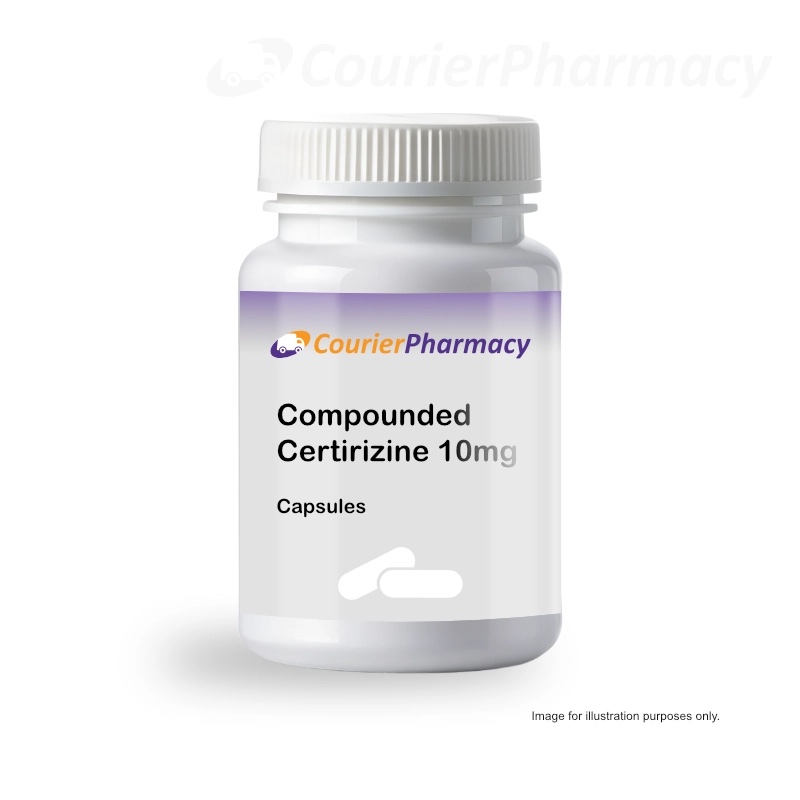
Firstly, this is a UK-compounded medicine in a capsule containing 10mg of cetirizine dihydrochloride, the same active antihistamine used in Zirtek, Piriteze, Benadryl Allergy Relief, and other branded cetirizine tablets. So the therapeutic effect is identical. In particular, the difference is the excipients. Furthermore, most branded cetirizine tablets contain lactose, film coating, dyes, magnesium stearate, and other excipients that some patients react to. As a result, this specials capsule strips the formulation back to only what is essential.
The three-ingredient formulation
Each capsule contains only:
Cetirizine dihydrochloride 10mg, the active antihistamine.
Microcrystalline cellulose, a neutral, plant-derived filler that gives the capsule bulk.
Hydroxypropyl methylcellulose (HPMC), the plant-derived (vegetarian) capsule shell.
There is no lactose, gluten, gelatin, dye, magnesium stearate, sugar, alcohol, or preservative. So the excipient burden is as low as a cetirizine capsule can practically go.
Why an MCAS-friendly formulation matters
Mast cell activation syndrome (MCAS) patients often react to the very excipients used to make ordinary medicines. So lactose can trigger reactions in some MCAS patients, film-coating dyes are common triggers, and magnesium stearate is on some MCAS trigger lists. In particular, patients with restrictive diagnoses (coeliac disease, hereditary fructose intolerance, dye allergy, latex allergy) also benefit from a minimal-excipient product. As a result, the compounded three-ingredient formulation removes multiple potential trigger points at once.
Why we use HPMC capsules, not gelatin
Standard hard capsules are usually made of gelatin, which comes from animal bone and skin. So gelatin capsules are not suitable for vegetarians, vegans, or patients following religious observances that exclude animal products. In contrast, HPMC (hydroxypropyl methylcellulose) capsules are made from plant cellulose. Furthermore, HPMC capsules do not contain the trace bovine or porcine material some patients react to. In short, HPMC extends access to broader patient groups.
Key features and details
Format: HPMC (vegetarian) hard capsule, swallowed whole.
Active ingredient: cetirizine dihydrochloride 10mg per capsule.
Other ingredients: microcrystalline cellulose only (as filler).
Capsule shell: HPMC (plant-derived, vegetarian).
Legal status: POM specials medicine (unlicensed, prescription-only).
Compounded by: a UK MHRA-regulated specials manufacturer.
Compounded Cetirizine 10mg capsules, an excipient-minimal option for hypersensitive patients
Compounded Cetirizine 10mg capsules are our stripped-back specials formulation for patients who react to the excipients in standard cetirizine tablets. So each capsule contains only three ingredients: cetirizine dihydrochloride 10mg (the active antihistamine), microcrystalline cellulose (a neutral plant-derived filler), and an HPMC (hydroxypropyl methylcellulose) vegetarian capsule shell. In particular, this suits patients with mast cell activation syndrome (MCAS), multiple chemical sensitivity, coeliac disease, lactose intolerance, or dye allergy. Furthermore, the vegetarian capsule shell makes this a suitable option across most religious and dietary observances. As a result, this is one of our core specials for the excipient-sensitive patient population.
When to see a doctor before using compounded Cetirizine 10mg
Cetirizine is a well-established antihistamine, but some situations need proper medical review before you rely on it long-term:
Severe or worsening allergic symptoms despite regular cetirizine.
Anaphylaxis or symptoms of a severe allergic reaction (facial swelling, breathing difficulty, throat tightness), this is a 999 call, not a cetirizine dose.
New or unexplained skin lesions, flushing, or urticaria (may need MCAS or allergy workup).
Symptoms that spread beyond skin and airways: gut symptoms, cardiovascular symptoms, or neurological symptoms with hives (possible mast cell disease).
Kidney disease (cetirizine dose usually needs to be lowered).
Any change in symptoms that could point to a different underlying diagnosis.
Pregnancy or breastfeeding (specialist input matters here).
If the excipient-minimal formulation is not helping and you still react to what you’re taking.
For life-threatening allergic reactions, call 999. For urgent but non-emergency worries, call NHS 111 or your GP.
Five key takeaways about Compounded Cetirizine 10mg capsules
This is a compounded medicine: cetirizine dihydrochloride 10mg in a stripped-back three-ingredient formulation.
The only ingredients are cetirizine dihydrochloride, microcrystalline cellulose (filler), and an HPMC vegetarian capsule shell.
It contains NO lactose, NO gluten, NO gelatin, NO dyes, NO magnesium stearate, NO sugar, and NO alcohol.
It suits MCAS, coeliac, lactose-intolerant, vegetarian and vegan patients, and anyone with excipient sensitivity to standard cetirizine tablets.
It is a POM specials medicine. So every supply follows a proper clinical assessment through our specials pathway.
What is Cetirizine: overview
Cetirizine is a second-generation antihistamine. So it blocks the H1 histamine receptor and reduces allergic symptoms.
It is one of the most-prescribed antihistamines in the UK, and is available over the counter in tablet and liquid form.
At standard doses it is largely non-drowsy for most people, though some feel mildly sleepy.
It is used off-label in MCAS, chronic urticaria, cholinergic urticaria, and other mast-cell-driven conditions.
This compounded specials capsule strips the formulation back for patients who react to standard tablet excipients.
Cetirizine vs levocetirizine
Cetirizine is a racemic mixture of two mirror-image molecules. In contrast, levocetirizine (Xyzal, Xyzol) is just the “active” R-enantiomer. So a 10mg cetirizine dose is roughly equivalent to a 5mg levocetirizine dose. However, for most patients, either drug works fine, and the choice comes down to what your prescriber recommends and what your body tolerates.
The compounded specials pathway, in plain English
Because this exact formulation (cetirizine 10mg with only microcrystalline cellulose and an HPMC capsule) is not a licensed UK medicine, it is prepared as a compounded medicine. So a UK specialist compounding pharmacy makes each batch to a prescription under MHRA compounding rules. Furthermore, the finished capsule is quality-tested to the same pharmaceutical standards as any prescription medicine.
Why off-label matters
Prescribing an unlicensed compounded medicine is a normal part of UK medical practice. So the GMC and GPhC both provide guidance on it. However, off-label use places extra responsibility on the prescriber to justify the choice, and on the patient to give informed consent. In particular, our compounded cetirizine supply pathway covers this explicitly.
Why choose Courier Pharmacy for your Compounded Cetirizine
Registered, independent, and patient-led
Courier Pharmacy is a UK-registered independent pharmacy regulated by the General Pharmaceutical Council (GPhC 9010051). So when you order compounded medicines through us, you get a proper pharmacy team, not a warehouse. Furthermore, our independence means we have room to spend time on complex prescribing where a chain pharmacy would not.
MCAS and chronic illness expertise
At Courier Pharmacy, we routinely work with MCAS, ME/CFS, Long COVID, fibromyalgia, and chronic illness patients. In particular, our prescribers are specialists in long term conditions such as MCAS and Long COVID, so you are in safe hands. We understand the excipient-sensitivity picture and why standard antihistamine tablets sometimes fail these patients. Furthermore, we can support higher off-label cetirizine doses where a specialist has advised them.
Dr Ada Jex-Cori, our brand pharmacist
Our brand pharmacist is Dr Ada Jex-Cori. She represents the spirit of what we do. Named for Ada Lovelace, Sophia Jex-Blake, and Gerty Cori, she stands for evidence-led, unafraid-of-questions medicine. Her message runs through everything we prescribe:
You’re not broken. The system is. We’re here to change that.
For MCAS patients in particular, this matters. So many people arrive at MCAS after years of being dismissed, told their reactions are “in their head”, or handed a standard antihistamine that made their symptoms worse. Furthermore, we take those experiences as the starting point, not an inconvenience.
Excipient control and formulation flexibility
Because we work with specialist UK compounding pharmacies, we can arrange excipient-minimal formulations for patients whose excipient list needs are more specific than the standard three-ingredient version. So if you react even to microcrystalline cellulose, or if you need a smaller or larger cetirizine dose per capsule, we can discuss this. In particular, ask our team about custom-strength or alternative-filler options.
Ongoing care and follow-up
MCAS and chronic urticaria treatment is a long-term project. So we schedule reviews to check response, tolerability, and any need to adjust the dose. Furthermore, we coordinate with your GP, immunologist, or specialist where relevant.
Buy Compounded Cetirizine 10mg Capsules (Prescription Only) from Courier Pharmacy
Compounded Cetirizine 10mg capsules are a prescription-only specials medicine supplied through Courier Pharmacy’s specials pathway. So supply follows a proper clinical assessment. In particular, new patients complete a specials consultation before any capsules are dispensed. However, established patients can complete a shorter reassessment.
The four steps
Complete a quick online consultation covering your diagnosis, previous antihistamine trials, current medicines, and excipient sensitivities.
A UK prescriber reviews your answers.
If Compounded Cetirizine 10mg is clinically appropriate, a prescription is issued.
We dispense and deliver discreetly to your door.
If Compounded Cetirizine 10mg isn’t right for you
If our assessment shows a different approach fits your situation better, we’ll explain why and suggest the next best option. So this might mean:
Standard OTC cetirizine tablets (Zirtek, Piriteze, or generic) if you don’t need the excipient-minimal version.
Compounded levocetirizine 5mg capsules if levocetirizine suits you better than cetirizine.
Compounded Fexofenadine 180mg capsules if fexofenadine suits your MCAS picture better.
Compounded Famotidine 20mg capsules as an H2 blocker alongside your H1 antihistamine, for MCAS combination therapy.
A referral to an allergy or immunology clinic for MCAS workup.
Higher-dose cetirizine (up to 40mg daily) under specialist supervision, if appropriate.
Compounded cromoglicate or ketotifen for mast-cell stabilisation.
Above all, we won’t dispense a medicine that isn’t right for your situation. In short, honest guidance matters more than making the sale.
Active ingredient in Compounded Cetirizine 10mg Capsules
Cetirizine dihydrochloride
Each capsule contains 10mg of cetirizine dihydrochloride. So cetirizine is the sole active ingredient. In particular, cetirizine is a second-generation H1 antihistamine that selectively blocks peripheral H1 histamine receptors. Furthermore, it has minimal effect on central histamine receptors, which is why it causes much less drowsiness than first-generation antihistamines such as chlorphenamine or diphenhydramine.
Microcrystalline cellulose (filler)
Microcrystalline cellulose is a plant-derived, chemically inert filler that gives the capsule bulk and helps the powder flow during manufacture. So it is one of the most widely-used pharmaceutical excipients. In particular, it is not absorbed from the gut, does not react with cetirizine, and is generally well tolerated even by MCAS patients.
HPMC (vegetarian capsule shell)
The capsule shell is made of hydroxypropyl methylcellulose (HPMC), a plant-derived cellulose modification. So it contains no animal products. Furthermore, HPMC dissolves cleanly in the stomach to release the contents.
What is NOT in this capsule
No lactose (unlike standard cetirizine tablets).
No gluten or wheat starch.
No gelatin.
No dyes or colourings.
No magnesium stearate.
No sugar or sugar alcohols.
No alcohol or ethanol.
No soya, peanut, or other legume products.
No preservatives.
No film-coating agents.
What is Compounded Cetirizine 10mg for?
Compounded Cetirizine 10mg is used for allergic and mast-cell-driven conditions in patients who react to standard tablet excipients. So it is helpful in several common situations:
Mast cell activation syndrome (MCAS)
MCAS involves inappropriate mast cell activation, releasing histamine and other mediators. So H1 antihistamines are a foundation of MCAS treatment. In particular, cetirizine is one of the most commonly used first-line H1 blockers in MCAS. Furthermore, the excipient-minimal formulation matters because MCAS patients often react to the excipients in standard tablets.
Chronic idiopathic urticaria (CIU)
CIU means ongoing hives without a clear trigger. So H1 antihistamines are the first-line treatment. In particular, the UK BNF and NICE guidance both recommend a non-sedating H1 antihistamine at licensed dose first, with up-titration to two times the licensed dose (20mg for cetirizine) or even higher if needed under specialist supervision.
Cholinergic urticaria and exercise-induced hives
Cholinergic urticaria is triggered by rising body temperature (exercise, hot showers, stress). So daily cetirizine before likely triggers is a common preventive approach.
Allergic rhinitis (hay fever) and conjunctivitis
Seasonal or perennial allergic rhinitis responds to cetirizine. So daily use through the pollen season is a standard approach for many hay fever patients.
Chronic pruritus (persistent itching)
Persistent itching, especially of an allergic or mast-cell-driven origin, may respond to cetirizine. However, some causes of itching (liver disease, kidney disease, iron deficiency) do not respond to antihistamines and need a different approach.
Adjunct in Long COVID with MCAS features
Some Long COVID patients develop MCAS-like features (flushing, hives, food reactions, brain fog with histamine foods). So an H1 antihistamine is often trialled alongside other MCAS treatments. Furthermore, the excipient-minimal formulation matters for this group who often carry multiple sensitivities.
Where compounded cetirizine is not the right choice
However, some situations need a different approach:
Anaphylaxis: needs adrenaline (EpiPen/Emerade/Jext), not an oral antihistamine.
Severe kidney disease at standard dose: needs a reduced dose.
If you tolerate standard cetirizine tablets fine: the OTC option is cheaper.
If you've already failed cetirizine trials: try fexofenadine, levocetirizine, or bilastine instead.
MCAS with prominent gut symptoms: often needs an H2 blocker (famotidine) alongside.
How does Compounded Cetirizine 10mg work?
Cetirizine works by blocking H1 histamine receptors. So it prevents histamine from producing its symptoms. In particular, six pathways are worth understanding.
H1 histamine receptor blockade
Cetirizine is a selective, competitive antagonist at the peripheral H1 histamine receptor. So it binds to the receptor without activating it, blocking histamine from binding. Furthermore, this blocks histamine's effects on blood vessels, smooth muscle, and nerve endings. As a result, hives, itching, sneezing, runny nose, and watery eyes all reduce.
Effects on the vessel walls
Histamine normally causes small blood vessels to become leaky. So plasma escapes into surrounding tissue, causing swelling. In particular, cetirizine prevents this leakage. Furthermore, this is why hives (raised, itchy, red areas of leaked plasma) improve on cetirizine.
Effects on nerve endings
Histamine binds to sensory nerve endings in the skin, triggering the itch signal. So cetirizine blocks this binding and stops the itch signal at source. In particular, this makes cetirizine one of the more effective antihistamines for itch.
Non-sedating design
Cetirizine is a "second-generation" antihistamine. So unlike first-generation antihistamines (chlorphenamine, diphenhydramine), it barely crosses the blood-brain barrier. Furthermore, this means it does not block H1 receptors in the brain, and does not cause the heavy drowsiness of older antihistamines. However, some people still notice mild sleepiness, especially at higher doses.
Duration of action
Cetirizine has a plasma half-life of around 10 hours in healthy adults. So once-daily dosing gives 24-hour cover for most patients. Furthermore, the drug is minimally metabolised and is mostly excreted unchanged in the urine. As a result, kidney function is the main determinant of how quickly it clears.
Effects beyond H1 blockade (relevant in MCAS)
At standard and higher doses, cetirizine also shows mild mast-cell-stabilising activity and some eosinophil-modulating effects. So this may contribute to its usefulness in MCAS beyond simple H1 blockade. Furthermore, this is one of the reasons cetirizine is often preferred in MCAS over some other H1 blockers.
How to take Compounded Cetirizine 10mg Capsules
The basic pattern
Adults 18 and over: one 10mg capsule once daily.
Swallow the capsule whole with a drink of water.
Take at any time of day, but at the same time each day for a consistent effect.
Can be taken with or without food.
Do not open, crush, or chew the capsule unless your prescriber advises.
Best time of day
Evening dosing is common. So many patients take cetirizine at bedtime, both to catch any mild sedative effect during sleep and to have symptom cover through the overnight and morning hours. However, morning dosing is equally valid. In particular, the choice depends on when your symptoms are worst.
Onset and duration
Cetirizine starts to work within 20 to 60 minutes of a dose. So a bedtime dose gives cover through the night and into the following day. Furthermore, the once-daily rhythm keeps blood levels steady for continuous protection.
Storage
Store below 25°C in a dry place.
Keep in the original container with the desiccant if supplied.
Keep out of the sight and reach of children.
Do not use after the expiry date on the label.
Treatment dosage Compounded Cetirizine 10mg
The standard adult dose
The usual adult dose is one 10mg capsule once daily. So most patients take it at the same time each day, at any time that suits their routine. In particular, many patients take it in the evening for symptom control overnight and through the following day.
Dose in kidney disease
Cetirizine is mainly cleared by the kidneys. So in moderate or severe kidney disease, the dose is usually reduced (typically to 5mg daily or every other day). In particular, this needs prescriber input and knowledge of your estimated glomerular filtration rate (eGFR). Furthermore, do not adjust the dose yourself without asking your prescriber.
Higher off-label doses in MCAS and chronic urticaria
Some MCAS and chronic urticaria patients need higher-than-licensed cetirizine doses under specialist supervision (up to 20mg daily, quadruple the standard dose). So this is off-label and always needs proper prescriber and specialist input. In particular, if you have been advised to take a higher dose, tell our team when you request supply.
If a dose is missed
Take the missed dose as soon as you remember. However, if it is nearly time for the next dose, skip the missed one. So never take a double dose to catch up.
Warnings and precautions for Compounded Cetirizine 10mg
Kidney disease
Cetirizine is mainly cleared by the kidneys. So in moderate or severe kidney disease, the dose is usually reduced. In particular, patients with an eGFR under 30ml/min/1.73m² often need 5mg every other day. Furthermore, tell your prescriber if you have kidney disease before starting.
Elderly patients
Older adults may have reduced kidney function without knowing it. So a dose review may be needed. In particular, our compounded product is currently formulated for adults 18 and over, and we generally follow prescriber advice on dose in older patients.
Pregnancy and breastfeeding
Cetirizine is one of the more established antihistamines in pregnancy, but always ask a specialist. So do not start cetirizine in pregnancy without prescriber input. Furthermore, small amounts pass into breast milk, so breastfeeding needs specialist review.
Driving and machinery
Cetirizine is largely non-sedating for most people. However, some individuals notice mild drowsiness, especially in the first few days. So take care if driving or using machinery until you know how it affects you.
Alcohol
Moderate alcohol is not usually a problem with cetirizine. However, both cetirizine and alcohol can cause mild drowsiness in some people. So the combined effect can be stronger than either alone.
Higher off-label doses
Doses above 10mg daily are off-label. So the prescriber will discuss any higher dose (up to 40mg) with you, and monitor for side effects. In particular, higher doses may increase the mild sedation risk in sensitive individuals.
Not a rescue medicine for anaphylaxis
Cetirizine does not stop anaphylaxis. So if you have known anaphylaxis risk, always carry your adrenaline auto-injector (EpiPen, Jext, Emerade) and use it first in an emergency. In particular, do not take cetirizine instead of adrenaline in a severe reaction.
Side effects of Compounded Cetirizine 10mg
Cetirizine is generally well tolerated at the standard 10mg dose. So most people take it without any problem. However, some effects are worth knowing about:
Common effects (usually mild)
Mild drowsiness or fatigue.
Dry mouth.
Headache
Mild dizziness.
Less common effects
Nausea
Diarrhoea
Restlessness or agitation.
Increased appetite.
Rare but important
Severe allergic reaction (facial swelling, breathing difficulty, widespread rash).
Yellowing of the skin or eyes (possible liver concern).
Fast heartbeat or palpitations.
Severe skin reactions (very rare).
If side effects occur
Most side effects settle within the first week. However, if mild drowsiness persists, try taking your dose at bedtime instead of in the morning. In particular, stop and speak to a pharmacist or GP if any side effect is severe or persistent.
When to stop and get help
Stop Compounded Cetirizine and get medical help if you develop signs of a severe allergic reaction, signs of liver problems, or a fast heartbeat. So for life-threatening symptoms, call 999.
Yellow Card scheme: report any suspected side effects via https://yellowcard.mhra.gov.uk or the Yellow Card app. Reporting helps make medicines safer for everyone.
Drug interactions with Compounded Cetirizine 10mg
Sedatives and sleep medicines
Cetirizine can add to the sedating effect of benzodiazepines (diazepam, lorazepam), Z-drugs (zopiclone, zolpidem), opioid painkillers, sedating antihistamines (Nytol, Sominex), and mirtazapine. So the combined drowsiness can be stronger than expected.
Alcohol
Moderate alcohol is not usually a problem. However, both alcohol and cetirizine can cause mild sedation, so the combination may make you sleepier than either alone.
Theophylline
High-dose theophylline may slow the clearance of cetirizine. So dose adjustment may be needed at very high theophylline doses.
Other antihistamines
Do not take cetirizine alongside another H1 antihistamine (fexofenadine, loratadine, chlorphenamine) unless your prescriber has specifically advised. So the combined effect can add up. However, in MCAS, H1 antihistamines are sometimes combined with H2 antihistamines (famotidine, ranitidine) under specialist supervision.
Frequently asked questions about Compounded Cetirizine 10mg
What's the difference between this and standard cetirizine tablets?
The active drug (cetirizine 10mg) is the same. So the difference is the excipients. In particular, standard tablets contain lactose, film coating, dyes, magnesium stearate, and other excipients that some patients react to. Furthermore, this compounded capsule contains only cetirizine, microcrystalline cellulose, and an HPMC vegetarian shell.
Is this the same as Zirtek or Piriteze?
The active ingredient (cetirizine dihydrochloride 10mg) is the same. So the therapeutic effect is the same. However, Zirtek and Piriteze contain many more excipients, so they may not suit MCAS or excipient-sensitive patients.
Is this suitable for coeliac disease?
Yes. This compounded formulation contains no gluten or wheat starch. In particular, this makes it a suitable option for coeliac patients who react to gluten traces in some pharmaceutical excipients.
Is this suitable for a vegetarian or vegan diet?
Yes. The capsule shell is plant-derived HPMC (not gelatin). So the whole product is suitable for vegetarians and vegans.
Is this suitable for lactose intolerance?
Yes. This formulation contains no lactose. In particular, standard cetirizine tablets commonly contain lactose, which is one of the main reasons lactose-intolerant patients react to them.
Is this suitable for someone with mast cell activation syndrome (MCAS)?
Yes. This is one of our core products for MCAS patients. So the excipient-minimal formulation removes many common trigger points. Furthermore, our specials service is set up to work with MCAS patients as a routine part of what we do.
Can I take a higher dose than 10mg a day?
Only under specialist supervision. So chronic urticaria guidelines allow up to 20mg cetirizine daily (two times the licensed dose), and MCAS treatment sometimes uses higher off-label doses. However, this needs proper prescriber input.
How quickly does it work?
Cetirizine starts to work within 20 to 60 minutes of a dose. So a bedtime dose gives cover through the night and into the next day.
Will it make me drowsy?
For most people, no. Cetirizine is one of the less-sedating antihistamines. However, some individuals notice mild drowsiness, especially in the first few days. So many patients prefer bedtime dosing.
Can I take it long-term?
Yes. Cetirizine has a long safety record with continuous use over months and years. However, ongoing prescriber review remains sensible, particularly if your dose changes or new medicines are added.
Can I take it in pregnancy?
Not without specialist advice. Cetirizine is one of the more established antihistamines in pregnancy, but the decision needs proper prescriber input.
Can I take it while breastfeeding?
Small amounts pass into breast milk. So this needs specialist review before starting.
Why do I need a prescription for a compounded medicinal product?
Because this exact formulation is not a licensed UK medicine. So it is prepared as a compounded medicine under MHRA specials rules, and all specials are prescription-only. Furthermore, the prescription check ensures the specials medicine is right for you.
Can I take this with famotidine (Pepcid)?
Yes, under prescriber supervision. So many MCAS patients combine an H1 antihistamine (cetirizine) with an H2 antihistamine (famotidine). In particular, our team supplies compounded famotidine 20mg capsules alongside compounded cetirizine.
Can I take this with fexofenadine?
Not routinely. Both are H1 antihistamines. So combining them adds up the H1 effect without adding new coverage. However, some MCAS specialists rotate H1 antihistamines, and this needs proper prescriber input.
Can I take this with paracetamol or ibuprofen?
Yes. Paracetamol, ibuprofen, and other non-opioid painkillers do not interact with cetirizine.
Can I drink alcohol with cetirizine?
Moderate alcohol is not usually a problem. However, both cetirizine and alcohol can cause mild sedation, so combining them may make you sleepier than expected.
Can I drive after taking cetirizine?
For most people, yes. However, if you notice drowsiness in the first few days, be cautious about driving until you know how cetirizine affects you.
What if I have kidney disease?
Tell your prescriber. So cetirizine dose is usually lowered in moderate or severe kidney disease. In particular, our team will confirm the correct dose for your kidney function.
MCAS care that takes you seriously
MCAS patients often arrive at us after years of being dismissed, told their reactions are imagined, or handed standard medicines that made them worse. So our approach takes those experiences as the starting point. Furthermore, our compounded medicines pipeline (cetirizine, famotidine, ketotifen, and others) is designed for exactly this patient group.
Disclaimer
Disclaimer: This information is for education only and isn't a substitute for personal medical advice. Always follow your prescriber's instructions.