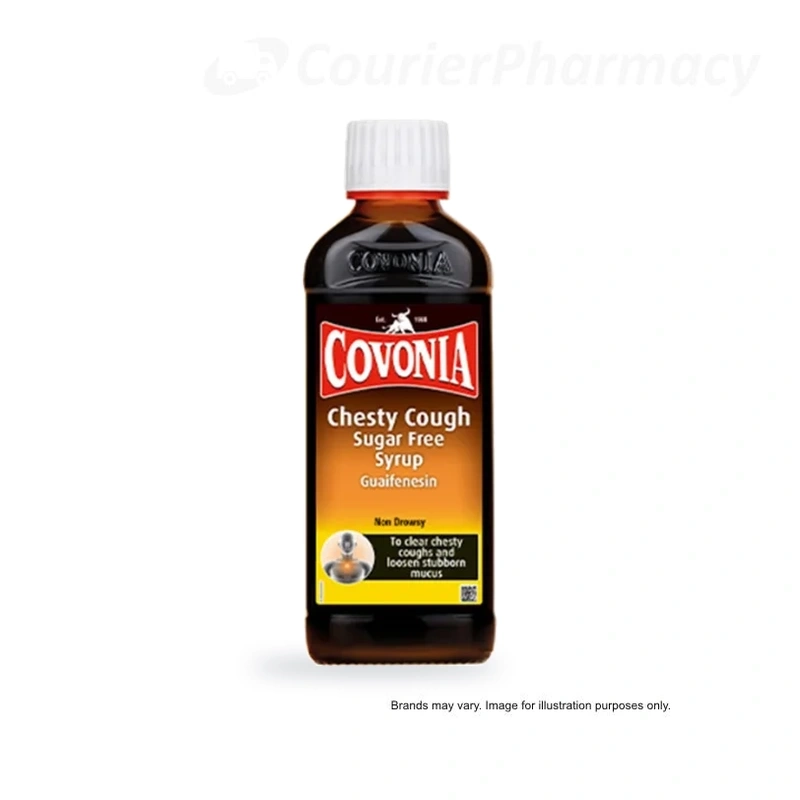
Covonia Chesty Cough Sugar Free Syrup
from£5.99
- Sugar-free expectorant syrup: guaifenesin 100mg per 5ml for productive chesty cough.
- Sorbitol-sweetened.
- For adults and children 12+. Available at Courier Pharmacy.
- Pack size: 150ml
TREATS:
Coughs and colds
FORMAT:
Oral liquid
Availability:
In stock


Watch
Watch
Description
Product description Covonia Chesty Cough Sugar Free Syrup
Notably, covonia Chesty Cough Sugar Free is a single-active expectorant syrup formulated without sucrose or glucose. It contains:
Doses
Furthermore, guaifenesin 100mg per 5ml: expectorant that thins mucus and increases cough productivity
Specifically, adult dose is 10ml (200mg guaifenesin) up to 4 times daily.
Standard pack size: 150ml bottle. Manufactured by Thornton & Ross Ltd. Meanwhile, licensed as General Sale List (GSL). In fact, for adults and children 12 years and over. In particular, uses sorbitol as the primary sweetener.
Note: Covonia formulations sometimes vary between packs. In short, always check the specific pack for the exact active ingredients and excipients.
Similarly, what distinguishes Covonia Chesty Cough Sugar Free from other cough products:
- Sugar-free formulation (sorbitol, no sucrose/glucose)
- Single active (guaifenesin only)
- Syrup format
- Suitable for diabetes considerations
- Non-cariogenic (kinder to teeth)
- GSL status (no pharmacy check needed)
- Thornton & Ross brand
The wider Covonia range:
- Covonia Chesty Cough Sugar Free (this product) — sugar-free expectorant
- Covonia Bronchial Balsam — traditional formulation with squill oxymel, menthol, and dextromethorphan
- Covonia Chesty Cough Mentholated — with menthol for cough soothing
- Covonia Dry Cough — for dry cough
- Covonia Night Time Cough Syrup — for night use with sedating properties
- Covonia Cold and Flu Formula — multi-symptom sachet
- Covonia Cough Sugar Free Formula — general cough
Indeed, this description covers Covonia Chesty Cough Sugar Free Syrup specifically.
As a result, the role of a sugar-free expectorant:
Standard cough syrups typically use sucrose or glucose:
- Palatable sweet taste
- Cheap and effective sweetening
- But: significant sugar load with regular use
- Concerns: diabetes management, dental health, weight management
Sugar-free alternatives use:
- Sorbitol (this product’s likely sweetener)
- Isomalt
- Xylitol
- Saccharin
- Sucralose
- Combinations
What to know
Generally, for a 4-doses-per-day treatment course during a cold or flu (40ml daily), the difference between sugar-containing and sugar-free is meaningful:
In addition, sugar-containing: ~4-8g sugar per day added
Sugar-free: negligible sugar
Additionally, for diabetes management, dental care, and weight-conscious use, sugar-free is the sensible default when it’s available at the same efficacy.
The advantages of sugar-free:
- Blood glucose stability — sorbitol has minimal impact
- Dental protection — sorbitol is non-cariogenic (doesn’t feed the bacteria that cause decay)
- Lower calorie load
- Reduced hyperglycaemia risk in diabetes during illness (illness itself can raise glucose)
The trade-off:
- Sorbitol taste is slightly less appealing than sucrose (some formulations mask this well)
- At higher daily intakes, sorbitol can cause loose stools (sugar alcohol laxative effect)
- Isomalt, xylitol, and other sugar alcohols have similar behaviours
At the standard dose (40ml daily = probably around 8-10g sorbitol from typical formulations), most people don’t notice gut effects. Some sensitive people do. For example, if loose stools develop, reduce the dose or use less frequently.
Importantly, what’s important to understand about the guaifenesin mechanism:
On the other hand, same as Benylin Mucus Cough Max Syrup and Benylin Chesty Cough Non-Drowsy — expectorant that thins mucus:
- Absorbed from the gut
- Acts on vagus nerve receptors in the respiratory tract
- Increases mucus secretion from airway goblet cells
- Draws water into secretions — reduces viscosity
- Cilia move thinner mucus more effectively
- Cough more productive at each attempt
This works best when:
- You have productive chesty cough (not dry)
- You drink plenty of water alongside
- You use regularly (4 doses daily) during the acute period
- You don’t combine with cough suppressants
Therefore, what’s important to understand about the “don’t combine with cough suppressants” rule:
Expectorants (guaifenesin) and cough suppressants (dextromethorphan, sedating antihistamines used for cough) have opposite mechanisms:
- Suppressants dampen the cough reflex
- Expectorants encourage productive coughing
- Combining them creates the contradictory situation: mucus loosened but the cough that would clear it is suppressed
Key points to remember
Consequently, choose one type based on cough character:
- Productive chesty cough ? expectorant (this product)
- Dry unproductive cough ? suppressant (Covonia Dry Cough, Benylin Dry Cough, dextromethorphan products)
- Cough that’s productive during day and disruptive at night ? possibly guaifenesin during day, suppressant at night (with pharmacist advice)
However, what’s important to understand about diabetes and cold and flu:
Moreover, illness itself can affect blood glucose:
- Viral infections raise cortisol and other stress hormones
- Blood glucose can be higher during a cold or flu
- Poor eating during illness can cause hypos in insulin-dependent diabetics
- Some cold and flu medications (pseudoephedrine, for example) can affect glucose
Choosing sugar-free where possible reduces one variable:
- Sugar-free cough syrup doesn’t add glucose load
- Choose sugar-free lozenges too (Strepsils Sugar Free variants)
- Avoid regular use of sugar-containing syrups
- Discuss with pharmacist which combinations suit your diabetes management
In summary, the relationship to other cough and cold products:
Overall, vs Benylin Mucus Cough Max Syrup (Honey and Lemon): same guaifenesin active. Benylin contains sucrose/glucose and honey. Notably, choose Covonia Sugar Free if avoiding sugars matters.
Additional considerations
Furthermore, vs Benylin Chesty Cough Non-Drowsy: same guaifenesin active. Check specific pack for sugar content — some Benylin variants have sugar-free options too.
Specifically, vs Sudafed Mucus Cough Liquid: same guaifenesin active, competing brand.
Meanwhile, vs Lemsip Cough for Mucus Cough and Catarrh: same guaifenesin active, competing brand.
In fact, vs Covonia Bronchial Balsam: traditional formulation with dextromethorphan (cough suppressant) — different mechanism. NOT to be combined with this sugar-free variant. Choose based on cough type.
In particular, vs Covonia Dry Cough: for dry cough. Do NOT combine.
In short, vs Covonia Night Time Cough: for night use with sedation. Different mechanism.
Similarly, vs simple linctus: pure demulcent (glycerin/syrup base). Even simpler.
Indeed, vs paracetamol or ibuprofen: for pain and fever. Compatible.
Vs multi-symptom combinations with guaifenesin (Beechams All in One, Beechams Max Strength Capsules, Cold and Flu Nurse Capsules, Lemsip Max All-in-One): duplication risk — don’t combine.
As a result, vs multi-symptom combinations without guaifenesin (Lemsip Max Cold and Flu Sachets, Sudafed Sinus Max Strength, Sudafed Sinus Pressure and Pain, Nurofen Cold and Flu, Sinutab, Sudafed Congestion and Headache Day and Night): no expectorant in those — this syrup can be added if chesty cough also present.
Generally, vs topical decongestants (Sudafed Sinus-Ease, Otrivine, Vicks Sinex, Sudafed Blocked Nose Spray): different mechanism, different area. Compatible.
Vs Sterimar Isotonic: saline. Compatible.
Important details
In addition, vs Vicks VapoRub, Vicks Inhaler, Olbas Inhaler: sensation products. Compatible.
Vs Strepsils range (Original, Extra, Sore Throat and Cough): sore throat products. Different area. Compatible.
Additionally, vs Ultra Chloraseptic, Difflam, Strefen: sore throat products. Compatible.
For example, vs steroid nasal sprays: different mechanism. Compatible.
Importantly, vs antibiotics: for confirmed bacterial infection. Compatible.
On the other hand, who Covonia Chesty Cough Sugar Free suits:
- Adults and 12+ with productive chesty cough
- Diabetes management during cold or flu
- Weight-conscious cough treatment
- Dental care considerations
- People who don’t like sweet syrups
- Post-viral cough with lingering mucus
- Cold or flu with cough as main current symptom
- Short-term use during acute cough
Covonia Chesty Cough Sugar Free is not the optimal choice for:
- Children under 12
- Dry unproductive cough
- Concurrent use with cough suppressants
- Cough persisting beyond 3 weeks (GP review)
- Cough with breathing difficulty, wheezing, or blood in sputum (urgent GP)
- People with hereditary fructose intolerance (sorbitol issue)
- People sensitive to sorbitol (loose stools)
- Pregnancy or breastfeeding without medical advice
Features and specifications:
- Active ingredient: guaifenesin 100mg per 5ml
- Form: sugar-free syrup
- Pack size: 150ml bottle
- Manufacturer: Thornton & Ross Ltd
- Class: expectorant (single active)
- Legal status: General Sale List (GSL)
- Age range: adults and 12+
- Adult dose: 10ml (200mg guaifenesin) up to 4 times daily
- Maximum daily dose: 800mg guaifenesin
- Contains sorbitol (sugar-free sweetener) — laxative caution at high intakes
- No sucrose or glucose
- Storage: below 25°C
- Discard after opening: check pack