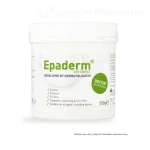
Epaderm Ointment occupies a specific niche in UK skin care. After all, when someone has very dry skin — psoriasis plaques, severe eczema, ichthyosis, or chronic cracked hands — light gel emollients often aren’t enough. So this is when a thick, occlusive ointment earns its place. Epaderm is one of the most established products in that category, with a 100% oil and wax composition (no water) and excellent moisture-trapping ability.
The three uses of Epaderm Ointment
This is what makes Epaderm distinctive. So one tub does three jobs:
**1. Leave-on emollient**
Scoop a small amount from the tub and smooth onto dry skin. It’s thick and waxy, so use less than you think — it spreads further than it looks. After all, you only need a thin film, not a thick layer. As a result, Epaderm is best applied at night, when the slightly shiny finish doesn’t matter.
**2. Soap substitute**
Smooth a small amount onto wet skin, massage gently, then rinse off. So Epaderm replaces soap, shower gel, or shampoo for the body. Because it doesn’t strip skin oils, the skin stays moisturised through washing — which is the opposite of what soap does.
**3. Bath additive**
Take about 4g (the size of a £2 coin), melt it in a tumbler of hot water, let it cool slightly, then pour into the bath. So the emollient disperses through the bath water, coating the skin during the soak. Important: the bath becomes slippery, so take extra care.
In short, one product does the work of three. As a result, many people find Epaderm simplifies their skin-care routine considerably.
Where Epaderm Ointment fits in UK skin care
Emollients sit at Step 1 of the UK approach to dry skin conditions:
Step 1: Daily leave-on emollient use — such as Epaderm Ointment for very dry skin, or lighter products like Doublebase Gel, Cetraben, or Diprobase for milder cases
Step 2: Emollient soap substitutes and bath additives, including Epaderm Ointment used in either role, or Dermol 600 for antimicrobial action
Step 4: Mild topical steroids like hydrocortisone 1% for mild flares
Step 5: Moderate to potent topical steroids (Eumovate, Betnovate, Elocon) for stronger flares
Step 6: Calcineurin inhibitors (tacrolimus, pimecrolimus) for face and sensitive areas
Step 7: Specialist skin care input for treatment-resistant cases
Step 8: Light therapy, immune medicines, or biologics for severe disease
Epaderm Ointment sits at Steps 1 AND 2 simultaneously — because it works as a leave-on, soap substitute, and bath additive. So it can cover several steps of the stepped approach with a single product.
Epaderm Ointment vs Epaderm Cream
Mölnlycke makes two main Epaderm products. So choosing between them depends on texture preference and severity:
Epaderm Ointment (this product): thick, waxy, 100% oils and wax — best for very dry skin and overnight use
Epaderm Cream: lighter cream texture with added water — easier for daytime use, less greasy
Both contain similar core ingredients, although Epaderm Cream has added water, glycerine, and chlorocresol (a preservative)
Epaderm Cream isn’t the triple-use product — only the ointment serves all three roles
Many people use Epaderm Ointment overnight and a lighter product (Epaderm Cream, Doublebase Gel) during the day
Epaderm Ointment vs other ointment emollients
The UK has several thick emollient ointments. So choosing between them depends on ingredient sensitivities and personal preference:
Epaderm Ointment (this product): three ingredients, SLS-free, triple-use
Hydromol Ointment: similar formulation (emulsifying wax, yellow soft paraffin, liquid paraffin), also triple-use
Diprobase Ointment: contains liquid paraffin and white soft paraffin, plus cetostearyl alcohol — slightly different texture
50:50 White Soft Paraffin and Liquid Paraffin: very simple, just two ingredients, deeply occlusive
Cetraben Ointment: white soft paraffin and light liquid paraffin
Aquamax: emulsifying wax, white soft paraffin, liquid paraffin, polysorbate 60
AproDerm Ointment: similar formulation, often used as a generic alternative
In general, these ointments are interchangeable for moisturising purposes. So personal preference (greasiness, smell, feel) and any specific allergies usually drive the choice. Epaderm and Hydromol are both popular for the triple-use convenience.
Who Epaderm Ointment suits well
This product particularly works well for people who:
Have very dry, scaly, or cracked skin
Have severe atopic eczema, particularly during flares
Have psoriasis with thick plaques needing serious moisturising
Have ichthyosis or similar genetic dry skin conditions
Need an overnight emollient that lasts until morning
Want one product that doubles as a soap substitute and bath additive
Have reacted to multi-ingredient emollients and want a simpler formulation
Have reacted to SLS-containing products and need an SLS-free emulsifying ointment
Use wet-wrap therapy for severe eczema (Epaderm is a common base for this)
Have cracked, deep hand or foot eczema needing heavy occlusion
Who might suit other options better
Other options may work better for people who:
Need a light, non-greasy emollient for daytime use under work clothes — Doublebase Gel, Cetraben Cream, or Diprobase Cream all suit better
Have a known allergy to cetostearyl alcohol (a possible sensitiser in Epaderm)
Have eczema with active bacterial infection — Dermol 600 or Dermol 500 add antimicrobial action
Have mild dry skin where a lighter product would do the job
Have facial dryness — Epaderm is too thick for most people’s faces
Prefer fragranced or plant-based cosmetic moisturisers — Epaderm is a clinical emollient with no fragrance
Have very oily or acne-prone skin where ointments aren’t appropriate
Are at high fall risk and using it as a bath additive may be unsafe
Want active ingredients like colloidal oatmeal (Aveeno) or urea (Eucerin)
Courier Pharmacy supply
Epaderm Ointment is a General Sales List (GSL) medicine. So no prescription is needed, and no online consultation is required for purchase. However, our pharmacist is on hand to discuss whether Epaderm is the right emollient for your situation — and to suggest other options if it isn’t.
Very dry, cracked, or sensitive skin where lighter moisturisers just aren’t enough — severe eczema, ichthyosis, psoriasis between flares, or skin so dry it splits and bleeds. Maybe lotions and creams absorb and disappear within minutes, leaving the skin tight and dry again. Maybe you need something that works as moisturiser, soap substitute, and bath additive all in one.
Epaderm ointment is a heavy-duty emollient designed for the driest, most demanding skin: a greasy, protective ointment with no active medicines or fragrances, used as generously and as often as your skin needs. At Courier Pharmacy we want you to understand exactly how Epaderm works, who it suits, and how it compares to lighter emollients, so the choice feels properly yours.
Five key takeaways
Epaderm ointment is a plain emollient (no active medicines, antiseptics, or fragrances) containing emulsifying wax, yellow soft paraffin, and liquid paraffin. It’s one of the heaviest, most occlusive emollients available.
It serves three purposes in one product: a leave-on moisturiser, a soap substitute (washing without water-based cleansers), and a bath or shower additive.
The heavy occlusive formulation provides the most substantial barrier repair of the common emollients, making it particularly suitable for very dry skin conditions (severe eczema, ichthyosis, severe dry skin) and for overnight use.
There are no time limits on Epaderm use — like other plain emollients it can be used indefinitely for ongoing dry skin management. There’s no active medicine to limit exposure.
The greasy texture is the trade-off for its effectiveness — it can feel heavy and may transfer to clothing and bedding. Many patients use Epaderm overnight or for very dry areas, and lighter emollients during the day.
Treatment dosage Epaderm ointment
Epaderm ointment is applied liberally and frequently. There isn’t a strict “dose” — apply as much as needed, as often as needed.
As a leave-on moisturiser:
Apply liberally to dry skin areas and surrounding skin
Use at least 2-4 times daily, or more if skin is very dry
Apply within 3 minutes of washing while skin is still slightly damp (this traps moisture in the skin)
Smooth gently in the direction of hair growth (don’t rub vigorously)
A little warmth from your hands helps the ointment spread; rub it between your palms first
Use enough to leave a protective layer; the ointment isn’t meant to fully absorb
As a soap substitute:
Apply a small amount to dry skin before washing
Wet your hands and gently massage over the skin
Rinse with water (the emulsifying wax allows it to rinse more easily than pure paraffin)
Pat dry rather than rubbing
Apply more Epaderm or another emollient within 3 minutes
As a bath or shower additive:
For a bath, dissolve a small amount (a teaspoonful or so) in warm bath water
For a shower, apply to wet skin, massage gently, and rinse
Take care: the ointment makes baths and showers slippery — use a non-slip mat and hold handrails
The amount needed varies hugely with body surface area and how dry the skin is. Adults with widespread severe dry skin may use 500g or more per week across all uses. The 500g tub provides a substantial supply.
For children, the same liberal approach applies, scaled to body surface area. Epaderm can be used from birth onwards.
There are no time limits — Epaderm can be used indefinitely as part of ongoing dry skin management.
Overview of Epaderm ointment
Five things worth knowing:
Epaderm’s emulsifying wax content is what allows it to function as a soap substitute and bath additive as well as a leave-on moisturiser. The wax acts as a mild surfactant, allowing the otherwise greasy ointment to mix with water and rinse off skin.
The high occlusive content (paraffins and wax) makes Epaderm one of the most effective emollients for reducing transepidermal water loss — the escape of water through compromised skin that drives dry skin conditions.
It contains no fragrances and is formulated to minimise common sensitising ingredients, which makes it suitable for sensitive and reactive skin. It’s frequently recommended for patients who have reacted to other moisturisers.
The Epaderm range also includes Epaderm cream (a lighter formulation for daytime use) and Epaderm Junior. The ointment is the heaviest and most occlusive of the range.
Unlike antimicrobial emollients (Dermol) or medicated products, Epaderm has no active medicines, so there are no time limits, no antimicrobial resistance concerns, and minimal interaction or sensitisation risk.
Epaderm sits at the heavy end of the broad emollient landscape:
Pure ointments and heavy emollients (Epaderm ointment, white soft paraffin, Hydromol ointment) — most occlusive, best for very dry skin and overnight use, greasiest texture
Gels (Doublebase gel) — substantial moisturisation in a quicker-absorbing vehicle
Lotions (E45 lotion, Aveeno lotion) — light, quick-absorbing, least occlusive
Antimicrobial emollients (Dermol cream/lotion) — emollient plus antiseptic content
For most patients with significant dry skin, the right approach often involves more than one emollient. Many patients use Epaderm overnight (when the greasy texture doesn’t matter and the prolonged occlusion provides maximum barrier repair) and a lighter emollient or gel during the day (when cosmetic acceptability matters more).
The Epaderm-vs-Doublebase question often comes up. Both are plain emollients. Epaderm ointment is heavier, greasier, and more occlusive — best for very dry skin and overnight. Doublebase gel is lighter and absorbs more quickly — better for daytime use and milder dryness. Many patients use both.
For people living with complex conditions and skin sensitivities, Epaderm’s simple, fragrance-free formulation is often among the best-tolerated options. The trade-off is the greasy texture, which some patients find unacceptable for daytime use. For very dry, demanding skin, the effectiveness usually justifies the texture, particularly for overnight use.
The “soap substitute” role deserves emphasis. Many people with eczema and very dry skin find that conventional soaps, even mild ones, strip the skin’s natural oils and trigger flares. Using Epaderm as a soap substitute provides cleansing while simultaneously moisturising, which can substantially reduce flare frequency for some patients.
Why choose Courier Pharmacy for Epaderm ointment
Emollients are foundational to dry skin and eczema management, but choosing the right one for your skin and your lifestyle makes a real difference. A heavy ointment like Epaderm is brilliant for very dry skin and overnight use, but impractical for some daytime situations. Every Epaderm supply at Courier Pharmacy is reviewed by a UK pharmacist who reads your answers properly, asks about your skin condition and preferences, and explains the decision either way.
We’ll discuss whether Epaderm is the right choice. For patients with very dry skin, severe eczema, ichthyosis, or skin that cracks and splits, the heavy occlusive nature of Epaderm provides the substantial barrier repair that lighter products can’t match. For patients who find heavy ointments impractical for daytime, we’ll suggest a combination approach (Epaderm overnight, a lighter emollient or gel during the day) or a lighter primary emollient.
We’ll explain the practical realities — generous application, the three-in-one functions, the greasy texture, and the important fire safety considerations.
Our brand guide, Dr Ada Jex-Cori, sums it up: you’re not broken. The system that’s failed you might be. We want to do the part we can do, properly, and connect you with the rest. That includes our free fortnightly drop-in clinics and talks at Insomnia in Derby, where you can ask questions face-to-face without spending a penny. Why not take advantage of the AJC10 coupon and use it to get 10% off all purchases.
Buy Epaderm ointment from Courier Pharmacy
Epaderm ointment is available without prescription in the UK. Buying through Courier Pharmacy is straightforward and built around your time, not ours.
Here’s how it works:
Complete a quick online consultation about your skin condition
A UK pharmacist reviews your answers
If suitable, supply is approved
We dispense and deliver discreetly to your door
If it isn’t suitable for you, we’ll explain why and suggest the next best option.
Active ingredients in Epaderm ointment
Epaderm ointment is a plain emollient — it contains no active medicines, antiseptics, or fragrances. Its effects come from three emollient ingredients working together.
Emulsifying wax is a blend of fatty alcohols and an emulsifier. In Epaderm, it serves two roles: it provides emollient (skin-softening) effect, and it acts as a mild surfactant that allows the otherwise greasy ointment to mix with water. This second role is what makes Epaderm usable as a soap substitute and bath additive — the wax lets the ointment rinse from the skin rather than leaving an impermeable greasy film.
Yellow soft paraffin (yellow petrolatum) is a semi-solid mixture of hydrocarbons derived from petroleum. It’s one of the most effective occlusive agents available — it creates a robust protective film on the skin surface that dramatically reduces water loss. Yellow soft paraffin has been a mainstay of dermatological treatment for over a century. The “yellow” version (as opposed to “white” soft paraffin) is minimally processed and retains a pale yellow colour; both forms work similarly as emollients.
Liquid paraffin is a colourless, odourless mineral oil that provides both occlusive action and direct skin lubrication. It’s lighter than soft paraffin, helping to make the ointment slightly more spreadable while still contributing to the occlusive barrier.
The combination of these three ingredients gives Epaderm its specific properties: substantial occlusion and barrier repair (from the paraffins), with the ability to function as a wash product (from the emulsifying wax).
After topical application, the emollient ingredients work entirely through physical effects on the skin surface and barrier:
Immediate occlusion — the ointment creates a protective film that traps moisture in the skin
Reduced water loss — transepidermal water loss is dramatically reduced, allowing the skin to rehydrate
Skin softening — the lubricating effect reduces the rough, scaly texture of dry skin
Barrier support — with regular use, the skin barrier can repair over time
Epaderm has no systemic effects, no meaningful drug interactions, and isn’t significantly absorbed beyond the skin surface.
What is Epaderm ointment for?
Epaderm ointment is used for the management of dry skin conditions in adults and children of all ages, including:
Atopic eczema (particularly severe or very dry presentations)
Psoriasis (as supportive moisturisation alongside specific psoriasis treatments)
Severe dry skin from any cause (age-related, weather-related, medication-related, occupational)
Contact dermatitis (as part of barrier repair and protection)
Other dry skin conditions where heavy-duty moisturisation is needed
The product is suitable as a moisturiser, soap substitute, and bath/shower additive across all these conditions.
Epaderm is not appropriate for:
Active bacterial skin infections (which need antibiotic treatment)
Active viral skin infections (which need specific treatment)
Active fungal skin infections (which need antifungal treatment)
Open wounds requiring wound care (where wound-specific products are appropriate)
Patients with known hypersensitivity to any of the ingredients
NICE guidance for eczema recommends emollient use as foundational treatment. The choice of specific emollient depends on the severity of dryness, body areas, personal preference, and practical considerations. Heavy emollients like Epaderm are particularly suited to very dry skin and overnight use.
How does Epaderm ointment work?
Dry skin conditions all involve dysfunction of the skin barrier. The outermost layer of the skin (stratum corneum) is the body’s primary defence against water loss and against penetration of irritants and allergens. In healthy skin, this barrier works through a structured arrangement of skin cells embedded in a lipid-rich, effectively waterproof matrix.
In dry skin conditions, the barrier is compromised:
The skin loses water faster than it can be replenished (increased transepidermal water loss)
The lipid matrix becomes disorganised
The skin becomes rough, flaky, cracked, and sometimes fissured
It becomes more sensitive to irritants and more permeable to allergens
Itching develops, leading to scratching, which damages skin further
Epaderm addresses these problems through its heavy-duty emollient action:
Maximal occlusion — the high content of paraffins and emulsifying wax creates a robust, sustained protective film on the skin surface. This film dramatically slows water loss, allowing the skin to retain and rebuild its moisture content. For very dry skin where lighter emollients don’t hold enough moisture, this maximal occlusion is the key advantage.
Sustained barrier protection — because the ointment is heavy and occlusive, it persists on the skin for many hours, providing prolonged protection. This is particularly valuable overnight, when the skin has uninterrupted time to rehydrate under the protective layer.
Skin softening and smoothing — the lubricating effect of the paraffins reduces the rough, scaly texture of dry skin, reducing itching and the inflammatory cascade that itching triggers.
Soap substitute protection — when used as a wash product, Epaderm provides cleansing without the drying effect of conventional soaps. Soaps strip the skin’s natural oils; using Epaderm instead protects the barrier during washing.
Barrier repair over time — with consistent use, the skin barrier can repair and improve, leading to benefits that persist beyond individual applications.
The combined effect, applied generously and frequently, is gradual improvement in skin barrier function and substantial reduction in dry skin symptoms. For acute flares of eczema or other inflammatory conditions, emollients alone aren’t sufficient — specific anti-inflammatory treatment (typically topical corticosteroids) is needed alongside the emollient.
Onset of moisturisation is immediate. Visible improvement in skin appearance and feel is usually noticed within days of consistent generous use. Cumulative barrier repair builds over weeks of regular use.
How to use Epaderm ointment
Use Epaderm liberally and frequently. The product is designed for generous, repeated application across its three functions.
As a leave-on moisturiser:
Wash and gently pat dry the affected skin (don’t rub dry)
Within 3 minutes (while skin is still slightly damp), apply Epaderm liberally
Warm a small amount between your palms first to help it spread
Smooth into the skin in the direction of hair growth
Don’t try to rub it in until it disappears — leave a protective layer on the skin
Repeat at least 2-4 times daily, more for very dry skin
The recommended amount for adults with significant dry skin is generous — often 500g per week or more across all uses. Deliberate generous application is key to good outcomes.
As a soap substitute:
Before washing, apply a small amount of Epaderm to dry skin
Wet your hands and gently massage the ointment over the skin
Rinse with water (the emulsifying wax helps it rinse off)
Pat dry rather than rubbing
Apply more Epaderm or another emollient within 3 minutes
As a bath additive:
Dissolve a small amount (a teaspoonful or so) in warm running bath water
Soak as usual
Pat dry and apply more emollient afterwards
Be careful — the ointment makes the bath slippery; use a non-slip mat and grab rails
As a shower product:
Apply to wet skin in the shower
Massage gently
Rinse
Be careful of slipperiness
Combining with other treatments:
For eczema or psoriasis flares requiring topical corticosteroids:
Apply the corticosteroid to affected areas
Wait 15-30 minutes for it to absorb
Apply Epaderm over the area and to surrounding skin
Don’t mix the corticosteroid and emollient in your hand before applying
For combination with a daytime emollient: many patients use Epaderm overnight (heavy occlusion, texture doesn’t matter while sleeping) and a lighter emollient or gel during the day.
Practical considerations:
The greasy texture transfers to clothing and bedding — use older bedding or a towel over pillows for overnight use
Allow the ointment to settle before dressing
The ointment can make surfaces slippery — be careful with bathroom floors and grab rails
Tubs are economical but introduce bacteria from fingers; use a clean spoon to remove ointment, or choose tube formats for hygiene
For very dry hands, applying Epaderm at night under cotton gloves enhances overnight repair
Fire safety: like all paraffin-based emollients, Epaderm can be a fire hazard if it soaks into clothing, bedding, or dressings. Keep away from naked flames and smoking materials. Change and wash clothing and bedding regularly during heavy use.
If you miss applications, just resume normal use; there’s no need to “make up” missed doses.
Warnings and precautions for Epaderm ointment
Epaderm ointment is contraindicated in:
Known hypersensitivity to any of the ingredients (emulsifying wax, yellow soft paraffin, liquid paraffin)
This is essentially the only contraindication — Epaderm is otherwise very well-tolerated and suitable for almost all patients with dry skin conditions, including infants and pregnant or breastfeeding women.
Use with care in:
Patients with very inflamed or weeping skin (where any product may cause mild initial stinging, though this is uncommon with Epaderm)
Patients with active skin infections (which need specific treatment alongside emollient use)
Patients with open wounds (which need wound-specific care)
Fire safety is the most important practical safety consideration. Emollients containing paraffin (which includes Epaderm) can be a serious fire hazard if they soak into clothing, bedding, dressings, or hair. The paraffin residue is flammable and can ignite from a naked flame, cigarette, or spark, sometimes causing severe burns.
Practical fire safety measures:
Don’t smoke or be near naked flames when skin or clothing is covered in emollient
Keep away from candles, gas hobs, open fires, and other ignition sources
Change clothing and bedding regularly during heavy emollient use
Wash clothing and bedding at high temperatures to remove paraffin residue (note that washing may not remove all residue)
Be particularly careful for patients with reduced mobility, dementia, or who smoke
The MHRA has issued specific safety guidance about emollient fire risks. For most patients applying emollients normally and not near ignition sources, the risk is low, but it’s a genuine and serious hazard worth taking seriously.
Slipperiness — Epaderm makes baths, showers, and floors slippery. Use non-slip mats and grab rails, and take care to avoid falls.
Initial stinging can occur on very broken or inflamed skin, although Epaderm is generally very well-tolerated. If persistent or severe, an alternative emollient may be better.
Folliculitis (irritation around hair follicles) can occur if the ointment is applied against the direction of hair growth. Smooth in the direction of hair growth to minimise this.
Allergic reactions are uncommon but possible to any ingredient. Emulsifying wax contains cetostearyl alcohol, which is a recognised (though uncommon) contact allergen. If you develop a new rash that worsens with each application, stop and try an alternative emollient under guidance.
Pregnancy: Epaderm can be used freely during pregnancy. No special precautions needed.
Breastfeeding: Epaderm can be used freely during breastfeeding. If applying to the breast area, wipe the area before breastfeeding.
Children: Epaderm can be used in children of all ages, including newborns.
If your skin condition worsens during Epaderm use, the most likely cause is the underlying condition needing different treatment, not the emollient. Plain emollients essentially never cause worsening of inflammatory dermatoses. Contact your prescriber for review.
Side effects of Epaderm ointment
Most patients tolerate Epaderm very well. Side effects are uncommon and generally mild.
Common side effects, between 1 in 100 and 1 in 10 people, are essentially limited to the practical inconveniences of a heavy ointment (greasy feel, transfer to clothing) rather than medical side effects.
Uncommon side effects, between 1 in 1,000 and 1 in 100 people, include mild local irritation (more likely on very inflamed or broken skin), folliculitis (if applied against hair growth direction), and rare contact allergic reactions (most commonly to the cetostearyl alcohol in the emulsifying wax).
Rare side effects, fewer than 1 in 1,000 people, include allergic contact dermatitis requiring discontinuation, and theoretical reactions to specific ingredients in highly sensitised individuals.
Very rare and serious side effects include severe allergic reactions including anaphylaxis. This is essentially unreported for plain emollients but listed for completeness. Anaphylaxis is a medical emergency; call 999.
The fire safety hazard mentioned in the warnings section isn’t a side effect in the medical sense but is the most clinically important safety consideration for heavy emollient use.
If you experience any side effect that worries you, you can report it directly to the MHRA’s Yellow Card scheme. This helps improve safety data for everyone who uses the medicine. Our pharmacy team are happy to help you submit a Yellow Card report if you’d like assistance.
Drug interactions with Epaderm ointment
Epaderm ointment has essentially no significant drug interactions. As a plain emollient with no active medicines, it doesn’t interact with systemic medicines.
Local considerations:
Topical corticosteroids — Epaderm is often used alongside topical corticosteroids for eczema or psoriasis. Apply the steroid first, allow to absorb (15-30 minutes), then apply Epaderm. This sequencing maximises both treatments’ effectiveness. Don’t mix them in the same application.
Topical calcineurin inhibitors (tacrolimus, pimecrolimus) — same principle; apply the active medicine first, allow to absorb, then apply Epaderm.
Other emollients — combining different emollients (Epaderm overnight, a lighter emollient during the day, for example) is generally fine and often beneficial.
Other topical products — most can be combined with Epaderm, with attention to sequencing (active medicines first, emollient over the top).
Tell your prescriber or pharmacist about all medicines and skin products you use, although significant interactions with plain emollients are very rare.
Frequently asked questions about Epaderm ointment
What is Epaderm ointment used for?
Epaderm is a plain emollient used for very dry skin conditions including atopic eczema, ichthyosis, psoriasis, and severe dry skin from any cause. It works as a moisturiser, soap substitute, and bath/shower additive.
How is Epaderm different from lighter moisturisers?
Epaderm ointment is one of the heaviest, most occlusive emollients available. It provides more substantial barrier repair than lighter creams, gels, or lotions, making it particularly suitable for very dry skin and overnight use. The trade-off is the greasy texture.
How is Epaderm different from Doublebase gel?
Both are plain emollients. Epaderm ointment is heavier, greasier, and more occlusive — best for very dry skin and overnight. Doublebase gel is lighter and absorbs more quickly — better for daytime and milder dryness. Many patients use both.
Can I use Epaderm as a soap substitute?
Yes, this is one of its three intended uses. Apply to dry skin before washing, then wet your hands and massage over the skin. Rinse with water. The emulsifying wax content allows it to rinse off, unlike pure paraffin ointments.
Can I use Epaderm in the bath?
Yes. Dissolve a small amount in warm bath water as a bath additive. Be careful — it makes the bath slippery, so use a non-slip mat and grab rails to avoid falls.
How often should I apply Epaderm?
Apply liberally at least 2-4 times daily, or more if skin is very dry. Within 3 minutes of washing while skin is still slightly damp is particularly effective. Use generously — under-using is the most common mistake.
Can I use Epaderm on my face?
Yes, although some patients find it too heavy for facial skin. For the face, the lighter Epaderm cream or another light emollient may be preferable. If you tolerate the ointment on your face, it’s safe.
Can I use Epaderm on my children?
Yes, Epaderm can be used in children of all ages, including newborns. Use the amount appropriate for body surface area.
Can I use Epaderm during pregnancy?
Yes, Epaderm can be used freely during pregnancy. No special precautions needed.
Is Epaderm safe while breastfeeding?
Yes. If applying to the breast area, wipe the area before breastfeeding.
Why is Epaderm a fire risk?
Like all paraffin-based emollients, Epaderm can soak into clothing, bedding, and dressings, where it becomes flammable. Keep away from naked flames, cigarettes, and sparks. Change and wash clothing and bedding regularly. This is a genuine and serious hazard worth taking seriously.
Will Epaderm make my skin greasy?
Yes, Epaderm is a heavy, greasy ointment — this is what makes it effective for very dry skin. The greasiness is the trade-off for the substantial barrier repair. Many patients use it overnight when the texture matters less, and lighter products during the day.
Can I use Epaderm with topical steroids?
Yes, this combination is standard for eczema and psoriasis. Apply the steroid first, wait 15-30 minutes for it to absorb, then apply Epaderm over the top. Don’t mix them in the same application.
How long can I use Epaderm?
Indefinitely. Unlike medicated products with time limits, plain emollients like Epaderm can be used for years as part of ongoing dry skin management.
What’s the difference between Epaderm ointment and Epaderm cream?
Same brand, different formulations. The ointment is heavier and more occlusive (best for very dry skin and overnight). The cream is lighter and absorbs more quickly (better for daytime and milder dryness). Many patients use the ointment overnight and the cream during the day.
Can I be allergic to Epaderm?
Allergic reactions are uncommon, but possible. The emulsifying wax contains cetostearyl alcohol, a recognised (though uncommon) contact allergen. If you develop a new rash that worsens with each application, try a different emollient under guidance.
Will Epaderm cure my eczema?
No, eczema is a chronic condition with no cure. Epaderm helps manage it by supporting the skin barrier and reducing dryness, which can reduce flare frequency. Other treatments (topical corticosteroids, topical calcineurin inhibitors, systemic treatments) are usually needed alongside emollients for active management.
Can I use Epaderm with other emollients?
Yes, many patients benefit from using different emollients at different times. Epaderm overnight plus a lighter product during the day is a common and effective combination for very dry skin.
What if Epaderm is too greasy for me?
Try using it only overnight (when texture matters less) with a lighter emollient during the day. Alternatively, switch to a lighter primary emollient (Epaderm cream, Doublebase gel, or a cream) if the ointment is impractical for your lifestyle.
Can I stop Epaderm suddenly?
Yes, Epaderm can be stopped at any time. Your skin will become drier without ongoing emollient use, so switching to another emollient rather than stopping all moisturisation is usually preferred.
Disclaimer: This article is for information only and isn’t a substitute for personal medical advice. Always speak to a qualified prescriber before starting or changing treatment.