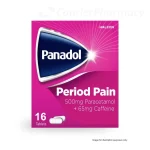
Panadol Period Pain 500mg/65mg Tablets are film-coated tablets that combine paracetamol 500mg with caffeine 65mg in each dose. People often choose them for period pain (dysmenorrhoea), especially when cramps need fast, reliable relief.
These tablets are white to off-white, oval, and film-coated. They are marked xPx (with a “P” inside a circle) on one side and — on the other. Packs contain 16 tablets.
Panadol Period Pain uses the same formulation as Panadol Extra Advance 500mg/65mg Tablets and shares the same SmPC. In other words, the “Period Pain” name is mainly a branding choice to highlight its use for menstrual cramps, rather than a different medicine.
The “Advance” formulation is designed to break down faster than standard paracetamol and caffeine tablets. As a result, the paracetamol can dissolve and absorb sooner, which may lead to earlier pain relief. This matters for period pain because taking an analgesic at the first sign of cramping often works better than waiting until the pain is fully established.
Product specifications
Active ingredients (per tablet): Paracetamol 500mg, Caffeine 65mg
Form: White to off-white, film-coated, oval tablets marked xPx / —
Pack size: 16 tablets
Classification: General Sale List (GSL)
Same formulation as: Panadol Extra Advance 500mg/65mg Tablets
Adults and ages 16+: 2 tablets every 4 hours, max 8 tablets/day
Children 12–15: 1 tablet every 4 hours, max 4 tablets/day
Not suitable for: Children under 12; pregnancy
MOJO WISDOM
Take control of your health by understanding your condition and what this medication is doing for you.
READ:
More information about this treatment.
UK-based doctors and pharmacists
Discreet and Confidential
UK-based doctors and pharmacists
Free, Expert Advice
No video link provided.
No video link provided.
UK-based doctors and pharmacists
Free, expert advice
Discrete and confidential
Fast delivery
Giving you trusted clinical advice for over 40 conditions
A UK regulated pharmacy providing safe, effective treatments online since 2014
Faster-absorbed paracetamol and caffeine, specifically positioned for period pain alongside the full range of pain and fever conditions.
Period pain does not always arrive with much warning, and it does not wait for a convenient moment. Panadol Period Pain Tablets are the same Advance-formulation paracetamol and caffeine product as Panadol Extra Advance, but marketed specifically for period pain and positioned to reassure women that this is a product developed with their experience in mind.
Each tablet delivers paracetamol 500mg and caffeine 65mg in a formulation clinically demonstrated to be faster-absorbed than standard paracetamol and caffeine tablets.
At Courier Pharmacy, we believe in giving people the complete picture, including the important note that this product is not suitable during pregnancy, and the caffeine content that can add up if you also drink coffee or tea.
Five key takeaways
Each tablet contains paracetamol 500mg and caffeine 65mg in an advanced formulation absorbed faster than standard paracetamol and caffeine tablets, providing earlier onset of period pain relief.
Indicated for the treatment of period pain (dysmenorrhoea), headache, migraine, backache, toothache, and rheumatic pain, and for cold and flu aches and fever. It is a broad-spectrum analgesic marketed to emphasise its period pain indication.
Adults and those aged 16 and over: 2 tablets every 4 hours, maximum 8 tablets per 24 hours. Children aged 12-15: 1 tablet every 4 hours, maximum 4 per day.
A General Sale List (GSL) medicine manufactured by Haleon Ireland Dungarvan Limited. Available in packs of 16. PIL last revised January 2025.
Not recommended during pregnancy or breastfeeding due to the caffeine content. Avoid excessive additional caffeine from food and drink during use. Lithium interaction: caffeine increases lithium clearance.
Overview of Panadol Period Pain 500mg/65mg Tablets
Period pain is one of the most under-treated conditions in women’s health. Research consistently shows that menstrual pain is undertreated relative to its clinical impact on daily functioning, work attendance, educational participation, and quality of life. OTC analgesics, taken appropriately and at the right time, can meaningfully reduce this burden.
The clinical rationale for analgesic superiority in dysmenorrhoea goes like this: primary dysmenorrhoea (cramping without an underlying pathological cause) is driven primarily by prostaglandin-mediated uterine contractions. The uterus in primary dysmenorrhoea produces elevated levels of prostaglandin F2-alpha (PGF2a), which cause intense, painful myometrial contractions and vasoconstriction of the uterine vasculature.
NSAIDs (ibuprofen, naproxen) directly inhibit the COX enzymes responsible for PGF2a synthesis, addressing the biochemical cause of the cramping. Paracetamol does not have this peripheral anti-inflammatory action.
However, paracetamol at 1000mg (the two-tablet adult dose) with caffeine adjuvant at 130mg still provides meaningful pain relief for many women with primary dysmenorrhoea, particularly those with mild to moderate symptoms. The faster absorption of the Advanced formulation supports early intervention before the prostaglandin-driven cramping cycle becomes entrenched.
For women managing dysmenorrhoea alongside conditions where NSAIDs are contraindicated, including those with peptic ulcer history, NSAID hypersensitivity, or cardiovascular risk factors, Panadol Period Pain provides an effective analgesic option. Our free fortnightly drop-in talks at Insomnia, Derby, from 10 am to 12 pm are a space to discuss these nuanced pain management choices.
Treatment dosage for Panadol Period Pain 500mg/65mg Tablets
Swallow tablets whole with water. Do not take with any other paracetamol-containing product. Avoid excessive caffeine from food, coffee, tea, and energy drinks while taking this product.
Adults and those aged 16 and over: 2 tablets every 4 hours. Maximum 8 tablets in 24 hours.
Children aged 12-15 years: 1 tablet every 4 hours. Maximum 4 tablets in 24 hours.
Do not take more frequently than every 4 hours.
Not for children under 12 years.
If symptoms persist, seek medical advice.
Why choose Courier Pharmacy for Panadol Period Pain Tablets
Period pain deserves to be taken seriously, not dismissed with a recommendation to put up with it. At Courier Pharmacy, Dr Ada Jex-Cori’s approach means we engage with the clinical reality of dysmenorrhoea: that for mild to moderate symptoms, Panadol Period Pain is a well-formulated, evidence-supported option; that for severe dysmenorrhoea, NSAIDs are pharmacologically superior; and that persistent severe period pain warrants medical assessment for underlying conditions.
We also note that Panadol Period Pain and Panadol Extra Advance are identical medicines, so if you have run out of one and have the other, they can be used interchangeably. Our GPhC-registered team is here to help you understand which product is most appropriate for your specific situation.
Our free fortnightly drop-in talks at Insomnia, Derby, from 12 to 1pm are open to everyone. Learn more about our community talks at courierpharmacy.co.uk.
Buy Panadol Period Pain Tablets from Courier Pharmacy
Panadol Period Pain Tablets are a General Sale List (GSL) medicine, available without a prescription. Add them to your basket and complete your order.
If you have questions about period pain management or whether this product is the right choice for your situation, our pharmacist team is here to help.
If it isn’t suitable for you, we’ll explain why and suggest the next best option.
Summary
Panadol Period Pain and Panadol Extra Advance are the same medicine. Both share EMC product 5340 (Period Pain, GSL, 16 tablets) and EMC product 4504 (Extra Advance, GSL, multiple pack sizes). The formulation, active ingredients, doses, and clinical profile are identical. The brand positioning differs to emphasise the period pain indication.
For dysmenorrhoea, ibuprofen at anti-inflammatory doses is pharmacologically superior to paracetamol because ibuprofen directly inhibits the prostaglandin synthesis that drives uterine cramping. However, for people with NSAID contraindications, or those who prefer or tolerate paracetamol better, Panadol Period Pain is an appropriate and effective first-line option.
The caffeine content of 65mg per tablet (130mg per adult two-tablet dose) is close to the caffeine content of a large cup of coffee. For women already consuming significant caffeine as part of their daily routine, the combined daily caffeine intake during the maximum dosing period warrants attention.
Taking the analgesic at the first sign of period pain, before cramping becomes severe, produces significantly better outcomes than waiting until pain is established. The faster-absorbed Advanced formulation is particularly suited to this early-intervention approach.
Dysmenorrhoea that is consistently severe, refractory to OTC analgesics, or accompanied by features suggesting endometriosis or other underlying conditions warrants medical assessment rather than ongoing self-management with OTC products alone.
Active ingredients in Panadol Period Pain 500mg/65mg Tablets
Paracetamol 500mg per tablet inhibits prostaglandin synthesis centrally, reducing pain perception and normalising the hypothalamic temperature set point. Its analgesic efficacy for dysmenorrhoea is primarily central, modulating pain signal processing rather than directly reducing peripheral prostaglandin-driven uterine contractions.
Caffeine 65mg per tablet is an adenosine receptor antagonist that enhances paracetamol's analgesic efficacy beyond what paracetamol alone achieves. The Cochrane review of caffeine as an analgesic adjuvant confirms meaningful improvement in analgesic effect across multiple pain types, including dysmenorrhoea, with the addition of caffeine 65-100mg to standard paracetamol doses.
What is Panadol Period Pain Tablets for?
Panadol Period Pain Tablets are indicated for the treatment of dysmenorrhoea (period pain) as their primary marketing indication, and for the broad analgesic and antipyretic indications covered by the formulation: headache including migraine, backache, toothache, rheumatic pain, and the fever, aches, and pains of colds and flu. For adults and children aged 12 and over.
How does Panadol Period Pain Tablets work?
The Advanced formulation achieves faster dissolution and paracetamol absorption than standard tablets, enabling earlier analgesic onset. Paracetamol inhibits prostaglandin synthesis centrally, reducing pain perception and fever. Caffeine enhances paracetamol efficacy through adenosine receptor antagonism, providing meaningful additional pain relief beyond the paracetamol component alone.
How to use Panadol Period Pain Tablets
Take 2 tablets with water every 4 hours as needed. Do not exceed 8 tablets in 24 hours. Do not take with any other paracetamol-containing product. Avoid excessive caffeine from food and drink during use. For best results, take at the first sign of period pain rather than waiting for cramping to become severe. If symptoms persist or are not adequately controlled, consult a pharmacist or GP.
Warnings and precautions for Panadol Period Pain 500mg/65mg Tablets
Not recommended in pregnancy due to the caffeine content. Caffeine is associated with a possible increased risk of lower birth weight and spontaneous abortion at higher cumulative intakes. Not recommended during breastfeeding; caffeine passes into breast milk and may have a stimulating effect on breastfed infants. Avoid excessive additional dietary caffeine from coffee, tea, cola, energy drinks, and chocolate while taking this product.
Do not take with any other paracetamol-containing product. Paracetamol overdose causes serious delayed liver damage; seek emergency medical advice immediately if overdose is suspected. Care required in renal and hepatic impairment. Not for children under 12. Caffeine increases lithium clearance; this product is not recommended for people on lithium therapy.
If period pain is severe, consistently poorly controlled, or associated with features such as pain outside menstruation, deep dyspareunia, or pelvic mass, consult a GP as underlying conditions such as endometriosis may be present.
Side effects of Panadol Period Pain 500mg/65mg Tablets
Paracetamol: very rare serious skin reactions; rare blood dyscrasias; hepatotoxicity from overdose. Caffeine: insomnia if taken close to bedtime, palpitations, anxiety, nervousness, restlessness.
Combined caffeine from this product and dietary sources may cause cumulative stimulant effects. Report any suspected adverse effect to the MHRA via yellowcard.mhra.gov.uk.
Drug interactions with Panadol Period Pain 500mg/65mg Tablets
Paracetamol: warfarin anticoagulant effect enhanced by regular daily use; metoclopramide and domperidone increase absorption rate; cholestyramine reduces absorption; flucloxacillin increases metabolic acidosis risk in susceptible patients. Do not combine with any other paracetamol product.
Caffeine: increases lithium clearance (not recommended alongside lithium); may enhance effects of other stimulants; may reduce efficacy of sedatives and hypnotics. Avoid excessive dietary caffeine during use.
Frequently asked questions about Panadol Period Pain Tablets
What is in Panadol Period Pain Tablets?
Each tablet contains paracetamol 500mg and caffeine 65mg. The formulation is identical to Panadol Extra Advance 500mg/65mg Tablets. The tablets are white to off-white, film-coated, and oval.
Are Panadol Period Pain and Panadol Extra Advance the same medicine?
Yes. Both contain paracetamol 500mg and caffeine 65mg per tablet in the same Advanced formulation. They share the same SmPC on the Electronic Medicines Compendium. The Period Pain branding emphasises the dysmenorrhoea indication; the product and its clinical profile are identical.
Why is ibuprofen sometimes recommended over Panadol for period pain?
Primary dysmenorrhoea is driven by prostaglandin-mediated uterine contractions. Ibuprofen directly inhibits prostaglandin synthesis peripherally, addressing the biochemical cause of cramping. Paracetamol does not have this peripheral anti-inflammatory action. For people who can tolerate NSAIDs, ibuprofen is pharmacologically more targeted for period pain. For those with NSAID contraindications, Panadol Period Pain is an appropriate and effective alternative.
When should I take Panadol Period Pain for best results?
At the first sign of period pain or cramping, before it becomes severe. Taking the analgesic early in the pain cycle produces better outcomes than waiting until cramping is established. The faster-absorbed Advanced formulation supports this early-intervention approach.
Can I take Panadol Period Pain during my period if I am also drinking coffee?
The adult two-tablet dose delivers 130mg of caffeine. A standard mug of coffee contains approximately 80-100mg. If you are taking Panadol Period Pain at maximum dose alongside regular coffee drinking, your total daily caffeine intake may be significant. Reduce dietary caffeine during use and monitor for caffeine-related effects such as insomnia, palpitations, or anxiety.
Is Panadol Period Pain safe in pregnancy?
No. The product is not recommended in pregnancy due to the caffeine content, which is associated with possible risks of lower birth weight and spontaneous abortion at higher intakes. Use plain paracetamol during pregnancy if pain relief is needed, and seek GP or midwife advice.
Can I take Panadol Period Pain if I am on lithium?
No. Caffeine increases the renal clearance of lithium, which may reduce plasma lithium to sub-therapeutic levels. Use a caffeine-free analgesic if you are on lithium therapy.
My period pain is very severe and not responding to painkillers. What should I do?
Consult your GP. Severe dysmenorrhoea that is not adequately controlled by OTC analgesics may indicate underlying conditions such as endometriosis, fibroids, or other gynaecological pathology that requires diagnosis and specific treatment. Do not continue self-managing severe, refractory period pain without medical assessment.
Can I take Panadol Period Pain with ibuprofen?
Paracetamol and ibuprofen work through different mechanisms and can be combined or alternated, provided doses of each remain within their individual maximums and you have no NSAID contraindications. Do not combine Panadol Period Pain with any other paracetamol-containing product.
How many tablets can I take per day?
Adults and those aged 16 and over: maximum 8 tablets in 24 hours (four two-tablet doses every 4 hours). Children aged 12-15: maximum 4 tablets in 24 hours.
Can I take Panadol Period Pain for headache?
Yes. Headache, migraine, backache, toothache, and cold and flu aches are all licensed indications alongside period pain. The product is a general-purpose analgesic marketed with a period pain emphasis.
What if I accidentally take too many tablets?
Seek emergency medical advice immediately, even if you feel well. Paracetamol overdose causes delayed serious liver damage that may not produce symptoms for 24-72 hours.
Can teenagers take Panadol Period Pain?
Children aged 12-15 may take one tablet every 4 hours, maximum 4 tablets per day. Not for children under 12 years.
How does the faster absorption help with period pain?
Dysmenorrhoea tends to build in intensity. Taking an analgesic at the earliest sign of cramping, before pain becomes established, produces better overall pain control than trying to treat severe established cramping. The Advanced formulation achieves therapeutic paracetamol plasma levels faster than standard tablets, providing earlier onset of relief for early intervention.
Does Panadol Period Pain contain ibuprofen?
No. It contains only paracetamol and caffeine. It is not an NSAID. For people who cannot take ibuprofen or other NSAIDs, Panadol Period Pain provides effective analgesic relief without NSAID-related risks.
Does Panadol Period Pain cause drowsiness?
No. The caffeine content is mildly stimulating rather than sedating. Avoid taking close to bedtime to minimise any risk of sleep disruption from the caffeine.
Do I need a prescription?
No. Panadol Period Pain Tablets are a GSL medicine available without a prescription.
Disclaimer: This article is for general information only and isn’t a substitute for personal medical advice, diagnosis, or treatment. Always check with a GP, pharmacist, or specialist before starting a new supplement if you have a medical condition or take regular medicines.
References
[1] Haleon UK Trading Limited (2025) Panadol Period Pain 500mg/65mg Tablets: Summary of Product Characteristics. Electronic Medicines Compendium. Available at: https://www.medicines.org.uk/emc/product/5340/smpc