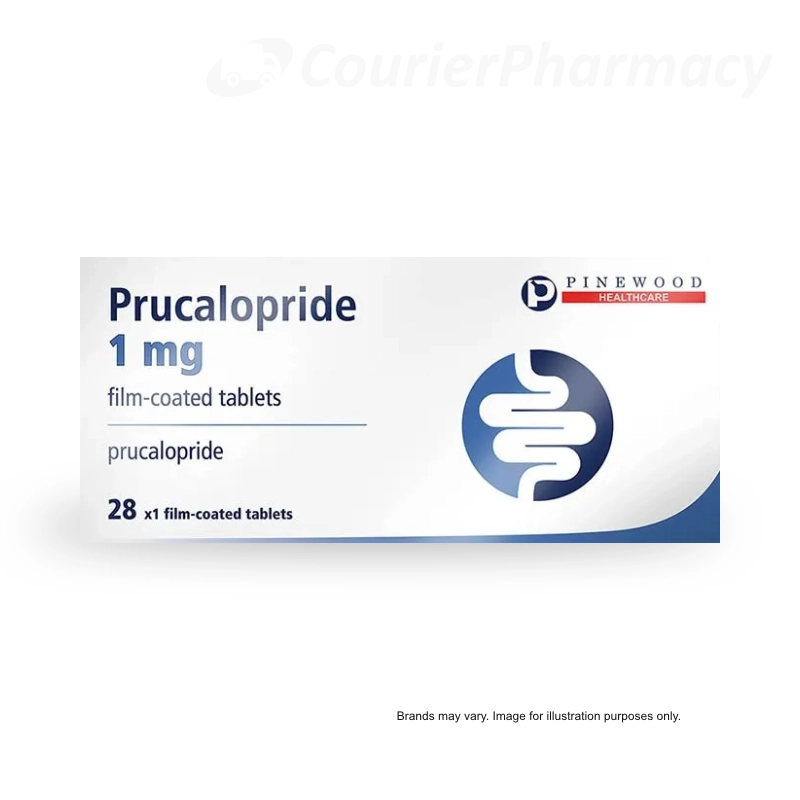
Prucalopride 1mg and 2mg Tablets — Selective 5-HT4 Prokinetic for Chronic Idiopathic Constipation
This is a licensed prescription medicine — Prucalopride is a selective serotonin 5-HT4 receptor agonist licensed for the symptomatic treatment of chronic idiopathic constipation in adults where laxatives haven’t provided adequate relief. It works differently from bulk-forming, osmotic, or stimulant laxatives by directly stimulating the gut’s own motility through 5-HT4 receptor activation, restoring more normal bowel movement patterns rather than simply softening stool or stimulating a single evacuation. Available as Resolor 1mg and 2mg film-coated tablets from Takeda, prucalopride is typically taken once daily with or without food. It sits in the specialist end of the chronic constipation treatment ladder — not a first-line option, but genuinely useful for patients whose constipation hasn’t responded adequately to conventional laxatives across at least two different classes over sufficient duration. Available at Courier Pharmacy after full clinical review.
At Courier Pharmacy, we believe in treatment that fits the person, but only where it’s honest, safe, and consented to.
This page covers what prucalopride is, how the 5-HT4 mechanism differs from conventional laxatives, who it may suit, how the 1mg and 2mg strengths are used, how it compares to other constipation treatments, and the practical points that matter — including when first-line laxatives should be tried first, realistic expectations, and the specific safety considerations that apply.
Five key takeaways
- Prucalopride is a selective 5-HT4 receptor agonist that directly stimulates gut motility, licensed for chronic idiopathic constipation in adults where conventional laxatives haven’t provided adequate relief
- Different mechanism from bulk-forming, osmotic, or stimulant laxatives — prucalopride restores normal peristaltic patterns through receptor-mediated action rather than softening stool or stimulating single evacuations
- Available as Resolor 1mg and 2mg film-coated tablets from Takeda. Standard adult dose is 2mg once daily, with 1mg once daily reserved for elderly patients (over 65) or those with severe renal or hepatic impairment
- Not a first-line treatment — should be considered when laxatives from at least two different classes have been tried at adequate doses for sufficient duration (typically 6 months) without adequate relief
- Generally well-tolerated but can cause headache, nausea, diarrhoea, and abdominal pain particularly in the first days. Cardiovascular safety has been demonstrated in extensive studies, addressing concerns raised by older 5-HT4 agonists. Prescriber assessment before supply is essential
Why choose Courier Phamacy for chronic constipation support
At Courier Pharmacy, our approach starts with a simple idea: treatment should fit the person, not force the person to fit the system.
Dr Ada Jex-Cori
Our service is shaped by the philosophy of Dr Ada Jex-Cori, our brand pharmacist.
Dr Ada represents the spirit of the pharmacy: evidence-led, community-rooted, and willing to challenge the one-size-fits-all approach to medicine. She is named in honour of three pioneering women in science: Ada Lovelace, the mathematician and visionary; Sophia Jex-Blake, the first female doctor in the UK who fought the medical establishment; and Gerty Cori, the biochemist and Nobel Prize winner.
In our fictional world of Etherwell, Dr Ada fights against pharma’s standardised approach to medicine. In the real world, she represents what we stand for. Her view is straightforward: you are not broken. The system is. And we are here to change that.

Chronic constipation deserves serious attention
Chronic constipation is often dismissed as a minor issue. Courier Pharmacy is different. So we recognise that:
- Chronic constipation genuinely impacts quality of life
- Standard advice (more fibre, more water, more movement) doesn’t work for everyone
- Patients who have done everything asked deserve better than being told to try harder
- The step-wise treatment ladder exists for a reason and should be worked through properly
- Prokinetics like prucalopride are underused because clinicians are unfamiliar with them
- Getting the right treatment at the right stage matters for long-term outcomes
Honest framing about prucalopride response rates
The reality of the evidence:
- Approximately 1 in 4 to 1 in 3 patients achieve the primary trial endpoint
- This means most patients won’t achieve full target response
- Many more patients get meaningful partial improvement even without hitting the target
- Quality of life measures often improve more than raw bowel frequency
- 4-week treatment trial with response assessment is the standard approach
- If prucalopride isn’t going to work, this is usually clear by 4 weeks
Honest framing about prucalopride vs conventional laxatives
Different mechanisms, appropriate positioning:
- Prucalopride is more expensive than conventional laxatives
- Prucalopride requires prescription while most laxatives are OTC
- For most people with new-onset constipation, conventional laxatives work well
- Prucalopride specifically addresses the underlying dysmotility
- This matters when laxatives haven’t been enough despite proper use
- Position in the treatment ladder reflects the appropriate role
Honest framing about the treatment ladder
Why the sequence matters:
- Laxatives from at least two classes should be tried at adequate doses
- Adequate duration means weeks to months, not days
- Skipping the ladder increases costs without necessarily improving outcomes
- However, patients who have genuinely worked through the ladder shouldn’t be delayed further
- Prescriber judgement identifies when the ladder has been adequately tried
- The goal is right treatment at right stage, not delay for delay’s sake
Chronic constipation and the bigger picture
Constipation rarely sits in isolation. So our prescriber can discuss:
- Comprehensive management approach
- Dietary patterns that support gut health
- Physical activity and gut motility
- Stress and gut function
- Pelvic floor considerations if relevant
- Menstrual cycle and hormonal factors
- Menopause and gut function
- Medications that may contribute to constipation
- Investigations if red flag symptoms emerge
- When to consider specialist referral
- Long-term monitoring approach
Sometimes constipation is one part of a wider health picture worth talking through.
Prescriber support before and after supply
Our team is here to discuss:
- Whether prucalopride fits your specific situation
- Whether conventional laxatives should be tried further first
- Alternative approaches
- Comprehensive lifestyle work alongside medication
- Correct use technique
- Realistic expectations
- Monitoring approach
- What to do if you don’t respond by 4 weeks
- What to do if side effects develop
- When to review or adjust approach
Trust earned, not claimed
We are GPhC-regulated, and our content is grounded in the licensed Resolor Summary of Product Characteristics (Takeda), NICE technology appraisal guidance for prucalopride, the pivotal Phase III trial evidence (Camilleri et al 2008, Quigley et al 2009, Tack et al 2009, Ke et al 2012), the extensive post-marketing safety data from over 15 years of clinical use, MHRA guidance on prescription medicine supply, and the real experience of patients managing chronic idiopathic constipation.
If prucalopride isn’t the right answer for your situation, we’ll tell you honestly. After all, getting the right approach matters more than fulfilling a request.
How supply works
Prucalopride is a licensed prescription medicine, which means the supply process has proper clinical steps rather than a straight checkout. Here’s how it works from your first click to your tablets arriving.
Step 1: Eligibility check
Complete the chronic constipation consultation on courierpharmacy.co.uk. This takes about 15-20 minutes and covers your constipation history, duration, symptoms, previous treatments tried, and specific goals. We ask specifically about which laxatives you’ve tried, at what doses, and for how long, so we can assess whether prucalopride is genuinely appropriate.
Step 2: Prescriber review
Your consultation goes to our UK-qualified prescriber, who reviews your clinical picture in detail. This isn’t automatic approval. The prescriber assesses whether prucalopride genuinely fits your situation, whether further conventional laxative trials might be needed first, whether investigations should be arranged before prescribing, whether specialist referral would be more appropriate, or whether an entirely different approach makes more sense. If any of these fit better, we’ll say so.
Step 3: Prescription and dispensing
If the prescriber judges prucalopride is appropriate, they issue a prescription for the appropriate strength (1mg or 2mg) and quantity. Your medication is dispensed from our GPhC-regulated pharmacy premises. As a licensed medicine, prucalopride is sourced from authorised UK wholesale channels rather than compounded to order.
Step 4: Discreet delivery and ongoing support
Your order is dispatched in plain packaging with no external indication of contents, suitable for home or workplace delivery. Free prescriber support is available throughout your treatment, and we schedule a 4-week review to assess response and consider ongoing supply.
The whole process typically takes a few days from consultation completion to tablets arriving. However, the important part is that clinical judgement sits at every step. So if something in your situation makes prucalopride unsuitable, we identify it before supply rather than after.
When other options might suit better
If prucalopride isn’t right, we’ll explain why. Other options may include:
- Fybogel (ispaghula husk) — bulk-forming, if not adequately tried
- Cosmocol or Movicol (macrogol) — osmotic, if not adequately tried
- Lactulose — osmotic, alternative option
- Senna or bisacodyl — stimulant, if not adequately tried
- Dulcolax Pico (sodium picosulfate) — stimulant liquid
- Combination approaches (osmotic plus stimulant)
- Glycerol suppositories — for local rectal stimulation
- Linaclotide (Constella) — for IBS-C specifically
- Naldemedine or naloxegol — for opioid-induced constipation
- Specialist gastroenterology referral for complex cases
- Biofeedback for pelvic floor dysfunction
- Dietary review with a dietitian
- Investigation for underlying causes if red flags present
Our community service
Our free fortnightly drop-in clinics at Insomnia, Derby run every other week from 10am to 12pm.
Healthcare shouldn’t only happen when you’re paying for it. So we show up, even when it’s free.
We cover weight management, GLP-1 therapy, MCAS, menopause, women’s health, men’s health, chronic pain, digestive health, allergies, asthma, sleep, migraine, headache, skincare, acne, hair loss, and whatever else people bring through the door. No appointment needed, no charge, no pressure.

Active ingredient
Each film-coated tablet contains:
- Prucalopride 1mg (as prucalopride succinate) — for elderly patients over 65 or those with severe renal/hepatic impairment
- Prucalopride 2mg (as prucalopride succinate) — standard adult dose
- Lactose monohydrate
- Microcrystalline cellulose
- Colloidal silica
- Magnesium stearate
- Film coating with hypromellose, lactose monohydrate, triacetin, titanium dioxide, macrogol 3000, and iron oxides for colour differentiation
Why prucalopride specifically
Prucalopride offers meaningful pharmacological advantages:
- Highly selective for 5-HT4 receptors with minimal affinity for 5-HT2B or hERG channels
- This selectivity addresses the cardiovascular concerns that led to withdrawal of older 5-HT4 agonists (cisapride, tegaserod)
- Extensive cardiovascular safety data from clinical trials and post-marketing surveillance
- Directly stimulates the gut's own motility rather than relying on stool softening or single stimulation
- Effective across the whole gastrointestinal tract
- Once-daily dosing supports adherence
- Well-characterised through Phase III trials and NICE technology appraisal
In short, prucalopride represents modern 5-HT4 pharmacology with the safety profile that older agonists lacked. After all, the pharmacological class as a whole had a difficult history with cisapride and tegaserod, so the selectivity that prucalopride offers matters clinically.
Why the 5-HT4 mechanism
Understanding what serotonin receptor targeting adds:
- 5-HT4 receptors are located throughout the gastrointestinal tract
- Activating them enhances peristalsis, the wave-like muscle contractions that move contents through the gut
- This mimics the gut's own natural signalling rather than overriding it
- Enhanced peristalsis moves contents at a more normal rate through the colon
- Reduced transit time means less water is reabsorbed, giving softer stools
- More regular emptying patterns emerge
- Different mechanism from bulk-forming laxatives (increasing stool bulk)
- Different from osmotic laxatives (drawing water into the bowel)
- Different from stimulant laxatives (direct nerve stimulation to trigger evacuation)
So prucalopride restores normal gut motility patterns rather than acting as a workaround. This distinction matters clinically because it addresses the underlying dysmotility rather than just its consequences.
Why the 1mg vs 2mg strength choice
The two strengths serve different patient groups:
- 2mg once daily: standard adult dose for most patients
- 1mg once daily: elderly patients (over 65)
- 1mg once daily: patients with severe renal impairment (creatinine clearance under 30 ml/min)
- 1mg once daily: patients with severe hepatic impairment (Child-Pugh C)
- 1mg once daily may also be used if 2mg not tolerated in some patients
- Prescriber determines appropriate strength based on individual factors
After all, prucalopride is renally cleared, so patients with reduced renal function need lower dosing to avoid accumulation. Similarly, elderly patients often have subtly reduced renal function and may be more sensitive to side effects. So the 1mg option isn't a weaker version — it's the appropriate dose for specific patient groups.
Other ingredients
The tablets contain lactose monohydrate as an excipient. So patients with rare hereditary problems of galactose intolerance, total lactase deficiency, or glucose-galactose malabsorption shouldn't take prucalopride.
Complete excipients list is provided with each supply. So mention any known allergies or sensitivities during your consultation.

What is prucalopride for?
Prucalopride is licensed for the symptomatic treatment of chronic idiopathic constipation in adults where laxatives haven't provided adequate relief. So it fits a specific clinical scenario — not new-onset or occasional constipation, but persistent constipation that has continued despite trying conventional laxatives properly. As a result, it's positioned as a step-up option in the constipation treatment ladder rather than a first-line choice.
What chronic idiopathic constipation means
The specific clinical picture:
- "Chronic" means constipation lasting at least 6 months
- "Idiopathic" means no identifiable underlying cause after appropriate investigation
- Fewer than 3 bowel movements per week is a common threshold
- Straining, hard stools, incomplete evacuation, or feeling of blockage are common symptoms
- Rome IV criteria provide the formal diagnostic framework
- Different from constipation caused by opioids, cancer, neurological conditions, or specific dietary factors
- Different from constipation-predominant IBS (IBS-C), which has separate treatment pathways
Who might prucalopride suit?
This medicine may suit:
- Adults with chronic idiopathic constipation of at least 6 months' duration
- Adults who have tried laxatives from at least two different classes at adequate doses
- Adults where laxatives haven't provided adequate relief despite proper use
- Adults with confirmed idiopathic constipation (secondary causes ruled out)
- Adults who have had appropriate investigations for their age and symptoms
- Adults committed to lifestyle measures alongside medication
- Adults engaged with prescriber-led review and monitoring
- Adults understanding this is a step-up rather than first-line option
What prucalopride may help with
Based on the 5-HT4 mechanism and clinical trial evidence:
- Increased frequency of spontaneous complete bowel movements
- Reduced straining during bowel movements
- Improved stool consistency
- Reduced sensation of incomplete evacuation
- Restoration of more regular bowel movement patterns
- Reduced reliance on rescue laxatives
- Improved constipation-related quality of life measures
- Reduced abdominal bloating in some patients
Important honesty point: prucalopride is an effective medicine for many patients but doesn't work for everyone. Clinical trials showed roughly 1 in 4 to 1 in 3 patients achieve the primary endpoint of at least 3 spontaneous complete bowel movements per week. So while it works well when it works, individual response varies significantly, and 4-week treatment trials with response assessment are the standard approach.
What prucalopride doesn't claim to do
Honest framing matters:
- It doesn't work for constipation with an identifiable underlying cause (opioids, structural, neurological, endocrine)
- It isn't first-line — conventional laxatives should be tried properly first
- It doesn't work overnight — meaningful effect typically emerges over days to weeks
- It doesn't replace the need for adequate fibre intake, hydration, and physical activity
- It doesn't help everyone — significant proportion of patients don't achieve target response
- It isn't licensed for children or adolescents under 18
- It isn't licensed for IBS-C specifically (different treatment pathway)
- It isn't for occasional or short-term constipation

How prucalopride works
Understanding the 5-HT4 mechanism helps explain both what to expect and why prucalopride differs from conventional laxatives.
The 5-HT4 receptor mechanism
Prucalopride targets a specific serotonin receptor:
- Highly selective for 5-HT4 receptors located throughout the gastrointestinal tract
- Activation enhances release of acetylcholine from enteric nerves
- This stimulates peristalsis, the wave-like muscle contractions of the gut wall
- Peristalsis moves contents through the digestive tract at a more normal rate
- Enhanced motility particularly affects the colon
- Reduced colonic transit time means less water is reabsorbed from stool
- Softer stool with more regular passage patterns emerges
- The selectivity avoids 5-HT2B and hERG channel effects that caused problems with older 5-HT4 agonists
So the mechanism works with the gut's own signalling system rather than around it. This is genuinely different from adding bulk to stool, drawing water into the bowel, or forcing a single evacuation.
Onset timeline
What to expect:
- First 24-72 hours: many patients notice individual bowel movements
- Week 1: pattern of movements may begin to change
- Weeks 2-4: full response typically becomes apparent
- Week 4 review: standard time point for assessing whether treatment is working
- If no meaningful improvement by 4 weeks, prucalopride is probably not going to work for you
- If working, continued daily dosing maintains the response
- Individual variation is significant
What response looks like
The clinical trial primary endpoint:
- At least 3 spontaneous complete bowel movements per week
- Spontaneous means without rescue laxative use in previous 24 hours
- Complete means with sensation of full evacuation
- This threshold reflects meaningful restoration of near-normal bowel patterns
- Approximately 1 in 4 to 1 in 3 patients achieved this in trials
- Many more had partial improvement even without hitting this threshold
- Quality of life improvements often exceed the raw frequency numbers

Frequently asked questions

How is prucalopride different from laxatives?
Different mechanism:
- Laxatives work by adding bulk, drawing water in, or stimulating a single evacuation
- Prucalopride directly stimulates the gut's own peristaltic waves
- This restores more normal transit patterns rather than working around dysmotility
- Prucalopride is prescription-only; most laxatives are OTC
- Both have their place in the treatment ladder
Do I need to try laxatives first?
Yes, typically:
- Prucalopride is licensed specifically for constipation where laxatives haven't provided adequate relief
- Laxatives from at least two different classes should have been tried
- Adequate doses for adequate duration (typically 6 months of chronic constipation)
- Prescriber assesses whether adequate trial has occurred
- Skipping this stage isn't clinically appropriate
How long before I see if it's working?
4-week assessment:
- Some effect often noted in first 24-72 hours
- Pattern changes typically over 1-2 weeks
- Full response by 4 weeks
- If no meaningful improvement at 4 weeks, treatment usually stopped
- If working, continued daily use maintains response
What if 2mg is too much?
Options include:
- Try 1mg instead of 2mg
- Persist for 1-2 weeks if side effects are mild — they often settle
- Discuss with prescriber if severe or persistent
What if it doesn't work?
Options include:
- Consider specialist referral
- Investigations for underlying causes if not already done
- Alternative approaches (linaclotide for IBS-C, biofeedback for pelvic floor dysfunction)
- Combination approaches
- Discuss with prescriber
Can I take it long-term?
Depends on individual situation:
- Some patients use long-term with regular review
- Others cycle on and off based on symptom pattern
- Prescriber assesses ongoing need periodically
- Consider gradual tapering to assess if benefit persists
Can I take it with other laxatives?
Yes, initially:
- Continue rescue laxatives as needed during initial response development
- Taper laxative use as prucalopride response develops
- Don't combine with other 5-HT4 agonists
- Discuss combined approach with prescriber
Will it interact with my other medications?
Generally clean interaction profile:
- Prucalopride has relatively few significant interactions
- Ketoconazole and erythromycin may modestly increase levels
- Warfarin monitoring reasonable
- Contraceptives unaffected
- Provide full medication list at consultation for comprehensive check
Can I use it in pregnancy?
No:
- Prucalopride not for use during pregnancy or planning pregnancy
- Effective contraception during use
- Contact prescriber if pregnancy occurs during treatment
Can children take it?
No:
- Prucalopride not licensed for children or adolescents under 18
- Paediatric constipation has different treatment pathways
- Consult paediatric services for children's constipation
What if I forget a dose?
Standard approach:
- Take the next dose at the usual time
- Don't double up to make up for a missed dose
- Occasional missed doses won't significantly affect treatment
- Frequent missed doses may reduce effectiveness
Is prucalopride the same as Resolor?
Yes:
- Resolor is the original brand name (Takeda)
- Prucalopride is the active ingredient generic name
- Generic prucalopride tablets are bioequivalent
- Same clinical effect and side effect profile
- Different pricing may apply
What if I get severe abdominal pain?
Stop and seek assessment:
- Severe abdominal pain with vomiting can indicate obstruction
- Needs urgent medical assessment
- Stop prucalopride pending assessment
How should I store it?
- Below 25°C
- In original blister pack
- Away from direct heat and moisture
- Keep out of reach of children
- Use by expiry date
Is my packaging discreet?
- Plain packaging with no mention of contents
- Suitable for delivery to home or workplace
How do I order from Courier Pharmacy?
Complete the chronic constipation consultation on courierpharmacy.co.uk. Our prescriber will review your history, previous treatments tried, and current situation, then supply prucalopride if clinically appropriate. Your order goes out in plain, discreet packaging with support available throughout your treatment.
More than a prescription: our community
Healthcare shouldn't only happen when you're paying for it.
Every fortnight we run free drop-in talks and clinics at Insomnia, Derby, from 10am to 12pm. So we show up, even when it's free.
Bring a question, bring a friend, bring a stack of bewildering letters from another clinic. We'll sit with you.
We cover weight management, GLP-1 therapy, MCAS, menopause, women's health, men's health, chronic pain, digestive health, allergies, asthma, sleep, migraine, skincare, acne, hair loss, and whatever else people bring through the door. No appointment. No cost. No pressure. Just real support and treatment that fits.
Disclaimer: This information is for education only and isn’t a substitute for personal medical advice. Always follow your prescriber’s instructions.
This page is for information only and isn't a substitute for personal medical advice. Prucalopride is a licensed prescription medicine (POM) for chronic idiopathic constipation in adults where conventional laxatives haven't provided adequate relief. It's contraindicated in intestinal perforation, intestinal obstruction, severe inflammatory bowel conditions, severe renal impairment requiring dialysis, pregnancy, breastfeeding, and in children under 18. Prescriber assessment before supply is essential. Signs of intestinal obstruction (severe abdominal pain with vomiting or fever) need urgent medical assessment. Signs of severe allergic reaction (facial swelling, breathing difficulty, widespread rash) need immediate medical attention (999). Red flag symptoms (blood in stool, unexplained weight loss, family history of bowel cancer) need investigation before prucalopride is prescribed. This medicine should be used alongside comprehensive lifestyle measures for chronic constipation.
How this content was created
Written by the Courier Pharmacy editorial team and reviewed by a GPhC-registered prescribing pharmacist.
References
- Electronic Medicines Compendium (emc) (n.d.) [Summary of Product Characteristics for product 13752]. Available at: https://www.medicines.org.uk/emc/product/13752/smpc (Accessed: 10 July 2026).
-
-
-
-