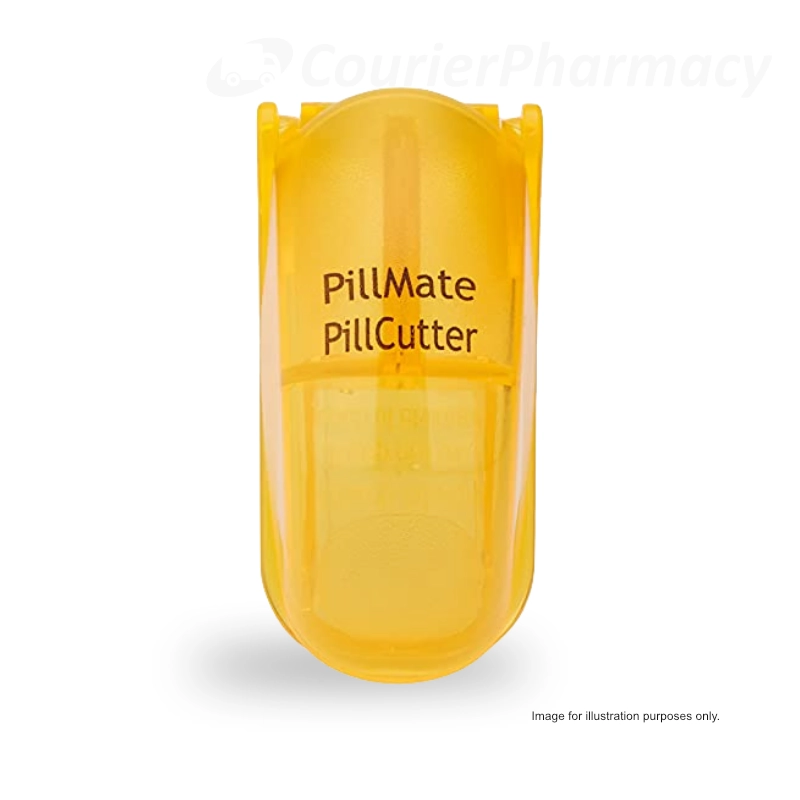
The Pillmate pill cutter is a hand-held plastic device, around the size of a matchbox, with a hinged top lid, a V-shaped tablet holder in the base, and a stainless steel blade on the underside of the lid.
So you place the tablet in the holder, close the lid, and the blade divides the tablet along its vertical centre line. In particular, the V-shape of the holder is designed to centre tablets of different sizes and shapes so the blade cuts through the midline. Furthermore, many Pillmate models include a small compartment under the cutting area to hold the split tablet pieces until use.
Where a pill cutter fits in medicine use at home
A pill cutter is used in two main situations. So the first is when the prescriber has prescribed a dose that is half of an available tablet strength (for example, 2.5mg of a tablet that only comes in 5mg).
In particular, splitting the 5mg tablet in half is a routine way to achieve that dose. Furthermore, the second use is for patients who have swallowing difficulty (dysphagia) and need to break tablets into smaller pieces, where the SmPC confirms the medicine is still safe and effective when split.
Why a dedicated cutter beats a kitchen knife
Hand-splitting a tablet with a kitchen knife or by snapping it between your fingers gives uneven pieces, with one half often considerably bigger than the other. So dose accuracy suffers, and small differences matter for medicines with narrow therapeutic windows. In particular, published studies on tablet splitting show that dedicated pill cutters give substantially more accurate halves than hand splitting or kitchen knives.
Furthermore, a cutter also keeps your fingers away from the blade and keeps the tablet dust contained.
Key features and details
Compact plastic body, typically pocket-sized.
Hinged lid with a stainless steel blade bonded to the underside.
V-shaped tablet holder to centre tablets of different shapes.
Storage compartment (model dependent) to hold split tablet pieces.
Non-sterile, re-usable, for one patient only.
MOJO WISDOM
Take control of your health by understanding your condition and what this medication is doing for you.
READ:
More information about this treatment.
UK-based doctors and pharmacists
Discreet and Confidential
UK-based doctors and pharmacists
Free, Expert Advice
No video link provided.
No video link provided.
UK-based doctors and pharmacists
Free, expert advice
Discrete and confidential
Fast delivery
Giving you trusted clinical advice for over 40 conditions
A UK regulated pharmacy providing safe, effective treatments online since 2014
Pillmate pill cutter, a simple device for safely halving prescribed tablets
The Pillmate pill cutter is a small plastic device with a stainless steel blade designed to cut prescription tablets in half accurately and safely. So this is a widely-used UK home device for patients whose prescriber has recommended taking half a tablet, for example when a dose does not match an available tablet strength. In particular, splitting a tablet by hand gives uneven pieces and risks a wrong dose; a dedicated pill cutter with a V-shaped tablet holder and a hinged blade keeps the two halves close to equal. Furthermore, the Pillmate is also useful for patients who find whole tablets difficult to swallow and need to break them down into smaller pieces (where the SmPC permits).
When to see your prescriber before splitting tablets
A pill cutter is a device, not a treatment, but some situations need professional input before using one. So check with your prescriber or pharmacist first if any of these apply:
Your prescriber has not confirmed that your tablet is safe to split.
The tablet is modified-release, prolonged-release, enteric-coated, or film-coated (splitting usually destroys the coating).
The tablet is a capsule (capsules should not be split; use the correct capsule strength instead).
The medicine has a narrow therapeutic index (lithium, warfarin, digoxin, levothyroxine), where small dose variations matter.
The medicine is a cytotoxic drug (chemotherapy), hormone, or anything that would be harmful if the dust reached another person’s skin or lungs.
The tablet has no score line (unscored tablets split less accurately).
You find it hard to see or feel the tablet to position it correctly.
A child, pet, or non-consenting adult may have access to the cutter blade.
You have never been shown how to use a pill cutter.
For life-threatening symptoms after an accidental overdose or exposure, call 999. For urgent but non-emergency concerns, call NHS 111.
Five key takeaways about the Pillmate pill cutter
A re-usable plastic pill cutter with a stainless steel blade for halving tablets at home.
Suits scored, immediate-release tablets your prescriber has confirmed can be split.
Not suitable for modified-release, enteric-coated, or film-coated tablets, or for capsules.
Keep for one patient only; clean after each use with a dry cloth.
Low-cost pharmacy (P) medical device, available over the counter after a brief pharmacy check.
Choosing between tablet splitting and a different dose strength
Before buying a pill cutter, it is worth asking whether tablet splitting is the right answer at all. So some situations suit a cutter and some suit a different approach:
When a pill cutter is the right choice
Your prescriber confirms the tablet is safe to split, and no suitable half-dose strength exists.
The tablet is immediate-release and has a score line.
You have swallowing difficulty and the SmPC confirms splitting is acceptable.
You need to titrate a dose up or down in half-tablet steps under prescriber guidance.
When a different dose strength would fit better
A tablet strength matching your dose already exists (ask the pharmacist to switch).
The medicine is modified-release, enteric-coated, or film-coated.
The medicine is a capsule (cannot be safely split).
The medicine has a narrow therapeutic index where dose accuracy to within a few percent matters.
An oral solution or liquid is available (sometimes a better fit for dysphagia).
Why choose Courier Pharmacy for your Pillmate pill cutter
Registered, independent, and patient-led
Courier Pharmacy is a UK-registered independent pharmacy regulated by the General Pharmaceutical Council (GPhC 9010051). So when you order a Pillmate through us, you work with a proper pharmacy team, not a warehouse. Furthermore, our independence means we can spend time on dose and tablet-splitting questions where a chain would not.
Pharmacist advice on whether to split or switch
Many patients do not need a pill cutter at all; a different tablet strength or an oral solution would be a better fit. So we are happy to review your prescription and tell you whether splitting is the right answer, before you spend on the device. In particular, if your prescriber has specified half a tablet of a modified-release medicine, we would want to speak to them before confirming a sale.
Specialist prescriber expertise
Our Superintendent Pharmacist Shazlee Ahsan holds an MSc in Endocrinology and a PGDip in Infectious Diseases. So we understand the dose-accuracy context for a range of medicines, from thyroxine titration to blood-pressure medicines to compounded hormone preparations. In particular, this matters because the medicines that need half-tablet doses are often ones where dose accuracy really counts.
Dr Ada Jex-Cori, our brand pharmacist
Our brand pharmacist is Dr Ada Jex-Cori. She represents the spirit of what we do. Named for Ada Lovelace, Sophia Jex-Blake, and Gerty Cori, she stands for evidence-led, unafraid-of-questions medicine. Her message runs through everything we prescribe:
You’re not broken. The system is. We’re here to change that.
For patients balancing on half-tablet doses in particular, this matters. So many patients have been splitting tablets for years without a proper review of whether a different strength would simplify their life. Furthermore, a short pharmacist conversation often unlocks a cleaner dose plan.
Care that keeps showing up
A pill cutter is a long-term bit of kit for most patients who use one. So we are here for the follow-up questions along the way: when the blade dulls, when a change in medicine means splitting is no longer safe, and when a dose change opens the option of a whole-tablet strength. In particular, we would rather help you refine your routine than just repeat-sell devices.
Buy a Pillmate Pill Cutter from Courier Pharmacy
The Pillmate pill cutter is a pharmacy (P) medical device supplied at courierpharmacy.co.uk. So you can buy it without a prescription after a brief pharmacy check, which confirms the device suits your medicine and that you have been shown how to use it. However, if you are not sure whether your tablet is safe to split, speak to our team first.
The four steps
Add the Pillmate pill cutter to your basket and tell us which tablet you plan to split during the pharmacy check.
Our pharmacy team reviews the sale and confirms the tablet is safe to split (immediate-release, scored, not cytotoxic).
Your order dispatches promptly.
Follow the directions on the pack and your prescriber’s advice. Contact us if you have any questions.
If a pill cutter isn’t right for you
If our pharmacy check shows a different approach fits your situation better, we’ll explain why and suggest the next best option. So this might mean:
A different tablet strength that matches your dose without splitting.
An oral solution or liquid formulation (useful for dysphagia or children).
A dispersible or orodispersible tablet that avoids both splitting and swallowing issues.
A specialist formulation from a compounding pharmacy if no suitable licensed form exists.
A different pill-management device (dosette box, blister pack) if the real issue is remembering doses rather than dose size.
A conversation with your prescriber to update the prescription.
A tablet crusher instead of a cutter, where crushing (not splitting) is appropriate.
Above all, we won’t sell you something that isn’t right for your situation. In short, honest guidance matters more than making the sale.
Materials and components of the Pillmate pill cutter
A pill cutter is a medical device, not a medicine, so it has no active pharmaceutical ingredient. However, the materials and components matter because they determine durability, blade sharpness, and whether the device can be cleaned properly. In particular, the Pillmate is a non-sterile, re-usable device for one patient only.
The body
The main body is injection-moulded plastic (typically ABS or polypropylene). So it is lightweight, pocket-sized, and durable through many uses. In particular, the hinged top lid has a sprung action for consistent closing pressure. Furthermore, the V-shaped tablet holder in the base is designed to centre tablets of different shapes and sizes against the blade's cutting plane.
The blade
The blade is stainless steel, bonded to the underside of the hinged lid. So it is designed to stay sharp through many uses and to resist corrosion when wiped clean after use. In particular, the blade is positioned to cut vertically through the tablet midline when the lid closes. Furthermore, the blade is not user-replaceable in most Pillmate models; replace the whole device when the blade dulls.
The storage compartment
Many Pillmate models include a small plastic storage compartment under or beside the cutting area. So this holds split tablet pieces between uses, which is helpful if you take half a tablet in the morning and the other half in the evening. However, long-term storage of split tablets is not usually recommended because the exposed cut surface may be affected by air, light, or moisture.
What the device does NOT contain
No latex.
No sterile covering (the device is non-sterile).
No batteries, no electronics.
No active pharmaceutical ingredient.
No single-use parts (the device is re-usable for one patient).
Pack and labelling
The Pillmate is supplied in retail packaging with a leaflet of use and care instructions. So the packaging may vary slightly between batches but the device itself is unchanged. In particular, check that the blade is intact and clean before first use. Furthermore, keep the original packaging if you want to store the device clean between uses.
What is the Pillmate pill cutter for?
The Pillmate pill cutter is used for dividing immediate-release prescription tablets into halves where the prescriber or the SmPC confirms splitting is acceptable. So it is used in several common home-medicine situations:
Half-dose steps during dose titration
Many medicines need gradual dose adjustment up or down in half-tablet steps. So a cutter lets you achieve this when a half-dose tablet strength does not exist. In particular, this is common with blood-pressure medicines, antidepressants, and hormone replacement, where dose fine-tuning happens over weeks or months.
Achieving a prescribed dose that is half a tablet strength
Sometimes a prescriber specifies a dose that is half of an available tablet (for example, 2.5mg of a 5mg tablet). So a cutter is the standard way to achieve this. However, if a 2.5mg tablet exists in another brand, asking the pharmacist to switch avoids the need to split.
Swallowing difficulty (dysphagia)
Patients with dysphagia (post-stroke, Parkinson's, cancer treatment, learning disability) sometimes find whole tablets difficult to swallow. So dividing a tablet into smaller pieces can help, but only if the SmPC confirms the medicine is still safe and effective when split. In particular, modified-release, enteric-coated, or film-coated tablets usually cannot be safely split for this purpose; an oral solution or dispersible form is often better.
Veterinary dose titration
Pet owners sometimes use a pill cutter to divide tablets prescribed for a cat or dog where the dose is a half-tablet. So this is a common off-label use, though vets will usually be able to advise on an appropriate device.
Where this device is NOT the right choice
However, some situations need a different approach:
Modified-release, prolonged-release, slow-release, or sustained-release tablets (splitting destroys the controlled-release coating).
Enteric-coated tablets (splitting destroys the acid-resistant coating).
Capsules (cannot be safely split; use the correct capsule strength).
Cytotoxic medicines (chemotherapy) and most hormones that would be harmful to another person exposed to the dust.
Narrow-therapeutic-index medicines where a few percent dose variation matters.
Tablets without a score line (dose accuracy suffers).
Tablets that are small, round, or oddly shaped and will not sit stably in the holder.
How does the Pillmate pill cutter work?
A pill cutter works through simple mechanics: a sharp blade is driven through a stabilised tablet by closing a lid. So the design controls two things that hand-splitting fails on: the position of the cut (vertical, through the midline) and the force of the cut (even, from above). Furthermore, five aspects of the device design are worth understanding.
The V-shaped holder centres the tablet
The holder in the base of the cutter has a V-shape, which naturally funnels a tablet toward the centre regardless of its shape. So round, oval, oblong, and capsule-shaped tablets all end up with their midline sitting roughly under the blade. In particular, this is the main design feature that distinguishes a dedicated pill cutter from a kitchen knife, where lining up the midline by eye is difficult.
The blade cuts vertically along the midline
When you close the lid, the blade comes down vertically through the tablet along its centre line. So this gives two halves of (approximately) equal mass, which is the main dose-accuracy claim of a pill cutter. In particular, published studies have shown that pill cutters give substantially better dose accuracy than hand splitting, though not perfect (typical variation is still in the 10 to 15 percent range).
Why score lines help
A score line is a shallow groove pressed into the tablet during manufacture to indicate where it can be split. So the tablet breaks preferentially along this line when pressure is applied. In particular, lining up the score line parallel to the blade before closing the lid gives the best halving accuracy. Furthermore, unscored tablets can usually still be split by a cutter but with less reliable accuracy.
Why some tablets must not be cut
Modified-release and enteric-coated tablets have engineered coatings that control when and where the drug is released. So cutting through these coatings destroys the release mechanism, leading to a dose dumped all at once (modified-release) or being destroyed by stomach acid (enteric-coated). In particular, this can be dangerous for modified-release opioids, modified-release calcium channel blockers, or enteric-coated aspirin. Furthermore, capsules should not be split because the shell is designed to deliver the medicine intact to the site of absorption.
Why hygiene matters
A pill cutter is re-usable but is only for one patient. So small amounts of medicine dust accumulate inside the device between uses, which could cross-contaminate if the device is shared. In particular, patients on cytotoxic medicines (chemotherapy) or hormones should not share a cutter with anyone else and ideally use a dedicated device just for that medicine. Furthermore, wiping the cutter dry with a clean cloth after each use removes most residue; do not immerse in water (which can rust the blade).
How to use the Pillmate pill cutter safely
Before you start
Wash and dry your hands.
Confirm the tablet is one your prescriber or pharmacist has said is safe to split.
Check the cutter is clean, dry, and the blade is intact.
Have your prescription label and your usual medicines kit to hand.
Loading the tablet
Open the lid of the cutter.
Place the tablet flat in the V-shaped holder, with the score line parallel to the blade.
Let the V-shape nudge the tablet toward the centre; do not force it.
For round tablets, position the score line (if any) along the cutting plane.
Making the cut
Close the lid firmly and smoothly, in one motion.
Do not slam the lid; smooth pressure gives a cleaner cut.
Open the lid and remove both halves.
Take one half as prescribed; place the other half in the storage compartment or back in the pack as instructed.
After use
Wipe the blade and holder with a dry, clean cloth or soft tissue.
Do not run under water (rust risk).
Close the lid.
Store in a dry place, out of reach of children and pets.
Storing split tablets
Split tablets are more exposed to air, light, and moisture than whole tablets. So use the second half within 24 to 48 hours, ideally. In particular, do not pre-split a week's worth of tablets at once unless your prescriber has specifically advised this. Furthermore, store split tablets in the original pack or in the cutter's storage compartment, not loose in a pillbox with other medicines.
Cleaning and maintenance
Routine cleaning
Wipe the blade and holder dry with a clean cloth or tissue after each use.
Remove any tablet dust from the storage compartment.
Keep the device dry between uses.
What NOT to do
Do not run the device under water (rust risk to the blade).
Do not put it in a dishwasher.
Do not use harsh solvents or bleach.
Do not sharpen the blade yourself.
Do not share the cutter with another household member.
When to replace the cutter
When the blade feels dull (uneven, ragged cuts instead of clean halves).
If the hinge becomes loose and the lid no longer closes squarely.
If the V-shape in the holder cracks or chips.
After a long storage break where sterility of the surfaces is uncertain.
If you switch to a new medicine where cross-contamination from the previous one would matter.
Warnings and precautions
Sharp blade
The blade is designed to cut through a tablet, so it will also cut skin. So keep fingers clear of the cutting area at all times. In particular, keep the device closed when not in use, and keep it well out of reach of children and anyone who could not understand the risk.
Only split tablets your prescriber has confirmed
Do not assume a tablet can be safely split. So some tablets look splittable (round, white, with a score line) but have engineered coatings that must not be broken. In particular, check with your prescriber or pharmacist before splitting any new medicine for the first time.
One patient, one cutter
A pill cutter is for one patient only. So small amounts of medicine dust accumulate between uses, and sharing a cutter risks cross-contamination between medicines. In particular, this matters most for cytotoxic drugs (chemotherapy) and hormones.
Children and pets
Keep the cutter and any split tablets out of reach of children and pets. So an uncovered split tablet is more accessible than a tablet in its blister pack. In particular, store the cutter closed, in a cabinet or drawer that children cannot reach.
Dust and inhalation
Splitting tablets produces a small amount of dust, which can be an issue for cytotoxic or hormone medicines. So patients on these medicines (and anyone splitting them) should wash hands after each use and avoid splitting over food or eating surfaces. In particular, a dedicated cutter for cytotoxic or hormone medicines is a sensible precaution.
Narrow-therapeutic-index medicines
Medicines where small dose changes matter (lithium, warfarin, digoxin, levothyroxine) are usually prescribed in exact strengths rather than requiring splitting. So if splitting is proposed for such a medicine, discuss alternatives with your prescriber first. In particular, pill cutters give better accuracy than hand splitting but are not perfect; typical variation is still in the 10 to 15 percent range.
Common issues when splitting tablets
Uneven halves
Tablet not properly centred, re-centre and try again with a fresh tablet.
Score line not aligned with the blade, re-check tablet orientation.
Dull blade, consider replacing the cutter.
Tablet shape not stable in the holder, consider asking for a different strength.
Crumbling tablet
Tablet is coated and should not be split, stop and speak to your pharmacist.
Tablet is old or has absorbed moisture.
Blade is too dull, replace the cutter.
When to stop and seek advice
Contact your pharmacist if the tablets consistently crumble or split unevenly, if you accidentally cut yourself on the blade, or if you are not sure whether a new medicine is safe to split. So do not persist with a splitting routine that is not working; a different tablet strength or formulation is usually a cleaner answer.
Yellow Card scheme: report any suspected medical device problems via https://yellowcard.mhra.gov.uk or the Yellow Card app. Reporting helps make devices safer for everyone.
Drug and medicine compatibility with the Pillmate pill cutter
A pill cutter is a device, not a medicine, so it does not have drug interactions in the usual sense. However, the right device for the job depends on what you are splitting, and some medicines must never be cut. So if you are unsure whether your tablet is safe to split, check with your pharmacist before you use the cutter. In particular, our team can check the medicine's SmPC or the manufacturer's guidance for you.
Medicines commonly suitable for splitting
Many immediate-release tablets with a visible score line can be safely split under prescriber direction. So typical examples include:
Amlodipine 5mg or 10mg (immediate release, scored or scorable).
Levothyroxine (where fine titration is needed and the brand is scored, though a different tablet strength is usually better).
Beta blockers such as bisoprolol or propranolol in standard immediate-release form (depending on brand).
Many antidepressants (sertraline, citalopram, mirtazapine) during dose titration if the specific brand confirms splitting is acceptable.
Hormonal preparations such as spironolactone or compounded hormones (follow the prescriber's advice).
However, confirm each specific medicine with your pharmacist. In particular, brand and formulation vary and what is safe to split in one brand may not be in another.
Enteric-coated (EC) tablets (such as enteric-coated aspirin, mesalazine EC).
Film-coated tablets where the coating masks a bitter taste or protects the drug (check the SmPC).
Capsules of any kind (not splittable; may contain beads with their own coating).
Cytotoxic medicines (chemotherapy): dust exposure is dangerous and specialist pharmacy preparation is needed.
Teratogenic medicines where dust exposure to a pregnant partner would be harmful (dutasteride, finasteride, methotrexate; consult your prescriber).
Hormone replacement where splitting dust could expose another person (particularly oestradiol or testosterone tablets).
Sublingual or buccal tablets where disintegration behaviour matters.
Orodispersible tablets (they disintegrate on contact with water and should not be split).
Materials and safety
The Pillmate is polypropylene or ABS plastic with a stainless steel blade. So this is compatible with most tablet formulations without affecting the medicine. However, if the medicine has specific stability concerns with plastic contact or metal contact (uncommon but possible for some biologics or compounded preparations), check the SmPC. In particular, the Pillmate is latex-free.
Check with your pharmacist if unsure
If you are not sure whether your tablet is safe to split, speak to your pharmacist before you cut it. So this is particularly important for new prescriptions, modified-release products, specials and compounded medicines, and anything in the "narrow therapeutic index" category. In particular, our team at Courier Pharmacy can check the medicine's SmPC and your prescriber's instructions to confirm. Furthermore, if splitting is not safe, we can usually find a tablet strength, oral solution, or alternative formulation that avoids the need to split at all.
Frequently asked questions about the Pillmate pill cutter
What is a pill cutter?
A pill cutter is a small device with a sharp blade designed to divide prescription tablets into halves accurately. So it is used when a prescribed dose is half of an available tablet strength, or when a patient needs to break tablets into smaller pieces to swallow. In particular, it gives more accurate halves than hand splitting or a kitchen knife.
How do I use a pill cutter?
Place the tablet flat in the V-shaped holder with the score line parallel to the blade, close the lid firmly in one smooth motion, and open to remove both halves. So this gives the cleanest cut. In particular, do not slam the lid; smooth pressure gives a better halving.
Can I split any tablet with a pill cutter?
No. Only split tablets that your prescriber or pharmacist has confirmed are safe to divide. So modified-release, enteric-coated, and most film-coated tablets must not be split. In particular, capsules should never be split; use the correct capsule strength instead.
How accurate is a pill cutter?
Dedicated pill cutters give substantially more accurate halves than hand splitting, but variation is still typically in the 10 to 15 percent range. So for narrow-therapeutic-index medicines (where small dose differences matter) a tablet strength that matches your dose is usually a cleaner option than splitting.
Which tablets should not be cut?
Modified-release, prolonged-release, slow-release, sustained-release, controlled-release, and enteric-coated tablets. So also avoid capsules, cytotoxic drugs, and some hormones where dust exposure matters. In particular, if you see MR, PR, SR, CR, XL, XR, ER, or EC in the tablet name, do not split without checking with your pharmacist.
Can I split a capsule?
No. Capsules are not designed to be split; the shell delivers the medicine intact to the site of absorption. So if you need a smaller dose, ask your prescriber for a lower-strength capsule.
Why does my split tablet crumble?
Common reasons include a dull blade, an old or moisture-affected tablet, a tablet that was not meant to be split, or a tablet without a score line. So if your tablets crumble consistently, speak to your pharmacist about an alternative strength or formulation.
Can I share my pill cutter with family?
No. A pill cutter is for one patient only. So small amounts of medicine dust accumulate between uses, which could cross-contaminate if shared. In particular, this matters more for cytotoxic or hormone medicines.
How do I clean the Pillmate?
Wipe the blade and holder dry with a clean cloth or tissue after each use. So do not run under water (rust risk) and do not put it in a dishwasher. In particular, avoid harsh solvents.
When do I need to replace it?
Replace when the blade feels dull (uneven cuts, crumbled halves), when the hinge becomes loose, when the V-shape chips, or when you switch to a medicine where cross-contamination from the previous one would matter. So most Pillmates last for months to years of regular use.
Can I pre-split a week's tablets at once?
Not usually. Split tablets are more exposed to air, light, and moisture than whole tablets. So use split halves within 24 to 48 hours ideally. In particular, pre-splitting a week's worth risks loss of potency, especially for tablets with uncoated active ingredients.
Can I use a Pillmate for my cat or dog's medicine?
Yes, pet owners often use a pill cutter for small animal doses. However, use a separate device for the pet (do not share with human use) and check with your vet that the specific tablet is safe to split. So the same splitting rules apply to veterinary medicines.
What if I accidentally cut myself?
Wash the cut with soap and water, apply pressure to stop bleeding, and cover with a plaster. So contact NHS 111 if the cut is deep or will not stop bleeding. In particular, Pillmate blades are stainless steel and the device is clean in normal use, so infection risk is low.
Can I split tablets to save money?
In some systems patients split a higher-strength tablet to get two doses at the lower price. So this is sometimes called "tablet splitting for cost". However, under the NHS this is uncommon and should only be done with prescriber direction, since dose accuracy and modified-release restrictions still apply. In particular, buying a device just to save a few pence per tablet rarely makes sense once you factor in time and dose accuracy risk.
Is the Pillmate NHS-prescribable?
Pill cutters are not routinely prescribable on the NHS; they are usually bought over the counter. So you may be able to get one on prescription in specific circumstances (dysphagia, dexterity limitations) if your prescriber supports it, but this is unusual.
Is the Pillmate dishwasher-safe?
No. The hot water, detergents, and metal contact in a dishwasher can rust the blade and damage the hinge. So wipe with a dry cloth only.
How long does a Pillmate last?
A Pillmate typically lasts for months to years of regular use. So replace it when the blade dulls, the hinge becomes loose, or if you switch to a medicine where cross-contamination matters.
Can I split warfarin, lithium, digoxin, or levothyroxine?
These are "narrow therapeutic index" medicines where small dose variations matter. So splitting is usually not the preferred approach; a tablet strength that matches the dose is better. In particular, if your prescriber has specifically asked you to split one of these, use a pill cutter rather than hand-splitting, and ask whether a different strength is available instead.
Can I split tablets if I have arthritis or weak hands?
A pill cutter is often easier than hand-splitting for people with dexterity issues. So the Pillmate's simple close-the-lid action gives a cut without needing to grip or twist. In particular, if the Pillmate is still awkward, ask the pharmacist whether a different tablet strength, oral solution, or dispersible form would help.
Disclaimer
Disclaimer: This information is for education only and isn't a substitute for personal medical advice. Always follow your prescriber's instructions.
References
Elliott I, Mayxay M, Yeuichaixong S, Lee SJ, Newton PN (2014). The practice and clinical implications of tablet splitting in international health. Tropical Medicine & International Health, 19(7), pp.754-760. Available at: https://onlinelibrary.wiley.com/doi/full/10.1111/tmi.12309
Hill SW, Varker AS, Karlage K, Myrdal PB (2009). Analysis of drug content and weight uniformity for half-tablets of six commonly split medications. Journal of Managed Care Pharmacy, 15(3), pp.253-261. Available at: https://pubmed.ncbi.nlm.nih.gov/19326956/