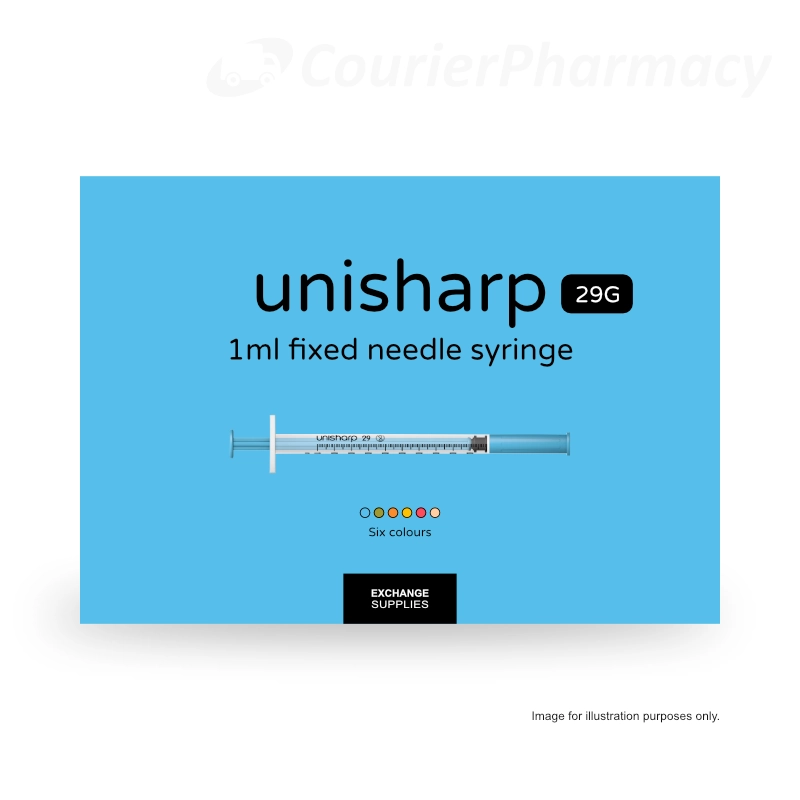
The Unisharp 29G 12mm is a 1ml clear plastic barrel syringe with a 29 gauge, 12mm hypodermic needle bonded permanently to the tip. So there is no Luer connector, no needle screw-on step, no needle to buy separately. In particular, the barrel carries clear graduations down the side (U-100 insulin scale, with 1-unit markings) which also allows measurement of millilitre volumes up to 1ml. Furthermore, the plunger runs smoothly for controlled, comfortable dose delivery.
Fixed needle vs detachable (Luer Lock)
There are two broad designs for small-volume syringes:
Fixed needle (this product): the needle is permanently bonded to the syringe tip. So there is no needle swap, lower dead space, fewer parts, and no risk of a loose connection.
Luer Lock (detachable needle): a separate needle screws onto a threaded Luer tip. So you can use a wider needle to draw up and a finer needle to inject, which suits viscous oil-based medicines.
For water-thin medicines where one needle does both jobs well, a fixed-needle syringe like this one is the simpler and often cheaper choice. However, for oil-based hormones, a Luer Lock syringe with a wider draw needle is usually preferred.
What 29 gauge and 12mm mean
Needle sizing has two parts, gauge and length:
Gauge (G): the diameter of the needle shaft. Counter-intuitively, higher gauge means a finer needle. So 29G is finer than 25G, which is finer than 21G. In particular, 29G (0.33mm) is a comfortable, low-pain gauge used for most subcutaneous injections including insulin.
Length (mm): how deep the needle enters. So 12mm is longer than a typical insulin pen needle (4mm, 5mm, 6mm, 8mm) and suits adults with average body mass who are injecting subcutaneously or giving a shallow intramuscular injection.
Furthermore, the 29G x 12mm combination is used widely for vitamin B12 injection and for small-volume water-based medicines at home.
Key features and details
Barrel volume: 1ml.
Needle: 29 gauge (0.33mm) x 12mm, permanently fixed.
Graduations: U-100 insulin scale with 1-unit marks, plus clear 0 to 1ml markings.
Connector: none (fixed needle; no Luer connection).
Needle included: YES (fixed, no separate needle to buy).
Plunger: smooth-running siliconised rubber seal.
Sterility: individually blister-packed, sterile until opened.
Regulatory: CE-marked, single-use medical device, manufactured to ISO 7886-1.
Pack sizes: 10 and 100.
Storage: at room temperature in the original box.
Disposal: use a 1-litre yellow sharps bin (available separately).
MOJO WISDOM
Take control of your health by understanding your condition and what this medication is doing for you.
READ:
More information about this treatment.
UK-based doctors and pharmacists
Discreet and Confidential
UK-based doctors and pharmacists
Free, Expert Advice
No video link provided.
No video link provided.
UK-based doctors and pharmacists
Free, expert advice
Discrete and confidential
Fast delivery
Giving you trusted clinical advice for over 40 conditions
A UK regulated pharmacy providing safe, effective treatments online since 2014
Unisharp 29G 12mm fixed-needle syringe, a simple one-piece syringe for water-thin injections
The Unisharp 29G 12mm fixed-needle syringe is a sterile, single-use, 1ml plastic syringe with a 29 gauge, 12mm needle permanently bonded on. So the needle does not come off, which keeps the device simple, lowers the risk of needle-stick during assembly, and keeps the dead space (wasted medicine) small. In particular, the fine 29 gauge needle makes injections more comfortable than wider gauges, and the 12mm length suits subcutaneous or shallow intramuscular injection in average-build adults. Furthermore, this is a common choice for vitamin B12, water-based hormone injections, and other small-volume parenteral medicines where a single needle is enough.
When to see your prescriber before using this syringe
This is a medical device, not a treatment on its own. So some situations need proper professional input before you start using a fixed-needle syringe:
If you have not been shown how to give the injection by a nurse, pharmacist, or doctor.
If you are not sure whether 29G x 12mm is the right needle choice for your medicine and injection site.
If your medicine is oil-based (testosterone in oil, oil-based oestrogen or progesterone) rather than water-based, a fixed-needle syringe may not be ideal.
If you have a bleeding disorder or are on blood-thinning medicines (warfarin, DOACs, dual antiplatelets).
If the injection site becomes red, swollen, hot, or painful (possible infection).
If you get a lump, hard patch, or dimple that does not settle at your injection sites.
If you cannot arrange safe sharps disposal.
If a child or non-consenting adult may have access to the syringes.
If you have had a needle-stick injury or an accidental self-injection with the wrong dose.
For any needle-stick injury, contact NHS 111 or occupational health. In particular, do not delay if the syringe carried a medicine that could cause harm at the wrong dose (hormones, insulin, anticoagulants).
Five key takeaways about the Unisharp 29G 12mm fixed-needle syringe
Sterile, single-use medical device with a 1ml barrel and a permanently fixed 29G 12mm needle.
The 29 gauge (0.33mm) needle is fine for comfort; the 12mm length suits subcutaneous and shallow intramuscular injection in average-build adults.
No separate needle to buy, no needle swap, lower dead space than a Luer Lock syringe.
Best for water-thin medicines (B12, water-based hormones, insulin). Oil-based medicines usually need a Luer Lock syringe with a wider draw needle instead.
Sharps disposal is the user’s responsibility, so a 1-litre yellow sharps bin (available separately) is the standard UK home option.
Choosing between a fixed-needle and a detachable-needle syringe
The right syringe for the job depends on what you are injecting. So the main decision is whether a fixed-needle syringe (like this one) or a detachable Luer Lock syringe (like the Unifix 1ml) suits your medicine and routine.
When a fixed-needle syringe (this product) is the right choice
Water-thin medicines, including insulin, vitamin B12 (hydroxocobalamin, cyanocobalamin), and water-based hormone preparations.
Small single doses where one needle does both the draw and the injection well.
Patients who want the simplest possible routine: open one package, inject, dispose.
Patients with dexterity limitations where screwing on a needle is awkward.
Doses where dead space matters (fixed-needle syringes have the lowest dead space).
When a detachable Luer Lock syringe is better
Oil-based medicines (testosterone, oestradiol valerate, progesterone in oil): need a wider draw needle than you would ever want to inject with.
Any medicine where draw-and-inject with two different needles makes sense.
Patients who prefer to pair this syringe with a specific inject needle gauge or length not available fixed.
Compounded medicines where device choice has been specified by the prescriber as Luer Lock.
Why choose Courier Pharmacy for your Unisharp 29G 12mm syringes
Registered, independent, and patient-led
Courier Pharmacy is a UK-registered independent pharmacy regulated by the General Pharmaceutical Council (GPhC 9010051). So when you order Unisharp syringes through us, you work with a proper pharmacy team, not a warehouse. Furthermore, our independence means we can spend time on injection questions where a chain would not.
Specialist prescriber expertise
Our Superintendent Pharmacist Shazlee Ahsan holds an MSc in Endocrinology and a PGDip in Infectious Diseases. So we understand self-injection within its wider clinical context, from B12 replacement to insulin to hormone therapy. In particular, we can help you decide whether 29G x 12mm is the right needle for your medicine or whether a different needle length and gauge would fit better.
Needle choice and sharps advice that goes beyond selling you a box
A self-injecting patient usually needs more than just the syringe. So we help with needle choice (fixed vs detachable, gauge, length), sharps bin sourcing, and the practical questions that come up in the first few weeks of a new injection routine. In particular, we would rather you take 5 minutes to ask than find out mid-dose that something is wrong.
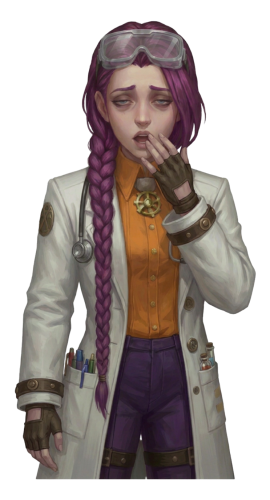
Dr Ada Jex-Cori, our brand pharmacist
Our brand pharmacist is Dr Ada Jex-Cori. She represents the spirit of what we do. Named for Ada Lovelace, Sophia Jex-Blake, and Gerty Cori, she stands for evidence-led, unafraid-of-questions medicine. Her message runs through everything we prescribe:
You’re not broken. The system is. We’re here to change that.
For self-injecting patients in particular, this matters. So many patients feel awkward asking “basic” questions about needle choice, injection sites, or sharps disposal. Furthermore, there are no basic questions in self-injection, only questions that have not yet been asked.
Care that keeps showing up
Self-injection is a long-term routine. So we are here for the follow-up questions along the way: injection site rotation, lumps that will not settle, needle anxiety, travelling with syringes, and when a change in needle size or syringe type is worth considering. In particular, if your routine is not working for you, we would rather help you troubleshoot than just send a repeat order.
Buy Unisharp 29G 12mm Fixed Needle Syringes from Courier Pharmacy
Unisharp 29G 12mm syringes are a pharmacy (P) medical device supplied at courierpharmacy.co.uk. So you can buy them without a prescription after a brief pharmacy check, which confirms the needle is right for your medicine and that you have the training and equipment (including a sharps bin) to use it safely. However, if you are not sure which needle size you need, speak to our team first.
The four steps
Add Unisharp 29G 12mm syringes to your basket and tell us what you are injecting during the pharmacy check.
Our pharmacy team reviews the sale, confirms needle choice fits your medicine, and asks about your sharps bin.
Your order dispatches promptly.
Follow the directions on the pack and your prescriber’s advice. Contact us if you have any questions.
If this syringe isn’t right for you
If our pharmacy check shows a different syringe fits your situation better, we’ll explain why and suggest the next best option. So this might mean:
Unisharp 30G 8mm or 29G 12.7mm if a different gauge or length suits your injection site and body mass better.
A Luer Lock syringe (such as the Unifix 1ml) if you need the two-needle draw-and-inject method for an oil-based medicine.
A 2ml, 3ml, 5ml, or 10ml syringe if your regular dose is more than 1ml.
A dedicated insulin pen needle if you use an insulin pen rather than vial-and-syringe.
A sharps bin if you do not already have one.
A conversation with your prescriber if you have not been formally trained in self-injection.
Above all, we won’t sell you something that isn’t right for your situation. In short, honest guidance matters more than making the sale.
Materials and components of the Unisharp 29G 12mm syringe
A syringe is a medical device, not a medicine, so it has no active pharmaceutical ingredient. However, the materials and components matter because they determine sterility, compatibility with your medicine, and how the syringe feels in use. In particular, the Unisharp 29G 12mm syringe is manufactured to ISO 7886-1 for sterile single-use hypodermic syringes.
The barrel
The barrel is made of medical-grade polypropylene. So it is transparent for clear reading of graduation marks, chemically inert for most parenteral medicines, and shatter-resistant. In particular, the U-100 insulin scale is printed in high-contrast ink, with 1-unit markings down one side and 0 to 1ml markings available for non-insulin volumes. Furthermore, the barrel includes a small finger flange at the top to brace against while the thumb drives the plunger.
The plunger
The plunger is a polyethylene or polypropylene rod with a siliconised rubber plunger seal at the tip. So the seal moves smoothly along the barrel wall without juddering. In particular, this smooth action matters for small-volume accuracy, since a juddering plunger makes it hard to stop at a precise line. Furthermore, the plunger includes a stop that prevents it from being pulled fully out of the barrel.
The fixed needle
A 29 gauge (0.33mm diameter) stainless steel hypodermic needle, 12mm long, is bonded permanently to the syringe tip at the manufacturing stage. So there is no Luer connector, no needle screw-on step, and no risk of a loose or leaking needle connection. In particular, the needle is tri-bevelled and lubricated for ease of skin entry. Furthermore, each needle comes with a plastic protective cap that stays on until the moment of use.
What the syringe does NOT contain
No latex (the syringe is latex-free).
No PVC in the barrel or plunger.
No DEHP or other phthalates.
No Luer connector (needle is fixed by design).
No active pharmaceutical ingredient; this is a sterile empty syringe.
Sterility and pack
Each Unisharp syringe is supplied sterile in an individually sealed peel-pouch and is for single use only. So the sterility expiry date is printed on the pouch and on the outer carton. In particular, if the peel-pouch is torn, opened, or shows signs of damage, discard the syringe and use a fresh one. Furthermore, do not re-sterilise or re-use.
What is the Unisharp 29G 12mm syringe for?
The Unisharp 29G 12mm fixed-needle syringe is used for self-injection of small-volume, water-thin medicines where a single needle does both the draw and the injection well. So it is used in several common home-injection situations:
Vitamin B12 (hydroxocobalamin or cyanocobalamin)
B12 injections are one of the most common home uses for this syringe. So B12 is a water-based medicine, typically 1mg in 1ml, given subcutaneously or by shallow intramuscular injection. In particular, 29G x 12mm is a comfortable, well-established choice for home B12 injections. Furthermore, our Superintendent Pharmacist has an endocrinology background and can advise on dosing frequency and the maintenance schedule if you are new to B12 injections.
Insulin from a vial
Although most insulin users now use pen devices, some patients still draw insulin from a vial. So a dedicated insulin syringe with U-100 markings (as this one carries) is the standard safe setup. However, insulin pen needles (4 to 6mm) are usually shorter than this 12mm needle and may suit lean adults better; discuss with your diabetes team if you are unsure.
Water-based hormone injections
Some water-based hormone preparations are given subcutaneously or shallow intramuscularly. So a 29G x 12mm fixed-needle syringe is a reasonable choice when the medicine is water-thin and the dose fits in 1ml. However, oil-based preparations need a Luer Lock syringe with a wider draw needle instead.
Allergen immunotherapy and other small-volume subcutaneous injections
Some immunotherapy, biologic, or specialist preparations are supplied in vials for home administration. So a 29G x 12mm fixed-needle syringe can be used where the medicine is water-based and the dose fits. However, always follow the prescriber's and manufacturer's instructions for the specific product.
Veterinary self-injection at home
Some pet owners give home injections to a pet under veterinary direction (for instance, insulin for a diabetic cat or dog). So the Unisharp 29G 12mm is a common choice here too, particularly for small animals where a fine, short needle is comfortable.
Where this syringe is not the right choice
However, some situations need a different product:
Oil-based medicines (Susatnon). Use a Luer Lock syringe with a wider draw needle instead.
Doses larger than 1ml. Use a 2ml, 3ml, 5ml, or 10ml syringe.
Medicines supplied in prefilled pens or auto-injectors (use the manufacturer's device).
Deep intramuscular injection in larger adults, where a longer needle (25mm or 38mm) is often needed.
Patients who have not been trained in self-injection technique.
How does the Unisharp 29G 12mm syringe work?
A syringe works on the basic physics of a piston inside a cylinder. So pulling the plunger back creates a partial vacuum inside the barrel, drawing fluid in through the fixed needle. In particular, pushing the plunger forward displaces the fluid out through the needle tip at a rate the user controls. Furthermore, the fixed-needle design keeps this straightforward principle simple, since there is no needle connection to leak and no needle to swap.
Pressure, vacuum, and fluid displacement
When you pull the plunger back, the volume inside the barrel increases while the fluid in the vial is at atmospheric pressure. So the pressure difference pushes fluid up the needle and into the barrel until pressures equalise. In particular, injecting a small volume of air into the vial first (equal to the dose you want to draw) raises vial pressure and makes drawing easier. Furthermore, when you push the plunger forward during injection, you overcome the slight back-pressure of the tissue so fluid flows out of the needle tip.
Low dead space
Dead space is the small volume of fluid that stays trapped in the needle and tip after you push the plunger all the way down. So fixed-needle syringes have the lowest dead space of any syringe design because the needle is bonded directly to the tip with no connector volume in between. In particular, this matters for small doses, where dead space is a significant fraction of the dose. Furthermore, low dead space also means less wasted medicine over time.
Why 29G makes injections more comfortable
The gauge of a needle is the main driver of injection pain. So a finer needle (higher gauge number) causes less skin damage and less nerve-ending stimulation on entry. In particular, 29G (0.33mm) is one of the finest needle gauges used for standard subcutaneous and intramuscular injection, and the difference in pain between 29G and 25G is noticeable to most patients. Furthermore, tri-bevelled sharpening of the needle tip reduces resistance further.
Why 12mm length matters
Needle length determines how deep the medicine is deposited. So 12mm reaches subcutaneous tissue reliably in average-build adults and can give a shallow intramuscular injection in the thigh or deltoid in leaner individuals. In particular, if you have very low or very high body mass, discuss needle length with your prescriber: lean adults may do better with 6 to 8mm, larger adults with 25mm for IM. Furthermore, injection site (abdomen, thigh, deltoid) also affects which length is right.
Reading the dose accurately
The barrel is marked with the U-100 insulin scale (1-unit marks) and 0 to 1ml volume markings. So read the dose from the leading edge of the black rubber plunger seal, not the trailing edge or the rubber dome. In particular, holding the syringe vertically at eye level during the dose read removes parallax error that can throw a reading off. Furthermore, if you are drawing a non-insulin volume (such as a B12 dose), use the millilitre markings rather than the insulin unit markings.
Single use, by design
Each Unisharp syringe is designed, sterilised, and labelled for single use only. So re-using a syringe risks contamination, needle-stick injury, and dulling of the needle tip (which makes the next injection noticeably more painful). In particular, the siliconised plunger loses lubricity after one use, so a re-used syringe no longer gives smooth plunger action. Furthermore, UK sharps regulations treat used syringes as clinical waste that must go directly into a sharps bin.
How to use the Unisharp 29G 12mm syringe safely
Before you start
Wash your hands with soap and water.
Gather your medicine vial, one Unisharp syringe, alcohol swabs, cotton wool, and your sharps bin.
Check the medicine label matches your prescription, and the expiry date is in date.
Check the syringe peel-pouch is sealed and in date.
Drawing the dose
Remove the needle cap and set it aside.
Pull the plunger back to draw up a volume of air equal to your intended dose.
Insert the needle through the vial stopper and push the air in; this makes drawing easier.
Turn the vial upside down and withdraw the plunger to your dose mark on the barrel.
Tap the barrel gently to float any air bubbles up to the needle hub, and push them back into the vial.
Adjust the plunger to the correct dose mark (read from the leading edge of the plunger seal).
Withdraw the needle from the vial.
Giving the injection
Clean the injection site with an alcohol swab and let it dry.
Pinch a fold of skin (for subcutaneous) or stretch the skin flat (for intramuscular), per your training.
Insert the needle at the angle you were taught (90 degrees for most, 45 degrees for some SC in lean adults).
Push the plunger slowly and smoothly.
Withdraw the needle at the same angle you went in.
Apply gentle pressure with cotton wool; do not rub.
Place the used syringe straight into your sharps bin.
Rotate injection sites
Rotate between sites (abdomen, outer thigh, upper outer arm, upper outer buttock) and between left and right. So this reduces the risk of lipohypertrophy (lumpy fatty tissue that can distort absorption). In particular, aim to stay 2cm away from your previous injection site each time.
Sharps disposal, in plain English
Every used Unisharp syringe is clinical sharps waste and must go into a UK-standard sharps bin (yellow, with a British Standard conformity mark). So this is not optional, it is a legal and safety requirement. Furthermore, we sell 1-litre sharps bins alongside our syringes.
Which bin
A 1-litre yellow sharps bin with an orange or yellow lid is standard for home use.
The bin must meet the UN3291 standard for clinical waste transport.
How to fill and close
Drop the used syringe in needle-first; do not try to re-cap the needle (needle-stick injury risk).
Fill the bin only to the "fill line" (usually three-quarters full).
Close the lid firmly and permanently when the bin reaches the line.
Keep the bin out of reach of children and pets.
How to arrange collection
In most of England, your local council collects full sharps bins for free on request. So search your council's website for "clinical waste collection" or "sharps bin collection", or call them directly. In particular, some areas use a specific supplier (such as Veolia or Grundon) that the council arranges. Furthermore, never put used sharps in household rubbish or recycling, and never put them in a glass bottle or drinks can.
Warnings and precautions
Needle-stick injury
A needle-stick injury is a sharps injury where a used needle enters your skin or someone else's skin accidentally. So this carries risk of medicine exposure at the wrong dose and (less commonly for home use) infection risk. In particular, if you have a needle-stick injury, wash the area with soap and water, encourage it to bleed, and contact NHS 111 or occupational health for advice. Furthermore, do not re-cap used needles, since re-capping is the most common cause of needle-stick injury.
Infection risk
Every injection breaks the skin barrier. So good hand hygiene, skin cleaning with an alcohol swab, and never re-using a syringe are the three practical defences. In particular, contact your prescriber if an injection site becomes red, swollen, hot, painful, or discharging. Furthermore, this is more important in immunosuppressed patients.
Lumps and lipohypertrophy
Injecting repeatedly into the same spot can cause lipohypertrophy, a lumpy fatty area that absorbs medicine unpredictably. So this is why injection site rotation matters. In particular, if you notice a lump that does not settle within 2 weeks, show it to your prescriber.
Children
Keep syringes and sharps bins out of reach of children. So this is particularly important in shared households. In particular, store syringes and the sharps bin in a locked box if any risk exists.
Travel with syringes
When travelling with syringes, carry a prescription or doctor's letter explaining why you have them. So most airports allow syringes in carry-on when accompanied by the medicine and a letter. Furthermore, pack a travel sharps container for the trip.
Common injection reactions
Most injections pass without any noticeable reaction. However, some are worth knowing about:
Common and usually mild
A small bruise at the injection site.
A tiny spot of blood when the needle comes out.
A brief sting on injection.
Mild redness or warmth that settles within a few hours.
Managing common reactions
Bruise: apply light pressure for 30 seconds after injecting; it usually fades within 3 to 5 days.
Bleeding spot: cotton wool with gentle pressure; do not rub.
Sting: usually brief; letting the alcohol swab fully dry before injecting helps.
Redness/warmth: usually settles; contact your prescriber if it spreads or persists over 24 hours.
Less common
Transient dizziness (particularly in needle-phobic patients).
A lump that persists more than 2 weeks at the injection site.
A rash around the injection site (possible medicine or alcohol swab reaction).
When to seek urgent help
Contact your GP if you develop signs of an injection site infection, an allergic reaction to your medicine, or an unexpected change in how your medicine is working. So for life-threatening symptoms, call 999.
Yellow Card scheme: report any suspected medical device problems via https://yellowcard.mhra.gov.uk or the Yellow Card app. Reporting helps make devices safer for everyone.
Drug and medicine compatibility with the Unisharp syringe
A syringe is a device, not a medicine, so it does not have drug interactions in the usual sense. However, the right syringe for the job depends on what you are injecting, and some medicine-and-syringe pairings matter more than others. So if you are unsure whether the Unisharp 29G 12mm is the right fit for your specific medicine, check with your pharmacist before you order. In particular, our team can confirm compatibility against the medicine's SmPC or the device requirements set out by your prescriber.
What determines whether this syringe suits your medicine
The route of injection (subcutaneous, intramuscular) and the volume per dose.
The viscosity of the medicine (29G needles are too fine for most oil-based preparations).
Any specific device guidance from your prescriber or from the medicine's SmPC.
Whether a draw-and-inject needle swap is actually needed (if yes, use a Luer Lock syringe instead).
Patient-specific factors like body mass, injection site, and dexterity.
Medicines commonly used with this syringe
The Unisharp 29G 12mm is widely used for water-thin, small-volume parenteral medicines where a single needle does both jobs well. So typical pairings include:
Insulin drawn from a vial (U-100 scale is already on the barrel).
Water-based hormone preparations (the exception is testosterone cypionate)
Allergen immunotherapy at home where water-based.
When this syringe is not the right choice
Some medicines come with their own device or require a different syringe type. So the Unisharp 29G 12mm is not the right choice for:
Oil-based TRT (Sustanon), oil-based oestrogen or progesterone (29G is too fine for oil draw-up, and there is no needle swap).
Insulin that is already supplied in a prefilled pen (use the pen).
GLP-1 analogues (semaglutide, liraglutide, tirzepatide, dulaglutide) where the licensed product is a prefilled pen.
Doses larger than 1ml (use a 2ml or 3ml syringe).
Deep intramuscular injection in larger adults (12mm may not reach muscle; a 25mm or 38mm needle fits better).
Medicines where the SmPC specifies a silicone-free, latex-free, or polycarbonate-free syringe.
Materials, latex, and silicone
The Unisharp 29G 12mm is a standard polypropylene barrel with a siliconised plunger seal and a stainless steel needle. So this is the standard material set for most parenteral medicines. However, a few medicines (notably certain monoclonal antibodies and some compounded sterile preparations) have specific stability concerns with siliconised syringes if drawn up and stored for prolonged periods. In particular, draw up and inject promptly rather than storing the drawn-up syringe. Furthermore, the Unisharp is latex-free, so it is suitable for patients with latex allergy.
Check with your pharmacist if unsure
If you are not sure whether the Unisharp 29G 12mm syringe is right for the medicine you are injecting, speak to your pharmacist before you order. So this is particularly important for compounded medicines, specials, or medicines prescribed off-label where device guidance may differ from the licensed product. In particular, our team at Courier Pharmacy can check the SmPC and your prescriber's instructions to confirm the right syringe for your situation.
Frequently asked questions about Unisharp 29G 12mm syringes
What does 29G mean?
29G is the needle gauge, which describes the diameter of the needle shaft. So 29G is 0.33mm diameter, a fine gauge used for comfortable subcutaneous and intramuscular injections. In particular, higher gauge numbers mean finer needles, which is counter-intuitive but standard across the industry.
What does 12mm mean?
12mm is the length of the needle from the hub to the tip. So the needle enters the skin to this depth. In particular, 12mm suits subcutaneous and shallow intramuscular injection in average-build adults.
Is the needle already attached?
Yes. The 29G x 12mm needle is permanently bonded to the syringe at the manufacturing stage. So you do not need to screw on a separate needle, and you cannot remove it.
Can I use this for insulin?
Yes, this syringe has the U-100 insulin scale on the barrel. So it is compatible with U-100 insulin from a vial. However, if you use insulin from a pen device, use the pen needles instead.
Can I use this for B12 injections?
Yes, this syringe is a very common choice for home B12 (hydroxocobalamin or cyanocobalamin) injections. So the 29G x 12mm size is comfortable and suits subcutaneous or shallow intramuscular B12 injection in average-build adults.
Can I use this for testosterone injections?
For oil-based testosterone (enanthate, cypionate, propionate, Sustanon, Nebido), this syringe is not usually the right choice. So the 29G needle is too fine for drawing up viscous oil, and there is no needle swap option. In particular, a Unifix 1ml Luer Lock syringe with a wider draw needle fits oil-based TRT better.
What's the difference between a Unisharp syringe and a Unifix syringe?
Unisharp syringes have a permanently fixed needle. So you cannot swap needles between draw and inject. In contrast, Unifix syringes have a detachable Luer Lock connector where any standard needle can be screwed on. Furthermore, Unisharp is simpler for water-based medicines; Unifix is better for oil-based medicines that need a two-needle workflow.
Does the needle hurt?
29G is one of the finer needle gauges used in standard injections. So most patients report minimal discomfort, especially compared with wider gauges. In particular, letting the alcohol swab fully dry before injecting (so it does not sting on entry) makes a noticeable difference.
Can I reuse a Unisharp syringe?
No. Each syringe is designed and sterilised for single use only. So reusing a syringe risks contamination, needle-stick injury, and increased pain from a dulled needle. In particular, the plunger silicone loses lubricity after one use.
How do I dispose of used syringes?
Use a 1-litre yellow sharps bin. So drop the used syringe straight in needle-first after each injection. When the bin is three-quarters full, seal it and arrange collection. In many parts of England, your local council collects full sharps bins for free.
Where can I get a sharps bin?
You can buy a 1-litre sharps bin from our website alongside your syringes. Furthermore, GP surgeries and pharmacies may provide sharps bins on prescription for some patients.
Can I use this syringe if the blister is damaged?
No. If the blister is torn, opened, or damaged, discard the syringe. So sterility is not guaranteed once the pack is compromised.
Can I use this syringe past the expiry date?
No. Do not use after the expiry date printed on the box. So sterility is not guaranteed beyond that date.
What if I get a needle-stick injury?
Wash the area with soap and water, encourage the site to bleed, and contact NHS 111 or occupational health for advice. So urgent review matters if the needle carried a medicine that could cause harm at the wrong dose.
How should I store these syringes?
Store at room temperature in the original box, out of direct sunlight. So keep them out of reach of children. In particular, keep them away from damp environments where the sterile pack could degrade.
Can I use this syringe for intramuscular injection?
For average-build adults, 12mm reaches muscle in the thigh or deltoid as a shallow intramuscular injection. However, larger adults may need a longer needle (25mm or 38mm) to reach muscle reliably. So discuss needle length with your prescriber if you are not sure.
Can I use this for subcutaneous injection in the abdomen?
Yes, 12mm works well for subcutaneous abdominal injection in most adults. So pinch a fold of skin and inject at 90 degrees. In particular, lean adults may prefer a shorter needle (6 to 8mm) to avoid risk of intramuscular rather than subcutaneous injection.
Can I travel with these syringes?
Yes, but carry a prescription or doctor's letter explaining why you have them. So most airports allow syringes in carry-on when accompanied by the medicine and a letter. Furthermore, pack a small travel sharps container.
What if the plunger feels stiff?
A new Unisharp plunger should run smoothly. So if the plunger feels stiff from the start, discard that syringe and use a fresh one. In particular, a stiff plunger usually indicates a damaged seal or compromised pack.
Disclaimer
Disclaimer: This information is for education only and isn't a substitute for personal medical advice. Always follow your prescriber's instructions.
National Institute for Health and Care Excellence (2012, updated 2017). Healthcare-associated infections: prevention and control in primary and community care. NICE clinical guideline CG139. Available at: https://www.nice.org.uk/guidance/cg139
International Organization for Standardization (2017). ISO 7886-1:2017 Sterile hypodermic syringes for single use, Part 1: Syringes for manual use. Available at: https://www.iso.org/standard/70907.html
International Organization for Standardization (2021). ISO 80369-7:2021 Small-bore connectors for liquids and gases in healthcare applications, Part 7: Connectors for intravascular or hypodermic applications. Available at: https://www.iso.org/standard/79173.html