
Sober October has a better record than most health resolutions, and the research backs that up. A month without alcohol improves sleep, mood, blood pressure and liver markers, and people are still drinking less six months later.
However, the catch is the bit nobody puts on the poster. Plenty of people complete the month, feel genuinely better, and are back where they started by December.
So this guide covers what makes the month stick rather than simply pass, the safety check that has to come first, and what to consider if abstinence months have never quite worked for you.
Please read this first if you get shakes, sweats or bad anxiety in the morning, or you drink to steady yourself, do not stop suddenly. Abrupt withdrawal from heavy drinking can cause seizures and can be dangerous. Speak to your GP or alcohol service before you start.
Five Key Takeaways
- The evidence is genuinely good. Studies covering over 150,000 people link a dry month to better sleep, mood, weight, blood pressure and liver function.
- Benefits persist beyond the month. One study found participants still reporting an extra dry day each week the following August.
- Success is predictable. How often you got drunk in the previous month predicts completion better than motivation does.
- Stopping suddenly is not safe for everyone. Physical dependence needs supervised withdrawal, not a challenge.
- A dry month and the Sinclair Method answer different questions. One tests whether you can stop. The other aims to reduce drinking permanently, and it needs you to keep drinking.
Why Sober October Works
Macmillan Cancer Support launched Go Sober for October in 2014 as a fundraiser. It grew into something larger, and researchers have since studied the format closely.
A review from Brown University pulled together sixteen studies covering more than 150,000 participants. People who completed a dry month reported better sleep, improved mood, weight loss, healthier liver function and lower blood pressure, along with better concentration.
Meanwhile, a separate trial published in BMJ Open found that a single alcohol-free month improved insulin resistance, weight, blood pressure and cancer-related growth factors in moderate to heavy drinkers.
The more interesting finding, though, concerns what happens afterwards. Research from the University of Sussex followed participants and found that by the following August they were reporting roughly one extra dry day per week. Those improvements appeared regardless of whether people completed the month perfectly.
That last point deserves emphasis. Slipping up does not waste the attempt.
Sober October is linked to better sleep, mood, weight, blood pressure and liver function. Research suggests benefits persist, with participants drinking less months later even if they did not complete the month perfectly.

The Sober October Safety Check
This section matters more than anything else here, and most Sober October articles skip it entirely.
For most people, stopping drinking for a month is straightforward and safe. However, for a smaller group it is neither, and abrupt withdrawal can be genuinely dangerous.
Do not stop suddenly if you experience shakes, sweating, nausea or bad anxiety in the mornings, drink first thing to steady yourself, have had withdrawal symptoms before, or drink heavily every day.
In physically dependent people, alcohol withdrawal can cause seizures and, rarely, a life-threatening condition called delirium tremens. It needs medical supervision, and it is entirely treatable when planned properly.
So speak to your GP or your local alcohol service. NHS alcohol services are free, self-referral is usually possible, and they can arrange a safe reduction rather than a sudden stop.
Pharmacist’s tip needing supervision is not a reason to abandon the idea. It is a reason to do it properly, and the outcome is generally better than going it alone.
What Predicts Sober October Success
Here is where the research becomes practically useful, because success is more predictable than most people assume.
How often you got drunk beforehand matters most. Studies found that completion was best predicted by a lower frequency of drunkenness in the month before starting, rather than by motivation or intention.
Then what you expect from alcohol matters too. People with stronger positive expectations about drinking were less likely to complete the month.
Finally, registering formally helps. People who signed up to the campaign and used its tools did better than those who simply decided privately.
None of that is a reason not to try. It does suggest that if you drink heavily most days, a straight month of abstinence is a bigger ask than the campaign implies, and it may be worth planning support rather than relying on willpower.
How to Make Sober October Stick
In practice, the difference between a month that passes and one that changes something comes down to a few things.
- Sign up properly. Macmillan’s campaign and Alcohol Change UK both provide structure, and the evidence suggests formal participation improves completion.
- Tell people. Social accountability does real work, and it removes the awkward explaining at every occasion.
- Plan the hard occasions in advance. Work drinks, a birthday, a wedding. Decide what you will hold, and what you will say, before you arrive.
- Track it. The NHS Drink Free Days app is free. So is a note on your phone. Either beats memory.
- Replace the ritual, not just the drink. Most people are not missing alcohol at six o’clock. They are missing the marker between work and the evening. Something has to occupy that space.
- Above all, expect week two to be the hardest. Novelty has worn off and the benefits have not arrived yet.
- Notice what you actually gain. Sleep, money, mornings. People who register what improved are more likely to keep some of it.
- Decide what happens on 1 November before you get there. This is the step almost everyone skips, and it is the one that determines whether October was a reset or a pause.
What Happens Across a Sober October
This is a rough guide rather than a schedule, since people differ considerably.
Days 1 to 3. Sleep often worsens before it improves, which surprises people. Alcohol sedates rather than helping genuine sleep, and your brain takes a few nights to readjust.
Week 1. Sleep quality improves. Many people notice mornings feel different first.
Week 2. Frequently the hardest stretch socially. The novelty has gone and the payoff still feels abstract.
Weeks 3 to 4. Mood, concentration and energy tend to lift. Liver markers improve, blood pressure often falls, and some people lose weight.
End of month. The most useful moment of the whole exercise, because you now have information you did not have in September about what alcohol was doing for you and to you.

The November Question
Most people do not rebound, and the evidence here is more reassuring than the headlines suggest.
Research following Dry January participants found very few reported increased drinking afterwards, and most were drinking less six months later. So the fear of a compensatory blowout is largely unfounded.
However, there is a real exception. The Brown review noted that a small number of people who were unable to complete the month reported drinking more afterwards.
So that points to something worth naming. If you have done several dry months and returned to your previous level each time, the month is not changing the underlying habit. It is demonstrating that you can stop, which is genuinely useful information, without altering what happens when you start again.
That is a different problem, and it needs a different answer.
Where the Sinclair Method Fits After Sober October
This is where honesty matters more than a neat sales pitch.
The Sinclair Method is not a way to do Sober October. It is close to the opposite.
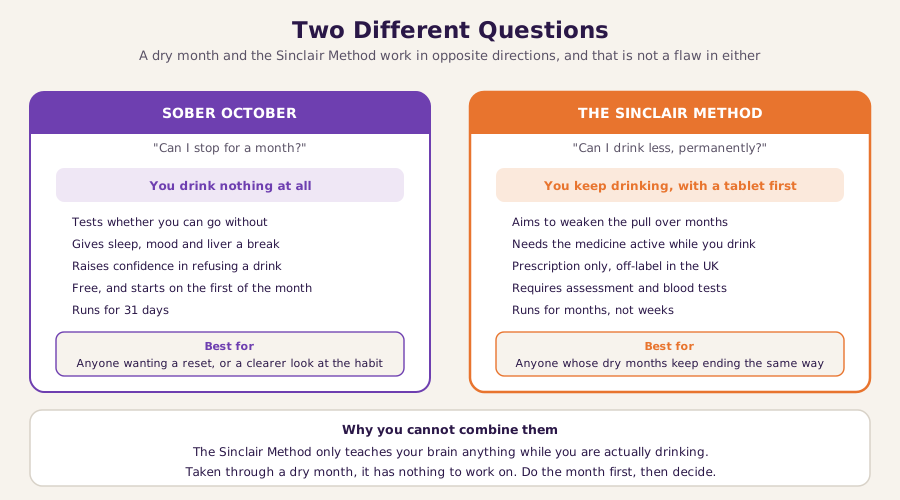
In short, the approach uses naltrexone taken an hour or two before drinking. Alcohol normally releases endorphins that deliver a reward signal, teaching your brain that drinking was worth repeating. Naltrexone blocks that signal, so drinking repeatedly without the reward gradually weakens the craving.
Crucially, though, this only works while you are drinking. Extinction weakens a response that is actually made, so a tablet taken through a dry month has nothing to act on.
Sinclair’s own animal work found that opioid blockers given during abstinence did not reduce later drinking, and in some cases the animals drank more afterwards. Three controlled trials in people found the same pattern: naltrexone helped where participants kept drinking, and did not help where abstinence was enforced.
So the two answer different questions. Sober October asks whether you can stop for a month. The Sinclair Method asks whether you can drink less permanently.
Our guide to how the Sinclair Method works explains the mechanism, and our evidence review looks honestly at what the trials show.
If You Have Done This Before
Meanwhile, some questions are worth sitting with at the end of the month.
Did stopping feel harder than expected?
That is information, not failure.
Did you return to exactly where you were?
If that has happened more than once, willpower is probably not the missing ingredient.
Was your goal actually to stop, or to drink less?
Those need different approaches, and plenty of people default to abstinence challenges because they are the only option anyone advertises.
Are you drinking to manage something?
Stress, sleep or low mood all deserve attention in their own right.
So if reduction rather than abstinence is what you want, that is a legitimate goal with legitimate treatments behind it. Speak to your GP, contact your local NHS alcohol service, which is free and usually accepts self-referral, or arrange a private assessment.
Courier Pharmacy offers clinician-led appointments for people considering a structured approach, including targeted naltrexone where a prescriber decides it is appropriate.
Summary
Sober October works better than its reputation as a novelty suggests. The evidence links it to improved sleep, mood, weight, blood pressure and liver function, with benefits persisting months later even for people who did not complete it perfectly.
Meanwhile, making it stick comes down to practical things: formal sign-up, telling people, planning the difficult occasions, replacing the ritual rather than just the drink, and deciding what happens on 1 November before you arrive there.
The safety point comes first, though. Anyone with morning shakes or who drinks to steady themselves should not stop suddenly, and needs medical support to do it safely.
And if dry months have never quite changed anything, that is worth taking seriously rather than repeating. Reduction and abstinence are different goals, and the Sinclair Method addresses the first by working in a way a dry month cannot.
FAQs
Does Sober October actually work?
The evidence is reasonably strong. Reviews covering over 150,000 people report better sleep, mood, weight, blood pressure and liver function, with benefits lasting months.
Is it safe to stop drinking suddenly?
For most people yes. Anyone with morning shakes, sweats or who drinks to steady themselves needs medical supervision, since abrupt withdrawal can cause seizures.
Will I drink more in November?
Most people do not. Research found very few reported increased drinking afterwards, though a small number who could not complete the month did.
What if I slip up mid-month?
Carry on. Studies found benefits at six months regardless of whether people completed the month perfectly.
Can I take naltrexone during Sober October?
The Sinclair Method needs you to be drinking, so it does not fit a dry month. Daily naltrexone is used differently, after a supported withdrawal, and that is a decision for a prescriber.
Why does my sleep get worse at first?
Alcohol sedates rather than producing normal sleep. Your brain takes a few nights to readjust, after which sleep quality usually improves.
I have done dry months before and nothing changed. What now?
That suggests the month is not altering the underlying habit. Reduction-focused approaches, including targeted naltrexone, address a different problem.
Where can I get free support?
NHS alcohol services are free and usually accept self-referral. Drinkline is available on 0300 123 1110.

Disclaimer
This article is for information only. If you are worried about your drinking, please speak to your GP, your local alcohol service, or Drinkline on 0300 123 1110.
References
- Courier Pharmacy (2026) The Sinclair Method: blocking endorphin-driven reward. Courier Pharmacy. Available at: https://courierpharmacy.co.uk/the-sinclair-method-blocking-endorphin-driven-reward/ (Accessed: 2 September 2026).
- de Visser, R.O., Robinson, E. and Bond, R. (2016) ‘Voluntary temporary abstinence from alcohol during “Dry January” and subsequent alcohol use’, Health Psychology, 35(3), pp. 281-289. doi: 10.1037/hea0000297.
- Mehta, G., Macdonald, S., Cronberg, A., Rosselli, M., Khera-Butler, T., Sumpter, C. et al. (2018) ‘Short-term abstinence from alcohol and changes in cardiovascular risk factors, liver function tests and cancer-related growth factors’, BMJ Open, 8(5), e020673. doi: 10.1136/bmjopen-2017-020673.
- National Health Service (2026) Drink Free Days. Available at: nhs.uk (Accessed: 2 September 2026).
- National Institute for Health and Care Excellence (2011) Alcohol-use disorders: diagnosis, assessment and management of harmful drinking (high-risk drinking) and alcohol dependence. NICE guideline CG115. Available at: nice.org.uk/guidance/cg115 (Accessed: 2 September 2026).
- Sinclair, J.D. (2001) ‘Evidence about the use of naltrexone and for different ways of using it in the treatment of alcoholism’, Alcohol and Alcoholism, 36(1), pp. 2-10. doi: 10.1093/alcalc/36.1.2.