



What you should know about multiple sclerosis
MS is a lifelong autoimmune condition affecting the brain and spinal cord. As the NHS explains, the immune system attacks myelin, the protective coating around nerves, which disrupts the signals between the brain and body. This causes symptoms like fatigue, vision problems, altered sensation, and difficulties with movement. It affects everyone differently, and it’s usually diagnosed in younger adults.
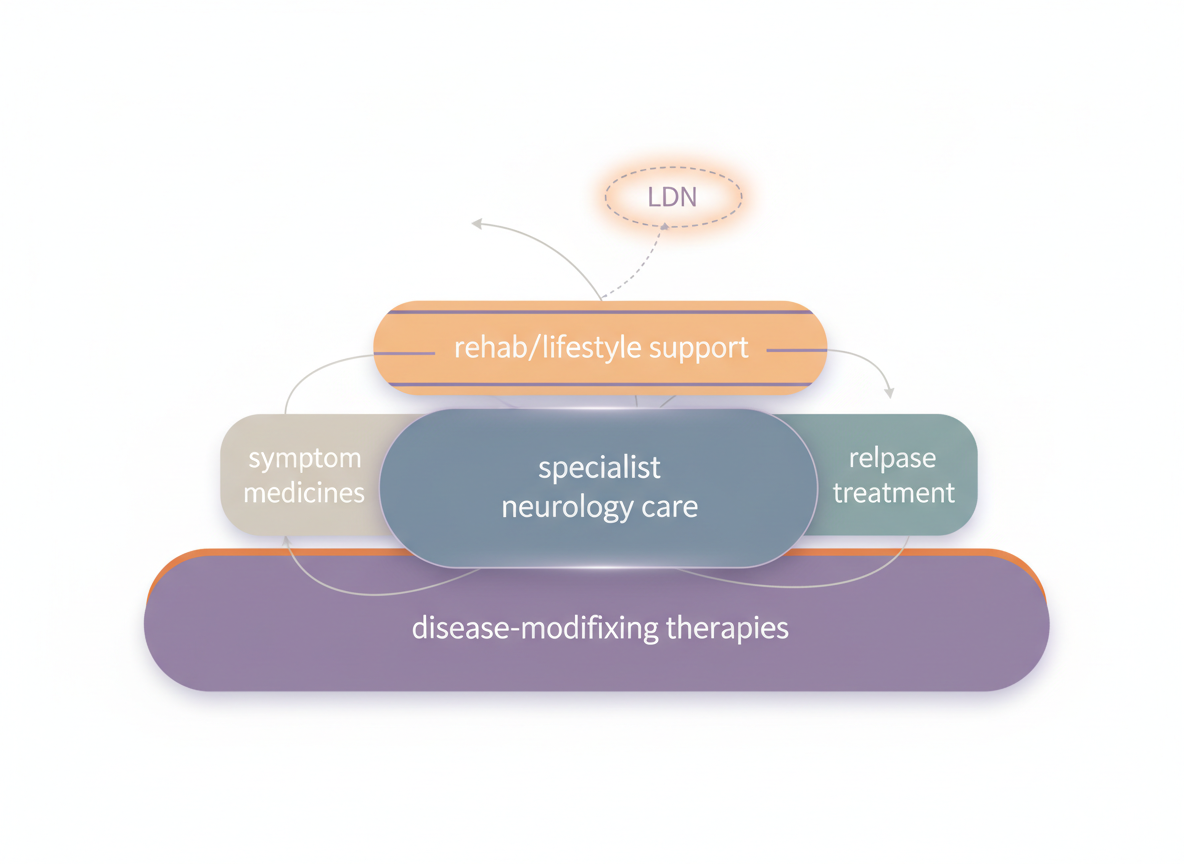
Specialist care and disease-modifying therapies. As the MS Society describes, there are around twenty disease-modifying therapies on the NHS, prescribed by neurology teams, which reduce relapses and slow the build-up of disability in relapsing MS. Alongside these, relapses can be treated with steroids, and a wide range of treatments help manage individual symptoms. This specialist care is the foundation of managing MS well.
Not in the way people sometimes hope. LDN is not a disease-modifying therapy, and as the MS Society notes, there’s no evidence it reduces disability or slows MS progression. A few small studies have suggested possible improvements in some quality of life measures for some people, but the evidence is limited and mixed. LDN is best understood as an option some explore for symptoms and wellbeing, alongside proper specialist care, not as a treatment for MS itself.
LDN uses a low dose of naltrexone, usually about 1.5mg to 4.5mg at night, far lower than the 50mg used for addiction. As the research literature describes, it’s thought to cause a rebound rise in the body’s endorphins and to have anti-inflammatory and immune modulating effects. Because these strengths aren’t available off the shelf, LDN is compounded to order, for us by APC Labs.
LDN is usually well tolerated, with mild side effects like vivid dreams or sleep disturbance early on. The most important safety point is that it must not be taken with opioid painkillers, as it blocks them and can trigger withdrawal, which matters in MS where opioids are sometimes used for pain. It also needs caution in liver disease. This is why it’s prescriber-assessed and coordinated with your wider care.
No. This is really important. LDN is not a replacement for your disease-modifying treatment or your specialist care. As the evidence stands, DMTs are what reduce relapses and slow MS, and the LDN research is still growing. If you choose to explore LDN, it should be alongside your prescribed treatment and your neurology team, never instead of them. We’d always encourage you to keep your MS team informed.
We don’t diagnose MS, which needs a neurologist, and we don’t replace your specialist MS care. What we can do is offer honest guidance, support you alongside your neurology team, and, where appropriate and safe, provide low dose naltrexone as an option to explore for symptoms and wellbeing. We’re clear about what it can and can’t do, and we work with your wider care, not around it.
We offer honest, evidence-based information, a prescriber consultation for low dose naltrexone where it’s appropriate for you, and blood tests and monitoring to support safe treatment, all alongside your GP and neurology team. We’ll never oversell LDN or suggest it replaces specialist care. It starts with a consultation or a chat with a pharmacist.
Additional information
Multiple sclerosis
Multiple sclerosis, or MS, is a lifelong condition where the immune system attacks the protective coating around your nerves, disrupting the messages between your brain and body. It affects everyone differently, and living with it can be unpredictable and exhausting. At Courier Pharmacy, we believe healthcare should fit the person, not force the person to fit the system. So we work alongside your neurology team, never instead of them, offering honest guidance and, where it’s right for you, low dose naltrexone as one option some people explore for symptoms and wellbeing. Healthcare that fits you, and your life with MS. Living with MS and looking at every option? We’re here to help, honestly.

Five key takeaways
- MS is an autoimmune condition of the nervous system. As the NHS describes, the immune system damages the coating around nerves.
- Specialist care is essential. Disease-modifying therapies, prescribed by neurology, are the mainstay of treatment.
- Symptoms can be managed. Fatigue, spasticity, bladder problems, and more all have dedicated treatments.
- Low dose naltrexone is an option some explore. As the MS Society notes, the evidence is limited, and it isn’t a disease-modifying therapy.
- LDN sits alongside your MS care. It never replaces your neurologist or your disease-modifying treatment.
How Courier Pharmacy helps
- Honest, personalised guidance on living with MS and your options
- Low dose naltrexone via a prescriber consultation, where it’s appropriate for you
- A clear, evidence-based explanation of what LDN can and can’t do
- Support that works alongside your GP and neurology team, never instead of them
MS needs specialist care. We complement that care, we don’t replace it, and we’ll always encourage you to stay under your neurology team.
What you should know about MS treatment
Good care for MS follows a clear, sensible path. First, stay under specialist neurology care, because MS needs expert assessment and monitoring. Second, use disease-modifying therapies where appropriate, as these are the mainstay for altering the course of the condition. Third, treat symptoms actively, since much can be done for fatigue, spasticity, and more. Fourth, consider additional options like low dose naltrexone honestly, understanding the evidence, and always alongside your specialist care.
This is the approach the NHS and NICE take, and the one we support at Courier Pharmacy. As NICE guidance describes, MS care involves a specialist team, disease-modifying treatment, and coordinated symptom management. The goal isn’t a single cure. It’s slowing the condition where possible, easing symptoms, and helping you live as fully as you can.
Multiple sclerosis overview
Multiple sclerosis is a condition that affects the brain and spinal cord, causing a wide range of possible symptoms. As the NHS explains, it’s a lifelong condition that can sometimes cause serious disability, though it’s often milder than people fear, and treatments have improved enormously.
The impact is deeply personal and often invisible. MS can bring fatigue, problems with movement, sensation, vision, and thinking, and it can be unpredictable, which is its own particular challenge. As the MS community describes, the uncertainty can be as hard as the symptoms themselves. None of that is something you should face without support.
The encouraging truth is that MS is more treatable than ever. As the MS Society describes, there are now around twenty disease-modifying therapies available on the NHS, alongside effective treatments for symptoms and a growing understanding of the condition. A diagnosis today looks very different from one a generation ago.
Why does this matter? Because MS is serious but manageable, and the landscape is genuinely hopeful. Understanding your condition, staying under specialist care, and knowing your options, including where something like low dose naltrexone might fit, helps you take an active part in your own care.
What is multiple sclerosis?
Multiple sclerosis is an autoimmune condition, meaning the immune system mistakenly attacks part of the body. As the NHS explains, in MS it attacks the myelin, the protective sheath that surrounds nerve fibres in the brain and spinal cord, which disrupts the electrical signals that travel along them.
Common symptoms include:
- Fatigue, often overwhelming and one of the most common symptoms
- Problems with vision, such as blurring or eye pain
- Numbness, tingling, or altered sensation
- Muscle stiffness, spasms, and weakness
- Problems with balance and walking
- Bladder and bowel difficulties
- Problems with memory, concentration, and thinking
As the NHS notes, MS affects everyone differently, and few people experience all of these. Symptoms may come and go, or gradually build, depending on the type of MS.

Types of multiple sclerosis
MS behaves differently in different people, and it’s grouped into types. As the NHS and MS charities describe:
- Relapsing-remitting MS is the most common form, where symptoms flare up in relapses, then partly or fully settle in periods of remission.
- Secondary progressive MS can develop later in some people with relapsing-remitting MS, where symptoms gradually worsen over time.
- Primary progressive MS is where symptoms gradually worsen from the outset, without distinct relapses.
Knowing your type matters, because it guides which treatments, including disease-modifying therapies, are likely to help.
How common is multiple sclerosis?
MS is one of the most common neurological conditions affecting younger adults. As the MS Society reports, more than 130,000 people live with MS in the UK, and it’s most often diagnosed in people in their twenties, thirties, and forties.
It’s around two to three times more common in women than men, and more common further from the equator, which is part of what points to environmental factors in its cause. If you’ve been diagnosed, you are far from alone, and there’s a large, active community and a strong evidence base behind your care.
What causes multiple sclerosis?
The exact cause isn’t fully known, but it’s understood to involve a mix of factors. The NHS and research literature describe the main ones.
An autoimmune process
At its core, MS is driven by the immune system attacking myelin. Why this happens isn’t fully understood, but it’s the central mechanism, and it’s what disease-modifying therapies aim to calm.
Genetics
MS isn’t directly inherited, but genetics play a part. Having a close relative with MS slightly increases your risk, suggesting a genetic susceptibility that interacts with other factors.
Environmental factors
Several environmental factors are linked to MS risk, including low vitamin D and less sunlight exposure, smoking, and having had certain viral infections. As the research literature describes, infection with the Epstein-Barr virus in particular is now strongly associated with MS.
A combination
Most researchers believe MS develops when someone with a genetic susceptibility meets environmental triggers. It’s no one’s fault, and nothing you did caused it.
What happens in the body with MS?
Your nerves carry electrical signals, and myelin is the insulating layer that lets those signals travel quickly and cleanly, much like the coating on an electrical wire. As the NHS explains, in MS the immune system damages this myelin, in a process called demyelination.
Where myelin is damaged, patches of scarring, called lesions or plaques, form, and nerve signals slow down, become distorted, or are blocked entirely. This is what produces the symptoms, and because MS can affect many different areas of the brain and spinal cord, the symptoms vary so widely from person to person.
Over time, repeated damage can affect the nerve fibres themselves, not just their coating. This is why treatments that calm the immune attack early, the disease-modifying therapies, are so important, and why so much research focuses on protecting nerves and, one day, repairing myelin.
When to see a doctor
If you have new or worsening neurological symptoms, such as changes to your vision, balance, sensation, or movement, see a doctor. As the NHS advises, these should be assessed properly, and if MS is suspected, you’ll be referred to a neurologist.
If you already have MS and think you may be having a relapse, contact your MS team or GP, as relapses can sometimes be treated to help you recover more quickly. And as always, seek urgent help for any sudden, severe symptoms. Staying connected to your specialist team is one of the most important things you can do.
Diagnosing multiple sclerosis
MS is diagnosed by a neurologist, not online, and not by any single test. As the NHS describes, diagnosis is based on your symptoms and history, a neurological examination, and investigations such as an MRI scan, which can show the characteristic lesions, and sometimes other tests.
This matters because many conditions can mimic MS, and getting the right diagnosis is essential before starting treatment. If you’re worried about possible MS, your GP is the first step towards specialist assessment. Courier Pharmacy doesn’t diagnose MS, but we can support you alongside your specialist care once you’re under a neurology team.7

Treating multiple sclerosis
MS treatment has several strands, and they work together. As NICE and the NHS describe, specialist care coordinates it all.
Disease-modifying therapies
Disease-modifying therapies, or DMTs, are the mainstay of treatment for relapsing MS, and for some forms of progressive MS. As the MS Society describes, there are around twenty available on the NHS, and they work by calming the immune attack to reduce relapses and slow the build-up of disability. These are specialist medicines, prescribed and monitored by your neurology team, and they’re the single most important part of altering the course of MS.
Treating relapses
When a relapse occurs, a short course of steroids may be used to speed up recovery, under specialist guidance. Steroids don’t change the long-term course of MS, but they can help you get over a flare more quickly.
Managing symptoms
A great deal can be done for the symptoms of MS. As the NHS describes, there are specific treatments for fatigue, muscle stiffness and spasms, bladder problems, pain, and mood, often coordinated by a specialist team including physiotherapists and specialist nurses. Good symptom management can transform daily life.
Rehabilitation and lifestyle
Physiotherapy, occupational therapy, and staying as active as possible all play an important role. As the research literature notes, looking after vitamin D levels, staying active, not smoking, and general good health all support living well with MS. These sit alongside medical treatment, not instead of it.
Low dose naltrexone (LDN) and MS
Many people with MS come across low dose naltrexone, or LDN, and ask about it. Because it’s an option we can offer, and one that generates a lot of interest, we want to explain it clearly and honestly, including its limits.
What is LDN?
Naltrexone is a medicine licensed to treat opioid and alcohol dependence, at a dose of around 50mg. Low dose naltrexone uses a much smaller dose, typically between about 1.5mg and 4.5mg, taken at night. At this low dose it’s used off-label, meaning outside its licensed purpose, for a range of conditions including MS and other autoimmune conditions. Because these low strengths aren’t available off the shelf, LDN is prepared as a compounded medicine, which for us is made by APC Labs, our compounding partner.
The theory behind it
The idea behind LDN is interesting. As the research literature describes, taking a brief, low dose of naltrexone is thought to cause a rebound rise in the body’s own endorphins, and to have anti-inflammatory effects on immune cells in the nervous system. Some researchers have proposed it may reduce damage to the cells that make myelin. These mechanisms are plausible and are why LDN has been studied in MS, but it’s important to understand they remain theoretical.
What the evidence actually shows
Here’s the honest picture, because you deserve it. As the MS Society and MS Trust describe, only a few small trials of LDN in MS have been carried out, and the results are mixed and limited. One pilot trial reported improvements in some quality of life measures, such as mental health and pain, while another found it was safe and reduced spasticity but showed no significant change in fatigue or quality of life. As the MS Society’s review concluded, these trials were too short and small to draw firm conclusions.
What LDN is not
This is the most important part. LDN is not a disease-modifying therapy. As the LDN research community itself acknowledges, the evidence doesn’t support it slowing MS or preventing relapses. It is not a replacement for your disease-modifying treatment, and it is not a substitute for specialist neurology care. Anyone with MS should stay under their neurologist and continue any prescribed DMT. Where LDN may have a place is as an additional option that some people choose to explore, alongside their proper care, in the hope of easing certain symptoms or supporting wellbeing, with clear eyes about the limited evidence.
Who might consider it, and important safety points
LDN is generally well tolerated, and side effects are usually mild, such as vivid dreams or sleep disturbance early on, and occasionally headache or stomach upset. But there are firm safety points. LDN must not be taken by anyone using opioid medicines, including many strong painkillers, because it blocks them and can trigger sudden withdrawal or stop pain relief working. This matters a great deal in MS, where opioid painkillers are sometimes used. It also needs caution in liver disease, and isn’t recommended in pregnancy or breastfeeding without specialist advice. This is exactly why LDN is prescriber-assessed, so we can check it’s safe and appropriate for you, and coordinate with your wider care.

Patient experiences and challenges
Living with MS can be a daily exercise in uncertainty. People tell us about the exhaustion that sleep doesn’t fix, the frustration of invisible symptoms others don’t understand, and the mental load of never quite knowing what tomorrow holds. That’s a lot to carry.
Many also tell us they’ve spent hours researching every possible option, including LDN, and found it hard to get a straight, honest answer, caught between overblown promises and blanket dismissal. That gap is exactly what we try to fill.
Here’s what we want you to hear. You know your body, and wanting to explore every reasonable avenue is completely understandable. You are not naive for asking about LDN, and you are not giving up by staying under your neurologist, both can be true at once. You’re the one living with MS, and you deserve honest information and care that respects your judgement. Our job is to give you the facts, support your specialist care, and help you make choices that are right for you.
Looking to the future: research and hope
There’s genuine reason for optimism in MS. As the research literature describes, disease-modifying therapies keep improving, treatments for progressive MS are emerging, and research into protecting nerves and even repairing myelin is advancing. Understanding of the causes, including the role of the Epstein-Barr virus, is opening new avenues too.
For LDN specifically, the honest position is that it needs larger, well-designed trials to know whether it truly helps, and researchers and the LDN community continue to call for exactly that. We won’t overpromise. What we will say is that MS care has been transformed in recent decades, and that staying informed and well supported puts you in the best possible position.
How Courier Pharmacy helps with MS
We started Courier Pharmacy because too many people feel either dismissed or oversold, especially when they’re navigating a serious condition. MS is a clear example. Your MS, your symptoms, and your goals are unique, so your support should be too. That personalisation is the first of our four pillars.
The other pillars carry it through. Guidance means we give you honest, evidence-based information, including the real limits of options like LDN, so you can decide with clear eyes. Trust means we’re a UK-regulated pharmacy that will always tell you when something isn’t a substitute for specialist care, and will work alongside your neurology team rather than around it. Community means we show up for people, even when there’s nothing to sell.
That spirit has a face in Dr Ada Jex-Cori, the voice of our approach, whose message is simple: you’re not broken, and you deserve healthcare that fits your life. For MS, that means honest support, real options, and respect for you and your specialist team. Healthcare that fits you, not the other way round.

Frequently asked questions about multiple sclerosis
What is multiple sclerosis?
MS is a lifelong autoimmune condition affecting the brain and spinal cord. As the NHS explains, the immune system attacks myelin, the protective coating around nerves, which disrupts the signals between the brain and body. This causes symptoms like fatigue, vision problems, altered sensation, and difficulties with movement. It affects everyone differently, and it’s usually diagnosed in younger adults.
What is the main treatment for MS?
Specialist care and disease-modifying therapies. As the MS Society describes, there are around twenty disease-modifying therapies on the NHS, prescribed by neurology teams, which reduce relapses and slow the build-up of disability in relapsing MS. Alongside these, relapses can be treated with steroids, and a wide range of treatments help manage individual symptoms. This specialist care is the foundation of managing MS well.
Does low dose naltrexone treat MS?
Not in the way people sometimes hope. LDN is not a disease-modifying therapy, and as the MS Society notes, there’s no evidence it reduces disability or slows MS progression. A few small studies have suggested possible improvements in some quality of life measures for some people, but the evidence is limited and mixed. LDN is best understood as an option some explore for symptoms and wellbeing, alongside proper specialist care, not as a treatment for MS itself.
How does LDN work, and what dose is used?
LDN uses a low dose of naltrexone, usually about 1.5mg to 4.5mg at night, far lower than the 50mg used for addiction. As the research literature describes, it’s thought to cause a rebound rise in the body’s endorphins and to have anti-inflammatory and immune modulating effects. Because these strengths aren’t available off the shelf, LDN is compounded to order, for us by APC Labs.
Is LDN safe, and can I take it with my other medicines?
LDN is usually well tolerated, with mild side effects like vivid dreams or sleep disturbance early on. The most important safety point is that it must not be taken with opioid painkillers, as it blocks them and can trigger withdrawal, which matters in MS where opioids are sometimes used for pain. It also needs caution in liver disease. This is why it’s prescriber-assessed and coordinated with your wider care.
Should I stop my disease-modifying therapy if I try LDN?
No. This is really important. LDN is not a replacement for your disease-modifying treatment or your specialist care. As the evidence stands, DMTs are what reduce relapses and slow MS, and LDN has no proven effect on either. If you choose to explore LDN, it should be alongside your prescribed treatment and your neurology team, never instead of them. We’d always encourage you to keep your MS team informed.
Can Courier Pharmacy diagnose or manage my MS?
We don’t diagnose MS, which needs a neurologist, and we don’t replace your specialist MS care. What we can do is offer honest guidance, support you alongside your neurology team, and, where appropriate and safe, provide low dose naltrexone as an option to explore for symptoms and wellbeing. We’re clear about what it can and can’t do, and we work with your wider care, not around it.
How can Courier Pharmacy help with MS?
We offer honest, evidence-based information, a prescriber consultation for low dose naltrexone where it’s appropriate for you, and blood tests and monitoring to support safe treatment, all alongside your GP and neurology team. We’ll never oversell LDN or suggest it replaces specialist care. It starts with a consultation or a chat with a pharmacist.

Important disclaimer
This page is for general information and education. It isn’t medical advice, and it isn’t a substitute for a consultation with a qualified healthcare professional. MS must be diagnosed and managed by a specialist neurology team, and disease-modifying therapies are the mainstay of treatment. Low dose naltrexone is an off-label, experimental option with limited evidence in MS; it is not a disease-modifying therapy, does not slow MS progression, and must never replace specialist care or prescribed treatment. LDN must not be taken with opioid medicines. Always speak to your neurology team, prescriber, or pharmacist before starting, stopping, or changing any treatment.
References
- Courier Pharmacy (no date) LDN and multiple sclerosis. Available at: https://courierpharmacy.co.uk/ldn-and-multiple-sclerosis/ (Accessed: 27 July 2026).
- National Health Service (2022) Multiple sclerosis. Available at: https://www.nhs.uk/conditions/multiple-sclerosis/ (Accessed: 27 July 2026).
- National Institute for Health and Care Excellence (2022) Multiple sclerosis in adults: management (NG220). Available at: https://www.nice.org.uk/guidance/ng220 (Accessed: 27 July 2026).
- MS Society (no date) Low-dose naltrexone (LDN). Available at: https://www.mssociety.org.uk/research/explore-our-research/emerging-research-and-treatments/low-dose-naltrexone-ldn (Accessed: 27 July 2026).
- MS Trust (no date) Low dose naltrexone (LDN). Available at: https://mstrust.org.uk/a-z/low-dose-naltrexone-ldn (Accessed: 27 July 2026).
- Cree, B.A., Kornyeyeva, E. and Goodin, D.S. (2010) ‘Pilot trial of low-dose naltrexone and quality of life in multiple sclerosis’, Annals of Neurology, 68(2), pp. 145–150. Available at: https://pubmed.ncbi.nlm.nih.gov/20695007/ (Accessed: 27 July 2026).
- Gironi, M. et al. (2008) ‘A pilot trial of low-dose naltrexone in primary progressive multiple sclerosis’, Multiple Sclerosis Journal, 14(8), pp. 1076–1083. Available at: https://pubmed.ncbi.nlm.nih.gov/18728058/ (Accessed: 27 July 2026).


BSc Pharmacy, Independent Prescriber, PgDip Endocrinology, MSc Endocrinology, PgDip Infectious Diseases
Superintendant Pharmacist, Independent Prescriber

BSc Pharmacy
Compounding Pharmacist

